

Microsoft’s 13-inch Surface Pro OLED with Snapdragon X2 Elite is now being tested as a 2026 flagship convertible, and Notebookcheck’s review data shows a familiar Surface story: strong display and audio polish, higher Arm performance, and lingering questions about value, thermals, and Windows-on-Arm tradeoffs. The headline is not that Microsoft has finally made a tablet that can pretend to be a laptop; it has been making that argument for more than a decade. The headline is that the Surface Pro is becoming Microsoft’s purest expression of the Copilot+ PC bet, where industrial design, battery life, OLED, local AI, and Arm compatibility all have to succeed at once. That makes this review less about one benchmark table and more about whether the Windows ecosystem is ready to live inside Microsoft’s preferred future.
The Surface Pro has always been less a product than a thesis. Microsoft has spent years arguing that the right Windows machine is not a clamshell, not a tablet, and not a detachable compromise, but a single slab that becomes whatever the workday demands. The 2026 Surface Pro OLED with Snapdragon X2 Elite sharpens that thesis by removing some ambiguity: this is the premium Surface experience Microsoft wants associated with Windows on Arm.
Notebookcheck’s review, published today, lands at a useful moment. Microsoft formally introduced its new Surface Pro and Surface Laptop generation in June, with the company’s own devices blog positioning Snapdragon X2 as the engine for better performance, graphics, battery life, and AI workloads. TechRadar, Tom’s Hardware, and other launch coverage similarly framed the refresh as a higher-priced Surface generation built around Qualcomm’s second major Copilot+ PC wave.
That timing matters because the first Snapdragon X Elite Surface Pro was a proof-of-viability machine. It showed that Arm Windows could be fast, quiet, and battery-friendly enough for mainstream premium buyers, but it also forced users to keep a mental compatibility ledger. The X2 generation is supposed to move the conversation from “Can this run my stuff?” to “Why would I buy the Intel version?”
Notebookcheck’s numbers suggest Microsoft is closer to that second conversation, but not completely there. The Surface Pro OLED looks more mature than revolutionary: the chassis remains recognizably Surface, the OLED panel remains central to the pitch, and the detachable keyboard remains both essential and annoyingly separate in the buying decision. The chip is new; the wager is old.
For IT buyers, the shape is known. For accessory makers, the category is known. For users who already live with a Surface Pro, the rhythm of lap compromises, desk convenience, conference-room note-taking, and tablet-mode reading is known. Microsoft’s design continuity keeps the product from becoming an experiment every refresh cycle.
Notebookcheck’s audio measurements are a small but revealing example of that maturity. The Surface Pro 13 OLED with Snapdragon X2 Elite reached 84.9 dB in the supplied audio analysis, slightly louder than the Lunar Lake OLED comparison unit at 83.1 dB and above prior Copilot+ Surface Pro measurements around 82.4 dB. That is not the kind of spec that wins a keynote, but it is the kind of polish that makes a premium detachable feel less like a tablet with laptop ambitions and more like a proper mobile computer.
The frequency response data also shows why Surface tends to feel better than many spec-sheet rivals. Bass remains limited, as physics demands in a thin tablet chassis, but the overall linearity numbers are strong for the class. Notebookcheck’s comparison data placed the X2 Elite OLED unit ahead of most tested devices, and well ahead of the Minisforum V3 in loudness and overall linearity.
That does not make the Surface Pro an audiophile device. It makes it a disciplined one. Microsoft has learned that a convertible fails not only when its processor is too slow, but when its speakers are tinny, its webcam is mediocre, its hinge feels awkward, or its display makes text look like a compromise. The Surface Pro survives because Microsoft sweats the small experience details that many Windows OEMs still treat as optional.
Microsoft’s own launch materials claimed significant graphics gains over the previous Surface Pro generation, and the company’s regional announcements have leaned hard into the idea that Snapdragon X2 turns Surface into a more capable AI and productivity platform. The important nuance is that Microsoft’s most aggressive performance language often compares the new machine to older Snapdragon X hardware, not necessarily to every Intel, AMD, or Apple alternative in the same price band.
That is where Notebookcheck’s independent testing becomes useful. A Surface Pro can feel fast in day-to-day Windows, but buyers at flagship prices care about sustained behavior. Thin tablets are thermally constrained, and a detachable cannot dissipate heat like a 14-inch performance laptop. The Snapdragon X2 Elite may be a major improvement, but Surface Pro remains a fanless-or-near-silent-form-factor argument first and a performance workstation second.
This is the central tension of the 2026 Surface Pro. Microsoft wants it to be judged as a flagship PC, but the hardware still asks to be understood as a convertible. If a buyer wants the fastest sustained CPU and GPU performance per dollar, a conventional laptop will usually be easier to justify. If a buyer wants a premium note-taking, presenting, reading, writing, and travel machine that can also be a full Windows PC, Surface Pro remains unusually persuasive.
The real question is not whether Snapdragon X2 Elite makes Surface Pro faster. It almost certainly does. The question is whether it makes Windows on Arm boring, because boring compatibility is the milestone Microsoft needs most.
The Snapdragon X generation changed that conversation because performance finally became good enough to hide some of the architectural seams. Native Arm64 apps expanded, emulation improved, and everyday tasks moved from “possible” to “pleasant.” For many users, the 2024 Copilot+ Surface Pro was the first Arm Windows machine that felt like a normal premium PC rather than a controlled experiment.
But memory matters in enterprise IT. Administrators remember VPN clients, printer utilities, endpoint agents, legacy plug-ins, engineering tools, and line-of-business apps that did not behave on Arm. Even if most of those problems are solved for a given organization, the verification burden remains real. Intel and AMD machines get the benefit of decades of boring assumptions; Arm machines still have to be certified.
That is why Microsoft’s 2026 Surface strategy is more complicated than a processor swap. The company is not merely selling Qualcomm silicon. It is asking the Windows ecosystem to accept Arm as a first-class deployment target, not a premium side branch. That means developers, security vendors, peripheral makers, and IT departments all need confidence that the architecture will be supported for the long haul.
Notebookcheck’s review can measure performance, battery life, speakers, display behavior, and thermals. It cannot fully measure organizational confidence. Yet that confidence may decide whether the Surface Pro OLED with Snapdragon X2 Elite becomes a mainstream corporate device or a beloved machine for enthusiasts, executives, consultants, and mobile professionals who can choose their own hardware.
OLED deepens that advantage. Contrast, perceived sharpness, HDR presentation, and color saturation all help a detachable feel more expensive. The screen becomes the device, and on a tablet-style PC that matters more than it does on a conventional notebook.
But OLED also complicates the enterprise conversation. IT buyers care about consistency, longevity, power draw, and panel behavior across fleets. Burn-in anxiety is less dramatic than it used to be, but it has not disappeared, especially for users who live in static productivity interfaces all day. Microsoft can mitigate this with panel management and warranty confidence, but the concern is still part of the purchasing calculus.
There is also the battery tradeoff. OLED can be efficient in dark content and punishing in bright, mostly white productivity work. A Surface Pro user staring at Outlook, Excel, Edge, Teams, and admin consoles may not see the same endurance story as someone looping video or writing in a dark-themed editor. That does not make OLED a bad choice; it makes it a premium choice with workload-dependent behavior.
The sharper point is that Microsoft is now segmenting Surface not only by processor, memory, and storage, but by experience. OLED is no longer merely a display option. It is the visual proof that you bought into the flagship story.
The 2026 refresh appears to continue that premium posture. Launch coverage from Tom’s Hardware and TechRadar emphasized higher starting prices for the Snapdragon X2 generation, with Surface Pro and Surface Laptop configurations moving firmly into territory where Apple, Lenovo, HP, Dell, and Asus all have serious alternatives. Once a keyboard, pen, storage upgrade, and memory upgrade enter the picture, Surface Pro stops being a tablet purchase and becomes a flagship laptop purchase with tablet ergonomics.
That is where Notebookcheck’s review data becomes more than enthusiast trivia. If Microsoft asks flagship money, the machine has to behave like a flagship in every mundane category. Speakers cannot be an afterthought. The display cannot be merely decent. Battery life cannot collapse under common work. Performance cannot feel conditional. Compatibility cannot be a footnote.
The Surface Pro OLED does many of those things well, but its value proposition remains narrow. It is strongest for people who need the detachable form factor and weakest for people who merely like the idea of it. A buyer who leaves the keyboard attached 98 percent of the time may be happier with a Surface Laptop, MacBook Air, ThinkPad, EliteBook, or Zenbook. A buyer who annotates PDFs, presents from a tablet, travels light, and uses the kickstand daily may find the Surface Pro uniquely hard to replace.
That is the old Surface paradox, sharpened by 2026 pricing. The device is expensive because it does something unusual. But if you do not actually need the unusual thing, the price exposes every compromise.
The challenge is that AI hardware is easier to market than AI habits. Users understand why a brighter OLED screen matters. They understand why speakers, battery life, and keyboard quality matter. They understand why a faster processor matters. The NPU is different: its value depends on software workflows that many people have not yet adopted.
Features like live captions, image generation, local recall-style search, background effects, and AI-assisted creation can be useful, but they are not yet the universal daily rituals that justify a PC purchase on their own. Microsoft knows this, which is why Surface messaging blends AI into the broader productivity story rather than relying on it entirely. The company is selling a better Surface today and an AI platform for tomorrow.
For WindowsForum readers, the practical question is whether Copilot+ status should drive a buying decision. For most individual users, it should be a bonus rather than the central reason. For developers and IT planners, it is more interesting: local AI APIs, Arm64 optimization, and NPU availability could shape the next wave of Windows software. The hardware base has to exist before the software market can fully respond.
That makes the Surface Pro OLED with Snapdragon X2 Elite a platform signal. Microsoft is telling developers that premium Windows users will increasingly have Arm CPUs and capable NPUs. Whether developers believe that signal depends on volume, consistency, and Microsoft’s willingness to keep pushing through the awkward middle years.
The Snapdragon X2 Elite version adds another layer. Before deploying it widely, organizations need to validate endpoint security, VPN compatibility, print workflows, remote support tools, device management baselines, accessibility software, browser extensions, and any legacy Win32 applications that matter. Microsoft can make the case that Arm Windows is ready, but IT departments still have to prove it in their own environments.
The upside is real. If the new Surface Pro delivers strong battery life, quieter operation, better standby behavior, and enough performance for knowledge work, it could be an excellent travel and hybrid-work device. The detachable format is especially useful for field teams, healthcare, education, inspections, executive travel, and any workflow that moves between desk, meeting, and handheld use.
The risk is unevenness. A fleet that is 95 percent fine can still generate too many helpdesk tickets if the remaining 5 percent involves critical software. That is why many organizations will treat Snapdragon X2 Surface devices as targeted deployments before they become default laptop replacements. The first wave may go to users whose workflows are mostly Microsoft 365, browser-based SaaS, Teams, OneNote, Edge, and modern native apps.
Microsoft likely understands this. The company’s business Surface portfolio still gives organizations options across Intel and Snapdragon configurations. That dual-track strategy is less elegant than a clean Arm revolution, but it is more realistic. Windows wins by accommodating messy enterprise reality, not by pretending it does not exist.
The Surface Pro 13 OLED with Snapdragon X2 Elite measured louder than the Lunar Lake OLED comparison and the earlier Copilot+ Surface Pro entries in Notebookcheck’s data. Its bass remains reduced, as expected, but mids and highs were generally controlled enough for a thin convertible. Compared with the Minisforum V3, which measured much quieter at 74.8 dB and showed weaker overall linearity, Microsoft’s tuning looks like the work of a company that has iterated this form factor for years.
This matters because Windows hardware has too often competed on processors and ports while letting the sensory experience drift. Apple trained premium buyers to expect laptops that sound better than their size suggests. Microsoft, to its credit, absorbed that lesson earlier than many Windows OEMs.
The result is that Surface can appear underwhelming on a spec chart and still feel more coherent in use. That does not excuse high prices or compatibility concerns. It explains why the line has staying power despite them.
A Snapdragon chip in a thick gaming laptop invites direct comparison with x86 performance machines. A Snapdragon chip in a Surface Pro tells a cleaner story: thin, light, quiet, connected, responsive, battery-conscious, AI-ready. That is the environment where Qualcomm’s PC silicon has the best chance to look like the future rather than an alternative.
The danger is that Surface also magnifies every Windows-on-Arm weakness. If an app fails, users blame Windows on Arm. If performance throttles, they blame Snapdragon. If a peripheral utility lacks native support, they blame the platform. A flagship reference device has less room to hide behind “early adopter” excuses.
That is why the 2026 Surface Pro OLED review cycle matters. Independent reviewers are no longer treating these machines as curiosities. They are testing them against Intel Lunar Lake, prior Snapdragon X systems, Windows detachables, and mainstream premium laptops. That is exactly the scrutiny Microsoft and Qualcomm asked for.
The early shape of the verdict is nuanced but promising: the hardware is credible, the experience is polished, and the platform questions are narrower than before. Narrower is not the same as gone.
For enthusiasts, the machine will be easy to admire. It has the Surface design language, an OLED display, strong measured audio for its class, modern wireless and AI positioning, and a processor generation that appears to move Qualcomm’s Windows ambitions forward. It is the kind of device that makes a coffee-shop table look like a Microsoft ad.
For practical buyers, the recommendation is more conditional. If your workflow is modern, cloud-heavy, Microsoft-centric, and mobile, this may be one of the best expressions of Windows hardware available. If your workflow depends on older drivers, specialized utilities, niche creative tools, or games with anti-cheat and compatibility baggage, the safer answer may still be Intel or AMD.
That split is not a failure. It is the reality of a platform transition happening inside the world’s most backward-compatible desktop operating system. Apple could move the Mac to Arm by controlling the whole stack and dragging developers across a bridge it built itself. Microsoft has to move Windows while keeping the bridge open to decades of software traffic.
The Surface Pro OLED with Snapdragon X2 Elite is therefore less a destination than a pressure test. It asks whether Microsoft can make the future attractive enough that users voluntarily accept the validation work still attached to it.
For WindowsForum readers, the concrete takeaways are straightforward:
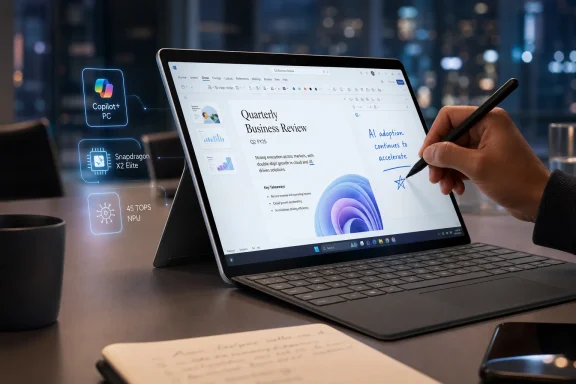 Microsoft’s Most Microsoft PC Is Now an Arm Flagship
The Surface Pro has always been less a product than a thesis. Microsoft has spent years arguing that the right Windows machine is not a clamshell, not a tablet, and not a detachable compromise, but a single slab that becomes whatever the workday demands. The 2026 Surface Pro OLED with Snapdragon X2 Elite sharpens that thesis by removing some ambiguity: this is the premium Surface experience Microsoft wants associated with Windows on Arm.Notebookcheck’s review, published today, lands at a useful moment. Microsoft formally introduced its new Surface Pro and Surface Laptop generation in June, with the company’s own devices blog positioning Snapdragon X2 as the engine for better performance, graphics, battery life, and AI workloads. TechRadar, Tom’s Hardware, and other launch coverage similarly framed the refresh as a higher-priced Surface generation built around Qualcomm’s second major Copilot+ PC wave.
That timing matters because the first Snapdragon X Elite Surface Pro was a proof-of-viability machine. It showed that Arm Windows could be fast, quiet, and battery-friendly enough for mainstream premium buyers, but it also forced users to keep a mental compatibility ledger. The X2 generation is supposed to move the conversation from “Can this run my stuff?” to “Why would I buy the Intel version?”
Notebookcheck’s numbers suggest Microsoft is closer to that second conversation, but not completely there. The Surface Pro OLED looks more mature than revolutionary: the chassis remains recognizably Surface, the OLED panel remains central to the pitch, and the detachable keyboard remains both essential and annoyingly separate in the buying decision. The chip is new; the wager is old.
The Review Says the Surface Formula Still Works Because Microsoft Refuses to Change It
There is a temptation to criticize Microsoft for not reinventing the Surface Pro every couple of years. The bezels, kickstand, keyboard cover, pen support, 3:2 aspect ratio, and aluminum tablet body have become so familiar that the product can look static from a distance. But Surface Pro is one of the few Windows hardware lines where conservatism is also a feature.For IT buyers, the shape is known. For accessory makers, the category is known. For users who already live with a Surface Pro, the rhythm of lap compromises, desk convenience, conference-room note-taking, and tablet-mode reading is known. Microsoft’s design continuity keeps the product from becoming an experiment every refresh cycle.
Notebookcheck’s audio measurements are a small but revealing example of that maturity. The Surface Pro 13 OLED with Snapdragon X2 Elite reached 84.9 dB in the supplied audio analysis, slightly louder than the Lunar Lake OLED comparison unit at 83.1 dB and above prior Copilot+ Surface Pro measurements around 82.4 dB. That is not the kind of spec that wins a keynote, but it is the kind of polish that makes a premium detachable feel less like a tablet with laptop ambitions and more like a proper mobile computer.
The frequency response data also shows why Surface tends to feel better than many spec-sheet rivals. Bass remains limited, as physics demands in a thin tablet chassis, but the overall linearity numbers are strong for the class. Notebookcheck’s comparison data placed the X2 Elite OLED unit ahead of most tested devices, and well ahead of the Minisforum V3 in loudness and overall linearity.
That does not make the Surface Pro an audiophile device. It makes it a disciplined one. Microsoft has learned that a convertible fails not only when its processor is too slow, but when its speakers are tinny, its webcam is mediocre, its hinge feels awkward, or its display makes text look like a compromise. The Surface Pro survives because Microsoft sweats the small experience details that many Windows OEMs still treat as optional.
Snapdragon X2 Elite Is the Real Upgrade, but Not the Whole Answer
The Snapdragon X2 Elite gives Microsoft something it badly needed: a second act for Windows on Arm that is not built on novelty. The first Copilot+ PC wave asked buyers to take a chance on architecture change in return for battery life, instant-on responsiveness, and NPU headroom. The second wave has to prove that Arm PCs are not a special case anymore.Microsoft’s own launch materials claimed significant graphics gains over the previous Surface Pro generation, and the company’s regional announcements have leaned hard into the idea that Snapdragon X2 turns Surface into a more capable AI and productivity platform. The important nuance is that Microsoft’s most aggressive performance language often compares the new machine to older Snapdragon X hardware, not necessarily to every Intel, AMD, or Apple alternative in the same price band.
That is where Notebookcheck’s independent testing becomes useful. A Surface Pro can feel fast in day-to-day Windows, but buyers at flagship prices care about sustained behavior. Thin tablets are thermally constrained, and a detachable cannot dissipate heat like a 14-inch performance laptop. The Snapdragon X2 Elite may be a major improvement, but Surface Pro remains a fanless-or-near-silent-form-factor argument first and a performance workstation second.
This is the central tension of the 2026 Surface Pro. Microsoft wants it to be judged as a flagship PC, but the hardware still asks to be understood as a convertible. If a buyer wants the fastest sustained CPU and GPU performance per dollar, a conventional laptop will usually be easier to justify. If a buyer wants a premium note-taking, presenting, reading, writing, and travel machine that can also be a full Windows PC, Surface Pro remains unusually persuasive.
The real question is not whether Snapdragon X2 Elite makes Surface Pro faster. It almost certainly does. The question is whether it makes Windows on Arm boring, because boring compatibility is the milestone Microsoft needs most.
Windows on Arm Is No Longer a Science Project, but It Still Has a Memory
The Surface Pro’s biggest historical burden is not hardware; it is trust. Microsoft has tried Arm Windows before, and early attempts left scars. Windows RT taught buyers that “Windows” could mean “not quite Windows,” while later Surface Pro X devices were beautiful but constrained by app compatibility, emulation limits, and developer indifference.The Snapdragon X generation changed that conversation because performance finally became good enough to hide some of the architectural seams. Native Arm64 apps expanded, emulation improved, and everyday tasks moved from “possible” to “pleasant.” For many users, the 2024 Copilot+ Surface Pro was the first Arm Windows machine that felt like a normal premium PC rather than a controlled experiment.
But memory matters in enterprise IT. Administrators remember VPN clients, printer utilities, endpoint agents, legacy plug-ins, engineering tools, and line-of-business apps that did not behave on Arm. Even if most of those problems are solved for a given organization, the verification burden remains real. Intel and AMD machines get the benefit of decades of boring assumptions; Arm machines still have to be certified.
That is why Microsoft’s 2026 Surface strategy is more complicated than a processor swap. The company is not merely selling Qualcomm silicon. It is asking the Windows ecosystem to accept Arm as a first-class deployment target, not a premium side branch. That means developers, security vendors, peripheral makers, and IT departments all need confidence that the architecture will be supported for the long haul.
Notebookcheck’s review can measure performance, battery life, speakers, display behavior, and thermals. It cannot fully measure organizational confidence. Yet that confidence may decide whether the Surface Pro OLED with Snapdragon X2 Elite becomes a mainstream corporate device or a beloved machine for enthusiasts, executives, consultants, and mobile professionals who can choose their own hardware.
OLED Gives Surface Its Premium Shine and Its Practical Caveats
The OLED Surface Pro is, visually, the version Microsoft wants people to notice. The 3:2 display is central to the Surface identity because it treats documents, webpages, OneNote pages, and vertical work as first-class citizens. In a world of media-first 16:9 and 16:10 laptops, Surface still feels designed around reading and writing.OLED deepens that advantage. Contrast, perceived sharpness, HDR presentation, and color saturation all help a detachable feel more expensive. The screen becomes the device, and on a tablet-style PC that matters more than it does on a conventional notebook.
But OLED also complicates the enterprise conversation. IT buyers care about consistency, longevity, power draw, and panel behavior across fleets. Burn-in anxiety is less dramatic than it used to be, but it has not disappeared, especially for users who live in static productivity interfaces all day. Microsoft can mitigate this with panel management and warranty confidence, but the concern is still part of the purchasing calculus.
There is also the battery tradeoff. OLED can be efficient in dark content and punishing in bright, mostly white productivity work. A Surface Pro user staring at Outlook, Excel, Edge, Teams, and admin consoles may not see the same endurance story as someone looping video or writing in a dark-themed editor. That does not make OLED a bad choice; it makes it a premium choice with workload-dependent behavior.
The sharper point is that Microsoft is now segmenting Surface not only by processor, memory, and storage, but by experience. OLED is no longer merely a display option. It is the visual proof that you bought into the flagship story.
The Price Makes Every Compromise Louder
Surface pricing has always depended on a peculiar form of arithmetic. Microsoft sells the device as a laptop replacement, then often leaves the keyboard and pen as separate purchase considerations. Buyers know the routine by now, but familiarity does not make it less painful.The 2026 refresh appears to continue that premium posture. Launch coverage from Tom’s Hardware and TechRadar emphasized higher starting prices for the Snapdragon X2 generation, with Surface Pro and Surface Laptop configurations moving firmly into territory where Apple, Lenovo, HP, Dell, and Asus all have serious alternatives. Once a keyboard, pen, storage upgrade, and memory upgrade enter the picture, Surface Pro stops being a tablet purchase and becomes a flagship laptop purchase with tablet ergonomics.
That is where Notebookcheck’s review data becomes more than enthusiast trivia. If Microsoft asks flagship money, the machine has to behave like a flagship in every mundane category. Speakers cannot be an afterthought. The display cannot be merely decent. Battery life cannot collapse under common work. Performance cannot feel conditional. Compatibility cannot be a footnote.
The Surface Pro OLED does many of those things well, but its value proposition remains narrow. It is strongest for people who need the detachable form factor and weakest for people who merely like the idea of it. A buyer who leaves the keyboard attached 98 percent of the time may be happier with a Surface Laptop, MacBook Air, ThinkPad, EliteBook, or Zenbook. A buyer who annotates PDFs, presents from a tablet, travels light, and uses the kickstand daily may find the Surface Pro uniquely hard to replace.
That is the old Surface paradox, sharpened by 2026 pricing. The device is expensive because it does something unusual. But if you do not actually need the unusual thing, the price exposes every compromise.
Microsoft’s AI PC Pitch Is Still Waiting for Its Killer Habit
The Snapdragon X2 Elite is not just a CPU story. It is also part of the Copilot+ PC platform, where the NPU is supposed to make local AI features faster, more private, and more power-efficient. Microsoft has spent two years trying to make that idea feel inevitable.The challenge is that AI hardware is easier to market than AI habits. Users understand why a brighter OLED screen matters. They understand why speakers, battery life, and keyboard quality matter. They understand why a faster processor matters. The NPU is different: its value depends on software workflows that many people have not yet adopted.
Features like live captions, image generation, local recall-style search, background effects, and AI-assisted creation can be useful, but they are not yet the universal daily rituals that justify a PC purchase on their own. Microsoft knows this, which is why Surface messaging blends AI into the broader productivity story rather than relying on it entirely. The company is selling a better Surface today and an AI platform for tomorrow.
For WindowsForum readers, the practical question is whether Copilot+ status should drive a buying decision. For most individual users, it should be a bonus rather than the central reason. For developers and IT planners, it is more interesting: local AI APIs, Arm64 optimization, and NPU availability could shape the next wave of Windows software. The hardware base has to exist before the software market can fully respond.
That makes the Surface Pro OLED with Snapdragon X2 Elite a platform signal. Microsoft is telling developers that premium Windows users will increasingly have Arm CPUs and capable NPUs. Whether developers believe that signal depends on volume, consistency, and Microsoft’s willingness to keep pushing through the awkward middle years.
Enterprise IT Will See a Beautiful Device and a Validation Project
For sysadmins, Surface Pro has always been both attractive and irritating. It is well-built, popular with executives, and tightly aligned with Microsoft’s management stack. It is also a detachable device with accessories, repair considerations, firmware dependencies, and model-specific quirks that have to be absorbed into fleet planning.The Snapdragon X2 Elite version adds another layer. Before deploying it widely, organizations need to validate endpoint security, VPN compatibility, print workflows, remote support tools, device management baselines, accessibility software, browser extensions, and any legacy Win32 applications that matter. Microsoft can make the case that Arm Windows is ready, but IT departments still have to prove it in their own environments.
The upside is real. If the new Surface Pro delivers strong battery life, quieter operation, better standby behavior, and enough performance for knowledge work, it could be an excellent travel and hybrid-work device. The detachable format is especially useful for field teams, healthcare, education, inspections, executive travel, and any workflow that moves between desk, meeting, and handheld use.
The risk is unevenness. A fleet that is 95 percent fine can still generate too many helpdesk tickets if the remaining 5 percent involves critical software. That is why many organizations will treat Snapdragon X2 Surface devices as targeted deployments before they become default laptop replacements. The first wave may go to users whose workflows are mostly Microsoft 365, browser-based SaaS, Teams, OneNote, Edge, and modern native apps.
Microsoft likely understands this. The company’s business Surface portfolio still gives organizations options across Intel and Snapdragon configurations. That dual-track strategy is less elegant than a clean Arm revolution, but it is more realistic. Windows wins by accommodating messy enterprise reality, not by pretending it does not exist.
The Audio Data Quietly Shows Why Surface Still Feels Expensive
The user-supplied Notebookcheck audio analysis may look like a niche technical insert, but it highlights a larger Surface advantage. Premium perception is cumulative. A device feels expensive when the screen, speakers, microphones, cameras, chassis, keyboard, trackpad, thermals, and standby behavior all avoid drawing attention to themselves.The Surface Pro 13 OLED with Snapdragon X2 Elite measured louder than the Lunar Lake OLED comparison and the earlier Copilot+ Surface Pro entries in Notebookcheck’s data. Its bass remains reduced, as expected, but mids and highs were generally controlled enough for a thin convertible. Compared with the Minisforum V3, which measured much quieter at 74.8 dB and showed weaker overall linearity, Microsoft’s tuning looks like the work of a company that has iterated this form factor for years.
This matters because Windows hardware has too often competed on processors and ports while letting the sensory experience drift. Apple trained premium buyers to expect laptops that sound better than their size suggests. Microsoft, to its credit, absorbed that lesson earlier than many Windows OEMs.
The result is that Surface can appear underwhelming on a spec chart and still feel more coherent in use. That does not excuse high prices or compatibility concerns. It explains why the line has staying power despite them.
The Surface Pro Is Becoming the Reference PC Qualcomm Needed
Qualcomm needs Surface almost as much as Microsoft does. The Windows-on-Arm market cannot mature on silicon alone; it needs halo devices that define what the platform is supposed to feel like. Surface Pro is the most visible candidate because it carries Microsoft’s own brand and because its mobility-first design makes Arm’s strengths legible.A Snapdragon chip in a thick gaming laptop invites direct comparison with x86 performance machines. A Snapdragon chip in a Surface Pro tells a cleaner story: thin, light, quiet, connected, responsive, battery-conscious, AI-ready. That is the environment where Qualcomm’s PC silicon has the best chance to look like the future rather than an alternative.
The danger is that Surface also magnifies every Windows-on-Arm weakness. If an app fails, users blame Windows on Arm. If performance throttles, they blame Snapdragon. If a peripheral utility lacks native support, they blame the platform. A flagship reference device has less room to hide behind “early adopter” excuses.
That is why the 2026 Surface Pro OLED review cycle matters. Independent reviewers are no longer treating these machines as curiosities. They are testing them against Intel Lunar Lake, prior Snapdragon X systems, Windows detachables, and mainstream premium laptops. That is exactly the scrutiny Microsoft and Qualcomm asked for.
The early shape of the verdict is nuanced but promising: the hardware is credible, the experience is polished, and the platform questions are narrower than before. Narrower is not the same as gone.
The Surface Pro OLED Verdict Is Really a Windows Ecosystem Verdict
The 2026 Surface Pro OLED with Snapdragon X2 Elite is not interesting because it exists. Microsoft was always going to refresh Surface around Qualcomm’s next PC chip. It is interesting because it tests whether the Windows ecosystem can sustain a premium Arm device without asking users to become platform advocates.For enthusiasts, the machine will be easy to admire. It has the Surface design language, an OLED display, strong measured audio for its class, modern wireless and AI positioning, and a processor generation that appears to move Qualcomm’s Windows ambitions forward. It is the kind of device that makes a coffee-shop table look like a Microsoft ad.
For practical buyers, the recommendation is more conditional. If your workflow is modern, cloud-heavy, Microsoft-centric, and mobile, this may be one of the best expressions of Windows hardware available. If your workflow depends on older drivers, specialized utilities, niche creative tools, or games with anti-cheat and compatibility baggage, the safer answer may still be Intel or AMD.
That split is not a failure. It is the reality of a platform transition happening inside the world’s most backward-compatible desktop operating system. Apple could move the Mac to Arm by controlling the whole stack and dragging developers across a bridge it built itself. Microsoft has to move Windows while keeping the bridge open to decades of software traffic.
The Surface Pro OLED with Snapdragon X2 Elite is therefore less a destination than a pressure test. It asks whether Microsoft can make the future attractive enough that users voluntarily accept the validation work still attached to it.
The Buying Advice Hidden Inside Notebookcheck’s Numbers
Notebookcheck’s review data does not reduce to a single yes or no, and neither should the buying advice. The Surface Pro OLED with Snapdragon X2 Elite looks like a highly polished premium convertible, but it is still a device for people who will actually exploit the convertible part. The more you treat it like a normal laptop, the more normal laptops start to look like better bargains.For WindowsForum readers, the concrete takeaways are straightforward:
- The Surface Pro OLED with Snapdragon X2 Elite is best understood as Microsoft’s premium Windows-on-Arm reference device, not merely a faster Surface refresh.
- Notebookcheck’s audio measurements show unusually strong speaker performance for a detachable, with loudness and linearity that help support the flagship positioning.
- The Snapdragon X2 Elite upgrade strengthens the case for Arm Windows, but organizations should still validate legacy apps, drivers, VPNs, endpoint tools, and peripherals before broad deployment.
- OLED remains a major experiential advantage for Surface Pro, especially for reading, writing, media, and pen work, but its battery and longevity implications depend on workload.
- The value proposition is strongest for users who need tablet, pen, kickstand, and laptop modes in one machine; buyers who rarely detach the keyboard should compare premium clamshells carefully.
- Copilot+ capability is strategically important, but for most buyers today it should be treated as future-facing platform insurance rather than the sole reason to upgrade.
References
- Primary source: Notebookcheck
Published: Tue, 07 Jul 2026 16:08:00 GMT
Loading…
www.notebookcheck.net - Related coverage: windowscentral.com
Loading…
www.windowscentral.com - Related coverage: notebookcheck.com
Loading…
www.notebookcheck.com - Related coverage: notebookcheck.org
Loading…
www.notebookcheck.org - Related coverage: techspot.com
Microsoft refreshes Surface Pro and Surface Laptop with Snapdragon X2 chips, longer battery life, and higher prices | TechSpot
The new Surface Pro is the 13-inch 12th Edition model, while the Surface Laptop is now in its 8th Edition and remains available in 13.8-inch and 15-inch...www.techspot.com - Related coverage: notebookcheck.pl
Loading…
www.notebookcheck.pl
- Related coverage: phonearena.com
A new Surface Pro with Snapdragon X2 Elite power leaks in great detail ahead of June 16 launch - PhoneArena
Microsoft's next-gen 13-inch flagship will be considerably faster than its predecessor and last longer between charges.www.phonearena.com - Related coverage: techradar.com
Microsoft reveals new Surface Pro and Surface Laptop with big graphics upgrades from Snapdragon X2 CPUs — but they're seriously pricey | TechRadar
Around an up to 50% boost in graphics performancewww.techradar.com - Related coverage: tomshardware.com
Microsoft debuts Surface Pro and Surface Laptop with new jade green color and Qualcomm Snapdragon X2 chips — refreshed devices start at $1,499 with 16GB of RAM | Tom's Hardware
The Laptop features Microsoft's new haptic touchpad.www.tomshardware.com - Related coverage: tomsguide.com
Loading…
www.tomsguide.com - Official source: cdn-dynmedia-1.microsoft.com
Loading…
cdn-dynmedia-1.microsoft.com - Official source: microsoft.com
Surface Pro for Business Fact Sheet May 2024
</rdf:Alt> </dc:description> <dc:creator><rdf:Seq><rdf:li>Joseph Galbraith (MBO Partners, Inc.)www.microsoft.com
- Official source: news.microsoft.com
</rdf:Alt> </dc:title> <dc:description><rdf:Alt><rdf:li xml:lang="x-default"/> </rdf:Alt> </dc:description> <dc:creator><rdf:Seq><rdf:li>Joseph Galbraith (MBO Partners, Inc.)
</rdf:Alt> </dc:description> <dc:creator><rdf:Seq><rdf:li>Joseph Galbraith (MBO Partners, Inc.)news.microsoft.com
- Official source: learn.microsoft.com
Tech specs—Surface Pro for Business, Copilot+ PC, Snapdragon X Series processor, 11th Edition - Surface | Microsoft Learn
See technical specifications for Surface Pro 11th Edition with Snapdragon processors, including display, battery life, and ports.learn.microsoft.com - Official source: blogs.windows.com
Introducing the next Surface Pro and Surface Laptop, built for performance and flexibility
For more than 13 years, Surface has been shaped by the people who use it. Architects sketch buildings, developers train models, students build startups and field engineers solve problems that rarely make headlines. We didn't intend to design for onblogs.windows.com - Related coverage: gadgets360.com
Loading…
www.gadgets360.com - Official source: support.microsoft.com
Surface Pro for business 13-inch (12th Edition)(Intel) features | Microsoft Support
Learn what features are included with Surface Pro (12th Edition).support.microsoft.com