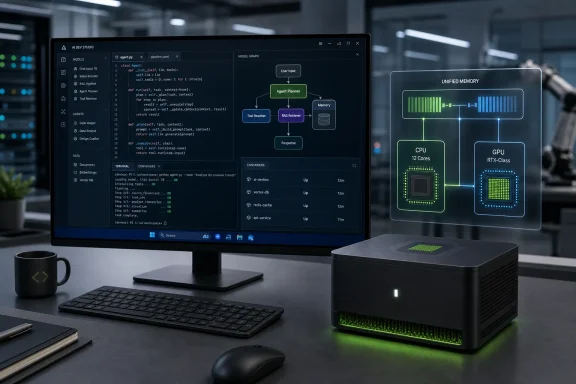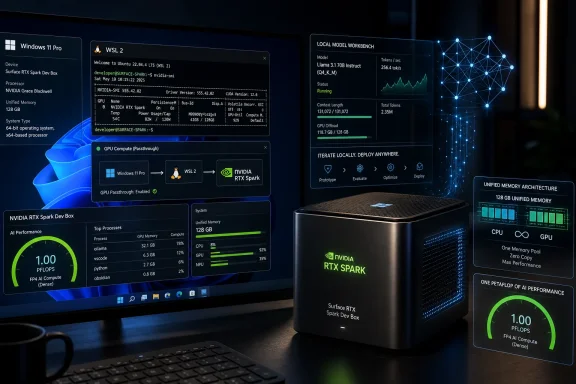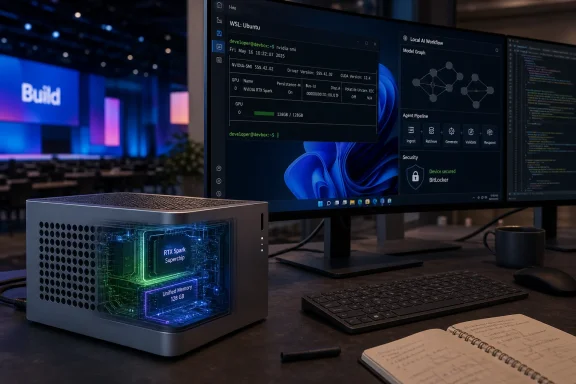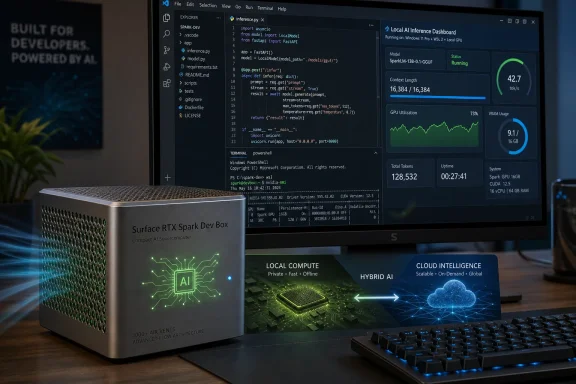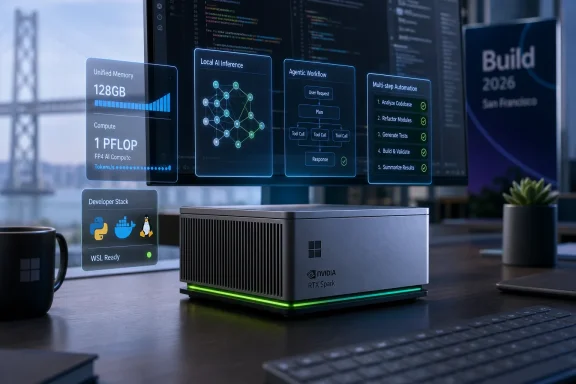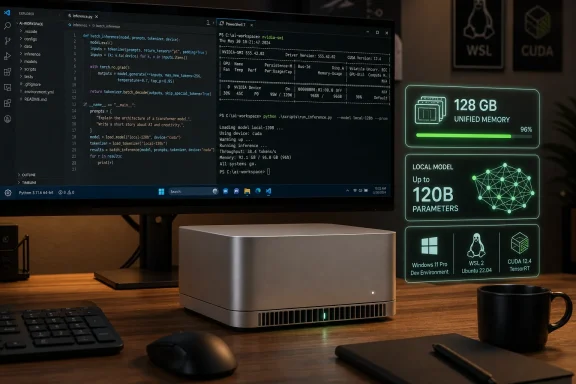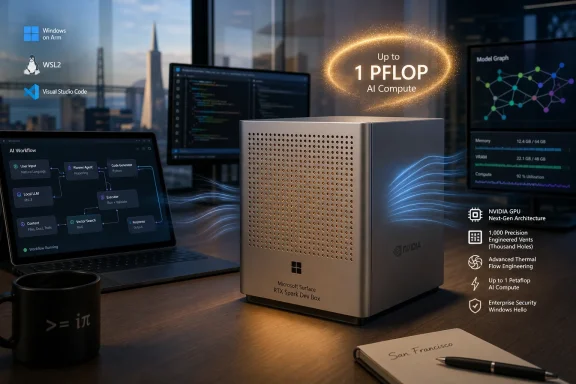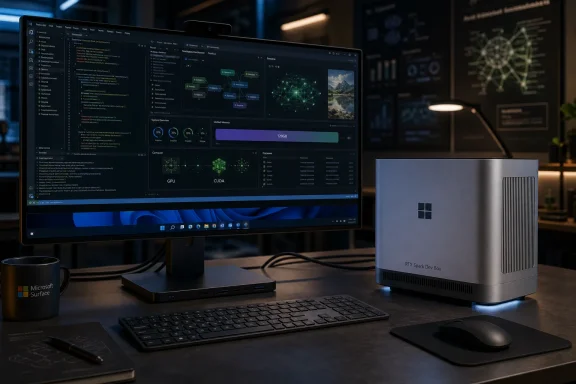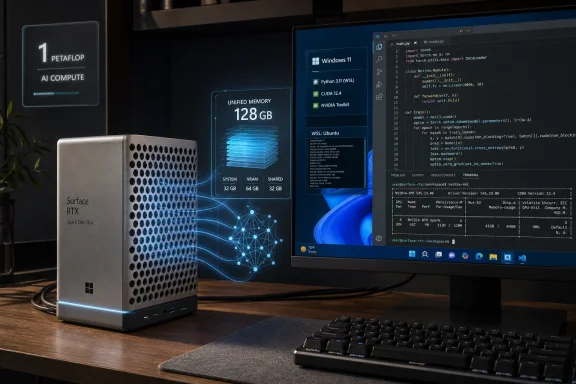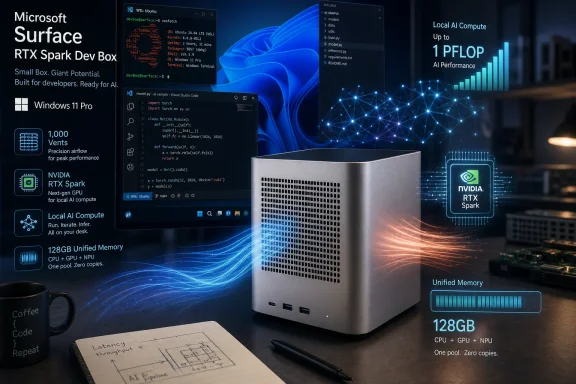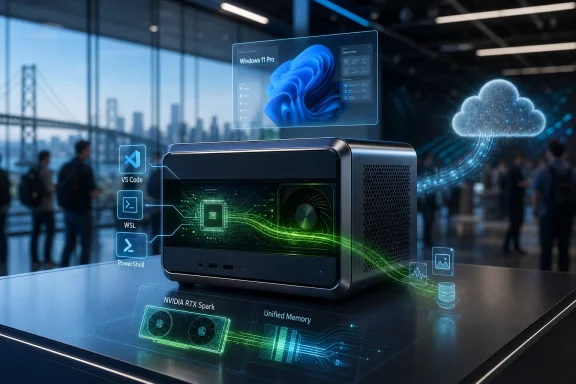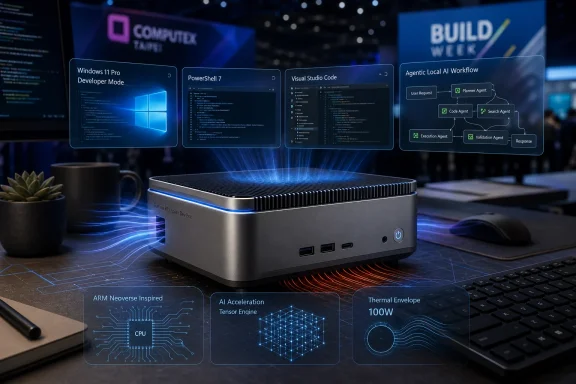
Microsoft unveiled the Surface RTX Spark Dev Box on June 2, 2026, at its Build developer conference, positioning the compact Windows desktop as a local AI development machine with Nvidia RTX Spark silicon, 128GB of unified memory, and up to one petaflop of AI compute. The pitch is simple enough to fit on a keynote slide: give developers a box that can run frontier-adjacent models without renting a cloud GPU every time they want to test an agent. The more consequential claim is buried beneath the specs. Microsoft is trying to make Windows the place where AI agents are built, contained, governed, and eventually trusted.
That is a bigger swing than another Surface form factor. For most of the AI boom, Windows has been the client endpoint, Azure has been the compute story, and developers have tolerated the awkward middle ground between local experimentation and cloud-scale deployment. Surface RTX Spark Dev Box is Microsoft’s attempt to close that gap, not by replacing the cloud, but by making the local Windows machine feel like a legitimate first-class node in the AI development pipeline.
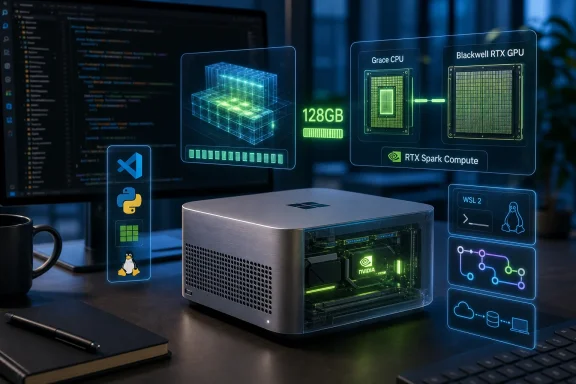
The Surface RTX Spark Dev Box is not being sold as a general-purpose mini PC with a fashionable AI badge. Microsoft describes it as a developer machine built around Nvidia’s RTX Spark platform, combining a Blackwell-class RTX GPU, Grace CPU technology, CUDA support, and a unified memory architecture that lets the CPU and GPU share a large memory pool. The headline numbers are aggressive for a desktop that is intended to sit near a monitor rather than in a rack: up to one petaflop of AI compute and 128GB of unified memory.
The memory figure matters more than the petaflop figure for many developers. AI performance marketing tends to orbit peak throughput, but the first practical question for local model work is brutally mundane: will the model fit? Microsoft says the Dev Box can run models with up to 120 billion parameters using 4-bit quantization, which places it well beyond the class of hobbyist local AI boxes and into the territory where serious prototyping becomes plausible.
That does not mean developers are suddenly training the next GPT-class model under a desk. The Surface RTX Spark Dev Box is better understood as a local inference, experimentation, agent orchestration, and workflow development machine. It is the place where a team can test a model, wire it into tools, simulate agent behavior, and iterate before pushing the workload into Azure or another production environment.
Microsoft’s timing is not accidental. Build has become the company’s annual venue for explaining how it wants developers to think about the platform beneath their code. In 2026, that platform story is no longer “Windows plus Visual Studio plus Azure.” It is Windows as the operating substrate for AI agents, with Visual Studio Code, GitHub Copilot, WSL 2, CUDA, containers, policy enforcement, and cloud handoff all arranged into a single funnel.
Cloud GPUs are powerful, but they introduce friction. Developers must provision resources, manage cost, move data, navigate quotas, and deal with latency. For enterprise teams, there are also governance questions about where sensitive prompts, embeddings, logs, and proprietary code are going. A local AI development box does not eliminate those problems, but it changes the rhythm of early-stage work.
The Surface RTX Spark Dev Box is Microsoft’s answer to a specific developer pain point: the AI workflow has become too cloud-dependent too early. If the first meaningful test of an agent requires a paid GPU instance, a cloud sandbox, and an approval chain, experimentation slows. If the same work can begin locally on Windows with the same tooling stack that will later connect to Azure, Microsoft gains leverage over the developer’s entire path from prototype to production.
That leverage is the real product. Hardware margins are not the reason Microsoft is putting Surface branding on an Nvidia-powered AI desktop. The Dev Box is a physical argument that Windows should remain central even as more development moves toward AI-native systems. It tells developers: do your local testing here, use our editor, use our agent tooling, use our containment model, and when you need scale, the cloud handoff is already waiting.
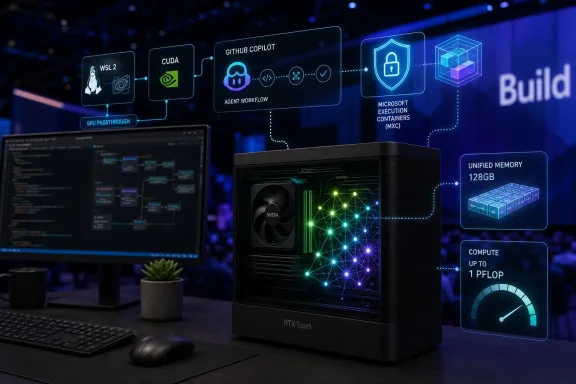
This is why the inclusion of WSL 2 GPU passthrough and CUDA support is so important. Microsoft cannot win serious AI developers by pretending Windows-native tooling alone is enough. The modern AI stack is deeply tied to Linux workflows, Python environments, CUDA libraries, open-source model tooling, and containerized deployment habits. By making WSL 2 a first-class bridge to Nvidia acceleration, Microsoft is trying to prevent developers from leaving Windows just because their AI toolchain expects Linux.
That makes RTX Spark strategically convenient for Microsoft. It gives Windows a credible local AI engine without requiring Microsoft to build and evangelize an entirely new developer compute stack from scratch. Nvidia supplies the GPU architecture, the CUDA ecosystem, and the AI software credibility; Microsoft supplies Windows, Surface industrial design, developer tooling, identity, management, and the enterprise channel.
The partnership is also a hedge against Apple. Apple’s unified memory architecture and increasingly capable Neural Engine and GPU stack have made Macs attractive to many developers working with local models, especially those who value battery life, silence, and a Unix-like development environment. Microsoft cannot answer that merely by saying Windows has more users. It needs hardware that makes local AI feel technically serious.
The Surface RTX Spark Dev Box is not a Mac Studio clone, but the comparison is unavoidable. Both ideas revolve around the same basic premise: put a large shared memory pool close to accelerated compute and let developers work locally on models that would choke ordinary PCs. Microsoft’s differentiator is not elegance; it is enterprise Windows integration and Nvidia compatibility.
That is a credible differentiation, but not a guaranteed victory. Apple’s advantage is coherence. Nvidia and Microsoft’s advantage is ecosystem reach. The Surface box will succeed only if the Windows AI development experience feels less like a pile of adapters and more like a platform.
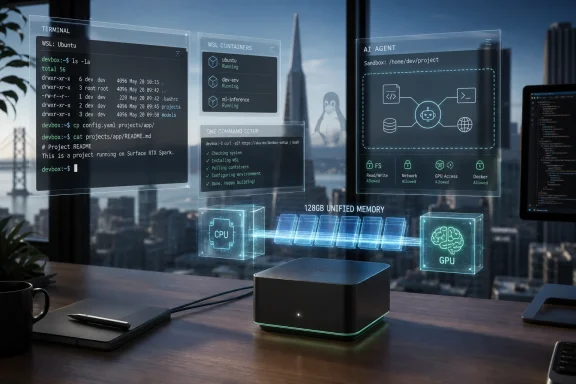
Microsoft’s answer is Microsoft Execution Containers, or MXC, now in preview. The company describes MXC as a policy-driven execution layer for agents across Windows and WSL, intended to give developers and IT administrators a way to create enterprise sandbox environments. In plain English, Microsoft is acknowledging that agents cannot be allowed to roam around a user’s PC or a corporate environment with the same vague permissions model that governed earlier desktop automation.
That acknowledgement is overdue. The risk profile of an AI agent is different from that of a traditional application. A normal app generally performs operations the developer anticipated. An agent interprets intent, calls tools, reads context, chains actions, and may interact with files, browsers, terminals, APIs, and other apps. The more useful it becomes, the more dangerous a sloppy permission model becomes.
Microsoft says MXC can help define agent boundaries at the operating system level, manage inference, enforce policies, mask personally identifiable information, and limit visibility into systems and data. Those are the right nouns. The question is whether they become enforceable primitives that administrators can trust or merely another policy surface that works until a developer needs to bypass it for convenience.
Enterprise IT will be skeptical, and it should be. Windows history is full of powerful technologies whose security posture depended on how well they were configured in the real world. If MXC is to matter, it must be manageable through familiar enterprise tools, observable during incidents, compatible with developer workflows, and resistant to the slow erosion that happens when productivity pressure meets security policy.
The old desktop security model was built around users, applications, files, processes, and network boundaries. Agentic systems blur those lines. An agent may be acting on behalf of a user, inside an application, through a browser, with access to cloud credentials, while generating code or commands that another tool executes. If something goes wrong, the blame chain is not obvious.
That is why Microsoft’s Build message is broader than a new Surface. The company is trying to define the control plane for agents before the ecosystem settles into unsafe defaults. If developers begin building agents on Windows with MXC, Foundry Agent Service, GitHub Copilot, and managed identity baked into the workflow, Microsoft gets to shape the assumptions of the next generation of Windows software.
The alternative is less attractive for Redmond. If agent development standardizes around browser extensions, ad hoc Python scripts, open-source desktop automation tools, and cloud-only sandboxes, Windows becomes the thing being automated rather than the platform doing the governing. That would leave Microsoft defending the endpoint while others control the agent runtime.
There is also a consumer angle, though Microsoft is wisely leading with developers and enterprises. The company has more than a billion Windows users, and any future in which everyday PC users delegate tasks to AI agents will require a permissions model ordinary people can understand. “This agent can see your Downloads folder but not your tax documents” is not a trivial user experience problem. Neither is “this agent can use your browser session but cannot submit forms without approval.”
That last clause is doing a lot of work. Every AI coding assistant now has to reassure developers that they remain in control, because the industry has raced from autocomplete to autonomous code modification with very little time for teams to absorb the implications. The productivity upside is obvious. The review burden, security exposure, and maintenance risk are just as real.
The use of Git worktrees is a practical detail that suggests Microsoft understands the messiness of real development. Parallel agent work sounds impressive until two agents edit overlapping files, generate incompatible assumptions, or produce code that passes local tests but violates architectural intent. Git gives Microsoft a familiar structure for isolating work, comparing changes, and forcing human review before integration.
Still, the agentic coding market is not waiting for Microsoft. OpenAI, Anthropic, Google, JetBrains, Cursor, Sourcegraph, and a swarm of startups are pushing toward deeper codebase awareness and more autonomous software development. Microsoft’s advantage is GitHub itself. If Copilot becomes the agent manager inside the repository where the work already happens, it does not need to be the flashiest coding agent to become the default.
The Surface RTX Spark Dev Box makes that pitch more tangible. A developer can run local models, use Copilot, test agent workflows, and keep sensitive code closer to the machine rather than constantly sending context to remote services. That does not solve every privacy or IP question, but it gives Microsoft a better answer than “trust the cloud.”
That symmetry matters. Microsoft does not want local and cloud AI development to feel like separate worlds. It wants developers to build and test locally, then move to managed cloud execution when the workload demands more capacity, multi-user access, compliance controls, or integration with enterprise systems. Surface RTX Spark Dev Box is the workstation; Foundry is the production lane.
This is classic Microsoft platform strategy. The company rarely wins by owning only one layer. It wins when the layers reinforce one another: Windows client, developer tools, identity, management, cloud services, collaboration software, and now AI agents. The more coherent the path between those layers, the harder it is for competitors to dislodge one piece.
But the coherence is also where Microsoft must be careful. Developers are allergic to funnels that look like lock-in. If the Surface RTX Spark Dev Box works best only when paired with Microsoft services, it will be seen as an Azure acquisition device in aluminum clothing. If it works well with open models, standard tools, WSL workflows, CUDA libraries, GitHub repositories, and competing deployment targets, it has a better chance of becoming trusted developer hardware.
The strongest version of Microsoft’s strategy is not “all AI roads lead to Azure.” It is “Windows is the most practical place to build AI systems that may later run anywhere.” That is a more developer-friendly argument, and it is the one Microsoft should lean into if it wants adoption beyond committed Microsoft shops.
Scientific AI is attractive because it gives the industry a more substantive story than “the chatbot can write your email.” It also demands workflows that are compute-heavy, data-sensitive, and tool-rich. Researchers need local experimentation, reproducible environments, access to specialized models, and scalable cloud resources. That sounds a lot like the Surface-to-Foundry path Microsoft is assembling.
The launch of Discovery also helps Microsoft answer a growing skepticism around generative AI’s economic value. Enterprise buyers are increasingly asking where the durable return is. Coding assistance has a clearer productivity case than many office copilots, and scientific acceleration may have an even more compelling long-term payoff if AI can shorten research cycles or surface candidate materials and molecules faster.
The risk is that “AI for science” becomes another broad platform claim without enough concrete adoption evidence. Microsoft will need case studies, not just demos. Researchers and labs are demanding customers; they care less about keynote integration and more about reproducibility, model validity, data provenance, and whether the system helps produce results that survive peer scrutiny.
Still, Discovery reinforces the broader message of Build 2026. Microsoft is positioning AI not as a feature sprinkled onto Windows, but as a workload category that needs new machines, new runtime boundaries, new developer loops, and new cloud services.
The Surface RTX Spark Dev Box is not primarily about mobility, but it participates in the same shift as the newly announced RTX Spark laptops. Microsoft and Nvidia are arguing that Windows on Arm can become the foundation for high-performance local AI systems, not merely a Qualcomm-powered alternative to Intel ultrabooks. That is a much more ambitious identity.
For developers, the success of that identity depends on boring details. Toolchains must work. Drivers must be stable. WSL 2 must feel seamless. CUDA support must behave predictably. Visual Studio Code extensions, Python packages, containers, and model runtimes must not turn into compatibility treasure hunts. The hardware can be impressive and still fail if the developer experience feels brittle.
Microsoft appears to understand that the developer audience will not be persuaded by AI PC branding alone. That is why the company is emphasizing Visual Studio Code, GitHub Copilot, WSL 2 GPU passthrough, CUDA, and enterprise security integration out of the box. It is not selling a benchmark. It is selling a prepared environment.
The catch is that prepared environments age quickly. AI frameworks move fast, model formats change, quantization techniques evolve, and developers often need low-level control. Microsoft and Nvidia will need to keep the platform current after launch, not just polished on day one.
For individual developers, the value calculation will depend on how often they currently rent cloud GPU time, how much they need local privacy, and whether their workloads fit within the machine’s capabilities. For startups and enterprise teams, the question is different: can a fleet of local AI dev boxes reduce cloud experimentation costs, accelerate development, or satisfy data-handling requirements that cloud workflows complicate?
The total cost argument could be compelling in some cases. Cloud GPUs are flexible, but persistent experimentation can become expensive, especially when teams leave instances running or duplicate environments across projects. A local box with predictable cost and immediate availability has appeal, particularly for teams doing repeated inference, evaluation, and agent testing.
But local hardware also has disadvantages. It depreciates. It must be managed. It can be lost, damaged, underutilized, or outgrown. It may not match the production environment. It may tempt teams to optimize for a local configuration that differs from cloud deployment realities. IT departments will want management hooks, security baselines, and procurement clarity before they treat this as more than a specialist workstation.
This is where Microsoft’s Surface branding helps and hurts. Surface implies a premium, integrated, polished device. It also implies premium pricing and a degree of vendor control. The Dev Box will have to justify itself against not only cloud GPUs, but also custom workstations, Nvidia DGX-style personal AI systems, Mac Studio configurations, and whatever PC OEMs ship around the same RTX Spark platform.
Microsoft wants to collapse that sprawl into a Windows-centered workflow. The Dev Box is a beachhead. It says the local Windows machine can host serious models, run Linux-based AI tooling through WSL, use Nvidia acceleration, coordinate coding agents, enforce containment policy, and connect naturally to cloud-hosted agent services.
That is an appealing vision if it works. It is also a lot to ask of one platform transition. Developers will test the weak seams first. They will ask whether model runtimes perform as expected, whether GPU passthrough is reliable, whether the memory architecture delivers practical benefits, whether Copilot’s agents create more review work than they save, and whether MXC gets in the way of real tasks.
Microsoft’s advantage is distribution. Windows remains the default enterprise desktop, GitHub is central to modern software development, Visual Studio Code is everywhere, and Azure is deeply entrenched in corporate IT. If Microsoft can make the AI developer workflow feel native across those assets, it does not need every independent researcher to switch overnight.
The danger is complacency. AI developers have shown they will move quickly toward tools that save time, even if those tools come from small companies or open-source communities. Microsoft cannot rely on Windows’ installed base to win an AI-native development market. It has to earn the default.
That matters because the AI PC category has been muddled. Many machines sold as AI PCs have featured neural processing units useful for certain local effects, background tasks, and optimized inference scenarios, but they have not fundamentally changed what developers can do. A machine that can load much larger models locally is a different proposition.
If OEMs follow with varied RTX Spark desktops and laptops, Microsoft benefits even if Surface itself remains niche. The company needs a class of Windows machines capable of making its agent-native runtime credible. A runtime for local agents is less persuasive if most PCs cannot run meaningful models or if developers must immediately offload everything to the cloud.
Nvidia benefits too. The company extends its AI dominance from data centers and workstations into a new category of personal AI computers. CUDA becomes not only the cloud training and inference substrate, but also the local agent development substrate. That is a powerful continuity story for developers.
The broader PC industry badly wants this kind of story. After years of incremental upgrades, “AI PC” has often felt like a marketing wrapper waiting for a killer use case. Local agents and large-model development may finally provide one, though it will begin at the high end before trickling down.
The harder part begins after the keynote. Developers will judge the Surface RTX Spark Dev Box by latency, compatibility, thermals, noise, tooling, price, and whether it saves them real time. Administrators will judge MXC by manageability, auditability, and whether it prevents agent behavior from becoming the next shadow IT nightmare. Security teams will judge the entire agent-native Windows pitch by what happens when a model is tricked, a tool is misused, or a boundary is tested.
Microsoft’s strongest move is that it is treating agent safety as an operating-system problem rather than a documentation problem. That is the right instinct. Prompts can be manipulated, models can hallucinate, plugins can overreach, and users can approve things they do not understand. Durable safety has to live below the agent, in identity, policy, isolation, and observable execution.
But operating-system-level trust is hard-won. Windows users remember eras of ActiveX, macro malware, UAC fatigue, driver chaos, and enterprise policy sprawl. If Microsoft wants Windows to host autonomous software actors, it must make the boundaries visible, enforceable, and boring. The future of agentic Windows depends less on whether an AI can book a meeting and more on whether IT can prove what the agent did, why it did it, and what it was prevented from doing.
That is a bigger swing than another Surface form factor. For most of the AI boom, Windows has been the client endpoint, Azure has been the compute story, and developers have tolerated the awkward middle ground between local experimentation and cloud-scale deployment. Surface RTX Spark Dev Box is Microsoft’s attempt to close that gap, not by replacing the cloud, but by making the local Windows machine feel like a legitimate first-class node in the AI development pipeline.
Microsoft Turns the Developer PC Into an AI Appliance
The Surface RTX Spark Dev Box is not being sold as a general-purpose mini PC with a fashionable AI badge. Microsoft describes it as a developer machine built around Nvidia’s RTX Spark platform, combining a Blackwell-class RTX GPU, Grace CPU technology, CUDA support, and a unified memory architecture that lets the CPU and GPU share a large memory pool. The headline numbers are aggressive for a desktop that is intended to sit near a monitor rather than in a rack: up to one petaflop of AI compute and 128GB of unified memory.The memory figure matters more than the petaflop figure for many developers. AI performance marketing tends to orbit peak throughput, but the first practical question for local model work is brutally mundane: will the model fit? Microsoft says the Dev Box can run models with up to 120 billion parameters using 4-bit quantization, which places it well beyond the class of hobbyist local AI boxes and into the territory where serious prototyping becomes plausible.
That does not mean developers are suddenly training the next GPT-class model under a desk. The Surface RTX Spark Dev Box is better understood as a local inference, experimentation, agent orchestration, and workflow development machine. It is the place where a team can test a model, wire it into tools, simulate agent behavior, and iterate before pushing the workload into Azure or another production environment.
Microsoft’s timing is not accidental. Build has become the company’s annual venue for explaining how it wants developers to think about the platform beneath their code. In 2026, that platform story is no longer “Windows plus Visual Studio plus Azure.” It is Windows as the operating substrate for AI agents, with Visual Studio Code, GitHub Copilot, WSL 2, CUDA, containers, policy enforcement, and cloud handoff all arranged into a single funnel.
The Cloud Is Still the Destination, but Local Compute Is the New On-Ramp
For years, the economic logic of AI development has pushed serious work into the cloud. If a developer needed access to high-end GPUs, the answer was not to buy a workstation; it was to rent capacity from Azure, AWS, Google Cloud, CoreWeave, or another provider. That model is not going away, but it has become increasingly uncomfortable for experimentation.Cloud GPUs are powerful, but they introduce friction. Developers must provision resources, manage cost, move data, navigate quotas, and deal with latency. For enterprise teams, there are also governance questions about where sensitive prompts, embeddings, logs, and proprietary code are going. A local AI development box does not eliminate those problems, but it changes the rhythm of early-stage work.
The Surface RTX Spark Dev Box is Microsoft’s answer to a specific developer pain point: the AI workflow has become too cloud-dependent too early. If the first meaningful test of an agent requires a paid GPU instance, a cloud sandbox, and an approval chain, experimentation slows. If the same work can begin locally on Windows with the same tooling stack that will later connect to Azure, Microsoft gains leverage over the developer’s entire path from prototype to production.
That leverage is the real product. Hardware margins are not the reason Microsoft is putting Surface branding on an Nvidia-powered AI desktop. The Dev Box is a physical argument that Windows should remain central even as more development moves toward AI-native systems. It tells developers: do your local testing here, use our editor, use our agent tooling, use our containment model, and when you need scale, the cloud handoff is already waiting.
This is why the inclusion of WSL 2 GPU passthrough and CUDA support is so important. Microsoft cannot win serious AI developers by pretending Windows-native tooling alone is enough. The modern AI stack is deeply tied to Linux workflows, Python environments, CUDA libraries, open-source model tooling, and containerized deployment habits. By making WSL 2 a first-class bridge to Nvidia acceleration, Microsoft is trying to prevent developers from leaving Windows just because their AI toolchain expects Linux.
Nvidia Gets the Silicon Win Microsoft Could Not Build Alone
The Surface RTX Spark Dev Box also says something uncomfortable about Microsoft’s hardware ambitions: for this generation of AI PCs, Nvidia owns the most important layer. Microsoft has invested heavily in custom silicon for the cloud, including its own AI accelerators, but the developer desktop is a different battlefield. CUDA remains the gravitational center of practical AI development, and Nvidia’s software stack is still the default assumption for many frameworks, libraries, and model workflows.That makes RTX Spark strategically convenient for Microsoft. It gives Windows a credible local AI engine without requiring Microsoft to build and evangelize an entirely new developer compute stack from scratch. Nvidia supplies the GPU architecture, the CUDA ecosystem, and the AI software credibility; Microsoft supplies Windows, Surface industrial design, developer tooling, identity, management, and the enterprise channel.
The partnership is also a hedge against Apple. Apple’s unified memory architecture and increasingly capable Neural Engine and GPU stack have made Macs attractive to many developers working with local models, especially those who value battery life, silence, and a Unix-like development environment. Microsoft cannot answer that merely by saying Windows has more users. It needs hardware that makes local AI feel technically serious.
The Surface RTX Spark Dev Box is not a Mac Studio clone, but the comparison is unavoidable. Both ideas revolve around the same basic premise: put a large shared memory pool close to accelerated compute and let developers work locally on models that would choke ordinary PCs. Microsoft’s differentiator is not elegance; it is enterprise Windows integration and Nvidia compatibility.
That is a credible differentiation, but not a guaranteed victory. Apple’s advantage is coherence. Nvidia and Microsoft’s advantage is ecosystem reach. The Surface box will succeed only if the Windows AI development experience feels less like a pile of adapters and more like a platform.
The Agent-Native Windows Pitch Is Really a Security Pitch
The hardware announcement landed alongside a more important software claim: Microsoft wants Windows to become an “agent-native runtime.” That phrase risks sounding like keynote vapor, but the substance is worth attention. As AI agents move from chat windows into actual task execution, the operating system has to decide what an agent is allowed to see, touch, change, and remember.Microsoft’s answer is Microsoft Execution Containers, or MXC, now in preview. The company describes MXC as a policy-driven execution layer for agents across Windows and WSL, intended to give developers and IT administrators a way to create enterprise sandbox environments. In plain English, Microsoft is acknowledging that agents cannot be allowed to roam around a user’s PC or a corporate environment with the same vague permissions model that governed earlier desktop automation.
That acknowledgement is overdue. The risk profile of an AI agent is different from that of a traditional application. A normal app generally performs operations the developer anticipated. An agent interprets intent, calls tools, reads context, chains actions, and may interact with files, browsers, terminals, APIs, and other apps. The more useful it becomes, the more dangerous a sloppy permission model becomes.
Microsoft says MXC can help define agent boundaries at the operating system level, manage inference, enforce policies, mask personally identifiable information, and limit visibility into systems and data. Those are the right nouns. The question is whether they become enforceable primitives that administrators can trust or merely another policy surface that works until a developer needs to bypass it for convenience.
Enterprise IT will be skeptical, and it should be. Windows history is full of powerful technologies whose security posture depended on how well they were configured in the real world. If MXC is to matter, it must be manageable through familiar enterprise tools, observable during incidents, compatible with developer workflows, and resistant to the slow erosion that happens when productivity pressure meets security policy.
The Agent Boom Has a Permissions Problem Windows Cannot Ignore
The excitement around agents is easy to understand. A useful agent can file tickets, summarize documents, modify code, operate a browser, query databases, and coordinate work across multiple services. The problem is that each of those capabilities requires access, and access is where enterprise security programs go to lose sleep.The old desktop security model was built around users, applications, files, processes, and network boundaries. Agentic systems blur those lines. An agent may be acting on behalf of a user, inside an application, through a browser, with access to cloud credentials, while generating code or commands that another tool executes. If something goes wrong, the blame chain is not obvious.
That is why Microsoft’s Build message is broader than a new Surface. The company is trying to define the control plane for agents before the ecosystem settles into unsafe defaults. If developers begin building agents on Windows with MXC, Foundry Agent Service, GitHub Copilot, and managed identity baked into the workflow, Microsoft gets to shape the assumptions of the next generation of Windows software.
The alternative is less attractive for Redmond. If agent development standardizes around browser extensions, ad hoc Python scripts, open-source desktop automation tools, and cloud-only sandboxes, Windows becomes the thing being automated rather than the platform doing the governing. That would leave Microsoft defending the endpoint while others control the agent runtime.
There is also a consumer angle, though Microsoft is wisely leading with developers and enterprises. The company has more than a billion Windows users, and any future in which everyday PC users delegate tasks to AI agents will require a permissions model ordinary people can understand. “This agent can see your Downloads folder but not your tax documents” is not a trivial user experience problem. Neither is “this agent can use your browser session but cannot submit forms without approval.”
GitHub Copilot Moves From Pair Programmer to Agent Manager
The preview of a GitHub Copilot app for developers fits neatly into this strategy. Microsoft describes a workflow where developers can begin from a natural-language idea, an existing issue, or a code merge suggestion, then coordinate multiple agents in parallel through review, integration, and final merge. Copilot uses Git worktrees to manage multiple branch tasks, while the developer remains in control.That last clause is doing a lot of work. Every AI coding assistant now has to reassure developers that they remain in control, because the industry has raced from autocomplete to autonomous code modification with very little time for teams to absorb the implications. The productivity upside is obvious. The review burden, security exposure, and maintenance risk are just as real.
The use of Git worktrees is a practical detail that suggests Microsoft understands the messiness of real development. Parallel agent work sounds impressive until two agents edit overlapping files, generate incompatible assumptions, or produce code that passes local tests but violates architectural intent. Git gives Microsoft a familiar structure for isolating work, comparing changes, and forcing human review before integration.
Still, the agentic coding market is not waiting for Microsoft. OpenAI, Anthropic, Google, JetBrains, Cursor, Sourcegraph, and a swarm of startups are pushing toward deeper codebase awareness and more autonomous software development. Microsoft’s advantage is GitHub itself. If Copilot becomes the agent manager inside the repository where the work already happens, it does not need to be the flashiest coding agent to become the default.
The Surface RTX Spark Dev Box makes that pitch more tangible. A developer can run local models, use Copilot, test agent workflows, and keep sensitive code closer to the machine rather than constantly sending context to remote services. That does not solve every privacy or IP question, but it gives Microsoft a better answer than “trust the cloud.”
Foundry Becomes the Cloud Half of the Same Story
Microsoft’s Foundry Agent Service, also discussed in preview form, supplies the other half of the architecture. For cloud-hosted agents, Microsoft is emphasizing session-by-session isolated execution, persistent memory, and elastic scaling. The language mirrors the local MXC story: isolation, control, memory, scale.That symmetry matters. Microsoft does not want local and cloud AI development to feel like separate worlds. It wants developers to build and test locally, then move to managed cloud execution when the workload demands more capacity, multi-user access, compliance controls, or integration with enterprise systems. Surface RTX Spark Dev Box is the workstation; Foundry is the production lane.
This is classic Microsoft platform strategy. The company rarely wins by owning only one layer. It wins when the layers reinforce one another: Windows client, developer tools, identity, management, cloud services, collaboration software, and now AI agents. The more coherent the path between those layers, the harder it is for competitors to dislodge one piece.
But the coherence is also where Microsoft must be careful. Developers are allergic to funnels that look like lock-in. If the Surface RTX Spark Dev Box works best only when paired with Microsoft services, it will be seen as an Azure acquisition device in aluminum clothing. If it works well with open models, standard tools, WSL workflows, CUDA libraries, GitHub repositories, and competing deployment targets, it has a better chance of becoming trusted developer hardware.
The strongest version of Microsoft’s strategy is not “all AI roads lead to Azure.” It is “Windows is the most practical place to build AI systems that may later run anywhere.” That is a more developer-friendly argument, and it is the one Microsoft should lean into if it wants adoption beyond committed Microsoft shops.
Scientific Discovery Gives the AI Push a More Serious Costume
Microsoft also officially launched Discovery, an AI platform aimed at scientific research. This could be read as a separate announcement, but it belongs in the same strategic frame. Microsoft is trying to show that its AI platform is not merely about office productivity and code generation; it wants to be infrastructure for research, simulation, materials science, chemistry, and other high-value domains.Scientific AI is attractive because it gives the industry a more substantive story than “the chatbot can write your email.” It also demands workflows that are compute-heavy, data-sensitive, and tool-rich. Researchers need local experimentation, reproducible environments, access to specialized models, and scalable cloud resources. That sounds a lot like the Surface-to-Foundry path Microsoft is assembling.
The launch of Discovery also helps Microsoft answer a growing skepticism around generative AI’s economic value. Enterprise buyers are increasingly asking where the durable return is. Coding assistance has a clearer productivity case than many office copilots, and scientific acceleration may have an even more compelling long-term payoff if AI can shorten research cycles or surface candidate materials and molecules faster.
The risk is that “AI for science” becomes another broad platform claim without enough concrete adoption evidence. Microsoft will need case studies, not just demos. Researchers and labs are demanding customers; they care less about keynote integration and more about reproducibility, model validity, data provenance, and whether the system helps produce results that survive peer scrutiny.
Still, Discovery reinforces the broader message of Build 2026. Microsoft is positioning AI not as a feature sprinkled onto Windows, but as a workload category that needs new machines, new runtime boundaries, new developer loops, and new cloud services.
Windows on Arm Gets a Developer Story It Badly Needed
The Nvidia RTX Spark platform also gives Windows on Arm a sharper reason to exist. For years, Windows on Arm has been caught between promise and compromise. Battery life, connectivity, and modern silicon designs were appealing, but app compatibility, performance expectations, and developer confidence lagged. AI changes the calculation because the desired machine is no longer just a thinner laptop; it is a device with a large shared memory architecture and efficient accelerated compute.The Surface RTX Spark Dev Box is not primarily about mobility, but it participates in the same shift as the newly announced RTX Spark laptops. Microsoft and Nvidia are arguing that Windows on Arm can become the foundation for high-performance local AI systems, not merely a Qualcomm-powered alternative to Intel ultrabooks. That is a much more ambitious identity.
For developers, the success of that identity depends on boring details. Toolchains must work. Drivers must be stable. WSL 2 must feel seamless. CUDA support must behave predictably. Visual Studio Code extensions, Python packages, containers, and model runtimes must not turn into compatibility treasure hunts. The hardware can be impressive and still fail if the developer experience feels brittle.
Microsoft appears to understand that the developer audience will not be persuaded by AI PC branding alone. That is why the company is emphasizing Visual Studio Code, GitHub Copilot, WSL 2 GPU passthrough, CUDA, and enterprise security integration out of the box. It is not selling a benchmark. It is selling a prepared environment.
The catch is that prepared environments age quickly. AI frameworks move fast, model formats change, quantization techniques evolve, and developers often need low-level control. Microsoft and Nvidia will need to keep the platform current after launch, not just polished on day one.
The Price Question Hangs Over the Whole Machine
Microsoft has not made price the center of the announcement, and that omission is telling. A 128GB unified-memory Nvidia-powered Surface developer desktop is unlikely to be cheap. That does not make it unviable, but it narrows the audience.For individual developers, the value calculation will depend on how often they currently rent cloud GPU time, how much they need local privacy, and whether their workloads fit within the machine’s capabilities. For startups and enterprise teams, the question is different: can a fleet of local AI dev boxes reduce cloud experimentation costs, accelerate development, or satisfy data-handling requirements that cloud workflows complicate?
The total cost argument could be compelling in some cases. Cloud GPUs are flexible, but persistent experimentation can become expensive, especially when teams leave instances running or duplicate environments across projects. A local box with predictable cost and immediate availability has appeal, particularly for teams doing repeated inference, evaluation, and agent testing.
But local hardware also has disadvantages. It depreciates. It must be managed. It can be lost, damaged, underutilized, or outgrown. It may not match the production environment. It may tempt teams to optimize for a local configuration that differs from cloud deployment realities. IT departments will want management hooks, security baselines, and procurement clarity before they treat this as more than a specialist workstation.
This is where Microsoft’s Surface branding helps and hurts. Surface implies a premium, integrated, polished device. It also implies premium pricing and a degree of vendor control. The Dev Box will have to justify itself against not only cloud GPUs, but also custom workstations, Nvidia DGX-style personal AI systems, Mac Studio configurations, and whatever PC OEMs ship around the same RTX Spark platform.
The Real Competition Is the Developer’s Default Workflow
The most important rival to the Surface RTX Spark Dev Box is not a specific machine. It is inertia. Developers already have workflows, and AI developers in particular are accustomed to cobbling together whatever works: a MacBook for coding, a Linux box for local tests, a rented GPU for heavier inference, GitHub for collaboration, containers for deployment, and Slack messages for everything that breaks in between.Microsoft wants to collapse that sprawl into a Windows-centered workflow. The Dev Box is a beachhead. It says the local Windows machine can host serious models, run Linux-based AI tooling through WSL, use Nvidia acceleration, coordinate coding agents, enforce containment policy, and connect naturally to cloud-hosted agent services.
That is an appealing vision if it works. It is also a lot to ask of one platform transition. Developers will test the weak seams first. They will ask whether model runtimes perform as expected, whether GPU passthrough is reliable, whether the memory architecture delivers practical benefits, whether Copilot’s agents create more review work than they save, and whether MXC gets in the way of real tasks.
Microsoft’s advantage is distribution. Windows remains the default enterprise desktop, GitHub is central to modern software development, Visual Studio Code is everywhere, and Azure is deeply entrenched in corporate IT. If Microsoft can make the AI developer workflow feel native across those assets, it does not need every independent researcher to switch overnight.
The danger is complacency. AI developers have shown they will move quickly toward tools that save time, even if those tools come from small companies or open-source communities. Microsoft cannot rely on Windows’ installed base to win an AI-native development market. It has to earn the default.
The Surface Box Is a Signal to OEMs as Much as Developers
Surface devices have often served as reference designs for the broader Windows ecosystem. The Surface RTX Spark Dev Box should be read the same way. Microsoft is showing PC makers what an AI developer desktop can look like, while Nvidia supplies the silicon platform that OEMs can build around.That matters because the AI PC category has been muddled. Many machines sold as AI PCs have featured neural processing units useful for certain local effects, background tasks, and optimized inference scenarios, but they have not fundamentally changed what developers can do. A machine that can load much larger models locally is a different proposition.
If OEMs follow with varied RTX Spark desktops and laptops, Microsoft benefits even if Surface itself remains niche. The company needs a class of Windows machines capable of making its agent-native runtime credible. A runtime for local agents is less persuasive if most PCs cannot run meaningful models or if developers must immediately offload everything to the cloud.
Nvidia benefits too. The company extends its AI dominance from data centers and workstations into a new category of personal AI computers. CUDA becomes not only the cloud training and inference substrate, but also the local agent development substrate. That is a powerful continuity story for developers.
The broader PC industry badly wants this kind of story. After years of incremental upgrades, “AI PC” has often felt like a marketing wrapper waiting for a killer use case. Local agents and large-model development may finally provide one, though it will begin at the high end before trickling down.
The Windows AI Future Now Depends on Trust, Not Demos
Microsoft’s Build 2026 announcements are impressive in the way platform announcements are often impressive: the pieces line up cleanly on stage. A powerful local AI desktop. A preview containment layer. A Copilot app that coordinates coding agents. A cloud service for isolated agent execution. A scientific discovery platform. A Windows story that stretches from silicon to sandbox to Azure.The harder part begins after the keynote. Developers will judge the Surface RTX Spark Dev Box by latency, compatibility, thermals, noise, tooling, price, and whether it saves them real time. Administrators will judge MXC by manageability, auditability, and whether it prevents agent behavior from becoming the next shadow IT nightmare. Security teams will judge the entire agent-native Windows pitch by what happens when a model is tricked, a tool is misused, or a boundary is tested.
Microsoft’s strongest move is that it is treating agent safety as an operating-system problem rather than a documentation problem. That is the right instinct. Prompts can be manipulated, models can hallucinate, plugins can overreach, and users can approve things they do not understand. Durable safety has to live below the agent, in identity, policy, isolation, and observable execution.
But operating-system-level trust is hard-won. Windows users remember eras of ActiveX, macro malware, UAC fatigue, driver chaos, and enterprise policy sprawl. If Microsoft wants Windows to host autonomous software actors, it must make the boundaries visible, enforceable, and boring. The future of agentic Windows depends less on whether an AI can book a meeting and more on whether IT can prove what the agent did, why it did it, and what it was prevented from doing.
The Dev Box Draws a New Line Around Local AI
Microsoft’s announcement is not just another entry in the premium developer hardware catalog. It marks a shift in where the company thinks AI work should begin, how it should be governed, and which platform should mediate the jump from experiment to production.- The Surface RTX Spark Dev Box is designed for local AI development, with up to one petaflop of AI compute, 128GB of unified memory, and support for running models up to 120 billion parameters with 4-bit quantization.
- Microsoft is using Nvidia’s RTX Spark platform to give Windows developers access to a CUDA-friendly local AI stack without abandoning WSL-based Linux workflows.
- Microsoft Execution Containers are the most strategically important software piece because they frame agent safety as an operating-system containment problem.
- The new GitHub Copilot app points toward a future in which developers manage multiple coding agents rather than merely accept autocomplete suggestions.
- Foundry Agent Service gives Microsoft a cloud continuation of the local development story, with isolated execution, persistent memory, and scaling for production agent workloads.
- The success of the whole strategy will depend on price, reliability, enterprise manageability, and whether developers see the Surface box as a time-saver rather than a locked-down Azure gateway.
References
- Primary source: 디지털투데이
Published: 2026-06-02T19:52:12.462950
Microsoft unveils Surface RTX Spark Dev Box desktop for AI development
Microsoft unveiled the Surface RTX Spark Dev Box, a desktop supercomputer for developing AI agents, at its annual Build developer conference on June 2. The company said the device offers up to 1 petaflop of AI computing performance and 128 gigabytes of unified memory, and can run models with up...www.digitaltoday.co.kr
- Independent coverage: The Economic Times
Published: 2026-06-02T17:52:12.465645
Microsoft showcases new PC, cloud AI tools at developer conference - The Economic Times
Microsoft's Build conference showcased the new Surface RTX Spark Dev Box. This powerful machine features an Nvidia chip, promising to bring advanced AI directly to personal computers. Microsoft aims to enhance AI safety for its Windows users and compete with rivals in the cloud and PC markets.m.economictimes.com
- Related coverage: tomshardware.com
Microsoft Surface Laptop Ultra weilds Nvidia's RTX Spark superchip with 128GB of RAM, 20 Arm CPU cores, and a Blackwell GPU — 15-inch mini-LED PixelSense Ultra display rounds out the powerful package
Microsoft + Nvidia = Mivida?www.tomshardware.com
- Related coverage: windowscentral.com
Microsoft and NVIDIA’s Surface Laptop Ultra pushes Windows on Arm into high‑performance territory
Microsoft and NVIDIA unveil the Surface Laptop Ultra, a 128GB RAM beast with Blackwell graphics and a mini-LED display that redefines performance for Windows on Arm.
www.windowscentral.com
- Related coverage: axios.com
Microsoft debuts Nvidia-powered Microsoft Surface Ultra laptop
Microsoft is trying again to redefine the PC for the AI era.www.axios.com
- Official source: microsoft.com
- Related coverage: nvidianews.nvidia.com
NVIDIA and Microsoft Reinvent Windows PCs for the Age of Personal AI
NVIDIA today unveiled NVIDIA RTX Spark™, a new superchip that reinvents Windows PCs for the era of personal AI agents — offering a new class of computer that moves from tool to teammate.nvidianews.nvidia.com
- Official source: blogs.windows.com
Building the next generation of devices for developers: Surface RTX Spark Dev Box
Software developers are some of the most ambitious makers we serve. They push devices harder, ask more of their tools and expect their environment to help define the pace of modern software creation. Development today means longer runnin
blogs.windows.com
- Official source: news.microsoft.com
Microsoft Build Live
The home for real-time coverage of the news as it is announced from Microsoft Build, June 2-3, 2026.
news.microsoft.com
- Related coverage: investor.nvidia.com
NVIDIA and Microsoft Reinvent Windows PCs for the Age of Personal AI
RTX Spark — a 1-Petaflop Superchip, the Full CUDA and RTX Ecosystem, and Windows-Native Agents — a New Beginning for Personal Computers News Summary: NVIDIA RTX Spark powers the world’s first Windows PCs purpose-built for personal agents, featuring 1 petaflop of AI performance, industry-leading...investor.nvidia.com
- Related coverage: banklesstimes.com
Nvidia, Microsoft Unveil RTX Spark: 1-Petaflop AI PC Chip | BanklessTimes
NVIDIA has unveiled RTX Spark, a new superchip for a new generation of Windows PCs built around personal AI agents.
www.banklesstimes.com
- Related coverage: signal65.com