

Microsoft’s Surface line entered May 2026 with its flagship consumer redesigns still anchored to Surface Pro 11 and Surface Laptop 7 hardware introduced in June 2024, even as Microsoft’s Xbox and Windows teams publicly moved into visible reboot mode. That contrast is the story: Microsoft can still find urgency when a platform becomes strategically uncomfortable. Surface, once the company’s clearest answer to what Windows hardware should be, now looks like the division waiting outside the meeting room. The result is not just a stale product shelf, but a credibility gap at the exact moment Windows needs better ambassadors.
The complaint from Windows Central lands because it names something Surface fans have been muttering for a while: Microsoft’s hardware brand no longer feels like the pace-setter. Xbox is being repositioned around Project Helix and a renewed hardware identity. Windows 11 is reportedly being put through a quality-and-polish campaign under the Windows K2 banner. Surface, meanwhile, appears to be coasting on the same Copilot+ PC wave it helped launch two years ago.
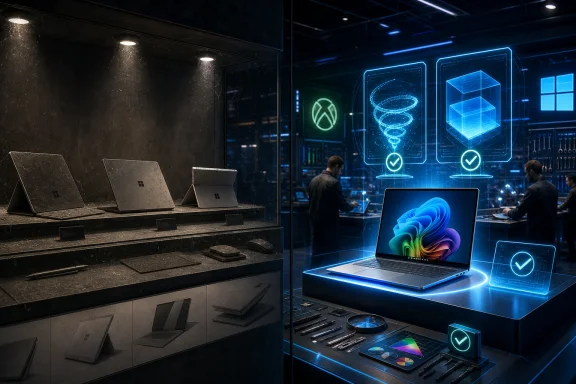
That does not mean Surface is dead. Microsoft still sells Surface Pro, Surface Laptop, Surface Laptop Studio, Surface Laptop Go, and other related devices in various channels. The problem is that availability is not the same as momentum, and the Surface shelf increasingly reads like a museum of recent Microsoft eras: Windows on Arm optimism, pen-and-tablet ambition, creator-laptop experimentation, and entry-level compromise.
Surface used to make a simple promise. If OEM Windows PCs were messy, Microsoft would show the industry what disciplined Windows hardware could look like. The Surface Pro turned that promise into a product category; the Surface Laptop made it mainstream; the Surface Studio made it aspirational, even if it never became common. Today, the same brand too often feels like a purchasing footnote beside Lenovo, HP, Dell, ASUS, and Samsung machines that are iterating faster.
That is why the Xbox and Windows comparison stings. Microsoft is not incapable of course correction. It is simply choosing where to spend visible institutional energy, and Surface does not appear to be near the front of the queue.
That matters because it shows the conditions under which Microsoft moves quickly. Xbox became too strategically noisy to ignore. Its identity problem affected developers, subscribers, console buyers, cloud ambitions, and the company’s public story about gaming. When a brand with that much capital starts to wobble, Microsoft can suddenly rediscover the value of narrative coherence.
Surface has the opposite problem. It is not loud enough. It is not failing spectacularly, not dominating dramatically, and not central enough to force an all-hands intervention. It can drift because the drift is quiet.
That quiet drift is dangerous in a different way. Xbox’s problems are debated by fans every week because gamers are noisy and console wars are a renewable energy source. Surface’s problems show up when a buyer who might once have reflexively chosen a Microsoft laptop realizes the best Windows hardware example now probably comes from someone else.
The company may be comfortable with that. Microsoft’s Windows business has always depended on OEM partners, and Surface was never meant to replace them at scale. But there is a difference between not competing with partners too aggressively and surrendering the role of standard-bearer entirely.
A quality campaign is not glamorous, but it is exactly what Windows needs. Operating systems age in public. Every small delay, context-menu hesitation, Settings inconsistency, and forced design detour trains users to distrust the platform a little more. Microsoft does not need Windows 11 to become exciting; it needs Windows 11 to become boring in the best possible way.
That is where Surface should be central. If Microsoft wants to persuade users that Windows 11 is being refined rather than merely monetized, it needs hardware that makes those refinements obvious. A clean laptop with excellent battery life, a responsive display, stable sleep behavior, great microphones, no driver weirdness, and a trackpad that never feels like an afterthought can do more for Windows sentiment than another keynote slide about productivity.
Instead, the user-facing Windows comeback is being asked to stand on a hardware stage that Microsoft itself has not freshly rebuilt. The Surface Pro 11 and Surface Laptop 7 were important Copilot+ PC launch vehicles in 2024, especially for Windows on Arm. But by 2026, “important two years ago” is not the same as “the device you buy today to see the future.”
The deeper problem is that Surface no longer has a clean job. Is it supposed to be Microsoft’s premium Windows laptop brand? A showcase for Windows on Arm? A tablet-first productivity device? A pen and creativity platform? A business fleet option? A developer machine? A MacBook rival? A reference design for OEMs? The answer has often been “yes,” which is another way of saying the brand has become diffuse.
The early Surface years had a sharp thesis: Windows could be both touch-first and productivity-first, and Microsoft would build the hardware to prove it. Not every device succeeded, but the argument was clear. Surface had enemies, constraints, and a point of view.
The modern line has fewer edges. The Surface Laptop is a handsome clamshell. The Surface Pro remains the detachable Windows tablet to beat, but the category itself is no longer the center of the PC conversation. The Laptop Studio is interesting but overdue for a clearer future. The Go machines occupy a value tier where Microsoft’s premium instincts and budget realities keep colliding.
That ambiguity makes Surface easier to neglect. A product line with a crisp mission generates its own pressure. A product line that is merely respectable can be postponed.
But the moment needed a second act. A new architecture launch can create curiosity; sustained product excellence creates trust. By 2026, buyers are no longer asking whether Windows on Arm can technically run their lives. They are asking which machine gives them the fewest compromises for the money.
That is where OEMs have been ruthless. Lenovo’s Yoga Slim 7x, repeatedly praised in the Windows Central piece, is the kind of machine that makes Surface’s restraint look less like elegance and more like hesitation. It is thin, modern, well-built, and aggressively positioned. Other manufacturers have been just as willing to experiment with OLED displays, lighter chassis designs, better port mixes, faster refresh cycles, and sharper pricing.
Microsoft’s problem is not that partners are doing well. That is good for Windows. The problem is that Surface no longer obviously defines the top of the Windows experience. When a reviewer tells buyers to skip the Surface Laptop because a Lenovo better represents what Windows hardware can be in 2026, the reference-design crown has slipped.
This is especially awkward because Copilot+ PCs were supposed to make Windows hardware feel newly differentiated. If the flagship Microsoft-branded devices do not remain among the most persuasive examples of that differentiation, then Surface becomes a launch prop rather than a product strategy.
That logic has merit, but only up to a point. Surface was never valuable merely because it shipped units. It was valuable because it gave Windows a physical argument. It said: this is what Microsoft thinks a Windows PC should feel like when the software and hardware are designed with the same priorities.
Apple understands this at a religious level. The Mac is not just another way to run macOS; it is the proof object for macOS. Google has used Pixel similarly for Android, sometimes unevenly but with clear intent. Even Valve’s Steam Deck has become a powerful argument for a particular version of PC gaming because the hardware, software, store, and controls tell one coherent story.
Surface used to play that role for Windows. It did not always win on specs or price, but it framed the conversation. Detachable keyboards, kickstands, precision trackpads, tall displays, Windows Hello cameras, pen integration, and premium magnesium bodies all pushed the ecosystem forward.
Now the ecosystem often seems to be pushing Surface. That inversion is not fatal, but it is reputationally costly. If Microsoft’s own devices are not the machines reviewers reach for when they want to show Windows at its best, Surface has become just another OEM with a famous logo.
Apple Silicon changed the terms. The MacBook Air became fast, silent, efficient, and simple in a way Windows laptops still struggle to match consistently. Premium Windows PCs can absolutely compete, and in some categories they surpass Apple with OLED displays, touch, pen support, gaming compatibility, broader form factors, and more flexible pricing. But the burden of proof shifted.
Surface should be Microsoft’s answer to that shift. Not by copying the MacBook, but by articulating what a modern Windows laptop is for. Is it the best device for hybrid work? The best AI development edge machine? The best note-taking and tablet-convertible productivity device? The most elegant expression of Windows on Arm? The safest business laptop for Microsoft 365 environments?
Instead, Surface too often asks buyers to infer the answer from the product grid. That is not enough when competitors are moving quickly and Apple’s baseline experience is so strong. A premium device cannot live on heritage indefinitely.
This is why the age of the hardware matters even when the machines remain usable. A two-year-old laptop is not automatically obsolete. But a two-year-old flagship in a category defined by battery gains, NPU requirements, display improvements, and AI-era positioning needs a reason to remain the recommendation. Surface has not always provided that reason loudly enough.
There is also enormous strategic value in Microsoft owning a first-party PC line. Windows is entering an awkward era where local AI, cloud services, Arm compatibility, enterprise manageability, security baselines, and user trust all have to be reconciled. Surface can be the controlled environment where Microsoft proves those pieces work together before asking the broader ecosystem to follow.
That is especially important for IT pros. Fleet buyers care less about romance and more about lifecycle clarity, supportability, imaging, repair options, firmware reliability, security posture, and predictable refreshes. A revitalized Surface line could give Microsoft a serious business-hardware story around Windows 11, Microsoft 365, Copilot, Intune, Defender, and silicon-level security.
But to do that, Microsoft has to treat Surface as more than a storefront category. It needs cadence. It needs communication. It needs fewer half-updated branches and more clear product lanes. It needs to stop making enthusiasts guess whether a device family is being quietly retired or merely waiting for a chip cycle.
The irony is that Surface does not need to become massive to matter. It just needs to become decisive again.
Microsoft should start by making the Surface Laptop impossible to dismiss. That means best-in-class battery life, excellent sustained performance, a display that does not feel like a compromise, a modern port selection, haptics that belong in the premium tier, and pricing that does not assume buyers will pay a Surface tax for nostalgia. If Windows 11 K2 is about perceived speed and consistency, the Surface Laptop should be the machine where that work is most visible.
The Surface Pro needs a sharper identity, too. It remains the soul of the brand, but the detachable category is no longer novel. Microsoft has to make the tablet experience feel less like a laptop reluctantly missing its base and more like a first-class Windows mode. That means touch behavior, pen workflows, windowing, battery life, thermals, and accessory pricing all matter as part of the product, not as afterthoughts.
The Surface Laptop Studio is the harder call. It has fans, and its pull-forward display is genuinely distinct, but it risks becoming the Zune HD of Surface: beloved by a subset, admired by reviewers, and strategically orphaned. Microsoft should either recommit to it as a serious creator and developer workstation or let the concept rest. The worst option is letting it linger as an expensive curiosity.
The Go tier deserves similar discipline. Affordable Surface devices make sense if they express the brand’s values at a lower price. They make less sense if they merely give Microsoft a way to advertise a cheaper entry point while shipping compromises that undermine the Surface name.
Surface should be the device family where Microsoft refuses to blame anyone else. No OEM utility conflicts. No questionable driver stacks. No bargain-bin panels. No mystery firmware behavior. No shrugging at the gap between what Windows promises and what a Windows PC actually does at 8:43 a.m. before a meeting.
That is not just a consumer pitch. For administrators, a first-party Surface fleet should represent the cleanest path through Microsoft’s own management stack. Autopilot, Intune, Windows Update for Business, Defender, BitLocker, firmware updates, device health reporting, and Copilot governance should feel less like a box of parts and more like a designed system. Microsoft sells the whole workplace cloud; Surface should prove the endpoint can be just as intentional.
The AI angle makes this even more urgent. Microsoft has spent years telling customers that Copilot will reshape work. But AI features running on a mediocre or aging client device feel like theater. If local models, NPUs, Recall-style memory features, semantic search, and agentic workflows are going to become part of Windows, users need hardware that makes those features feel fast, private, controllable, and worth the tradeoffs.
Surface is the obvious place to demonstrate that balance. If Microsoft does not use it, the company is effectively outsourcing the physical experience of its AI operating system to partners with different priorities.
That is a healthier but more embarrassing problem than the old days. Windows laptops are not waiting for Surface to save them. The best OEM machines are thin, fast, efficient, attractive, and often better priced than Microsoft’s equivalents. Some are more adventurous. Some are more practical. Some simply arrive sooner.
For Windows users, that is good news. Nobody should buy Surface out of brand loyalty if a Lenovo, HP, Dell, ASUS, or Samsung machine better fits the job. The PC market is supposed to be competitive, and Microsoft’s partners have earned their wins.
For Microsoft, though, the optics are rough. If Surface exists only as one option among many, then it has to compete like one option among many. That means faster refreshes, sharper pricing, clearer differentiation, and fewer assumptions that a clean chassis and a Windows logo are enough.
The company cannot have it both ways. Surface cannot be treated internally as a low-urgency side business while being marketed externally as the premium expression of Windows. Either it is a strategic product line, or it is just inventory.
Source: Windows Central Surface is being left behind while Xbox and Windows 11 get a second life
 Microsoft Found the Reset Button, Just Not for Surface
The complaint from Windows Central lands because it names something Surface fans have been muttering for a while: Microsoft’s hardware brand no longer feels like the pace-setter. Xbox is being repositioned around Project Helix and a renewed hardware identity. Windows 11 is reportedly being put through a quality-and-polish campaign under the Windows K2 banner. Surface, meanwhile, appears to be coasting on the same Copilot+ PC wave it helped launch two years ago.That does not mean Surface is dead. Microsoft still sells Surface Pro, Surface Laptop, Surface Laptop Studio, Surface Laptop Go, and other related devices in various channels. The problem is that availability is not the same as momentum, and the Surface shelf increasingly reads like a museum of recent Microsoft eras: Windows on Arm optimism, pen-and-tablet ambition, creator-laptop experimentation, and entry-level compromise.
Surface used to make a simple promise. If OEM Windows PCs were messy, Microsoft would show the industry what disciplined Windows hardware could look like. The Surface Pro turned that promise into a product category; the Surface Laptop made it mainstream; the Surface Studio made it aspirational, even if it never became common. Today, the same brand too often feels like a purchasing footnote beside Lenovo, HP, Dell, ASUS, and Samsung machines that are iterating faster.
That is why the Xbox and Windows comparison stings. Microsoft is not incapable of course correction. It is simply choosing where to spend visible institutional energy, and Surface does not appear to be near the front of the queue.
Xbox Got the Panic That Surface Has Not Earned
Xbox’s recent shift is not happening because everything was fine. It follows years of strategic muddiness: console identity diluted by “play anywhere” messaging, Game Pass growth pressure, expensive acquisitions, and an uneasy relationship between Xbox as a box and Xbox as a service. Project Helix, as described in recent reporting, is Microsoft’s attempt to pull those tensions into a new hardware-and-PC hybrid strategy rather than pretend the console business can be preserved in amber.That matters because it shows the conditions under which Microsoft moves quickly. Xbox became too strategically noisy to ignore. Its identity problem affected developers, subscribers, console buyers, cloud ambitions, and the company’s public story about gaming. When a brand with that much capital starts to wobble, Microsoft can suddenly rediscover the value of narrative coherence.
Surface has the opposite problem. It is not loud enough. It is not failing spectacularly, not dominating dramatically, and not central enough to force an all-hands intervention. It can drift because the drift is quiet.
That quiet drift is dangerous in a different way. Xbox’s problems are debated by fans every week because gamers are noisy and console wars are a renewable energy source. Surface’s problems show up when a buyer who might once have reflexively chosen a Microsoft laptop realizes the best Windows hardware example now probably comes from someone else.
The company may be comfortable with that. Microsoft’s Windows business has always depended on OEM partners, and Surface was never meant to replace them at scale. But there is a difference between not competing with partners too aggressively and surrendering the role of standard-bearer entirely.
Windows 11 Is Getting a Redemption Arc Because It Needs One
Windows 11’s reported K2 push also illustrates Microsoft’s renewed sensitivity to accumulated user irritation. The OS has spent years carrying complaints about performance, UI inconsistency, Start menu compromises, taskbar regressions, control-panel sprawl, account nudges, advertising-adjacent prompts, and AI features that too often feel bolted on rather than woven in. Even users who like Windows 11 can usually name three things they wish Microsoft had fixed before shipping it.A quality campaign is not glamorous, but it is exactly what Windows needs. Operating systems age in public. Every small delay, context-menu hesitation, Settings inconsistency, and forced design detour trains users to distrust the platform a little more. Microsoft does not need Windows 11 to become exciting; it needs Windows 11 to become boring in the best possible way.
That is where Surface should be central. If Microsoft wants to persuade users that Windows 11 is being refined rather than merely monetized, it needs hardware that makes those refinements obvious. A clean laptop with excellent battery life, a responsive display, stable sleep behavior, great microphones, no driver weirdness, and a trackpad that never feels like an afterthought can do more for Windows sentiment than another keynote slide about productivity.
Instead, the user-facing Windows comeback is being asked to stand on a hardware stage that Microsoft itself has not freshly rebuilt. The Surface Pro 11 and Surface Laptop 7 were important Copilot+ PC launch vehicles in 2024, especially for Windows on Arm. But by 2026, “important two years ago” is not the same as “the device you buy today to see the future.”
Surface’s Real Problem Is Not Age, It Is Ambiguity
It is easy to reduce the issue to stale hardware, and that is certainly part of it. The Surface Laptop Studio 2 dates back to 2023. The Surface Laptop Go 3 is also from 2023. The Surface Laptop 7 and Surface Pro 11 arrived in 2024. Some business-focused Intel refreshes helped fill gaps, but they did not create a broad feeling of reinvention.The deeper problem is that Surface no longer has a clean job. Is it supposed to be Microsoft’s premium Windows laptop brand? A showcase for Windows on Arm? A tablet-first productivity device? A pen and creativity platform? A business fleet option? A developer machine? A MacBook rival? A reference design for OEMs? The answer has often been “yes,” which is another way of saying the brand has become diffuse.
The early Surface years had a sharp thesis: Windows could be both touch-first and productivity-first, and Microsoft would build the hardware to prove it. Not every device succeeded, but the argument was clear. Surface had enemies, constraints, and a point of view.
The modern line has fewer edges. The Surface Laptop is a handsome clamshell. The Surface Pro remains the detachable Windows tablet to beat, but the category itself is no longer the center of the PC conversation. The Laptop Studio is interesting but overdue for a clearer future. The Go machines occupy a value tier where Microsoft’s premium instincts and budget realities keep colliding.
That ambiguity makes Surface easier to neglect. A product line with a crisp mission generates its own pressure. A product line that is merely respectable can be postponed.
The Copilot+ PC Moment Should Have Been Surface’s Opening
Microsoft did have a real Surface moment in 2024. The Copilot+ PC launch gave Surface Pro 11 and Surface Laptop 7 a reason to exist beyond ordinary spec bumps. Qualcomm’s Snapdragon X chips finally made Windows on Arm feel less like a science project and more like a credible mainstream option. Battery life improved. Performance became more competitive. The idea of local AI acceleration gave Microsoft a new hardware story.But the moment needed a second act. A new architecture launch can create curiosity; sustained product excellence creates trust. By 2026, buyers are no longer asking whether Windows on Arm can technically run their lives. They are asking which machine gives them the fewest compromises for the money.
That is where OEMs have been ruthless. Lenovo’s Yoga Slim 7x, repeatedly praised in the Windows Central piece, is the kind of machine that makes Surface’s restraint look less like elegance and more like hesitation. It is thin, modern, well-built, and aggressively positioned. Other manufacturers have been just as willing to experiment with OLED displays, lighter chassis designs, better port mixes, faster refresh cycles, and sharper pricing.
Microsoft’s problem is not that partners are doing well. That is good for Windows. The problem is that Surface no longer obviously defines the top of the Windows experience. When a reviewer tells buyers to skip the Surface Laptop because a Lenovo better represents what Windows hardware can be in 2026, the reference-design crown has slipped.
This is especially awkward because Copilot+ PCs were supposed to make Windows hardware feel newly differentiated. If the flagship Microsoft-branded devices do not remain among the most persuasive examples of that differentiation, then Surface becomes a launch prop rather than a product strategy.
The Best Windows PC Should Not Be a Third-Party Correction
There is a generous interpretation of Surface’s current posture: Microsoft has decided to stop crowding its OEM partners. If Lenovo, HP, Dell, ASUS, Acer, Samsung, and others can build outstanding Windows machines, perhaps Surface does not need to chase every refresh cycle. The Windows ecosystem is healthier when many manufacturers compete for the best experience.That logic has merit, but only up to a point. Surface was never valuable merely because it shipped units. It was valuable because it gave Windows a physical argument. It said: this is what Microsoft thinks a Windows PC should feel like when the software and hardware are designed with the same priorities.
Apple understands this at a religious level. The Mac is not just another way to run macOS; it is the proof object for macOS. Google has used Pixel similarly for Android, sometimes unevenly but with clear intent. Even Valve’s Steam Deck has become a powerful argument for a particular version of PC gaming because the hardware, software, store, and controls tell one coherent story.
Surface used to play that role for Windows. It did not always win on specs or price, but it framed the conversation. Detachable keyboards, kickstands, precision trackpads, tall displays, Windows Hello cameras, pen integration, and premium magnesium bodies all pushed the ecosystem forward.
Now the ecosystem often seems to be pushing Surface. That inversion is not fatal, but it is reputationally costly. If Microsoft’s own devices are not the machines reviewers reach for when they want to show Windows at its best, Surface has become just another OEM with a famous logo.
The MacBook Problem Has Changed Shape
For years, Surface’s implicit opponent was the MacBook. Microsoft’s ads made the comparison explicit: touchscreens, pens, detachable keyboards, Windows flexibility, and value against Apple’s polished but constrained laptops. That fight looked different when Intel Macs had thermal compromises, butterfly keyboards, and a more conservative hardware rhythm.Apple Silicon changed the terms. The MacBook Air became fast, silent, efficient, and simple in a way Windows laptops still struggle to match consistently. Premium Windows PCs can absolutely compete, and in some categories they surpass Apple with OLED displays, touch, pen support, gaming compatibility, broader form factors, and more flexible pricing. But the burden of proof shifted.
Surface should be Microsoft’s answer to that shift. Not by copying the MacBook, but by articulating what a modern Windows laptop is for. Is it the best device for hybrid work? The best AI development edge machine? The best note-taking and tablet-convertible productivity device? The most elegant expression of Windows on Arm? The safest business laptop for Microsoft 365 environments?
Instead, Surface too often asks buyers to infer the answer from the product grid. That is not enough when competitors are moving quickly and Apple’s baseline experience is so strong. A premium device cannot live on heritage indefinitely.
This is why the age of the hardware matters even when the machines remain usable. A two-year-old laptop is not automatically obsolete. But a two-year-old flagship in a category defined by battery gains, NPU requirements, display improvements, and AI-era positioning needs a reason to remain the recommendation. Surface has not always provided that reason loudly enough.
Surface Still Has Strengths Microsoft Should Not Waste
The frustrating part is that Surface is not a bad brand. The industrial design language remains recognizable. The Surface Pro form factor still has loyalists because nobody else has made the detachable Windows tablet feel quite as iconic. The Surface Laptop remains one of the cleaner clamshell designs in the Windows market. The keyboards, cameras, aspect ratios, and overall restraint still appeal to users who do not want their PC to look like it escaped from a gaming accessory aisle.There is also enormous strategic value in Microsoft owning a first-party PC line. Windows is entering an awkward era where local AI, cloud services, Arm compatibility, enterprise manageability, security baselines, and user trust all have to be reconciled. Surface can be the controlled environment where Microsoft proves those pieces work together before asking the broader ecosystem to follow.
That is especially important for IT pros. Fleet buyers care less about romance and more about lifecycle clarity, supportability, imaging, repair options, firmware reliability, security posture, and predictable refreshes. A revitalized Surface line could give Microsoft a serious business-hardware story around Windows 11, Microsoft 365, Copilot, Intune, Defender, and silicon-level security.
But to do that, Microsoft has to treat Surface as more than a storefront category. It needs cadence. It needs communication. It needs fewer half-updated branches and more clear product lanes. It needs to stop making enthusiasts guess whether a device family is being quietly retired or merely waiting for a chip cycle.
The irony is that Surface does not need to become massive to matter. It just needs to become decisive again.
A Real Surface Reboot Would Be Smaller Than Fans Think
The obvious fan demand is “new hardware,” but Microsoft should resist the temptation to solve the problem with scattered spec bumps. A faster chip in an otherwise unchanged chassis can be useful, especially for business customers, but it will not restore Surface’s role as the Windows standard-bearer. The reboot has to be editorial, not just silicon.Microsoft should start by making the Surface Laptop impossible to dismiss. That means best-in-class battery life, excellent sustained performance, a display that does not feel like a compromise, a modern port selection, haptics that belong in the premium tier, and pricing that does not assume buyers will pay a Surface tax for nostalgia. If Windows 11 K2 is about perceived speed and consistency, the Surface Laptop should be the machine where that work is most visible.
The Surface Pro needs a sharper identity, too. It remains the soul of the brand, but the detachable category is no longer novel. Microsoft has to make the tablet experience feel less like a laptop reluctantly missing its base and more like a first-class Windows mode. That means touch behavior, pen workflows, windowing, battery life, thermals, and accessory pricing all matter as part of the product, not as afterthoughts.
The Surface Laptop Studio is the harder call. It has fans, and its pull-forward display is genuinely distinct, but it risks becoming the Zune HD of Surface: beloved by a subset, admired by reviewers, and strategically orphaned. Microsoft should either recommit to it as a serious creator and developer workstation or let the concept rest. The worst option is letting it linger as an expensive curiosity.
The Go tier deserves similar discipline. Affordable Surface devices make sense if they express the brand’s values at a lower price. They make less sense if they merely give Microsoft a way to advertise a cheaper entry point while shipping compromises that undermine the Surface name.
Windows K2 Gives Surface a Reason to Matter Again
If Windows K2 is real in the form reporting suggests, it may be Surface’s best chance at relevance. A quality-focused Windows initiative needs a showcase machine because software polish is easiest to believe when it is felt. Benchmarks can show improvement, but users notice whether the lid opens and everything is instantly ready, whether animations hitch, whether Teams behaves, whether sleep drains the battery, and whether the system feels composed under pressure.Surface should be the device family where Microsoft refuses to blame anyone else. No OEM utility conflicts. No questionable driver stacks. No bargain-bin panels. No mystery firmware behavior. No shrugging at the gap between what Windows promises and what a Windows PC actually does at 8:43 a.m. before a meeting.
That is not just a consumer pitch. For administrators, a first-party Surface fleet should represent the cleanest path through Microsoft’s own management stack. Autopilot, Intune, Windows Update for Business, Defender, BitLocker, firmware updates, device health reporting, and Copilot governance should feel less like a box of parts and more like a designed system. Microsoft sells the whole workplace cloud; Surface should prove the endpoint can be just as intentional.
The AI angle makes this even more urgent. Microsoft has spent years telling customers that Copilot will reshape work. But AI features running on a mediocre or aging client device feel like theater. If local models, NPUs, Recall-style memory features, semantic search, and agentic workflows are going to become part of Windows, users need hardware that makes those features feel fast, private, controllable, and worth the tradeoffs.
Surface is the obvious place to demonstrate that balance. If Microsoft does not use it, the company is effectively outsourcing the physical experience of its AI operating system to partners with different priorities.
The OEMs Are Doing Their Job; Microsoft Must Do Its
The Windows Central comparison to Lenovo’s Yoga Slim 7x is pointed because it avoids a common trap. This is not an argument that Windows hardware is bad. It is an argument that Microsoft’s own Windows hardware is no longer the obvious recommendation.That is a healthier but more embarrassing problem than the old days. Windows laptops are not waiting for Surface to save them. The best OEM machines are thin, fast, efficient, attractive, and often better priced than Microsoft’s equivalents. Some are more adventurous. Some are more practical. Some simply arrive sooner.
For Windows users, that is good news. Nobody should buy Surface out of brand loyalty if a Lenovo, HP, Dell, ASUS, or Samsung machine better fits the job. The PC market is supposed to be competitive, and Microsoft’s partners have earned their wins.
For Microsoft, though, the optics are rough. If Surface exists only as one option among many, then it has to compete like one option among many. That means faster refreshes, sharper pricing, clearer differentiation, and fewer assumptions that a clean chassis and a Windows logo are enough.
The company cannot have it both ways. Surface cannot be treated internally as a low-urgency side business while being marketed externally as the premium expression of Windows. Either it is a strategic product line, or it is just inventory.
The Dust on Surface Is Really Dust on Microsoft’s Hardware Imagination
The most concrete reading of the moment is simple: do not buy a Surface merely because it is a Surface. In 2026, buyers should compare Microsoft’s machines against the best OEM alternatives with no sentimental discount. That is not a betrayal of the brand; it is the only pressure that might make the brand better.- Microsoft’s newest major consumer Surface Pro and Surface Laptop designs are rooted in the 2024 Copilot+ PC launch, which makes the lineup feel slow beside faster-moving OEM rivals.
- Xbox’s Project Helix push shows that Microsoft can still rebuild a troubled product narrative when the strategic stakes become impossible to ignore.
- Windows 11’s reported K2 quality effort creates an opening for Surface to become the showcase for a faster, cleaner, less irritating Windows experience.
- Surface’s problem is not just old hardware, but a blurred mission that makes it unclear whether the brand is a tablet pioneer, a premium laptop line, an Arm showcase, or an enterprise endpoint strategy.
- The strongest Windows laptops increasingly come from Microsoft’s partners, which is good for users but awkward for a first-party hardware brand that once defined the category.
- A real Surface reboot would require a clearer product cadence, more aggressive hardware standards, and a renewed willingness to make devices that argue for Windows rather than merely run it.
Source: Windows Central Surface is being left behind while Xbox and Windows 11 get a second life
