

Swiss Post’s decision to pin Copilot Chat to the navigation bar for its entire workforce and then expand into Microsoft 365 Copilot, Copilot Studio agents, and a formal “Agent Factory” program marks a decisive shift from AI pilots to operationalized, enterprise-scale AI—and it offers one of the clearest, most instructive examples yet of how a public-sector titan is building an AI-first workplace while attempting to keep governance, ethics, and security front and center.
Swiss Post is one of Switzerland’s largest employers, with roughly 45,000–47,000 people across logistics, retail, financial services, and corporate functions—a workforce that spans desk-based knowledge workers and geographically dispersed frontline staff. The company has placed digital transformation at the heart of its Post of Tomorrow strategy and has partnered with Campana & Schott and Microsoft to scale a practical Everyday AI program across that population. The Microsoft customer story published about the program lays out three linked moves:
That said, the program’s success will ultimately be judged by the mechanics: can Swiss Post prevent agent sprawl, control cost and credentials, and ensure that agent outputs are grounded, auditable, and safe for frontline and customer-facing use? Vendor-reported adoption and session counts are impressive, but they remain reported metrics. Independent operational telemetry, periodic third-party audits, and transparent governance reporting will be important to maintain trust across customers, employees, and regulators. For organizations watching closely, the lessons are clear: democratize discovery, invest heavily in enablement and governance, treat agents as first-class software assets, and maintain a posture of skeptical verification for vendor-reported impact claims. Swiss Post’s path offers a practical, repeatable blueprint for operationalizing Copilot, Copilot Studio agents, and an Agent Factory—but executing this at scale remains a complex program of people, process, and technology rather than a single technical switch.
Source: Microsoft Swiss Post empowers 45K employees with Copilot Chat and expands AI innovation with Microsoft 365 Copilot and an Agent Factory | Microsoft Customer Stories
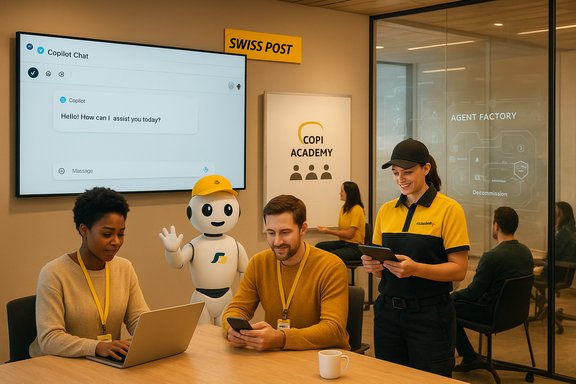 Background / Overview
Swiss Post is one of Switzerland’s largest employers, with roughly 45,000–47,000 people across logistics, retail, financial services, and corporate functions—a workforce that spans desk-based knowledge workers and geographically dispersed frontline staff. The company has placed digital transformation at the heart of its Post of Tomorrow strategy and has partnered with Campana & Schott and Microsoft to scale a practical Everyday AI program across that population. The Microsoft customer story published about the program lays out three linked moves:- Roll out Copilot Chat as the universal, always-available UI for AI for every employee.
- Provide Microsoft 365 Copilot seats to targeted office roles (more than 3,000 licenses reported so far) for deeper, tenant-grounded productivity inside Word, Excel, Outlook, and Teams.
- Launch an Agent Factory—a centralized Center of Excellence and governance model that supports Copilot Studio–built agents while ensuring alignment with Responsible AI and security guardrails.
What Swiss Post did — the rollout, at a glance
1) Copilot Chat for every employee
Swiss Post deployed Copilot Chat broadly and made it discoverable by pinning it to the navigation bar for all staff—effectively turning it into the corporate “UI for AI.” That move intentionally lowers friction for discovery and exploratory use across job roles and devices, including mobile access for field staff. The Microsoft case notes that this early exposure built confidence and curiosity across the organization.2) Microsoft 365 Copilot for office workers
Office workers have been given targeted access to Microsoft 365 Copilot seats—Microsoft’s tenant-aware, Graph-grounded Copilot that reasons over calendar, email, SharePoint and other internal sources. The customer story reports more than 3,000 active Copilot licenses in production to date; Swiss Post’s sequencing prioritized Copilot Chat first to normalize the interface, then expanded to in‑app Copilots for deeper productivity scenarios.3) Agent Factory: a governed production model for agents
Swiss Post formalized an Agent Factory—a centralized-yet-flexible model run through a Center of Excellence with an Agent Governance Framework and alignment to the company’s Responsible AI principles. The Agent Factory’s purpose is to let teams invent and publish agents quickly while giving security, compliance, and review processes the power to block, remediate, or approve agents before they scale. This design mirrors patterns other customers and partners have used to move from isolated pilots into repeatable, auditable agent deployments.4) Copi Academy: enablement and a mascot
Swiss Post ran a structured enablement program—Copi Academy—with regular sessions (30–40 live sessions reported) and an approachable mascot called Copi to make training more human and inclusive. These efforts reinforced change management and helped translate curiosity into measurable usage. Swiss Post reports high attendance at enablement events and ongoing surveys to measure impact. Vendor-reported metrics are highlighted in their customer story.Why this matters: operationalizing everyday AI at scale
Three reasons the Swiss Post case is significant for IT leaders, CIOs, and Microsoft 365 administrators:- Scale across heterogeneous roles. Swiss Post’s workforce includes postal carriers, retail clerks, drivers, IT staff, and executives. The strategy shows an intentional sequencing (low-friction chat for all → premium Copilot for office roles → governed agents for automation) as a practical path to include frontline workers rather than limiting AI to knowledge workers.
- Democratized creation with governance. By combining Copilot Studio (low-code agent authoring) with a Center of Excellence and an Agent Governance Framework, Swiss Post aims to let internal teams create real value while preventing the classic failure modes of “shadow agents” and uncontrolled data access. This parallels recommended best practice patterns other large organisations have adopted.
- A repeatable operating model. The Agent Factory concept is explicitly designed to make agent creation repeatable and auditable—effectively treating agents like software assets with lifecycle, identity, and observability controls. That operational framing is where a pilot becomes business-as-usual.
Technical verification: what’s real and what’s vendor-reported
To maintain journalistic rigor, the most important technical claims have been verified against Microsoft’s published customer story and independent partner/customer signals.- Swiss Post’s workforce size (the 45K figure cited in the Microsoft story) lines up with Swiss Post’s own published headcount, which is reported in the company’s annual materials at roughly 46,000 employees (annual reporting and facts pages). This confirms the scale claim.
- The rollout sequence—Copilot Chat for broad access followed by targeted Microsoft 365 Copilot seats and Copilot Studio agents—is confirmed in Swiss Post’s customer story and echoed by Campana & Schott’s public communications about the program. These two independent sources align on the approach and the high-level numbers (Copilot Chat for 45K employees; 3,000 Copilot seats; dozens of enablement sessions). Those operational metrics are reported by Swiss Post and its partners; they should be treated as vendor‑provided and may not be independently audited outside the company.
- Platform capabilities that underpin the Agent Factory (Copilot Studio authoring, Agent identity and lifecycle controls, admin governance surfaces, and the idea of an agent catalog/Center of Excellence) are consistent with Microsoft’s product direction and public documentation about Copilot, Copilot Studio, and enterprise agent governance. Internal product analyses and field reports further describe Agent 365–style control planes and Entra Agent ID concepts used to treat agents as managed identities. These technical building blocks are real product constructs in the Copilot ecosystem.
Strengths: what Swiss Post is doing well
- Inclusive design and sequencing. Starting with a single, discoverable interface (Copilot Chat) ensures all staff can see AI in action before the organization asks them to adopt deeper tools. That lowers cognitive friction and helps generate early champions in unexpected places.
- Formal enablement with measurable cadence. Copi Academy’s recurring sessions and the use of a mascot to personalize learning demonstrates an investment in culture change rather than a thin, checkbox training program. Training cadence and role-specific modules are key to real adoption.
- Governance-first engineering. Creating an Agent Factory with a dedicated Center of Excellence and an Agent Governance Framework signals that Swiss Post intends to avoid agent sprawl and protect sensitive business data—an approach recognized as essential in regulated environments.
- Partner-led acceleration. Working with Campana & Schott provides implementation experience and an operational playbook, reducing the time needed to go from concept to production. Partner involvement also helps bridge policy, compliance, and technical delivery gaps.
Risks, open questions, and where caution is required
- Data leakage and grounding risk. Agents are powerful because they can access multiple systems. Without strict data-exposure rules, agents could provide answers that combine or leak proprietary or personal data. While Swiss Post references Information Protection and Responsible AI alignment, all agent-facing connectors must be configured with least privilege, and every agent should have documented grounding sources.
- Agent sprawl and lifecycle complexity. Democratized agent creation without lifecycle processes leads to hundreds of lightly governed agents, brittle automations, and duplicate functionality. The Agent Factory concept attempts to prevent that, but the devil is in the operational details: publishing approvals, scheduled reviews, owner assignment, and decommissioning policies must be enforced.
- Model hallucination and trust. Agents that synthesize or draft content must be explicitly grounded to trusted sources and provide provenance. In regulated contexts (customer communications, public statements, financial reporting), Swiss Post will need multi-step verification flows and human-in-the-loop checks before agent outputs proceed to customers.
- Identity and credential risks. Treating agents as directory objects (Entra Agent ID) is a positive step, but it introduces new identity lifecycle headaches—agent credentials, conditional access policies, access reviews, and emergency kill‑switches must be exercised regularly. Any misconfiguration could leave an agent with excessive permissions.
- Cost and licensing transparency. Copilot licensing models and pay-as-you-go agent consumption can generate unexpected costs if usage, model choice, or agent compute/blended-model selection aren’t tracked and controlled. Organizations need real-time cost telemetry and budgeting processes.
- Workforce and labor implications. Scaling agents to frontline tasks raises questions about job redesign, retraining, and union/works-council engagement. Swiss Post’s emphasis on upskilling via Copi Academy is good practice, but long-term workforce planning is required to avoid disruptive surprises.
Practical guidance for IT leaders planning a similar program
- Start with discovery and low-friction access
- Pin a chat‑first UI (Copilot Chat or similar) to your users’ workspace to encourage discovery and lower the activation energy. Use analytics to see where people click first.
- Sequence adopters and measure outcomes
- Pilot Copilot in specific office roles, measure time saved, error rates, and satisfaction, then expand with targeted licensing. Use A/B testing for high-impact workflows. Swiss Post’s 3,000-seat approach is a practical middle ground before enterprise-wide paid seats.
- Build a Center of Excellence and governance framework
- Define agent categories (informational, action-taking, order-of-risk) and impose review gates for mid-/high‑risk agents. Require agent owners, versioning, and scheduled audits.
- Treat agents as software assets
- Require code reviews, test suites, observability dashboards, SLAs, and deprecation plans. Apply standard DevOps processes to agent builds even when they come from low-code tools.
- Enforce least-privilege and identity lifecycle
- Use managed identities (Entra Agent ID), conditional access, and short-lived credentials for agents. Put agents through access reviews and emergency quarantine mechanisms.
- Ground outputs and provide provenance
- Design agents to surface their sources, include citation metadata, and escalate outputs that fail confidence thresholds to human reviewers.
- Control costs and model selection
- Track agent model choices, per-call costs, and compute usage. Establish cost budgets and a central approvals process for high-cost models or heavy‑usage agents.
- Scale enablement and change management
- Invest in repeatable learning modules (train-the-trainer), community champions, and recurring clinics. Swiss Post’s Copi Academy cadence is a good model for continuous engagement.
The competitive and policy context
Swiss Post’s approach is aligned with broader trends: Microsoft’s own Copilot roadmap and the broader enterprise market increasingly position agents as the primary interface for work and service automation. Microsoft’s announcements about Copilot Studio, agent control planes, and identity-first agent models validate the technical direction Swiss Post is operationalizing. Independent partner and customer cases show that other organizations are following similar patterns, indicating that this is not a single-outlier experiment but an emerging playbook for “frontier firms” that embed AI across workflows. At the same time, public-sector entities and large employers are under special scrutiny for AI use in public-facing services—regulators and oversight bodies will want transparency on data flows, bias mitigation, and auditability. Swiss Post’s emphasis on Responsible AI alignment and a governance-first Agent Factory is therefore a necessary response to both operational and regulatory risk.Conclusion: a model with promise — and real work ahead
Swiss Post’s program is an exemplar of how to go beyond pilotitis: it sequences discovery, targeted premium capabilities, and governed agent innovation into a coherent Everyday AI strategy. The Agent Factory concept—centered on a CoE, formal governance, and an identity-aware agent lifecycle—addresses many of the operational problems that cripple early AI programs.That said, the program’s success will ultimately be judged by the mechanics: can Swiss Post prevent agent sprawl, control cost and credentials, and ensure that agent outputs are grounded, auditable, and safe for frontline and customer-facing use? Vendor-reported adoption and session counts are impressive, but they remain reported metrics. Independent operational telemetry, periodic third-party audits, and transparent governance reporting will be important to maintain trust across customers, employees, and regulators. For organizations watching closely, the lessons are clear: democratize discovery, invest heavily in enablement and governance, treat agents as first-class software assets, and maintain a posture of skeptical verification for vendor-reported impact claims. Swiss Post’s path offers a practical, repeatable blueprint for operationalizing Copilot, Copilot Studio agents, and an Agent Factory—but executing this at scale remains a complex program of people, process, and technology rather than a single technical switch.
Source: Microsoft Swiss Post empowers 45K employees with Copilot Chat and expands AI innovation with Microsoft 365 Copilot and an Agent Factory | Microsoft Customer Stories
