HEGLA‑HANIC’s new glass365 platform brings an industry‑tuned Microsoft Copilot into the heart of glass order entry, promising to turn hours of manual data entry into seconds of automated drafting—while keeping production teams firmly in control of every confirmation step. The system is built on Microsoft Dynamics 365 Business Central and, according to vendor materials and public statements, combines document intelligence (emails, PDFs, image captures and even handwritten sketches) with real‑time inventory checks to produce draft orders and customer quotations for user review. The move is significant for glass processors because it blends ERP modernization with practical AI automation targeted at the unique demands of flat‑glass production and fabrication.
The glass industry is ready for smarter order entry—glass365 stakes a credible claim in that direction, but success will depend on measurable pilot outcomes, clear governance and careful integration into both office and shop‑floor systems.
Source: glassonweb.com AI Meets Glass ERP: Smarter Order Entry with glass365
 Background
Why ERP matters for glass processors
Glass fabrication is process‑intensive: orders arrive in many formats, special cut lists and shapes are described in sketches, and production planning depends on precise inventory and sequencing. Historically, ERP systems in the glass sector have focused on machine‑level integration (cutting tables, tempering lines) and logistics, while order intake remained a manual bottleneck—emails, faxes, scanned drawings and attachments that need human interpretation before scheduling or nesting. The latest generation of ERP products promises to remove those chokepoints by combining robust shop‑floor control with document intelligence and automation. HEGLA‑HANIC’s glass365 is positioned as one such system, explicitly aimed at replacing legacy order‑entry friction with an AI‑assisted workflow.The Microsoft foundation: Dynamics 365 Business Central
glass365 is built on Microsoft Dynamics 365 Business Central, giving HEGLA‑HANIC a modern cloud ERP backbone with built‑in finance, inventory, sales and service modules and native ties to the Microsoft 365 ecosystem. Business Central supports extensibility for industry‑specific modules, and Microsoft has been rolling out Copilot features to inject generative AI inside Business Central workflows—making it technically straightforward for ISVs to embed a Copilot experience tailored to vertical needs. HEGLA‑HANIC’s announcement and product descriptions indicate glass365 leverages this foundation to deliver industry‑specific UX, add‑ons and the AI assistant.What glass365 delivers: a practical breakdown
An AI copilot adapted to glass workflows
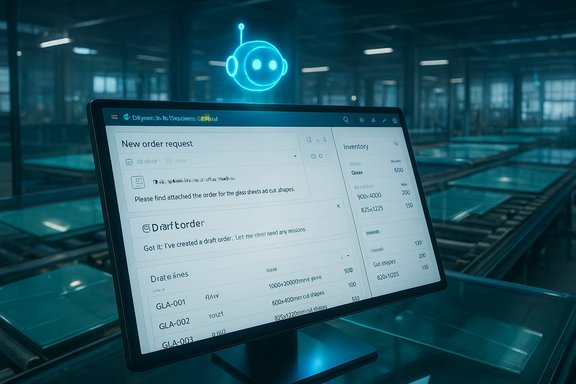
HEGLA‑HANIC markets the glass365 Copilot as different from off‑the‑shelf AI assistants. Rather than a generic chat agent, the Copilot is customised to understand glass‑specific terms, drawings and workflows: it extracts order details from emails and attachments, interprets handwritten sketches or notes, proposes items and processing steps, and creates a draft sales order and quotation for review. The vendor stresses that the human remains the arbiter—every draft is reviewable and editable before being committed to the ERP. Public product messaging and a company LinkedIn post describe this workflow and the emphasis on user control.- Key automation steps HEGLA‑HANIC highlights:
- Parsing incoming emails and document attachments to extract order details.
- Converting sketches and handwriting into structured order data.
- Suggesting item lines, processing operations and packaging instructions.
- Checking real‑time inventory and stock availability.
- Producing quotations and sending them for customer approval or internal sign‑off.
Document intelligence and handwriting recognition
The capability to handle diverse document formats is central to the pitch. Modern document intelligence systems (including Microsoft Azure Document Intelligence / Computer Vision) can extract structured data from PDFs, images and even handwritten inputs with reasonable accuracy when trained and tuned for a specific formset or handwriting style. HEGLA‑HANIC’s messaging explicitly calls out PDFs, email attachments and “handwritten sketches” as supported input types; the technical underpinning for this kind of functionality (OCR, form extraction, and handwriting recognition) is available in Microsoft’s AI stack, which Business Central partners commonly use. That makes the feature credible—subject to implementation quality and training data.Inventory checks and quotation generation
glass365 reportedly checks warehouse stock in real time and prepares quotations automatically as part of the draft order flow. Business Central already includes inventory management, stock reservations and sales‑quote capabilities; Copilot features in Dynamics are designed to access that same ERP context to provide suggestions (for example, suggest substitutions or identify stock shortfalls). HEGLA‑HANIC’s message is that the Copilot aggregates order parsing and ERP lookups into one fluid proposal for approval by the user. Public product descriptions and vendor posts corroborate those claims; independent product pages for Business Central and Microsoft Copilot document the technical viability of Copilot‑driven inventory queries and text generation.Technical reality check: what’s verified and what’s inferred
Verified claims
- glass365 is built on Microsoft Dynamics 365 Business Central. This fact appears in HEGLA‑HANIC product material and at trade coverage.
- Microsoft provides Copilot capabilities inside Dynamics 365 Business Central, and the platform supports AI‑driven assistance for business processes like sales orders and inventory queries. That makes Copilot integration technically feasible.
- HEGLA‑HANIC publicly states the Copilot will extract data from emails, PDFs and sketches to prepare draft orders and quotes. The company’s announcement and LinkedIn posts describe this functionality.
Claims that require caution or are not fully verifiable publicly
- Exact accuracy rates for OCR and handwritten sketch interpretation (for example, percent correctly parsed item lines or dimensions) are not published by HEGLA‑HANIC. Accuracy varies with input quality, handwriting legibility, and model training; users should expect a training and tuning phase. Treat accuracy figures as vendor‑specific and context dependent unless HEGLA‑HANIC publishes test results.
- The precise AI models and cloud services used by glass365 (for example, whether HEGLA‑HANIC uses Azure Document Intelligence, a third‑party IDP vendor, or an in‑house model) are not specified in public summaries. That affects data residency, governance and integration details and should be clarified during procurement.
- Performance under load (how many documents per minute, concurrency when many orders arrive simultaneously) and integration specifics with niche glass MES/PPS systems are not detailed in the announcement. Prospective customers should request benchmarks and integration diagrams.
How glass365 fits into the market: competitors and context
The broader trend: AI enters glass order entry
Glass industry software vendors are converging on the same problem: eliminate slow, error‑prone manual order entry and get accurate production data into MES and nesting systems faster. A+W’s Mira Order Entry AI and other vendor initiatives show that automatic extraction from customer email attachments and PDF orders is becoming mainstream. These solutions share common components: OCR/Document Intelligence for extraction, mapping engines to match customer wording to internal product codes, and ERP integration for stock checks and order creation. HEGLA‑HANIC’s approach—tying a Copilot directly into Business Central—is a logical execution route within the Microsoft ecosystem.Where glass365 can win
- Deep industry domain knowledge embedded in workflows (glass processing steps, special handling instructions, edge‑delete or lamination requirements) reduces the manual corrections needed after automated extraction. HEGLA‑HANIC emphasizes this domain tuning.
- Native use of Business Central and Microsoft Copilot can reduce integration friction for customers already in the Microsoft 365 ecosystem, providing single‑sign‑on, shared permissions and potentially simpler license management.
- The “review before commit” design keeps human oversight in the loop, which is vital in high‑value manufacturing where mistakes cascade into production errors and scrap.
Where the solution may struggle
- Document variability: customers still send a wide mix of formats—photos of sketches, hand‑annotated PDFs, or legacy spreadsheets. High accuracy extraction across that variability needs a lot of training data and continuous feedback loops.
- Change management: shops must reorganize order‑handling tasks and trust an automated pipeline. That requires pilot projects, user training, and a governance model for when the Copilot’s suggestions are rejected or repeatedly corrected.
- Integration with non‑Microsoft MES/PPS: while Business Central covers ERP, many fabricators have bespoke shop‑floor systems. The quality of connectors or APIs will determine real‑world automation success.
Security, data governance and compliance considerations
Data residency and privacy
Because glass365 is built on Microsoft cloud technologies, data residency and governance will be governed by Business Central and Azure policies unless HEGLA‑HANIC provides an on‑premises or private cloud deployment. Microsoft’s Copilot and AI services follow enterprise controls, but teams must confirm where extracted documents are stored, whether prompt data or extracted text is retained for training, and how consent is handled for customer attachments. These are procurement‑level questions that affect compliance, especially for companies with EU Data Boundary or industry‑specific regulations.Access control and audit
ERP systems are inherently sensitive—pricing, inventories, and customer data are core business assets. The Copilot must respect role‑based access controls and audit trails so that the user who approves an order is logged. Business Central supports robust permissioning and auditing, but an ISV‑implemented Copilot must be designed to inherit and enforce those permissions. Buyers should demand clear audit logs showing who accepted or edited Copilot proposals.Model transparency and vendor commitments
Ask HEGLA‑HANIC the following:- Does the Copilot retain prompts or extracted text for model training?
- Can your company opt out of vendor‑level telemetry or training data sharing?
- Are the AI components run in‑tenant, on‑premises containers, or multitenant cloud services?
Practical deployment checklist for glass shops
- Start with a pilot focused on one order channel (for example, email attachments from a single key customer). A narrow scope reduces variability while proving the extraction‑to‑ERP workflow.
- Collect representative documents (PDF orders, scanned sketches, customer Excel templates) and include corrections as training data. The improvement curve for IDP systems depends heavily on labeled examples.
- Verify integration points: confirm how glass365 will talk to your MES, nesting software and cutting table schedulers; request a sequence diagram that shows the data flow from Copilot draft → user approval → ERP order → MES dispatch.
- Define acceptance criteria for the pilot: percent of orders auto‑drafted correctly, average time saved per order, and error rate after human correction. Use these to justify full rollout.
- Demand documentation on data residency, retention and model training policies before signing for production use.
Business impact: speed, accuracy and workforce implications
Faster order throughput
If the automated pipeline works as advertised, order drafting shifts from a manual, repetitive task to a review activity. That reduces lead time between customer request and production scheduling and can materially shorten cycle times for small to medium batch runs.Accuracy gains and error modes
Automation reduces transcription errors for structured, templated documents (digital PDFs, standardized order forms). However, for hand‑drawn sketches or ambiguous notes, the system may introduce new error modes—misread dimensions or missed processing steps—if the Copilot’s mapping engine lacks the proper rules. A robust human review step is essential to catch edge cases.Workforce shifts
Order entry clerks become exception managers and quality reviewers. That can raise job satisfaction if staff are retrained into higher‑value roles, but poor change management risks resistance. Vendors that provide clear training and incremental rollout plans often see smoother adoption.Critical risks and vendor due diligence
- Do not accept black‑box assurances. Insist on demonstrations that use your actual documents. Performance in vendor demos with sanitized inputs often overstates production accuracy.
- Confirm rollback procedures. A failed automation step must be reversible and traceable to avoid cascading production errors.
- Licensing complexity: Microsoft Copilot features, Business Central, Azure AI calls and HEGLA‑HANIC add‑ons can create layered license overhead. Ask for an itemised cost projection: license fees, Azure AI consumption (if billed separately), and implementation fees.
Conclusion: measured optimism for an industry problem
glass365 is an example of sensible evolution in industry ERP: a modern Microsoft backbone combined with a tailored Copilot makes the promise of faster, more accurate order entry realistic for glass fabricators. HEGLA‑HANIC’s public messaging matches verified industry capabilities—Business Central’s Copilot features, Azure document intelligence and emerging IDP approaches make the core functionality plausible and achievable. However, the real value will be in execution: the quality of document mapping, how well handwritten sketches are interpreted after tuning, the reliability of MES/ERP connectors, and the vendor’s transparency about data handling and model training. Prospective customers should pilot with their own documents, demand concrete SLAs and auditability, and plan for change management so that staff are empowered to review and improve AI outcomes rather than displaced by them.The glass industry is ready for smarter order entry—glass365 stakes a credible claim in that direction, but success will depend on measurable pilot outcomes, clear governance and careful integration into both office and shop‑floor systems.
Source: glassonweb.com AI Meets Glass ERP: Smarter Order Entry with glass365