

Synnex Group is sharpening its position in the Microsoft channel after announcing four new Microsoft specialisations spanning Azure migration, cloud security, threat protection, and Microsoft 365 Copilot. For resellers, managed service providers, and systems integrators, the development is significant less because of a badge count than because it brings deeper technical assistance, enablement resources, and professional-services capability into the distributor’s Microsoft practice.
The four focus areas—Azure Migrate and Modernise, Cloud Security, Threat Protection, and Microsoft 365 Copilot—sit squarely at the intersection of the strongest Microsoft partner opportunities. They also mirror the combined challenges facing customers: moving workloads safely to Azure, strengthening an increasingly fragmented security posture, responding to threats faster, and turning generative AI licenses into measurable business outcomes.
Synnex’s announcement therefore represents a practical expansion of its partner-facing services. It gives partners a potentially stronger route to market for complex Microsoft projects, particularly where they lack in-house specialists or need extra capacity to deliver larger deployments. At the same time, the news highlights a broader truth of the Microsoft ecosystem: specialisation is becoming increasingly important, but it is not a substitute for sound architecture, governance, customer readiness, and long-term operational capability.
A distributor’s role in the modern Microsoft channel has changed considerably. Traditional distribution functions—supply, pricing, licensing, credit, and transaction support—remain essential. Yet those services alone do not solve the increasingly technical challenges partners encounter when selling cloud platforms, security suites, and AI services.
Customers do not buy Azure, Microsoft Defender, or Microsoft 365 Copilot as isolated products. They buy outcomes, even if those outcomes are described in very different terms:
That combination matters because many channel partners are strong in one or two disciplines but not all of them. A Microsoft 365 reseller may be highly capable with licensing, tenant administration, and collaboration, yet need specialist support for a Sentinel deployment, cloud-security architecture, or a complicated Azure migration. An infrastructure-focused partner may understand servers and networks but require assistance with Copilot readiness, Purview controls, or organisational change management.
By expanding its Microsoft practice across all four areas, Synnex is positioning itself to help partners bridge those gaps rather than forcing them to build every technical competency internally.
That distinction is important. A broad Microsoft designation can indicate that a business has met requirements across performance, skilling, and customer success in a solution area. A specialisation typically goes further, adding focused prerequisites, technical validation, customer evidence, performance thresholds, or independent audits.
For end customers, the intended message is straightforward: a specialised provider should have more than a sales pitch or a handful of certified technicians. It should be able to demonstrate that it has delivered the relevant technology in genuine customer environments.
Microsoft’s formal partner specialisation framework has used titles such as Infra and Database Migration to Microsoft Azure and, in some cases, other workload-specific migration and modernisation credentials. The practical relevance remains similar: a partner must demonstrate capability in assessing, migrating, modernising, operating, and optimising customer workloads on Azure.
For channel partners, the key takeaway is not semantic. It is whether Synnex can provide credible engineering expertise and delivery support for migration projects that involve servers, databases, applications, networking, identity, security, backup, disaster recovery, and post-migration optimisation.
That direction is logical. A partner claiming expertise in cloud security or Copilot deployment needs to show that it can work with modern technologies and current risks—not rely indefinitely on legacy certifications or stale customer references.
For Synnex partners, this means distributor-led enablement may become more valuable. Keeping pace with new Microsoft requirements, renamed credentials, retired exams, revised audit models, and changing platform capabilities can consume substantial time for smaller managed service providers.
A successful Azure Migrate and Modernise engagement starts with discovery. Partners need to understand the existing environment, including servers, databases, dependencies, network architecture, storage requirements, performance profiles, security controls, compliance obligations, and business-critical applications.
From there, the customer and partner must decide what should happen to each workload. The familiar migration approaches remain useful:
A distributor that can assist with migration planning also gives partners a chance to retain ownership of the customer relationship. Rather than handing the entire project to a major systems integrator, a smaller partner may be able to lead the commercial conversation while drawing on Synnex for specialist delivery functions.
This is where Azure modernisation becomes more valuable than a simple lift-and-shift approach. Modernisation may involve managed databases, container platforms, platform-as-a-service components, automation, policy-driven governance, or improved observability. It may also require a hard conversation with the customer about whether a legacy application should be retained at all.
Partners should resist treating Azure consumption as the only measure of success. Higher cloud consumption does not automatically mean a better customer outcome. If a customer migrates poorly sized workloads without governance, the result can be higher costs, avoidable complexity, and disappointment with the cloud transition.
Synnex’s opportunity is to help partners make migration projects more disciplined. That means leading with assessment, landing-zone design, security baselines, cost controls, and operational ownership—not merely promoting a fast move to Azure.
Cloud security is also broad. It can encompass identity and access controls, network segmentation, workload protection, security posture management, encryption, vulnerability management, logging, policy enforcement, and compliance monitoring. In a Microsoft environment, it often includes services across Azure, Microsoft Defender, Microsoft Entra, Microsoft Purview, and related platforms.
A stronger model embeds security from the beginning:
However, consolidation should not become an excuse for complacency. Using Microsoft security products does not automatically create a secure environment. Technology requires correct configuration, skilled operators, clear ownership, and a response plan that works outside a slide deck.
The strongest Synnex-led partner engagements will be those that combine platform deployment with practical operating guidance. That includes security baselines, managed detection and response processes, escalation procedures, customer reporting, vulnerability remediation, and recurring reviews of identity and access controls.
Microsoft’s threat-protection ecosystem can cover endpoints, identities, email, collaboration tools, cloud applications, and security operations. For partners, this creates a substantial managed-services opportunity, but it also raises the standard for delivery.
A security product that produces alerts without a trained team to investigate them can create a false sense of safety. An overwhelmed customer may ignore warnings, misclassify incidents, or lack the authority to act quickly when an account, device, or application has been compromised.
This model can create more durable customer relationships, but it carries real responsibility. Partners should be precise about what they are promising. If a service is business-hours monitoring rather than round-the-clock security operations, it must be described honestly. If incident remediation is excluded or billed separately, that should be unambiguous in the service agreement.
Synnex’s specialisation can help make these services more accessible, but partner businesses still need to own their customer commitments. Technical accreditation does not eliminate the need for carefully designed service catalogs, appropriate insurance, experienced personnel, and clear contractual boundaries.
Yet Copilot is also one of the easiest technologies to oversell.
Customers may expect immediate productivity gains, near-perfect answers, automated business processes, or an AI assistant that understands every document and decision in the organisation. Those expectations can be unrealistic if the underlying Microsoft 365 environment is poorly governed, permissions are overly broad, files are disorganised, or business processes have not been defined clearly enough to support automation.
The answer is not to avoid AI. It is to improve the quality of the Microsoft 365 environment before and during adoption.
This is particularly important in regulated industries, customer-facing roles, legal or financial workflows, and environments where an inaccurate statement can create contractual, operational, or reputational consequences.
Synnex’s enhanced Copilot support could help partners structure adoption programs around governance and change management rather than license activation alone. That is the correct emphasis. The partners most likely to succeed will be those that treat Copilot as an organisational capability, not simply a feature attached to Microsoft 365.
Customers should still assess proposed solutions carefully. They should ask for a defined scope of work, a migration plan, security responsibilities, acceptance criteria, escalation procedures, and post-deployment support arrangements.
In some cases, distributor-led expertise may be exactly what a customer needs. In others, customers may expect their primary partner to retain full technical ownership. Clear communication avoids confusion and protects trust.
Partners should avoid promising a universal return on investment. Instead, they should identify high-value roles and use cases, establish baselines, run pilots, and measure tangible results. A focused rollout with evidence of value is often more sustainable than a broad deployment driven by executive enthusiasm alone.
If a partner relies on Synnex support for elements of delivery, that can be a sensible operational decision. But it should be underpinned by a well-defined support model that explains precisely what happens when a serious alert or incident occurs.
The strategic logic is strong. Cloud migration creates a need for cloud security. Cloud security needs operational threat protection. Effective Copilot adoption requires a well-governed, secure, and properly managed Microsoft 365 environment. These are not separate markets so much as connected stages in the same customer transformation journey.
For Synnex partners, the practical opportunity is to use the distributor’s deeper expertise to pursue projects they may previously have considered too complex or too resource-intensive. The challenge will be ensuring that every engagement remains grounded in customer readiness, transparent responsibilities, disciplined governance, and measurable business outcomes.
That is the difference between simply selling the latest Microsoft technologies and building a durable Microsoft practice around them.
The four focus areas—Azure Migrate and Modernise, Cloud Security, Threat Protection, and Microsoft 365 Copilot—sit squarely at the intersection of the strongest Microsoft partner opportunities. They also mirror the combined challenges facing customers: moving workloads safely to Azure, strengthening an increasingly fragmented security posture, responding to threats faster, and turning generative AI licenses into measurable business outcomes.
Synnex’s announcement therefore represents a practical expansion of its partner-facing services. It gives partners a potentially stronger route to market for complex Microsoft projects, particularly where they lack in-house specialists or need extra capacity to deliver larger deployments. At the same time, the news highlights a broader truth of the Microsoft ecosystem: specialisation is becoming increasingly important, but it is not a substitute for sound architecture, governance, customer readiness, and long-term operational capability.
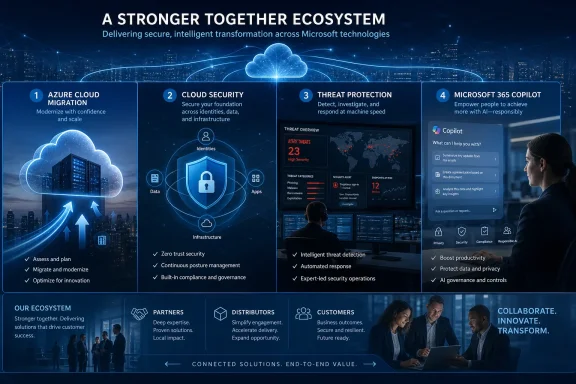 Overview: Why Four Microsoft Capabilities Matter Together
A distributor’s role in the modern Microsoft channel has changed considerably. Traditional distribution functions—supply, pricing, licensing, credit, and transaction support—remain essential. Yet those services alone do not solve the increasingly technical challenges partners encounter when selling cloud platforms, security suites, and AI services.Customers do not buy Azure, Microsoft Defender, or Microsoft 365 Copilot as isolated products. They buy outcomes, even if those outcomes are described in very different terms:
- Reducing data-center costs and operational risk
- Modernising legacy applications and infrastructure
- Protecting identities, endpoints, cloud workloads, and data
- Detecting and responding to security incidents more effectively
- Improving productivity without exposing sensitive information
- Building safe, governed AI-assisted business processes
That combination matters because many channel partners are strong in one or two disciplines but not all of them. A Microsoft 365 reseller may be highly capable with licensing, tenant administration, and collaboration, yet need specialist support for a Sentinel deployment, cloud-security architecture, or a complicated Azure migration. An infrastructure-focused partner may understand servers and networks but require assistance with Copilot readiness, Purview controls, or organisational change management.
By expanding its Microsoft practice across all four areas, Synnex is positioning itself to help partners bridge those gaps rather than forcing them to build every technical competency internally.
Background: Microsoft’s Shift Toward Proven Capability
Microsoft’s partner ecosystem increasingly rewards organisations that can demonstrate real-world delivery capability rather than simply attest to product knowledge. The company’s Solutions Partner designations provide broad validation within major solution areas, while specialisations are intended to signal deeper expertise in particular technologies and workloads.That distinction is important. A broad Microsoft designation can indicate that a business has met requirements across performance, skilling, and customer success in a solution area. A specialisation typically goes further, adding focused prerequisites, technical validation, customer evidence, performance thresholds, or independent audits.
For end customers, the intended message is straightforward: a specialised provider should have more than a sales pitch or a handful of certified technicians. It should be able to demonstrate that it has delivered the relevant technology in genuine customer environments.
A Note on Azure Migrate and Modernise Terminology
There is an important terminology nuance in the announcement. Azure Migrate and Modernise is commonly used as the name of Microsoft’s migration and modernisation offering, program, and customer engagement motion. It is not always identical to the formal naming of a Microsoft partner specialisation.Microsoft’s formal partner specialisation framework has used titles such as Infra and Database Migration to Microsoft Azure and, in some cases, other workload-specific migration and modernisation credentials. The practical relevance remains similar: a partner must demonstrate capability in assessing, migrating, modernising, operating, and optimising customer workloads on Azure.
For channel partners, the key takeaway is not semantic. It is whether Synnex can provide credible engineering expertise and delivery support for migration projects that involve servers, databases, applications, networking, identity, security, backup, disaster recovery, and post-migration optimisation.
Validation Is Becoming More Rigorous
Microsoft has also been evolving how specialisations are assessed. Security and AI-related competencies are becoming more closely tied to measurable customer activity, up-to-date skills, and structured validation processes.That direction is logical. A partner claiming expertise in cloud security or Copilot deployment needs to show that it can work with modern technologies and current risks—not rely indefinitely on legacy certifications or stale customer references.
For Synnex partners, this means distributor-led enablement may become more valuable. Keeping pace with new Microsoft requirements, renamed credentials, retired exams, revised audit models, and changing platform capabilities can consume substantial time for smaller managed service providers.
Azure Migrate and Modernise: More Than a Lift-and-Shift Exercise
Azure migration remains one of the most durable opportunities in the Microsoft channel, but the phrase “migration” can oversimplify the work involved. Moving a virtual machine from an on-premises host to Azure is often the least strategically demanding part of a broader transformation project.A successful Azure Migrate and Modernise engagement starts with discovery. Partners need to understand the existing environment, including servers, databases, dependencies, network architecture, storage requirements, performance profiles, security controls, compliance obligations, and business-critical applications.
From there, the customer and partner must decide what should happen to each workload. The familiar migration approaches remain useful:
- Rehost workloads with minimal changes
- Replatform applications or databases for managed cloud services
- Refactor applications to take advantage of cloud-native architecture
- Retire obsolete or redundant systems
- Retain workloads that should remain on-premises or move later
- Replace legacy applications with SaaS alternatives where appropriate
Why Distributor-Led Migration Support Can Help
Many Microsoft partners can identify an Azure opportunity but struggle to convert it into a complete engagement. The obstacles are predictable:- Limited solution-architecture capacity
- Uncertainty around workload sizing and Azure cost modelling
- Complex database migration requirements
- Insufficient experience with application dependencies
- Concerns about business continuity and rollback planning
- A lack of technical resources for post-migration optimisation
A distributor that can assist with migration planning also gives partners a chance to retain ownership of the customer relationship. Rather than handing the entire project to a major systems integrator, a smaller partner may be able to lead the commercial conversation while drawing on Synnex for specialist delivery functions.
The Real Value Is Modernisation
The strongest Azure projects should not end when workloads are running in Microsoft’s cloud. Customers need ongoing value in the form of resilience, security, operational automation, performance management, backup, cost governance, and application improvement.This is where Azure modernisation becomes more valuable than a simple lift-and-shift approach. Modernisation may involve managed databases, container platforms, platform-as-a-service components, automation, policy-driven governance, or improved observability. It may also require a hard conversation with the customer about whether a legacy application should be retained at all.
Partners should resist treating Azure consumption as the only measure of success. Higher cloud consumption does not automatically mean a better customer outcome. If a customer migrates poorly sized workloads without governance, the result can be higher costs, avoidable complexity, and disappointment with the cloud transition.
Synnex’s opportunity is to help partners make migration projects more disciplined. That means leading with assessment, landing-zone design, security baselines, cost controls, and operational ownership—not merely promoting a fast move to Azure.
Cloud Security: Building Protection Into the Architecture
The Cloud Security specialisation is arguably the most strategically important part of Synnex’s four-part expansion. Security has become inseparable from every Microsoft project, whether the customer is migrating infrastructure, rolling out Microsoft 365, enabling remote work, or adopting AI tools.Cloud security is also broad. It can encompass identity and access controls, network segmentation, workload protection, security posture management, encryption, vulnerability management, logging, policy enforcement, and compliance monitoring. In a Microsoft environment, it often includes services across Azure, Microsoft Defender, Microsoft Entra, Microsoft Purview, and related platforms.
Security Cannot Be Added at the End
One of the persistent risks in cloud projects is that security becomes a separate phase that starts after the workload has been migrated. This approach is often expensive and inefficient. It can leave customers with overly permissive identities, inconsistent network controls, missing logs, unmanaged secrets, poorly configured storage, and unclear accountability.A stronger model embeds security from the beginning:
- Define identity and access requirements before migration.
- Establish Azure governance, policies, and resource standards.
- Design secure network connectivity and segmentation.
- Enable logging, monitoring, and alerting early.
- Protect workloads using relevant Defender capabilities.
- Review data classification, encryption, retention, and compliance requirements.
- Test incident-response processes before a real incident occurs.
The Business Case Is Strong—but Needs Discipline
Cloud security has a compelling commercial case. Customers are under pressure from ransomware, identity attacks, regulatory scrutiny, insurance requirements, supplier questionnaires, and board-level concern over cyber risk. Microsoft’s integrated security portfolio offers partners an opportunity to consolidate tools and improve visibility across a customer’s environment.However, consolidation should not become an excuse for complacency. Using Microsoft security products does not automatically create a secure environment. Technology requires correct configuration, skilled operators, clear ownership, and a response plan that works outside a slide deck.
The strongest Synnex-led partner engagements will be those that combine platform deployment with practical operating guidance. That includes security baselines, managed detection and response processes, escalation procedures, customer reporting, vulnerability remediation, and recurring reviews of identity and access controls.
Threat Protection: Moving From Tools to Operational Readiness
While cloud security provides the architectural foundation, Threat Protection focuses on the operational side of defending the environment. This includes detecting suspicious activity, investigating alerts, responding to incidents, and continuously improving the organisation’s defensive posture.Microsoft’s threat-protection ecosystem can cover endpoints, identities, email, collaboration tools, cloud applications, and security operations. For partners, this creates a substantial managed-services opportunity, but it also raises the standard for delivery.
A security product that produces alerts without a trained team to investigate them can create a false sense of safety. An overwhelmed customer may ignore warnings, misclassify incidents, or lack the authority to act quickly when an account, device, or application has been compromised.
What Effective Threat Protection Requires
A credible threat-protection service requires more than deploying Microsoft Defender or connecting logs to a security information and event management platform. It should involve:- Clear alert triage and prioritisation processes
- Defined escalation paths and service-level expectations
- Incident-response playbooks for common attack types
- Identity compromise procedures
- Endpoint isolation and remediation controls
- Regular tuning to reduce noisy or irrelevant alerts
- Threat-hunting practices where appropriate
- Reporting that explains risk and action, not just alert counts
A Stronger Path to Managed Security Services
The channel opportunity extends beyond one-off deployment projects. Threat protection can lead to recurring services around Microsoft Defender, Sentinel, identity protection, incident response, vulnerability management, and compliance reporting.This model can create more durable customer relationships, but it carries real responsibility. Partners should be precise about what they are promising. If a service is business-hours monitoring rather than round-the-clock security operations, it must be described honestly. If incident remediation is excluded or billed separately, that should be unambiguous in the service agreement.
Synnex’s specialisation can help make these services more accessible, but partner businesses still need to own their customer commitments. Technical accreditation does not eliminate the need for carefully designed service catalogs, appropriate insurance, experienced personnel, and clear contractual boundaries.
Microsoft 365 Copilot: The High-Growth Opportunity With the Highest Expectations
The addition of Microsoft 365 Copilot capability is likely to attract the greatest attention. Copilot is one of Microsoft’s most visible AI offerings, and it has created a new category of opportunity for cloud solution providers, modern-work specialists, managed service providers, and business-application partners.Yet Copilot is also one of the easiest technologies to oversell.
Customers may expect immediate productivity gains, near-perfect answers, automated business processes, or an AI assistant that understands every document and decision in the organisation. Those expectations can be unrealistic if the underlying Microsoft 365 environment is poorly governed, permissions are overly broad, files are disorganised, or business processes have not been defined clearly enough to support automation.
Copilot Readiness Is a Security and Data Project
A successful Microsoft 365 Copilot engagement should begin with readiness, not licenses. Before broad deployment, partners need to examine:- Identity and authentication controls
- Multifactor authentication and conditional access
- Privileged-access management
- Microsoft 365 licensing eligibility
- SharePoint and OneDrive permissions
- Oversharing risks in Teams sites and document libraries
- Data classification and sensitivity labels
- Retention, eDiscovery, and compliance requirements
- Endpoint management and device security
- Acceptable-use policies and AI governance
The answer is not to avoid AI. It is to improve the quality of the Microsoft 365 environment before and during adoption.
Adoption Must Be Linked to Business Use Cases
The most effective Copilot deployments focus on specific, measurable use cases rather than generic claims about productivity. Useful examples may include:- Drafting and summarising customer communications
- Extracting action items from meetings
- Preparing first versions of proposals and reports
- Summarising lengthy project documentation
- Assisting with policy, procedure, and knowledge-base retrieval
- Accelerating content creation within approved governance boundaries
- Building controlled agents for defined internal workflows
Copilot Does Not Eliminate Human Accountability
Generative AI can produce inaccurate, incomplete, biased, or contextually unsuitable output. It can also generate language that appears confident even when it is wrong. Employees therefore need training that covers validation, appropriate disclosure, data handling, intellectual property considerations, and the limits of AI-generated material.This is particularly important in regulated industries, customer-facing roles, legal or financial workflows, and environments where an inaccurate statement can create contractual, operational, or reputational consequences.
Synnex’s enhanced Copilot support could help partners structure adoption programs around governance and change management rather than license activation alone. That is the correct emphasis. The partners most likely to succeed will be those that treat Copilot as an organisational capability, not simply a feature attached to Microsoft 365.
What This Means for Microsoft Partners
For Synnex’s partner base, the main benefit is access to a more complete support model across cloud, security, and AI. That can affect both technical delivery and commercial strategy.Potential Partner Benefits
The most meaningful advantages are likely to include:- Specialist technical expertise for complicated Azure, security, and Copilot engagements
- Enablement programs that help sales, presales, and engineering teams build capability
- Professional services support where partners need extra delivery capacity
- Improved solution design for projects involving multiple Microsoft technologies
- Faster time to market for partners that do not want to build every capability from scratch
- Greater confidence when pursuing larger or more complex customer opportunities
- Potential recurring-revenue models around managed cloud, security, and AI services
The Best Opportunity Is the Combined Customer Journey
The greatest value may come from packaging these capabilities into a coherent customer journey:- Assess the customer’s estate, security posture, and business objectives.
- Define the Azure migration and modernisation roadmap.
- Establish identity, governance, and cloud-security foundations.
- Deploy threat-protection controls and operational processes.
- Prepare Microsoft 365 data, permissions, and compliance settings.
- Launch Copilot through controlled pilots and priority use cases.
- Measure outcomes and improve the environment continuously.
Risks and Limitations Partners Should Not Ignore
The announcement is positive, but there are practical limitations that partners and customers should keep in view.Specialisations Are Not a Guarantee of Project Success
A Microsoft specialisation is a meaningful signal of competence, but it cannot guarantee the quality of every individual implementation. The actual customer experience will depend on the specific engineers involved, the project scope, the condition of the existing environment, customer decision-making, and the partner’s operational discipline.Customers should still assess proposed solutions carefully. They should ask for a defined scope of work, a migration plan, security responsibilities, acceptance criteria, escalation procedures, and post-deployment support arrangements.
Capability May Depend on Engagement Model
Synnex can strengthen a partner’s capacity through enablement and professional services, but the delivery model matters. Partners should be transparent about who is architecting, implementing, managing, and supporting each part of the solution.In some cases, distributor-led expertise may be exactly what a customer needs. In others, customers may expect their primary partner to retain full technical ownership. Clear communication avoids confusion and protects trust.
AI Economics Remain Under Scrutiny
Microsoft 365 Copilot can create value, but its economics will be judged closely. Customers will assess whether the time savings and improved workflows justify licensing, enablement, governance, and change-management costs.Partners should avoid promising a universal return on investment. Instead, they should identify high-value roles and use cases, establish baselines, run pilots, and measure tangible results. A focused rollout with evidence of value is often more sustainable than a broad deployment driven by executive enthusiasm alone.
Security Services Require Mature Operations
Security is not a one-time configuration project. Threat protection depends on monitoring, response, remediation, testing, reporting, and continuous improvement. Partners entering managed security services should ensure they have the right staffing model, skills, tools, service hours, and incident processes.If a partner relies on Synnex support for elements of delivery, that can be a sensible operational decision. But it should be underpinned by a well-defined support model that explains precisely what happens when a serious alert or incident occurs.
A More Complete Microsoft Practice
Synnex Group’s four Microsoft specialisations strengthen its ability to support partners where demand is moving fastest: Azure migration and modernisation, cloud security, threat protection, and Microsoft 365 Copilot. The combination creates a more credible platform for partners looking to move beyond licensing transactions and into higher-value consulting, implementation, managed services, and AI adoption work.The strategic logic is strong. Cloud migration creates a need for cloud security. Cloud security needs operational threat protection. Effective Copilot adoption requires a well-governed, secure, and properly managed Microsoft 365 environment. These are not separate markets so much as connected stages in the same customer transformation journey.
For Synnex partners, the practical opportunity is to use the distributor’s deeper expertise to pursue projects they may previously have considered too complex or too resource-intensive. The challenge will be ensuring that every engagement remains grounded in customer readiness, transparent responsibilities, disciplined governance, and measurable business outcomes.
That is the difference between simply selling the latest Microsoft technologies and building a durable Microsoft practice around them.