

Systemd 261 was released on June 19, 2026, adding a cloud Instance Metadata Service subsystem, expanded TPM and measured-boot plumbing, boot-loader safeguards, networkd and resolved updates, and new compatibility warnings for distributions, cloud images, containers, and virtual-machine tooling. The release is less about one headline feature than about systemd continuing to move up the stack. It is becoming not merely the thing that starts Linux, but the thing that standardizes how Linux discovers where it is running, proves how it booted, and survives increasingly dynamic update models. That ambition is useful, controversial, and very much on display here.
The most revealing part of systemd 261 is not that it contains many changes. That has been true of almost every major systemd release for years. The revealing part is where those changes cluster: cloud identity, measured boot, metadata access, live update handoff, resolver policy, virtual-machine lifecycle, and declarative rollout control.
Those are not traditional init-system concerns in the old Unix sense. They are the concerns of machines that are cloned, attested, sealed, migrated, rebooted through kexec, and managed as members of a fleet. Systemd 261 assumes the Linux host is no longer a snowflake sitting under a desk. It assumes the host is an artifact, and that the operating system must understand its own provenance and environment early enough to make policy decisions.
That is the argument behind the new IMDS work. Cloud metadata services have long been one of the awkward seams in Linux platform engineering. Every cloud exposes some version of instance identity, network configuration, user data, region, availability zone, and credential material, but each provider does so through its own conventions. Systemd 261’s answer is to put a local broker in the middle.
The result is a release that will likely delight image builders and make some security teams lean forward in their chairs. It also gives systemd skeptics fresh material, because the project is again absorbing territory once handled by specialized agents, boot scripts, cloud-init modules, or distribution glue. The question is not whether systemd is expanding. It plainly is. The question is whether this expansion reduces operational complexity or merely centralizes it.
That matters because IMDS has always been both indispensable and dangerous. It is indispensable because cloud instances need a way to learn who they are, where they are, what credentials they may use, and what bootstrapping data they were given. It is dangerous because metadata endpoints have historically been a prize target for server-side request forgery, container escapes, over-permissive local workloads, and confused-deputy failures.
Systemd 261 tries to make that boundary more explicit. It adds a hardware database file,
That is the right instinct. A local broker can enforce access rules, normalize provider differences, and make metadata retrieval visible to the operating system rather than leaving every component to rediscover the same magic IP address. It also gives distributions a more coherent target for generic cloud images. Instead of shipping a growing pile of provider-specific assumptions, an image can ask the local systemd layer what it knows about the cloud beneath it.
But this is also where the release notes’ compatibility warning becomes more than boilerplate. Traditional IMDS clients such as
Systemd is not eliminating the old world in this release. It is building a parallel path and nudging the ecosystem toward it. The practical problem is that cloud images are often boring on purpose. Their job is to boot reliably everywhere, including environments where the hypervisor metadata, network timing, and guest agent stack are already a little fragile. A more secure metadata model is welcome, but it must fail predictably, because metadata failures tend to look like broken networking, broken identity, or broken first boot.
A systemd-mediated interface could make that authority less ad hoc. Local programs can consume metadata through Varlink, and systemd tooling can import IMDS-provided fields into credentials for later services. That aligns with systemd’s broader credential model, where secrets and configuration can be passed to units in controlled ways rather than sprayed into files and environment variables.
The security case is obvious. If metadata is sensitive, the host should know when it is fetched, by whom, and through which policy path. A direct HTTP metadata endpoint is simple, but simplicity is not always safety. Standardizing metadata access through a local broker makes it easier to restrict clients without pretending the endpoint does not exist.
The operational case is just as important. A unified IMDS interface could reduce provider-specific logic in services that only need basic facts such as instance ID, region, or cloud name. That is particularly attractive for vendors shipping appliances, generic images, or fleet agents across several public clouds.
The risk is that systemd becomes another compatibility surface cloud vendors and distributions must test. If the broker misunderstands platform detection, if SMBIOS data is unusual, or if a private cloud imitates a public one poorly, generic behavior can become generically wrong. Cloud-init earned its place by being ugly in precisely the ways real cloud bootstrapping is ugly. Systemd will have to prove that its cleaner abstraction survives contact with that mess.
That small difference matters. Unified Kernel Images have given systemd a clean model for measuring a signed boot artifact, but not every deployment is built around the same UKI assumptions. A broader
Systemd-boot and systemd-stub also now measure SMBIOS Type 1, Type 2, and Type 11 data into PCR 1 when firmware does not do it. That is a pragmatic fix for a familiar problem: measured boot depends on a chain of measurements, and firmware implementations are not always complete or consistent. If the firmware omits useful platform data, the operating-system boot path can compensate.
For administrators, the value is not that PCR numbers suddenly become fun to think about. The value is that services can make decisions based on whether the platform reached a known boot state. Disk unlocking, credential release, remote attestation, and workload gating all become more plausible when the boot path produces consistent measurements.
This is also where systemd’s expanding role is least surprising. Boot measurement is inherently cross-cutting. It touches firmware, boot loader, kernel command line, initrd, credentials, disk encryption, and service startup. A project that already sits across those boundaries is well positioned to make the pieces talk to one another, even if that makes systemd feel less like a service manager and more like an operating-system framework.
The serial-console change is the kind of feature that earns quiet gratitude from people who manage headless servers, appliances, and remote virtual machines. Unified Kernel Images simplify one part of the boot chain by bundling kernel, initrd, and metadata into a single signed artifact, but they can complicate late adjustments that administrators used to make in boot-loader entries. Automatically carrying the active EFI serial console into the kernel command line removes one more manual trap.
The fallback boot-secret mechanism is more philosophically interesting. TPMs are the preferred anchor for many modern measured-boot and credential workflows, but TPM availability is not universal. Virtual machines, development environments, recovery paths, and odd hardware can all lack a usable TPM. Providing fallback key material lets some workflows remain functional instead of simply degrading into failure.
That does not make the fallback equivalent to a hardware TPM. It should not be treated as one. But it acknowledges a reality that security engineering often trips over: an elegant design that fails closed too often will be bypassed, masked, or disabled. A less perfect fallback can preserve the shape of the model while keeping systems bootable.
Systemd-boot’s new habit of storing the existing binary as a fallback when installing a new version and creating a fallback UEFI boot entry follows the same operational logic. Bootloader updates are high-stakes because failure arrives before the administrator has a full operating system. Keeping the old binary reachable is not glamorous, but it is exactly the sort of defensive engineering that separates a clever boot stack from a supportable one.
This is a niche-sounding feature with broad implications. File descriptors are often where real service continuity lives. A daemon can keep a listening socket, a connection, or other stateful handle while its own process is restarted; systemd’s file descriptor store already made some of that possible across service restarts. Extending preservation across kexec pushes the idea into the reboot boundary itself.
Kexec has long promised faster restarts by jumping into a new kernel without a full firmware reboot. In practice, the surrounding user-space choreography has often limited how seamless that feels. If systemd can coordinate state preservation through a kexec transition, certain update models become less disruptive.
User session managers also gain support for persisting user units’ file descriptor stores. Combined with kexec handover, that opens the door to user services retaining selected state across session manager restarts and some kexec reboot paths. That is not the same as making desktop sessions immortal, but it narrows the gap between “restart the manager” and “throw away the world.”
The catch is that these features depend on kernel support, explicit configuration, and services designed to take advantage of them. They are not magic continuity dust. For now, administrators should read them as infrastructure for future reliability work rather than as an immediate promise that reboots no longer matter.
This is a small feature with a very modern assumption baked in. Systemd is no longer only modeling dependencies on a single host. It is acknowledging that many hosts are members of a managed population, and that safe change often means exposing one slice of that population before the rest.
The appeal is obvious for organizations that ship units through images or configuration management. A vendor can include a new service everywhere but activate it on only 5 percent of machines, then increase the fraction as confidence grows. Because the decision is based on the machine ID and a tag, it can remain stable rather than randomly changing on every boot.
Still, staged rollout logic inside unit conditions should be used carefully. It can make behavior harder to reason about from one machine to the next, especially if administrators forget that a unit’s absence of activity is policy rather than failure. Observability becomes part of the feature: if rollout selection is invisible, help desks and on-call engineers will waste time chasing ghosts.
Systemd also adds a
That matters for appliance vendors, cluster agents, installers, and cloud-init-like tooling. Network state is no longer just a pile of files plus netlink calls. It is becoming something a local management agent can query and mutate through a defined service boundary. The upside is cleaner orchestration. The downside is yet another place where distributions must decide how far into the systemd networking stack they want to step.
The static-record support is especially telling.
Of course, resolved remains one of systemd’s more debated components. Some administrators prefer explicit resolver stacks they can reason about with traditional tools. Others welcome a local resolver that understands modern split DNS, DNS-over-TLS policies, LLMNR, mDNS, and per-link configuration. Systemd 261 does not settle that debate. It simply gives the resolved camp more reasons to keep using it.
For
The file descriptor preservation work mirrors the host-side kexec handover theme. Containers are not merely processes to kill and respawn. They can host system managers with their own service state. Preserving selected descriptors across restarts gives long-running payloads more room to survive lifecycle operations without pretending container restarts are cost-free.
Systemd wants a native vocabulary for machines, whether they are containers, VMs, portable services, or booted images. That vocabulary includes storage, console, firmware state, logs, metadata, and lifecycle control. The project is not trying to replace every hypervisor or container orchestrator. It is trying to make local machine management coherent enough that higher-level tools do not have to reinvent the same host-side plumbing.
The removal warnings are just as important. Systemd 262 is expected to remove support for
This is the maintenance tax of a project that moves quickly. Experimental interfaces eventually become either supported contracts or dead ends. For administrators, distribution maintainers, and tool authors, the lesson is straightforward: if you built against the experimental D-Bus API, you need to move.
The broader signal is that Varlink is becoming increasingly important in systemd’s management plane. We see it in IMDS, networkd, sysupdate, service management, and machine interfaces. D-Bus is not disappearing from systemd, but Varlink is clearly where the project is putting many newer local-service APIs.
That choice will not matter to every user. Most people will encounter it indirectly through tools and distributions. But for developers integrating with systemd, the message is hard to miss: the command-line surface is not the only supported interface, and in some new areas it may not even be the primary one.
That does not mean administrators can ignore it. The riskiest changes are not necessarily the ones with the most exciting feature names. The riskiest changes are the ones that alter assumptions made by existing automation.
The IMDS lockdown option is the clearest example. It is recommended for secure installations, but it can conflict with traditional metadata clients. A hardened cloud image that blocks direct IMDS access before its provisioning stack understands
Measured-boot enhancements also require careful interpretation. New conditions and measurements are useful only if the surrounding policy is clear. A service gated on
Networking changes are lower risk but still operationally relevant. If
The same caution applies to sysupdate and boot-loader interface removals. Systemd gives advance warning, but the ecosystem is large. Old scripts have a way of surviving inside images, installers, appliance build systems, and one-off recovery tooling. The time to find those dependencies is before systemd 262 turns warnings into missing interfaces.
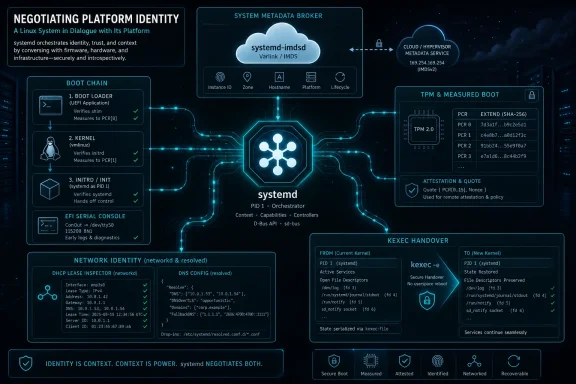 Systemd Keeps Turning Local Boot Into Platform Negotiation
The most revealing part of systemd 261 is not that it contains many changes. That has been true of almost every major systemd release for years. The revealing part is where those changes cluster: cloud identity, measured boot, metadata access, live update handoff, resolver policy, virtual-machine lifecycle, and declarative rollout control.Those are not traditional init-system concerns in the old Unix sense. They are the concerns of machines that are cloned, attested, sealed, migrated, rebooted through kexec, and managed as members of a fleet. Systemd 261 assumes the Linux host is no longer a snowflake sitting under a desk. It assumes the host is an artifact, and that the operating system must understand its own provenance and environment early enough to make policy decisions.
That is the argument behind the new IMDS work. Cloud metadata services have long been one of the awkward seams in Linux platform engineering. Every cloud exposes some version of instance identity, network configuration, user data, region, availability zone, and credential material, but each provider does so through its own conventions. Systemd 261’s answer is to put a local broker in the middle.
The result is a release that will likely delight image builders and make some security teams lean forward in their chairs. It also gives systemd skeptics fresh material, because the project is again absorbing territory once handled by specialized agents, boot scripts, cloud-init modules, or distribution glue. The question is not whether systemd is expanding. It plainly is. The question is whether this expansion reduces operational complexity or merely centralizes it.
The IMDS Broker Is the Release’s Sharpest Knife
The new cloud Instance Metadata Service subsystem is the most strategically important addition in systemd 261. The centerpiece issystemd-imdsd, a local Varlink-based service that lets local programs consume cloud metadata through a unified interface rather than talking directly to AWS, Azure, Google Cloud, Oracle, Hetzner, Scaleway, Tencent, Alibaba, Vultr, or another provider’s endpoint.That matters because IMDS has always been both indispensable and dangerous. It is indispensable because cloud instances need a way to learn who they are, where they are, what credentials they may use, and what bootstrapping data they were given. It is dangerous because metadata endpoints have historically been a prize target for server-side request forgery, container escapes, over-permissive local workloads, and confused-deputy failures.
Systemd 261 tries to make that boundary more explicit. It adds a hardware database file,
hwdb.d/40-imds.hwdb, to identify public cloud platforms using SMBIOS information. Once a platform is recognized, systemd can expose a provider-neutral metadata path locally and, where configured, lock down direct network access to the provider metadata endpoint.That is the right instinct. A local broker can enforce access rules, normalize provider differences, and make metadata retrieval visible to the operating system rather than leaving every component to rediscover the same magic IP address. It also gives distributions a more coherent target for generic cloud images. Instead of shipping a growing pile of provider-specific assumptions, an image can ask the local systemd layer what it knows about the cloud beneath it.
But this is also where the release notes’ compatibility warning becomes more than boilerplate. Traditional IMDS clients such as
cloud-init expect to reach the metadata service directly. Locking that path down may be desirable for hardened installations, but it can break existing provisioning models if distributions or administrators flip the switch without a migration plan.Systemd is not eliminating the old world in this release. It is building a parallel path and nudging the ecosystem toward it. The practical problem is that cloud images are often boring on purpose. Their job is to boot reliably everywhere, including environments where the hypervisor metadata, network timing, and guest agent stack are already a little fragile. A more secure metadata model is welcome, but it must fail predictably, because metadata failures tend to look like broken networking, broken identity, or broken first boot.
Cloud Images Get a New Control Plane, Not Just a New Daemon
The interesting thing aboutsystemd-imdsd is that it reframes metadata as a local operating-system facility. That sounds subtle until you consider how much boot-time logic currently depends on the first component that successfully talks to the cloud. In many deployments, that component becomes the de facto authority for hostname setup, SSH keys, network identity, credentials, and first-boot scripts.A systemd-mediated interface could make that authority less ad hoc. Local programs can consume metadata through Varlink, and systemd tooling can import IMDS-provided fields into credentials for later services. That aligns with systemd’s broader credential model, where secrets and configuration can be passed to units in controlled ways rather than sprayed into files and environment variables.
The security case is obvious. If metadata is sensitive, the host should know when it is fetched, by whom, and through which policy path. A direct HTTP metadata endpoint is simple, but simplicity is not always safety. Standardizing metadata access through a local broker makes it easier to restrict clients without pretending the endpoint does not exist.
The operational case is just as important. A unified IMDS interface could reduce provider-specific logic in services that only need basic facts such as instance ID, region, or cloud name. That is particularly attractive for vendors shipping appliances, generic images, or fleet agents across several public clouds.
The risk is that systemd becomes another compatibility surface cloud vendors and distributions must test. If the broker misunderstands platform detection, if SMBIOS data is unusual, or if a private cloud imitates a public one poorly, generic behavior can become generically wrong. Cloud-init earned its place by being ugly in precisely the ways real cloud bootstrapping is ugly. Systemd will have to prove that its cleaner abstraction survives contact with that mess.
Measured Boot Moves From Niche Feature to Operating-System Vocabulary
Systemd 261’s TPM updates continue a multi-release pattern: measured boot is becoming ordinary Linux plumbing rather than an exotic hardening option. The newConditionSecurity=measured-os unit condition lets services check whether the system booted with measured-boot semantics. It is similar in spirit to ConditionSecurity=measured-uki, but more generic and applicable where TPM functionality is provided at the OS level.That small difference matters. Unified Kernel Images have given systemd a clean model for measuring a signed boot artifact, but not every deployment is built around the same UKI assumptions. A broader
measured-os condition gives unit authors a way to express policy around the presence of measured boot without tying everything to one packaging and boot format.Systemd-boot and systemd-stub also now measure SMBIOS Type 1, Type 2, and Type 11 data into PCR 1 when firmware does not do it. That is a pragmatic fix for a familiar problem: measured boot depends on a chain of measurements, and firmware implementations are not always complete or consistent. If the firmware omits useful platform data, the operating-system boot path can compensate.
For administrators, the value is not that PCR numbers suddenly become fun to think about. The value is that services can make decisions based on whether the platform reached a known boot state. Disk unlocking, credential release, remote attestation, and workload gating all become more plausible when the boot path produces consistent measurements.
This is also where systemd’s expanding role is least surprising. Boot measurement is inherently cross-cutting. It touches firmware, boot loader, kernel command line, initrd, credentials, disk encryption, and service startup. A project that already sits across those boundaries is well positioned to make the pieces talk to one another, even if that makes systemd feel less like a service manager and more like an operating-system framework.
The Boot Chain Is Getting More Forgiving Without Getting Simpler
Systemd 261 adds several boot-related features that look modest individually but point toward a more resilient boot story.systemd-stub now maintains a “boot secret” derived from a persistent EFI variable, intended as fallback key material when a TPM is unavailable. It also detects the active EFI serial console and passes the corresponding console= parameter to the kernel command line.The serial-console change is the kind of feature that earns quiet gratitude from people who manage headless servers, appliances, and remote virtual machines. Unified Kernel Images simplify one part of the boot chain by bundling kernel, initrd, and metadata into a single signed artifact, but they can complicate late adjustments that administrators used to make in boot-loader entries. Automatically carrying the active EFI serial console into the kernel command line removes one more manual trap.
The fallback boot-secret mechanism is more philosophically interesting. TPMs are the preferred anchor for many modern measured-boot and credential workflows, but TPM availability is not universal. Virtual machines, development environments, recovery paths, and odd hardware can all lack a usable TPM. Providing fallback key material lets some workflows remain functional instead of simply degrading into failure.
That does not make the fallback equivalent to a hardware TPM. It should not be treated as one. But it acknowledges a reality that security engineering often trips over: an elegant design that fails closed too often will be bypassed, masked, or disabled. A less perfect fallback can preserve the shape of the model while keeping systems bootable.
Systemd-boot’s new habit of storing the existing binary as a fallback when installing a new version and creating a fallback UEFI boot entry follows the same operational logic. Bootloader updates are high-stakes because failure arrives before the administrator has a full operating system. Keeping the old binary reachable is not glamorous, but it is exactly the sort of defensive engineering that separates a clever boot stack from a supportable one.
Kexec Handover Is a Bet on Reboots That Behave Less Like Reboots
The service manager in systemd 261 adds support for the kernel’s Live Update Orchestration and Kexec Handover mechanisms when available. In plain English, that means system units can preserve file descriptor stores across kexec if the kernel supports it andFileDescriptorStorePreserve=yes is configured.This is a niche-sounding feature with broad implications. File descriptors are often where real service continuity lives. A daemon can keep a listening socket, a connection, or other stateful handle while its own process is restarted; systemd’s file descriptor store already made some of that possible across service restarts. Extending preservation across kexec pushes the idea into the reboot boundary itself.
Kexec has long promised faster restarts by jumping into a new kernel without a full firmware reboot. In practice, the surrounding user-space choreography has often limited how seamless that feels. If systemd can coordinate state preservation through a kexec transition, certain update models become less disruptive.
User session managers also gain support for persisting user units’ file descriptor stores. Combined with kexec handover, that opens the door to user services retaining selected state across session manager restarts and some kexec reboot paths. That is not the same as making desktop sessions immortal, but it narrows the gap between “restart the manager” and “throw away the world.”
The catch is that these features depend on kernel support, explicit configuration, and services designed to take advantage of them. They are not magic continuity dust. For now, administrators should read them as infrastructure for future reliability work rather than as an immediate promise that reboots no longer matter.
Fleet Rollouts Get a Native Primitive
Systemd 261 introducesConditionFraction=, a unit condition aimed squarely at staged rollouts across machine fleets. It uses the system’s machine ID and a tag string to decide whether a unit should run on a specified percentage of systems. That gives administrators a deterministic way to enable behavior gradually without building a separate rollout mechanism into every unit.This is a small feature with a very modern assumption baked in. Systemd is no longer only modeling dependencies on a single host. It is acknowledging that many hosts are members of a managed population, and that safe change often means exposing one slice of that population before the rest.
The appeal is obvious for organizations that ship units through images or configuration management. A vendor can include a new service everywhere but activate it on only 5 percent of machines, then increase the fraction as confidence grows. Because the decision is based on the machine ID and a tag, it can remain stable rather than randomly changing on every boot.
Still, staged rollout logic inside unit conditions should be used carefully. It can make behavior harder to reason about from one machine to the next, especially if administrators forget that a unit’s absence of activity is policy rather than failure. Observability becomes part of the feature: if rollout selection is invisible, help desks and on-call engineers will waste time chasing ghosts.
Systemd also adds a
ReloadCount property over D-Bus and Varlink, incrementing after successful daemon-reload and resetting after daemon-reexec. That is a narrower management feature, but it fits the same trend. The service manager is exposing more state for automation to inspect, and automation increasingly expects systemd to be an API, not merely a command-line tool.Networkd and Resolved Keep Eating the Glue Code
The networking changes in systemd 261 are practical rather than theatrical.networkctl dhcp-lease INTERFACE now displays acquired DHCP lease information, including options received from the server. For anyone who has debugged DHCP behavior by spelunking logs, lease files, packet captures, and guessed server options, that is a welcome bit of visibility.systemd-networkd also exposes Varlink methods for describing, reconfiguring, renewing, and force-renewing links, with networkctl preferring those methods when possible. This continues systemd’s march toward structured local APIs. The command-line tool remains, but the underlying model is increasingly programmatic.That matters for appliance vendors, cluster agents, installers, and cloud-init-like tooling. Network state is no longer just a pile of files plus netlink calls. It is becoming something a local management agent can query and mutate through a defined service boundary. The upside is cleaner orchestration. The downside is yet another place where distributions must decide how far into the systemd networking stack they want to step.
systemd-resolved also gets more capable. It can now load static DNS resource records from JSON drop-in files under systemd/resolve/static.d/, extending the role traditionally served by /etc/hosts. It adds cache-size settings for DNS, MulticastDNS, and LLMNR, and it now re-reads /etc/hosts entries on reload.The static-record support is especially telling.
/etc/hosts is simple and durable, but it is also crude. JSON drop-ins give administrators and image builders a more structured way to define local DNS data while fitting systemd’s broader drop-in configuration model. For complex local environments, that is cleaner than continuing to overload a flat hosts file.Of course, resolved remains one of systemd’s more debated components. Some administrators prefer explicit resolver stacks they can reason about with traditional tools. Others welcome a local resolver that understands modern split DNS, DNS-over-TLS policies, LLMNR, mDNS, and per-link configuration. Systemd 261 does not settle that debate. It simply gives the resolved camp more reasons to keep using it.
Containers and VMs Become First-Class State Machines
The container and virtual-machine changes in systemd 261 show the same pattern as the rest of the release: systemd is treating machines as stateful objects that can be started, stopped, inspected, modified, and partially preserved.systemd-nspawn gains options for forwarding journal entries from the payload to selected journal sockets. It can also preserve the payload system manager’s file descriptor store across container restarts when configured.For
nspawn, which sits somewhere between developer convenience, lightweight container runtime, and systemd-native machine tool, journal forwarding is a natural improvement. Logs are the first artifact administrators need when a containerized system fails, and systemd-managed payloads already speak journal fluently. Making forwarding more selective gives operators finer control over where those logs go.The file descriptor preservation work mirrors the host-side kexec handover theme. Containers are not merely processes to kill and respawn. They can host system managers with their own service state. Preserving selected descriptors across restarts gives long-running payloads more room to survive lifecycle operations without pretending container restarts are cost-free.
systemd-vmspawn receives a larger batch of improvements: bind-volume support, headless console operation, EFI NVRAM state handling, direct kernel boot without UEFI firmware, selectable image disk types, and runtime storage manipulation through the io.systemd.MachineInstance Varlink interface. That is a lot of machinery for a tool still less familiar than mainstream virtualization stacks, but it reveals the direction.Systemd wants a native vocabulary for machines, whether they are containers, VMs, portable services, or booted images. That vocabulary includes storage, console, firmware state, logs, metadata, and lifecycle control. The project is not trying to replace every hypervisor or container orchestrator. It is trying to make local machine management coherent enough that higher-level tools do not have to reinvent the same host-side plumbing.
Sysupdate Graduates, and the Old Interfaces Start to Fall Away
One of the quieter but important changes is thatsystemd-sysupdate is now installed in /usr/bin/ with other user-facing tools and is no longer experimental. That promotion matters because system update tooling is not a side quest for the modern systemd project. It is part of the same image-based, measured, rollback-aware operating-system model behind UKIs, credentials, boot counting, and sysupdate’s own design.The removal warnings are just as important. Systemd 262 is expected to remove support for
/run/boot-loader-entries/ and related interfaces, while UAPI.1 Boot Loader Specification support remains. The experimental systemd-sysupdated D-Bus API is also slated for removal, with clients directed to use Varlink to communicate directly with systemd-sysupdate.This is the maintenance tax of a project that moves quickly. Experimental interfaces eventually become either supported contracts or dead ends. For administrators, distribution maintainers, and tool authors, the lesson is straightforward: if you built against the experimental D-Bus API, you need to move.
The broader signal is that Varlink is becoming increasingly important in systemd’s management plane. We see it in IMDS, networkd, sysupdate, service management, and machine interfaces. D-Bus is not disappearing from systemd, but Varlink is clearly where the project is putting many newer local-service APIs.
That choice will not matter to every user. Most people will encounter it indirectly through tools and distributions. But for developers integrating with systemd, the message is hard to miss: the command-line surface is not the only supported interface, and in some new areas it may not even be the primary one.
Compatibility Is the Real Upgrade Risk
Systemd 261 is not a release that most desktop users will install by hand. It will arrive through distributions, likely first in rolling and development branches and then in later stable releases. By the time it reaches many servers and workstations, maintainers will already have made choices about defaults, build flags, packaging, and migration paths.That does not mean administrators can ignore it. The riskiest changes are not necessarily the ones with the most exciting feature names. The riskiest changes are the ones that alter assumptions made by existing automation.
The IMDS lockdown option is the clearest example. It is recommended for secure installations, but it can conflict with traditional metadata clients. A hardened cloud image that blocks direct IMDS access before its provisioning stack understands
systemd-imdsd could fail in confusing ways. The right migration path is to test the broker, the old client, and the lockdown mode together, not to treat the security recommendation as a drop-in toggle.Measured-boot enhancements also require careful interpretation. New conditions and measurements are useful only if the surrounding policy is clear. A service gated on
ConditionSecurity=measured-os may behave differently across hardware, firmware, VM platforms, and boot methods. That may be exactly what the administrator wants, but it must be documented as intentional behavior.Networking changes are lower risk but still operationally relevant. If
networkctl begins preferring Varlink paths, monitoring and automation built around specific command behavior should be tested. If resolved static records move into JSON drop-ins, configuration management should ensure those records are visible, reloadable, and not duplicated across old and new mechanisms.The same caution applies to sysupdate and boot-loader interface removals. Systemd gives advance warning, but the ecosystem is large. Old scripts have a way of surviving inside images, installers, appliance build systems, and one-off recovery tooling. The time to find those dependencies is before systemd 262 turns warnings into missing interfaces.
The Parts Administrators Should Actually Put on Their Change Calendars
Systemd 261 is broad enough that treating it as a single upgrade event misses the point. The practical response is to map its changes to the systems where they can actually bite: cloud images, measured-boot deployments, image-based update pipelines, networkd-managed hosts, and local VM/container tooling.- Administrators building generic cloud images should test
systemd-imdsdalongside existing cloud-init or provider-agent workflows before enabling metadata-network lockdown. - Security teams using TPM-backed boot policy should review
ConditionSecurity=measured-osand the new SMBIOS measurements into PCR 1 as possible building blocks, not as automatic protection. - Operators relying on kexec or fast reboot paths should track kernel support for Live Update Orchestration and Kexec Handover before expecting file descriptor preservation to work.
- Network teams using
systemd-networkdandsystemd-resolvedshould evaluate the new DHCP lease inspection, Varlink link controls, static DNS drop-ins, cache settings, and/etc/hostsreload behavior. - Tool authors using experimental sysupdate D-Bus interfaces or
/run/boot-loader-entries/should migrate before systemd 262 removes those paths. - Container and VM users experimenting with
nspawnorvmspawnshould treat the new journal forwarding, state preservation, volume, console, firmware, and storage controls as signs that systemd’s machine-management layer is becoming more capable.
References
- Primary source: Linuxiac
Published: 2026-06-19T19:30:08.782836
Systemd 261 Lands with Cloud IMDS, TPM, and Network Updates
Systemd 261 adds a new cloud IMDS subsystem, TPM updates, boot improvements, networking changes, and several compatibility notes.linuxiac.com - Related coverage: phoronix.com
systemd 261-rc1 Released With OS Installer, IMDS Subsystem & New storagectl - Phoronix
The first release candidate of systemd 261 is out today and it includes yet more features for this Linux init system and service manager.www.phoronix.com
- Related coverage: newreleases.io
systemd/systemd v261-rc4 on GitHub
New release systemd/systemd version v261-rc4 systemd v261-rc4 on GitHub. newreleases.io
- Related coverage: linux.org.hk
Hong Kong Linux User Group - 香港Linux用家協會(HKLUG) > Archive > systemd 261-rc1 Introduces Native OS Installer, Cloud Metadata Service and Unified Storage Tool
The systemd project has published the first release candidate of version 261, delivering a substantial set of new capabilities that extend the init system and swww.linux.org.hk - Official source: github.com
Releases · systemd/systemd · GitHub
The systemd System and Service Manager . Contribute to systemd/systemd development by creating an account on GitHub. github.com
- Related coverage: app.daily.dev
systemd 261-rc1 Released With OS Installer, IMDS...
systemd 261-rc1 introduces several notable features: systemd-sysinstall, a textual OS installer wrapping systemd's partitioning and credential management;... app.daily.dev
- Related coverage: vivaolinux.com.br
Systemd 261-rc1 lançado com instalador de SO, subsistema IMDS e novo storagectl [Notícia]
A primeira versão candidata do Systemd 261 foi lançada hoje (22/05/2026) e inclui ainda mais recursos para esse gandulo dentro do Linux.www.vivaolinux.com.br - Related coverage: linuxmint.hu
- Related coverage: packages.fedoraproject.org
systemd-261~rc4-1.fc45 - Fedora Packages
View systemd-261~rc4-1.fc45 in Fedora Rawhide. systemd: System and Service Managerpackages.fedoraproject.org - Related coverage: freedesktop.org
- Related coverage: deepwiki.com
Early Boot, UEFI, and Measured Boot | systemd/systemd | DeepWiki
This document describes systemd's early boot components focusing on the UEFI boot manager (`systemd-boot`), Unified Kernel Images (UKI) with `systemd-stub`, and the TPM2-based measured boot infrastrucdeepwiki.com - Related coverage: archive.fosdem.org
- Related coverage: fosdem.org
