

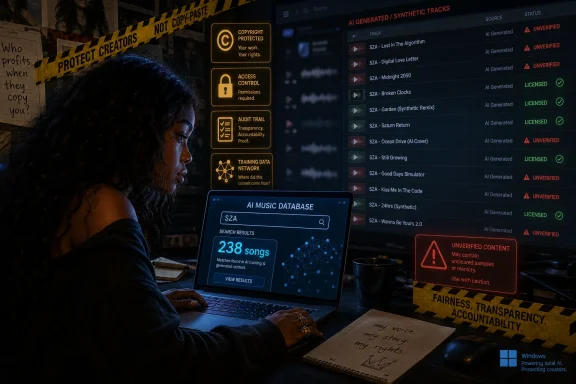
SZA said on June 21, 2026, that she had found 238 of her songs listed in an AI music training database, including what she believed may be unreleased material, and condemned musicians who support generative music systems. Her outburst was not a celebrity side note to the AI debate; it was a copyright, labor, culture, and platform-governance alarm bell arriving in the language of someone whose work has already been absorbed. The number matters less than the mechanism. If an artist can discover, after the fact, that hundreds of recordings may have become training material, the industry’s consent architecture has already failed.
For years, the debate over AI and music sounded abstract enough for every side to hide inside its favorite word. Developers talked about learning. Labels talked about infringement. Artists talked about theft. Fans, meanwhile, mostly heard jokes about fake Drake tracks, novelty covers, and voice-cloned memes that seemed too uncanny to become infrastructure.
SZA’s accusation cuts through that fog because it turns an argument about models into an inventory dispute. Not “could AI have trained on copyrighted work?” but “how many of my songs are in there?” Not “will this someday affect artists?” but “why am I finding my catalog in a dataset now?”
The reported figure, 238 songs, is the kind of number that makes the dispute legible to normal people. It is not a vibe, not a policy paper, not a speculative harm. It is a count of creative labor that an artist says was ingested without her blessing.
That is why her anger landed. The music business is used to ugly fights over sampling, interpolation, publishing splits, producer points, sync rights, masters, and streaming royalties. But those fights at least presume that a human act is being licensed, disputed, or monetized. AI training introduces a colder premise: a work can be valuable enough to copy at scale, yet not valuable enough for its creator to be asked first.
But the important part of generative AI happens before the prompt. The model’s apparent fluency is built from an upstream supply chain of recordings, lyrics, performances, vocal timbres, production patterns, genre conventions, and metadata. The end-user interface may look frictionless, but the system’s cultural memory had to come from somewhere.
SZA’s post targets that hidden layer. Her complaint is not merely that someone can make “AI SZA” slop or imitate R&B songwriting. It is that the training process may have converted her catalog into raw material for a market she did not authorize.
That distinction matters for Windows users, PC hobbyists, creators, and sysadmins because AI is becoming a local and cloud workflow rather than a novelty website. The same pattern now appears across code assistants, image generators, document summarizers, voice tools, and audio models: the output is marketed as empowerment, while the input layer remains murky. The question is no longer whether AI can generate media. The question is whether its vendors can prove the media pipeline is lawful, auditable, and consensual.
What SZA is rejecting is not every computational tool. She is rejecting the substitution of permission with extraction.
That distinction is the center of the fight now. If AI helps a producer clean a vocal take, organize a session, generate a visualizer, or build an authorized remix tool around licensed stems, many artists may accept it as another instrument in the studio. If AI companies train on catalogs first and negotiate later, the same technology becomes a laundering machine for other people’s work.
The industry has already begun drawing that line in court and in licensing deals. Lawsuits against music generation companies have alleged mass use of copyrighted recordings to build models. Some AI developers have argued that training is fair use. Record companies have countered that ingesting entire catalogs to create competing commercial systems is not technological progress but industrial-scale appropriation.
This is why SZA’s wording was so severe. To her, artists who support unlicensed AI music are not merely adopting a new tool. They are legitimizing a supply chain that may have fed on their peers.
That is a primitive way to govern billion-dollar systems.
A real consent framework would not require a singer to discover her presence in a dataset by accident. It would give rightsholders a clear record of what works were used, when they were used, by whom, under what license, and for what model version. It would distinguish between officially released tracks, demos, leaks, live recordings, stems, lyrics, voice likeness, metadata, and derivative works.
Instead, the AI music debate has been defined by opacity. Developers often treat training data as proprietary, competitively sensitive, or too large to disclose. Artists experience that secrecy as a one-way mirror: their work is visible enough to be scraped, but the scraping is not visible enough to challenge.
That asymmetry is intolerable in music because music is already a rights-dense medium. One recording can implicate performers, songwriters, publishers, labels, producers, sample owners, featured artists, session musicians, estates, and neighboring rights regimes. A model trained on music is not training on “content” in the abstract. It is training on a stack of contracts.
AI intensifies that pattern because it can imitate not just a song but a style world. It can learn the contours of R&B phrasing, gospel melisma, Southern soul textures, hip-hop cadences, blues progressions, trap percussion, and the emotional vocabulary of genres born from specific communities. It can then repackage those signals as promptable aesthetics.
That is why the phrase “AI music” understates the cultural stakes. A model does not merely generate “a song.” It generates a statistical collage of what it has learned people associate with a genre, a scene, an accent, a mood, a lineage. When the training data is unlicensed and the resulting outputs are monetized elsewhere, the familiar extraction story gains a new interface.
SZA’s critique of “stereotypical struggle music” generated by AI points to the same concern. Bad synthetic music is not only bad because it is derivative. It can also flatten lived experience into a set of tropes, producing a marketable imitation of pain, romance, spirituality, or resilience without the biography that gives those forms meaning.
The tech industry often answers cultural objections with scale. It says models learn from patterns too broad to be owned by any individual. But the history of Black music makes that answer feel evasive. Patterns can be communal, and exploitation can still be real.
The number should terrify anyone who cares about discovery. Streaming services already struggle with spam, fraudulent plays, fake artists, royalty dilution, playlist manipulation, and background-music farms. AI turns those problems from artisanal fraud into automated logistics.
The old streaming scam required some effort: create tracks, upload them, manipulate streams, route money. Generative systems reduce the cost of producing plausible filler to nearly zero. If a bad actor can generate hundreds or thousands of tracks with minimal labor, the streaming catalog becomes less like a library and more like an adversarial database.
Deezer’s reporting also shows why raw upload share is only part of the story. AI tracks may account for a huge percentage of new submissions while representing a much smaller share of actual listening, especially when platforms detect and demonetize fraudulent activity. But that is not a comfort. It means platforms must spend increasing resources filtering garbage before users even encounter it.
This is the same moderation dynamic that hit email, search, social media, app stores, and software repositories. Once creation becomes cheap enough, curation becomes the product.
The controversy around Xania Monet matters because it exposes the category error at the heart of AI music. Is the “artist” the person writing prompts? The person writing lyrics? The model vendor? The avatar? The dataset? The label that markets the result? The answer changes depending on who is trying to collect money, avoid liability, or claim cultural legitimacy.
Kehlani’s criticism of AI artists reflected a broader anxiety among working musicians: the industry may not need AI music to be better than human music. It may only need it to be cheaper, faster, controllable, and good enough for certain contexts.
That is the threat SZA is reacting to. AI does not have to replace the top one percent of artists to reshape the labor market. It can flood the lower and middle tiers: sync libraries, playlist filler, social sound beds, background music, demo vocals, reference tracks, advertising loops, game assets, and cheap localization. Once that happens, the economic foundation that supports developing musicians gets thinner.
The superstar fight is visible. The working-musician fight is structural.
That is the version of AI music the industry wants to sell regulators and the public: opt-in, licensed, controlled, transparent, and monetized for rightsholders. It is a plausible path, and it may be the only one that scales without endless litigation.
But licensing has a legitimacy problem if it arrives after years of unlicensed training. Artists may reasonably ask whether new deals are actually protecting them or simply normalizing a market created through earlier extraction. Consent is less meaningful when the models already exist, the style maps have already been learned, and the competitive baseline has already shifted.
There is also an internal industry conflict. Labels may license catalogs. Publishers may license compositions. Estates may license likenesses. Platforms may design tools. But individual artists may still object on moral, cultural, or reputational grounds. The law can answer who controls a right. It cannot always answer who gets to decide whether an artist’s voice should be promptable.
That is where AI music becomes more than a copyright issue. It becomes a question of artistic autonomy.
That shift complicates enforcement. Cloud platforms can be pressured to filter uploads, label synthetic content, maintain logs, and cut licensing deals. Local models and open weights are harder to supervise. Once a model capable of generating convincing vocals or genre-specific tracks is running on consumer hardware, the distinction between personal experimentation and commercial infringement becomes much harder to police.
For sysadmins and IT departments, this is not hypothetical. Corporate environments are already writing policies for generative AI use, data leakage, copyright exposure, and provenance. Music may look like a consumer-entertainment issue, but the governance pattern is the same as code generation or document summarization: employees can create output that carries hidden rights risks from opaque training sources.
A marketing team generating a jingle, a small studio producing background tracks, a game developer using AI music for a prototype, or a YouTuber creating a soundtrack may all assume that a paid AI subscription means the output is safe. That assumption is dangerous. Licensing terms vary, training data remains contested, and platform promises may not immunize users from every claim.
The PC made creativity democratic. AI may make infringement democratic too.
The music industry has always had an environmental footprint, from vinyl production to touring to streaming. But AI changes the economics of waste. If a platform receives tens of thousands of synthetic tracks per day that almost nobody listens to, then compute is being burned not for culture but for spam probability. That is a grim bargain.
The environmental stakes become sharper when paired with the copyright issue. Communities may bear infrastructure costs so companies can train models on artists’ work without permission, generate synthetic output at scale, and then force platforms to spend even more compute filtering the result. The convenience is privatized. The externalities spread outward.
Tech companies prefer to discuss efficiency curves, renewable energy commitments, and model optimization. Those things matter. But they do not erase the central question: what social value justifies the resource burn? A licensed accessibility tool, restoration workflow, or artist-approved remix system is easier to defend than a slop engine trained on unwilling creators.
This lag is familiar in technology policy. Platforms scale first; law catches up later; users and creators absorb the ambiguity in between. By the time a doctrine becomes clear, the business model has often already reorganized the market around the contested behavior.
Music is particularly vulnerable because streaming economics are already fragile for many artists. If AI-generated supply dilutes attention, clogs discovery systems, and competes for low-value functional listening, the damage may not show up as one dramatic replacement event. It will appear as slower growth, fewer placements, weaker royalties, diminished leverage, and a harder path for new artists to build a fan base.
That kind of harm is difficult to litigate. It is diffuse, cumulative, and distributed across thousands of careers. SZA’s outrage is useful because it makes the diffuse concrete. Her catalog gives the story a focal point.
That does not mean every trade secret has to be dumped onto the public internet. It does mean auditors, rightsholders, collecting societies, courts, and regulators need mechanisms to inspect datasets and model behavior. Without that, artists are being asked to trust systems that were built precisely because trust was not required.
Labeling synthetic output is also necessary, but it is not enough. A watermark on an AI-generated track tells listeners something about the product. It does not tell artists whether their work helped create it. Provenance has to run backward as well as forward.
The same principle should apply across creative AI. Users deserve to know when media is synthetic. Creators deserve to know when their work was used. Platforms deserve to know whether they are distributing licensed material or laundering legal risk. The current system offers fragments of all three and guarantees none.
Her anger is also a signal to musicians tempted by AI opportunism. The industry will always have early adopters willing to trade legitimacy for reach, novelty, or money. Some will argue that resistance is futile. Others will say that artists should adapt, build their own models, license their voices, or use AI before it uses them.
There is truth in the adaptation argument, but it becomes morally thin when it ignores the training layer. Artists can experiment with AI and still oppose unlicensed ingestion. They can use assistive tools and still reject synthetic clones. They can participate in licensed remix systems and still condemn models trained on scraped catalogs.
That nuance is often lost because the AI debate rewards absolutism. SZA’s language was absolutist, but the policy question beneath it is not. The real dividing line is not human versus machine. It is consent versus extraction.
That creates an opening for the music business, but also a danger. If only the largest labels can negotiate meaningful AI deals, independent artists may end up with fewer protections and less bargaining power. If only superstar catalogs are opt-in, everyone else’s work may remain exposed. If licensing revenue flows mainly to rightsholders rather than performers, the same old royalty fights will reappear under a new acronym.
The industry needs a system that can handle both the SZA-level catalog and the unknown artist whose songs may have been scraped from streaming platforms, social media, leaks, or archives. Otherwise, AI licensing becomes another ladder pulled up by incumbents.
For technology companies, the lesson is equally blunt. The era of “train first, explain later” is ending. It may not end cleanly, and it may not end everywhere, but the political and cultural tolerance for opaque creative extraction is shrinking.
 The AI Music Fight Has Moved From Theory to Inventory
For years, the debate over AI and music sounded abstract enough for every side to hide inside its favorite word. Developers talked about learning. Labels talked about infringement. Artists talked about theft. Fans, meanwhile, mostly heard jokes about fake Drake tracks, novelty covers, and voice-cloned memes that seemed too uncanny to become infrastructure.SZA’s accusation cuts through that fog because it turns an argument about models into an inventory dispute. Not “could AI have trained on copyrighted work?” but “how many of my songs are in there?” Not “will this someday affect artists?” but “why am I finding my catalog in a dataset now?”
The reported figure, 238 songs, is the kind of number that makes the dispute legible to normal people. It is not a vibe, not a policy paper, not a speculative harm. It is a count of creative labor that an artist says was ingested without her blessing.
That is why her anger landed. The music business is used to ugly fights over sampling, interpolation, publishing splits, producer points, sync rights, masters, and streaming royalties. But those fights at least presume that a human act is being licensed, disputed, or monetized. AI training introduces a colder premise: a work can be valuable enough to copy at scale, yet not valuable enough for its creator to be asked first.
SZA Is Not Objecting to a Toy, but to a Supply Chain
It is tempting to treat AI music as a consumer product: a prompt box that spits out a bedroom-pop song, a fake duet, or a parody cover. That framing is convenient for tech companies because it makes the act feel small. A user types a few words, a model generates something, and the result floats off into the disposable churn of social media.But the important part of generative AI happens before the prompt. The model’s apparent fluency is built from an upstream supply chain of recordings, lyrics, performances, vocal timbres, production patterns, genre conventions, and metadata. The end-user interface may look frictionless, but the system’s cultural memory had to come from somewhere.
SZA’s post targets that hidden layer. Her complaint is not merely that someone can make “AI SZA” slop or imitate R&B songwriting. It is that the training process may have converted her catalog into raw material for a market she did not authorize.
That distinction matters for Windows users, PC hobbyists, creators, and sysadmins because AI is becoming a local and cloud workflow rather than a novelty website. The same pattern now appears across code assistants, image generators, document summarizers, voice tools, and audio models: the output is marketed as empowerment, while the input layer remains murky. The question is no longer whether AI can generate media. The question is whether its vendors can prove the media pipeline is lawful, auditable, and consensual.
The Music Industry Wanted AI, Just Not Like This
The most revealing thing about the current backlash is that the major music industry is not anti-AI in any simple sense. Labels, publishers, platforms, and artists have been experimenting with AI for restoration, stem separation, mastering, marketing, rights management, recommendation systems, and fan engagement. Nobody with a serious view of technology thinks the music business will remain untouched.What SZA is rejecting is not every computational tool. She is rejecting the substitution of permission with extraction.
That distinction is the center of the fight now. If AI helps a producer clean a vocal take, organize a session, generate a visualizer, or build an authorized remix tool around licensed stems, many artists may accept it as another instrument in the studio. If AI companies train on catalogs first and negotiate later, the same technology becomes a laundering machine for other people’s work.
The industry has already begun drawing that line in court and in licensing deals. Lawsuits against music generation companies have alleged mass use of copyrighted recordings to build models. Some AI developers have argued that training is fair use. Record companies have countered that ingesting entire catalogs to create competing commercial systems is not technological progress but industrial-scale appropriation.
This is why SZA’s wording was so severe. To her, artists who support unlicensed AI music are not merely adopting a new tool. They are legitimizing a supply chain that may have fed on their peers.
A Database Search Became a Copyright Audit
The reported trigger for SZA’s post was a search of her name in an AI music database. That detail is important because it suggests artists are now performing their own informal audits of the AI economy. In the absence of formal disclosure regimes, they are left to search, screenshot, compare, and post.That is a primitive way to govern billion-dollar systems.
A real consent framework would not require a singer to discover her presence in a dataset by accident. It would give rightsholders a clear record of what works were used, when they were used, by whom, under what license, and for what model version. It would distinguish between officially released tracks, demos, leaks, live recordings, stems, lyrics, voice likeness, metadata, and derivative works.
Instead, the AI music debate has been defined by opacity. Developers often treat training data as proprietary, competitively sensitive, or too large to disclose. Artists experience that secrecy as a one-way mirror: their work is visible enough to be scraped, but the scraping is not visible enough to challenge.
That asymmetry is intolerable in music because music is already a rights-dense medium. One recording can implicate performers, songwriters, publishers, labels, producers, sample owners, featured artists, session musicians, estates, and neighboring rights regimes. A model trained on music is not training on “content” in the abstract. It is training on a stack of contracts.
The Black Music Argument Is the Hardest One for Tech to Answer
SZA has also framed AI music as a disproportionate threat to Black artists and Black musical traditions. That argument cannot be dismissed as celebrity rhetoric. Popular music history is filled with examples of Black innovation being copied, commercialized, sanitized, and redistributed by institutions with more capital and legal power than the creators themselves.AI intensifies that pattern because it can imitate not just a song but a style world. It can learn the contours of R&B phrasing, gospel melisma, Southern soul textures, hip-hop cadences, blues progressions, trap percussion, and the emotional vocabulary of genres born from specific communities. It can then repackage those signals as promptable aesthetics.
That is why the phrase “AI music” understates the cultural stakes. A model does not merely generate “a song.” It generates a statistical collage of what it has learned people associate with a genre, a scene, an accent, a mood, a lineage. When the training data is unlicensed and the resulting outputs are monetized elsewhere, the familiar extraction story gains a new interface.
SZA’s critique of “stereotypical struggle music” generated by AI points to the same concern. Bad synthetic music is not only bad because it is derivative. It can also flatten lived experience into a set of tropes, producing a marketable imitation of pain, romance, spirituality, or resilience without the biography that gives those forms meaning.
The tech industry often answers cultural objections with scale. It says models learn from patterns too broad to be owned by any individual. But the history of Black music makes that answer feel evasive. Patterns can be communal, and exploitation can still be real.
The Streaming Platforms Are Already Drowning in Synthetic Supply
SZA’s comments arrived in a year when AI music stopped looking like a boutique controversy and started looking like a volume problem. Deezer has said that nearly 75,000 fully AI-generated tracks are being uploaded to its service every day, representing about 44 percent of daily deliveries. That is not a future scenario. That is platform operations.The number should terrify anyone who cares about discovery. Streaming services already struggle with spam, fraudulent plays, fake artists, royalty dilution, playlist manipulation, and background-music farms. AI turns those problems from artisanal fraud into automated logistics.
The old streaming scam required some effort: create tracks, upload them, manipulate streams, route money. Generative systems reduce the cost of producing plausible filler to nearly zero. If a bad actor can generate hundreds or thousands of tracks with minimal labor, the streaming catalog becomes less like a library and more like an adversarial database.
Deezer’s reporting also shows why raw upload share is only part of the story. AI tracks may account for a huge percentage of new submissions while representing a much smaller share of actual listening, especially when platforms detect and demonetize fraudulent activity. But that is not a comfort. It means platforms must spend increasing resources filtering garbage before users even encounter it.
This is the same moderation dynamic that hit email, search, social media, app stores, and software repositories. Once creation becomes cheap enough, curation becomes the product.
The Fake Artist Is No Longer a Joke
The AI artist Xania Monet became a flashpoint because it turned synthetic music into a market event. An AI-generated R&B persona reportedly landed a multimillion-dollar record deal after chart activity, with a human creator behind the project using generative tools to turn poetry into songs. Supporters saw a new creative pathway. Critics saw an industry rewarding a synthetic performer while human artists fight for visibility.The controversy around Xania Monet matters because it exposes the category error at the heart of AI music. Is the “artist” the person writing prompts? The person writing lyrics? The model vendor? The avatar? The dataset? The label that markets the result? The answer changes depending on who is trying to collect money, avoid liability, or claim cultural legitimacy.
Kehlani’s criticism of AI artists reflected a broader anxiety among working musicians: the industry may not need AI music to be better than human music. It may only need it to be cheaper, faster, controllable, and good enough for certain contexts.
That is the threat SZA is reacting to. AI does not have to replace the top one percent of artists to reshape the labor market. It can flood the lower and middle tiers: sync libraries, playlist filler, social sound beds, background music, demo vocals, reference tracks, advertising loops, game assets, and cheap localization. Once that happens, the economic foundation that supports developing musicians gets thinner.
The superstar fight is visible. The working-musician fight is structural.
Licensing Deals May Civilize AI or Launder It
Recent licensing activity suggests that parts of the music business are trying to build authorized AI systems rather than fight every use case. Spotify and Universal Music Group have moved toward tools that would let users generate AI covers or remixes of licensed tracks from participating artists. Warner has pursued arrangements that emphasize artist control over names, likenesses, voices, compositions, and the use of AI-generated music.That is the version of AI music the industry wants to sell regulators and the public: opt-in, licensed, controlled, transparent, and monetized for rightsholders. It is a plausible path, and it may be the only one that scales without endless litigation.
But licensing has a legitimacy problem if it arrives after years of unlicensed training. Artists may reasonably ask whether new deals are actually protecting them or simply normalizing a market created through earlier extraction. Consent is less meaningful when the models already exist, the style maps have already been learned, and the competitive baseline has already shifted.
There is also an internal industry conflict. Labels may license catalogs. Publishers may license compositions. Estates may license likenesses. Platforms may design tools. But individual artists may still object on moral, cultural, or reputational grounds. The law can answer who controls a right. It cannot always answer who gets to decide whether an artist’s voice should be promptable.
That is where AI music becomes more than a copyright issue. It becomes a question of artistic autonomy.
The Windows Angle Is the Coming Local-AI Mess
WindowsForum readers do not need to be music-industry insiders to see where this is going. AI generation is moving from centralized web tools into desktop apps, browser features, DAWs, plug-ins, GPUs, NPUs, and local model workflows. The same PC that runs a game, a code editor, a video suite, and a Windows Insider build can increasingly run creative AI tools at the edge.That shift complicates enforcement. Cloud platforms can be pressured to filter uploads, label synthetic content, maintain logs, and cut licensing deals. Local models and open weights are harder to supervise. Once a model capable of generating convincing vocals or genre-specific tracks is running on consumer hardware, the distinction between personal experimentation and commercial infringement becomes much harder to police.
For sysadmins and IT departments, this is not hypothetical. Corporate environments are already writing policies for generative AI use, data leakage, copyright exposure, and provenance. Music may look like a consumer-entertainment issue, but the governance pattern is the same as code generation or document summarization: employees can create output that carries hidden rights risks from opaque training sources.
A marketing team generating a jingle, a small studio producing background tracks, a game developer using AI music for a prototype, or a YouTuber creating a soundtrack may all assume that a paid AI subscription means the output is safe. That assumption is dangerous. Licensing terms vary, training data remains contested, and platform promises may not immunize users from every claim.
The PC made creativity democratic. AI may make infringement democratic too.
The Environmental Complaint Is Not a Distraction
SZA has also criticized AI’s energy and pollution costs, pointing in particular to the burden that data centers can place on Black and brown communities. That argument often gets treated as a separate activist concern, but it belongs in the same analysis. Generative AI is not magic. It is infrastructure: power, water, chips, land, cooling, transmission, and permitting.The music industry has always had an environmental footprint, from vinyl production to touring to streaming. But AI changes the economics of waste. If a platform receives tens of thousands of synthetic tracks per day that almost nobody listens to, then compute is being burned not for culture but for spam probability. That is a grim bargain.
The environmental stakes become sharper when paired with the copyright issue. Communities may bear infrastructure costs so companies can train models on artists’ work without permission, generate synthetic output at scale, and then force platforms to spend even more compute filtering the result. The convenience is privatized. The externalities spread outward.
Tech companies prefer to discuss efficiency curves, renewable energy commitments, and model optimization. Those things matter. But they do not erase the central question: what social value justifies the resource burn? A licensed accessibility tool, restoration workflow, or artist-approved remix system is easier to defend than a slop engine trained on unwilling creators.
Copyright Law Is Too Slow for Platform Reality
The courts will matter, but they will not move fast enough to solve the immediate problem. Major lawsuits over AI training may establish boundaries around fair use, licensing, damages, and disclosure. Those decisions will shape the market. They may also arrive after models, workflows, and user expectations have hardened.This lag is familiar in technology policy. Platforms scale first; law catches up later; users and creators absorb the ambiguity in between. By the time a doctrine becomes clear, the business model has often already reorganized the market around the contested behavior.
Music is particularly vulnerable because streaming economics are already fragile for many artists. If AI-generated supply dilutes attention, clogs discovery systems, and competes for low-value functional listening, the damage may not show up as one dramatic replacement event. It will appear as slower growth, fewer placements, weaker royalties, diminished leverage, and a harder path for new artists to build a fan base.
That kind of harm is difficult to litigate. It is diffuse, cumulative, and distributed across thousands of careers. SZA’s outrage is useful because it makes the diffuse concrete. Her catalog gives the story a focal point.
Transparency Is the Minimum Price of Admission
If the AI music industry wants legitimacy, it has to start with disclosure. Not slogans about responsible AI. Not vague claims about publicly available data. Not assurances that models only learn “ideas.” The minimum standard is a practical record of what went into training and what rights governed that use.That does not mean every trade secret has to be dumped onto the public internet. It does mean auditors, rightsholders, collecting societies, courts, and regulators need mechanisms to inspect datasets and model behavior. Without that, artists are being asked to trust systems that were built precisely because trust was not required.
Labeling synthetic output is also necessary, but it is not enough. A watermark on an AI-generated track tells listeners something about the product. It does not tell artists whether their work helped create it. Provenance has to run backward as well as forward.
The same principle should apply across creative AI. Users deserve to know when media is synthetic. Creators deserve to know when their work was used. Platforms deserve to know whether they are distributing licensed material or laundering legal risk. The current system offers fragments of all three and guarantees none.
SZA’s Anger Is a Market Signal
Celebrity outrage can be performative. This does not look like that. SZA’s comments fit a wider pattern of artists realizing that AI companies, platforms, labels, and fans are making decisions that could reshape their careers without meaningful consent.Her anger is also a signal to musicians tempted by AI opportunism. The industry will always have early adopters willing to trade legitimacy for reach, novelty, or money. Some will argue that resistance is futile. Others will say that artists should adapt, build their own models, license their voices, or use AI before it uses them.
There is truth in the adaptation argument, but it becomes morally thin when it ignores the training layer. Artists can experiment with AI and still oppose unlicensed ingestion. They can use assistive tools and still reject synthetic clones. They can participate in licensed remix systems and still condemn models trained on scraped catalogs.
That nuance is often lost because the AI debate rewards absolutism. SZA’s language was absolutist, but the policy question beneath it is not. The real dividing line is not human versus machine. It is consent versus extraction.
The Catalog Is the Battlefield Now
The next phase of AI music will be fought over catalogs, not novelty demos. The companies that can secure large, clean, well-labeled, licensed datasets will have a commercial advantage. The companies that relied on murkier training pipelines will face litigation, reputational risk, and possibly technical pressure to rebuild.That creates an opening for the music business, but also a danger. If only the largest labels can negotiate meaningful AI deals, independent artists may end up with fewer protections and less bargaining power. If only superstar catalogs are opt-in, everyone else’s work may remain exposed. If licensing revenue flows mainly to rightsholders rather than performers, the same old royalty fights will reappear under a new acronym.
The industry needs a system that can handle both the SZA-level catalog and the unknown artist whose songs may have been scraped from streaming platforms, social media, leaks, or archives. Otherwise, AI licensing becomes another ladder pulled up by incumbents.
For technology companies, the lesson is equally blunt. The era of “train first, explain later” is ending. It may not end cleanly, and it may not end everywhere, but the political and cultural tolerance for opaque creative extraction is shrinking.
The 238-Song Number Is a Warning Label for Everyone Else
SZA’s post gives the AI music debate its cleanest recent metaphor: an artist looking up her own name and finding hundreds of works allegedly absorbed into a machine she did not invite. That image should haunt anyone building, buying, deploying, or defending generative systems.- Artists are no longer debating AI music in the abstract; they are looking for their own catalogs inside training datasets.
- Streaming platforms are already facing industrial-scale synthetic uploads, with AI music becoming an operational spam and fraud problem as much as a creative one.
- Licensing deals may create a lawful path for AI remixes and covers, but they cannot retroactively solve the legitimacy problem of models trained without clear consent.
- Black artists have specific historical reasons to distrust tools that can imitate genre, voice, pain, and style while separating those signals from their communities.
- Windows users, creators, and IT teams should treat AI-generated audio like any other rights-sensitive asset, because a paid tool does not automatically make its outputs legally or ethically clean.
- The sustainable version of AI music will require disclosure, opt-in rights, auditability, and compensation rather than after-the-fact outrage management.
References
- Primary source: TheGrio
Published: Sun, 21 Jun 2026 15:26:27 GMT
SZA Blasts AI Music, Says Models Trained On 238 Of Her Songs - TheGrio
SZA is calling out AI music as Warner Bros. Discovery rolls out AI-powered ad tech, raising questions about consent and culture.thegrio.com - Independent coverage: شبكة تواصل الإخبارية
Published: 2026-06-21T11:30:16.130779
SZA hits out at “disgusting” AI music after learning over 200 of her songs had been used to train artificial intelligence - شبكة تواصل الإخبارية
SZA has hit out at those making music with AI after discovering that over 200 of her tracks had been used to train the software.twaslnews1.twaslnews.com - Independent coverage: NME
Published: Sun, 21 Jun 2026 10:32:25 GMT
SZA hits out at "disgusting" AI music after learning over 200 of her songs had been used to train artificial intelligence
SZA has hit out at those making music with AI after discovering that over 200 of her tracks had been used to train the software. www.nme.com
- Related coverage: whathifi.com
How much of your playlist is AI-generated? Find out with Deezer’s new AI music detector | What Hi-Fi?
As AI-generated content gets ever harder to recognise, you can check your playlists with the streaming platform’s new AI detection tool.www.whathifi.com - Related coverage: techcrunch.com
Deezer says 44% of songs uploaded to its platform daily are AI-generated | TechCrunch
Deezer says consumption of AI-generated music on the platform is still very low, between 1% and 3% of the total streams, and 85% of these streams are detected as fraudulent and are demonetized.techcrunch.com - Related coverage: arstechnica.com
Deezer says 44% of new music uploads are AI-generated, most streams are fraudulent - Ars Technica
AI tracks account for a small fraction of Deezer streams, and most are demonetized for fraud.arstechnica.com
- Related coverage: explosion.com
Deezer: 44% of New Music Uploads Are AI-Generated — Explosion
Almost half of the songs uploaded to Deezer each day are generated by AI, and most of the streams those tracks receive are fake, according to new datawww.explosion.com - Related coverage: soundguys.com
Nearly half of all new music uploaded to Deezer is AI-generated
Deezer reveals 44% of daily music uploads are now AI-generated, totaling 75,000 tracks a day, and most are there to commit royalty fraud.www.soundguys.com - Related coverage: engadget.com
Deezer says AI-made songs make up 44 percent of daily uploads
The French music streaming platform reported only 20,000 AI-generated song uploads a day the previous year.www.engadget.com - Related coverage: weraveyou.com
AI-made music now makes up 44% of daily uploads to Deezer
Deezer has revealed AI-generated music now accounts for 44% of daily uploads, with 75,000 AI tracks landing on the platform every day.weraveyou.com - Related coverage: dataconomy.com
Deezer reports AI music reaches 44% of new uploads
Music streaming services such as Spotify and YouTube Music are now the primary platforms for music consumption, overshadowing traditional albumdataconomy.com - Related coverage: newrobotoverlords.com
44% of New Songs on Deezer Are AI. Nobody's Actually Listening. | New Robot Overlords
75,000 AI-generated tracks hit Deezer every day — 44% of all new uploads. Listeners stream less than 3% of them. The supply side of music has been transformed. The demand side hasn't. newrobotoverlords.com
- Related coverage: alternativeto.net
Deezer says 44% of daily uploads are AI-generated, but only represent ≈1-3% of streams | AlternativeTo
Deezer says it now gets 75,000 AI-generated tracks daily, 44% of total uploads, but they only represent around 1-3% of streams, with 85% flagged as fraudulent and demonetized. Deezer labels AI tracks and excludes them from recommendations.alternativeto.net
- Related coverage: musicradar.com
“Daily deliveries keep increasing”: 44% of Deezer's daily uploads are AI slop | MusicRadar
That’s 2 million tracks each monthwww.musicradar.com - Related coverage: pcgamer.com
Deezer says it's being bombarded by 'nearly 75,000' AI-generated tunes every day, and that 97% of survey respondents can't tell the difference between human-made and AI music | PC Gamer
Robot music is no longer beeps and boops.www.pcgamer.com - Related coverage: theweek.com
AI music: The fake artists filling up playlists | The Week
Is AI about to end music as we know it?theweek.com - Related coverage: forbes.com
AI Singer Xania Monet Just Charted On Billboard, Signed $3 Million Deal. Is This The Future Of Music?
Will the next breakout voice in music come from an algorithm? Xania Monet — an AI-powered R&B singer has cracked billboard, and was created by 31-year-old Talisha Jones.www.forbes.com - Related coverage: aimusicpreneur.com
AI Artist Xania Monet Signs $3M Record Deal
AI artist Xania Monet signs $3M record deal with Hallwood Media. Created by Telisha Jones using Suno AI, debuts at No. 1 R&B digital sales. → Read more herewww.aimusicpreneur.com
- Related coverage: artthreat.net
At war over Artificial Intelligence: SZA criticizes AI-generated stereotypical struggle music - Art Threat
SZA is sounding an alarm about how rapidly expanding artificial intelligence is reshaping music—and not in ways that favor creators who have long carried the culture. In a recent interview with i.d., the Grammy-winning singer framed the surge of AI-generated tracks as an immediate threat...artthreat.net - Related coverage: techradar.com
AI musicians may be signing record deals, but that won’t make the songs any better | TechRadar
Xania Monet is breaking records, but don’t ask her to perform livewww.techradar.com - Related coverage: loeb.com
- Related coverage: latimes.com
Major record labels sue AI companies for allegedly stealing copyrighted music
Major record labels have sued AI companies Suno and Udio for allegedly stealing copyrighted sound recordings, the RIAA announced.www.latimes.com - Related coverage: axios.com
AI music startup Suno defends against copyright claims
The recording industry has been at this kind of technological juncture before — when Napster and digital file formats massively disrupted its business models.www.axios.com
- Related coverage: tomshardware.com
Anthropic to pay $1.5B over pirated books in Claude AI training — payouts of roughly $3,000 per infringed work | Tom's Hardware
Anthropic has agreed to pay at least $1.5 billion to settle a class-action lawsuit brought by authors over the use of pirated books in training its LLMs.www.tomshardware.com
