

Tanium used the week of June 10, 2026, to advance its Autonomous IT strategy across Japan, Las Vegas conference promotion, exposure management, AI-driven security operations, FedRAMP-authorized services, ServiceNow integration, and Windows Server vulnerability remediation messaging for enterprise IT and security buyers. The through line was not subtle: Tanium wants to be seen less as an endpoint visibility vendor and more as the operating layer for continuous remediation. That is a bigger claim than a product launch, and it lands in a market where security teams are tired of dashboards that can diagnose risk faster than organizations can fix it. The company’s busy week therefore matters because it shows where endpoint management, vulnerability management, AI operations, and platform consolidation are being pulled into the same commercial argument.
The old endpoint-management pitch was built around inventory: tell me what I own, tell me what is broken, tell me what is missing. Tanium’s current framing is more ambitious and more aggressive. It argues that the useful unit of enterprise IT is no longer the scan result, the asset record, or the ticket, but the closed loop between finding risk and changing the endpoint state.
That distinction is not marketing trivia. Most large Windows estates already have scanners, patch systems, configuration tooling, CMDBs, EDR agents, identity platforms, and incident response workflows. The problem is that each of those systems often contains a different partial truth, updated on a different schedule, owned by a different team, and trusted only until the next outage proves otherwise.
Tanium’s Autonomous IT language is designed to attack that fragmentation directly. The company is saying that an operator should be able to ask a question, get real-time endpoint context, understand business risk, and execute remediation without starting a scavenger hunt through half a dozen consoles. If that sounds like the same consolidation story every platform vendor now tells, it is — but Tanium has a sharper endpoint-native angle than many of its rivals.
The bet is that real-time endpoint data becomes more valuable as AI and automation spread through IT operations. An AI assistant without reliable telemetry is just a faster way to hallucinate operational confidence. Tanium’s platform argument is that automation only becomes safe when it is grounded in continuously refreshed data from the machines that actually run the business.
That matters because Japan is a demanding market for enterprise IT vendors. Large Japanese organizations tend to prize reliability, local partnership, long-term operational trust, and integration with existing service models. A vendor that can win attention there is not merely proving that its messaging translates; it is testing whether its product strategy can survive conservative procurement cultures and mission-critical environments.
The event’s structure also says something about the state of demand. Breakout tracks on autonomous patching, exposure reduction, and threat hunting point to a buyer base that is no longer satisfied with passive reporting. Hands-on labs filling quickly suggests that customers are not just looking for strategic reassurance; they want to see whether the tools can actually make operational work simpler.
For Windows administrators in particular, this is the interesting part. Japan’s enterprise landscape includes plenty of complex Microsoft estates, legacy application dependencies, and heavily regulated industries. The promise of autonomous patching is attractive precisely because patching remains one of the least glamorous and most consequential jobs in IT.
Tanium’s challenge will be proving that “autonomous” does not mean reckless. In mature environments, patch automation succeeds only when it respects maintenance windows, business criticality, exception handling, rollback needs, and the informal knowledge that veteran administrators carry in their heads. The market will reward speed, but it will punish vendors that flatten operational nuance into a demo script.
This is where Tanium’s messaging becomes less abstract. If attackers can weaponize a newly disclosed issue in days, then an organization that discovers exposure on Friday, triages it the next week, opens tickets the week after that, and validates remediation sometime later is not running a vulnerability management program so much as a historical archive. The data may be accurate enough to explain the incident after it happens, but not timely enough to prevent it.
Traditional vulnerability management was built around counting and prioritizing CVEs. That was reasonable when the volume was lower, exploitation was slower, and patch cycles were more predictable. In 2026, the bigger question is not simply whether a device has a CVE, but whether that device is reachable, business-critical, misconfigured, compensating controls are absent, exploit code exists, the vulnerability appears in CISA’s Known Exploited Vulnerabilities catalog, and remediation can be applied without breaking production.
Tanium is pushing the market toward that broader definition of exposure. That is a smart move because CVSS scores alone have long been a blunt instrument. A theoretically severe vulnerability on an isolated lab system is not the same risk as a moderately rated bug on an internet-facing identity server. The industry has known this for years; the difference now is that the time pressure makes lazy prioritization more dangerous.
The company’s guidance around scanner evaluation fits this argument. Coverage, credentialed assessment models, exploitability prediction, CISA KEV alignment, and validation after remediation are not glamorous topics, but they are the mechanics that decide whether a vulnerability program reduces risk or simply produces work. Tanium is effectively telling buyers that detection without remediation proof is unfinished business.
The details are exactly the kind that make administrators sweat: Windows Server, Netlogon, domain controllers, critical severity, and reports of exploitation activity. Even organizations with disciplined patching programs often treat domain controllers carefully because disruption to Active Directory can turn a security fix into a business outage. That caution is rational, but it also creates the delay that attackers exploit.
Tanium positioned its Comply and Patch capabilities as a way to identify unpatched domain controllers and move quickly toward remediation. The interesting claim is not that a tool can find missing patches; many tools can do that. The more meaningful claim is that Tanium can help close the loop quickly enough, with enough endpoint certainty, to matter during an active exploitation window.
For WindowsForum.com readers, this is where the broader Autonomous IT story becomes practical. A domain controller vulnerability does not care how elegant a dashboard looks. Administrators need to know which servers are affected, which are actually domain controllers, which patches apply, which maintenance constraints exist, which systems failed installation, and whether the environment’s risk posture changed after remediation.
That last step is where many programs fall down. A patch deployment report is not the same as exposure reduction. Machines can be offline, supersedence logic can be misunderstood, update installation can fail silently, and inventory can be stale. Tanium’s promise is that real-time validation turns patch management from a best-effort process into a measurable risk-reduction loop.
This is the difference between vulnerability management and exposure management. Vulnerability management asks which known software flaws exist. Exposure management asks how an attacker could use the total state of the environment to create an incident. The second question is messier, but it is closer to reality.
The market has been moving this way for several years, partly because CVE volume has become overwhelming and partly because security leaders need to explain risk in business terms. A thousand unpatched endpoints is an alarming number, but it does not automatically tell a CISO what to fix first. A smaller number of exposed, critical, exploitable, internet-reachable, identity-adjacent systems is often the real priority.
Tanium’s real-time risk scoring and context-aware exposure language is designed to put the company in that more mature category. It wants to be judged not by how many findings it can generate, but by how quickly it can tell an organization what matters and help fix it. That is a more valuable promise, but also a harder one to prove.
The challenge is that risk scoring can become another vendor-specific abstraction. Every platform wants to produce the number that executives trust. The danger is that teams begin managing to the score rather than the underlying exposure. Tanium will need to show that its scoring is explainable, operationally useful, and connected to actual remediation outcomes — not just another colored gauge on an executive dashboard.
Threat Navigator appears aimed at a real pain point: turning threat hunting from an artisanal process into a repeatable workflow that can combine historical and live endpoint data. Good hunters already work iteratively, testing hypotheses and refining them as evidence appears. If Tanium can capture that motion and convert successful hunts into alerts or reusable intelligence, it could help understaffed security teams scale expertise.
Anomaly Detection for Enterprise Software is similarly pragmatic. Software inventory has always been harder than it should be, especially in large estates where unauthorized tools, outdated utilities, shadow IT, and risky applications accumulate quietly. Detecting deviations from peer groups and organizational norms is a sensible use of AI, provided the signal-to-noise ratio is good enough that teams do not drown in “interesting” but irrelevant findings.
Enforce pushes the story into configuration control. Tanium says it can import selected CIS Build Kits as enforceable policies and use continuous drift detection and remediation to keep endpoints aligned. That is a natural extension of the exposure management argument: if drift creates exposure, then drift correction becomes a security function, not just an endpoint management chore.
The important caveat is governance. Autonomous enforcement can be powerful, but a bad policy deployed at scale is just an outage with better branding. Enterprises will need guardrails, approval flows, staged rollouts, exception handling, and rollback paths. Tanium’s long-term credibility in Autonomous IT will depend as much on restraint as on speed.
The newly authorized services, including Tanium Ask, Connector for Microsoft Intune, Jump Gate, Endpoint Management for Operational Technology, and Endpoint Management for Mobile, suggest a broadening footprint. This is not just about Windows laptops anymore. It is about hybrid endpoint fleets, mobile devices, operational technology, government compliance boundaries, and the increasingly blurry edge between IT operations and security operations.
The ServiceNow angle points to another strategic reality. Tanium may want to be the real-time endpoint truth layer, but many enterprises still run operational process through ServiceNow. Tickets, change workflows, CMDBs, incident processes, and service operations are deeply embedded. A vendor that ignores that reality risks becoming another specialist console outside the system of work.
That is why Tanium’s partnership and integration story matters. CMDB accuracy is a perennial enterprise headache, and stale configuration data can sabotage everything from vulnerability prioritization to incident response. If Tanium can feed ServiceNow with more accurate real-time endpoint intelligence, it does not have to replace the system of record. It can make the system of record less fictional.
The deeper partnership with The Advania Group fits the same pattern. Channel and services partners are often the difference between platform ambition and customer adoption, especially in regional markets and complex transformation projects. Autonomous IT may be the slogan, but implementation is still very human.
This is the shape of enterprise security in 2026: everyone wants to be the platform that reduces tool sprawl. The irony, of course, is that the platform war itself can create new sprawl as each vendor adds overlapping capabilities. A CISO may want fewer tools, but vendors want more budget categories.
Tanium’s differentiator is still its endpoint architecture and the claim of real-time, high-fidelity data at scale. That gives it credibility in conversations where accuracy and speed are the core problem. But platform buyers will compare not only technical depth, but ecosystem fit, licensing complexity, operational maturity, AI trust, and whether the vendor’s automation can coexist with existing Microsoft and ServiceNow investments.
For Windows-heavy organizations, the Microsoft comparison is unavoidable. Microsoft owns the operating system, the identity plane, the management stack, and much of the security telemetry. Tanium’s pitch must therefore be that it provides a faster, broader, more operationally precise layer across heterogeneous environments than Microsoft-native tooling alone can deliver.
That is a plausible argument in complex estates, especially where Windows is only part of the fleet and where existing endpoint data is fragmented across business units. But it is not an automatic win. The more Microsoft integrates Intune, Defender, Entra, and Copilot into a coherent security operations story, the more Tanium must prove that its independent layer is worth the additional spend.
The appeal is obvious. IT and security teams are overloaded, and many routine decisions follow patterns that should be automatable. Which endpoints are missing a patch? Which risky software is unusual for this peer group? Which devices drifted from policy? Which certificate expirations will create operational risk? These are not mysteries so much as time-consuming investigations.
But trust is the bottleneck. Operators do not trust automation because a vendor says it is intelligent. They trust it when the system explains what it sees, why it recommends an action, what blast radius the action may have, how it will be staged, and how success or failure will be verified. In IT operations, credibility is earned through boring repeatability.
Atlas therefore has to be more than a clever AI shell over Tanium telemetry. It must become a place where operators feel safer moving quickly than they would moving manually. That is a high bar, especially in environments where a mistaken remediation can interrupt patient care, manufacturing lines, payment processing, or government services.
If Tanium can meet that bar, the upside is substantial. The most successful enterprise AI products may not be the ones that generate the flashiest prose or the prettiest dashboards. They may be the ones that convert messy operational intent into governed, auditable, reversible action.
That does not mean every organization should hand over change control to autonomous tooling tomorrow. It does mean administrators should treat real-time endpoint state as a strategic requirement, not a luxury. The CVE-2026-41089 example is a reminder that identity infrastructure remains a high-value target, and that the time between “patch available” and “attackers are probing” can be brutally short.
Security teams should also be cautious about vendor framing. Autonomous IT is a useful ambition, but it is not a magic exemption from disciplined operations. The organizations that benefit most will be the ones that already know their critical assets, have sane change-management processes, can define policy clearly, and are willing to measure remediation outcomes rather than activity volume.
The real shift is cultural as much as technical. Vulnerability management has often been treated as the security team’s reporting burden and the infrastructure team’s backlog problem. Exposure management reframes it as a shared operational system: identify, prioritize, fix, validate, and repeat continuously.
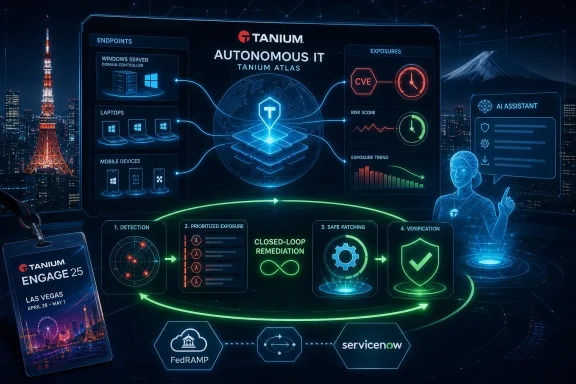 Tanium Is Selling Remediation, Not Merely Visibility
The old endpoint-management pitch was built around inventory: tell me what I own, tell me what is broken, tell me what is missing. Tanium’s current framing is more ambitious and more aggressive. It argues that the useful unit of enterprise IT is no longer the scan result, the asset record, or the ticket, but the closed loop between finding risk and changing the endpoint state.That distinction is not marketing trivia. Most large Windows estates already have scanners, patch systems, configuration tooling, CMDBs, EDR agents, identity platforms, and incident response workflows. The problem is that each of those systems often contains a different partial truth, updated on a different schedule, owned by a different team, and trusted only until the next outage proves otherwise.
Tanium’s Autonomous IT language is designed to attack that fragmentation directly. The company is saying that an operator should be able to ask a question, get real-time endpoint context, understand business risk, and execute remediation without starting a scavenger hunt through half a dozen consoles. If that sounds like the same consolidation story every platform vendor now tells, it is — but Tanium has a sharper endpoint-native angle than many of its rivals.
The bet is that real-time endpoint data becomes more valuable as AI and automation spread through IT operations. An AI assistant without reliable telemetry is just a faster way to hallucinate operational confidence. Tanium’s platform argument is that automation only becomes safe when it is grounded in continuously refreshed data from the machines that actually run the business.
Japan Gives the Autonomous IT Story a Regional Test Case
Tanium’s Tokyo event, billed as the closing stop of its Converge World Tour, was more than another customer meetup in a hotel ballroom. The company used the gathering to introduce Tanium Atlas to the Japanese market and to associate its Autonomous IT message with serious institutional buyers, including keynotes tied to Japan’s Ministry of Defense and NEC.That matters because Japan is a demanding market for enterprise IT vendors. Large Japanese organizations tend to prize reliability, local partnership, long-term operational trust, and integration with existing service models. A vendor that can win attention there is not merely proving that its messaging translates; it is testing whether its product strategy can survive conservative procurement cultures and mission-critical environments.
The event’s structure also says something about the state of demand. Breakout tracks on autonomous patching, exposure reduction, and threat hunting point to a buyer base that is no longer satisfied with passive reporting. Hands-on labs filling quickly suggests that customers are not just looking for strategic reassurance; they want to see whether the tools can actually make operational work simpler.
For Windows administrators in particular, this is the interesting part. Japan’s enterprise landscape includes plenty of complex Microsoft estates, legacy application dependencies, and heavily regulated industries. The promise of autonomous patching is attractive precisely because patching remains one of the least glamorous and most consequential jobs in IT.
Tanium’s challenge will be proving that “autonomous” does not mean reckless. In mature environments, patch automation succeeds only when it respects maintenance windows, business criticality, exception handling, rollback needs, and the informal knowledge that veteran administrators carry in their heads. The market will reward speed, but it will punish vendors that flatten operational nuance into a demo script.
The Vulnerability Clock Is Now the Sales Clock
The most compelling part of Tanium’s week was its emphasis on the shrinking window between vulnerability disclosure and exploitation. The company cited Mandiant’s M-Trends 2026 reporting that put mean time to exploit at roughly seven days in 2025. Whether one treats that number as an industry-wide law or a directional warning, the operational implication is grim: weekly and monthly scan cycles are increasingly misaligned with attacker behavior.This is where Tanium’s messaging becomes less abstract. If attackers can weaponize a newly disclosed issue in days, then an organization that discovers exposure on Friday, triages it the next week, opens tickets the week after that, and validates remediation sometime later is not running a vulnerability management program so much as a historical archive. The data may be accurate enough to explain the incident after it happens, but not timely enough to prevent it.
Traditional vulnerability management was built around counting and prioritizing CVEs. That was reasonable when the volume was lower, exploitation was slower, and patch cycles were more predictable. In 2026, the bigger question is not simply whether a device has a CVE, but whether that device is reachable, business-critical, misconfigured, compensating controls are absent, exploit code exists, the vulnerability appears in CISA’s Known Exploited Vulnerabilities catalog, and remediation can be applied without breaking production.
Tanium is pushing the market toward that broader definition of exposure. That is a smart move because CVSS scores alone have long been a blunt instrument. A theoretically severe vulnerability on an isolated lab system is not the same risk as a moderately rated bug on an internet-facing identity server. The industry has known this for years; the difference now is that the time pressure makes lazy prioritization more dangerous.
The company’s guidance around scanner evaluation fits this argument. Coverage, credentialed assessment models, exploitability prediction, CISA KEV alignment, and validation after remediation are not glamorous topics, but they are the mechanics that decide whether a vulnerability program reduces risk or simply produces work. Tanium is effectively telling buyers that detection without remediation proof is unfinished business.
CVE-2026-41089 Shows Why Domain Controllers Distort the Risk Equation
Tanium’s focus on CVE-2026-41089, a critical Windows Netlogon remote code execution vulnerability affecting Windows Server domain controllers, gave its platform message a concrete Windows-world anchor. Domain controllers are not ordinary servers. They sit near the center of enterprise identity, and a serious pre-authentication remote code execution issue against them is the sort of vulnerability that compresses theoretical risk into a board-level problem.The details are exactly the kind that make administrators sweat: Windows Server, Netlogon, domain controllers, critical severity, and reports of exploitation activity. Even organizations with disciplined patching programs often treat domain controllers carefully because disruption to Active Directory can turn a security fix into a business outage. That caution is rational, but it also creates the delay that attackers exploit.
Tanium positioned its Comply and Patch capabilities as a way to identify unpatched domain controllers and move quickly toward remediation. The interesting claim is not that a tool can find missing patches; many tools can do that. The more meaningful claim is that Tanium can help close the loop quickly enough, with enough endpoint certainty, to matter during an active exploitation window.
For WindowsForum.com readers, this is where the broader Autonomous IT story becomes practical. A domain controller vulnerability does not care how elegant a dashboard looks. Administrators need to know which servers are affected, which are actually domain controllers, which patches apply, which maintenance constraints exist, which systems failed installation, and whether the environment’s risk posture changed after remediation.
That last step is where many programs fall down. A patch deployment report is not the same as exposure reduction. Machines can be offline, supersedence logic can be misunderstood, update installation can fail silently, and inventory can be stale. Tanium’s promise is that real-time validation turns patch management from a best-effort process into a measurable risk-reduction loop.
Exposure Management Is Vulnerability Management After the Walls Collapse
The company’s June 10 exposure management webinar sharpened the argument by widening the aperture beyond CVEs. Tanium emphasized misconfigurations, compliance drift, missing controls, and expiring certificates as part of the same risk surface. That is the right direction, because attackers rarely care whether the initial weakness came from a formal vulnerability record, a bad configuration, an expired certificate, an exposed service, or a neglected endpoint.This is the difference between vulnerability management and exposure management. Vulnerability management asks which known software flaws exist. Exposure management asks how an attacker could use the total state of the environment to create an incident. The second question is messier, but it is closer to reality.
The market has been moving this way for several years, partly because CVE volume has become overwhelming and partly because security leaders need to explain risk in business terms. A thousand unpatched endpoints is an alarming number, but it does not automatically tell a CISO what to fix first. A smaller number of exposed, critical, exploitable, internet-reachable, identity-adjacent systems is often the real priority.
Tanium’s real-time risk scoring and context-aware exposure language is designed to put the company in that more mature category. It wants to be judged not by how many findings it can generate, but by how quickly it can tell an organization what matters and help fix it. That is a more valuable promise, but also a harder one to prove.
The challenge is that risk scoring can become another vendor-specific abstraction. Every platform wants to produce the number that executives trust. The danger is that teams begin managing to the score rather than the underlying exposure. Tanium will need to show that its scoring is explainable, operationally useful, and connected to actual remediation outcomes — not just another colored gauge on an executive dashboard.
AI Is Useful Only If It Can Touch the Endpoint Reality
At the Gartner Security & Risk Management Summit, Tanium showcased AI-driven features including Threat Navigator, Anomaly Detection for Enterprise Software, and Enforce. The names are familiar in the current enterprise software climate, where every product now seems to contain some combination of “AI,” “navigator,” “copilot,” “agent,” or “autonomous.” The difference worth watching is whether these tools alter operational workflows or merely decorate them.Threat Navigator appears aimed at a real pain point: turning threat hunting from an artisanal process into a repeatable workflow that can combine historical and live endpoint data. Good hunters already work iteratively, testing hypotheses and refining them as evidence appears. If Tanium can capture that motion and convert successful hunts into alerts or reusable intelligence, it could help understaffed security teams scale expertise.
Anomaly Detection for Enterprise Software is similarly pragmatic. Software inventory has always been harder than it should be, especially in large estates where unauthorized tools, outdated utilities, shadow IT, and risky applications accumulate quietly. Detecting deviations from peer groups and organizational norms is a sensible use of AI, provided the signal-to-noise ratio is good enough that teams do not drown in “interesting” but irrelevant findings.
Enforce pushes the story into configuration control. Tanium says it can import selected CIS Build Kits as enforceable policies and use continuous drift detection and remediation to keep endpoints aligned. That is a natural extension of the exposure management argument: if drift creates exposure, then drift correction becomes a security function, not just an endpoint management chore.
The important caveat is governance. Autonomous enforcement can be powerful, but a bad policy deployed at scale is just an outage with better branding. Enterprises will need guardrails, approval flows, staged rollouts, exception handling, and rollback paths. Tanium’s long-term credibility in Autonomous IT will depend as much on restraint as on speed.
FedRAMP and ServiceNow Reveal the Real Buyer
Tanium’s expanded FedRAMP-authorized services are not a side note. Public-sector buyers and regulated enterprises are often slower to adopt new operational models, but when they do, they bring serious scale and durability. By expanding the services available within Tanium Cloud for U.S. Government, the company is trying to make its Autonomous IT platform more viable for agencies and contractors that cannot simply adopt the newest SaaS feature because a vendor keynote says it is ready.The newly authorized services, including Tanium Ask, Connector for Microsoft Intune, Jump Gate, Endpoint Management for Operational Technology, and Endpoint Management for Mobile, suggest a broadening footprint. This is not just about Windows laptops anymore. It is about hybrid endpoint fleets, mobile devices, operational technology, government compliance boundaries, and the increasingly blurry edge between IT operations and security operations.
The ServiceNow angle points to another strategic reality. Tanium may want to be the real-time endpoint truth layer, but many enterprises still run operational process through ServiceNow. Tickets, change workflows, CMDBs, incident processes, and service operations are deeply embedded. A vendor that ignores that reality risks becoming another specialist console outside the system of work.
That is why Tanium’s partnership and integration story matters. CMDB accuracy is a perennial enterprise headache, and stale configuration data can sabotage everything from vulnerability prioritization to incident response. If Tanium can feed ServiceNow with more accurate real-time endpoint intelligence, it does not have to replace the system of record. It can make the system of record less fictional.
The deeper partnership with The Advania Group fits the same pattern. Channel and services partners are often the difference between platform ambition and customer adoption, especially in regional markets and complex transformation projects. Autonomous IT may be the slogan, but implementation is still very human.
Platform Consolidation Is a Knife Fight in Slow Motion
Tanium is not alone in trying to collapse endpoint management, exposure management, vulnerability remediation, and security operations into a more unified platform. Microsoft has Defender, Intune, Sentinel, Security Copilot, and a gravity well around Windows and Entra ID. CrowdStrike, Palo Alto Networks, SentinelOne, Qualys, Tenable, ServiceNow, and others are all pressing versions of the same argument from different starting points.This is the shape of enterprise security in 2026: everyone wants to be the platform that reduces tool sprawl. The irony, of course, is that the platform war itself can create new sprawl as each vendor adds overlapping capabilities. A CISO may want fewer tools, but vendors want more budget categories.
Tanium’s differentiator is still its endpoint architecture and the claim of real-time, high-fidelity data at scale. That gives it credibility in conversations where accuracy and speed are the core problem. But platform buyers will compare not only technical depth, but ecosystem fit, licensing complexity, operational maturity, AI trust, and whether the vendor’s automation can coexist with existing Microsoft and ServiceNow investments.
For Windows-heavy organizations, the Microsoft comparison is unavoidable. Microsoft owns the operating system, the identity plane, the management stack, and much of the security telemetry. Tanium’s pitch must therefore be that it provides a faster, broader, more operationally precise layer across heterogeneous environments than Microsoft-native tooling alone can deliver.
That is a plausible argument in complex estates, especially where Windows is only part of the fleet and where existing endpoint data is fragmented across business units. But it is not an automatic win. The more Microsoft integrates Intune, Defender, Entra, and Copilot into a coherent security operations story, the more Tanium must prove that its independent layer is worth the additional spend.
The Atlas Bet Is Really a Bet on Operator Trust
Tanium Atlas sits at the center of the company’s Autonomous IT narrative. The platform is described as an autonomous operating system for IT and security operators, using AI and real-time endpoint intelligence to guide action. That phrase, “operating system,” is doing a lot of work. It implies not merely a console, but a control plane.The appeal is obvious. IT and security teams are overloaded, and many routine decisions follow patterns that should be automatable. Which endpoints are missing a patch? Which risky software is unusual for this peer group? Which devices drifted from policy? Which certificate expirations will create operational risk? These are not mysteries so much as time-consuming investigations.
But trust is the bottleneck. Operators do not trust automation because a vendor says it is intelligent. They trust it when the system explains what it sees, why it recommends an action, what blast radius the action may have, how it will be staged, and how success or failure will be verified. In IT operations, credibility is earned through boring repeatability.
Atlas therefore has to be more than a clever AI shell over Tanium telemetry. It must become a place where operators feel safer moving quickly than they would moving manually. That is a high bar, especially in environments where a mistaken remediation can interrupt patient care, manufacturing lines, payment processing, or government services.
If Tanium can meet that bar, the upside is substantial. The most successful enterprise AI products may not be the ones that generate the flashiest prose or the prettiest dashboards. They may be the ones that convert messy operational intent into governed, auditable, reversible action.
Windows Administrators Should Read the Week as a Warning
The practical message for Windows administrators is not that Tanium has a new slogan. It is that the patching and exposure management model many organizations still rely on is becoming obsolete. Monthly patch cycles, slow asset reconciliation, post-hoc validation, and ticket-driven remediation are struggling against an exploitation tempo that has accelerated.That does not mean every organization should hand over change control to autonomous tooling tomorrow. It does mean administrators should treat real-time endpoint state as a strategic requirement, not a luxury. The CVE-2026-41089 example is a reminder that identity infrastructure remains a high-value target, and that the time between “patch available” and “attackers are probing” can be brutally short.
Security teams should also be cautious about vendor framing. Autonomous IT is a useful ambition, but it is not a magic exemption from disciplined operations. The organizations that benefit most will be the ones that already know their critical assets, have sane change-management processes, can define policy clearly, and are willing to measure remediation outcomes rather than activity volume.
The real shift is cultural as much as technical. Vulnerability management has often been treated as the security team’s reporting burden and the infrastructure team’s backlog problem. Exposure management reframes it as a shared operational system: identify, prioritize, fix, validate, and repeat continuously.
The Week’s Message Is Clearer Than the Marketing
Tanium’s announcements are best read as one coordinated argument: real-time endpoint intelligence is becoming the substrate for AI-era IT operations. Strip away the conference branding and the vendor gloss, and several concrete points remain.- Tanium is positioning Autonomous IT as a closed-loop remediation model, not simply as AI-assisted visibility.
- The Tokyo Converge event showed that the company is trying to turn regional customer engagement into a serious expansion lever, especially in Japan’s enterprise and public-sector-adjacent markets.
- The company’s exposure management push reflects a broader industry move away from CVE counting and toward risk context, exploitability, asset criticality, and remediation validation.
- CVE-2026-41089 gave Tanium a timely Windows Server example for why domain controller patching requires speed, confidence, and proof of completion.
- The Gartner announcements expanded the AI story into threat hunting, anomaly detection, policy enforcement, FedRAMP-authorized services, and integrations that feed existing enterprise workflows.
- The ServiceNow and partner-led motions show that Tanium understands platform ambition still has to travel through the systems and service providers customers already use.
References
- Primary source: TipRanks
Published: 2026-06-13T15:40:07.748894
- Related coverage: converge.tanium.com
Tanium Converge 2026
November 16 - 19, 2026 in Las Vegas, NV. Join us at the ARIA Resort & Casino for insightful keynotes, informative breakout sessions, hands-on lab experiences, certifications, and more. Visit converge.tanium.com for more details.converge.tanium.com - Related coverage: tanium.com
Tanium’s Converge World Tour Paris Explores Autonomous IT in the Age of AI | Tanium
More than 250 customers, partners, and thought leaders to gather at Hôtel Salomon de Rothschild for a day of keynotes, hands-on labs and customer insights on the future of Autonomous ITwww.tanium.com
- Related coverage: site.tanium.com
