

Homen Thangjam’s July 5, 2026 retelling of Taothingmang for e-pao.net turns an early Manipuri royal chronicle into a hearthside story about infrastructure, legitimacy, and memory, drawing on the Cheitharon Kumpapa, Gangmumei Kabui’s history of pre-colonial Manipur, and older traditions such as the Toreilol Lambuba and Tutenglon. On the surface, it is a story for young readers about a boy-king, a flooded valley, an arrow wound, and a man-eating bird. Underneath, it is doing something more serious: reminding us that some of the oldest political stories are not about conquest at all, but about drainage.
That may sound like an odd way to enter a legend. Yet Thangjam’s version of Taothingmang is compelling precisely because the heroism is physical, muddy, and administrative. The king does not merely inherit Kangla; he proves his right to rule by reshaping the valley that sustains it. In a world where modern states still rise and fall on roads, water, power, and public trust, the tale feels less like distant folklore than an old argument wearing the clothes of myth.
Taothingmang begins the story with a political problem before he ever faces a supernatural one. According to the chronology used in Thangjam’s source tradition, he began to reign in Sakabda 186, corresponding to 264 CE, when he was only eight years old. He was not the elder son; that place belonged to Yoimongpa, who was eleven.
That detail matters because it gives the story its first tension. The boy is king, but the story does not pretend that kingship is self-explanatory. Thangjam’s narrator openly admits that the sources do not tell us why the younger brother was chosen over the elder. Perhaps Taothingmang was judged more capable, perhaps Yoimongpa did not want the throne, perhaps the nobles made a calculation that history later reversed.
What the tale insists upon, however, is that Yoimongpa did not become the bitter brother from a palace melodrama. He becomes the indispensable ally. In a royal chronicle, that is more than a sentimental detail. It tells us that Taothingmang’s authority rests on kinship, consent, and competence, not merely on a throne placed beneath him.
The choice to frame the king as a child also changes the moral temperature of the story. Taothingmang is not introduced as a warrior already hardened by victory. He is a younger son inheriting a damaged landscape. His reign begins not with triumph but with vulnerability, and the great test before him is not whether he can defeat another king but whether he can make the valley habitable.
That is where Thangjam’s retelling finds its strongest contemporary charge. The boy-king’s legitimacy is not theatrical. It is infrastructural. The water must move, the marshes must drain, the fields must return, and the people must survive.
This is not decorative scenery. The flood explains why political order and hydraulic order are fused in the tale. If the rivers fail, the kingdom fails. If fields become lakes in the rains and cracked earth in the dry season, sovereignty becomes an abstraction.
The geography in the retelling is concrete. The Imphal and Iril, or Linwai in older stories, meet at Lilong and form the Manipur River, which then pushes south through the rocky exit near Sugnu before leaving the valley system. The problem is not simply “too much water.” It is water in the wrong places, at the wrong times, with channels too shallow or choked to do the work of carrying it away.
That is why the quote Thangjam foregrounds from the older record lands with such force: if the Manipuris were to survive, the marshes had to be drained. Survival, not grandeur, is the operating word. This is a political theology of maintenance.
Modern readers should resist the temptation to flatten the story into either pure environmental history or pure legend. Its power lies in refusing that split. The river system is real enough to shape settlement and hunger; the memory of flood is social enough to shape kingship; the heroic narrative is imaginative enough to make drainage morally unforgettable.
That detail changes how we read both brothers. Yoimongpa is not merely the elder sibling who graciously refuses rivalry. He is the carrier of the mother’s command. Taothingmang becomes the king who can enact it, but Yoimongpa becomes the one who remembers why it matters.
The result is a layered picture of authority. The visible sovereign is the boy-king; the initiating voice belongs to the queen; the operational partner is the elder brother; the labor force is the people. The chronicle may honor kings, but Thangjam’s retelling lets us glimpse a broader social architecture behind the royal name.
This is where the story is most sharply political. Good rule is not presented as solitary brilliance. It is a relay: memory becomes counsel, counsel becomes decision, decision becomes labor, and labor becomes a changed landscape. The hero is real, but the hero is not alone.
That matters because the later epilogue asks what the chronicle forgot. The farmers, women, children, and unnamed workers who helped dredge the rivers are not recorded as individuals, yet the story cannot function without them. Thangjam does not discard the royal frame; he opens it just enough for the hidden hands to appear.
Royal power usually elevates the ruler above the body. The king commands; others sweat. Here, Taothingmang’s body becomes part of the work. His hands blister, his back bends, his clothes are muddied, and the people see that the labor is not beneath him.
This image does several things at once. It makes the infrastructure project credible as a collective undertaking. It turns royal authority into example rather than command. It also converts environmental repair into a public ritual in which the people watch, hesitate, and then join.
The story is not naïve about power. The people do not immediately rush into the river because a king has announced a scheme. They watch. They judge whether the project is real. Only when they see water begin to move do they take up tools.
That is one of the most believable details in the whole tale. People trust public works when public works work. Grand announcements do not drain marshes. Channels do.
Phunal Tenheipa, the Angom archer, tells the brothers they cannot dig through his land. In a lesser story, this might be treated as villainy pure and simple. But the episode is more interesting if read as a clash between local autonomy and emerging central authority.
Yoimongpa’s response is cautious. He turns westward, avoids the contested land, and continues by another route. Taothingmang’s response is different. Seeing that his brother has gone ahead, he chooses the shortcut through Angom territory and is struck by Phunal Tenheipa’s arrow.
The wound gives the story one of its strongest place-names: Nganglou, the red field. The king’s blood marks the political cost of forcing a channel through contested land. The hydrological shortcut becomes a sovereign assertion, and the body of the king pays for it.
Thangjam’s retelling does not give us enough evidence to adjudicate the dispute in modern legal terms, and it wisely does not try. Instead, it preserves the ambiguity. Taothingmang is brave, perhaps rash. Yoimongpa is prudent, perhaps slow. Phunal Tenheipa is an obstacle to the royal project, but he is also defending a boundary.
That ambiguity is part of why the story endures. Infrastructure is never just technical. A canal, a road, a transmission line, a data center, a dam, a drainage channel — each one crosses someone’s land, rearranges someone’s risk, and tests the reach of central power. Lilong is the ancient version of a modern permitting fight, except the appeal is an arrow.
The wound is not incidental. Without it, Taothingmang is merely energetic. With it, he becomes the figure who continues the public work after the project has drawn blood. His legitimacy is no longer just that he digs; it is that he keeps digging after being hurt.
There is an obvious danger in romanticizing this. Societies have too often demanded that leaders, workers, soldiers, and ordinary citizens bleed for abstractions. But Thangjam’s story is careful to keep the purpose concrete. The king bleeds not for vanity but for drainage, food, water, and the survival of the valley.
The Nganglou episode also binds geography to memory. A place-name becomes a scar. The land does not merely receive the public work; it records the violence that made the work possible.
This is how oral and chronicle traditions often preserve complexity. They may not give us a full administrative record, but they encode conflicts into names, journeys, and wounds. The red field becomes an archive.
On another level, it is the logical next test for a ruler whose legitimacy has been built through public works. Drainage makes land usable, but fear can still make it unlivable. The people of Lokha-Haokha cannot tend fields or move freely. Their problem is not water alone; it is terror.
The Kakyen may be a bird, a demon, a remembered predator magnified by retelling, or a symbolic condensation of dangers that made the southern valley unsafe. Thangjam lets these possibilities coexist. That is the right choice, because folklore often tells the truth slantwise.
What matters in the narrative is that the brothers do not dismiss the villagers’ fear. They listen, set a trap, catch the Kakyen, and kill it. The king’s role expands from hydraulic repair to public safety.
That transition is politically important. Taothingmang does not win Lokha-Haokha by marching in as a conqueror. He removes the threat that has trapped the village inside itself. The resulting tributary relationship is still an expansion of power, but the story frames it as incorporation through rescue rather than subjugation.
This is not a modern liberal fantasy of consent. It is still kingship, still hierarchy, still a tributary order. But the tale knows the difference between power that arrives as extraction and power that arrives as protection. Taothingmang’s advantage is that he can plausibly claim the latter.
This is the most striking fusion of myth and hydrology in the story. The monster’s body becomes infrastructure. The same wings that once made the sky dangerous are repurposed to regulate water.
As storytelling, the image is magnificent. As political myth, it is even better. The king does not merely kill danger; he converts danger into utility. The enemy becomes part of the system that sustains the people.
Loktak Lake’s presence gives the episode additional weight. In Thangjam’s telling, water management is not only about draining marshes but about retaining enough water for dry seasons. The kingdom’s task is balance. Too much water destroys fields; too little water destroys life.
That balance is the core ecological intelligence of the tale. The dredging opens channels; the wing at Yithing preserves water. The hero does not simply dominate nature. He learns that rule means regulation, timing, and restraint.
This is why the story should interest more than specialists in Manipuri history. It encodes a sophisticated political idea in a form a child can remember: a good ruler makes water flow, but not vanish.
A century-long reign may mean a very long reign, a dynastic memory, a telescoping of achievements, or a symbolic duration attached to a foundational king. The important thing is that the tradition remembers Taothingmang as a ruler whose work outlived ordinary political time. His reign feels as long as the channels he opened.
This is a useful reminder for modern readers accustomed to treating historical uncertainty as a defect. Early chronicles are not spreadsheets. They are instruments of memory, legitimacy, theology, and political storytelling. Their numbers may not always behave like modern records, but their emphases are rarely accidental.
The story’s silence about Taothingmang’s death deepens that effect. He vanishes into heaven, mist, divinity, or the rivers themselves, depending on the strand of tradition. The maker becomes part of the made.
That ending would be sentimental if the story had not spent so much time in mud. Because it has, the transformation feels earned. Taothingmang becomes the rivers because the rivers are where he placed his labor, his blood, and his claim to rule.
The missing people matter. The chronicle gives us Taothingmang and Yoimongpa, but the dredging would have required a social body: farmers, women carrying silt, children bringing water, unnamed workers whose labor changed the valley but did not enter the royal line. Thangjam’s story invites them back without pretending to know all their names.
The queen matters too. Nongmainu Ahongbi’s wish, if accepted from the tradition Thangjam cites, means the project’s moral origin lies outside the king’s own imagination. The mother sees the suffering, passes the obligation to Yoimongpa, and thereby shapes the reign of Taothingmang.
Haonukhu of the Angom clan also complicates the political memory. Taothingmang reportedly marries into the same clan associated with the archer who wounded him. That marriage may have been reconciliation, strategy, affection, or all three. The record does not say, and the story is stronger for admitting the gap.
Most of all, Yoimongpa matters. He is the elder brother who might have been a rival but becomes the co-worker. He carries the mother’s wish, chooses prudence at Lilong, and helps kill the Kakyen. The throne belongs to Taothingmang, but the story’s moral machinery depends on Yoimongpa.
This is the quiet argument of the piece: royal memory simplifies, but living memory can complicate. Thangjam is not tearing down Taothingmang. He is making the hero more believable by restoring the network of obligation around him.
The answer in Taothingmang’s story is not branding. It is not inevitability. It is not even pure authority. People trust the king when they see him enter the mud, when the water moves, when the danger is confronted, and when survival improves.
That framework travels surprisingly well. Every durable system, ancient or digital, depends on maintenance that most people notice only when it fails. Drainage channels, update pipelines, identity systems, power grids, backups, and flood defenses share a basic political property: they become visible during crisis.
Taothingmang’s tale is therefore not merely a legend about a noble ruler. It is a story about the public legitimacy of maintenance. The king’s greatness lies less in commanding awe than in reducing helplessness.
That may be why the Kakyen episode fits rather than distracts. Infrastructure alone is not enough if people are too afraid to move. Security alone is not enough if the land cannot feed them. A functioning order must handle both the slow problem of silt and the sudden problem of terror.
The best part of Thangjam’s retelling is that it does not reduce this to a slogan. It lets a child understand it through rivers, arrows, wings, and a red field. That is what strong public memory does: it makes complexity portable.
That may sound like an odd way to enter a legend. Yet Thangjam’s version of Taothingmang is compelling precisely because the heroism is physical, muddy, and administrative. The king does not merely inherit Kangla; he proves his right to rule by reshaping the valley that sustains it. In a world where modern states still rise and fall on roads, water, power, and public trust, the tale feels less like distant folklore than an old argument wearing the clothes of myth.
 The Boy-King Becomes Legitimate Only When the Water Moves
Taothingmang begins the story with a political problem before he ever faces a supernatural one. According to the chronology used in Thangjam’s source tradition, he began to reign in Sakabda 186, corresponding to 264 CE, when he was only eight years old. He was not the elder son; that place belonged to Yoimongpa, who was eleven.That detail matters because it gives the story its first tension. The boy is king, but the story does not pretend that kingship is self-explanatory. Thangjam’s narrator openly admits that the sources do not tell us why the younger brother was chosen over the elder. Perhaps Taothingmang was judged more capable, perhaps Yoimongpa did not want the throne, perhaps the nobles made a calculation that history later reversed.
What the tale insists upon, however, is that Yoimongpa did not become the bitter brother from a palace melodrama. He becomes the indispensable ally. In a royal chronicle, that is more than a sentimental detail. It tells us that Taothingmang’s authority rests on kinship, consent, and competence, not merely on a throne placed beneath him.
The choice to frame the king as a child also changes the moral temperature of the story. Taothingmang is not introduced as a warrior already hardened by victory. He is a younger son inheriting a damaged landscape. His reign begins not with triumph but with vulnerability, and the great test before him is not whether he can defeat another king but whether he can make the valley habitable.
That is where Thangjam’s retelling finds its strongest contemporary charge. The boy-king’s legitimacy is not theatrical. It is infrastructural. The water must move, the marshes must drain, the fields must return, and the people must survive.
A Flooded Valley Makes the First Demand on Power
The story’s Manipur valley is not a passive backdrop. It is the first antagonist. Thangjam’s narrative describes an older catastrophic flood, linked to the Leimatak River, that scattered clans, drove people into the hills, and left the valley changed by marshes and stagnant pools.This is not decorative scenery. The flood explains why political order and hydraulic order are fused in the tale. If the rivers fail, the kingdom fails. If fields become lakes in the rains and cracked earth in the dry season, sovereignty becomes an abstraction.
The geography in the retelling is concrete. The Imphal and Iril, or Linwai in older stories, meet at Lilong and form the Manipur River, which then pushes south through the rocky exit near Sugnu before leaving the valley system. The problem is not simply “too much water.” It is water in the wrong places, at the wrong times, with channels too shallow or choked to do the work of carrying it away.
That is why the quote Thangjam foregrounds from the older record lands with such force: if the Manipuris were to survive, the marshes had to be drained. Survival, not grandeur, is the operating word. This is a political theology of maintenance.
Modern readers should resist the temptation to flatten the story into either pure environmental history or pure legend. Its power lies in refusing that split. The river system is real enough to shape settlement and hunger; the memory of flood is social enough to shape kingship; the heroic narrative is imaginative enough to make drainage morally unforgettable.
The Mother’s Wish Turns Public Works Into Inheritance
One of the most interesting moves in Thangjam’s version is the role given to Queen Nongmainu Ahongbi. According to the tradition he invokes from the Tutenglon, the desire to dredge and maintain the valley’s rivers begins not as a royal policy paper but as a mother’s dying wish to Yoimongpa. The state project is born as a family obligation.That detail changes how we read both brothers. Yoimongpa is not merely the elder sibling who graciously refuses rivalry. He is the carrier of the mother’s command. Taothingmang becomes the king who can enact it, but Yoimongpa becomes the one who remembers why it matters.
The result is a layered picture of authority. The visible sovereign is the boy-king; the initiating voice belongs to the queen; the operational partner is the elder brother; the labor force is the people. The chronicle may honor kings, but Thangjam’s retelling lets us glimpse a broader social architecture behind the royal name.
This is where the story is most sharply political. Good rule is not presented as solitary brilliance. It is a relay: memory becomes counsel, counsel becomes decision, decision becomes labor, and labor becomes a changed landscape. The hero is real, but the hero is not alone.
That matters because the later epilogue asks what the chronicle forgot. The farmers, women, children, and unnamed workers who helped dredge the rivers are not recorded as individuals, yet the story cannot function without them. Thangjam does not discard the royal frame; he opens it just enough for the hidden hands to appear.
The King Who Digs Collapses the Distance Between Throne and Mud
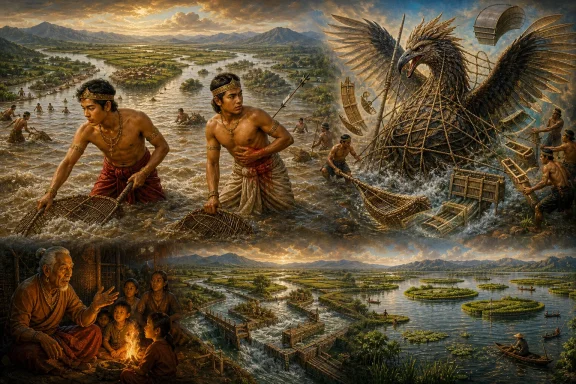
The central image of the story is almost anti-monarchical: the king and his elder brother standing knee-deep in mud, dredging the rivers with their own hands. Thangjam emphasizes that the chronicle says they dredged, not merely ordered dredging. That distinction carries the whole moral argument.Royal power usually elevates the ruler above the body. The king commands; others sweat. Here, Taothingmang’s body becomes part of the work. His hands blister, his back bends, his clothes are muddied, and the people see that the labor is not beneath him.
This image does several things at once. It makes the infrastructure project credible as a collective undertaking. It turns royal authority into example rather than command. It also converts environmental repair into a public ritual in which the people watch, hesitate, and then join.
The story is not naïve about power. The people do not immediately rush into the river because a king has announced a scheme. They watch. They judge whether the project is real. Only when they see water begin to move do they take up tools.
That is one of the most believable details in the whole tale. People trust public works when public works work. Grand announcements do not drain marshes. Channels do.
Lilong Shows That Infrastructure Is Always Territorial
The story becomes more complicated at Lilong, where the Imphal and Iril meet and where Angom territory obstructs the brothers’ plan. This is the moment when the tale stops being only about humans versus water. It becomes humans versus humans over the right to alter land.Phunal Tenheipa, the Angom archer, tells the brothers they cannot dig through his land. In a lesser story, this might be treated as villainy pure and simple. But the episode is more interesting if read as a clash between local autonomy and emerging central authority.
Yoimongpa’s response is cautious. He turns westward, avoids the contested land, and continues by another route. Taothingmang’s response is different. Seeing that his brother has gone ahead, he chooses the shortcut through Angom territory and is struck by Phunal Tenheipa’s arrow.
The wound gives the story one of its strongest place-names: Nganglou, the red field. The king’s blood marks the political cost of forcing a channel through contested land. The hydrological shortcut becomes a sovereign assertion, and the body of the king pays for it.
Thangjam’s retelling does not give us enough evidence to adjudicate the dispute in modern legal terms, and it wisely does not try. Instead, it preserves the ambiguity. Taothingmang is brave, perhaps rash. Yoimongpa is prudent, perhaps slow. Phunal Tenheipa is an obstacle to the royal project, but he is also defending a boundary.
That ambiguity is part of why the story endures. Infrastructure is never just technical. A canal, a road, a transmission line, a data center, a dam, a drainage channel — each one crosses someone’s land, rearranges someone’s risk, and tests the reach of central power. Lilong is the ancient version of a modern permitting fight, except the appeal is an arrow.
The Arrow Wound Turns Persistence Into Political Myth
After being struck, Taothingmang does not turn back. He presses his hand to the wound, crosses the Angom territory, and catches up to Yoimongpa at Lokha-Haokha. This is the point where the story moves from administrative heroism into mythic endurance.The wound is not incidental. Without it, Taothingmang is merely energetic. With it, he becomes the figure who continues the public work after the project has drawn blood. His legitimacy is no longer just that he digs; it is that he keeps digging after being hurt.
There is an obvious danger in romanticizing this. Societies have too often demanded that leaders, workers, soldiers, and ordinary citizens bleed for abstractions. But Thangjam’s story is careful to keep the purpose concrete. The king bleeds not for vanity but for drainage, food, water, and the survival of the valley.
The Nganglou episode also binds geography to memory. A place-name becomes a scar. The land does not merely receive the public work; it records the violence that made the work possible.
This is how oral and chronicle traditions often preserve complexity. They may not give us a full administrative record, but they encode conflicts into names, journeys, and wounds. The red field becomes an archive.
The Man-Eating Bird Is Fear Given Wings
At Lokha-Haokha, the brothers encounter Kakyen Meengamba, the man-eating bird that has terrorized the village. On one level, this is the story’s most fantastical episode. A giant bird carries people off, prevents movement, and makes the sky itself unsafe.On another level, it is the logical next test for a ruler whose legitimacy has been built through public works. Drainage makes land usable, but fear can still make it unlivable. The people of Lokha-Haokha cannot tend fields or move freely. Their problem is not water alone; it is terror.
The Kakyen may be a bird, a demon, a remembered predator magnified by retelling, or a symbolic condensation of dangers that made the southern valley unsafe. Thangjam lets these possibilities coexist. That is the right choice, because folklore often tells the truth slantwise.
What matters in the narrative is that the brothers do not dismiss the villagers’ fear. They listen, set a trap, catch the Kakyen, and kill it. The king’s role expands from hydraulic repair to public safety.
That transition is politically important. Taothingmang does not win Lokha-Haokha by marching in as a conqueror. He removes the threat that has trapped the village inside itself. The resulting tributary relationship is still an expansion of power, but the story frames it as incorporation through rescue rather than subjugation.
This is not a modern liberal fantasy of consent. It is still kingship, still hierarchy, still a tributary order. But the tale knows the difference between power that arrives as extraction and power that arrives as protection. Taothingmang’s advantage is that he can plausibly claim the latter.
The Bird’s Wings Make Myth Do Environmental Work
The death of the Kakyen does not end with a trophy. Its wings are turned into landscape instruments. One is placed at the entrance of a cave or gorge; the other is used to help dam the waters of Loktak Lake so it will not dry up completely, giving rise to the place called Yithing.This is the most striking fusion of myth and hydrology in the story. The monster’s body becomes infrastructure. The same wings that once made the sky dangerous are repurposed to regulate water.
As storytelling, the image is magnificent. As political myth, it is even better. The king does not merely kill danger; he converts danger into utility. The enemy becomes part of the system that sustains the people.
Loktak Lake’s presence gives the episode additional weight. In Thangjam’s telling, water management is not only about draining marshes but about retaining enough water for dry seasons. The kingdom’s task is balance. Too much water destroys fields; too little water destroys life.
That balance is the core ecological intelligence of the tale. The dredging opens channels; the wing at Yithing preserves water. The hero does not simply dominate nature. He learns that rule means regulation, timing, and restraint.
This is why the story should interest more than specialists in Manipuri history. It encodes a sophisticated political idea in a form a child can remember: a good ruler makes water flow, but not vanish.
A Hundred-Year Reign Signals Memory, Not Mathematics
The chronicle’s claim that Taothingmang reigned for 100 years is treated by Thangjam with the right mix of respect and skepticism. He does not mock the number, nor does he flatten it into literal biography. He reads it as old stories often ask to be read: as a measure of magnitude.A century-long reign may mean a very long reign, a dynastic memory, a telescoping of achievements, or a symbolic duration attached to a foundational king. The important thing is that the tradition remembers Taothingmang as a ruler whose work outlived ordinary political time. His reign feels as long as the channels he opened.
This is a useful reminder for modern readers accustomed to treating historical uncertainty as a defect. Early chronicles are not spreadsheets. They are instruments of memory, legitimacy, theology, and political storytelling. Their numbers may not always behave like modern records, but their emphases are rarely accidental.
The story’s silence about Taothingmang’s death deepens that effect. He vanishes into heaven, mist, divinity, or the rivers themselves, depending on the strand of tradition. The maker becomes part of the made.
That ending would be sentimental if the story had not spent so much time in mud. Because it has, the transformation feels earned. Taothingmang becomes the rivers because the rivers are where he placed his labor, his blood, and his claim to rule.
The Chronicle’s Silences Are Where the Modern Story Breathes
Thangjam’s epilogue is not an afterthought. It is the place where the retelling becomes self-aware. The author reminds readers that the Cheitharon Kumpapa, like many royal chronicles, was written to honor kings. That does not make it false; it makes it partial.The missing people matter. The chronicle gives us Taothingmang and Yoimongpa, but the dredging would have required a social body: farmers, women carrying silt, children bringing water, unnamed workers whose labor changed the valley but did not enter the royal line. Thangjam’s story invites them back without pretending to know all their names.
The queen matters too. Nongmainu Ahongbi’s wish, if accepted from the tradition Thangjam cites, means the project’s moral origin lies outside the king’s own imagination. The mother sees the suffering, passes the obligation to Yoimongpa, and thereby shapes the reign of Taothingmang.
Haonukhu of the Angom clan also complicates the political memory. Taothingmang reportedly marries into the same clan associated with the archer who wounded him. That marriage may have been reconciliation, strategy, affection, or all three. The record does not say, and the story is stronger for admitting the gap.
Most of all, Yoimongpa matters. He is the elder brother who might have been a rival but becomes the co-worker. He carries the mother’s wish, chooses prudence at Lilong, and helps kill the Kakyen. The throne belongs to Taothingmang, but the story’s moral machinery depends on Yoimongpa.
This is the quiet argument of the piece: royal memory simplifies, but living memory can complicate. Thangjam is not tearing down Taothingmang. He is making the hero more believable by restoring the network of obligation around him.
The Old Story Reads Like a Manual for Public Trust
For WindowsForum readers, a Manipuri hearthside story from the third century may seem far from the usual terrain of operating systems, patches, security advisories, and platform politics. But the underlying question is familiar: what makes people trust a system that governs their lives?The answer in Taothingmang’s story is not branding. It is not inevitability. It is not even pure authority. People trust the king when they see him enter the mud, when the water moves, when the danger is confronted, and when survival improves.
That framework travels surprisingly well. Every durable system, ancient or digital, depends on maintenance that most people notice only when it fails. Drainage channels, update pipelines, identity systems, power grids, backups, and flood defenses share a basic political property: they become visible during crisis.
Taothingmang’s tale is therefore not merely a legend about a noble ruler. It is a story about the public legitimacy of maintenance. The king’s greatness lies less in commanding awe than in reducing helplessness.
That may be why the Kakyen episode fits rather than distracts. Infrastructure alone is not enough if people are too afraid to move. Security alone is not enough if the land cannot feed them. A functioning order must handle both the slow problem of silt and the sudden problem of terror.
The best part of Thangjam’s retelling is that it does not reduce this to a slogan. It lets a child understand it through rivers, arrows, wings, and a red field. That is what strong public memory does: it makes complexity portable.
Taothingmang’s Muddy Kingdom Leaves Five Hard Lessons Behind
The story endures because it gives heroism a practical test. A ruler, or any institution claiming authority, must be judged by whether life becomes more livable under its care.- Taothingmang’s kingship is remembered through public works, not palace ceremony.
- Yoimongpa’s role shows that legitimacy often depends on the loyal second figure whom official memory underplays.
- The conflict at Lilong reminds us that infrastructure projects cross real boundaries and create political resistance.
- The Kakyen episode turns public safety into part of the same governing duty as water management.
- The use of the bird’s wing at Loktak Lake makes the story’s environmental lesson clear: survival requires both drainage and retention.
- The chronicle’s silences are not empty; they are invitations to remember the workers, women, clans, and compromises behind the royal name.
References
- Primary source: E-Pao
Published: 2026-07-05T03:50:12.328981
Loading…
e-pao.net