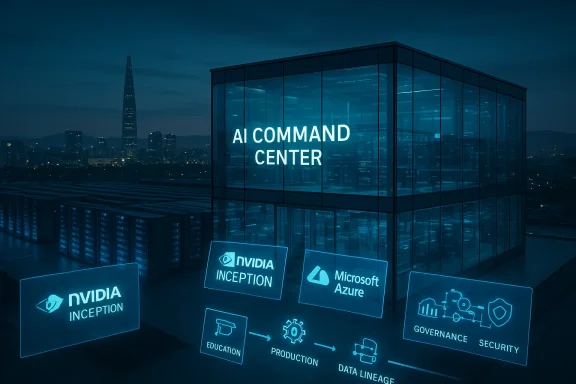
Team Sparta’s simultaneous entry into the NVIDIA Inception Program and Microsoft’s AI Cloud Partner Program is more than a credential — it’s a strategic pivot that reframes a Korean edtech startup as a potential linchpin in the country’s push from education-led AI readiness to enterprise-scale AI transformation (AX). Announced on January 20, the dual recognition gives Team Sparta immediate access to two complementary ecosystems: GPU infrastructure, SDKs and training from NVIDIA, plus cloud-scale deployment, Copilot integrations and go-to-market muscle from Microsoft. The result is an AX playbook that blends compute, productization, and distribution — and it could accelerate how Korean firms adopt AI across operations and industries.
Team Sparta began as an education company focused on AI upskilling and technical training. Over recent quarters the company has evolved its offerings from classroom and course-based services into consulting and productized AX services that help businesses move from pilot projects to embedded AI solutions. That shift mirrors a broader pattern in Korea: startups are increasingly positioning themselves as the intermediaries that connect global infrastructure providers and local enterprises hungry for practical AI adoption.
This move coincides with an intensified national push to scale AI computing infrastructure, talent development, and industrial adoption. The South Korean government and major domestic corporations have publicly outlined ambitions to elevate the country’s position in the global AI landscape — often speaking in terms of becoming one of the world’s leading AI powerhouses within the next decade. Against that backdrop, partnerships with NVIDIA and Microsoft are both symbolic and practical: they reduce technical friction and create clearer pathways to enterprise customers.
Key NVIDIA advantages Team Sparta can leverage:
[LISTT]
[*]Expanded access to GPU compute for model training and inference.
[*]Training and certification paths via DLI to upskill internal teams and enterprise customers.
[*]Preferred pricing and partner programs for NVIDIA software stacks (CUDA, cuDNN, Triton inference server, etc..
[*]Networking opportunities with investors and enterprise partners in NVIDIA’s ecosystem.
[/LIST]
It’s important to note that NVIDIA’s Inception Program historically excludes firms whose primary business is consulting or outsourced development. Team Sparta’s onboarding suggests the company either qualifies as a productized AI firm or has articulated a clear product/service mix that aligns with NVIDIA’s membership rules.
Microsoft advantages Team Sparta can exploit:
Tactical priorities indicated by the company:
Strategic importance for the domestic ecosystem:
Operational benefits include:
Tactical GTM steps:
Macroeconomic and policy implications:
The potential upside is significant: a Korean AX intermediary that can standardize deployments, provide trained talent, and scale through Microsoft’s marketplace could play an outsized role in moving thousands of enterprises from experimentation to operational AI. The principal risks — vendor lock-in, cost overruns, and regulatory friction — are manageable with disciplined engineering, transparent commercial models, and a governance-first approach.
Team Sparta’s next milestones should focus less on badge accumulation and more on demonstrable customer outcomes: measurable efficiency gains, reproducible deployment patterns, and certified architectures for regulated industries. If those elements are delivered, the company’s dual ecosystem access will be an enabling force, not merely a marketing credential — and it will offer a replicable blueprint for how Korean startups can convert national AI ambitions into operational reality.
Source: koreatechdesk.com How Team Sparta Is Building Korea’s AX Engine with NVIDIA and Microsoft Global Partnerships - KoreaTechDesk | Korean Startup and Technology News
 Background
Team Sparta began as an education company focused on AI upskilling and technical training. Over recent quarters the company has evolved its offerings from classroom and course-based services into consulting and productized AX services that help businesses move from pilot projects to embedded AI solutions. That shift mirrors a broader pattern in Korea: startups are increasingly positioning themselves as the intermediaries that connect global infrastructure providers and local enterprises hungry for practical AI adoption.This move coincides with an intensified national push to scale AI computing infrastructure, talent development, and industrial adoption. The South Korean government and major domestic corporations have publicly outlined ambitions to elevate the country’s position in the global AI landscape — often speaking in terms of becoming one of the world’s leading AI powerhouses within the next decade. Against that backdrop, partnerships with NVIDIA and Microsoft are both symbolic and practical: they reduce technical friction and create clearer pathways to enterprise customers.
What the NVIDIA and Microsoft Partnerships Bring
NVIDIA Inception Program: compute, SDKs, and technical credibility
As an Inception Program member, Team Sparta gains access to NVIDIA’s startup-focused benefits: GPU credits, discounted or preferential pricing on hardware and SDKs, training through the NVIDIA Deep Learning Institute (DLI), and technical support/access to developer resources. These benefits are designed to accelerate model development and prototyping, reduce early-stage infrastructure costs, and open technical channels to NVIDIA’s developer ecosystem.Key NVIDIA advantages Team Sparta can leverage:
[LISTT]
[*]Expanded access to GPU compute for model training and inference.
[*]Training and certification paths via DLI to upskill internal teams and enterprise customers.
[*]Preferred pricing and partner programs for NVIDIA software stacks (CUDA, cuDNN, Triton inference server, etc..
[*]Networking opportunities with investors and enterprise partners in NVIDIA’s ecosystem.
[/LIST]
It’s important to note that NVIDIA’s Inception Program historically excludes firms whose primary business is consulting or outsourced development. Team Sparta’s onboarding suggests the company either qualifies as a productized AI firm or has articulated a clear product/service mix that aligns with NVIDIA’s membership rules.
Microsoft AI Cloud Partner Program (MAICPP): cloud scale, Copilot, and marketplace
Microsoft’s AI Cloud Partner Program provides a different but complementary set of capabilities. Benefits include Azure credits, security and compliance resources, access to Microsoft’s Copilot technologies, and opportunities to publish and co-sell offerings via the Microsoft commercial marketplace. For a firm moving from training and bespoke projects into productized AX services, Microsoft’s partner stack addresses deployment, governance, and distribution.Microsoft advantages Team Sparta can exploit:
- Azure credits and architecture guidance to build enterprise-grade, scalable deployments.
- Access to Microsoft Copilot and Copilot Studio capabilities for embedding assistant-like features into applications and services.
- The Microsoft commercial marketplace and co-sell programs to scale distribution and reach enterprise buyers.
- Security, compliance, and governance frameworks that help enterprises trust and adopt AI solutions.
How Team Sparta Intends to Use the Dual Ecosystem
Team Sparta’s public statements indicate a deliberate strategy: move from project-based, one-off engagements to building a repeatable AX ecosystem that connects talent, infrastructure, and business outcomes.Tactical priorities indicated by the company:
- Use NVIDIA’s GPU access and DLI training to bolster R&D, accelerate model development, and build internal capabilities for higher-value AX engagements.
- Deploy standardized, secure solutions on Azure that comply with enterprise security and localization needs, then publish productized offerings on Microsoft’s marketplace.
- Leverage co-sell eligibility and partner channels to access global enterprise pipelines and scale sales beyond consulting engagements.
Why This Matters for Korea’s AI Agenda
Team Sparta’s dual partnership is a microcosm of a broader industrial strategy. Korea’s national AI agenda emphasizes three pillars that this move also touches: expanding infrastructure (GPUs, data centers), building human capital, and accelerating industrial adoption. Startups positioned at the intersection of education, engineering, and commercial deployment can act as multiplier agents — moving more corporations from pilots to embedded automation and productivity gains.Strategic importance for the domestic ecosystem:
- Bridges between supply (global infrastructure providers) and demand (Korean SMEs and conglomerates).
- A pipeline for talent re-use: students and bootcamp graduates who trained with Team Sparta become project engineers on AX rollouts.
- A domestic AX supply chain: local packaged solutions, integration, and managed services that reduce lead times and cultural friction for adopters.
Technical and Operational Analysis
Infrastructure and model lifecycle
Pairing NVIDIA’s compute resources with Azure’s deployment and governance tools addresses the full model lifecycle: training large models (or fine-tuning pre-built foundation models) on GPU clusters, wrapping models with inference serving frameworks (e.g., Triton, ONNX Runtime), and deploying as scalable APIs on Azure Kubernetes Service (AKS) or Azure Machine Learning.Operational benefits include:
- Faster iteration cycles via GPU acceleration.
- More predictable productionization using Azure-managed services for monitoring, model versioning, and CI/CD.
- Improved security and compliance through Azure’s identity, logging, and policy controls.
- Design model serving for efficiency: use mixed precision and optimized inference runtimes to reduce costs.
- Implement comprehensive observability: latency, accuracy drift, data drift, and input/output logging with privacy-preserving redaction.
- Build robust rollout strategies: blue/green deployments, canarying, and automated rollback on performance regressions.
Data, governance, and security
Enterprise adoption hinges on trust. Azure brings tools to help secure data at rest and in transit, manage identities (Microsoft Entra), and implement compliance guardrails. Still, building production-grade AX services requires deliberate attention to:- Data minimization and pseudonymization for regulated industries.
- Integration with on-premises and hybrid clouds for sensitive workloads.
- Clear data lineage and model explainability to satisfy audit requirements.
Productization challenges
Packaging bespoke consulting into reusable SaaS or managed services is non-trivial. Key challenges Team Sparta must solve:- Standardization versus customization trade-offs: templates and accelerators that cover 70–80% of common enterprise needs while leaving room for bespoke integration.
- Pricing models: balancing compute-heavy workloads (which generate variable Azure spend) with fixed-fee professional services.
- Multi-tenancy and data isolation: designing architectures that prevent cross-tenant data leakage while maintaining operational efficiency.
Market and Go-to-Market Implications
Co-sell and marketplace expansion
Publishing on Microsoft’s commercial marketplace opens two strategic advantages: discoverability to enterprise customers and co-sell opportunities where Microsoft field sellers can recommend Team Sparta’s solutions. That can substantially shorten sales cycles for mid-market and enterprise deals — provided Team Sparta meets co-sell readiness requirements and builds the one-pagers, pitch decks, and reference architectures Microsoft expects for marketplace offers.Tactical GTM steps:
- Achieve co-sell readiness by preparing required sales collateral and customer references.
- Use private offers and multiparty private offers to engage CSPs and resellers for SMB reach.
- Combine training and enablement services with packaged product offers to create a funnel from education to paid deployments.
Positioning as an AX intermediary
Team Sparta can capitalize on its edtech origins by packaging training as part of the delivery. Selling transformation as a combination of capability building plus managed deployment addresses the two largest enterprise adoption barriers: skills and change management. By offering “train + deploy” bundles, Team Sparta can increase customer stickiness and outcomes.Risks, Limitations, and Cautionary Notes
Vendor lock-in and platform dependency
Relying on NVIDIA GPUs and Azure services will accelerate time-to-market but increases exposure to vendor lock-in. Mitigations include:- Designing cloud-agnostic abstractions for model serving (e.g., containerized runtimes, infrastructure-as-code).
- Maintaining exportable model artifacts and data portability plans.
- Evaluating hybrid and multi-cloud strategies for critical workloads.
Compliance, data sovereignty and localization
Many Korean enterprises — and public sector customers — have strict data residency and privacy requirements. Azure provides sovereign and regional capabilities, but each deal will need explicit architecture reviews and potentially hybrid on-prem deployments. Team Sparta must be prepared to support these scenarios technically and contractually.Cost and commercial viability
Access to credits and discounted pricing reduces initial friction but does not eliminate ongoing operational expenses. Large language models and inference workloads are expensive at scale. Team Sparta will need transparent cost models, chargeback mechanisms, and performance-optimized inference stacks to keep customer economics compelling.Eligibility and program constraints
NVIDIA’s Inception Program disallows certain business models (notably pure outsourced development/consulting). Team Sparta’s acceptance suggests it has productized or sufficiently differentiated its offerings. However, this area introduces a reputation risk if the company’s market positioning is more services-led than product-led.Market competition
Korean market dynamics include powerful incumbents and highly funded local players with strong channel relationships. Team Sparta will face competition from:- Large system integrators and consulting firms bundling AI solutions.
- Domestic tech giants and cloud-native vendors that can offer end-to-end stacks.
- Specialized startups offering narrowly focused AI products or vertical solutions.
Strategic Recommendations for Team Sparta
- Standardize core AX offerings into modular bundles.
- Create three tiers: Assess (AI readiness + data diagnostic), Build (accelerated model/prototype), and Run (managed inference & support).
- Invest in cost-optimized inference engineering.
- Adopt model quantization, batching, and server-side caching to lower per-transaction cost.
- Build a governance-first architecture template.
- Provide a reference architecture for regulated customers with hybrid deployment patterns and audit controls.
- Prioritize co-sell readiness and marketplace hygiene.
- Publish a minimal viable offer on the commercial marketplace and acquire first reference customers to unlock Microsoft co-sell motions.
- Clarify customer economics and ROI.
- Deliver TCO calculators and outcomes-based pricing pilots to de-risk procurement decisions for SMEs.
- Maintain multi-vendor agility.
- Keep abstractions that allow swapping GPU clouds or inference runtimes to reduce long-term dependency.
Broader Implications for Korea’s AX Ecosystem
Team Sparta is a case study for how local startups can act as integration points between global infrastructure suppliers and domestic value chains. The company’s strategy — combining education, R&D acceleration, and enterprise deployment — exemplifies a potential operating model for other Korean startups that want to scale beyond local projects into globalized workflows.Macroeconomic and policy implications:
- Startups such as Team Sparta can accelerate AI diffusion across SMEs by packaging technical and human-capital investments together.
- Public-private partnerships and government infrastructure projects (data dams, national computing centers) will increase the addressable market for AX integrators.
- The emergence of more domestic AX intermediaries reduces reliance on foreign system integrators for local digital transformation.
Final Assessment
Team Sparta’s dual acceptance into the NVIDIA Inception Program and Microsoft’s AI Cloud Partner Program is a strategic alignment that materially improves its capacity to deliver production-grade AI solutions at scale. The two partnerships are complementary: NVIDIA supplies the compute and developer stack; Microsoft supplies the cloud governance, Copilot integrations, commerce, and distribution channels. Together they lower technical and commercial barriers — but they do not eliminate the core challenges of industrial AI adoption: data governance, predictable ROI, and talent retention.The potential upside is significant: a Korean AX intermediary that can standardize deployments, provide trained talent, and scale through Microsoft’s marketplace could play an outsized role in moving thousands of enterprises from experimentation to operational AI. The principal risks — vendor lock-in, cost overruns, and regulatory friction — are manageable with disciplined engineering, transparent commercial models, and a governance-first approach.
Team Sparta’s next milestones should focus less on badge accumulation and more on demonstrable customer outcomes: measurable efficiency gains, reproducible deployment patterns, and certified architectures for regulated industries. If those elements are delivered, the company’s dual ecosystem access will be an enabling force, not merely a marketing credential — and it will offer a replicable blueprint for how Korean startups can convert national AI ambitions into operational reality.
Source: koreatechdesk.com How Team Sparta Is Building Korea’s AX Engine with NVIDIA and Microsoft Global Partnerships - KoreaTechDesk | Korean Startup and Technology News