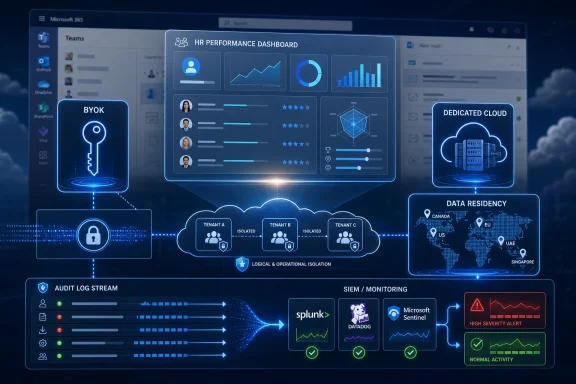
Teamflect announced on May 26, 2026, that its new Teamflect Enterprise plan adds customer-managed encryption keys, dedicated cloud infrastructure, and customer-selectable Microsoft Azure data residency to its performance management platform for Microsoft Teams and Outlook. The company is framing the launch as a category first, and the claim matters less as a trophy than as a sign of where HR software is heading. Performance management tools are no longer lightweight engagement apps floating at the edge of the enterprise. They are becoming sensitive systems of record, and security teams are starting to treat them accordingly.
For years, the performance management category sold itself on adoption. The pitch was almost always about ease: get managers to complete reviews, keep goals visible, make one-on-ones less chaotic, put recognition where employees already work. That made sense when these tools were viewed as workflow layers rather than repositories of organizational risk.
But the data inside them has changed the conversation. A modern performance platform can hold salary-sensitive feedback, promotion signals, succession planning, private manager notes, career development discussions, engagement data, disciplinary history, and sometimes behavioral context pulled from productivity suites. In the wrong hands, that is not just HR paperwork. It is a map of the company’s internal power structure.
That is why Teamflect’s Enterprise plan is more interesting than a routine packaging announcement. The company is not merely adding another premium tier with onboarding hours and dashboards. It is acknowledging that enterprise buyers now expect HR applications to answer the same security questions that infrastructure, finance, and customer-data vendors have been answering for years.
The important shift is not that Teamflect has discovered security. The important shift is that security has discovered performance management.
That proximity is commercially useful. If reviews, goals, feedback, and one-on-ones happen inside Teams and Outlook, adoption friction falls. Managers do not have to remember another destination, and employees encounter performance processes in the same environment where meetings, messages, and documents already live.
But proximity also increases scrutiny. A performance management tool embedded in Microsoft 365 is not perceived as an isolated HR utility; it becomes part of the enterprise collaboration fabric. For a CISO, that raises obvious questions about identity, access, tenant isolation, auditability, and data flow.
This is the paradox of modern SaaS distribution. The closer an app gets to the tools employees actually use, the more valuable it becomes — and the more security teams want proof that it will not become an invisible side door into sensitive business context.
Data residency used to be discussed mostly in the language of compliance checkboxes. European customers asked about GDPR. Canadian public-sector buyers asked about domestic storage. Multinational companies wanted assurances that employee records would not casually drift across regions. Those concerns remain, but the conversation has widened.
For global organizations, performance data is politically and operationally sensitive. A succession plan for a European subsidiary, manager notes about a pending termination in Canada, or leadership assessments for an employee in the UAE can implicate local privacy law, works council expectations, internal governance, and contractual obligations. The question is no longer simply whether a vendor has a privacy policy. It is whether the customer can choose the geography in which the system operates.
Azure is a useful foundation for that promise because Microsoft has spent years turning global cloud geography into an enterprise buying argument. Teamflect is borrowing that infrastructure story and applying it to a corner of HR tech that has often lagged behind the security posture of larger enterprise platforms.
The caveat is that data residency is not data sovereignty by itself. Residency answers where data is stored and processed under normal operating conditions. Sovereignty can also involve legal jurisdiction, administrative access, support workflows, backups, telemetry, and incident response. Serious buyers will still ask what “in region” means in operational detail.
That matters because encryption is often oversold in SaaS. Nearly every credible vendor can say data is encrypted in transit and at rest. For enterprise risk teams, that baseline is not enough when the vendor controls the full operational chain. If the vendor manages the infrastructure, the application, the administrators, and the encryption keys, then the customer’s real control is contractual rather than technical.
Customer-managed keys do not magically eliminate trust in the vendor. The application still needs to function, support teams may still have defined access paths, and implementation details matter enormously. But BYOK changes the posture. It gives the customer a stronger lever in the relationship, especially in regulated environments or high-risk internal deployments.
The ability to revoke a key is particularly important symbolically and practically. If a customer can make its data unreadable by withdrawing key access, it has a form of technical exit power. That does not solve every data lifecycle issue, but it is a more serious answer than a PDF stating that the vendor follows “industry best practices.”
This is why Teamflect’s claim of a category-first control will resonate with some buyers even if rivals respond quickly. The feature represents a move from compliance marketing into architectural negotiation.
Now the pendulum is moving back, at least for sensitive workloads. Some customers want the convenience of SaaS but the isolation story of a private environment. Dedicated infrastructure attempts to satisfy that demand without returning all the way to the old world of bespoke hosted software.
For performance management data, the argument is straightforward. If one customer’s environment has no shared components with another’s, the theoretical blast radius of a tenant isolation failure narrows. It may also simplify certain audits and internal risk assessments, because the customer can point to architectural separation rather than relying entirely on logical controls.
That does not mean dedicated infrastructure is automatically safer in every dimension. More isolated environments can create operational complexity. They may introduce deployment lag, monitoring challenges, or configuration drift if the vendor is not disciplined. Security depends not just on separation, but on how consistently those separated environments are patched, observed, and governed.
Still, the demand is real. The enterprise SaaS market is increasingly full of buyers who like cloud economics but dislike pooled risk. Teamflect’s move suggests that this expectation has reached performance management software, a category that historically competed more on user experience than infrastructure topology.
Security operations teams do not simply want vendors to secure data. They want vendors to produce events that can be monitored, correlated, retained, and investigated. A suspicious login, a mass export, an unusual administrator action, or a permissions change becomes more useful when it lands in the same operational view as the rest of the company’s security telemetry.
The SIEM integration language is important because it places HR software inside the security operations workflow. That is a major cultural change. HR systems used to be reviewed during procurement and then largely left to HR administrators unless something went wrong. Real-time logs imply continuous oversight.
Granular access controls matter for a similar reason. Performance data is not uniformly sensitive in a single way. A manager may need access to one team’s review cycle but not another’s. HR business partners may need cross-functional visibility. Executives may need aggregated talent views. Legal may need access during an investigation. The security challenge is not merely keeping outsiders out; it is preventing insiders from seeing more than their role requires.
This is where many SaaS tools still disappoint enterprise buyers. They can authenticate users through Microsoft Entra ID, but their internal permission models remain too coarse for messy organizational reality. Teamflect is signaling that HR security now lives in the details of role design, log export, retention, and IP restrictions.
SOC 2 Type II tells buyers that controls were evaluated over a period of time. GDPR and CCPA alignment tells them the vendor is aware of major privacy obligations. But neither automatically answers the deeper operational questions that now dominate security reviews: who can decrypt the data, where exactly it resides, what happens during support access, how logs are exported, how quickly access can be revoked, and what happens when a customer leaves.
That is why Teamflect’s CEO quote in the announcement is well chosen. The company says enterprise customers kept asking where the data lives, who holds the keys, and what happens when an employee leaves. Those are not abstract compliance questions. They are the practical questions of an organization trying to reduce ambiguity before a breach, audit, merger, lawsuit, or regulator forces the issue.
The broader lesson is that compliance has become a market entry requirement, not a differentiator. The new differentiation is control. Enterprise customers want vendors to expose enough of the security model that the customer’s own governance program can act on it.
But even if the phrase is marketing, the direction is meaningful. Performance management software is being pulled into the same security maturity curve that already reshaped cloud data platforms, developer tools, analytics products, and collaboration systems. Features that were once reserved for infrastructure-grade software are now migrating into HR workflows.
That pattern is familiar. A SaaS category starts with usability and adoption. It grows into mid-market scale. Then large enterprises arrive and ask uncomfortable questions. The vendor either builds enterprise controls, retreats into smaller customers, or gets squeezed by incumbents with deeper compliance machinery.
Teamflect is choosing the first path. Its bet is that performance management will not remain a lightweight category once the data inside these systems becomes central to workforce strategy. If the bet is right, competitors will be forced to respond not with prettier review templates, but with stronger security primitives.
The most interesting implication is that HR buyers may lose unilateral control over HR software selection. Procurement, legal, privacy, and security teams will increasingly shape which platforms are eligible before HR evaluates which platform is most pleasant to use. That may slow purchases, but it will also professionalize a category that has sometimes treated security as a procurement hurdle rather than a product capability.
Scale changes the risk profile of performance management. A tool used by a 200-person startup contains sensitive information, but the organizational blast radius is limited. A tool used across continents by a global employer touches multiple legal regimes, languages, management cultures, and HR operating models. At that point, edge cases become normal cases.
Large deployments also create more administrative complexity. People change roles, managers inherit teams, HR business partners rotate, employees leave, contractors come and go, and executives request broader visibility. Every one of those transitions is an access-control event waiting to become a governance failure if the system is not designed carefully.
The reference to G2 badges for enterprise ease of setup and ease of doing business serves a different purpose. Teamflect wants to argue that enterprise security does not have to come with enterprise pain. That is the commercial sweet spot: stronger controls without turning deployment into a consulting marathon.
Whether Teamflect can maintain that balance is the operational question. Dedicated infrastructure, BYOK, custom residency, SIEM streaming, HRIS integrations, and custom Power BI dashboards all sound enterprise-ready. They also create implementation complexity. The company’s “white-glove” implementation language is an implicit admission that these features require careful rollout.
That is a coherent enterprise story. Identity can align with Microsoft Entra. Collaboration happens in Teams and Outlook. Security telemetry can flow into Sentinel. Reporting can extend into Power BI. Data residency can ride Azure’s regional footprint. For Microsoft-heavy shops, that reduces architectural sprawl.
But Microsoft alignment should not be mistaken for automatic security approval. A third-party application inside the Microsoft ecosystem still needs its own vendor review, data processing terms, permissions assessment, incident response commitments, and lifecycle governance. The fact that a product lives in Teams does not make it Microsoft software.
This is especially important because Teams has become a distribution surface for business applications, not merely a chat client. The same convenience that makes embedded apps attractive can make them easy to underestimate. If employees access performance data through Teams, administrators must still understand where that data is stored, which application owns it, what Graph permissions are involved, and how access is revoked.
The better way to view Teamflect Enterprise is as a Microsoft-aligned security posture, not a Microsoft-guaranteed one. It gives Microsoft-centric customers a more legible path through procurement, but it does not eliminate due diligence.
That information can be explosive. It can reveal who is considered promotable, who is being managed out, which teams are underperforming, which executives are worried about retention, and which employees are being positioned for leadership. In aggregate, it can expose the company’s internal assessment of its own people.
Attackers understand the value of personnel data. So do litigants, regulators, journalists, competitors, and insiders. A breach of customer records is obviously serious, but a breach of performance and succession data can corrode trust inside the organization in a uniquely personal way.
That is why enterprise controls are not mere checkbox inflation. They are a response to the changing strategic value of workforce data. The more HR platforms promise to make talent decisions data-driven, the more sensitive the underlying data becomes.
The rise of AI in workplace tools will intensify this pressure. Even when Teamflect’s announcement is not primarily an AI story, the broader HR software market is moving toward summarization, coaching, sentiment analysis, and predictive talent insights. Once vendors begin deriving conclusions from employee interactions and performance histories, customers will ask even harder questions about training data, inference storage, explainability, and deletion.
Dedicated infrastructure raises its own questions. Customers will want to know whether “no shared components” applies to application servers, databases, storage, queues, logging systems, backups, management planes, and support tooling. In cloud architecture, shared components can hide in places that marketing language does not naturally describe.
Data residency requires similar precision. Buyers should ask whether primary data, replicas, backups, logs, analytics exports, support snapshots, and telemetry all remain in the selected region. They should also ask how cross-region disaster recovery is handled and what options exist when resilience requirements conflict with residency preferences.
Audit logging is only as useful as its completeness and clarity. Security teams will need event schemas, retention guarantees, latency expectations, administrator activity logs, export reliability, and documentation of which events are not captured. A SIEM integration that only reports logins is very different from one that reports data access, permission changes, exports, key events, and administrative actions.
This is not skepticism for its own sake. It is what mature customers should do with any SaaS vendor claiming enterprise-grade controls. Teamflect has put the right themes on the table. The procurement process will determine how much substance sits underneath them.
That changes the language vendors must speak. A CHRO may care about calibration workflows and review completion rates. A CISO cares about key custody, audit events, tenant isolation, administrator access, incident notification, and identity integration. A privacy officer cares about data minimization, retention, residency, deletion, and processor obligations. A CIO cares about integration, supportability, and vendor risk.
The winning vendors will be the ones that can satisfy all of those constituencies without making the product unusable. Security that destroys adoption will fail in HR. Ease of use that ignores governance will fail in enterprise procurement. The market is moving toward products that can do both.
Teamflect’s Microsoft-first posture helps because it lets the company map its story onto tools many enterprises already understand. Sentinel, Power BI, Azure regions, Teams, Outlook, and Microsoft 365 are familiar reference points. That familiarity shortens the distance between HR’s desired workflow and IT’s required control model.
But the competitive field will not stand still. Larger HR suites, talent platforms, and employee experience vendors can add similar controls, especially if large customers demand them. Teamflect’s advantage, if it has one, is speed and focus: a narrower performance-management product can sometimes move faster than a suite vendor carrying decades of architecture and acquisitions.
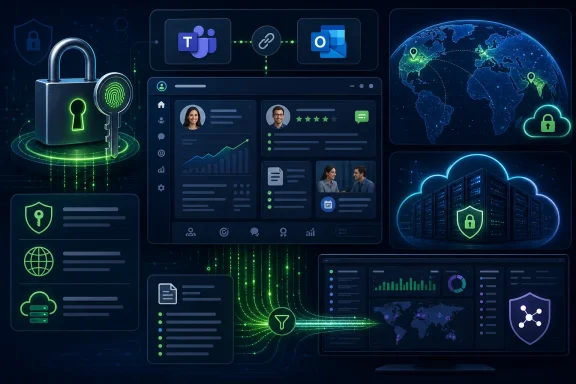 HR Software Just Crossed Into Security’s Blast Radius
For years, the performance management category sold itself on adoption. The pitch was almost always about ease: get managers to complete reviews, keep goals visible, make one-on-ones less chaotic, put recognition where employees already work. That made sense when these tools were viewed as workflow layers rather than repositories of organizational risk.But the data inside them has changed the conversation. A modern performance platform can hold salary-sensitive feedback, promotion signals, succession planning, private manager notes, career development discussions, engagement data, disciplinary history, and sometimes behavioral context pulled from productivity suites. In the wrong hands, that is not just HR paperwork. It is a map of the company’s internal power structure.
That is why Teamflect’s Enterprise plan is more interesting than a routine packaging announcement. The company is not merely adding another premium tier with onboarding hours and dashboards. It is acknowledging that enterprise buyers now expect HR applications to answer the same security questions that infrastructure, finance, and customer-data vendors have been answering for years.
The important shift is not that Teamflect has discovered security. The important shift is that security has discovered performance management.
The Microsoft 365 Wedge Makes the Stakes Higher
Teamflect’s market position is unusually tied to Microsoft’s collaboration universe. The product is built for Microsoft Teams and Outlook, which gives it a practical advantage in organizations that already live in Microsoft 365. It also means the platform sits close to the daily operating layer of work, not off in a separate HR portal employees reluctantly visit twice a year.That proximity is commercially useful. If reviews, goals, feedback, and one-on-ones happen inside Teams and Outlook, adoption friction falls. Managers do not have to remember another destination, and employees encounter performance processes in the same environment where meetings, messages, and documents already live.
But proximity also increases scrutiny. A performance management tool embedded in Microsoft 365 is not perceived as an isolated HR utility; it becomes part of the enterprise collaboration fabric. For a CISO, that raises obvious questions about identity, access, tenant isolation, auditability, and data flow.
This is the paradox of modern SaaS distribution. The closer an app gets to the tools employees actually use, the more valuable it becomes — and the more security teams want proof that it will not become an invisible side door into sensitive business context.
“Where Does the Data Live?” Is No Longer a Procurement Afterthought
Teamflect’s announcement leans heavily on customer-selectable Azure data residency, including availability across any region where Microsoft Azure operates a datacenter. That is a direct response to a procurement environment in which geography has become a security and legal control, not a footnote.Data residency used to be discussed mostly in the language of compliance checkboxes. European customers asked about GDPR. Canadian public-sector buyers asked about domestic storage. Multinational companies wanted assurances that employee records would not casually drift across regions. Those concerns remain, but the conversation has widened.
For global organizations, performance data is politically and operationally sensitive. A succession plan for a European subsidiary, manager notes about a pending termination in Canada, or leadership assessments for an employee in the UAE can implicate local privacy law, works council expectations, internal governance, and contractual obligations. The question is no longer simply whether a vendor has a privacy policy. It is whether the customer can choose the geography in which the system operates.
Azure is a useful foundation for that promise because Microsoft has spent years turning global cloud geography into an enterprise buying argument. Teamflect is borrowing that infrastructure story and applying it to a corner of HR tech that has often lagged behind the security posture of larger enterprise platforms.
The caveat is that data residency is not data sovereignty by itself. Residency answers where data is stored and processed under normal operating conditions. Sovereignty can also involve legal jurisdiction, administrative access, support workflows, backups, telemetry, and incident response. Serious buyers will still ask what “in region” means in operational detail.
Customer-Held Keys Move Trust From Slogan to Architecture
The most consequential control in Teamflect Enterprise is customer-managed encryption keys, often described as bring your own key or BYOK. In practical terms, the feature gives customers more control over the cryptographic keys used to protect their data, including rotation, revocation, and audit control through their own key management system.That matters because encryption is often oversold in SaaS. Nearly every credible vendor can say data is encrypted in transit and at rest. For enterprise risk teams, that baseline is not enough when the vendor controls the full operational chain. If the vendor manages the infrastructure, the application, the administrators, and the encryption keys, then the customer’s real control is contractual rather than technical.
Customer-managed keys do not magically eliminate trust in the vendor. The application still needs to function, support teams may still have defined access paths, and implementation details matter enormously. But BYOK changes the posture. It gives the customer a stronger lever in the relationship, especially in regulated environments or high-risk internal deployments.
The ability to revoke a key is particularly important symbolically and practically. If a customer can make its data unreadable by withdrawing key access, it has a form of technical exit power. That does not solve every data lifecycle issue, but it is a more serious answer than a PDF stating that the vendor follows “industry best practices.”
This is why Teamflect’s claim of a category-first control will resonate with some buyers even if rivals respond quickly. The feature represents a move from compliance marketing into architectural negotiation.
Dedicated Infrastructure Is the Old Enterprise Dream Repackaged for SaaS
The second major control, dedicated cloud infrastructure with no shared components between customers, is equally revealing. Multi-tenant SaaS won because shared infrastructure made software cheaper, faster to update, and easier to operate at scale. Enterprise customers accepted that model because the economics were overwhelming and because vendors built enough logical separation to make it workable.Now the pendulum is moving back, at least for sensitive workloads. Some customers want the convenience of SaaS but the isolation story of a private environment. Dedicated infrastructure attempts to satisfy that demand without returning all the way to the old world of bespoke hosted software.
For performance management data, the argument is straightforward. If one customer’s environment has no shared components with another’s, the theoretical blast radius of a tenant isolation failure narrows. It may also simplify certain audits and internal risk assessments, because the customer can point to architectural separation rather than relying entirely on logical controls.
That does not mean dedicated infrastructure is automatically safer in every dimension. More isolated environments can create operational complexity. They may introduce deployment lag, monitoring challenges, or configuration drift if the vendor is not disciplined. Security depends not just on separation, but on how consistently those separated environments are patched, observed, and governed.
Still, the demand is real. The enterprise SaaS market is increasingly full of buyers who like cloud economics but dislike pooled risk. Teamflect’s move suggests that this expectation has reached performance management software, a category that historically competed more on user experience than infrastructure topology.
Audit Logs Are Where Security Claims Meet Reality
Teamflect Enterprise also includes real-time audit logs and granular access controls, with streaming to platforms such as Splunk, Datadog, Microsoft Sentinel, and other SIEM tools. This part of the announcement is less flashy than BYOK or dedicated infrastructure, but it may be the feature security teams use most often.Security operations teams do not simply want vendors to secure data. They want vendors to produce events that can be monitored, correlated, retained, and investigated. A suspicious login, a mass export, an unusual administrator action, or a permissions change becomes more useful when it lands in the same operational view as the rest of the company’s security telemetry.
The SIEM integration language is important because it places HR software inside the security operations workflow. That is a major cultural change. HR systems used to be reviewed during procurement and then largely left to HR administrators unless something went wrong. Real-time logs imply continuous oversight.
Granular access controls matter for a similar reason. Performance data is not uniformly sensitive in a single way. A manager may need access to one team’s review cycle but not another’s. HR business partners may need cross-functional visibility. Executives may need aggregated talent views. Legal may need access during an investigation. The security challenge is not merely keeping outsiders out; it is preventing insiders from seeing more than their role requires.
This is where many SaaS tools still disappoint enterprise buyers. They can authenticate users through Microsoft Entra ID, but their internal permission models remain too coarse for messy organizational reality. Teamflect is signaling that HR security now lives in the details of role design, log export, retention, and IP restrictions.
Compliance Badges Are Becoming the Floor, Not the Ceiling
Teamflect says the platform is SOC 2 Type II certified and GDPR and CCPA compliant. Those statements matter, but they also illustrate how quickly the enterprise baseline has moved. A few years ago, those badges might have been enough to satisfy many procurement reviews for HR software. Today they are often the beginning of the questionnaire.SOC 2 Type II tells buyers that controls were evaluated over a period of time. GDPR and CCPA alignment tells them the vendor is aware of major privacy obligations. But neither automatically answers the deeper operational questions that now dominate security reviews: who can decrypt the data, where exactly it resides, what happens during support access, how logs are exported, how quickly access can be revoked, and what happens when a customer leaves.
That is why Teamflect’s CEO quote in the announcement is well chosen. The company says enterprise customers kept asking where the data lives, who holds the keys, and what happens when an employee leaves. Those are not abstract compliance questions. They are the practical questions of an organization trying to reduce ambiguity before a breach, audit, merger, lawsuit, or regulator forces the issue.
The broader lesson is that compliance has become a market entry requirement, not a differentiator. The new differentiation is control. Enterprise customers want vendors to expose enough of the security model that the customer’s own governance program can act on it.
The “Category First” Claim Is Less Important Than the Category Catching Up
Teamflect describes its three major controls as firsts for the performance management category. Without a full audit of every private enterprise contract in HR tech, that kind of claim should always be handled carefully. Vendors sometimes define categories narrowly, and competitors may have similar controls available under custom arrangements.But even if the phrase is marketing, the direction is meaningful. Performance management software is being pulled into the same security maturity curve that already reshaped cloud data platforms, developer tools, analytics products, and collaboration systems. Features that were once reserved for infrastructure-grade software are now migrating into HR workflows.
That pattern is familiar. A SaaS category starts with usability and adoption. It grows into mid-market scale. Then large enterprises arrive and ask uncomfortable questions. The vendor either builds enterprise controls, retreats into smaller customers, or gets squeezed by incumbents with deeper compliance machinery.
Teamflect is choosing the first path. Its bet is that performance management will not remain a lightweight category once the data inside these systems becomes central to workforce strategy. If the bet is right, competitors will be forced to respond not with prettier review templates, but with stronger security primitives.
The most interesting implication is that HR buyers may lose unilateral control over HR software selection. Procurement, legal, privacy, and security teams will increasingly shape which platforms are eligible before HR evaluates which platform is most pleasant to use. That may slow purchases, but it will also professionalize a category that has sometimes treated security as a procurement hurdle rather than a product capability.
The Securitas and Invacare References Are Really About Scale
Teamflect’s announcement points to enterprise customers including Securitas and Invacare, with deployments across multiple continents and tens of thousands of users. That detail is not just customer-logo decoration. It explains why the new controls exist.Scale changes the risk profile of performance management. A tool used by a 200-person startup contains sensitive information, but the organizational blast radius is limited. A tool used across continents by a global employer touches multiple legal regimes, languages, management cultures, and HR operating models. At that point, edge cases become normal cases.
Large deployments also create more administrative complexity. People change roles, managers inherit teams, HR business partners rotate, employees leave, contractors come and go, and executives request broader visibility. Every one of those transitions is an access-control event waiting to become a governance failure if the system is not designed carefully.
The reference to G2 badges for enterprise ease of setup and ease of doing business serves a different purpose. Teamflect wants to argue that enterprise security does not have to come with enterprise pain. That is the commercial sweet spot: stronger controls without turning deployment into a consulting marathon.
Whether Teamflect can maintain that balance is the operational question. Dedicated infrastructure, BYOK, custom residency, SIEM streaming, HRIS integrations, and custom Power BI dashboards all sound enterprise-ready. They also create implementation complexity. The company’s “white-glove” implementation language is an implicit admission that these features require careful rollout.
Microsoft-Centric Buyers Get a Cleaner Story, But Not a Free Pass
For WindowsForum.com readers, the Microsoft angle is the practical hook. Teamflect is not pitching a generic HR SaaS tool that happens to support Microsoft login. It is positioning itself as a performance management layer for organizations already standardized on Teams, Outlook, Microsoft 365, Azure, Sentinel, and Power BI.That is a coherent enterprise story. Identity can align with Microsoft Entra. Collaboration happens in Teams and Outlook. Security telemetry can flow into Sentinel. Reporting can extend into Power BI. Data residency can ride Azure’s regional footprint. For Microsoft-heavy shops, that reduces architectural sprawl.
But Microsoft alignment should not be mistaken for automatic security approval. A third-party application inside the Microsoft ecosystem still needs its own vendor review, data processing terms, permissions assessment, incident response commitments, and lifecycle governance. The fact that a product lives in Teams does not make it Microsoft software.
This is especially important because Teams has become a distribution surface for business applications, not merely a chat client. The same convenience that makes embedded apps attractive can make them easy to underestimate. If employees access performance data through Teams, administrators must still understand where that data is stored, which application owns it, what Graph permissions are involved, and how access is revoked.
The better way to view Teamflect Enterprise is as a Microsoft-aligned security posture, not a Microsoft-guaranteed one. It gives Microsoft-centric customers a more legible path through procurement, but it does not eliminate due diligence.
HR Data Is Becoming a Board-Level Risk Category
The deeper story behind this launch is that HR data has become more valuable, more sensitive, and more exposed. Performance systems are no longer just repositories of annual review scores. They increasingly capture the messy, continuous conversation between employees, managers, and the company.That information can be explosive. It can reveal who is considered promotable, who is being managed out, which teams are underperforming, which executives are worried about retention, and which employees are being positioned for leadership. In aggregate, it can expose the company’s internal assessment of its own people.
Attackers understand the value of personnel data. So do litigants, regulators, journalists, competitors, and insiders. A breach of customer records is obviously serious, but a breach of performance and succession data can corrode trust inside the organization in a uniquely personal way.
That is why enterprise controls are not mere checkbox inflation. They are a response to the changing strategic value of workforce data. The more HR platforms promise to make talent decisions data-driven, the more sensitive the underlying data becomes.
The rise of AI in workplace tools will intensify this pressure. Even when Teamflect’s announcement is not primarily an AI story, the broader HR software market is moving toward summarization, coaching, sentiment analysis, and predictive talent insights. Once vendors begin deriving conclusions from employee interactions and performance histories, customers will ask even harder questions about training data, inference storage, explainability, and deletion.
The Real Test Comes After the Press Release
A launch announcement can establish intent, but enterprise trust is earned in implementation details. Customer-managed keys sound powerful, but buyers will need to understand what data is covered, what metadata remains outside the key boundary, how revocation behaves, and how recovery works if a customer mismanages keys.Dedicated infrastructure raises its own questions. Customers will want to know whether “no shared components” applies to application servers, databases, storage, queues, logging systems, backups, management planes, and support tooling. In cloud architecture, shared components can hide in places that marketing language does not naturally describe.
Data residency requires similar precision. Buyers should ask whether primary data, replicas, backups, logs, analytics exports, support snapshots, and telemetry all remain in the selected region. They should also ask how cross-region disaster recovery is handled and what options exist when resilience requirements conflict with residency preferences.
Audit logging is only as useful as its completeness and clarity. Security teams will need event schemas, retention guarantees, latency expectations, administrator activity logs, export reliability, and documentation of which events are not captured. A SIEM integration that only reports logins is very different from one that reports data access, permission changes, exports, key events, and administrative actions.
This is not skepticism for its own sake. It is what mature customers should do with any SaaS vendor claiming enterprise-grade controls. Teamflect has put the right themes on the table. The procurement process will determine how much substance sits underneath them.
The Buying Committee Has Changed, and HR Vendors Must Adapt
The old HR software sale often centered on HR leadership, employee experience, and operational efficiency. Those still matter, but the buying committee is expanding. Security, privacy, legal, procurement, IT operations, and sometimes works councils now have more influence over whether a platform can be adopted at scale.That changes the language vendors must speak. A CHRO may care about calibration workflows and review completion rates. A CISO cares about key custody, audit events, tenant isolation, administrator access, incident notification, and identity integration. A privacy officer cares about data minimization, retention, residency, deletion, and processor obligations. A CIO cares about integration, supportability, and vendor risk.
The winning vendors will be the ones that can satisfy all of those constituencies without making the product unusable. Security that destroys adoption will fail in HR. Ease of use that ignores governance will fail in enterprise procurement. The market is moving toward products that can do both.
Teamflect’s Microsoft-first posture helps because it lets the company map its story onto tools many enterprises already understand. Sentinel, Power BI, Azure regions, Teams, Outlook, and Microsoft 365 are familiar reference points. That familiarity shortens the distance between HR’s desired workflow and IT’s required control model.
But the competitive field will not stand still. Larger HR suites, talent platforms, and employee experience vendors can add similar controls, especially if large customers demand them. Teamflect’s advantage, if it has one, is speed and focus: a narrower performance-management product can sometimes move faster than a suite vendor carrying decades of architecture and acquisitions.
The Enterprise Plan Turns HR Procurement Into a Security Review
The concrete lesson from Teamflect’s announcement is that performance management software now belongs in the same vendor-risk conversation as other sensitive enterprise systems. The product category may still sell employee experience, but the purchase now hinges on control.- Organizations evaluating performance management tools should treat review notes, compensation context, succession plans, and one-on-one records as high-sensitivity data rather than routine HR content.
- Customer-managed encryption keys give enterprises more leverage over data access, but buyers still need to verify exactly which data and metadata the key model protects.
- Dedicated infrastructure can reduce shared-tenant risk, but customers should ask which components are truly isolated and how patching, monitoring, and backups work.
- Azure data residency is useful for global organizations, but residency promises should be tested against backups, logs, telemetry, support access, and disaster recovery.
- SIEM streaming and granular access controls are not premium luxuries; they are becoming baseline requirements for HR platforms used at enterprise scale.
- Microsoft 365 integration makes Teamflect easier to place in Microsoft-heavy environments, but it does not remove the need for a full third-party application security review.
References
- Primary source: Morningstar
Published: 2026-05-26T11:30:14.066265
- Related coverage: teamflect.com
Teamflect Enterprise Plan: Security, Compliance & White-Glove Service
The new Teamflect for Enterprises plan brings enterprise-grade infrastructure, security, and implementation support to large global organizations. teamflect.com
- Related coverage: newswire.ca
Amid Tightening Enterprise Security Demands on HR Software, Teamflect Sets a New Security Standard with Three Category-First Controls
/CNW/ -- Performance management platforms used to sit in a quiet corner of the enterprise software stack. Today they hold some of the most sensitive employee... www.newswire.ca
- Related coverage: g2.com
- Official source: learn.microsoft.com
Application Information for Teamflect by Teamflect - Microsoft 365 App Certification
All available security and compliance information information for Teamflect, its data handling policies, its Microsoft Cloud App Security app catalog information, and security/compliance information in the CSA STAR registry.learn.microsoft.com - Related coverage: prnewswire.com
Zilliz Cloud Launches Customer-Managed Encryption Keys for Enterprise Data Sovereignty
/PRNewswire/ -- Zilliz, the company behind Milvus, the world's most widely adopted open-source vector database, today announced the general availability of... www.prnewswire.com
- Related coverage: docs.databricks.com
Customer-managed keys for encryption | Databricks on Google Cloud
Learn about using your own key with a Databricks workspace to encrypt some types of data.docs.databricks.com
- Related coverage: teamblee.blob.core.windows.net