

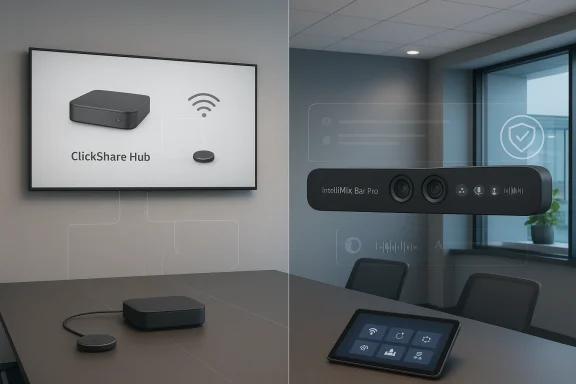
Microsoft’s latest push into meeting-room hardware is less about a single product launch than a broader strategic shift: Teams-certified room systems are becoming the new battleground for collaboration vendors. Barco’s ClickShare Hub bundles with Sennheiser, built on the Microsoft Device Ecosystem Platform (MDEP), are designed to make wireless room systems feel more like a native part of the Teams stack than a bolt-on accessory, and that matters for buyers who care about security, simplicity, and deployment scale. At the same time, Shure’s IntelliMix Bar Pro is pushing the same market in a different direction, packaging audio, video, and on-device intelligence into an all-in-one form factor that is explicitly tuned for Teams and Copilot-era meeting workflows.
What looks, on the surface, like a product-news roundup is actually a snapshot of how Microsoft’s ecosystem strategy is rippling through the physical workplace. Partners are no longer merely claiming compatibility; they are competing on certification, manageability, and how closely their hardware can align with the operational assumptions of Microsoft 365, Teams Rooms, and the MDEP security model. That is why the timing of the launch matters, and why the article’s closing reference to SharePoint’s 25th anniversary is more than a nostalgic aside: it underscores how Microsoft is still turning foundational productivity platforms into durable enterprise platforms with long tail effects.
The two device announcements in Technology Record Issue 40 sit squarely inside a larger redefinition of the meeting room. Barco’s certified bundles pair ClickShare Hub Core with Sennheiser’s TeamConnect Bar S for small rooms and ClickShare Hub Pro with TeamConnect Bar M for medium rooms, while Shure’s IntelliMix Bar Pro goes after medium-to-large spaces with a single integrated device. Both approaches are built around the idea that the room should behave as a managed, reliable, software-aware endpoint rather than a bundle of mixed vendor parts. That is not just an aesthetic choice; it is a procurement, support, and security decision.
The Microsoft angle is equally important. MDEP is emerging as a meaningful platform layer for partners that want to align with Microsoft’s security and lifecycle expectations, and Microsoft’s own documentation on Teams certification emphasizes quality, reliability, compatibility, and optimized meeting experiences as core standards. In practical terms, certification is both a marketing label and a buying signal. For IT teams, it can reduce uncertainty, simplify support contracts, and lower the risk that a room system becomes a fragile science project after deployment.
This matters because hybrid work has matured beyond the era when “good enough video” was enough. Enterprises now want audio that supports transcription, camera framing that improves remote participation, and management interfaces that fit into established admin tooling. Shure’s promotional language about AI-driven transcription and Copilot-ready audio, and Barco’s emphasis on secure wireless sharing and Teams certification, both point to the same conclusion: the meeting room is now part of the AI productivity stack.
There is also a competitive story hidden in plain sight. Vendors that once competed mainly on room peripherals are now competing on platform trust. That shifts power toward Microsoft and, to some extent, toward the brands that can successfully carry Microsoft’s standards into physical hardware without making the room feel rigid or overmanaged. In a market where buyers are trying to rationalize device sprawl, those are the vendors most likely to win renewals.
That shift is especially important in regulated sectors. Financial services, healthcare, government, and legal organizations are all more likely to prefer room systems that fit neatly into managed environments and support admin-side observability. A Teams-certified system is not automatically “secure” in every sense, but it is easier to justify in procurement and easier to support at scale.
For buyers, the practical benefit is a room system that behaves more predictably over time. That may sound mundane, but in enterprise IT, predictability is often the real premium feature. A room that breaks less often, updates more cleanly, and supports remote management saves more money than a room that merely looks cutting-edge at launch.
The small-room and medium-room pairing also shows commercial discipline. Rather than pushing a one-size-fits-all device into every floor plan, Barco and Sennheiser have aligned bundle size with room size, which is exactly how enterprise AV buyers prefer to shop. It reduces ambiguity during deployment and makes it easier for channel partners to standardize proposals.
A bundle strategy also reduces friction for IT teams. Instead of shopping for separate components and then testing how they behave together, buyers get a pre-integrated configuration with a clearer support story. In a procurement cycle, that kind of simplification can be the difference between a pilot and a purchase order.
This also reflects a broader market reality: collaboration buyers are no longer primarily dazzled by hardware feature lists. They care whether the product can be supported across multiple offices, maintained remotely, and integrated into the policy frameworks already used by the organization. Certification helps translate technical complexity into procurement confidence.
The product’s technical positioning also fits the current AI moment. Shure is clearly leaning into the idea that high-quality audio is not only about human clarity but about better transcription and more accurate AI-assisted meeting notes. That is a subtle but important shift: the microphone is no longer just a capture device, it is infrastructure for machine understanding.
The emphasis on precise transcription is especially telling. In an era where Copilot and similar tools are increasingly expected to summarize, extract action items, and index meeting content, audio quality becomes a productivity multiplier. Better audio is not a luxury feature; it is a data-quality issue.
Shure’s approach also suggests that audio brands understand where the value is moving. It is no longer enough to produce excellent microphones in isolation; the winning story now is about an end-to-end meeting experience that includes AI readiness, manageability, and room-scale adaptability. That makes Shure a credible competitor even in a market often associated with video-first vendors.
The key to that gravity is trust. Microsoft’s Teams certification framework explicitly focuses on quality, reliability, and compatibility, while partner materials repeatedly frame MDEP as a secure foundation for collaboration. In an enterprise market that has grown wary of fragmented device management, those promises carry real weight.
It also affects customer behavior. When buyers see “certified for Microsoft Teams,” they are more likely to assume the device will integrate cleanly with their existing environment. That assumption may not eliminate every deployment issue, but it reduces the perceived risk of choosing a new hardware platform.
The result is a room that behaves less like a standalone AV installation and more like a Microsoft-managed workspace node. That distinction matters for lifecycle planning, because organizations can now think in terms of policy, telemetry, and platform maintenance rather than ad hoc AV support.
The buying criteria have also changed because AI is now part of the business case. Meeting rooms are no longer judged solely by whether participants can hear and see each other. They are also judged by whether the captured content is clean enough to support transcription, summarization, and knowledge retrieval.
This is where the Microsoft ecosystem advantage becomes visible. If an organization already relies on Teams, Microsoft 365, and Copilot, then choosing room hardware that fits cleanly into that environment is a logical extension of the stack. The hardware becomes less of a standalone purchase and more of an ecosystem continuation.
The consumer spillover is more indirect but still real. As workplace hardware becomes more AI-aware and easier to manage, expectations rise across the board. People increasingly assume that a meeting room should “just work,” and that expectation is being set by enterprise products first.
That anniversary is relevant because SharePoint’s evolution mirrors the same trend visible in the meeting-room market. Both are examples of Microsoft turning foundational productivity infrastructure into a platform for higher-level work. In SharePoint’s case, the work is knowledge management and Copilot grounding; in the meeting room, it is collaboration, transcription, and AI-enhanced communication.
It also reinforces the value of ecosystem consistency. If SharePoint is the knowledge backbone and Teams is the collaboration front end, then room hardware that is certified and platform-aligned becomes the physical extension of a broader information architecture. That is a compelling story for CIOs who want every layer to reinforce the others.
For rivals, the message is clear: it is no longer enough to offer a decent room device and hope Teams users will accept it. Vendors must prove they can participate in Microsoft’s certification, security, and manageability model while still offering differentiated value. That is a harder standard, but also a more durable one.
That strategic shift may also favor partnerships. Barco and Sennheiser are pairing strengths instead of trying to do everything alone, and that may be the model more vendors eventually adopt. In a market increasingly shaped by certification and integration, partnership can be a competitive weapon.
A second pressure point will be serviceability. As room systems become more intelligent, buyers will expect better telemetry, clearer remote diagnostics, and fewer on-site interventions. The winning vendors will be the ones that make complex rooms feel simple not just on day one, but throughout the full ownership cycle.
Source: Technology Record Technology Record - Issue 40: Spring 2026
What looks, on the surface, like a product-news roundup is actually a snapshot of how Microsoft’s ecosystem strategy is rippling through the physical workplace. Partners are no longer merely claiming compatibility; they are competing on certification, manageability, and how closely their hardware can align with the operational assumptions of Microsoft 365, Teams Rooms, and the MDEP security model. That is why the timing of the launch matters, and why the article’s closing reference to SharePoint’s 25th anniversary is more than a nostalgic aside: it underscores how Microsoft is still turning foundational productivity platforms into durable enterprise platforms with long tail effects.
 Overview
The two device announcements in Technology Record Issue 40 sit squarely inside a larger redefinition of the meeting room. Barco’s certified bundles pair ClickShare Hub Core with Sennheiser’s TeamConnect Bar S for small rooms and ClickShare Hub Pro with TeamConnect Bar M for medium rooms, while Shure’s IntelliMix Bar Pro goes after medium-to-large spaces with a single integrated device. Both approaches are built around the idea that the room should behave as a managed, reliable, software-aware endpoint rather than a bundle of mixed vendor parts. That is not just an aesthetic choice; it is a procurement, support, and security decision.The Microsoft angle is equally important. MDEP is emerging as a meaningful platform layer for partners that want to align with Microsoft’s security and lifecycle expectations, and Microsoft’s own documentation on Teams certification emphasizes quality, reliability, compatibility, and optimized meeting experiences as core standards. In practical terms, certification is both a marketing label and a buying signal. For IT teams, it can reduce uncertainty, simplify support contracts, and lower the risk that a room system becomes a fragile science project after deployment.
This matters because hybrid work has matured beyond the era when “good enough video” was enough. Enterprises now want audio that supports transcription, camera framing that improves remote participation, and management interfaces that fit into established admin tooling. Shure’s promotional language about AI-driven transcription and Copilot-ready audio, and Barco’s emphasis on secure wireless sharing and Teams certification, both point to the same conclusion: the meeting room is now part of the AI productivity stack.
There is also a competitive story hidden in plain sight. Vendors that once competed mainly on room peripherals are now competing on platform trust. That shifts power toward Microsoft and, to some extent, toward the brands that can successfully carry Microsoft’s standards into physical hardware without making the room feel rigid or overmanaged. In a market where buyers are trying to rationalize device sprawl, those are the vendors most likely to win renewals.
Why certification matters now
Certification has always mattered, but why it matters has changed. In the past, it often functioned as a technical badge for compatibility. In 2026, it has become a shorthand for security posture, lifecycle confidence, and reduced integration risk. Microsoft’s certification framework for Teams devices exists precisely to enforce a consistent standard across third-party hardware.That shift is especially important in regulated sectors. Financial services, healthcare, government, and legal organizations are all more likely to prefer room systems that fit neatly into managed environments and support admin-side observability. A Teams-certified system is not automatically “secure” in every sense, but it is easier to justify in procurement and easier to support at scale.
The MDEP effect
MDEP is the quiet center of the story. Barco’s bundles are among the first wireless room systems built on that platform, and Microsoft has been positioning MDEP as a way to unify device expectations around security and manageability. For hardware partners, that is valuable because it allows them to align with Microsoft’s enterprise trust model rather than inventing one from scratch.For buyers, the practical benefit is a room system that behaves more predictably over time. That may sound mundane, but in enterprise IT, predictability is often the real premium feature. A room that breaks less often, updates more cleanly, and supports remote management saves more money than a room that merely looks cutting-edge at launch.
Barco’s wireless room strategy
Barco’s move is strategically smart because it takes a product category the company already understands — wireless collaboration — and extends it into the room-system market where Microsoft certification can add real commercial weight. The ClickShare Hub has been introduced as a modular conferencing system, but the new bundled approach makes the proposition easier to buy, install, and support. That is a meaningful shift from “wireless sharing accessory” to “room solution.”The small-room and medium-room pairing also shows commercial discipline. Rather than pushing a one-size-fits-all device into every floor plan, Barco and Sennheiser have aligned bundle size with room size, which is exactly how enterprise AV buyers prefer to shop. It reduces ambiguity during deployment and makes it easier for channel partners to standardize proposals.
Bundle logic and room sizing
The Core bundle targets smaller rooms, while the Pro bundle targets medium spaces. That distinction matters because room systems live or die on fit, and fit is about more than display size or headcount. It is about microphone coverage, camera framing, cable complexity, and the confidence that the room will perform consistently across repeat meetings.A bundle strategy also reduces friction for IT teams. Instead of shopping for separate components and then testing how they behave together, buyers get a pre-integrated configuration with a clearer support story. In a procurement cycle, that kind of simplification can be the difference between a pilot and a purchase order.
- Core/Pro segmentation matches room scale to deployment needs.
- Pre-validated combinations reduce integration guesswork.
- Standardized support is easier for channel partners to deliver.
- Consistent room behavior improves user trust.
- Simplified procurement can shorten buying cycles.
Security and trust as sales tools
Barco’s framing of the bundles as trusted and secure is not accidental. Teams certification has become a way to signal that the device is more likely to behave well in enterprise environments, especially where compliance reviews are part of the purchase process. That claim is stronger when the product is built on MDEP, because the platform itself is intended to reinforce Microsoft-aligned device management and security.This also reflects a broader market reality: collaboration buyers are no longer primarily dazzled by hardware feature lists. They care whether the product can be supported across multiple offices, maintained remotely, and integrated into the policy frameworks already used by the organization. Certification helps translate technical complexity into procurement confidence.
Shure’s all-in-one challenge
Shure’s IntelliMix Bar Pro takes a different route to the same destination. Instead of emphasizing a modular room system built around a wireless sharing hub, it packages audio and video into an all-in-one meeting bar aimed at simplifying medium-to-large rooms. That makes it especially appealing to IT teams that want fewer components, fewer cables, and fewer variables during installation.The product’s technical positioning also fits the current AI moment. Shure is clearly leaning into the idea that high-quality audio is not only about human clarity but about better transcription and more accurate AI-assisted meeting notes. That is a subtle but important shift: the microphone is no longer just a capture device, it is infrastructure for machine understanding.
Camera, audio, and AI capture
Shure’s pitch highlights four 4K cameras, AI face framing, multiple Microflex microphones, and stereo speakers. In other words, the company is trying to solve both ends of the meeting experience at once: how people sound and how they appear. That combination is particularly useful in larger spaces where remote participants can quickly become disengaged if the framing or audio capture fails.The emphasis on precise transcription is especially telling. In an era where Copilot and similar tools are increasingly expected to summarize, extract action items, and index meeting content, audio quality becomes a productivity multiplier. Better audio is not a luxury feature; it is a data-quality issue.
Why all-in-one still wins
All-in-one systems keep winning because many organizations do not want a museum of separate parts in every conference room. They want a device that can be installed quickly, supported remotely, and trusted by non-technical users. The more complex the organization, the more appealing that simplicity becomes.Shure’s approach also suggests that audio brands understand where the value is moving. It is no longer enough to produce excellent microphones in isolation; the winning story now is about an end-to-end meeting experience that includes AI readiness, manageability, and room-scale adaptability. That makes Shure a credible competitor even in a market often associated with video-first vendors.
Microsoft’s platform gravity
Microsoft’s role in these product stories is larger than many buyers may realize. By anchoring certification, security expectations, and ecosystem messaging around Teams and MDEP, Microsoft is quietly defining what “good” looks like in the modern meeting room. That is a form of platform gravity, and it influences everything from vendor roadmaps to channel strategy.The key to that gravity is trust. Microsoft’s Teams certification framework explicitly focuses on quality, reliability, and compatibility, while partner materials repeatedly frame MDEP as a secure foundation for collaboration. In an enterprise market that has grown wary of fragmented device management, those promises carry real weight.
Certification as a market filter
Certification is not just a technical step; it is a market filter. It narrows the field to vendors that can meet Microsoft’s standards, and that changes the competitive landscape. The vendors left standing are the ones with enough engineering maturity to survive a more demanding validation process.It also affects customer behavior. When buyers see “certified for Microsoft Teams,” they are more likely to assume the device will integrate cleanly with their existing environment. That assumption may not eliminate every deployment issue, but it reduces the perceived risk of choosing a new hardware platform.
MDEP and the managed-room future
MDEP is significant because it pushes the collaboration market closer to the managed endpoint model long familiar in PCs and mobile devices. If the room itself can be treated as a governed platform endpoint, then IT teams gain better control over updates, security posture, and user experience. That is the direction Microsoft appears to want the market to move.The result is a room that behaves less like a standalone AV installation and more like a Microsoft-managed workspace node. That distinction matters for lifecycle planning, because organizations can now think in terms of policy, telemetry, and platform maintenance rather than ad hoc AV support.
The enterprise buyer’s calculus
For enterprise buyers, the choice between Barco’s modular wireless bundle and Shure’s all-in-one bar is not merely a matter of taste. It is a decision about manageability, room standardization, and how much flexibility the organization wants to preserve. Some teams will prefer the modularity of Barco’s system, while others will be drawn to the simplicity of Shure’s integrated design.The buying criteria have also changed because AI is now part of the business case. Meeting rooms are no longer judged solely by whether participants can hear and see each other. They are also judged by whether the captured content is clean enough to support transcription, summarization, and knowledge retrieval.
Procurement priorities are shifting
IT leaders increasingly want fewer SKUs, fewer failure points, and clearer support lines. A certified bundle helps with all three. It also makes it easier to match room type to service tier, which matters for large organizations that operate across multiple sites and time zones.This is where the Microsoft ecosystem advantage becomes visible. If an organization already relies on Teams, Microsoft 365, and Copilot, then choosing room hardware that fits cleanly into that environment is a logical extension of the stack. The hardware becomes less of a standalone purchase and more of an ecosystem continuation.
- Lower support overhead is a major purchasing incentive.
- Better AI transcription increases the value of meeting content.
- Room standardization helps global IT teams.
- Certification makes compliance conversations easier.
- Ecosystem alignment reduces workflow disruption.
Consumer and SMB spillover
While these announcements are aimed at enterprises, smaller organizations often follow the same logic after a delay. SMBs may lack the scale for full service-management programs, but they still value simple setup and trustworthy performance. That makes all-in-one devices and preconfigured bundles attractive even outside the Fortune 500.The consumer spillover is more indirect but still real. As workplace hardware becomes more AI-aware and easier to manage, expectations rise across the board. People increasingly assume that a meeting room should “just work,” and that expectation is being set by enterprise products first.
SharePoint’s 25-year arc
The SharePoint anniversary mention in the issue is more than trivia. Microsoft’s own materials say SharePoint launched in March 2001, and the company marked the 25-year milestone in March 2026 with a celebration of how the platform evolved into a core enterprise knowledge system. That places the current collaboration wave into a long historical arc: from document repositories to intelligent content infrastructure.That anniversary is relevant because SharePoint’s evolution mirrors the same trend visible in the meeting-room market. Both are examples of Microsoft turning foundational productivity infrastructure into a platform for higher-level work. In SharePoint’s case, the work is knowledge management and Copilot grounding; in the meeting room, it is collaboration, transcription, and AI-enhanced communication.
Why the anniversary matters to collaboration buyers
SharePoint’s longevity tells enterprise buyers something important: Microsoft does not abandon the core collaboration layer; it deepens it. That continuity matters when organizations are choosing room systems and software investments that need to survive several budget cycles. A platform with 25 years of evolution looks safer than a fashionable point product with no clear roadmap.It also reinforces the value of ecosystem consistency. If SharePoint is the knowledge backbone and Teams is the collaboration front end, then room hardware that is certified and platform-aligned becomes the physical extension of a broader information architecture. That is a compelling story for CIOs who want every layer to reinforce the others.
Competitive implications
The competitive implications are bigger than Barco versus Shure. Microsoft is encouraging a market structure in which third-party vendors compete inside a clearly defined architecture, and that architecture favors firms that can combine hardware quality with platform discipline. That can be good for customers, but it also raises the barrier to entry.For rivals, the message is clear: it is no longer enough to offer a decent room device and hope Teams users will accept it. Vendors must prove they can participate in Microsoft’s certification, security, and manageability model while still offering differentiated value. That is a harder standard, but also a more durable one.
The hardware stack gets more strategic
The hardware stack is becoming strategic because it is now part of the software experience. A meeting bar that captures poor audio can undermine Copilot-generated notes just as quickly as a broken camera can ruin a hybrid meeting. Vendors that understand that dependency will have an edge over those that still think of AV as a standalone category.That strategic shift may also favor partnerships. Barco and Sennheiser are pairing strengths instead of trying to do everything alone, and that may be the model more vendors eventually adopt. In a market increasingly shaped by certification and integration, partnership can be a competitive weapon.
Strengths and Opportunities
The most compelling strength in this wave is that it aligns user experience, IT manageability, and Microsoft ecosystem trust into a single message. That alignment is rare, and it creates a clear runway for adoption. It is also exactly the kind of simplification enterprise buyers have been asking for since hybrid work became a permanent operating model.- Teams certification gives procurement teams a familiar trust marker.
- MDEP alignment supports a more managed device experience.
- Wireless room bundles reduce installation friction.
- All-in-one bars simplify deployment in larger rooms.
- Better audio quality improves AI transcription outcomes.
- Partnership-driven bundles can accelerate channel sell-through.
- Standardized room SKUs make global rollouts easier.
Risks and Concerns
The biggest risk is that certification can create a false sense of certainty. A Teams-certified device is still only one part of a much larger system, and room performance depends on network quality, room acoustics, policy configuration, and support readiness. Buyers who treat certification as a substitute for proper planning may still end up disappointed.- Integration issues can still emerge despite certification.
- Vendor lock-in may increase as ecosystem alignment deepens.
- Overreliance on AI transcription could expose audio-quality weaknesses.
- Complex room acoustics remain a hard problem in large spaces.
- Support expectations may rise faster than IT staffing.
- Platform dependence can make cross-vendor flexibility harder.
- Security assumptions should be validated, not presumed.
Looking Ahead
The next phase of competition will likely center on three things: deeper AI integration, more room-specific form factors, and better lifecycle management. Vendors will need to prove that their hardware is not just compatible with Microsoft’s current stack, but adaptable to the way that stack continues to evolve. That is a high bar, but it is also where the market is heading.A second pressure point will be serviceability. As room systems become more intelligent, buyers will expect better telemetry, clearer remote diagnostics, and fewer on-site interventions. The winning vendors will be the ones that make complex rooms feel simple not just on day one, but throughout the full ownership cycle.
What to watch next
- More MDEP-based devices from additional partners.
- Expanded Teams certification across new room categories.
- Deeper Copilot integration with room audio and meeting metadata.
- More bundled offerings that pair hardware brands by room size.
- Greater emphasis on remote observability and admin tooling.
- Channel programs that favor standardized Microsoft-aligned deployments.
Source: Technology Record Technology Record - Issue 40: Spring 2026
