

Lumen21, L&L Consulting Services, and TechWise Group announced on July 7, 2026, that they have merged into a single national Microsoft partner operating as TechWise Group, with service hubs in Chicago, Philadelphia, and Los Angeles for SMB and mid-market customers across the United States. The announcement, distributed through ACCESS Newswire, is not merely another small-channel consolidation story. It is a bet that the next phase of Microsoft services for the mid-market will be won less by firms that can sell a license or run a migration, and more by firms that can own the messy connective tissue between managed IT, cybersecurity, compliance, ERP, Azure, Microsoft 365, and AI adoption.
That is a sharp thesis because it cuts against how many smaller and mid-sized organizations actually buy technology. They buy Microsoft 365 from one provider, security tooling from another, ERP implementation from a specialist, and managed services from whoever answers the phone. Then, when an audit fails, an Azure bill spikes, a Business Central deployment stalls, or a Copilot pilot exposes rotten data governance, every vendor can plausibly claim the fault sits somewhere else.
The merged company’s pitch is straightforward: three previously separate practices are now one Microsoft-focused services organization under the TechWise Group name. According to the company’s announcement, the combined firm will serve growth-oriented SMB and mid-market customers with managed IT, cybersecurity and compliance, ERP, Microsoft 365, Azure, and AI adoption services.
That service menu matters, but the more interesting part is the operating model behind it. TechWise is arguing that the market has outgrown the era of modular Microsoft partners, at least for customers that are large enough to have compliance requirements, multi-site operations, finance-system complexity, and cloud governance problems, but not large enough to maintain an enterprise IT bureaucracy.
The firm’s own language is unusually blunt for a merger release. Lauren Schwartz, CEO of TechWise Group, framed the problem as customers buying Microsoft 365 and Azure from one vendor, managed IT from another, security from a third, and ERP from a fourth, then wondering why none of it works together. Eduardo Don Jr., CEO of Lumen21, put the risk in security terms: the gaps between vendors are where the risk lives. Munir Latif, CEO of L&L Consulting Services, made the ERP version of the same argument: implementations fail because of what happens outside the ERP.
That common diagnosis is the real merger rationale. This is not a roll-up that promises “synergies” in the abstract. It is a roll-up around a specific pain point: mid-market companies increasingly run on Microsoft’s cloud stack, but the work needed to make that stack reliable is scattered across too many professional-service silos.
Identity is now security. Security is now compliance. Compliance depends on device management, retention rules, audit logs, and access controls. ERP success depends on clean data, stable infrastructure, user permissions, reporting pipelines, integrations, and the reliability of the endpoints and networks people use to touch the system.
The Copilot and AI adoption wave makes this entanglement even more obvious. A company cannot credibly deploy AI across its Microsoft estate if its SharePoint permissions are chaotic, its ERP data is inconsistent, its identity hygiene is poor, and its endpoints are unmanaged. AI does not magically create governance; it amplifies whatever governance already exists.
That is why TechWise’s merger lands at a strategically sensible moment. Microsoft has spent years knitting together productivity, cloud infrastructure, security, business applications, and now AI into a platform story. Customers, meanwhile, have often kept buying services as if those categories remain separable. TechWise is effectively saying the partner model has to catch up with the product model.
A 300-person manufacturer, a regional life-sciences firm, a food and beverage distributor, or a professional-services company with several offices may have enough complexity to need serious Microsoft architecture but not enough staff to internalize every competency. These are the customers that can end up with a capable finance team, an overstretched IT manager, a part-time security consultant, a legacy ERP integrator, and a Microsoft licensing reseller all orbiting the same environment.
TechWise’s stated target is exactly that layer: SMB and mid-market companies that have scaled past what a single-discipline firm can handle. The merged company says it has hubs in Chicago, Philadelphia, and Los Angeles, giving it a national footprint across major time zones without pretending to be a global systems integrator.
That distinction matters. The mid-market often distrusts both extremes of the services market. A local MSP may be responsive but thin on ERP, Azure architecture, or regulated-industry security. A global consultancy may have every capability on paper but treat mid-sized accounts as a lower-margin delivery machine. The opportunity for a firm like TechWise is to occupy the gap: big enough to be multidisciplinary, small enough to remain accountable.
That composition is notable because each practice maps to a point where mid-market Microsoft projects commonly break. Managed IT fails when it is disconnected from the business systems people actually use. Security fails when it sees only perimeter controls and not the workflows, identities, and data flows underneath. ERP fails when implementation is treated as a finance application project rather than an operating-model project.
The company’s public positioning leans heavily on this “no finger-pointing” theme. Its website describes TechWise as built to end the dynamic in which the ERP partner blames the network, the IT provider blames the software, and the customer is left refereeing vendors during outages, audits, and month-end close.
That rhetoric is polished, but it is also recognizable. Anyone who has worked in mid-market IT has seen a version of the same meeting: the MSP says the application is slow, the application vendor says the network is unstable, the security consultant says controls are missing, and the CFO only wants to know why the close is late. The merged TechWise is trying to turn that pain into a commercial differentiator.
Still, designations are not a substitute for delivery. The Microsoft partner ecosystem is full of badges, tiers, specializations, marketplace listings, and award language that can blur together for customers who just need a reliable environment. A mid-market customer does not buy a designation; it buys a lower-risk migration, a cleaner audit, a faster close, a more predictable Azure bill, and a support model that does not collapse during a crisis.
This is where the merger creates both opportunity and exposure. TechWise can now credibly tell a fuller Microsoft story than a narrower MSP or ERP boutique. But the broader the promise, the harder it is to hide delivery gaps. If one team claims to own the Microsoft environment end to end, customers will expect one team to answer when the environment fails end to end.
That is the useful tension in this deal. The merged company is not just expanding its addressable market. It is raising the standard by which it should be judged.
ERP implementation is unforgiving because it touches finance, inventory, procurement, sales operations, reporting, approvals, integrations, and compliance. A project can look successful in a demo and still fail in production if master data is poor, permissions are wrong, integrations are brittle, or the surrounding IT environment is unstable. Latif’s quote in the announcement gets at this directly: ERP implementations fail most often because of what happens outside the ERP.
That is also why the L&L Consulting Services contribution is more than a vertical add-on. A Business Central partner with finance-first expertise can understand the operational stakes of a close process, audit trail, chart of accounts, or reporting package. But when that expertise sits inside a broader managed IT, cloud, and security organization, the implementation can be treated as part of an architecture rather than an isolated software deployment.
The risk, of course, is that ERP specialization gets diluted inside a broader services brand. Finance teams tend to trust specialists because they speak in operational consequences rather than platform diagrams. TechWise’s challenge will be preserving that domain fluency while integrating delivery, sales, and support under a single umbrella.
The merged company’s materials emphasize compliance-native security work and SOC 2 Type II audited controls. It also describes experience around frameworks and requirements such as CMMC, HIPAA, FDA 21 CFR Part 11, and SOX. Those claims will resonate with customers in manufacturing, life sciences, food and beverage, and professional services, which TechWise identifies as industries where it has completed Microsoft cloud deployments.
The strategic reason is simple: compliance gaps often reveal themselves at the seams. An auditor does not care that one vendor manages endpoints while another controls identity and a third maintains ERP access. The organization being audited owns the whole system, even if it bought the system in fragments.
That makes a unified provider attractive, especially for companies without a large internal GRC function. But it also concentrates trust. A single accountable team reduces vendor ambiguity, while also making vendor due diligence more important. If TechWise wants to be the owner of security posture, ERP integrity, Microsoft 365 governance, Azure operations, and AI readiness, customers should examine not only its badges but its processes, escalation paths, incident handling, documentation quality, and contractual accountability.
Copilot-style deployments depend on identity, permissions, data quality, retention, endpoint security, user training, licensing, and business-process clarity. If a company’s file repositories are sprawling, its Teams governance is weak, former employees still have access, and ERP data is inconsistent, AI adoption becomes less an innovation program than a risk multiplier.
This is why TechWise’s thesis is more interesting than a standard managed-services expansion. The company is not simply saying it can help customers “use AI.” It is saying, implicitly, that AI adoption requires the same unified accountability as cloud, security, and ERP. That is a more defensible argument because it treats AI as an outcome of operational maturity rather than a feature toggle.
For Microsoft partners, that could become a major line of separation. The firms that sell AI readiness assessments without control over the underlying environment will struggle to make recommendations stick. The firms that already manage identity, data, devices, ERP, compliance, and cloud cost have a better chance of turning AI from a pilot into a governed business capability.
This is not the geography of a giant consultancy. It is the geography of a mid-market services firm trying to look large enough for continuity while staying close enough to customers to avoid becoming faceless. That balance is important in managed services, where the customer relationship often matters as much as the technical catalog.
Regional context also matters. A Chicago hub gives TechWise proximity to manufacturing, distribution, food and beverage, and broader Midwest industrial customers. Philadelphia connects naturally to life sciences, healthcare, financial services, and the Mid-Atlantic corridor. Los Angeles gives the company a West Coast presence across media, distribution, professional services, and multi-entity businesses.
Whether those hubs become true delivery centers or simply sales geography will matter. Customers should watch for named teams, regional engineering depth, and continuity of account knowledge. A national promise is useful only if the person answering the ticket understands the customer’s environment rather than just its contract tier.
A partner that once made a living on Office 365 migrations now has to understand endpoint management, Entra identity, Defender, Purview, Teams Phone, SharePoint governance, Azure cost controls, Power Platform sprawl, Business Central, Fabric-adjacent analytics, and Copilot readiness. That is a lot for a small consultancy to cover credibly.
Mergers are one answer. They can assemble the capabilities customers already assume exist under one roof. They can also create cultural friction, overlapping systems, inconsistent delivery methods, and confused sales motion. The customer only experiences the promised “one team” if the integration work actually happens behind the scenes.
This is the part no press release can prove on day one. TechWise has a coherent story. It now has to make that story operationally boring, which is the highest compliment in managed services. The best version of this merger is not a splashy national brand; it is fewer customer meetings where everyone spends the first 20 minutes figuring out which vendor is responsible.
But accountability can become dependency. A customer that consolidates too much with one provider needs stronger governance, not weaker governance. Contracts should define response obligations, ownership boundaries, security responsibilities, documentation rights, data portability, and offboarding processes. The point of reducing vendor fragmentation is not to surrender institutional control.
Mid-market firms should also resist the temptation to hear “single partner” as “single magic answer.” The hard work still happens inside the customer’s organization. ERP decisions require finance leadership. Security posture requires executive backing. AI adoption requires data governance and user behavior change. Cloud cost discipline requires business owners who understand consumption.
A good partner can coordinate those domains. It cannot make executive decisions on behalf of the company. TechWise’s pitch is strongest when read as a promise of integrated execution, not outsourced judgment.
If a customer’s Microsoft estate is now an interconnected business platform, the partner ecosystem has to organize around outcomes rather than product lanes. “We manage your tenant” is not enough. “We implement Business Central” is not enough. “We deploy Defender” is not enough. The commercial question becomes whether the partner can make the whole environment work in the service of the business.
That is also where competition will sharpen. Other Microsoft partners already claim breadth across Azure, Modern Work, Security, Business Applications, and managed services. Some are larger than TechWise. Some have deeper specialization in one vertical. Some have more formal Microsoft designations. TechWise’s differentiation will have to come from execution for the mid-market segment it says it knows best.
The company’s current messaging is built around a recognizable enemy: finger-pointing. That is a useful villain because it is not abstract. It is the lived experience of customers trapped between MSPs, ERP consultants, security vendors, and licensing resellers. The question is whether TechWise can turn that frustration into a consistently better operating model.
The strongest sign would be architectural continuity. If the same team can discuss Business Central posting groups, Entra conditional access, endpoint compliance, Azure tagging, backup validation, Microsoft 365 governance, and audit evidence without pushing the customer into a vendor coordination meeting, the merger has teeth. If customers still experience separate practices with a shared logo, the deal becomes branding.
There is also a talent question. Services firms sell expertise, and expertise walks out the door if integration is mishandled. The announcement emphasizes former controllers, Microsoft-certified engineers, Microsoft MVPs, Microsoft alumni, and senior practitioners. Retaining those people and giving them a shared delivery culture will matter more than any corporate line about national coverage.
For WindowsForum’s audience, the practical lesson is broader than this one company. As Microsoft environments become more integrated, buyers should evaluate partners the same way they evaluate architecture: by dependencies, failure modes, and ownership. The vendor that can sell every component is not necessarily the vendor that can own the outcome.
That is a sharp thesis because it cuts against how many smaller and mid-sized organizations actually buy technology. They buy Microsoft 365 from one provider, security tooling from another, ERP implementation from a specialist, and managed services from whoever answers the phone. Then, when an audit fails, an Azure bill spikes, a Business Central deployment stalls, or a Copilot pilot exposes rotten data governance, every vendor can plausibly claim the fault sits somewhere else.
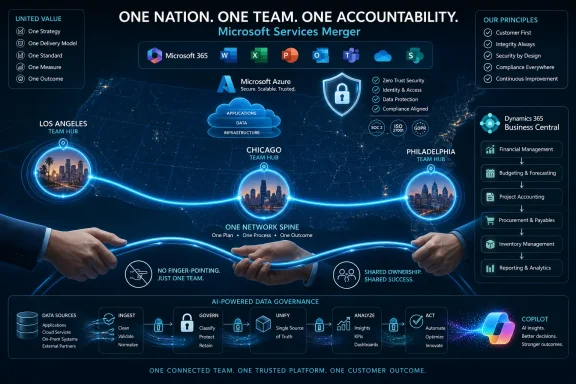 TechWise Is Selling Accountability, Not Just Scale
The merged company’s pitch is straightforward: three previously separate practices are now one Microsoft-focused services organization under the TechWise Group name. According to the company’s announcement, the combined firm will serve growth-oriented SMB and mid-market customers with managed IT, cybersecurity and compliance, ERP, Microsoft 365, Azure, and AI adoption services.That service menu matters, but the more interesting part is the operating model behind it. TechWise is arguing that the market has outgrown the era of modular Microsoft partners, at least for customers that are large enough to have compliance requirements, multi-site operations, finance-system complexity, and cloud governance problems, but not large enough to maintain an enterprise IT bureaucracy.
The firm’s own language is unusually blunt for a merger release. Lauren Schwartz, CEO of TechWise Group, framed the problem as customers buying Microsoft 365 and Azure from one vendor, managed IT from another, security from a third, and ERP from a fourth, then wondering why none of it works together. Eduardo Don Jr., CEO of Lumen21, put the risk in security terms: the gaps between vendors are where the risk lives. Munir Latif, CEO of L&L Consulting Services, made the ERP version of the same argument: implementations fail because of what happens outside the ERP.
That common diagnosis is the real merger rationale. This is not a roll-up that promises “synergies” in the abstract. It is a roll-up around a specific pain point: mid-market companies increasingly run on Microsoft’s cloud stack, but the work needed to make that stack reliable is scattered across too many professional-service silos.
The Microsoft Stack Has Become Too Interdependent for Fragmented Support
There was a time when an Office deployment, a server migration, and an accounting-system implementation could be treated as separate projects. That world has not disappeared, but it is increasingly fictional for companies built around Microsoft 365, Entra identity, Azure infrastructure, Defender security tooling, Teams collaboration, Power BI reporting, and Dynamics 365 Business Central.Identity is now security. Security is now compliance. Compliance depends on device management, retention rules, audit logs, and access controls. ERP success depends on clean data, stable infrastructure, user permissions, reporting pipelines, integrations, and the reliability of the endpoints and networks people use to touch the system.
The Copilot and AI adoption wave makes this entanglement even more obvious. A company cannot credibly deploy AI across its Microsoft estate if its SharePoint permissions are chaotic, its ERP data is inconsistent, its identity hygiene is poor, and its endpoints are unmanaged. AI does not magically create governance; it amplifies whatever governance already exists.
That is why TechWise’s merger lands at a strategically sensible moment. Microsoft has spent years knitting together productivity, cloud infrastructure, security, business applications, and now AI into a platform story. Customers, meanwhile, have often kept buying services as if those categories remain separable. TechWise is effectively saying the partner model has to catch up with the product model.
The Mid-Market Is Where Microsoft Complexity Hits Hardest
Enterprise customers have their own problems, but they usually have specialist teams, procurement muscle, and architectural governance boards to absorb platform complexity. Small businesses may have simpler environments and fewer formal requirements. The middle is where the trouble concentrates.A 300-person manufacturer, a regional life-sciences firm, a food and beverage distributor, or a professional-services company with several offices may have enough complexity to need serious Microsoft architecture but not enough staff to internalize every competency. These are the customers that can end up with a capable finance team, an overstretched IT manager, a part-time security consultant, a legacy ERP integrator, and a Microsoft licensing reseller all orbiting the same environment.
TechWise’s stated target is exactly that layer: SMB and mid-market companies that have scaled past what a single-discipline firm can handle. The merged company says it has hubs in Chicago, Philadelphia, and Los Angeles, giving it a national footprint across major time zones without pretending to be a global systems integrator.
That distinction matters. The mid-market often distrusts both extremes of the services market. A local MSP may be responsive but thin on ERP, Azure architecture, or regulated-industry security. A global consultancy may have every capability on paper but treat mid-sized accounts as a lower-margin delivery machine. The opportunity for a firm like TechWise is to occupy the gap: big enough to be multidisciplinary, small enough to remain accountable.
Each Merger Partner Fills a Different Failure Point
The announcement describes the three merged firms less as interchangeable MSP assets and more as complementary pieces of a full-stack Microsoft operating model. TechWise Group brings the Microsoft 365, Azure, managed IT, licensing, and adoption center of gravity. Lumen21 adds cybersecurity and compliance depth. L&L Consulting Services contributes finance-first ERP expertise around Dynamics 365 Business Central.That composition is notable because each practice maps to a point where mid-market Microsoft projects commonly break. Managed IT fails when it is disconnected from the business systems people actually use. Security fails when it sees only perimeter controls and not the workflows, identities, and data flows underneath. ERP fails when implementation is treated as a finance application project rather than an operating-model project.
The company’s public positioning leans heavily on this “no finger-pointing” theme. Its website describes TechWise as built to end the dynamic in which the ERP partner blames the network, the IT provider blames the software, and the customer is left refereeing vendors during outages, audits, and month-end close.
That rhetoric is polished, but it is also recognizable. Anyone who has worked in mid-market IT has seen a version of the same meeting: the MSP says the application is slow, the application vendor says the network is unstable, the security consultant says controls are missing, and the CFO only wants to know why the close is late. The merged TechWise is trying to turn that pain into a commercial differentiator.
Microsoft’s Partner Program Rewards Breadth, but Customers Need Proof
TechWise says it holds Microsoft Solutions Partner designations in Infrastructure and Azure, Modern Work, and Security, and that it is a Microsoft US SMB Champions Club Partner of the Year. Those labels are not trivial. Microsoft’s current partner designations replaced the older silver and gold competency system and are meant to signal verified capability, customer success, and technical performance in defined solution areas.Still, designations are not a substitute for delivery. The Microsoft partner ecosystem is full of badges, tiers, specializations, marketplace listings, and award language that can blur together for customers who just need a reliable environment. A mid-market customer does not buy a designation; it buys a lower-risk migration, a cleaner audit, a faster close, a more predictable Azure bill, and a support model that does not collapse during a crisis.
This is where the merger creates both opportunity and exposure. TechWise can now credibly tell a fuller Microsoft story than a narrower MSP or ERP boutique. But the broader the promise, the harder it is to hide delivery gaps. If one team claims to own the Microsoft environment end to end, customers will expect one team to answer when the environment fails end to end.
That is the useful tension in this deal. The merged company is not just expanding its addressable market. It is raising the standard by which it should be judged.
ERP Is the Quiet Center of the Deal
For WindowsForum readers, the Microsoft 365, Azure, and security angles may be the most immediately familiar. But the ERP component may be the most strategically important. Dynamics 365 Business Central is where technology projects become business transformation projects, and where a partner’s limitations become painfully visible.ERP implementation is unforgiving because it touches finance, inventory, procurement, sales operations, reporting, approvals, integrations, and compliance. A project can look successful in a demo and still fail in production if master data is poor, permissions are wrong, integrations are brittle, or the surrounding IT environment is unstable. Latif’s quote in the announcement gets at this directly: ERP implementations fail most often because of what happens outside the ERP.
That is also why the L&L Consulting Services contribution is more than a vertical add-on. A Business Central partner with finance-first expertise can understand the operational stakes of a close process, audit trail, chart of accounts, or reporting package. But when that expertise sits inside a broader managed IT, cloud, and security organization, the implementation can be treated as part of an architecture rather than an isolated software deployment.
The risk, of course, is that ERP specialization gets diluted inside a broader services brand. Finance teams tend to trust specialists because they speak in operational consequences rather than platform diagrams. TechWise’s challenge will be preserving that domain fluency while integrating delivery, sales, and support under a single umbrella.
Security and Compliance Are No Longer Adjacent Services
Lumen21’s role in the merger points to another industry shift: cybersecurity and compliance have moved from project work into the core of managed services. For regulated or quasi-regulated mid-market companies, security is no longer an annual assessment or a stack of tools. It is an everyday operating condition.The merged company’s materials emphasize compliance-native security work and SOC 2 Type II audited controls. It also describes experience around frameworks and requirements such as CMMC, HIPAA, FDA 21 CFR Part 11, and SOX. Those claims will resonate with customers in manufacturing, life sciences, food and beverage, and professional services, which TechWise identifies as industries where it has completed Microsoft cloud deployments.
The strategic reason is simple: compliance gaps often reveal themselves at the seams. An auditor does not care that one vendor manages endpoints while another controls identity and a third maintains ERP access. The organization being audited owns the whole system, even if it bought the system in fragments.
That makes a unified provider attractive, especially for companies without a large internal GRC function. But it also concentrates trust. A single accountable team reduces vendor ambiguity, while also making vendor due diligence more important. If TechWise wants to be the owner of security posture, ERP integrity, Microsoft 365 governance, Azure operations, and AI readiness, customers should examine not only its badges but its processes, escalation paths, incident handling, documentation quality, and contractual accountability.
AI Adoption Turns Vendor Fragmentation Into a Board-Level Problem
The merger announcement includes AI adoption in the combined service portfolio, and that phrase could easily be dismissed as obligatory 2026 marketing. It should not be. For Microsoft customers, AI adoption is becoming the forcing function that exposes every unresolved architecture decision underneath.Copilot-style deployments depend on identity, permissions, data quality, retention, endpoint security, user training, licensing, and business-process clarity. If a company’s file repositories are sprawling, its Teams governance is weak, former employees still have access, and ERP data is inconsistent, AI adoption becomes less an innovation program than a risk multiplier.
This is why TechWise’s thesis is more interesting than a standard managed-services expansion. The company is not simply saying it can help customers “use AI.” It is saying, implicitly, that AI adoption requires the same unified accountability as cloud, security, and ERP. That is a more defensible argument because it treats AI as an outcome of operational maturity rather than a feature toggle.
For Microsoft partners, that could become a major line of separation. The firms that sell AI readiness assessments without control over the underlying environment will struggle to make recommendations stick. The firms that already manage identity, data, devices, ERP, compliance, and cloud cost have a better chance of turning AI from a pilot into a governed business capability.
The Geography Is Modest, and That May Be the Point
The new TechWise footprint is national in reach but specific in physical presence: Chicago, Philadelphia, and Los Angeles. Those hubs cover the Midwest, East Coast, and West Coast, and they align with the company’s claim that it can serve customers across U.S. time zones.This is not the geography of a giant consultancy. It is the geography of a mid-market services firm trying to look large enough for continuity while staying close enough to customers to avoid becoming faceless. That balance is important in managed services, where the customer relationship often matters as much as the technical catalog.
Regional context also matters. A Chicago hub gives TechWise proximity to manufacturing, distribution, food and beverage, and broader Midwest industrial customers. Philadelphia connects naturally to life sciences, healthcare, financial services, and the Mid-Atlantic corridor. Los Angeles gives the company a West Coast presence across media, distribution, professional services, and multi-entity businesses.
Whether those hubs become true delivery centers or simply sales geography will matter. Customers should watch for named teams, regional engineering depth, and continuity of account knowledge. A national promise is useful only if the person answering the ticket understands the customer’s environment rather than just its contract tier.
The Merger Also Reflects a Larger MSP Consolidation Pattern
The managed-services market has been consolidating for years, pushed by security demands, cloud complexity, labor shortages, and private-capital interest in recurring revenue. Microsoft partners are not immune to that pressure. In fact, they may feel it more sharply because Microsoft’s portfolio keeps expanding into areas that used to belong to separate vendors.A partner that once made a living on Office 365 migrations now has to understand endpoint management, Entra identity, Defender, Purview, Teams Phone, SharePoint governance, Azure cost controls, Power Platform sprawl, Business Central, Fabric-adjacent analytics, and Copilot readiness. That is a lot for a small consultancy to cover credibly.
Mergers are one answer. They can assemble the capabilities customers already assume exist under one roof. They can also create cultural friction, overlapping systems, inconsistent delivery methods, and confused sales motion. The customer only experiences the promised “one team” if the integration work actually happens behind the scenes.
This is the part no press release can prove on day one. TechWise has a coherent story. It now has to make that story operationally boring, which is the highest compliment in managed services. The best version of this merger is not a splashy national brand; it is fewer customer meetings where everyone spends the first 20 minutes figuring out which vendor is responsible.
For Customers, One Throat to Choke Is Useful but Not Sufficient
The old enterprise phrase “one throat to choke” is crude, but it captures why unified providers appeal to executives. When something breaks, there is one accountable party. When a roadmap is built, one team sees the dependencies. When budgets are reviewed, one provider can connect licensing, infrastructure, support, security, and business applications.But accountability can become dependency. A customer that consolidates too much with one provider needs stronger governance, not weaker governance. Contracts should define response obligations, ownership boundaries, security responsibilities, documentation rights, data portability, and offboarding processes. The point of reducing vendor fragmentation is not to surrender institutional control.
Mid-market firms should also resist the temptation to hear “single partner” as “single magic answer.” The hard work still happens inside the customer’s organization. ERP decisions require finance leadership. Security posture requires executive backing. AI adoption requires data governance and user behavior change. Cloud cost discipline requires business owners who understand consumption.
A good partner can coordinate those domains. It cannot make executive decisions on behalf of the company. TechWise’s pitch is strongest when read as a promise of integrated execution, not outsourced judgment.
The Microsoft Ecosystem Is Moving Toward Outcome Ownership
The TechWise merger is worth watching because it aligns with Microsoft’s own direction of travel. Microsoft wants customers to consume a broader cloud, security, productivity, business-applications, and AI platform. That creates more opportunity for partners, but it also makes the old referral-chain model less satisfying.If a customer’s Microsoft estate is now an interconnected business platform, the partner ecosystem has to organize around outcomes rather than product lanes. “We manage your tenant” is not enough. “We implement Business Central” is not enough. “We deploy Defender” is not enough. The commercial question becomes whether the partner can make the whole environment work in the service of the business.
That is also where competition will sharpen. Other Microsoft partners already claim breadth across Azure, Modern Work, Security, Business Applications, and managed services. Some are larger than TechWise. Some have deeper specialization in one vertical. Some have more formal Microsoft designations. TechWise’s differentiation will have to come from execution for the mid-market segment it says it knows best.
The company’s current messaging is built around a recognizable enemy: finger-pointing. That is a useful villain because it is not abstract. It is the lived experience of customers trapped between MSPs, ERP consultants, security vendors, and licensing resellers. The question is whether TechWise can turn that frustration into a consistently better operating model.
The Real Test Comes After the Announcement Cycle
For IT leaders evaluating the merged company, the immediate news is less important than the post-merger integration. The announcement says the three firms are now operating under the TechWise Group name. Customers will want to know how quickly contracts, support processes, ticketing systems, security practices, project methodologies, and account teams become genuinely unified.The strongest sign would be architectural continuity. If the same team can discuss Business Central posting groups, Entra conditional access, endpoint compliance, Azure tagging, backup validation, Microsoft 365 governance, and audit evidence without pushing the customer into a vendor coordination meeting, the merger has teeth. If customers still experience separate practices with a shared logo, the deal becomes branding.
There is also a talent question. Services firms sell expertise, and expertise walks out the door if integration is mishandled. The announcement emphasizes former controllers, Microsoft-certified engineers, Microsoft MVPs, Microsoft alumni, and senior practitioners. Retaining those people and giving them a shared delivery culture will matter more than any corporate line about national coverage.
For WindowsForum’s audience, the practical lesson is broader than this one company. As Microsoft environments become more integrated, buyers should evaluate partners the same way they evaluate architecture: by dependencies, failure modes, and ownership. The vendor that can sell every component is not necessarily the vendor that can own the outcome.
The Bet TechWise Is Making in Plain English
The useful read on this merger is not that a Microsoft partner got bigger. It is that three specialties are being combined around a claim that mid-market technology failure is usually a coordination failure. That claim is plausible, and for many organizations it will sound painfully familiar.- The merged TechWise Group now combines managed IT, cybersecurity and compliance, ERP, Microsoft 365, Azure, and AI adoption under one national Microsoft partner brand.
- The deal brings together TechWise Group, Lumen21, and L&L Consulting Services, with hubs in Chicago, Philadelphia, and Los Angeles.
- The company is targeting SMB and mid-market customers that have outgrown single-discipline providers but do not want the cost or complexity of a global consultancy.
- The most important strategic addition may be the combination of Business Central ERP expertise with the surrounding infrastructure, security, identity, and Microsoft 365 work that determines whether ERP projects succeed.
- The merger’s credibility will depend on operational integration, not marketing language; customers should look for unified delivery, shared accountability, and clear contractual ownership.
- The AI adoption angle is meaningful only if TechWise can help customers fix the identity, permissions, data, compliance, and governance foundations that AI tools expose.
References
- Primary source: ACCESS Newswire
Published: 2026-07-07T14:12:07.612011
TechWise Group Merges, Expanding National Microsoft Services
TechWise Group, Lumen21, and L&L Consulting merge to provide unified managed IT, cybersecurity, compliance, and Microsoft cloud services.www.accessnewswire.com - Official source: microsoft.com
Your request has been blocked. This could be due to several reasons.
www.microsoft.com
- Official source: partner.microsoft.com
Partner of the Year Awards Winners
Meet our Partner of the Year Awards winners. Each year award recipients are selected based on their commitment to customers, the impact of their solutions, and their exemplary use of Microsoft technologies.partner.microsoft.com
- Related coverage: cbts.com

Microsoft Solutions Partner | Cloud, AI & Security | CBTS
Leverage Microsoft technologies with CBTS expertise. Advance cloud transformation, AI initiatives, cybersecurity, and workplace productivity.
www.cbts.com
- Related coverage: linkedin.com
TechWise Group | LinkedIn
TechWise Group | 749 followers on LinkedIn. We make technology work for your business to help you achieve more! | TechWise Group doesn’t just make technology work. We make technology work FOR your business; to help you achieve more. TechWise Group is a trusted tech partner with many awards...www.linkedin.com
- Related coverage: tier3tech.ie
- Related coverage: 2wtech.com
</rdf:Alt> </dc:title> <dc:description> <rdf:Alt> <rdf:li xml:lang="x-default"/> </rdf:Alt> </dc:description> <dc:creator> <rdf:Seq> <rdf:li>Sue Bre
</rdf:Alt> </dc:description> <dc:creator> <rdf:Seq> <rdf:li>Sue Bresee2wtech.com
- Related coverage: prlog.org
PRLog - TechWise Group Achieves Multiple Microsoft Gold Competencies
TechWise Group earns distinction and market leadership through demonstrated technology success and customer commitmentwww.prlog.org