

TeKnowledge’s arrival at WebSummit Qatar 2026 marks a practical turn in the region’s AI story: the company will be demonstrating what it calls enterprise‑ready agentic AI alongside Microsoft at the event in Doha, pitching a jump from pilots to production for governments and large organizations seeking measurable gains in productivity, customer experience, and decision support.
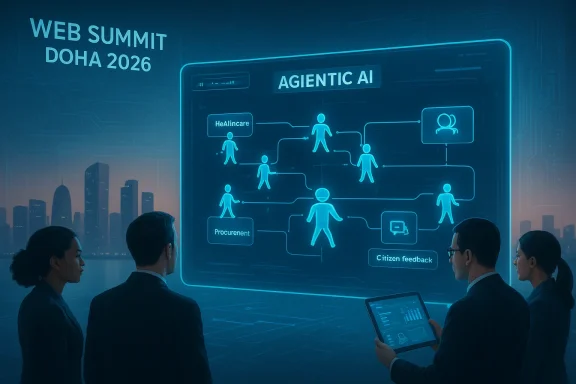
TeKnowledge is presenting itself as a systems integrator and adoption specialist that helps organizations move from AI experimentation to operational AI at scale. The company has publicly announced demonstrations of agentic AI adoption services at WebSummit Qatar (Doha, February 1–4, 2026) and highlighted a range of public‑sector deployments in Qatar that it says illustrate how intelligent agents can be applied across healthcare, procurement, citizen feedback analysis, and broader government operations.
This push is framed as part of Qatar’s broader digital ambitions under Vision 2030, and TeKnowledge emphasizes close partnership with Microsoft — specifically around Microsoft Copilot and agent frameworks — to deliver production‑grade solutions that combine automation, governance, and adoption support.
Multiple press releases and company posts recount the same set of performance claims and deployment metrics. Those figures come from the company and its distribution partners; they appear in TeKnowledge’s own materials and in syndicated press copies published around the announcement. Where I refer to performance numbers in this article I indicate where they are company‑reported and note when a claim is not independently verifiable.
Key elements of the TeKnowledge showcase include:
Readers should treat these figures as credible company claims supported by consistent reporting, but not as independently audited measurements.
For enterprises, that shift presents three potential upsides:
However, national AI adoption also raises questions:
Benefits include:
At the same time, the industry must temper enthusiasm with disciplined scrutiny. Company‑reported metrics are promising but require transparent methodologies and, ideally, third‑party validation. Operational risks from autonomous agents — cascading errors, privacy breaches, and vendor lock‑in — are real and require proactive architectural and contractual mitigations.
For IT leaders and policy makers evaluating agentic AI, the practical path is clear: pilot with measurable outcomes, codify governance before scale, mandate auditability and data portability, and invest in sustained human skilling. When those conditions are met, agentic AI can move from a buzzword to a durable productivity multiplier — but only if organizations pair technical capability with sober operational discipline.
Source: ZAWYA TeKnowledge brings enterprise‑ready agentic AI to WebSummit Qatar 2026
 Background / Overview
TeKnowledge is presenting itself as a systems integrator and adoption specialist that helps organizations move from AI experimentation to operational AI at scale. The company has publicly announced demonstrations of agentic AI adoption services at WebSummit Qatar (Doha, February 1–4, 2026) and highlighted a range of public‑sector deployments in Qatar that it says illustrate how intelligent agents can be applied across healthcare, procurement, citizen feedback analysis, and broader government operations.This push is framed as part of Qatar’s broader digital ambitions under Vision 2030, and TeKnowledge emphasizes close partnership with Microsoft — specifically around Microsoft Copilot and agent frameworks — to deliver production‑grade solutions that combine automation, governance, and adoption support.
Multiple press releases and company posts recount the same set of performance claims and deployment metrics. Those figures come from the company and its distribution partners; they appear in TeKnowledge’s own materials and in syndicated press copies published around the announcement. Where I refer to performance numbers in this article I indicate where they are company‑reported and note when a claim is not independently verifiable.
What TeKnowledge is showing at WebSummit Qatar 2026
Agentic AI on the enterprise floor
TeKnowledge is positioning agentic AI — software agents that carry out multi‑step tasks autonomously or semi‑autonomously on behalf of users — as the next phase of enterprise AI adoption, beyond basic Copilot integrations and single‑turn automation scripts.Key elements of the TeKnowledge showcase include:
- Agent orchestration for business workflows, presented as a way to automate multi‑step processes (procurement decisions, incident remediation, report generation).
- Copilot‑led front ends that unify interfaces for large employee populations, especially in healthcare and government.
- Governance and security layers meant to ensure agent decisions align with policy, data residency, and audit requirements.
- Skilling and change management programs designed to ramp thousands of users quickly and build internal adoption champions.
Use cases TeKnowledge highlights
TeKnowledge’s public messaging lists a set of high‑impact government use cases in Qatar:- A unified Microsoft Copilot interface streamlining workflows for thousands of healthcare employees.
- An AI‑driven analyzer that aggregates and interprets nationwide community feedback to inform policy and service design.
- An Intelligent Procurement Assistant that promises faster, more transparent purchasing decisions across government entities.
Verifying the claims: what’s documented and what’s company‑reported
TeKnowledge and syndicated press outlets have published several concrete metrics tied to Copilot rollouts in Qatar. The company reports:- More than 9,000 active users engaged with Copilot across government entities.
- Over 1.7 million Copilot‑powered actions executed.
- Productivity impact described as ~240,000 work hours saved.
- Function‑level improvements: HR support time reduced by 84%, financial reporting accelerated by 66%, and infrastructure monitoring time cut by 87%.
- More than 15,000 professionals trained in phase one, with an expansion into phase two covering 17 additional government and semi‑government entities.
Readers should treat these figures as credible company claims supported by consistent reporting, but not as independently audited measurements.
Why this matters: agentic AI, Copilot, and the enterprise readiness question
From Copilots to agents: a practical inflection point
Microsoft Copilot and similar large‑model copilots have been widely deployed as productivity overlays inside productivity suites. Agentic AI — agents that can plan, break down goals, call tools, and execute tasks across systems — represents a qualitative shift.For enterprises, that shift presents three potential upsides:
- Automating multi‑step, cross‑system workflows that previously required human coordination.
- Scaling specialist expertise by embedding subject‑matter logic into agents that can assist many employees or citizens simultaneously.
- Accelerating decision cycles via agents that can search, synthesize, and surface recommendations across datasets and services.
Enterprise‑readiness is about more than models
“Enterprise‑ready” must be defined by properties beyond raw model capability:- Data governance and residency: Where does agent‑processed data live? How are logs retained and protected?
- Access controls and role separation: Which agents can access financial systems, and how is privileged access audited?
- Explainability and audit trails: How are agent decisions justified when they affect citizen services or large procurements?
- Human‑in‑the‑loop controls: When must an agent pause for human approval?
- Resilience and rollback: How do you revert or quarantine a misbehaving agent?
Strengths in TeKnowledge’s approach
1. End‑to‑end adoption focus
One of the clearest strengths is TeKnowledge’s emphasis on adoption and skilling. Rapid agent deployments can create false starts if users aren’t trained or if the organization lacks change‑management discipline. The company’s claim of having trained thousands of staff and run structured adoption phases addresses a common failure mode.2. Microsoft partnership and ecosystem fit
TeKnowledge is leveraging Microsoft’s established enterprise stack (Copilot, Azure, identity and security tools). This has practical advantages:- Enterprises already invested in Microsoft technology face lower integration friction.
- Microsoft’s enterprise controls can be used as building blocks for agent governance.
- Working within a dominant vendor ecosystem simplifies procurement and operations for many public‑sector organizations.
3. Sector focus and demonstrated government experience
The company’s examples are sectoral and operational (healthcare workflows, procurement, citizen feedback). Governments require specialized compliance, so a partner with public‑sector experience is more likely to manage the policy and procurement constraints that accompany national digital transformation.Risks, gaps, and cautionary points
1. Metrics without transparent methodology
The press materials present compelling efficiency gains and hours‑saved figures, but the methodology underlying these metrics is not publicly documented. Questions to ask before accepting headline numbers:- How were “Copilot‑powered actions” defined and counted?
- What baseline productivity measurements were used to calculate hours saved?
- Were impacts measured across representative time periods and user cohorts?
2. Operational risk from agent autonomy
Agentic systems that make multi‑step decisions introduce specific operational risks:- Cascading failures: An agent that misreads a policy or misorders a procurement step can propagate errors across systems.
- Over‑automation: Agents may perform actions that require human discretion, leading to inappropriate outcomes if fail‑safes are not enforced.
- Security exposure: Agents with unfettered system access can amplify a compromised credential into broad system damage.
3. Privacy and citizen trust in public‑sector deployments
Public sector agents that analyze community feedback or automate citizen services must adhere to stringent privacy expectations. Key considerations:- Are community feedback datasets anonymized and handled per local data‑protection rules?
- How is opt‑in / opt‑out managed for citizens whose data might be analyzed?
- How are citizen communications labeled when an interaction was generated or moderated by an AI agent?
4. Vendor lock‑in and long‑term maintainability
Relying heavily on a single vendor stack — for example, Copilot plus tightly integrated agent frameworks — can speed deployment but create long‑term dependencies. Public entities should insist on:- Clear portability plans for agent logic and data exports.
- Documentation and runbooks that permit in‑house or alternate vendor support.
- Contract terms that define ownership of agent configurations, training data, and custom integrations.
5. Skills gap and change fatigue
Training 15,000 people (as TeKnowledge reports) is notable, but scale brings heterogeneity in skills and acceptance. Ongoing upskilling, governance refreshes, and periodic audits are required to avoid backsliding into shadow processes.Practical advice for IT leaders considering agentic AI adoption
If your organization is evaluating agentic AI or is approached by vendors claiming rapid time‑to‑value, follow a structured approach:- Start with a rigorous pilot that includes:
- A clear business metric (time saved, error rate reduction).
- A defined user cohort and a baseline measurement period.
- Design a governance framework before you grant agents any production privileges:
- Define approval gates, audit trails, and incident response steps.
- Test explainability and human‑in‑the‑loop behaviors:
- Require agents to provide human‑readable rationales for decisions that alter entitlements or expenditures.
- Plan for data portability and vendor exit:
- Contractually ensure agent definitions, logs, and training artifacts can be exported.
- Invest in sustained skilling and adoption:
- Not just a one‑time training event — continuous learning tracks and internal champion networks are essential.
The geopolitics of national AI adoption: Qatar’s Vision 2030 and regional implications
Qatar’s Vision 2030 emphasizes a knowledge‑based economy, and national technology initiatives are increasingly oriented toward adopting AI at scale. Deployments that automate citizen services, improve procurement transparency, and streamline health workflows align with that strategy.However, national AI adoption also raises questions:
- How will cross‑border data flows be managed, especially when global cloud providers are involved?
- Which local regulations must be updated to govern autonomous agents that participate in governance or procurement decisions?
- How will public accountability be maintained when algorithmic agents influence policy outcomes?
The vendor perspective: what TeKnowledge is selling — and why customers might buy it
From a vendor standpoint, TeKnowledge’s offering bundles several valuable elements:- Technical integration: connecting agents to legacy ERP, HR, financial reporting, and monitoring systems.
- Operationalization: packaging workflows, governance templates, and monitoring dashboards so agents can run reliably.
- Adoption support: training thousands of staff, creating change champions, and embedding agents into daily workflows.
Where agentic AI fits inside the broader Microsoft ecosystem
Microsoft’s Copilot and agent tooling are increasingly positioned as the enterprise default for AI augmentation. The combination of Microsoft’s identity, security, and cloud infrastructure reduces friction for organizations already standardized on the Microsoft stack.Benefits include:
- Unified authentication and enterprise policy enforcement.
- Managed cloud infrastructure for data governance and residency.
- Tooling that simplifies agent orchestration across Microsoft 365, Azure services, and third‑party APIs.
Technical considerations for secure, auditable agent deployments
To achieve true enterprise readiness, agent deployments should include:- Fine‑grained access controls: Agents must authenticate with scoped, ephemeral credentials; long‑lived keys should be avoided.
- Immutable logging and tamper‑proof audit trails: Audit logs must be tamper‑resistant and retained according to compliance requirements.
- Model provenance and dataset lineage: Be able to trace training and fine‑tuning data that influence agent behavior, especially when decisions impact citizens or finances.
- Robust monitoring and anomaly detection: Detect behavioral drift or unintended agent actions quickly and automatically.
- Fail‑safe governance: Automatic human escalation when confidence scores drop below thresholds or when decisions cross policy boundaries.
Market implications: who benefits and who competes
The agentic AI opportunity creates a competitive landscape that includes:- System integrators and managed service providers who can stitch agent tech into enterprise operations.
- Cloud platform providers who embed agent orchestration as a value‑add on their infrastructure.
- Niche startups building industry‑specific agent playbooks (healthcare triage, procurement bots).
- Consultancies and skilling vendors that can provide change management at scale.
Conclusion: measured optimism and practical caution
TeKnowledge’s presence at WebSummit Qatar 2026 is a useful bellwether: agentic AI is moving from demo halls into government program offices and enterprise digital transformation roadmaps. The company’s emphasis on adoption, governance, and Microsoft ecosystem integration addresses several of the central blockers that have historically stalled automation efforts.At the same time, the industry must temper enthusiasm with disciplined scrutiny. Company‑reported metrics are promising but require transparent methodologies and, ideally, third‑party validation. Operational risks from autonomous agents — cascading errors, privacy breaches, and vendor lock‑in — are real and require proactive architectural and contractual mitigations.
For IT leaders and policy makers evaluating agentic AI, the practical path is clear: pilot with measurable outcomes, codify governance before scale, mandate auditability and data portability, and invest in sustained human skilling. When those conditions are met, agentic AI can move from a buzzword to a durable productivity multiplier — but only if organizations pair technical capability with sober operational discipline.
Source: ZAWYA TeKnowledge brings enterprise‑ready agentic AI to WebSummit Qatar 2026
