

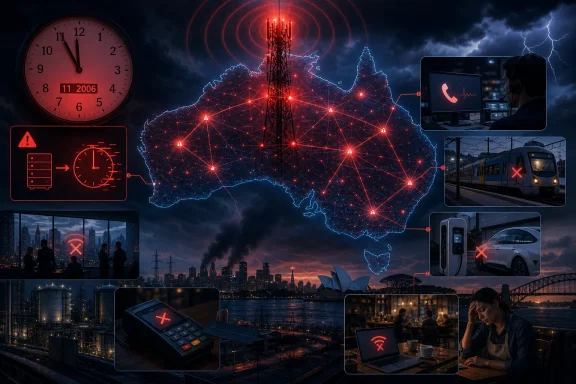
Telstra’s national mobile network collapsed within minutes early Wednesday after a software fault pushed critical time-telling systems back to November 2006, disrupting millions of customers, train services, EV chargers, Eftpos payments and some triple-zero calls before chief executive Vicki Brady was informed at 7am Sydney time. The immediate cause was technical, but the wider lesson is operational: a single carrier fault can now interrupt emergency access, transport, payments and connected equipment at the same time.
For consumers, the practical response during a mobile outage is to try another carrier or network where one is available; use Wi-Fi calling or an internet calling service if it was already configured; and, in an emergency, seek a landline or another person’s phone. Retrying a failed triple-zero call must not be presented as sufficient emergency advice. These are general resilience measures, not confirmed Telstra instructions for this incident.
Telstra now faces a Senate grilling, an Australian Communications and Media Authority investigation and potential civil penalties of up to $30m. The larger policy question is whether Australia’s telecommunications rules adequately cover the services that have come to depend on mobile connectivity.
The outage was Telstra’s third major national failure in less than a year. For a $56bn company powering about 25 million Australian mobile services, recurrence matters alongside root cause. Repeated nationwide incidents make prevention, escalation and emergency continuity questions for senior management and regulators, not engineering teams alone.
The failure sounds almost absurdly small. A software fault caused part of Telstra’s timing infrastructure to communicate that the date was November 2006, and within minutes the network began rejecting its own customers.
Modern mobile infrastructure depends on accurate time for more than displaying clocks. Network components can use shared timing to coordinate operations, order transactions and determine whether authentication information remains valid. If an authoritative component reports a date almost 20 years out of step, connected systems may treat legitimate devices, sessions or credentials as untrustworthy.
Guardian Australia, in reporting that incorporated material from Australian Associated Press, described an expert’s account of a “digital domino chain fall”: the incorrect date moved into connected systems, disrupting security and authentication processes and forcing users off the network. That propagation sequence is verified reporting about the incident. The precise internal architecture, however, remains a matter for Telstra’s investigation and ACMA’s examination; it should not be inferred from the public description alone.
The effects extended beyond ordinary calls and data. Some train services were taken offline, some EV chargers stopped working and shops were unable to use Eftpos. These were not separate accidents. They were examples of services whose operation depended on communications supplied directly or indirectly through the affected network.
Most seriously, some customers could not reach triple zero. Telstra subsequently conducted 639 welfare checks involving emergency-service callers, and seven people required assistance after initially failing to get through.
Each failed emergency call represents a moment when a person could not rely on the normal route for seeking help. That raises the standard against which the outage must be judged. Restoration time and the percentage of customers affected matter, but they cannot substitute for an account of what happened to emergency calls and how alternative arrangements worked.
Federal minister Jason Clare put the stakes plainly: “People could have lost their lives and that’s why there’s an investigation by Acma.” The investigation must therefore cover not just the technical trigger but containment, emergency-call handling, customer protection and incident escalation.
The delay does not by itself prove that Telstra’s escalation process failed. Operations teams should be capable of responding to faults without waiting for the chief executive, and the appropriate time for executive notification depends on what was known as an incident developed.
But this was not a routine fault. It became a national mobile disruption affecting emergency calls and services outside telecommunications. The Senate can reasonably ask when Telstra first classified it at that level, what threshold required notification of senior executives, whether that threshold was met earlier than 7am and who had authority to coordinate the company-wide response before Brady was alerted.
Brady said Telstra’s incident processes “worked as they should have”. She argued that the problem was identified and teams worked to rectify it as quickly as possible: “As the incident occurred, it was identified and then we worked to rectify it as quickly as possible.”
That defence addresses detection and restoration. It does not resolve prevention or containment. An incident process may find and repair a fault while still leaving open whether technical controls should have blocked the fault before it spread.
Telstra’s investigation therefore needs to answer a concise set of engineering questions. Why was the incorrect time accepted? What independent references were available? Could the anomalous value have been quarantined? Why did the effects cross enough network boundaries to create a national event? What testing was performed around the relevant software or maintenance work, and did it include startup or restart scenarios involving an implausible date?
Those are questions, not conclusions about Telstra’s internal design. The public facts establish the wrong-date event and its consequences; they do not yet establish the precise defect, architecture, propagation path or control failure.
The pledge is necessary, but it must produce evidence that can be evaluated outside Telstra. Customers can accept that complex networks sometimes fail. What requires closer scrutiny is a pattern of major incidents and whether corrective actions from earlier failures were sufficiently broad, tested and independently checked.
Telstra discussed the case of an elderly woman in South Australia who died during the disruption. Telstra and South Australia police concluded that the outage was not responsible for her death. That conclusion must be stated clearly: the available findings did not attribute the death to the outage.
Brady spoke to the family, offered condolences and apologised because relatives were unable to contact one another when the woman became unwell. The case should not be used to imply causation that investigators did not find. It nevertheless illustrates the distress that a communications failure can add during a medical emergency, even where it does not cause the emergency or change its outcome.
The seven triple-zero users who required assistance after failed attempts provide a more direct measure of exposure. Telstra needs to account for how those failures were detected, how quickly welfare checks began, what information was passed to emergency services and whether any backup routing or cross-network mechanisms behaved differently from expectations.
Consumer guidance must also be unambiguous. During an emergency, people should not be left to infer that repeatedly trying the same failed route is a complete fallback plan. Where possible, they should attempt another carrier or network, use a landline, seek another person’s phone, or use Wi-Fi calling or an internet calling service if it is already available and suitable. Not every option will work in every location, and internet calling services are not automatically substitutes for triple zero. The point is to provide multiple practical paths rather than a single instruction to keep retrying.
That guidance is general outage-preparedness advice. It should not be attributed to Telstra unless the company’s confirmed incident communications support the attribution.
The comparison is relevant, but its limits matter. An identical type of time-reset change does not establish that the Jersey provider and Telstra used the same software, system architecture, maintenance procedure, propagation path or safeguards. It does not prove that Telstra had the same defect or that its outage was preventable in precisely the same way.
What the Jersey event does establish is that corrupted time in telecommunications infrastructure belongs to a known failure class with potentially serious consequences. It gives carriers and regulators a reason to test how networks respond to implausible clock changes, without allowing them to assume that two superficially similar incidents share one cause.
The appropriate regulatory question is therefore not whether Telstra should have copied a specific Jersey fix. It is whether Telstra’s risk analysis considered anomalous time inputs and whether its safeguards were tested against realistic failure conditions.
Industry experience should inform threat modelling, but it is not evidence of negligence by itself. Determining preventability requires Telstra’s logs, configuration records, change history, test results and internal risk assessments.
That principle needs to be stated once and then tested directly. ACMA’s examination of Telstra’s network maintenance and configuration should determine whether supposedly separate systems shared the condition that allowed the date change to spread.
Maintenance can temporarily alter normal protections by taking systems out of service, restarting equipment or changing operating states. Configuration determines whether an anomalous value is accepted, rejected, compared with another source or isolated before downstream systems act on it.
Telstra has not completed its investigation, so it would be premature to claim that a particular maintenance action or configuration decision caused the collapse. “Software fault” identifies the trigger reported so far, but it does not answer why the trigger produced such wide consequences.
ACMA should examine the controls around timing validation, maintenance approval, rollback, monitoring, alert thresholds, escalation and separation between production domains. It should also determine whether Telstra’s testing reproduced the abnormal state involved in the outage rather than merely confirming that equipment operated normally under valid inputs.
The decisive test is practical: can the network detect an implausible date, prevent it from becoming authoritative, isolate affected components and maintain emergency-service access while operators investigate?
Mobile services are widely available and relatively simple to deploy, making them attractive for payments, remote equipment, telemetry and machine-to-machine communication. The efficiency can obscure concentration risk. When unrelated operators depend on the same carrier or mobile core, one outage can interrupt several sectors at once.
The effect on train services is especially significant because it connects a telecommunications fault to physical transport operations. RMIT Associate Professor Mark Gregory observed that “connecting railway networks over mobile didn’t happen” when Australia’s foundational telecommunications legislation was written.
EV chargers illustrate a similar issue. A charger may retain electrical power and functioning hardware but still become unavailable if it cannot communicate with systems used for payment, authorisation or management. Eftpos disruption can likewise leave a business open and stocked but unable to complete ordinary transactions.
The correct response is not to demand carrier-grade engineering from every small business. It is to identify which services cannot tolerate the loss of one communications provider and give those services a genuinely separate fallback.
A fixed broadband service and a mobile backup are not necessarily separate if both ultimately rely on the same carrier, operational platform or shared infrastructure. Organisations need to know the actual failure domains behind the services they buy.
That statement should be treated as Telstra’s current position, not as evidence that the question has already been resolved. The supplied facts do not establish that the restructure caused the outage, and it would be irresponsible to imply otherwise.
Scrutiny of organisational change is nevertheless legitimate after a major operational failure. Restructures can alter system ownership, approval chains, institutional knowledge and the number of specialists available to review risky work.
The inquiry should not speculate about whether a particular former employee would have prevented the incident. It should examine whether responsibility for timing infrastructure changed, whether staffing or approval arrangements were altered, and whether the merger of technology divisions created ambiguity in maintenance or incident management.
Brady said: “There is no indication that any restructuring of jobs has impacted on this particular issue. We will be very transparent and are committed to implementing changes that might be needed.”
Telstra can support that position by producing records showing that expertise, staffing, ownership and review controls remained adequate. If the evidence confirms that restructuring was unrelated, the inquiry should say so. If it reveals a relevant change in oversight, that should form part of the corrective plan.
The practical issue behind that language is accountability. Telstra’s scale and historical position mean that governments, businesses and consumers use its services for functions whose consequences extend beyond an ordinary commercial interruption.
Telstra must provide ACMA with a report within 45 days of the outage. Deputy ACMA chair Adam Suckling said it must explain “very, very clearly why it happened and what the steps that they’ve taken to make sure it won’t happen again”.
The regulator’s investigation will examine network maintenance and configuration. Under powers introduced after the 2025 Optus outage, Telstra could face civil penalties of up to $30m.
A penalty may punish noncompliance, but it cannot by itself demonstrate that the fault has been contained. The more important outcome is independently testable corrective work.
Wells described a gap between three decades of telecommunications regulation and what modern customers expect. “It is beholden on all of us to address that gap. We’ve been working on it. We’re closing it,” she said. “It is not closed and we all need to do a lot more work to make sure that it closes.”
2020 — A telecommunications provider in Jersey experienced a reported time-reset event that also affected emergency-service calling. The comparison identifies a known failure class, not a proven common defect.
2025 — The Optus outage prompted the Australian government to introduce regulatory powers under which Telstra could face civil penalties of up to $30m.
May — Telstra dismissed more than 100 employees and merged two of its largest technology divisions. Brady said there was no indication that the restructuring affected this incident.
Wednesday — Telstra’s outage began, widespread mobile disruption developed within minutes, and Brady was informed at 7am Sydney time, two and a half hours after the disruption started.
Friday — Brady returned to Australia.
Saturday — A Senate grilling was announced. A meeting of the relevant parliamentary inquiry could occur as early as the following week; the verified facts do not establish a snap meeting or confirm which executives would appear.
The Telecommunications Act came into effect in 1997, “back when the internet was brand new,” Gregory said. Smartphones had not been invented, and today’s routine uses of connected mobile equipment had not developed.
The age of a law does not automatically make it ineffective. Legislation can be amended, supplemented by standards and applied to technologies its original authors did not anticipate.
The harder problem is scope. Traditional telecommunications regulation focuses primarily on carriers, services and customers. Contemporary continuity planning must also account for the organisations using carrier connections to operate payments, transport, energy equipment and emergency-related systems.
Outage registers, customer notifications and post-incident reports can improve transparency. They do not prove that a railway operator, charging network, retailer or care facility has a communications path that will survive the loss of its primary carrier.
The next phase of regulation should therefore address shared failure domains as well as carrier conduct. Critical-service operators need clear expectations for communications diversity, offline operation and emergency procedures. Carriers need obligations that allow critical customers to understand whether supposedly separate products share a material dependency.
This need not involve publication of sensitive network diagrams. It requires enough disclosure for a customer to determine whether a fixed service and mobile backup could be lost in the same carrier event.
That is the standard the investigation should pursue. The country does not need another broad promise that lessons will be learned. It needs proof that an implausible clock change will be stopped before it crosses the network, that emergency communications have workable alternatives, and that organisations relying on mobile connectivity understand where one failure can still disable every path they thought they had.
For consumers, the practical response during a mobile outage is to try another carrier or network where one is available; use Wi-Fi calling or an internet calling service if it was already configured; and, in an emergency, seek a landline or another person’s phone. Retrying a failed triple-zero call must not be presented as sufficient emergency advice. These are general resilience measures, not confirmed Telstra instructions for this incident.
Telstra now faces a Senate grilling, an Australian Communications and Media Authority investigation and potential civil penalties of up to $30m. The larger policy question is whether Australia’s telecommunications rules adequately cover the services that have come to depend on mobile connectivity.
The outage was Telstra’s third major national failure in less than a year. For a $56bn company powering about 25 million Australian mobile services, recurrence matters alongside root cause. Repeated nationwide incidents make prevention, escalation and emergency continuity questions for senior management and regulators, not engineering teams alone.
 A Wrong Date Became a National Emergency
The failure sounds almost absurdly small. A software fault caused part of Telstra’s timing infrastructure to communicate that the date was November 2006, and within minutes the network began rejecting its own customers.Modern mobile infrastructure depends on accurate time for more than displaying clocks. Network components can use shared timing to coordinate operations, order transactions and determine whether authentication information remains valid. If an authoritative component reports a date almost 20 years out of step, connected systems may treat legitimate devices, sessions or credentials as untrustworthy.
Guardian Australia, in reporting that incorporated material from Australian Associated Press, described an expert’s account of a “digital domino chain fall”: the incorrect date moved into connected systems, disrupting security and authentication processes and forcing users off the network. That propagation sequence is verified reporting about the incident. The precise internal architecture, however, remains a matter for Telstra’s investigation and ACMA’s examination; it should not be inferred from the public description alone.
The effects extended beyond ordinary calls and data. Some train services were taken offline, some EV chargers stopped working and shops were unable to use Eftpos. These were not separate accidents. They were examples of services whose operation depended on communications supplied directly or indirectly through the affected network.
Most seriously, some customers could not reach triple zero. Telstra subsequently conducted 639 welfare checks involving emergency-service callers, and seven people required assistance after initially failing to get through.
Each failed emergency call represents a moment when a person could not rely on the normal route for seeking help. That raises the standard against which the outage must be judged. Restoration time and the percentage of customers affected matter, but they cannot substitute for an account of what happened to emergency calls and how alternative arrangements worked.
Federal minister Jason Clare put the stakes plainly: “People could have lost their lives and that’s why there’s an investigation by Acma.” The investigation must therefore cover not just the technical trigger but containment, emergency-call handling, customer protection and incident escalation.
Telstra Restored the Network but Still Has Questions to Answer
Brady learned of the outage at 7am Sydney time on Wednesday, two and a half hours after it began. The verified account supports that a voicemail from Telstra’s head of operations alerted her and that she returned to Australia on Friday.The delay does not by itself prove that Telstra’s escalation process failed. Operations teams should be capable of responding to faults without waiting for the chief executive, and the appropriate time for executive notification depends on what was known as an incident developed.
But this was not a routine fault. It became a national mobile disruption affecting emergency calls and services outside telecommunications. The Senate can reasonably ask when Telstra first classified it at that level, what threshold required notification of senior executives, whether that threshold was met earlier than 7am and who had authority to coordinate the company-wide response before Brady was alerted.
Brady said Telstra’s incident processes “worked as they should have”. She argued that the problem was identified and teams worked to rectify it as quickly as possible: “As the incident occurred, it was identified and then we worked to rectify it as quickly as possible.”
That defence addresses detection and restoration. It does not resolve prevention or containment. An incident process may find and repair a fault while still leaving open whether technical controls should have blocked the fault before it spread.
Telstra’s investigation therefore needs to answer a concise set of engineering questions. Why was the incorrect time accepted? What independent references were available? Could the anomalous value have been quarantined? Why did the effects cross enough network boundaries to create a national event? What testing was performed around the relevant software or maintenance work, and did it include startup or restart scenarios involving an implausible date?
Those are questions, not conclusions about Telstra’s internal design. The public facts establish the wrong-date event and its consequences; they do not yet establish the precise defect, architecture, propagation path or control failure.
Emergency Calling Changes the Standard of Proof
Brady said she took responsibility for maintaining confidence in triple zero “extremely seriously”. She also promised a full investigation: “We will complete our investigation into the actions needed to prevent it from happening again. You have my commitment on that.”The pledge is necessary, but it must produce evidence that can be evaluated outside Telstra. Customers can accept that complex networks sometimes fail. What requires closer scrutiny is a pattern of major incidents and whether corrective actions from earlier failures were sufficiently broad, tested and independently checked.
Telstra discussed the case of an elderly woman in South Australia who died during the disruption. Telstra and South Australia police concluded that the outage was not responsible for her death. That conclusion must be stated clearly: the available findings did not attribute the death to the outage.
Brady spoke to the family, offered condolences and apologised because relatives were unable to contact one another when the woman became unwell. The case should not be used to imply causation that investigators did not find. It nevertheless illustrates the distress that a communications failure can add during a medical emergency, even where it does not cause the emergency or change its outcome.
The seven triple-zero users who required assistance after failed attempts provide a more direct measure of exposure. Telstra needs to account for how those failures were detected, how quickly welfare checks began, what information was passed to emergency services and whether any backup routing or cross-network mechanisms behaved differently from expectations.
Consumer guidance must also be unambiguous. During an emergency, people should not be left to infer that repeatedly trying the same failed route is a complete fallback plan. Where possible, they should attempt another carrier or network, use a landline, seek another person’s phone, or use Wi-Fi calling or an internet calling service if it is already available and suitable. Not every option will work in every location, and internet calling services are not automatically substitutes for triple zero. The point is to provide multiple practical paths rather than a single instruction to keep retrying.
That guidance is general outage-preparedness advice. It should not be attributed to Telstra unless the company’s confirmed incident communications support the attribution.
The Jersey Incident Is a Failure-Class Warning
Guardian Australia reported that a telecommunications provider in Jersey suffered an outage in 2020 involving the same broad type of time-reset event. Emergency-service calling was also affected.The comparison is relevant, but its limits matter. An identical type of time-reset change does not establish that the Jersey provider and Telstra used the same software, system architecture, maintenance procedure, propagation path or safeguards. It does not prove that Telstra had the same defect or that its outage was preventable in precisely the same way.
What the Jersey event does establish is that corrupted time in telecommunications infrastructure belongs to a known failure class with potentially serious consequences. It gives carriers and regulators a reason to test how networks respond to implausible clock changes, without allowing them to assume that two superficially similar incidents share one cause.
| Dimension | Telstra national outage | Jersey telco outage |
|---|---|---|
| Timing | Wednesday, before Brady was informed at 7am Sydney time | 2020 |
| Time-reset symptom | Part of the system communicated November 2006 | Same broad type of time-reset change reported |
| Network effect | National mobile disruption developed within minutes | Telecommunications outage |
| Emergency impact | Some triple-zero calls failed | Emergency-service calling was affected |
| What the comparison proves | Wrong time could produce wide operational effects | The failure class had previously affected a carrier |
| What it does not prove | A particular defect, architecture or control failure | That Jersey and Telstra shared the same technical cause |
Industry experience should inform threat modelling, but it is not evidence of negligence by itself. Determining preventability requires Telstra’s logs, configuration records, change history, test results and internal risk assessments.
Redundancy Must Be Tested for Common-Mode Failure
Network redundancy is useful only when backup systems do not repeat the primary system’s error. Multiple nodes, routes or timing sources can still fail together if they trust the same corrupted input, share a software assumption or are exposed to one maintenance action.That principle needs to be stated once and then tested directly. ACMA’s examination of Telstra’s network maintenance and configuration should determine whether supposedly separate systems shared the condition that allowed the date change to spread.
Maintenance can temporarily alter normal protections by taking systems out of service, restarting equipment or changing operating states. Configuration determines whether an anomalous value is accepted, rejected, compared with another source or isolated before downstream systems act on it.
Telstra has not completed its investigation, so it would be premature to claim that a particular maintenance action or configuration decision caused the collapse. “Software fault” identifies the trigger reported so far, but it does not answer why the trigger produced such wide consequences.
ACMA should examine the controls around timing validation, maintenance approval, rollback, monitoring, alert thresholds, escalation and separation between production domains. It should also determine whether Telstra’s testing reproduced the abnormal state involved in the outage rather than merely confirming that equipment operated normally under valid inputs.
The decisive test is practical: can the network detect an implausible date, prevent it from becoming authoritative, isolate affected components and maintain emergency-service access while operators investigate?
The Blast Radius Now Extends Far Beyond Phones
The interruption of trains, EV chargers and Eftpos demonstrates how mobile connectivity has become embedded in other sectors.Mobile services are widely available and relatively simple to deploy, making them attractive for payments, remote equipment, telemetry and machine-to-machine communication. The efficiency can obscure concentration risk. When unrelated operators depend on the same carrier or mobile core, one outage can interrupt several sectors at once.
The effect on train services is especially significant because it connects a telecommunications fault to physical transport operations. RMIT Associate Professor Mark Gregory observed that “connecting railway networks over mobile didn’t happen” when Australia’s foundational telecommunications legislation was written.
EV chargers illustrate a similar issue. A charger may retain electrical power and functioning hardware but still become unavailable if it cannot communicate with systems used for payment, authorisation or management. Eftpos disruption can likewise leave a business open and stocked but unable to complete ordinary transactions.
The correct response is not to demand carrier-grade engineering from every small business. It is to identify which services cannot tolerate the loss of one communications provider and give those services a genuinely separate fallback.
A fixed broadband service and a mobile backup are not necessarily separate if both ultimately rely on the same carrier, operational platform or shared infrastructure. Organisations need to know the actual failure domains behind the services they buy.
What Businesses and Critical-Service Operators Should Do Now
Businesses do not need to wait for Telstra’s final report to review their own continuity arrangements. At a minimum, operators should:- Map carrier and mobile-core dependencies. Record which carrier, reseller, mobile core and upstream service support each critical connection, including embedded SIMs and managed devices.
- Test fixed and mobile failover for shared exposure. Confirm whether a backup mobile service uses the same carrier or operational infrastructure as the primary fixed service.
- Maintain an alternative path for critical sites. Where consequences justify it, use another carrier or a non-cellular option rather than relying on two services with one failure domain.
- Enable offline payment and authorisation procedures. Decide which transactions can continue safely during a connectivity loss, set limits and train staff before an outage occurs.
- Document emergency-call fallbacks. Identify available landlines, alternative-carrier devices, nearby staffed locations and escalation contacts for sites responsible for vulnerable people or essential operations.
- Test the arrangements. Conduct exercises in which the primary carrier is treated as completely unavailable, rather than assuming failover will work because a dashboard shows it as healthy.
Restructuring Is Not a Proven Cause, but It Is a Fair Question
In May, Telstra dismissed more than 100 employees and merged two of its largest technology divisions. Brady said there was no indication that the restructuring of jobs had affected this incident.That statement should be treated as Telstra’s current position, not as evidence that the question has already been resolved. The supplied facts do not establish that the restructure caused the outage, and it would be irresponsible to imply otherwise.
Scrutiny of organisational change is nevertheless legitimate after a major operational failure. Restructures can alter system ownership, approval chains, institutional knowledge and the number of specialists available to review risky work.
The inquiry should not speculate about whether a particular former employee would have prevented the incident. It should examine whether responsibility for timing infrastructure changed, whether staffing or approval arrangements were altered, and whether the merger of technology divisions created ambiguity in maintenance or incident management.
Brady said: “There is no indication that any restructuring of jobs has impacted on this particular issue. We will be very transparent and are committed to implementing changes that might be needed.”
Telstra can support that position by producing records showing that expertise, staffing, ownership and review controls remained adequate. If the evidence confirms that restructuring was unrelated, the inquiry should say so. If it reveals a relevant change in oversight, that should form part of the corrective plan.
Regulation Is Catching Up to a Networked Australia
Communications minister Anika Wells said Telstra occupies a “special trust” and is “respected as the premium service”. After the outage, she said that position “stands in peril” and promised to “hold Telstra’s feet to the fire”.The practical issue behind that language is accountability. Telstra’s scale and historical position mean that governments, businesses and consumers use its services for functions whose consequences extend beyond an ordinary commercial interruption.
Telstra must provide ACMA with a report within 45 days of the outage. Deputy ACMA chair Adam Suckling said it must explain “very, very clearly why it happened and what the steps that they’ve taken to make sure it won’t happen again”.
The regulator’s investigation will examine network maintenance and configuration. Under powers introduced after the 2025 Optus outage, Telstra could face civil penalties of up to $30m.
A penalty may punish noncompliance, but it cannot by itself demonstrate that the fault has been contained. The more important outcome is independently testable corrective work.
Wells described a gap between three decades of telecommunications regulation and what modern customers expect. “It is beholden on all of us to address that gap. We’ve been working on it. We’re closing it,” she said. “It is not closed and we all need to do a lot more work to make sure that it closes.”
Timeline
1997 — The Telecommunications Act commenced before smartphones and before widespread use of mobile networks for connected transport, payment and energy equipment.2020 — A telecommunications provider in Jersey experienced a reported time-reset event that also affected emergency-service calling. The comparison identifies a known failure class, not a proven common defect.
2025 — The Optus outage prompted the Australian government to introduce regulatory powers under which Telstra could face civil penalties of up to $30m.
May — Telstra dismissed more than 100 employees and merged two of its largest technology divisions. Brady said there was no indication that the restructuring affected this incident.
Wednesday — Telstra’s outage began, widespread mobile disruption developed within minutes, and Brady was informed at 7am Sydney time, two and a half hours after the disruption started.
Friday — Brady returned to Australia.
Saturday — A Senate grilling was announced. A meeting of the relevant parliamentary inquiry could occur as early as the following week; the verified facts do not establish a snap meeting or confirm which executives would appear.
A 1997 Framework Cannot See the Entire Dependency Chain
Gregory argued that Australia’s telecommunications legislation needs to be rebuilt “structurally from the ground up and in tune with the modern era”. His prescription was blunt: “We need to start again.”The Telecommunications Act came into effect in 1997, “back when the internet was brand new,” Gregory said. Smartphones had not been invented, and today’s routine uses of connected mobile equipment had not developed.
The age of a law does not automatically make it ineffective. Legislation can be amended, supplemented by standards and applied to technologies its original authors did not anticipate.
The harder problem is scope. Traditional telecommunications regulation focuses primarily on carriers, services and customers. Contemporary continuity planning must also account for the organisations using carrier connections to operate payments, transport, energy equipment and emergency-related systems.
Outage registers, customer notifications and post-incident reports can improve transparency. They do not prove that a railway operator, charging network, retailer or care facility has a communications path that will survive the loss of its primary carrier.
The next phase of regulation should therefore address shared failure domains as well as carrier conduct. Critical-service operators need clear expectations for communications diversity, offline operation and emergency procedures. Carriers need obligations that allow critical customers to understand whether supposedly separate products share a material dependency.
This need not involve publication of sensitive network diagrams. It requires enough disclosure for a customer to determine whether a fixed service and mobile backup could be lost in the same carrier event.
Five Reforms Telstra and ACMA Should Put to the Test
The government’s response to the 2025 Optus outage began closing the gap. The Telstra incident shows what the next stage should measure. The following are recommendations, not claims about controls that Telstra or ACMA already has in place.- Independent time-source validation. Critical network domains should compare authoritative time against independent references and generate high-severity alerts when the difference exceeds a tightly defined threshold.
- Automatic quarantine of implausible clock changes. A date shift measured in years should not propagate merely because one component presents itself as authoritative. Systems should reject, isolate or require controlled human approval for values outside credible operating bounds.
- Common-mode failure exercises. Telstra should run exercises in which primary and backup systems receive the same bad time, configuration or software state. The test should show whether emergency calling and minimum mobile service can continue despite the shared fault.
- Independent verification of corrective actions. ACMA should require evidence that fixes were deployed and tested under realistic failure conditions. Verification should extend beyond accepting a written assurance that a software patch or process change has been completed.
- Dependency disclosure for critical-service customers. Carriers should provide transport, payment, energy, health and other critical operators with enough information to identify when primary and backup services share a carrier, mobile core or material operational dependency.
That is the standard the investigation should pursue. The country does not need another broad promise that lessons will be learned. It needs proof that an implausible clock change will be stopped before it crosses the network, that emergency communications have workable alternatives, and that organisations relying on mobile connectivity understand where one failure can still disable every path they thought they had.