

 Inside Tesla’s Data-Labeling Operation: Private Footage, Flide Time, and Safety-Critical Work
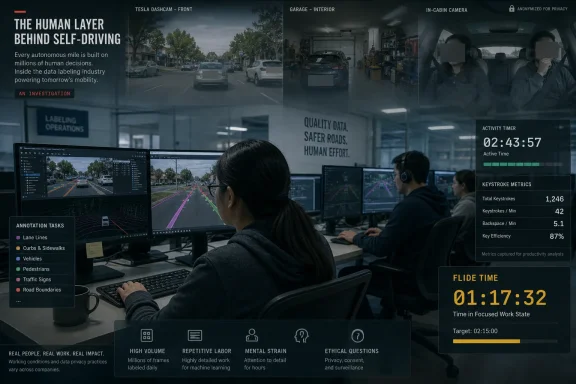
Tesla annotators reportedly do repetitive, safety-critical work for about $20 an hour while private footage, tightly measured in-app activity, and possible discipline create pressure points. The important limitation is that these are worker accounts about labeling operations—not proof of how a deployed Tesla vehicle behaves.Business Insider’s interviews with 17 current and former employees describe the human production line beneath Autopilot and Full Self-Driving. Full-time annotators in Buffalo, Palo Alto, and Draper reportedly turn customer-car images and short video clips into structured training data by marking objects, tracing lane lines, identifying curbs, and classifying scenes.
Their accounts raise concrete questions about access to sensitive footage, treatment of traumatic material, regional labeling instructions, and productivity measurements that may not capture all the judgment required by safety-critical annotation. The reporting does not establish that Tesla used every capability available in its workplace software or that every allegation reflects a formal companywide policy.
Tesla data-labeling fact box
- Reported locations: Buffalo, New York; Palo Alto, California; and Draper, Utah
- Reported pay: About $20 an hour for full-time annotation roles
- Expected Flide Time: Five to seven and a half hours per day, according to interviewed workers
- Five-minute allegation: Six workers said falling even five minutes short could trigger discipline
- Repeated-miss allegation: Workers said missing the requirement three times within six months could lead to termination
- HuMans caveat: Eye-tracking and audio capabilities were discussed in connection with the software, but the reporting did not establish that Tesla deployed those capabilities against annotation workers
Tesla’s Automated Future Starts With Human Repetition
Public discussion of artificial intelligence tends to emphasize software, cameras, computing power, and increasingly capable products. Business Insider’s reporting presents the less visible reality: Tesla’s driver-assistance development also depends on people reviewing images and short clips, marking relevant features, and deciding how scenes should be classified.According to workers interviewed by Business Insider, projects could last from a few days to several months. Some involved labeling short clips. Others required tracing still images or overlaying satellite data. One former employee described spending eight hours a day for months labeling lane lines and curbs across thousands of videos.
That repetition does not make the work trivial. A difficult scene may contain obscured road markings, contradictory visual cues, unusual driver behavior, or a regional rule that requires consultation. Individual labels become part of larger datasets used in development and evaluation, so consistent instructions and careful treatment of ambiguous examples matter even though no single annotation determines how a vehicle will behave.
Tesla distributed this work across facilities in Buffalo, Palo Alto, and Draper. The roughly $20-an-hour positions sit below the engineering and executive layers most commonly associated with automated driving, but the employees occupy an important point between raw camera footage and Tesla’s software-development process.
Elon Musk emphasized the financial importance of self-driving technology in 2022 when he described it as the difference between Tesla being worth a great deal and being worth essentially nothing. The operational foundation beneath that ambition includes employees performing thousands of small classification tasks under reported production expectations.
The Dataset Extends From Public Roads Into Private Spaces
Business Insider’s account shows how automotive data can move from public-road observation into private settings. Five workers said one project required annotators to label information captured inside some owners’ garages through Tesla’s Sentry Mode feature.A garage may reveal possessions, hobbies, other vehicles, household routines, family members, or parts of a home’s layout. Even when a clip is collected for a technical purpose, it can contain personal details unrelated to the task assigned to an annotator.
The reported “Selfie” project moved the camera inward. Two workers said they personally labeled or witnessed the labeling of footage from Tesla’s in-cabin cameras, while four additional workers told Business Insider that they knew of the program. According to those accounts, the project was intended to help Tesla recognize when a driver using Autopilot was not paying attention to the road.
Tesla’s owner documentation says that the cabin camera can share short video clips to support safety improvements and refine camera-dependent features. Tesla also says owners must opt in to data sharing before labelers can access their videos.
That opt-in condition is significant, but it does not answer every question about subsequent handling. The worker accounts indicate that labeler access depends on an owner’s participation in data sharing. They do not establish broader conclusions about what every Tesla records, which material remains on a vehicle by default, or how every category of footage is retained.
| Data stream | Reported project or task | Attribution | Central concern |
|---|---|---|---|
| Exterior road footage | Lane lines, curbs, signs, signals, accidents, and regional driving behavior | Described by interviewed workers | Safety-related labels must remain consistent across varied conditions |
| Sentry Mode footage | Labeling material captured inside some owners’ garages | Five workers | Vehicle cameras can reveal private property and household details |
| In-cabin footage | “Selfie,” reportedly intended to identify driver inattention during Autopilot use | Two witnesses and four additional workers aware of it | Safety analysis may expose intimate visual information |
Opt-In Consent Does Not Resolve Every Privacy Question
Tesla’s reported opt-in requirement distinguishes authorized labeler access from indiscriminate review of every owner’s footage. Consent, however, is only one stage of data handling. Separate questions include whether employee access is limited to assigned projects, how exceptions are approved, how sensitive material is discussed, and how long different forms of footage remain available.Visual information also presents limits that account-level anonymization cannot necessarily solve. A recording might omit an owner’s name or vehicle identifier while showing a recognizable face, home, garage, street, collision, or personal circumstance. A human reviewer may remember those details even when the associated database record is pseudonymous.
Fifteen workers told Business Insider that footage came from across the United States and from parts of Europe and South America. Two workers recalled handling clips they believed came from customer vehicles in Ukraine during Russia’s invasion.
That geographic reach can bring different road systems, languages, security conditions, social expectations, and privacy regimes into the same workflow. It makes project scope and context especially important: an employee who has a legitimate reason to view one category of road footage does not automatically need access to unrelated household or in-cabin material.
The reporting leaves important operational questions unanswered. It does not establish the retention period for every category of reviewed footage, whether every viewing action is logged, what privacy training applies to each team, or how consistently project-scoped permissions operate across facilities. Those should be treated as questions for Tesla and regulators—not as proven deficiencies.
A Global Model Collides With Local Driving Rules
The key limitation should remain explicit: labeling instructions described by workers do not prove how deployed Tesla vehicles behave. An annotator’s decision is separated from customer-facing software by additional development, training, engineering, testing, validation, and revision.With that safeguard established, the accounts still matter because annotation policy affects the data and classifications available during development.
Workers told Business Insider that they encountered footage from multiple countries and needed to remain aware of changing road rules. Seven current and former employees said Tesla sometimes appeared, from their perspective, to take a relaxed approach to some regional requirements.
Some said they were instructed to ignore “No Turn on Red” and “No U-Turn” signs rather than treat them as controlling the desired action for the labeling task. A former employee described what appeared to be a “driver-first mentality,” intended to make the system behave more like a person and less like a robot applying every rule mechanically.
Those claims raise practical questions about how Tesla distinguishes among legal restrictions, ordinary driver behavior, project-specific categories, and annotation shortcuts. Preserved task instructions and escalation records would make it easier to determine whether a disputed label reflected an approved policy, a narrow project convention, an annotator’s misunderstanding, or an isolated error.
For workers, the immediate issue is whether they have enough time to identify a regional conflict and ask for guidance. For Tesla, it is whether task instructions and quality review can reliably distinguish careful escalation from avoidable delay.
Disturbing Footage Becomes Workplace Material
Road-camera datasets can contain collisions, near misses, reckless maneuvers, injuries, and other disturbing events. Seven workers told Business Insider that they recalled labeling videos involving Tesla crashes or accidents involving nearby vehicles.Safety-related annotation may legitimately require review of serious incidents. The more specific workplace question is whether employees can pause, consult a supervisor, or escalate a difficult clip without that necessary response being interpreted as a productivity failure.
Four workers said a video showing a young boy on a bicycle being hit by a Tesla was distributed among employees. They described it as one of multiple videos and memes exchanged by workers. Reuters had previously reported on the bicycle clip and on employees privately sharing invasive or unusual recordings captured by customer vehicles.
A formal discussion needed to resolve an uncertain label is different from circulating footage because it is shocking or amusing. The reported sharing therefore raises a purpose question: was access being used to complete assigned work, to obtain legitimate guidance, or for unrelated workplace viewing?
The available reporting does not fully describe Tesla’s trauma-support practices or every technical control surrounding sensitive clips. Useful points for review include whether workers have a defined escalation channel, whether authorized consultation is counted as productive work, and whether employees can take an appropriate break after disturbing content without creating an unexplained gap in their activity record.
Tesla Reportedly Restricted Access After Reuters’ Reporting
Nine workers told Business Insider that Tesla restricted access to clips outside employees’ assigned projects after Reuters reported on workers sharing recordings. Workers also said Tesla added watermarks to some videos and images so redistributed material could be associated with a particular employee.Project-scoped access can reduce unnecessary exposure. Watermarks can deter redistribution and support an investigation after material is copied. The worker accounts support the narrower conclusion that access practices reportedly changed after Reuters’ story; they do not establish Tesla’s original rationale or the exact coverage of the later controls.
Several details remain unanswered. The reporting does not establish whether project scoping applies to every sensitive asset, whether all access events are recorded, how exceptions are authorized, or whether restrictions operate identically at every facility. Similarly, export controls, anomaly detection, retention limits, individualized privacy training, and tamper-resistant records are possible safeguards to examine—not controls that can be assumed either present or absent.
The meaningful test is whether access corresponds to an employee’s assigned purpose and whether Tesla can investigate a specific allegation using reliable records. Watermarking may help identify the source of a copied clip, but it cannot by itself prevent unnecessary viewing or off-screen recording.
HuMans Sets Expectations for Clip-Handling Time
The monitoring relationship in Tesla’s annotation facilities reportedly runs in both directions. Workers review customer footage, while Tesla measures aspects of worker activity through workplace cameras and performance software.Eleven employees told Business Insider that surveillance cameras overlooked the workspace at the Buffalo facility. Cameras may serve security purposes in a workplace handling sensitive data, but their presence adds context to the software-based productivity measurements described by workers.
Four workers identified a system called HuMans that set expectations for how much time an annotator should spend on a clip. According to those employees, workers who consistently exceeded the expected time could receive poor performance reviews or be placed on a performance improvement plan.
The reporting also discussed eye-tracking and audio-related capabilities associated with HuMans, but it did not establish that Tesla deployed those capabilities against annotation employees. They should not be presented as documented elements of Tesla’s monitoring program.
The supported concern is more focused: workers said expected completion times were attached to tasks whose complexity could vary. Time estimates may help with staffing and workflow planning, but a difficult or ambiguous clip can require additional review even when its duration is similar to that of a straightforward scene.
That concern becomes more concrete in the separate Flide Time accounts, which describe how activity inside the labeling application was counted—and how necessary work outside it reportedly was not.
Flide Time Can Create a Safety-Quality Tradeoff
All 17 workers interviewed by Business Insider described “Flide Time” as a Tesla measure of active time in labeling software. According to their accounts, it could track keystrokes and how long the application remained open, but it did not give credit for work performed in other computer tools.Workers described an expected daily Flide Time range of five to seven and a half hours. Six employees said falling even five minutes short could trigger disciplinary action. Workers also said missing the requirement three times within six months could lead to termination.
These are employee accounts, not a Tesla policy document reproduced in the reporting. They nevertheless identify a specific measurement problem with direct implications for data quality.
An annotator may need to leave the labeling application to:
- Consult task instructions or regional guidance.
- Ask a supervisor how to classify an ambiguous clip.
- Document a technical or policy problem.
- Escalate private, disturbing, or potentially important footage.
- Take a reasonable break after viewing traumatic content.
A precise activity total is not necessarily a complete performance record. It shows what the measurement was designed to observe, not every action required to produce a defensible annotation. If consultation, escalation, documentation, and recovery time are invisible, a five-minute deficit may appear more conclusive than the underlying evidence warrants.
Tesla has legitimate reasons to measure throughput, including staffing, project forecasting, training evaluation, and identification of technical bottlenecks. The concern is not measurement by itself. It is whether a metric based on application activity is interpreted alongside label quality, project complexity, system outages, documented escalations, and work completed outside the measured interface.
Workers Are Asked to Be Careful and Fast
Large annotation programs must balance speed, cost, consistency, and accuracy. What distinguishes these worker accounts is the combination of reported conditions: private and sometimes traumatic footage, projects spanning different regions, task-specific instructions, clip-level time expectations, and daily activity requirements precise enough that a five-minute deficit allegedly could matter.Not every period outside the labeling application has the same meaning. Technical downtime, instruction review, supervisory consultation, policy research, trauma-related recovery, and avoidable inactivity are different events. A performance process that treats them alike risks confusing invisible work with non-work.
That distinction becomes especially important when measurements influence a negative review, performance improvement plan, layoff decision, or termination. Workers need a way to document discrepancies and explain why the application counter did not capture required work. Managers need enough context to determine whether an apparent shortfall reflects poor performance, an incomplete metric, or a flaw in the workflow.
For WindowsForum readers who administer monitored workplaces, the lesson is concrete: telemetry should be treated as evidence about application activity, not as a self-executing verdict about employee effort or work quality. A timestamp or keystroke count may be useful, but it cannot explain why someone left an application or whether that departure protected the quality of the final result.
Buffalo’s Labor Fight Was Also About Measurement
In February 2023, Tesla data-annotation workers in Buffalo attempted to unionize. Organizers told Bloomberg that Tesla tracked employee keystrokes, and some workers said they were tired of “being treated like robots.”The union effort concerned compensation and workplace authority, but it also challenged the way software defined productive activity. When a metric determines whether someone appears active, it influences which tasks count, what output is considered normal, and when an employee is classified as deficient.
Tesla laid off workers at the Buffalo plant during February 2023. The National Labor Relations Board later alleged that some employees had been unlawfully terminated in retaliation for union activity and to discourage organizing.
Tesla disputed that allegation and said the workers were laid off for poor performance. The conflict between those positions makes the basis of performance decisions particularly important. Employees challenged the measurements used to assess them, while Tesla cited performance as the reason for the terminations.
Timeline
2016 — Tesla began building its driver-assist program and initially used a California-based labeling provider with offices in Kenya, according to Reuters.2019 — Reuters reported that Tesla brought data labeling in-house, giving the company more direct control over workflow, training, access, and performance management.
February 2023 — Buffalo data annotators attempted to unionize, with organizers criticizing keystroke monitoring and workers describing their treatment.
February 2023 — Tesla laid off workers at the Buffalo facility. The NLRB later alleged retaliation connected to union activity, while Tesla attributed the terminations to poor performance.
Later reporting
In a later companywide layoff round reported as occurring in April, Tesla’s Autopilot operation was affected, and a WARN notice described a reduction of nearly 300 employees in Buffalo. Because the supplied facts do not independently verify the year, that report should remain separate from the dated timeline rather than appearing as a confirmed chronological continuation of the 2023 events.The dispute illustrates why workers need access to the calculations and records used against them. If required consultation or technical downtime disappears from Flide Time, an employee should be able to document the discrepancy and request review before the number becomes a disciplinary finding.
Bringing Labeling In-House Concentrated Responsibility
Reuters reported that Tesla initially used a California-based labeling provider with offices in Kenya as it began building its driver-assist program in 2016. By 2019, Tesla had moved labeling in-house.That transition offered potential operational benefits. Direct employees could receive Tesla-specific training, coordinate more closely with engineers, respond to changing priorities, and work under instructions tailored to the company’s cameras and development needs.
It also concentrated responsibility within Tesla. Based on the worker accounts, the company controlled project assignments, access to customer footage, labeling guidance, time expectations, activity measurement, and the consequences associated with reported performance deficiencies.
Direct control can make consistent privacy and security practices easier to implement because product teams and annotators operate within the same organization. It can also make the relationship between company policy and workplace outcomes more direct. Questions about project access, sensitive-footage escalation, task instructions, and incomplete productivity records become matters for Tesla’s own management systems rather than solely for an outside vendor.
The reported restrictions and watermarks introduced after Reuters’ coverage show that controls can change. The next issue is not whether an idealized list of safeguards exists, but whether owners, employees, investigators, and regulators can obtain clear answers about specific projects and incidents.
What to Watch Next
For Tesla owners
Tesla’s documentation says owners must opt in to data sharing before labelers can access their videos. Owners who are concerned about footage leaving the vehicle should review their current data-sharing choices using Tesla’s official documentation and the controls available in their particular vehicle and software version.No universal menu path, retention control, or footage-export log can be stated from the supplied reporting. Tesla interfaces and documentation may change, and the worker accounts do not establish that owners can inspect an internal record showing which annotator viewed a clip.
Owners can still take practical steps without assuming that such a feature exists:
- Review whether participation in data sharing matches their privacy preferences.
- Recheck those choices after vehicle or application updates.
- Read the current description of what shared cabin and vehicle-camera data may be used for.
- Ask Tesla directly what categories of footage can reach human reviewers, how long they may be retained, and whether access is limited to assigned projects.
- Record the date, software version, and wording shown when making a consent decision or submitting a privacy request.
- Seek privacy counsel or contact the appropriate consumer-protection or privacy regulator if a specific disclosure, access event, or response appears inconsistent with applicable law.
For Tesla annotation workers
Employees and contractors should preserve contemporaneous records when a metric fails to capture necessary work, subject to lawful confidentiality and data-handling obligations.A useful record may include:
- The date and project involved.
- The expected and recorded Flide Time.
- Technical outages or application errors.
- Time spent consulting instructions.
- A request for supervisory guidance.
- An escalation involving ambiguous, private, or traumatic footage.
- Any approved break or accommodation.
- The instructions and response associated with a disputed label.
- A performance warning, review, or disciplinary notice connected to the discrepancy.
Where a specific concern involves retaliation, wage-and-hour rules, disability accommodation, workplace monitoring, privacy, psychological safety, or discipline based on incomplete records, employees can consider speaking with a union representative, labor counsel, privacy counsel, or the regulator responsible for that issue.
For administrators and managers
Organizations using activity telemetry for safety-related annotation should ask five direct questions:- Does access match the assigned project?
Review whether employees can open only the footage necessary for their current work and how temporary exceptions are approved. - What required work is invisible to the metric?
Identify instruction review, escalation, consultation, documentation, outages, and authorized recovery time that occur outside the measured application. - Can the worker challenge a discrepancy before discipline?
Preserve the worker’s explanation and compare it with task records, technical incidents, and supervisor communications. - Are speed and quality reviewed together?
A high activity score should not substitute for accurate labels, and a lower score should not automatically outweigh documented complexity. - Can a specific access or instruction be reconstructed?
Investigators should be able to determine which project was assigned, what guidance applied, who authorized an exception, and what happened after a concern was escalated.
For regulators and investigators
Regulators can narrow broad concerns into testable requests. Instead of asking whether Tesla’s annotation program is generally responsible, they can examine a defined project, time period, facility, or disciplinary case.Relevant questions include whether access was project-scoped, what consent language applied to the footage, which instructions governed the task, whether off-application work was required, how Flide Time was calculated, and whether a worker had an effective way to challenge a disputed result.
Where private or traumatic footage is involved, investigators can also ask whether viewing and discussion were connected to an assigned purpose and how Tesla responded to reported misuse. Where discipline is involved, they can compare the activity measurement with preserved instructions, escalation records, technical incidents, and supervisory communications.
The Next Test Is Specific, Not Abstract
The future of Tesla’s driver-assistance program will be debated through software releases, safety claims, crashes, regulatory actions, and technical performance. The worker accounts add another layer: the quality of the process depends partly on people whose work is repetitive, closely measured, and sometimes emotionally difficult.For Tesla owners, the immediate step is to review data-sharing choices, preserve the disclosure they relied on, and ask what human access their consent permits. For workers, it is to document Flide Time discrepancies and preserve task instructions, escalation requests, and disciplinary communications without copying customer footage. For managers, it is to determine which necessary tasks disappear from the activity counter. For regulators, it is to request records tied to specific projects and allegations rather than relying on broad assurances or assumptions.
None of that proves how a Tesla behaves on the road. It does establish why the human systems behind the data deserve scrutiny. When an annotator must choose between consulting an instruction and protecting an activity score, the issue is no longer generic workplace surveillance. It is whether the measurement system gives careful judgment enough room to exist.
References
- Primary source: aol.com
Published: 2026-07-10T03:20:33.507275
Loading…
www.aol.com - Related coverage: tesla.com
Loading…
www.tesla.com - Related coverage: washingtonpost.com
Loading…
www.washingtonpost.com - Related coverage: techcrunch.com
Loading…
techcrunch.com - Related coverage: ppgbuffalo.org
Loading…
ppgbuffalo.org - Related coverage: dol.ny.gov
Loading…
dol.ny.gov
- Related coverage: axios.com
Loading…
www.axios.com - Related coverage: autos.yahoo.com
Loading…
autos.yahoo.com - Related coverage: investing.com
Loading…
www.investing.com - Related coverage: nasa.gov
Loading…
www.nasa.gov - Related coverage: bloomberg.com
Loading…
www.bloomberg.com - Related coverage: ir.tesla.com
Loading…
ir.tesla.com - Related coverage: finance.yahoo.com
Loading…
finance.yahoo.com