

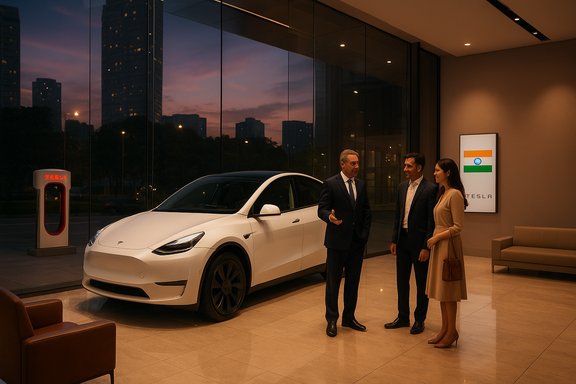
Sharad Agarwal’s arrival as Tesla’s new India head marks a clear pivot from remote oversight to a locally led, luxury-focused push — a strategic recalibration designed to convert curiosity into purchases in a market where high import duties, limited charging infrastructure and entrenched domestic rivals have so far blunted Tesla’s opening momentum.
Tesla entered India in mid‑2025 with showrooms and Model Y deliveries, but the launch produced modest order volumes relative to the company’s global scale. Reports indicate Tesla had accumulated roughly 600 orders by September, a figure that rose to just over 800 by October — a small base given the size of the market and Tesla’s global footprint. High import duties have pushed the Model Y’s on‑road price well into the premium segment, which has shaped Tesla’s early go‑to‑market position as a niche luxury contender rather than a mass EV player. In that context, Tesla’s decision to appoint Sharad Agarwal — a seasoned luxury auto executive best known for nearly a decade leading Lamborghini India — signals a deliberate shift to on‑the‑ground leadership with experience in selling aspirational, high‑value vehicles to affluent buyers across India’s metros and non‑metro pockets. Agarwal’s brief stint at Classic Legends (a Mahindra & Mahindra unit) prior to the Tesla move is also part of his recent résumé.
Yet the company’s future in India will be shaped more by structural factors than by any single executive: import duty policy, the economics of local production, charging and service rollout, and the pace of mainstream EV adoption. In that sense, Agarwal is an important but partial solution — well‑suited to clean up launch execution and premium conversions, but only one piece of a larger strategic puzzle that will require hard choices on manufacturing, pricing and long‑term investment.
For now, the hire is a signal of intent: Tesla is committing experienced leadership to India. The next months should reveal whether that intent translates into concrete manufacturing commitments, charging and service rollouts, and materially higher conversion rates — the metrics that will determine whether Tesla’s India experiment evolves into a full‑scale, sustainable business or remains a high‑end niche.
Source: Storyboard18 Sharad Agarwal takes the wheel as Tesla’s new India head
 Background / Overview
Tesla entered India in mid‑2025 with showrooms and Model Y deliveries, but the launch produced modest order volumes relative to the company’s global scale. Reports indicate Tesla had accumulated roughly 600 orders by September, a figure that rose to just over 800 by October — a small base given the size of the market and Tesla’s global footprint. High import duties have pushed the Model Y’s on‑road price well into the premium segment, which has shaped Tesla’s early go‑to‑market position as a niche luxury contender rather than a mass EV player. In that context, Tesla’s decision to appoint Sharad Agarwal — a seasoned luxury auto executive best known for nearly a decade leading Lamborghini India — signals a deliberate shift to on‑the‑ground leadership with experience in selling aspirational, high‑value vehicles to affluent buyers across India’s metros and non‑metro pockets. Agarwal’s brief stint at Classic Legends (a Mahindra & Mahindra unit) prior to the Tesla move is also part of his recent résumé. Who is Sharad Agarwal? A concise profile
- Track record in luxury vehicles: Agarwal spent close to ten years leading Lamborghini India, where he built the brand’s footprint beyond traditional metro strongholds and helped scale sales across more than 60 locations. That work is widely credited with strengthening Lamborghini’s position in India’s super‑luxury segment.
- Recent roles: In November 2024 Agarwal joined Classic Legends as Chief Business Officer, a short tenure that ended before the Tesla appointment. Industry reporting and his LinkedIn profile were cited in media accounts when describing this transition.
- Skill set: His background centers on premium brand building, network expansion, high‑net‑worth customer engagement, and retail strategy — skills Tesla is likely prioritising to accelerate conversions in India’s constrained early adopter segment.
The immediate significance of the hire
Tesla’s appointment of a documented luxury‑market veteran signals three concurrent, observable priorities:- Local leadership and stakeholder engagement: Moving from a remote‑managed model to an on‑the‑ground head reflects a desire for faster decisions, deeper retail coordination and direct engagement with dealers, customers and policymakers. Industry reporting describes the earlier structure as a small local team managed from regional hubs; Agarwal’s role replaces that model with a dedicated India leader.
- Luxury-first commercial posture: Given the high landed price of the Model Y in India (reported above ₹60 lakh after duties), Tesla’s immediate addressable audience is upper‑end buyers. Hiring a leader steeped in super‑luxury sales matches that commercial reality; marketing and retail actions are likely to prioritise premium positioning, bespoke customer experiences and targeted events rather than mass volume playbooks.
- Conversion and service focus: Early priorities will likely include converting bookings into deliveries, scaling pre‑sales demonstrations (mall pop‑ups and experience centres have already been used), improving aftersales/service coverage and building charging options to reduce range anxiety — practical steps that require local operational leadership.
Market reality: orders, pricing and the tariff problem
Tesla’s muted start in India cannot be divorced from policy economics. Key facts shaping the immediate market:- Order volumes: Public reporting placed Tesla’s India orders at around 600 in September, rising to ~800 by October — a modest uptake for a country of India’s size and a telling sign of constrained demand at current pricing levels.
- Model Y pricing and tariffs: High import duties (that can exceed 100% on fully built units) have pushed Model Y prices into the ₹60 lakh+ band, positioning the vehicle against established luxury brands rather than mainstream Indian EVs that typically sell for a fraction of that amount. India’s tariff regime — and the conditional reduced duty route for manufacturers that commit to local production — is central to Tesla’s operating calculus.
- EV market penetration: EVs account for a small share of all car sales in India (just a few percentage points), and the purchase economics for mainstream buyers are driven by price, charging access and local service coverage — areas where Tesla currently faces headwinds relative to local incumbents.
Strategy choices facing Sharad Agarwal and Tesla India
Agarwal’s remit will be complex and multi‑dimensional. The short to medium‑term strategy choices likely on his desk include:- Prioritise luxury buyers and lifestyle positioning to stabilise revenue while building brand desire.
- Expand direct retail and experience footprint to give prospective customers hands‑on exposure and test drives.
- Drive aftersales capacity (service centres, spare parts, technician training) to make ownership viable for premium buyers.
- Accelerate charging infrastructure roll‑out in key city corridors (Supercharger hubs in Mumbai/Delhi were reported as part of early plans).
- Commit to a local manufacturing or assembly plan to qualify for lower import duties and broader price competitiveness, or
- Persist with a luxury, import‑led model that accepts a premium position and slower volumetric growth.
Manufacturing: the fork in the road
- Option A — Local manufacturing / CKD assembly: Under India’s EV policy, manufacturers who commit minimum investments can obtain sharply reduced duties (a pathway that dramatically improves pricing competitiveness). Local production also enables broader model availability and better local component ecosystems. Yet the scale and capital commitment required — plus Tesla’s existing capacity globally — complicate this path. Reports vary on Tesla’s willingness to make that investment.
- Option B — Import and premium positioning: Continue importing Model Y at premium prices, focus on high‑net‑worth buyers, build brand desirability and service/charging coverage, and defer any large factory commitment. This approach carries predictable volume limits but lower near‑term capital needs. Observers point to this as the path Tesla appears to be using in the initial rollout.
Infrastructure and product issues (what tech‑savvy readers should watch)
- Charging network / Superchargers: Early reports indicate Tesla plans to deploy Supercharger facilities around Mumbai and New Delhi to support early adopters and deliveries. Robust, fast charging infrastructure is essential to premium EV ownership — particularly for owners who expect Tesla’s global charging experience. Scaling that network will be a practical priority for Agarwal’s team.
- Software, OTA and telematics: Tesla’s value proposition is heavily software‑driven: over‑the‑air (OTA) updates, a sophisticated vehicle app, and frequent feature rollouts. Delivering the same software experience in India requires regulatory clarity around connectivity, data handling and local telecom/roaming arrangements. There are no public signs Tesla will limit its telematics features in India initially, but regulators could raise questions on data locality and safety that need local engagement. Treat this as an operational issue that requires both technical planning and government dialogue.
- Autonomy and FSD features: Tesla continues to offer optional Full Self‑Driving (FSD) features in markets where regulators permit them. India’s road environment and regulatory posture make wide‑scale autonomous deployment challenging; any claims about immediate FSD rollout in India should be treated with caution given infrastructure and legal factors. Reuters reporting noted that India’s underdeveloped road infrastructure presents meaningful challenges for autonomous driving technologies.
- Service and parts logistics: Luxury buyers expect reliable, quick service. Tesla will need to establish authorised service hubs, parts supply chains and trained technicians — an area that previously constrained other premium EV launches. Success here will materially affect ownership satisfaction and referrals.
Competitive landscape and policy context
- Domestic EV makers and incumbents: Indian OEMs such as Tata Motors, Mahindra, and emerging players have made significant inroads with more affordably priced EVs and growing local supply chains. Tesla’s high‑price, import‑heavy entry puts it in a separate competitive bracket focused on aspirational buyers rather than the mass market. This limits near‑term market share upside but leaves room for demonstrable brand value in the luxury segment.
- Policy drivers: India’s EV policy framework creates both carrots and sticks. A conditional route to reduced import duty tied to local production is attractive — but requires heavy capital commitment. The government’s willingness to use tariffs to nurture domestic industry remains a structural barrier to import‑led mass penetration, and Tesla’s decision on whether to invest locally will be shaped by these mechanics. Reporting is mixed on whether Tesla will pursue a factory; until the company confirms, treat manufacturing plans as speculative.
Risks, downside scenarios and operational red flags
- Price elasticity and volume ceiling: With Model Y prices in the premium band, Tesla’s accessible market is small; if conversions and second‑hand resale values disappoint, the brand could face demand erosion and reputational harm. This is a commercial risk that Agarwal must manage through targeted incentive structures, experience programs and service guarantees.
- Infrastructure execution risk: Announcing Superchargers or service centres is one step; delivering a reliable network across India’s varied geographies is another. Delays or underperformance here directly impact customer trust and adoption. Early signals to monitor include site openings, uptime statistics, and technician certification rates.
- Policy flip risk: India’s tariff and production incentives can be revised; if incentives shift unfavourably, import economics could worsen and push Tesla’s pricing even higher or force urgent local investment. Strategic planners must model multiple regulatory scenarios.
- Brand and service mismatch: Luxury buyers demand white‑glove experiences. Any mismatch between premium pricing and delivery/service experience (long lead times, hard to source parts, inconsistent OTA behaviour) will damage word‑of‑mouth in a segment where referrals matter. Agarwal’s background in high‑touch luxury retail reduces this risk but does not eliminate it.
- Manufacturing commitment uncertainty: Conflicting public reports about Tesla’s willingness to produce locally create strategic ambiguity. If Tesla delays a firm commitment, reduced‑duty import windows and local partners may be hard to secure; conversely, a rushed manufacturing commitment could strain global capacity planning. Treat manufacturing claims as high‑impact but currently uncertain.
Opportunities and upside scenarios
- Premium foothold with brand halo: If Tesla establishes a flawless premium ownership experience in India, it can build a durable halo that aids future model launches and service partnerships. Luxury adoption often precedes broader consumer acceptance and can accelerate long‑term brand equity formation.
- Strategic partnerships: Contract manufacturing, joint ventures or component sourcing deals can reduce capex and accelerate a price‑competitive pathway. Several industry pieces suggested contract manufacturing and importing from Tesla’s Berlin plant as possible intermediate moves; these offer pragmatic ways to lower duty burden while testing the market.
- Energy ecosystem play: Beyond cars, Tesla can package home‑charging and energy products to wealthy customers, creating recurring revenue streams and deeper ecosystem lock‑in — a compelling business model if priced correctly and supported with local installations and service. This remains aspirational but plausible.
What to watch next — milestones and signals for readers and industry watchers
- Official confirmation and leadership communication: A formal Tesla statement or an interview with Sharad Agarwal outlining his mandate and KPIs will convert industry speculation into a clear mandate. Monitor Tesla newsroom and reputable business outlets for a formal announcement.
- Factory or CKD commitments: Any memorandum of understanding (MoU), state invitation acceptance, or definitive manufacturing plan would be transformational. Until then, treat large‑scale manufacturing as unconfirmed.
- Supercharger openings and service centre roll‑outs: Track the number and locations of charging stations and service hubs, their opening dates and early uptime/availability metrics. These are operational leading indicators of Tesla’s service capability.
- Sales conversion metrics and delivery cadence: Quarterly or monthly disclosure of delivered vehicles vs bookings will indicate whether Tesla’s localized strategy is raising conversion rates. Media updates that move orders materially beyond the ~800 mark would be meaningful.
- Pricing adjustments or localised models: Announcements of locally assembled or India‑specific variants — or price changes driven by tariff negotiations — would materially change the market calculus.
Practical takeaways for enterprise and technology readers
- For fleet and corporate IT teams considering EV integration: Tesla’s premium positioning suggests initial fleet uses will be niche (executive cars, demo fleets). Charging logistics, maintenance SLAs and warranty coverage must be contractually explicit before committing mission‑critical deployments.
- For developers and integrators building connected‑car software: Tesla’s OTA‑centric model and unique vehicle APIs are attractive but tightly controlled. Expect limited third‑party access compared to some OEMs; value will come from integrations that complement Tesla’s platform (e.g., enterprise telematics dashboards for premium corporate buyers).
- For consumer tech audiences: Tesla delivers a software‑first ownership model; buyers should prioritise hands‑on demos and clarity on OTA policy, regional feature parity and local data/privacy handling.
Final analysis — strengths, tradeoffs and the path ahead
Sharad Agarwal’s appointment is a pragmatic and well‑matched tactical move: Tesla needs someone who understands high‑touch luxury sales, can orchestrate retail experiences and press for rapid improvements in service and charging. His background gives Tesla a credible leader to shepherd a tough initial phase. That said, the strategic horizon still hinges on a hard economic reality: India’s tariff and manufacturing policy. If Tesla commits to local production — or a credible CKD/contract manufacturing pathway — the company gains a route to broader pricing competitiveness and scale. If it does not, Tesla’s India presence may remain a profitable but narrow luxury play with limited volume upside. Public reporting is currently mixed on Tesla’s manufacturing intentions; until Tesla makes a firm announcement, manufacturing remains a high‑stakes, unresolved variable. Operational execution will be the immediate battleground: converting bookings to deliveries, building dependable charging and service networks, and ensuring the ownership experience matches the premium price. Success in these areas will determine whether Tesla’s India chapter is a durable market entry or a high‑priced boutique experiment. Agarwal’s arrival increases the odds of a focused, locally responsive operational push — but it does not by itself solve the underlying economics of tariffs and scale.Conclusion
Tesla’s hire of Sharad Agarwal crystallises a strategic shift: from remote launch management to a locally led, luxury‑centric operational play. The appointment addresses a clear need — hands‑on leadership with experience selling aspirational vehicles across India’s varied markets — and gives Tesla a realistic path to stabilise its early performance.Yet the company’s future in India will be shaped more by structural factors than by any single executive: import duty policy, the economics of local production, charging and service rollout, and the pace of mainstream EV adoption. In that sense, Agarwal is an important but partial solution — well‑suited to clean up launch execution and premium conversions, but only one piece of a larger strategic puzzle that will require hard choices on manufacturing, pricing and long‑term investment.
For now, the hire is a signal of intent: Tesla is committing experienced leadership to India. The next months should reveal whether that intent translates into concrete manufacturing commitments, charging and service rollouts, and materially higher conversion rates — the metrics that will determine whether Tesla’s India experiment evolves into a full‑scale, sustainable business or remains a high‑end niche.
Source: Storyboard18 Sharad Agarwal takes the wheel as Tesla’s new India head
