

Harris County, Texas, cannot spend taxpayer money on private groups representing people in federal deportation proceedings while a state appeals court reviews Attorney General Ken Paxton’s challenge, the Texas Supreme Court said on Friday, June 26, 2026. The unsigned order did not finally decide whether the county’s immigrant legal-defense program is illegal, but six justices said there is “serious doubt” that Harris County has authority to run it. That is the practical story: the fund is frozen now, and the legal theory behind the freeze could reach far beyond immigration court. The fight is no longer just about who gets a lawyer; it is about how much room Texas counties have left to spend local money on contested social policy when state officials object.
The Texas Supreme Court’s order is temporary in form and consequential in effect. Harris County remains in litigation, and the statewide appeals court still has to weigh the attorney general’s claims. But the high court’s intervention means the county cannot keep money flowing while that process plays out.
That matters because legal-aid programs are not abstractions that can be paused without disruption. They depend on contracts, nonprofit staffing, intake systems, and the predictable availability of funding. When a court halts a program midstream, the immediate impact falls not on legal doctrine but on calendars, hearings, and families already facing federal removal proceedings.
The justices’ language also sends a signal. A court can grant temporary relief for many reasons, but saying there is “serious doubt” about a program’s constitutionality is not neutral housekeeping. It tells the appeals court, the county, and every other local government watching this case that the state’s argument has real traction at the top of Texas’ civil judiciary.
That does not mean Paxton has already won on the merits. It does mean Harris County’s defense has become harder. A program that was once framed by supporters as a local access-to-justice effort is now being treated by the state’s highest civil court as a potential constitutional overreach.
The program directed money to outside organizations that provide representation or legal assistance to immigrants facing deportation. Reported recipients have included groups such as BakerRipley, the Galveston-Houston Immigrant Representation Project, Justice for All Immigrants, Kids in Need of Defense, and the Refugee and Immigrant Center for Education and Legal Services. For county leaders, the argument was that legal defense helps residents understand their rights, keeps families more stable, and supports orderly participation in court.
This is not a public defender system in the constitutional sense. In criminal cases, the government must provide counsel to defendants who cannot afford it. In immigration court, which is civil rather than criminal, people can be represented by counsel, but generally not at government expense. That distinction is where local governments have tried to step in.
The policy case for doing so is straightforward. Deportation proceedings are legally complex, and outcomes can differ dramatically depending on whether someone has counsel. Local officials who support these programs argue that representation does not guarantee relief from deportation; it makes the process more accurate and less chaotic.
Paxton’s case attacks that framing. To the attorney general, Harris County is not merely funding neutral legal services. It is using taxpayer dollars to oppose federal deportations and to confer benefits on private groups and individuals without a lawful public purpose. That is a political claim, but it is also a legal one aimed at the constitutional boundaries of county spending.
That is why the Harris County deportation-defense fight carries more weight than its dollar amount suggests. The disputed allocation has been reported at roughly $1.3 million, a small figure in the budget of the state’s most populous county. But if the state can establish that counties lack authority to fund these services, similar programs become legally vulnerable wherever they exist in Texas.
The attorney general’s argument leans on a familiar conservative critique of local spending: public funds must serve a public purpose, and governments cannot simply transfer money to private organizations for ideological ends. Harris County’s answer is just as familiar: counties routinely contract with nonprofits to deliver public services, and legal assistance can serve a legitimate public purpose when it helps residents navigate systems that affect housing, family stability, and community welfare.
The difficult part is that both claims can sound plausible depending on how the court defines the program. If the legal fund is treated as a general access-to-justice program for indigent residents, Harris County has a stronger footing. If it is treated as a county-funded campaign against federal immigration enforcement, Paxton’s challenge becomes more potent.
That framing battle is now central. Courts often say they are applying neutral rules, but the description of the program may do much of the work. “Legal services for residents” and “taxpayer-funded deportation defense” are not merely different phrases; they are different legal worlds.
That distinction makes the case especially interesting. Harris County is not trying to regulate immigration status, block federal agents, or create a local immigration classification. It is funding lawyers. The state’s objection is that even this softer form of resistance or mitigation exceeds the county’s lawful role.
The Texas Supreme Court’s order suggests at least six justices are not comfortable assuming counties can act in this space just because the federal government does not provide counsel. Counties in Texas are not cities with broad home-rule authority. They are creatures of state law, and their powers are more limited. That structural fact gives Paxton a cleaner legal route than he would have in a challenge to a city ordinance.
For immigrant-rights advocates, that is the danger. If the question is whether legal representation produces better process, the county has a sympathetic argument. If the question is whether a Texas county has express or implied authority to subsidize removal defense through private nonprofits, the case becomes much less forgiving.
The order also shows how emergency litigation can shape policy before final judgment. A temporary pause may last long enough to disrupt contracts, chill future appropriations, or push nonprofits to scale back. By the time the appeals court reaches a full merits decision, the program may already have been functionally weakened.
Counties frequently contract with nonprofits for mental-health services, homelessness outreach, domestic-violence support, public-health work, and legal assistance. The mere fact that a private organization receives public money does not make a program unlawful. The harder question is whether the county has identified a legitimate public purpose and retained enough control to ensure the funds serve that purpose.
This is where the details of the contracts could matter. Courts may ask whether Harris County imposed eligibility rules, reporting requirements, limits on covered services, and oversight mechanisms. A tightly administered indigent legal-services program looks different from a discretionary grant to groups that pursue their own policy missions.
The practical problem is that immigration legal services sit at the intersection of law, politics, and identity. A nonprofit representing a detained parent may describe its work as due process. Paxton may describe the same work as obstruction of deportation. Courts will have to decide whether those political labels obscure or reveal the legal character of the spending.
There is also a human asymmetry built into the dispute. The state can litigate the legality of the fund as an institutional matter. People in removal proceedings encounter the pause as a personal crisis. If representation disappears, their cases do not necessarily wait for Texas courts to sort out county authority.
The statewide appeals court is itself part of the political architecture around this case. Texas’ newer statewide intermediate appellate structure was designed to handle certain cases involving state government and statewide significance. That means a fight that began as a county budget dispute is now moving through a judicial channel built for high-stakes state policy conflicts.
For Harris County, the legal task is to make the program look ordinary. Counties spend money to protect public welfare, contract with nonprofits, and support low-income residents. Immigration status may make the politics explosive, but the county will likely argue that the spending mechanism is not exotic.
For Paxton, the task is to make the program look extraordinary. The state will argue that Harris County has chosen sides in federal deportation proceedings and used public money to benefit people and organizations in a way Texas law does not authorize. The phrase “deportation defense” does much of the rhetorical work.
The appeals court’s eventual ruling could produce a narrow answer or a broad one. A narrow decision might turn on the specific contracts and budget language Harris County used. A broad decision could announce limits that make it risky for any Texas county to fund immigration-related legal services.
That parallel matters because state officials often build doctrine through repetition. One lawsuit can be dismissed as a dispute over local facts. Two or more lawsuits become a campaign to define the permissible edge of local government. Paxton’s office has made clear it views these funds as unlawful, not merely unwise.
If Harris County ultimately loses, Bexar County and other local governments will read the opinion closely for survival instructions. They may try to redesign programs as general civil legal aid, route money through different agencies, or impose tighter eligibility controls. Or they may conclude the risk is too high and abandon the effort.
If Harris County wins, the decision could give local governments a roadmap for funding legal assistance without crossing state-law boundaries. That would not end the politics, but it would clarify the legal architecture. In a state where local autonomy is frequently contested, even a narrow win would matter.
The uncertainty is already a policy outcome. Counties considering new immigrant legal funds now have to budget not only for services but for litigation. That cost alone may deter programs in places with less money, less political appetite, or less confidence in court.
Supporters of county-funded representation argue that this gap distorts outcomes. People with lawyers are more likely to appear in court, identify available defenses, apply for lawful relief, and avoid procedural mistakes. That does not mean every represented person wins. It means the system is less likely to decide life-altering cases by default, confusion, or paperwork failure.
Opponents see the same facts through a different lens. They argue that deportation is a federal enforcement matter and that local taxpayers should not finance efforts to help removable immigrants remain in the country. To them, legal defense is not neutral process but a public subsidy for resisting lawful removal.
The core disagreement is therefore not only legal. It is about what counts as the public’s interest. Is the public served when residents facing deportation get counsel and courts receive better-developed cases? Or is the public harmed when county money supports litigation against removal?
The Texas Supreme Court’s pause does not answer that moral question. It does, however, privilege one institutional view for now: when in doubt, stop the money until the courts decide whether the county had authority in the first place.
Harris County can argue that its general powers over public welfare, indigent services, and contracting support the program. But general welfare arguments can become fragile when a court demands a more specific statutory hook. The state’s strongest path is to say that counties cannot infer controversial powers from broad budget discretion.
This is why the case should worry local officials outside immigration policy. If the courts take a restrictive view of county authority, the reasoning could echo into other programs built on broad public-purpose claims. Guaranteed income, public-health outreach, legal aid, housing stabilization, and nonprofit service contracts all depend in varying degrees on local discretion.
That does not mean every county program is suddenly at risk. Courts distinguish among statutory schemes, beneficiaries, contract structures, and legislative authorizations. But a major ruling against Harris County could encourage more aggressive state challenges to local spending choices.
The politics are obvious, but the institutional consequence is deeper. Texas’ large urban counties are increasingly where state and national policy conflicts become administrative experiments. The state’s response is increasingly to litigate the experiments before they can mature.
The court’s statement that six justices saw serious doubt about the program’s constitutionality gives the public a bottom line but not a full doctrinal map. We know enough to understand the direction of concern. We do not yet know exactly which features of the program troubled the justices most.
Was it the immigration context? The private nonprofit recipients? The asserted lack of county authority? The possibility of public funds conferring private benefits? The answer matters because local governments can fix some defects more easily than others.
If the problem is inadequate oversight, Harris County could theoretically rewrite contracts. If the problem is that counties have no authority to fund deportation defense at all, redesign will not help much. If the problem is the political nature of the services, the ruling could become a precedent for scrutinizing local programs that align with contested ideological goals.
For now, the ambiguity favors the state. Local officials have to guess how much risk remains, and cautious lawyers will advise them to treat the order as a warning. That chilling effect is part of the order’s real-world force.
But the taxpayer argument is not one-directional. Harris County taxpayers also pay for family separation fallout, emergency services, child welfare pressures, jail and court coordination, homelessness systems, and other local consequences when residents are destabilized. County leaders can plausibly argue that funding legal services is a preventive public expense, not a giveaway.
That does not settle the legal issue. A program can be socially useful and still unauthorized. But the public-purpose analysis should not pretend that deportation has no local cost simply because the proceeding is federal.
The sharper question is who gets to make that cost-benefit judgment. Harris County commissioners believed local money should support representation. Paxton argues state law forbids that choice. The Texas Supreme Court has now indicated the county’s position may rest on shaky ground.
In practical politics, that is a victory for centralization. The state is asserting that some local spending choices are not merely bad policy but beyond local power. If courts agree, elections for county government will matter less in those policy areas because the menu of permissible options will shrink.
That timing problem is central. A temporary injunction in June 2026 may affect cases scheduled in July, August, and September. If someone misses a deadline or appears without counsel, the later restoration of funding may not undo the damage.
Nonprofits also cannot simply keep capacity waiting in the hope that money returns. Legal organizations hire staff, maintain caseloads, and plan outreach around grants and contracts. A pause can mean layoffs, reduced intake, or triage that prioritizes only the most urgent cases.
This is one reason emergency orders in service-delivery cases carry outsized consequences. Courts describe them as preserving the status quo, but the status quo for a legal-aid program is continued operation. Freezing funds may preserve the state’s claimed legal interest while altering the lived reality for clients.
Harris County’s supporters will likely emphasize that point as the litigation continues. Paxton’s office will counter that public money should not continue flowing under a program the state says is unlawful. The courts must decide which risk counts more: unauthorized spending or interrupted representation.
That dryness should not fool anyone. Structural legal rules often decide the most politically charged cases because they let courts avoid saying whether a policy is morally good or bad. A court can strike or pause a program by saying the county lacked power, not by saying immigrants should or should not receive lawyers.
For Paxton, that is a useful litigation posture. It allows the state to present the case as a rule-of-law dispute rather than solely as an immigration crackdown. The attorney general can argue that even sympathetic goals must be pursued through lawful channels.
For Harris County, the challenge is to keep the real-world function of the program visible. If the case becomes only an abstract debate over county powers, the people in removal proceedings disappear from view. The county needs the court to see legal representation as a public service rather than a political subsidy.
That rhetorical contest may influence how broadly the eventual ruling is written. Courts do not operate outside public meaning. The labels that stick in this case may become the categories that govern the next one.
Those are mirror-image strategies. State leaders try to increase enforcement pressure through litigation, policing policy, and challenges to federal discretion. Local leaders try to reduce collateral damage through legal aid, community services, and limits on cooperation. The Harris County fund sits squarely in that second category.
The Texas Supreme Court’s pause suggests that local mitigation may face a stricter path than state enforcement advocacy, at least under Texas law. The attorney general can sue to shape immigration policy from the state side. Counties may have less room to spend money softening the policy’s local effects.
That imbalance is not accidental. States possess sovereign authority that counties do not. Counties are subordinate entities. In a polarized federal system, that hierarchy becomes a practical weapon.
The result is a layered fight: federal immigration law at the top, state political power in the middle, and county service delivery at the bottom. Harris County is trying to act at the bottom layer. Paxton is using the middle layer to stop it.
The portability of that strategy depends on state law. Some local governments have broader home-rule powers than Texas counties. Some states have statutes expressly authorizing immigrant legal services or general civil legal aid. Others may leave enough ambiguity for challenges similar to Paxton’s.
That means the Harris County fight is unlikely to remain just a local story. If Paxton ultimately wins, conservative legal groups and state attorneys general elsewhere may study the opinion for arguments that can be adapted. If Harris County wins, local governments elsewhere may cite the case as reassurance that public-purpose arguments can survive immigration politics.
The uncertainty also complicates philanthropic and nonprofit planning. Legal-aid providers often blend public and private funding. If public funds become legally unstable, organizations may shift toward private grants, but private money may not be enough to replace county-scale support.
The broader access-to-counsel movement has always depended on local experimentation. A ruling that narrows experimentation in Texas would not end that movement nationally, but it would mark a significant setback in one of the country’s most consequential immigration states.
That changes political incentives. Local officials may become more cautious in how they describe programs, which organizations they fund, and what legal authority they cite before approving contracts. County attorneys may demand tighter findings, narrower scopes of work, and clearer public-purpose language.
This could produce better governance in some cases. Programs that spend public money should be carefully designed, transparent, and accountable. Vague grants to politically aligned organizations deserve scrutiny no matter which side benefits.
But excessive caution can also drain local government of responsiveness. Counties often move first because they are closest to the problem. If every contested program is designed primarily to survive state litigation, local policy becomes slower, narrower, and more defensive.
That may be exactly what the state wants in areas like immigration. The fight over the Harris County fund is not only about stopping one allocation. It is about teaching local governments which subjects are too legally dangerous to touch.
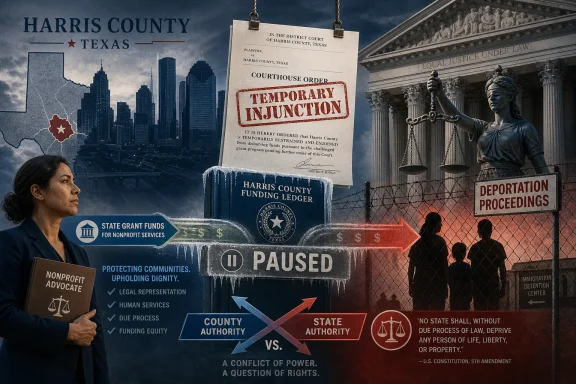 The Court Did Not End the Program, but It Changed the Terrain
The Texas Supreme Court’s order is temporary in form and consequential in effect. Harris County remains in litigation, and the statewide appeals court still has to weigh the attorney general’s claims. But the high court’s intervention means the county cannot keep money flowing while that process plays out.That matters because legal-aid programs are not abstractions that can be paused without disruption. They depend on contracts, nonprofit staffing, intake systems, and the predictable availability of funding. When a court halts a program midstream, the immediate impact falls not on legal doctrine but on calendars, hearings, and families already facing federal removal proceedings.
The justices’ language also sends a signal. A court can grant temporary relief for many reasons, but saying there is “serious doubt” about a program’s constitutionality is not neutral housekeeping. It tells the appeals court, the county, and every other local government watching this case that the state’s argument has real traction at the top of Texas’ civil judiciary.
That does not mean Paxton has already won on the merits. It does mean Harris County’s defense has become harder. A program that was once framed by supporters as a local access-to-justice effort is now being treated by the state’s highest civil court as a potential constitutional overreach.
Harris County Built a Local Answer to a Federal Courtroom Problem
Harris County’s immigrant legal services program began in 2020, when the county initially allocated $2.5 million to help people navigate immigration proceedings. The idea was simple: removal cases may be federal, but the social and economic fallout lands locally. Houston-area families, schools, employers, churches, and county services all absorb the consequences when residents are detained or deported.The program directed money to outside organizations that provide representation or legal assistance to immigrants facing deportation. Reported recipients have included groups such as BakerRipley, the Galveston-Houston Immigrant Representation Project, Justice for All Immigrants, Kids in Need of Defense, and the Refugee and Immigrant Center for Education and Legal Services. For county leaders, the argument was that legal defense helps residents understand their rights, keeps families more stable, and supports orderly participation in court.
This is not a public defender system in the constitutional sense. In criminal cases, the government must provide counsel to defendants who cannot afford it. In immigration court, which is civil rather than criminal, people can be represented by counsel, but generally not at government expense. That distinction is where local governments have tried to step in.
The policy case for doing so is straightforward. Deportation proceedings are legally complex, and outcomes can differ dramatically depending on whether someone has counsel. Local officials who support these programs argue that representation does not guarantee relief from deportation; it makes the process more accurate and less chaotic.
Paxton’s case attacks that framing. To the attorney general, Harris County is not merely funding neutral legal services. It is using taxpayer dollars to oppose federal deportations and to confer benefits on private groups and individuals without a lawful public purpose. That is a political claim, but it is also a legal one aimed at the constitutional boundaries of county spending.
Paxton Has Found a Pressure Point in Local Government
The Texas attorney general’s lawsuit fits a broader pattern in the state’s conflicts with large Democratic-led counties. Paxton has repeatedly challenged local programs that he argues exceed county authority or conflict with state policy, including Harris County’s earlier guaranteed-income pilot. The strategy is not just to win individual cases; it is to narrow what local governments can do when their priorities diverge from Austin’s.That is why the Harris County deportation-defense fight carries more weight than its dollar amount suggests. The disputed allocation has been reported at roughly $1.3 million, a small figure in the budget of the state’s most populous county. But if the state can establish that counties lack authority to fund these services, similar programs become legally vulnerable wherever they exist in Texas.
The attorney general’s argument leans on a familiar conservative critique of local spending: public funds must serve a public purpose, and governments cannot simply transfer money to private organizations for ideological ends. Harris County’s answer is just as familiar: counties routinely contract with nonprofits to deliver public services, and legal assistance can serve a legitimate public purpose when it helps residents navigate systems that affect housing, family stability, and community welfare.
The difficult part is that both claims can sound plausible depending on how the court defines the program. If the legal fund is treated as a general access-to-justice program for indigent residents, Harris County has a stronger footing. If it is treated as a county-funded campaign against federal immigration enforcement, Paxton’s challenge becomes more potent.
That framing battle is now central. Courts often say they are applying neutral rules, but the description of the program may do much of the work. “Legal services for residents” and “taxpayer-funded deportation defense” are not merely different phrases; they are different legal worlds.
The Order Turns Immigration Politics into a County-Powers Case
Texas immigration fights usually begin with federalism: what Washington controls, what the state may do, and whether Texas can push the outer edge of immigration enforcement. This case is different. It asks whether a county can spend money on legal defense in a federal system it does not control.That distinction makes the case especially interesting. Harris County is not trying to regulate immigration status, block federal agents, or create a local immigration classification. It is funding lawyers. The state’s objection is that even this softer form of resistance or mitigation exceeds the county’s lawful role.
The Texas Supreme Court’s order suggests at least six justices are not comfortable assuming counties can act in this space just because the federal government does not provide counsel. Counties in Texas are not cities with broad home-rule authority. They are creatures of state law, and their powers are more limited. That structural fact gives Paxton a cleaner legal route than he would have in a challenge to a city ordinance.
For immigrant-rights advocates, that is the danger. If the question is whether legal representation produces better process, the county has a sympathetic argument. If the question is whether a Texas county has express or implied authority to subsidize removal defense through private nonprofits, the case becomes much less forgiving.
The order also shows how emergency litigation can shape policy before final judgment. A temporary pause may last long enough to disrupt contracts, chill future appropriations, or push nonprofits to scale back. By the time the appeals court reaches a full merits decision, the program may already have been functionally weakened.
The Nonprofits Are the Machinery, Not the Sideshow
The state’s challenge focuses partly on the fact that Harris County funds private organizations. That is politically useful because it lets critics portray the program as a transfer to activist groups rather than as a service delivered to residents. But outsourcing is how much local government actually works.Counties frequently contract with nonprofits for mental-health services, homelessness outreach, domestic-violence support, public-health work, and legal assistance. The mere fact that a private organization receives public money does not make a program unlawful. The harder question is whether the county has identified a legitimate public purpose and retained enough control to ensure the funds serve that purpose.
This is where the details of the contracts could matter. Courts may ask whether Harris County imposed eligibility rules, reporting requirements, limits on covered services, and oversight mechanisms. A tightly administered indigent legal-services program looks different from a discretionary grant to groups that pursue their own policy missions.
The practical problem is that immigration legal services sit at the intersection of law, politics, and identity. A nonprofit representing a detained parent may describe its work as due process. Paxton may describe the same work as obstruction of deportation. Courts will have to decide whether those political labels obscure or reveal the legal character of the spending.
There is also a human asymmetry built into the dispute. The state can litigate the legality of the fund as an institutional matter. People in removal proceedings encounter the pause as a personal crisis. If representation disappears, their cases do not necessarily wait for Texas courts to sort out county authority.
A Statewide Appeals Court Now Holds the Next Real Move
The Texas Supreme Court did not issue a final ruling on the merits. The next substantive stage belongs to the statewide appeals court reviewing Paxton’s challenge. That court will have to consider whether Harris County’s program violates state law, exceeds county authority, or runs afoul of constitutional limits on public spending.The statewide appeals court is itself part of the political architecture around this case. Texas’ newer statewide intermediate appellate structure was designed to handle certain cases involving state government and statewide significance. That means a fight that began as a county budget dispute is now moving through a judicial channel built for high-stakes state policy conflicts.
For Harris County, the legal task is to make the program look ordinary. Counties spend money to protect public welfare, contract with nonprofits, and support low-income residents. Immigration status may make the politics explosive, but the county will likely argue that the spending mechanism is not exotic.
For Paxton, the task is to make the program look extraordinary. The state will argue that Harris County has chosen sides in federal deportation proceedings and used public money to benefit people and organizations in a way Texas law does not authorize. The phrase “deportation defense” does much of the rhetorical work.
The appeals court’s eventual ruling could produce a narrow answer or a broad one. A narrow decision might turn on the specific contracts and budget language Harris County used. A broad decision could announce limits that make it risky for any Texas county to fund immigration-related legal services.
The Fight Is Bigger Than Harris County Because Bexar County Is Already in the Frame
Harris County is not the only local government in Texas to fund immigrant legal services. Bexar County, home to San Antonio, has also supported legal representation for immigrants facing deportation, and Paxton has challenged that effort as well. A state district judge earlier allowed the Bexar County program to continue, but the broader legal climate has plainly shifted with the Texas Supreme Court’s Harris County order.That parallel matters because state officials often build doctrine through repetition. One lawsuit can be dismissed as a dispute over local facts. Two or more lawsuits become a campaign to define the permissible edge of local government. Paxton’s office has made clear it views these funds as unlawful, not merely unwise.
If Harris County ultimately loses, Bexar County and other local governments will read the opinion closely for survival instructions. They may try to redesign programs as general civil legal aid, route money through different agencies, or impose tighter eligibility controls. Or they may conclude the risk is too high and abandon the effort.
If Harris County wins, the decision could give local governments a roadmap for funding legal assistance without crossing state-law boundaries. That would not end the politics, but it would clarify the legal architecture. In a state where local autonomy is frequently contested, even a narrow win would matter.
The uncertainty is already a policy outcome. Counties considering new immigrant legal funds now have to budget not only for services but for litigation. That cost alone may deter programs in places with less money, less political appetite, or less confidence in court.
Immigration Court Is Where Due Process Becomes Logistics
One reason these programs are so contentious is that immigration court exposes a gap between formal rights and practical access. Noncitizens in removal proceedings may hire lawyers, but if they cannot afford one, the government generally does not supply one. In a complex legal system, the right to counsel at no public expense is only as useful as a person’s ability to find and pay for counsel.Supporters of county-funded representation argue that this gap distorts outcomes. People with lawyers are more likely to appear in court, identify available defenses, apply for lawful relief, and avoid procedural mistakes. That does not mean every represented person wins. It means the system is less likely to decide life-altering cases by default, confusion, or paperwork failure.
Opponents see the same facts through a different lens. They argue that deportation is a federal enforcement matter and that local taxpayers should not finance efforts to help removable immigrants remain in the country. To them, legal defense is not neutral process but a public subsidy for resisting lawful removal.
The core disagreement is therefore not only legal. It is about what counts as the public’s interest. Is the public served when residents facing deportation get counsel and courts receive better-developed cases? Or is the public harmed when county money supports litigation against removal?
The Texas Supreme Court’s pause does not answer that moral question. It does, however, privilege one institutional view for now: when in doubt, stop the money until the courts decide whether the county had authority in the first place.
The County’s Home-Rule Problem Is the State’s Opening
Texas counties operate under tighter legal constraints than many casual observers realize. A city with home-rule authority can often act unless state law forbids it. A county usually needs a source of authority to act. That difference may prove decisive.Harris County can argue that its general powers over public welfare, indigent services, and contracting support the program. But general welfare arguments can become fragile when a court demands a more specific statutory hook. The state’s strongest path is to say that counties cannot infer controversial powers from broad budget discretion.
This is why the case should worry local officials outside immigration policy. If the courts take a restrictive view of county authority, the reasoning could echo into other programs built on broad public-purpose claims. Guaranteed income, public-health outreach, legal aid, housing stabilization, and nonprofit service contracts all depend in varying degrees on local discretion.
That does not mean every county program is suddenly at risk. Courts distinguish among statutory schemes, beneficiaries, contract structures, and legislative authorizations. But a major ruling against Harris County could encourage more aggressive state challenges to local spending choices.
The politics are obvious, but the institutional consequence is deeper. Texas’ large urban counties are increasingly where state and national policy conflicts become administrative experiments. The state’s response is increasingly to litigate the experiments before they can mature.
The Supreme Court’s Wording Was Short, but Not Small
Unsigned emergency orders often leave readers wanting more. They can change policy without providing the full reasoning that would normally accompany a merits opinion. That is part of what makes this order powerful and frustrating.The court’s statement that six justices saw serious doubt about the program’s constitutionality gives the public a bottom line but not a full doctrinal map. We know enough to understand the direction of concern. We do not yet know exactly which features of the program troubled the justices most.
Was it the immigration context? The private nonprofit recipients? The asserted lack of county authority? The possibility of public funds conferring private benefits? The answer matters because local governments can fix some defects more easily than others.
If the problem is inadequate oversight, Harris County could theoretically rewrite contracts. If the problem is that counties have no authority to fund deportation defense at all, redesign will not help much. If the problem is the political nature of the services, the ruling could become a precedent for scrutinizing local programs that align with contested ideological goals.
For now, the ambiguity favors the state. Local officials have to guess how much risk remains, and cautious lawyers will advise them to treat the order as a warning. That chilling effect is part of the order’s real-world force.
The Local Taxpayer Argument Cuts Both Ways
Paxton’s case is framed around taxpayer money, and that framing has political power. Many voters are receptive to the idea that public funds should not be used to fight deportation. In a state where immigration politics are already intense, “taxpayer-funded lawyers for undocumented immigrants” is a phrase designed to land hard.But the taxpayer argument is not one-directional. Harris County taxpayers also pay for family separation fallout, emergency services, child welfare pressures, jail and court coordination, homelessness systems, and other local consequences when residents are destabilized. County leaders can plausibly argue that funding legal services is a preventive public expense, not a giveaway.
That does not settle the legal issue. A program can be socially useful and still unauthorized. But the public-purpose analysis should not pretend that deportation has no local cost simply because the proceeding is federal.
The sharper question is who gets to make that cost-benefit judgment. Harris County commissioners believed local money should support representation. Paxton argues state law forbids that choice. The Texas Supreme Court has now indicated the county’s position may rest on shaky ground.
In practical politics, that is a victory for centralization. The state is asserting that some local spending choices are not merely bad policy but beyond local power. If courts agree, elections for county government will matter less in those policy areas because the menu of permissible options will shrink.
For Immigrants, the Law’s Timing Is the Policy
The people most affected by the pause are unlikely to experience it as a debate about state constitutional structure. They will experience it as a canceled consultation, a delayed filing, or a missing lawyer at a hearing. Immigration proceedings move on their own schedule, and state-court litigation over funding does not automatically slow the federal docket.That timing problem is central. A temporary injunction in June 2026 may affect cases scheduled in July, August, and September. If someone misses a deadline or appears without counsel, the later restoration of funding may not undo the damage.
Nonprofits also cannot simply keep capacity waiting in the hope that money returns. Legal organizations hire staff, maintain caseloads, and plan outreach around grants and contracts. A pause can mean layoffs, reduced intake, or triage that prioritizes only the most urgent cases.
This is one reason emergency orders in service-delivery cases carry outsized consequences. Courts describe them as preserving the status quo, but the status quo for a legal-aid program is continued operation. Freezing funds may preserve the state’s claimed legal interest while altering the lived reality for clients.
Harris County’s supporters will likely emphasize that point as the litigation continues. Paxton’s office will counter that public money should not continue flowing under a program the state says is unlawful. The courts must decide which risk counts more: unauthorized spending or interrupted representation.
The Politics Are Loud Because the Doctrine Is Dry
On the surface, this is another Texas immigration clash. The cast is familiar: a Republican attorney general, a Democratic-led urban county, nonprofits serving immigrants, and courts asked to referee policy conflict. But the legal doctrine underneath is comparatively dry: county authority, public purpose, taxpayer spending, and temporary relief.That dryness should not fool anyone. Structural legal rules often decide the most politically charged cases because they let courts avoid saying whether a policy is morally good or bad. A court can strike or pause a program by saying the county lacked power, not by saying immigrants should or should not receive lawyers.
For Paxton, that is a useful litigation posture. It allows the state to present the case as a rule-of-law dispute rather than solely as an immigration crackdown. The attorney general can argue that even sympathetic goals must be pursued through lawful channels.
For Harris County, the challenge is to keep the real-world function of the program visible. If the case becomes only an abstract debate over county powers, the people in removal proceedings disappear from view. The county needs the court to see legal representation as a public service rather than a political subsidy.
That rhetorical contest may influence how broadly the eventual ruling is written. Courts do not operate outside public meaning. The labels that stick in this case may become the categories that govern the next one.
Washington Owns the Deportation System, but Texas Is Policing the Edges
The case also reflects a broader reality of American immigration policy: federal law dominates the formal system, but states and localities constantly fight over the edges. Texas has spent years testing how far a state can go in enforcement. Large counties and cities have often tested how far local governments can go in mitigation.Those are mirror-image strategies. State leaders try to increase enforcement pressure through litigation, policing policy, and challenges to federal discretion. Local leaders try to reduce collateral damage through legal aid, community services, and limits on cooperation. The Harris County fund sits squarely in that second category.
The Texas Supreme Court’s pause suggests that local mitigation may face a stricter path than state enforcement advocacy, at least under Texas law. The attorney general can sue to shape immigration policy from the state side. Counties may have less room to spend money softening the policy’s local effects.
That imbalance is not accidental. States possess sovereign authority that counties do not. Counties are subordinate entities. In a polarized federal system, that hierarchy becomes a practical weapon.
The result is a layered fight: federal immigration law at the top, state political power in the middle, and county service delivery at the bottom. Harris County is trying to act at the bottom layer. Paxton is using the middle layer to stop it.
The Order Gives Other States a Litigation Template
Although this is a Texas case under Texas law, other states will be watching. County- or city-funded immigrant representation programs exist in various forms around the country, especially in jurisdictions where local officials view deportation defense as part of access to justice. Opponents now have another model for challenging those programs: do not only argue immigration policy; argue local spending authority.The portability of that strategy depends on state law. Some local governments have broader home-rule powers than Texas counties. Some states have statutes expressly authorizing immigrant legal services or general civil legal aid. Others may leave enough ambiguity for challenges similar to Paxton’s.
That means the Harris County fight is unlikely to remain just a local story. If Paxton ultimately wins, conservative legal groups and state attorneys general elsewhere may study the opinion for arguments that can be adapted. If Harris County wins, local governments elsewhere may cite the case as reassurance that public-purpose arguments can survive immigration politics.
The uncertainty also complicates philanthropic and nonprofit planning. Legal-aid providers often blend public and private funding. If public funds become legally unstable, organizations may shift toward private grants, but private money may not be enough to replace county-scale support.
The broader access-to-counsel movement has always depended on local experimentation. A ruling that narrows experimentation in Texas would not end that movement nationally, but it would mark a significant setback in one of the country’s most consequential immigration states.
The Real Message Is Being Sent to County Commissioners
The obvious audience for the Texas Supreme Court’s order is the appeals court. The less obvious audience is every county commissioner in Texas considering a controversial social program. The message is blunt: if state leaders believe your spending crosses a line, the courts may stop it before final judgment.That changes political incentives. Local officials may become more cautious in how they describe programs, which organizations they fund, and what legal authority they cite before approving contracts. County attorneys may demand tighter findings, narrower scopes of work, and clearer public-purpose language.
This could produce better governance in some cases. Programs that spend public money should be carefully designed, transparent, and accountable. Vague grants to politically aligned organizations deserve scrutiny no matter which side benefits.
But excessive caution can also drain local government of responsiveness. Counties often move first because they are closest to the problem. If every contested program is designed primarily to survive state litigation, local policy becomes slower, narrower, and more defensive.
That may be exactly what the state wants in areas like immigration. The fight over the Harris County fund is not only about stopping one allocation. It is about teaching local governments which subjects are too legally dangerous to touch.
The Harris County Pause Leaves Five Hard Lessons on the Table
The court’s order is brief, but its implications are concrete. For now, Harris County’s program is stopped, Paxton’s challenge has momentum, and immigrant legal-aid providers face uncertainty while the appeals process continues.- Harris County is barred for now from spending taxpayer funds on private organizations that represent people in federal deportation proceedings.
- The Texas Supreme Court did not issue a final merits ruling, but six justices expressed serious doubt about the program’s constitutional footing.
- The dispute turns as much on county authority and public-purpose spending as on immigration policy itself.
- The pause could disrupt representation even if Harris County later prevails, because immigration cases and nonprofit staffing decisions will not wait for a final appellate ruling.
- Other Texas counties, especially those funding similar immigrant legal-services programs, now have to treat the Harris County order as a warning sign.
- The eventual appeals decision could either narrow the ruling to Harris County’s specific program design or reshape the legal boundaries for local social spending across Texas.
References
- Primary source: Bloomberg Law News
Published: 2026-06-26T16:50:14.542066
Texas Justices Pause Harris County Deportation Defense Fund
Harris County, Texas, is barred for now from giving taxpayer money to private organizations that represent individuals in federal deportation proceedings, the Texas Supreme Court said Friday.news.bloomberglaw.com
- Related coverage: texastribune.org
Harris County immigrant legal services program paused
The Texas Supreme Court has temporarily blocked Harris officials from financially supporting nonprofits that assist immigrants in deportation cases. The state is trying to permanently bar such programs.www.texastribune.org - Related coverage: hoodline.com
Texas Supreme Court Pauses Harris County Immigrant Legal Fund
Texas Supreme Court granted temporary relief blocking Harris County from disbursing money to its immigrant legal-services fund and hotline pending review.hoodline.com - Related coverage: investing.com
US judge blocks key parts of Texas migrant arrest law By Reuters
US judge blocks key parts of Texas migrant arrest lawwww.investing.com - Related coverage: law360.com
Texas Justices Block County's $1.3M Immigrant Defense Fund - Law360
The Texas Supreme Court blocked Harris County from allocating $1.3 million to several nonprofits that provide legal services to immigrants facing removal, saying Friday that there exist serious doubts that the county has constitutional authority to disburse the funds.www.law360.com - Related coverage: oag.state.tx.us
Attorney General Ken Paxton Sues Harris County for Unlawfully Directing Over $1.3 Million in Taxpayer Money to Defend Illegal Aliens from Deportation
Attorney General Ken Paxton has sued the Harris County Commissioners Court for unlawfully allocating more than $1.3 million in public money to radical leftist organizations that will use the money to oppose the lawful deportations of illegal aliens. www.oag.state.tx.us
- Related coverage: washingtonpost.com
- Related coverage: tpr.org
Bexar County immigration defense fund allowed to continue
A state district judge ruled in favor with Bexar County in a legal fight over the county’s immigrant legal services program.www.tpr.org - Related coverage: txcourts.gov
- Related coverage: washingtonexaminer.com
Judge blocks Biden-era rule that allowed indefinite closures of deportation cases
A federal judge in Texas struck down a Biden-era rule that allowed immigration judges to indefinitely close deportation cases. www.washingtonexaminer.com
- Related coverage: axios.com
Texas Attorney General Ken Paxton sues Bexar County over immigrant fund - Axios San Antonio
Paxton has filed a similar lawsuit against Harris County.www.axios.com
