
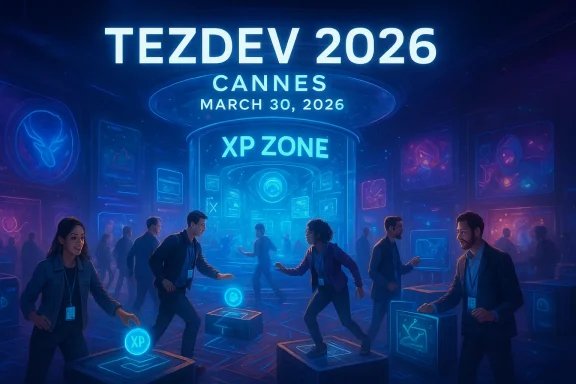
Tezos is trying to make a very specific point in Cannes on March 30, 2026: blockchain conferences no longer need to be lectures with a few side conversations. With TezDev 2026, the ecosystem is leaning into participation-first design, pairing a developer summit with gaming, immersive art, and challenge-based booth exploration rather than another round of passive panels. The message is clear enough that the event itself has become part of the product story: Tezos wants attendees to experience the network, not merely hear about it.
That shift matters because it arrives at a moment when crypto ecosystems are under pressure to prove utility, not just narrative. Tezos is using TezQuest, the new XP Zone, and a more interactive conference format to show that its stack is maturing into something users can actually touch, play with, and build on. It is also doing so on the back of real technical progress in Etherlink, the Tezos EVM-compatible Layer 2, which gives the event a stronger foundation than a typical marketing summit.
The result is a broader test of whether the next phase of blockchain adoption will be won by protocol specs or by experience design. Tezos appears to believe the answer is both, but with experience now taking the lead.
Tezos has spent years cultivating a reputation as a blockchain that prefers methodical evolution over explosive hype. Its self-amending governance model has long been one of the network’s defining features, letting the protocol update itself through on-chain coordination instead of relying on hard forks and external battles over chain direction. That philosophy has often made Tezos look quieter than rivals, but it also gave the ecosystem a durable identity: deliberate, technically opinionated, and resistant to the most chaotic forms of crypto politics.
That identity has increasingly been paired with a clearer product strategy. The Tezos brand is no longer trying to exist only as a “serious chain” for protocol researchers. It is now pairing the chain’s governance and architecture with visible applications in DeFi, gaming, art, and real-world asset experimentation. TezDev sits at the center of that effort because it is one of the few recurring events where the network can present itself as both infrastructure and culture.
The 2026 edition in Cannes lands in an especially useful place on the calendar. It is timed near the Ethereum Community Conference, which increases the odds that builders, investors, and ecosystem operators will be in the same region already. That proximity is not accidental; it lets Tezos borrow attention from the broader Ethereum-adjacent developer circuit while arguing that its own stack has moved beyond theory into user-facing execution.
What makes this year notable is the event design itself. Instead of treating a summit like a stage and a crowd, Tezos is turning it into a game loop. The XP Zone and TezQuest are built to convert curiosity into interaction, and interaction into memory, which is exactly what most blockchain events have lacked for years. The format suggests a confidence that the network can now be demonstrated through product touchpoints rather than merely described through slide decks.
At the same time, Tezos has been building a more credible technical and cultural backdrop for that kind of presentation. Etherlink’s recent performance improvements, the expansion of recognizable DeFi protocols, and the chain’s enduring strength in digital art give the ecosystem more than one story to tell. That breadth matters because an event like TezDev only works when it reflects an ecosystem that is already visibly moving.
The XP Zone is the clearest expression of that philosophy. Rather than sending attendees away with abstract talking points, it brings them into a 360-degree immersive room where they can interact with projects scaling on Tezos. This is less about spectacle for spectacle’s sake and more about reducing the distance between infrastructure and lived experience, which has become one of the most persistent adoption problems in blockchain.
The format also creates a stronger feedback loop for ecosystem builders. A booth that can convert interest into participation in real time is getting an early signal on messaging, UX, and community resonance. In crypto, that kind of signal is often more valuable than a polished talk. The booth becomes a miniature acquisition funnel, and the event becomes a testbed for product-market fit.
Key takeaways from the event design include:
By creating an immersive room and surrounding it with live projects, Tezos is effectively asking attendees to understand the chain through contextual interaction. Instead of saying “Tezos is growing,” the event is saying “step inside the ecosystem and see what’s happening.” That distinction may sound subtle, but it is strategically important because it shifts the burden of persuasion from marketing language to direct experience.
This is especially relevant for Tezos because its ecosystem spans categories that often fail to overlap cleanly: DeFi, art, gaming, infrastructure, and enterprise-adjacent experimentation. An immersive showcase gives the network a way to connect those audiences without forcing them into the same technical language. In a fragmented market, that connective tissue is valuable.
The likely advantages are straightforward:
The challenge-based approach also changes the social texture of the summit. Instead of a room full of people independently scanning a schedule, attendees are nudged into movement, discovery, and competition. That produces a more energetic floor, but it also creates more opportunities for projects to demonstrate themselves under real conditions rather than in a scripted presentation.
The challenges themselves also point to Tezos’s effort to broaden its appeal. If one booth focuses on market-making strategies with Hanji, a decentralized exchange, while another highlights mobile games launching on the network, the event is making a deliberate case that Tezos can support both financial infrastructure and consumer-facing entertainment. That matters because most chains still struggle to combine those two narratives without sounding forced.
Useful effects of this model include:
The conference program reportedly includes sessions on cross-runtime coordination, the protocol-level challenge of making different execution environments work together cleanly. That is one of the more important unsolved problems in modular blockchain design, and it is central to any serious scalability strategy. If Tezos can show credible progress here, it strengthens the case that Tezos X is not just a slogan but a coherent architecture.
This matters for trading, gaming, and any application where the user expects immediate feedback. Even half a second can feel sluggish in modern interfaces, especially when a product is trying to compete with web apps and mobile apps that operate nearly instantly. Tezos is effectively arguing that real-time UX is now a blockchain feature, not just a frontend concern.
The technical significance is easy to summarize:
The significance here is straightforward. A Layer 2 can have great technical performance, but if it lacks real protocols and capital, it remains a demo environment. Tezos is trying to avoid that trap by showing that Etherlink can host serious apps, not just sandbox use cases. That matters for any chain hoping to compete in a market where liquidity tends to follow wherever users already are.
The more subtle advantage is the feedback loop. Better UX encourages more users, more users attract more developers, and more developers generate more reasons to stay. That is the classic growth mechanism in blockchain ecosystems, but it only works when the chain can support both performance and distribution. Tezos is clearly trying to build that flywheel.
What stands out most is:
That cultural footprint matters because it gives Tezos a domain where it has long been more recognizable than many faster, larger, or more heavily funded rivals. In a market where most chains compete on the same handful of financial primitives, art offers a differentiated emotional and institutional proposition. It also helps Tezos speak to audiences that do not identify as crypto-native but do care about digital ownership and creative tooling.
This is one area where Tezos has a genuine strategic advantage. When a network can point to museums, creative tools, and recurring art events, it demonstrates utility that is not reducible to speculation. That breadth can be especially valuable when crypto markets turn risk-off and users look for ecosystems with more than one reason to exist.
The cultural pillar contributes several things:
For enterprises and professional builders, the pitch is about throughput, coordination, governance, and reliable execution. For consumers, it is about speed, fun, and memorable interaction. TezDev 2026 tries to package those together without making the conference feel schizophrenic. That is a harder task than it sounds, and it reflects a more mature understanding of how blockchain adoption actually happens.
On the consumer side, the XP Zone, TezQuest, gaming challenges, and immersive art matter more than the architecture diagrams. These features make the ecosystem feel alive, accessible, and socially legible. That matters because most users never begin with protocol ideology; they begin with a product they want to touch.
This dual-track approach is important because it broadens the funnel:
That matters because the market has become less forgiving of undifferentiated messaging. Many blockchain ecosystems can claim speed, composability, or a robust roadmap. Fewer can show that those claims translate into a live event experience, a coherent culture, and an increasingly credible app ecosystem. Tezos is trying to use all three as a form of differentiation.
The move also pressures other Layer 2 ecosystems to think more carefully about event design and community activation. Conferences have become marketing channels, but Tezos is treating them as product surfaces. That is a more sophisticated use of real-world gatherings than the standard “announce, panel, repeat” cycle.
The broader competitive effects include:
The second thing to watch is whether Tezos can keep connecting the dots between its various strengths. The network’s art credentials, DeFi ambitions, and technical roadmap have often lived in parallel lanes. If TezDev helps unify them into one recognizable ecosystem narrative, that could be more valuable than any single product launch.
Source: Bitcoin.com News Tezos Leads the Shift Toward User-Facing, Interactive Blockchain Summits
That shift matters because it arrives at a moment when crypto ecosystems are under pressure to prove utility, not just narrative. Tezos is using TezQuest, the new XP Zone, and a more interactive conference format to show that its stack is maturing into something users can actually touch, play with, and build on. It is also doing so on the back of real technical progress in Etherlink, the Tezos EVM-compatible Layer 2, which gives the event a stronger foundation than a typical marketing summit.
The result is a broader test of whether the next phase of blockchain adoption will be won by protocol specs or by experience design. Tezos appears to believe the answer is both, but with experience now taking the lead.
 Background
Tezos has spent years cultivating a reputation as a blockchain that prefers methodical evolution over explosive hype. Its self-amending governance model has long been one of the network’s defining features, letting the protocol update itself through on-chain coordination instead of relying on hard forks and external battles over chain direction. That philosophy has often made Tezos look quieter than rivals, but it also gave the ecosystem a durable identity: deliberate, technically opinionated, and resistant to the most chaotic forms of crypto politics.That identity has increasingly been paired with a clearer product strategy. The Tezos brand is no longer trying to exist only as a “serious chain” for protocol researchers. It is now pairing the chain’s governance and architecture with visible applications in DeFi, gaming, art, and real-world asset experimentation. TezDev sits at the center of that effort because it is one of the few recurring events where the network can present itself as both infrastructure and culture.
The 2026 edition in Cannes lands in an especially useful place on the calendar. It is timed near the Ethereum Community Conference, which increases the odds that builders, investors, and ecosystem operators will be in the same region already. That proximity is not accidental; it lets Tezos borrow attention from the broader Ethereum-adjacent developer circuit while arguing that its own stack has moved beyond theory into user-facing execution.
What makes this year notable is the event design itself. Instead of treating a summit like a stage and a crowd, Tezos is turning it into a game loop. The XP Zone and TezQuest are built to convert curiosity into interaction, and interaction into memory, which is exactly what most blockchain events have lacked for years. The format suggests a confidence that the network can now be demonstrated through product touchpoints rather than merely described through slide decks.
At the same time, Tezos has been building a more credible technical and cultural backdrop for that kind of presentation. Etherlink’s recent performance improvements, the expansion of recognizable DeFi protocols, and the chain’s enduring strength in digital art give the ecosystem more than one story to tell. That breadth matters because an event like TezDev only works when it reflects an ecosystem that is already visibly moving.
Why TezDev 2026 Is Different
The biggest change in TezDev 2026 is not the venue or even the speaker list. It is the assumption that a blockchain summit should feel like a product demo wrapped in community culture. Tezos is betting that the old conference model — keynote, panel, coffee break, repeat — undersells what modern crypto ecosystems are trying to build. That is a smart read on the market, because in 2026, a chain’s ability to make itself legible to non-engineers may be just as important as its ability to satisfy engineers.The XP Zone is the clearest expression of that philosophy. Rather than sending attendees away with abstract talking points, it brings them into a 360-degree immersive room where they can interact with projects scaling on Tezos. This is less about spectacle for spectacle’s sake and more about reducing the distance between infrastructure and lived experience, which has become one of the most persistent adoption problems in blockchain.
From Passive Attendance to Active Discovery
TezQuest deepens that design choice by turning the event into a series of hands-on challenges. Participants can visit booths, complete tasks, and compete for part of a $7,000 prize pool, which gives the summit a sense of progression and reward. That is not just a gimmick; it changes attendee behavior by giving them a reason to visit projects they might otherwise ignore.The format also creates a stronger feedback loop for ecosystem builders. A booth that can convert interest into participation in real time is getting an early signal on messaging, UX, and community resonance. In crypto, that kind of signal is often more valuable than a polished talk. The booth becomes a miniature acquisition funnel, and the event becomes a testbed for product-market fit.
Key takeaways from the event design include:
- Interactive engagement instead of passive listening.
- Booth-level discovery that rewards exploration.
- Game mechanics that make technical education feel less formal.
- Direct founder access through live project presence.
- Event memory strengthened by participation, not just attendance.
The XP Zone as a Product Narrative
The XP Zone is more than a themed room. It is a narrative device that lets Tezos show the ecosystem as a living environment rather than a list of technical claims. That matters because blockchain projects often struggle to explain themselves in ways that are visually and emotionally intuitive. A dense protocol can sound impressive while still feeling distant, and distance is often the enemy of adoption.By creating an immersive room and surrounding it with live projects, Tezos is effectively asking attendees to understand the chain through contextual interaction. Instead of saying “Tezos is growing,” the event is saying “step inside the ecosystem and see what’s happening.” That distinction may sound subtle, but it is strategically important because it shifts the burden of persuasion from marketing language to direct experience.
Experience as a Business Primitive
Crypto projects increasingly need to treat experience design as a business primitive. A chain can have strong throughput, clean governance, and a healthy developer base, but if the user journey feels opaque, adoption remains limited. The XP Zone makes user experience itself part of the thesis, which is why it could be more important than any single keynote.This is especially relevant for Tezos because its ecosystem spans categories that often fail to overlap cleanly: DeFi, art, gaming, infrastructure, and enterprise-adjacent experimentation. An immersive showcase gives the network a way to connect those audiences without forcing them into the same technical language. In a fragmented market, that connective tissue is valuable.
The likely advantages are straightforward:
- Lower conceptual friction for newcomers.
- Stronger retention through memorable interaction.
- More natural cross-pollination between project communities.
- Better storytelling for media and partners.
- A clearer demonstration of what “user-facing blockchain” actually means.
TezQuest and the Economics of Participation
TezQuest is the most obvious sign that Tezos understands attention as an economic resource. A $7,000 prize pool may not be huge by crypto standards, but the absolute value is almost beside the point. The real goal is to create a reason for attendees to spend time with the ecosystem, because time spent is often the first step toward retention, testing, and eventually contribution.The challenge-based approach also changes the social texture of the summit. Instead of a room full of people independently scanning a schedule, attendees are nudged into movement, discovery, and competition. That produces a more energetic floor, but it also creates more opportunities for projects to demonstrate themselves under real conditions rather than in a scripted presentation.
Why Game Mechanics Work in Crypto
Game mechanics work in crypto events because blockchain is already full of incentive structures. Wallets, rewards, quests, staking, and participation loops are part of the native vocabulary. TezQuest simply translates that vocabulary into event form, making the summit feel more aligned with the ecosystem’s actual logic.The challenges themselves also point to Tezos’s effort to broaden its appeal. If one booth focuses on market-making strategies with Hanji, a decentralized exchange, while another highlights mobile games launching on the network, the event is making a deliberate case that Tezos can support both financial infrastructure and consumer-facing entertainment. That matters because most chains still struggle to combine those two narratives without sounding forced.
Useful effects of this model include:
- Higher dwell time at individual booths.
- Improved product recall after the event.
- Better lead quality for participating teams.
- A more social atmosphere than a traditional conference.
- A built-in mechanism for content creation and sharing.
The Technical Story: Tezos X and Etherlink
TezDev 2026 would be easy to dismiss as a flashy event if it were not anchored in a real technical roadmap. Fortunately for Tezos, the ecosystem has recent infrastructure progress to point to, especially around Tezos X and Etherlink. Those two threads give the summit a stronger backbone because they suggest the network is not just rebranding itself; it is actually pushing performance and developer utility forward.The conference program reportedly includes sessions on cross-runtime coordination, the protocol-level challenge of making different execution environments work together cleanly. That is one of the more important unsolved problems in modular blockchain design, and it is central to any serious scalability strategy. If Tezos can show credible progress here, it strengthens the case that Tezos X is not just a slogan but a coherent architecture.
Why Sub-50ms Matters
Etherlink’s instant confirmations are one of the most meaningful headline improvements in the Tezos stack. According to Tezos’s own technical write-up, confirmation latency has dropped from about 500 milliseconds to under 50 milliseconds, a change that dramatically improves the feel of on-chain interactions. That is important because many blockchain experiences fail not from lack of security but from visible latency that breaks immersion.This matters for trading, gaming, and any application where the user expects immediate feedback. Even half a second can feel sluggish in modern interfaces, especially when a product is trying to compete with web apps and mobile apps that operate nearly instantly. Tezos is effectively arguing that real-time UX is now a blockchain feature, not just a frontend concern.
The technical significance is easy to summarize:
- Faster perceived finality improves user trust.
- Lower latency supports more active DeFi strategies.
- Gaming flows feel more natural and responsive.
- Developers gain room for richer interaction design.
- The network becomes easier to position against conventional web platforms.
Etherlink, DeFi, and Liquidity Expansion
One of the more important signals in the Tezos ecosystem is not simply that Etherlink is faster, but that it is starting to attract recognizable DeFi infrastructure. Tezos has highlighted growth in the L2’s total value locked and pointed to deployments involving Uniswap via OKU, Gearbox, and Lombard Finance. That combination gives the network a more credible claim to composable liquidity rather than isolated experiments.The significance here is straightforward. A Layer 2 can have great technical performance, but if it lacks real protocols and capital, it remains a demo environment. Tezos is trying to avoid that trap by showing that Etherlink can host serious apps, not just sandbox use cases. That matters for any chain hoping to compete in a market where liquidity tends to follow wherever users already are.
The Importance of Real Protocols
When major protocols arrive, they validate the idea that a network is not merely compatible but economically relevant. Uniswap, in particular, carries symbolic weight because it is one of the most recognizable names in decentralized finance. If users and liquidity providers can find familiar tools on Etherlink, the barrier to entry for experimentation drops substantially.The more subtle advantage is the feedback loop. Better UX encourages more users, more users attract more developers, and more developers generate more reasons to stay. That is the classic growth mechanism in blockchain ecosystems, but it only works when the chain can support both performance and distribution. Tezos is clearly trying to build that flywheel.
What stands out most is:
- Liquidity is becoming visible, not theoretical.
- Known DeFi brands help de-risk adoption.
- Performance improvements become economically meaningful.
- Developer confidence rises when tools feel production-ready.
- Tezos X gains credibility through practical deployment.
Tezos Art, Culture, and the Non-Financial Use Case
Tezos has always had an unusually strong art identity compared with many Layer 1 and Layer 2 ecosystems. In 2025, the network’s art scene reportedly recorded more than 500,000 sales, while institutional partnerships continued to reinforce its position in digital culture. The Museum of the Moving Image partnership and the network’s broader art portal show that Tezos is not just accommodating digital artists; it is actively curating a cultural brand around them.That cultural footprint matters because it gives Tezos a domain where it has long been more recognizable than many faster, larger, or more heavily funded rivals. In a market where most chains compete on the same handful of financial primitives, art offers a differentiated emotional and institutional proposition. It also helps Tezos speak to audiences that do not identify as crypto-native but do care about digital ownership and creative tooling.
Why “Clean NFT” Still Resonates
The phrase “clean NFT” is still useful because it captures the lingering concern around blockchain energy use and cultural legitimacy. Tezos has continued to position itself as an energy-efficient blockchain, which aligns well with the kind of creative and institutional partnerships it seeks out. That makes the art narrative more than a side project; it is an extension of the chain’s environmental and cultural identity.This is one area where Tezos has a genuine strategic advantage. When a network can point to museums, creative tools, and recurring art events, it demonstrates utility that is not reducible to speculation. That breadth can be especially valuable when crypto markets turn risk-off and users look for ecosystems with more than one reason to exist.
The cultural pillar contributes several things:
- Brand durability beyond market cycles.
- Institutional legitimacy through museum partnerships.
- Creative community loyalty that is hard to manufacture.
- A non-financial use case that broadens appeal.
- A softer on-ramp for newcomers wary of trading-centric crypto.
Enterprise and Consumer Impact
The most interesting thing about TezDev 2026 is that it speaks to both enterprise-style credibility and consumer-style delight, which is a difficult balance in blockchain. Many networks lean too far toward abstract infrastructure and lose the public, while others lean too far into spectacle and lose the builders. Tezos is trying to hold both audiences at once, and the event format makes that ambition visible.For enterprises and professional builders, the pitch is about throughput, coordination, governance, and reliable execution. For consumers, it is about speed, fun, and memorable interaction. TezDev 2026 tries to package those together without making the conference feel schizophrenic. That is a harder task than it sounds, and it reflects a more mature understanding of how blockchain adoption actually happens.
Two Different Audiences, One Ecosystem
On the enterprise side, the event’s technical sessions and protocol discussions are the more important layer. Businesses and infrastructure teams want proof that Tezos can support real workloads, and they want confidence that the chain’s architecture will keep evolving without breaking. The emphasis on Tezos X, cross-runtime coordination, and fast L2 confirmations directly serves that audience.On the consumer side, the XP Zone, TezQuest, gaming challenges, and immersive art matter more than the architecture diagrams. These features make the ecosystem feel alive, accessible, and socially legible. That matters because most users never begin with protocol ideology; they begin with a product they want to touch.
This dual-track approach is important because it broadens the funnel:
- Builders get technical substance.
- Users get interactive discovery.
- Investors get visible momentum.
- Artists get cultural validation.
- Partners get a network that can tell a coherent story.
Competitive Implications
Tezos is not staging TezDev 2026 in a vacuum. The event lands in a crowded market where chains are fighting for mindshare, liquidity, and developer loyalty across overlapping categories. By leaning into immersive experience and user-facing design, Tezos is attempting to occupy a slightly different competitive lane than chains that still focus primarily on throughput claims or speculative token narratives.That matters because the market has become less forgiving of undifferentiated messaging. Many blockchain ecosystems can claim speed, composability, or a robust roadmap. Fewer can show that those claims translate into a live event experience, a coherent culture, and an increasingly credible app ecosystem. Tezos is trying to use all three as a form of differentiation.
How Rivals Will Read the Move
Ethereum-adjacent ecosystems may view Tezos’s conference strategy as a bid to make user experience part of the competitive pitch. That could be uncomfortable for rivals because it raises a simple question: if users can feel the difference in the room, what else can they feel on-chain? A chain that can convert technical performance into tangible participation has a meaningful advantage in a market where many projects still struggle to translate architecture into adoption.The move also pressures other Layer 2 ecosystems to think more carefully about event design and community activation. Conferences have become marketing channels, but Tezos is treating them as product surfaces. That is a more sophisticated use of real-world gatherings than the standard “announce, panel, repeat” cycle.
The broader competitive effects include:
- More emphasis on UX across blockchain events.
- Increased pressure on rival ecosystems to prove real activity.
- Stronger competition for developer attention during conference season.
- Greater value placed on live demos over abstract claims.
- A clearer link between ecosystem culture and protocol performance.
Strengths and Opportunities
Tezos enters this moment with a surprisingly coherent set of strengths: protocol credibility, stronger L2 performance, a real art and culture franchise, and a conference format that finally matches the ecosystem’s mature ambitions. The opportunity is to convert those advantages into something more durable than event buzz. If Tezos can keep tying technical progress to user experience, it may be able to carve out a distinct position in a market that often rewards the loudest rather than the most deliberate projects.- Tezos X gives the network a future-facing technical narrative.
- Etherlink’s sub-50ms confirmations improve real-world UX.
- Art and culture provide a differentiated identity.
- TezQuest can turn attendance into measurable engagement.
- Immersive event design improves recall and social sharing.
- DeFi integrations help validate ecosystem seriousness.
- On-chain governance remains a durable structural advantage.
Risks and Concerns
The risks are also real. A better event does not automatically solve liquidity, retention, or developer conversion, and flashy experiences can sometimes obscure uneven adoption underneath. Tezos must prove that the summit reflects a healthy ecosystem rather than temporarily polishing one. If the interactive experience gets more attention than the underlying product usage, the story could drift into presentation over substance.- Marketing can outrun adoption if product usage lags.
- Incentive-driven activity may not persist after the event.
- DeFi liquidity remains difficult to maintain long term.
- Performance gains do not guarantee broad developer migration.
- Consumer interest may fade without recurring utility.
- Cultural appeal can become siloed from core protocol growth.
- Competition from larger ecosystems remains intense.
Looking Ahead
The key thing to watch after March 30 is whether TezDev 2026 produces outcomes that extend beyond a single event cycle. The summit may be the most visible proof point, but the real test will be whether it drives more developer interest, more ecosystem collaboration, and more sustained attention on Etherlink and Tezos X. That is where the event becomes strategically meaningful rather than merely polished.The second thing to watch is whether Tezos can keep connecting the dots between its various strengths. The network’s art credentials, DeFi ambitions, and technical roadmap have often lived in parallel lanes. If TezDev helps unify them into one recognizable ecosystem narrative, that could be more valuable than any single product launch.
- Attendance quality and booth-level engagement at TezDev.
- Developer follow-through after the summit.
- Momentum in Etherlink TVL and app deployments.
- New creative partnerships in the art ecosystem.
- Evidence that Tezos X is moving from concept to execution.
- Sustained media coverage beyond the event week.
Source: Bitcoin.com News Tezos Leads the Shift Toward User-Facing, Interactive Blockchain Summits
Last edited:
