

Custom platforms were supposed to be a competitive advantage—build exactly what you need, control every detail, own your technology destiny—but for many brands the promise quietly calcified into a tax: security patches, infrastructure bills, brittle integrations, and a backlog that never seems to shrink. The story that once began as "we’ll out-innovate the market" often ends with teams asking, week after week, "Can we keep this running?" rather than "What should we build next?"
Over the last decade commerce moved from “site plus plugins” to a fast, interconnected ecosystem where discovery surfaces multiply and customer expectations change by the quarter. New channels—mobile wallets, marketplaces, and now agentic AI assistants—shift where purchase intent starts. When your engineering capacity is consumed by firefighting, you lose runway for the very experiments that drive customer acquisition and retention.
This is the maintenance tax in plain terms: visible costs like cloud hosting, database licensing, CDNs, and SRE headcount, plus invisible costs such as delayed checkout optimizations, loyalty programs that remain on the backlog, and missed opportunities to expand into emergent channels. When infrastructure ownership competes directly with product innovation, growth slows and strategic options narrow.
Take these vendor-provided claims as directional data rather than gospel. The practical advice for enterprise decision-makers is to treat vendor-commissioned metrics as hypotheses to be validated against your catalog complexity, integrations, and operations:
A disciplined migration—scoped with pilots, governed with middleware and exports, and measured against conservative TCO scenarios—lets organizations reclaim runway. When maintenance becomes a service rather than a sink for developer time, teams can ask a different question: What should we build next to win customers? The answer is rarely more infrastructure. It’s better checkout experiences, smarter personalization, faster channel experimentation, and product innovation that scales with the business.
Stop subsidizing the past. Move the undifferentiated platform work where it’s most efficient, protect the pieces that truly differentiate your brand, and measure the outcome. When you do, innovation stops competing with maintenance—and it begins to win.
Source: Shopify Beyond Custom: When Innovation No Longer Competes with Maintenance (2026) - Shopify Philippines
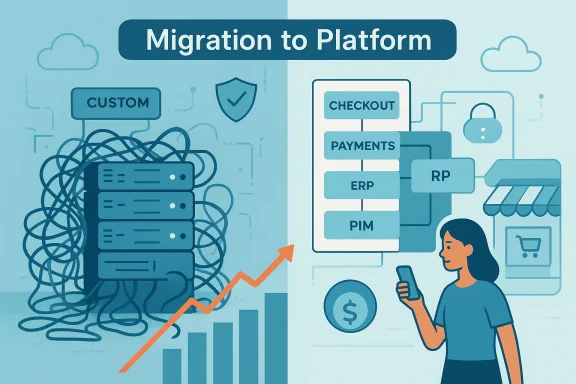 Background: Why the maintenance tax matters now
Over the last decade commerce moved from “site plus plugins” to a fast, interconnected ecosystem where discovery surfaces multiply and customer expectations change by the quarter. New channels—mobile wallets, marketplaces, and now agentic AI assistants—shift where purchase intent starts. When your engineering capacity is consumed by firefighting, you lose runway for the very experiments that drive customer acquisition and retention.This is the maintenance tax in plain terms: visible costs like cloud hosting, database licensing, CDNs, and SRE headcount, plus invisible costs such as delayed checkout optimizations, loyalty programs that remain on the backlog, and missed opportunities to expand into emergent channels. When infrastructure ownership competes directly with product innovation, growth slows and strategic options narrow.
Overview: What “built-for-commerce” platforms actually buy you
Moving the undifferentiated parts of commerce to a dedicated platform is not just about outsourcing servers. It’s a package of operational, economic, and product levers:- Operational defense: platform-managed security, compliance attestations, automatic vulnerability patching, SSL/DDoS protections, and dedicated fraud controls.
- Execution velocity: prebuilt integrations, a curated app ecosystem, admin automation, and platform-level product investment that reduce the time from idea to live feature.
- Channel readiness: turnkey primitives for new discovery and purchase surfaces—mobile wallets, marketplaces, and now AI-derived shopping experiences—so brands can show up faster.
The business case that vendors make — and how to treat it
Shopify’s enterprise messaging frames this as a practical pivot: stop subsidizing infrastructure and invest in commerce. The vendor claims measurable benefits from migration: faster time-to-value, lower migration and ongoing costs, and improved conversion through optimized checkout rails and Shop Pay adoption.Take these vendor-provided claims as directional data rather than gospel. The practical advice for enterprise decision-makers is to treat vendor-commissioned metrics as hypotheses to be validated against your catalog complexity, integrations, and operations:
- Build a three-year TCO model that includes migration fees, partner costs, platform subscriptions, app fees, ongoing infrastructure, and headcount.
- Scenario-test conservative and optimistic conversion uplifts; include opportunity cost from reclaimed engineering cycles (how many features you can ship faster and what revenue they deliver).
- Run a scoped pilot or feasibility sprint to validate migration assumptions rather than relying solely on headline percentages.
What brands actually reallocate when maintenance drops
Vendor case studies and enterprise migrations consistently report similar outcomes when maintenance overhead is removed:- Reallocated engineering capacity: teams move SRE and maintenance resources to product development.
- Shorter feature cycles: loyalty, personalization, and checkout experiments that took months on custom stacks ship in days or weeks with platform apps and primitives.
- Lower operating costs: reductions in infrastructure bills, fewer dedicated reliability hires, and simpler vendor management.
Key platform capabilities that replace months of custom work
When you move to a mature commerce platform, several product-level investments replicate functionality you would otherwise build and maintain in-house:- Networked checkout rails and accelerated payment flows (e.g., a saved-payment network) that increase conversion and reduce the work of implementing secure, scalable payments.
- Agentic storefronts and channel primitives that let your catalog appear inside AI assistants and other emergent discovery surfaces with minimal integration work.
- An admin assistant (AI-powered) that can generate automations, create Flow-like processes from plain language, suggest improvements from store data, and even scaffold apps or theme edits.
- Simulation and testing environments driven by AI shoppers modeled from your customer base so you can validate changes without waiting for statistically significant traffic volumes.
Technical realities and trade-offs
No migration is free of compromise. Moving to a platform changes the locus of control and introduces new governance demands. The major technical trade-offs to weigh:1. Customization vs. speed
Custom stacks grant near-total control over checkout flows, data models, and integrations. Platforms trade some absolute control for development speed and reliability via APIs, theme frameworks, and apps. The right choice depends on whether a particular capability is truly a sustainable differentiator or merely accumulated complexity.2. Integration surface complexity
Large enterprises run ERPs, OMS, PIM systems, tax engines, and bespoke fulfillment flows. Prebuilt connectors accelerate many integrations, but deep mappings and reconciliation work still require careful design, testing, and sometimes a middleware layer.3. Security and compliance responsibilities
Platforms centralize infrastructure security and often maintain PCI, SOC, and other compliance artifacts. This significantly lowers merchant burden, but merchants retain responsibility for data governance, app selection, and merchant-side controls. Platform compliance does not fully absolve merchant governance.4. Vendor concentration and lock-in
Consolidating core commerce primitives on a single vendor increases dependency on their roadmap, SLAs, pricing trajectory, and ecosystem rules. Mitigation strategies include preserving portability for critical business logic, exporting authoritative data models, and building a contingency plan for critical flows.5. Regulatory and residency constraints
If your business requires specific data residency, proprietary audit trails, or unusual regulatory controls, a multitenant platform may require customized architecture or be infeasible without additional controls.Practical migration playbook: an evidence-driven route out of the maintenance trap
If you’re evaluating migration, consider a staged, testable approach that validates the claims before full commitment.- Define the hypothesis in business terms.
- Example: “Migrating to a platform will free 40% of our SRE/devops cycles within 12 months and increase checkout conversion by 10% in 6 months.”
- Audit the build-vs-buy ledger.
- Inventory every bespoke feature and classify each as: revenue-differentiating, operational, or commoditized.
- Prioritize integrations and risk.
- Rank ERP, OMS, PIM, tax, and payment integrations by complexity and business impact.
- Run a 90-day feasibility sprint.
- Engage a systems integrator with enterprise platform experience for a scoped pilot that validates migration cadence and uplifts.
- Start phased migration with high-impact rails.
- Migrate checkout and payments first to capture conversion gains early and reduce transactional risk.
- Retain platform-agnostic capabilities.
- Keep a small team focused on cross-platform capabilities like data science, personalization rules, and middleware that preserve optionality.
- Measure reallocation and outcomes.
- Track reclaimed engineering time, number of accelerated features shipped, and conversion lift to validate your ROI model.
Governance and mitigation strategies for the risks of platform consolidation
Vendor lock-in and app-governance are real concerns. Practical mitigations include:- Architect a middleware layer for complex business rules so you can decouple ERP logic from the storefront.
- Maintain authoritative data exports (product, customer, order) and test restores periodically.
- Use feature flags and canary releases during migration to validate user flows without full cutovers.
- Establish an app governance policy: review third-party apps for data handling, performance, and maintenance cadence.
- Keep a small, internal team focused on vendor-agnostic capabilities (data science, personalization rules) that can be reimplemented elsewhere if required.
The economics: assessing migration cost vs. ongoing burn
A proper financial model must include more than platform subscription fees. Typical TCO modeling should include:- One-time migration costs: partner fees, integration labor, data migration, and cutover resources.
- Ongoing platform fees and app subscriptions.
- Ongoing in-house infrastructure costs avoided (hosting, SRE, security tooling).
- Revenue uplift scenarios from improved conversion and faster feature delivery.
- Opportunity value of reclaimed engineering capacity (estimate the features accelerated and their revenue impact).
What becomes possible when teams stop building infrastructure
Concrete outcomes reported by brands after migration illustrate the shift from maintenance to innovation:- Faster launches: features and product launches that previously took months are now delivered in weeks or days.
- Reallocated resources: SRE and maintenance engineers redeployed to strategic projects such as personalization, new channel launches, and product expansions.
- Cost savings: reductions in infrastructure and payment processing costs and fewer dedicated resiliency hires.
- Channel expansion: ability to appear in new discovery surfaces—marketplaces, mobile wallets, and AI assistants—without months of custom work.
- Increased conversion: optimized checkout rails and accelerated payment flows drive measurable improvement in conversion rates and lower CAC.
Strengths: why platform migration often wins for growth-oriented brands
- Speed: prebuilt rails and an app ecosystem dramatically accelerate time-to-market for common commerce features.
- Scale and reliability: platform SLAs, centralized security, and network-level optimizations reduce the burden of maintaining uptime and compliance.
- Product investment at scale: platform-level R&D and twice-yearly editions deliver functionality a single merchant could not build or maintain cost-effectively.
- Ecosystem benefits: an active app marketplace brings specialized solutions that are battle-tested across thousands of implementations.
- Channel readiness: primitives for emergent surfaces—especially AI-driven discovery—reduce the implementation burden for new channels.
Risks: where migration can fail or underdeliver
- Overlooking truly differentiating features: migrating core business logic that actually creates competitive advantage can harm your product positioning.
- Underestimating integration complexity: legacy ERP, tax, and fulfillment systems can require significant mapping and reconciliation work.
- App sprawl and governance failures: a large app portfolio can create new maintenance demands if not governed carefully.
- Vendor risk concentration: reliance on a single vendor for critical commerce primitives raises questions about future pricing and roadmap fit.
- Regulatory and residency mismatches: compliance needs that require specific architectures may not align with a multitenant platform.
How to decide: checklist for the migration decision
- Does your engineering team spend a material portion of time on maintenance rather than innovation?
- Do you have high-value experiments repeatedly delayed (checkout, loyalty, AI channels)?
- Are your conversion and payment rails under-optimized relative to your competitors?
- Can your differentiators be isolated as modules so the rest of commerce can run on a platform?
- Can you run a 90-day pilot that validates the vendor’s claims against your stack?
A pragmatic hybrid approach: keep what matters, platformize the rest
Not every module of commerce must move to a single platform. Many enterprise merchants adopt a hybrid model:- Platformize the storefront, checkout rails, and standard integrations to gain speed and reduce maintenance.
- Retain bespoke fulfillment, pricing engines, or proprietary recommendation systems as standalone services with API integrations.
- Use middleware to mediate between platform primitives and in-house systems, preserving portability and control over critical logic.
- Treat the platform as a managed service for undifferentiated components and focus internal engineering on unique product capabilities.
Conclusion: build commerce, not infrastructure
The maintenance tax is real: accumulated technical debt, patch cycles, and fragile integrations consume developer hours that should be spent on customer-facing innovation. For many brands the right strategic move is not a simplistic “platform vs custom” debate but a targeted reallocation of where engineering creates value.A disciplined migration—scoped with pilots, governed with middleware and exports, and measured against conservative TCO scenarios—lets organizations reclaim runway. When maintenance becomes a service rather than a sink for developer time, teams can ask a different question: What should we build next to win customers? The answer is rarely more infrastructure. It’s better checkout experiences, smarter personalization, faster channel experimentation, and product innovation that scales with the business.
Stop subsidizing the past. Move the undifferentiated platform work where it’s most efficient, protect the pieces that truly differentiate your brand, and measure the outcome. When you do, innovation stops competing with maintenance—and it begins to win.
Source: Shopify Beyond Custom: When Innovation No Longer Competes with Maintenance (2026) - Shopify Philippines
