

TheTVApp went offline on June 6, 2026, alongside TVPass and TVPlans, then resurfaced weeks later on a different domain while the original address and TVPass remained unavailable. That is not a comeback so much as an evasion maneuver. The service may be reachable again, but the facts that made it unstable before June 6 are still intact: unlicensed live TV streams, anonymous operation, brittle infrastructure, and no reliable path for users when access disappears.
The mistake is to treat a new domain as a new risk profile. In this corner of the streaming world, domains are disposable wrappers around the same legal and operational problem. TheTVApp’s new address changes where users type; it does not change what they are accessing.
A domain move can make an outage feel solved because the browser loads again. For users who only wanted the game, the news channel, or the nightly channel-surfing habit back, that is enough to create the impression of recovery. But from an infrastructure and enforcement perspective, a service moving rather than returning is usually a sign of pressure, not resilience.
The June 6 outage was notable because TheTVApp, TVPass, and TVPlans all vanished in the same window. That pattern looks less like a bad server and more like a shared dependency failing or being cut off. When services with overlapping audiences and infrastructure go dark together, the domain is rarely the root issue.
The silence mattered too. During earlier outages, community channels and user chatter provided at least some signal that operators were still present. This time, the associated Discord presence reportedly disappeared along with the streams, leaving users with the worst possible support model: no status page, no operator statement, no recovery ETA, and no accountable entity.
That is why the new domain should be understood as a continuation of the same lifecycle. TheTVApp has not re-emerged as a licensed, stable, consumer-facing product. It has reappeared as the same kind of unofficial live TV service at a different address.
That kind of coordinated disappearance is the signature users have seen across the piracy ecosystem for years. Enforcement does not always begin with a splashy press release or a domain seizure banner. It can start with pressure on hosts, registrars, payment rails, CDN providers, backend accounts, or other infrastructure that keeps the public site alive.
There is still no confirmed public enforcement notice tying a named agency or court action to TheTVApp’s June 6 outage. That matters, and it is worth saying plainly. The available facts support a strong inference of infrastructure-level disruption, but they do not prove who caused it or whether legal pressure was the immediate trigger.
Still, the absence of confirmation is not evidence of innocence. Many unauthorized services disappear without a neat courtroom breadcrumb trail that users can find. In practice, the first public sign is often exactly what TheTVApp users saw: a blank page, dead community channels, copycat domains, and speculation filling the vacuum.
But convenience does not create rights. Live TV is not just a generic internet feed; it is a licensed distribution business built on contracts among networks, leagues, studios, affiliates, and distributors. A service carrying major U.S. channels without authorization is not merely “disrupting” the bundle. It is distributing someone else’s signal without the legal machinery that makes distribution lawful.
That distinction is why the new domain cannot fix the underlying problem. The same channels, the same unlicensed model, and the same anonymous operation produce the same exposure. A domain change may frustrate casual blocking or buy time after a takedown, but it does not convert an unauthorized service into a legitimate one.
For WindowsForum readers, this is the practical lens: if a service cannot explain who operates it, what rights it has, how it secures users, or what happens when it vanishes, then the browser tab is not the product. The product is instability.
That means hosting providers, payment processors, domain registrars, ad networks, source servers, and identity trails matter more than the logo on the page. A streaming site can publish a new address in minutes, but rebuilding a trusted traffic funnel, server chain, source pipeline, and user community is harder. The more successful a service becomes, the harder it is to hide those dependencies.
The pattern has been visible across high-profile piracy operations. Sites cycle through domains, mirrors, Telegram posts, Discord servers, and clone-like branding, but enforcement pressure eventually follows the infrastructure. The larger the audience, the more attractive the target becomes.
That is why TheTVApp’s return should not be read as proof that the June 6 event was harmless. It is better understood as the next phase of the same contest. The domain moved; the pressure points remain.
That split outcome is common in unauthorized streaming clusters. One brand may reappear quickly because its operators still control enough infrastructure, while another disappears because a key dependency was lost or the risk calculus changed. Users experience both outcomes as randomness, but the difference often reflects who still has access to servers, domains, accounts, and source feeds.
For people who paid for TVPass or built viewing habits around it, the lack of recourse is the point. There is no regulator to complain to about service quality, no formal refund mechanism, no corporate support queue, and no enforceable promise that the service will exist tomorrow. The user may have paid money, but they did not buy consumer rights in any meaningful sense.
TheTVApp’s new domain does not erase that lesson. It simply gives users a second chance to accept the same bargain.
The more common user-facing consequence is ISP involvement. Connections associated with infringing services can draw warnings, throttling, account scrutiny, or notices passed through from rights holders. The experience varies by provider and circumstance, but “I am just watching in a browser” is not a magic shield.
There is also a difference between theoretical exposure and practical risk. Most users will never see a lawsuit over a single stream. But many users will encounter the operational side effects of using services that cannot operate openly: sudden outages, poisoned search results, fake mirrors, phishing pages, and aggressive ads masquerading as video controls.
That is the part of the risk model people underestimate. The legal issue may be quiet, but the security issue is loud.
A user trying to watch a live channel may be one misclick away from a malicious extension prompt or a fake codec installer. On Windows, that is not a theoretical concern. The desktop remains the richest target for credential theft, session hijacking, infostealers, and remote-access scams that begin with a browser redirect.
This is where the “use an ad blocker” advice becomes inadequate. Blocking scripts can reduce exposure, but it cannot make an unaccountable service trustworthy. If the site’s revenue model depends on low-quality ad demand and the operator has no brand reputation to protect, the user is doing the safety work that a legitimate platform normally does.
For sysadmins and family tech-support volunteers, the recommendation is simple: do not normalize these sites on machines used for banking, work, school, password management, or shared household accounts. The free stream is not free if the cleanup costs arrive later.
But the rise of free ad-supported streaming television, or FAST, has weakened one of the old excuses. Pluto TV, Tubi, Plex, The Roku Channel, and Sling Freestream now provide large legal channel grids with no monthly subscription. They are not perfect substitutes for a pirate live TV grid, especially for premium sports and full cable-network simulcasts, but they cover a large share of casual viewing.
That matters because a lot of TheTVApp usage was likely not mission-critical sports piracy. It was channel surfing, background news, reruns, movies, kids programming, and comfort TV. Those categories are exactly where free legal services have improved.
The limitation should not be hidden. FAST services generally do not replace ESPN, local RSNs, every broadcast affiliate, or every live event. But they do replace enough of the “I just want something on” use case that the security tradeoff becomes much harder to justify.
Pluto TV is still the closest legal analog to old-school channel surfing. Its grid is built around free live channels, movies, themed programming, news, sports-adjacent content, and familiar entertainment brands. It feels like television because it is designed to recreate the lean-back experience without asking for a credit card.
Tubi is stronger on the on-demand side while also offering live channels. Its value is breadth: movies, older series, niche genres, and a steadily expanding free catalog. It will not satisfy someone looking for every premium live sports feed, but it is often a better answer for users who were using TheTVApp as a general entertainment shortcut.
Plex is the interesting hybrid because it blends personal media management with free streaming channels. For Windows enthusiasts and home-lab users, Plex already occupies a familiar place in the media stack. Its free live TV offering adds a legal channel layer without requiring users to abandon their own libraries.
The Roku Channel and Sling Freestream round out the picture. Both show how far the free legal market has moved from a junk drawer of obscure channels to a credible default for casual viewing. Again, none of this makes the paid sports bundle disappear. It does mean that “there is no legal free alternative” is no longer true.
That creates a second-order risk beyond the original service. Even users who think they are merely following the community to the new location may land on a clone with different operators and worse intentions. The brand confusion is useful to scammers because there is no verified corporate channel to settle the matter.
Legitimate services solve this with app-store listings, verified social accounts, signed software, press pages, and customer support. Unauthorized services often rely on rumor, screenshots, and link-sharing. After an outage, that trust model collapses into vibes.
This is also why publishing or chasing new domains is a losing game for users. The address may change again. The “official” link may be copied. The mirror may be monetized by someone else. The more effort required to find the service, the more opportunities attackers have to intercept the demand.
A Windows PC with saved passwords, synced browser sessions, work accounts, cloud storage, and payment information is not an expendable viewing device. It is a high-value identity container. Streaming from a legally dubious site on that same machine collapses entertainment risk into account-security risk.
At minimum, users who insist on visiting such sites should avoid installing anything, granting notification permissions, disabling browser protections, entering payment details, or reusing credentials. But the better advice is not to build a workflow around a site whose trust model begins with anonymity and ends with redirects.
For administrators, the issue is broader than one domain. DNS filtering, endpoint protection, browser hardening, and user education should treat unauthorized streaming as part of the same risk family as cracked software and fake download portals. The content category may be entertainment, but the attack surface is enterprise-relevant.
If anything, a move after a coordinated outage should make users more cautious. It suggests the service is operating under pressure and improvising around disruption. That improvisation may be impressive from a technical perspective, but it is not the same as reliability.
The original domain remaining down is also meaningful. A true recovery usually restores the known address or provides a clear migration path through trusted channels. A quiet move to a different domain, with the old one still unavailable, is closer to a continuity workaround than a return to normal.
That distinction matters because many users make risk decisions based on whether a service “is back.” The better question is whether anything material changed. In TheTVApp’s case, the answer appears to be no.
The mistake is to treat a new domain as a new risk profile. In this corner of the streaming world, domains are disposable wrappers around the same legal and operational problem. TheTVApp’s new address changes where users type; it does not change what they are accessing.
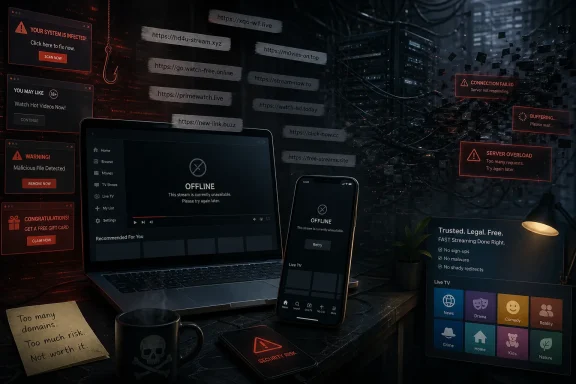 The New Domain Is the Least Interesting Part of the Story
A domain move can make an outage feel solved because the browser loads again. For users who only wanted the game, the news channel, or the nightly channel-surfing habit back, that is enough to create the impression of recovery. But from an infrastructure and enforcement perspective, a service moving rather than returning is usually a sign of pressure, not resilience.The June 6 outage was notable because TheTVApp, TVPass, and TVPlans all vanished in the same window. That pattern looks less like a bad server and more like a shared dependency failing or being cut off. When services with overlapping audiences and infrastructure go dark together, the domain is rarely the root issue.
The silence mattered too. During earlier outages, community channels and user chatter provided at least some signal that operators were still present. This time, the associated Discord presence reportedly disappeared along with the streams, leaving users with the worst possible support model: no status page, no operator statement, no recovery ETA, and no accountable entity.
That is why the new domain should be understood as a continuation of the same lifecycle. TheTVApp has not re-emerged as a licensed, stable, consumer-facing product. It has reappeared as the same kind of unofficial live TV service at a different address.
June 6 Looked Like Infrastructure Pressure, Not Routine Downtime
Unauthorized streaming services fail all the time for ordinary reasons. Servers overload, video sources break, DNS records rot, and ad scripts implode under their own weight. The June 6 event stood out because three related services went down together and stayed quiet afterward.That kind of coordinated disappearance is the signature users have seen across the piracy ecosystem for years. Enforcement does not always begin with a splashy press release or a domain seizure banner. It can start with pressure on hosts, registrars, payment rails, CDN providers, backend accounts, or other infrastructure that keeps the public site alive.
There is still no confirmed public enforcement notice tying a named agency or court action to TheTVApp’s June 6 outage. That matters, and it is worth saying plainly. The available facts support a strong inference of infrastructure-level disruption, but they do not prove who caused it or whether legal pressure was the immediate trigger.
Still, the absence of confirmation is not evidence of innocence. Many unauthorized services disappear without a neat courtroom breadcrumb trail that users can find. In practice, the first public sign is often exactly what TheTVApp users saw: a blank page, dead community channels, copycat domains, and speculation filling the vacuum.
TheTVApp’s Real Product Was Always Someone Else’s Signal
TheTVApp’s appeal was obvious. It offered a cable-like grid of live channels without the cable bill, the regional restrictions, or the annoying bundle economics that pushed many users away from traditional TV in the first place. For live sports, news, and background television, that convenience is powerful.But convenience does not create rights. Live TV is not just a generic internet feed; it is a licensed distribution business built on contracts among networks, leagues, studios, affiliates, and distributors. A service carrying major U.S. channels without authorization is not merely “disrupting” the bundle. It is distributing someone else’s signal without the legal machinery that makes distribution lawful.
That distinction is why the new domain cannot fix the underlying problem. The same channels, the same unlicensed model, and the same anonymous operation produce the same exposure. A domain change may frustrate casual blocking or buy time after a takedown, but it does not convert an unauthorized service into a legitimate one.
For WindowsForum readers, this is the practical lens: if a service cannot explain who operates it, what rights it has, how it secures users, or what happens when it vanishes, then the browser tab is not the product. The product is instability.
Enforcement Has Learned to Aim Below the Homepage
The old cat-and-mouse model of piracy imagined rights holders chasing individual websites, one domain at a time. That still happens, but the modern strategy is more patient and more structural. Anti-piracy groups increasingly target the infrastructure beneath the brand.That means hosting providers, payment processors, domain registrars, ad networks, source servers, and identity trails matter more than the logo on the page. A streaming site can publish a new address in minutes, but rebuilding a trusted traffic funnel, server chain, source pipeline, and user community is harder. The more successful a service becomes, the harder it is to hide those dependencies.
The pattern has been visible across high-profile piracy operations. Sites cycle through domains, mirrors, Telegram posts, Discord servers, and clone-like branding, but enforcement pressure eventually follows the infrastructure. The larger the audience, the more attractive the target becomes.
That is why TheTVApp’s return should not be read as proof that the June 6 event was harmless. It is better understood as the next phase of the same contest. The domain moved; the pressure points remain.
TVPass Shows What Non-Recovery Looks Like
TVPass is the important contrast. While TheTVApp has resurfaced under a different address, TVPass has not shown the same visible recovery signal. Its original domain has reportedly continued to fail connection checks, and no new address has been credibly tied to the original operators.That split outcome is common in unauthorized streaming clusters. One brand may reappear quickly because its operators still control enough infrastructure, while another disappears because a key dependency was lost or the risk calculus changed. Users experience both outcomes as randomness, but the difference often reflects who still has access to servers, domains, accounts, and source feeds.
For people who paid for TVPass or built viewing habits around it, the lack of recourse is the point. There is no regulator to complain to about service quality, no formal refund mechanism, no corporate support queue, and no enforceable promise that the service will exist tomorrow. The user may have paid money, but they did not buy consumer rights in any meaningful sense.
TheTVApp’s new domain does not erase that lesson. It simply gives users a second chance to accept the same bargain.
The Legal Risk Is Mostly Quiet Until It Isn’t
For individual U.S. users, the legal risk of watching unauthorized streams has historically been lower than the risk faced by operators. Rights holders usually pursue the people running services, selling subscriptions, hosting streams, or facilitating large-scale distribution. That does not mean users are outside the legal ecosystem; it means enforcement priorities have usually pointed upward.The more common user-facing consequence is ISP involvement. Connections associated with infringing services can draw warnings, throttling, account scrutiny, or notices passed through from rights holders. The experience varies by provider and circumstance, but “I am just watching in a browser” is not a magic shield.
There is also a difference between theoretical exposure and practical risk. Most users will never see a lawsuit over a single stream. But many users will encounter the operational side effects of using services that cannot operate openly: sudden outages, poisoned search results, fake mirrors, phishing pages, and aggressive ads masquerading as video controls.
That is the part of the risk model people underestimate. The legal issue may be quiet, but the security issue is loud.
The Ads Are Often More Dangerous Than the Streams
Unauthorized streaming sites tend to monetize through the parts of the ad ecosystem that legitimate publishers spend years trying to keep away from their readers. Pop-unders, fake download buttons, browser notification traps, scareware pages, and redirect chains are not incidental annoyances. They are part of the economics.A user trying to watch a live channel may be one misclick away from a malicious extension prompt or a fake codec installer. On Windows, that is not a theoretical concern. The desktop remains the richest target for credential theft, session hijacking, infostealers, and remote-access scams that begin with a browser redirect.
This is where the “use an ad blocker” advice becomes inadequate. Blocking scripts can reduce exposure, but it cannot make an unaccountable service trustworthy. If the site’s revenue model depends on low-quality ad demand and the operator has no brand reputation to protect, the user is doing the safety work that a legitimate platform normally does.
For sysadmins and family tech-support volunteers, the recommendation is simple: do not normalize these sites on machines used for banking, work, school, password management, or shared household accounts. The free stream is not free if the cleanup costs arrive later.
FAST TV Changed the Piracy Equation More Than Rights Holders Admit
The strongest argument for TheTVApp has always been convenience. Cable replacements are expensive, sports rights are fragmented, and paid streaming has recreated the bundle in slower, more confusing form. Users did not flock to unauthorized live TV sites because the experience was beautiful; they went because the official market often made simple viewing feel absurdly expensive.But the rise of free ad-supported streaming television, or FAST, has weakened one of the old excuses. Pluto TV, Tubi, Plex, The Roku Channel, and Sling Freestream now provide large legal channel grids with no monthly subscription. They are not perfect substitutes for a pirate live TV grid, especially for premium sports and full cable-network simulcasts, but they cover a large share of casual viewing.
That matters because a lot of TheTVApp usage was likely not mission-critical sports piracy. It was channel surfing, background news, reruns, movies, kids programming, and comfort TV. Those categories are exactly where free legal services have improved.
The limitation should not be hidden. FAST services generally do not replace ESPN, local RSNs, every broadcast affiliate, or every live event. But they do replace enough of the “I just want something on” use case that the security tradeoff becomes much harder to justify.
Pluto, Tubi, Plex, Roku, and Sling Are Boring in the Right Ways
Legal free streaming services are less thrilling than a pirate grid because they behave like products. They have apps in official stores. They have privacy policies, support pages, licensing arrangements, device compatibility lists, and advertisers who expect brand safety. That bureaucracy is exactly what makes them safer.Pluto TV is still the closest legal analog to old-school channel surfing. Its grid is built around free live channels, movies, themed programming, news, sports-adjacent content, and familiar entertainment brands. It feels like television because it is designed to recreate the lean-back experience without asking for a credit card.
Tubi is stronger on the on-demand side while also offering live channels. Its value is breadth: movies, older series, niche genres, and a steadily expanding free catalog. It will not satisfy someone looking for every premium live sports feed, but it is often a better answer for users who were using TheTVApp as a general entertainment shortcut.
Plex is the interesting hybrid because it blends personal media management with free streaming channels. For Windows enthusiasts and home-lab users, Plex already occupies a familiar place in the media stack. Its free live TV offering adds a legal channel layer without requiring users to abandon their own libraries.
The Roku Channel and Sling Freestream round out the picture. Both show how far the free legal market has moved from a junk drawer of obscure channels to a credible default for casual viewing. Again, none of this makes the paid sports bundle disappear. It does mean that “there is no legal free alternative” is no longer true.
The Copycat Problem Gets Worse After Every Outage
When a service like TheTVApp goes down and returns under a new domain, users become vulnerable to the most predictable scam on the internet: the fake replacement site. Search engines, social posts, Reddit threads, and short-lived domains fill with lookalikes promising access, APK downloads, Discord invites, or “official” mirrors.That creates a second-order risk beyond the original service. Even users who think they are merely following the community to the new location may land on a clone with different operators and worse intentions. The brand confusion is useful to scammers because there is no verified corporate channel to settle the matter.
Legitimate services solve this with app-store listings, verified social accounts, signed software, press pages, and customer support. Unauthorized services often rely on rumor, screenshots, and link-sharing. After an outage, that trust model collapses into vibes.
This is also why publishing or chasing new domains is a losing game for users. The address may change again. The “official” link may be copied. The mirror may be monetized by someone else. The more effort required to find the service, the more opportunities attackers have to intercept the demand.
Windows Users Should Treat These Sites Like Untrusted Software
The browser has trained people to think that visiting a site is less risky than installing an application. That is broadly true, but it can become misleading. Modern malicious campaigns use the browser as the first stage of compromise, especially when users are already primed to click through warnings in search of free content.A Windows PC with saved passwords, synced browser sessions, work accounts, cloud storage, and payment information is not an expendable viewing device. It is a high-value identity container. Streaming from a legally dubious site on that same machine collapses entertainment risk into account-security risk.
At minimum, users who insist on visiting such sites should avoid installing anything, granting notification permissions, disabling browser protections, entering payment details, or reusing credentials. But the better advice is not to build a workflow around a site whose trust model begins with anonymity and ends with redirects.
For administrators, the issue is broader than one domain. DNS filtering, endpoint protection, browser hardening, and user education should treat unauthorized streaming as part of the same risk family as cracked software and fake download portals. The content category may be entertainment, but the attack surface is enterprise-relevant.
The New Address Does Not Reset the Clock
TheTVApp’s new domain creates the illusion of a clean slate. Users can say the old site died, the new one works, and the crisis is over. But enforcement, infrastructure fragility, and security exposure do not reset just because the URL changed.If anything, a move after a coordinated outage should make users more cautious. It suggests the service is operating under pressure and improvising around disruption. That improvisation may be impressive from a technical perspective, but it is not the same as reliability.
The original domain remaining down is also meaningful. A true recovery usually restores the known address or provides a clear migration path through trusted channels. A quiet move to a different domain, with the old one still unavailable, is closer to a continuity workaround than a return to normal.
That distinction matters because many users make risk decisions based on whether a service “is back.” The better question is whether anything material changed. In TheTVApp’s case, the answer appears to be no.
TheTVApp’s Return Leaves Users With the Same Hard Choice
The concrete lesson from June 6 is not that unauthorized live TV sites always vanish forever. Some do come back. The lesson is that they can vanish without warning, return without explanation, move without accountability, and expose users to the same risks under a new name or address.- TheTVApp’s reappearance on a new domain does not change the licensing problem that made the service legally vulnerable in the first place.
- The coordinated June 6 outage across TheTVApp, TVPass, and TVPlans points to a shared infrastructure failure or pressure event rather than ordinary downtime.
- TVPass has not shown the same visible recovery, which underlines how little recourse users have when these services disappear.
- The most immediate user risk is often security rather than litigation, because fake mirrors, malicious ads, and phishing redirects thrive around disrupted piracy brands.
- Free legal services such as Pluto TV, Tubi, Plex, The Roku Channel, and Sling Freestream now cover much of the casual live-TV use case, though they do not fully replace premium sports or every cable simulcast.
References
- Primary source: DigitBin
Published: 2026-06-21T18:10:20.381939
TheTVApp Has a New Domain. The Legal Risk Is Exactly the Same
TheTVApp returned on a new domain after the June 6 shutdown. What changed, what the legal risks are, and free legal alternatives to use instead.www.digitbin.com - Related coverage: thetvapp.today
TheTVApp Not Working? Here Is How to Fix It (2026 Guide)
TheTVApp not working? Fix buffering, black screens and loading errors in minutes with these simple steps, plus backup stream and VPN tips that work.thetvapp.today - Related coverage: notopening.com
Is thetvapp.to down or not working right now? Troubleshoot and get help.
Get real-time current status and outage reports for thetvapp.to. Find out what other users are experiencing. Submit a report and share your experience with others online.notopening.com - Related coverage: the-tvapp.us
How to Fix TheTVApp Not Working (Buffering, Login Errors, etc.)
Streaming your favorite live channels shouldn’t feel like a gamble, but with TheTVApp, it often does. If you’re constantly dealing with buffering, errors, or streams that just won’t load, you’re not alone. This guide on How to Fix TheTVApp Not Working will walk you through simple and effective...the-tvapp.us
