

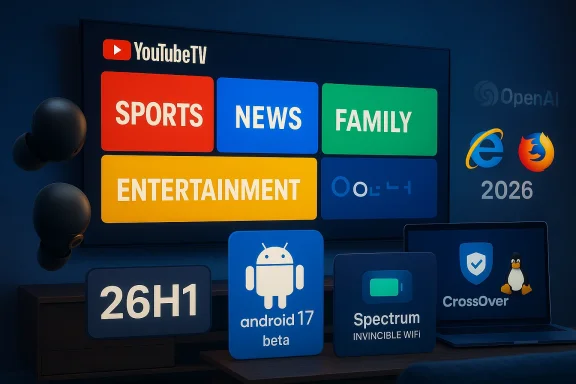
This week’s tech headlines felt like a speedrun through the industry: Google rewired how we might buy live TV, Microsoft shipped a hardware‑focused Windows release that will confuse upgrade checklists, Discord pushed a privacy‑rocky age‑verification plan, and every major browser vendor recommitted to fixing the long tail of web compatibility. Add new earbuds from Sony, a Wi‑Fi router that promises to keep your house online through storms, a developer‑heavy Android beta, and major compatibility progress for running Windows games on Mac and Linux — and you’ve got a week that mattered. Below I unpack the news, verify the technical claims where possible, explain the practical impact for power users and admins, and flag places you should treat with caution.
Background / Overview
The stories this week span three clear themes: platform transitions (Windows 26H1 and Android 17), product‑level refreshes that matter to consumers (Sony WF‑1000XM6, Spectrum Invincible Wi‑Fi, YouTube TV Plans), and infrastructure or policy moves with broader privacy, compatibility, or developer implications (Discord age verification, Interop 2026, CrossOver/Wine 11, OpenAI ads). I verified each major technical claim against vendor posts and multiple independent outlets where possible, and I’ve flagged items that remain partially disclosed or risky.YouTube TV’s “genre” breakup: more choice — and new complexity
YouTube TV’s big strategic shift is simple to state and harder to price: the company is breaking its single, 100+‑channel bundle into more than ten genre‑specific plans (sports, news, family, entertainment, etc.) so customers can pick only what they want. That change was announced by YouTube late last year and the rollout is scheduled for early 2026. (ndtvprofit.comWhy this matters
- For many cord‑cutters the single bundle felt wasteful: you paid for hundreds of channels you never watched. The new YouTube TV Plans aim to offer “skinny” alternatives while keeping core features like unlimited DVR intact. (webpronews.com
- The Sports Plan is being presented as the marquee offering — YouTube says it will include major broadcasters and the full ESPN suite (including ESPN Unlimited), plus multiview and fantasy features. That’s an attempt to monetize sports without forcing buyers to subsidize lifestyle channels. (ndtvprofit.com
- Pricing and full channel lineups were intentionally vague in official messaging; multiple outlets and community leaks filled the gap with expected price ranges, but exact costs and bundle mechanics (discounts for stacking multiple genre plans, local‑channel availability per market, and how premium add‑ons like NFL packages integrate) are still not fully public. Treat publicized numbers from early leaks as provisional. (red94.net
- The value proposition depends on your viewing habits. If you must subscribe to multiple genre plans to match today’s all‑in plan, the new model may not save you money. Expect this to start as a consumer choice exercise more than a guaranteed bill cut.
Discord’s controversial age‑verification rollout: identity checks and backlash
Discord announced it will begin enforcing stronger age verification measures for accounts, including the use of AI inference, document upload, and optional face‑based age checks. The company says the measures target accounts that its inference systems cannot reliably classify, and that most users will never be asked to submit ID or a face scan. That nuance didn’t stop a large, immediate backlash. (theverge.comWhat Discord says
- The stated intent is to protect teens and comply with regulatory pressure in markets that expect age‑segregation for certain content or interactions.
- Discord claims face scans are processed on device and that ID uploads are deleted after verification; they also emphasized that only accounts for which automated inference is uncertain will be prompted. (theverge.com
- Verification via ID and face data raises real privacy and security concerns, especially after prior incidents in which third‑party verification vendors were implicated in data exposures. Users fear scope creep, accidental leakage, and surveillance‑style profiling. That distrust has already triggered threats of mass departures and vocal criticism from privacy advocates. (theverge.com
- If you’re an admin of age‑restricted servers, prepare for tighter enforcement and nuance in how verified and unverified accounts are handled.
- If you value privacy, document Discord’s published retention and deletion promises now and consider alternatives or mitigations (server moderation tools, age‑gated invite workflows) while verification is optional for many accounts.
- Watch for regulatory clarifications — some jurisdictions may interpret “age checks” differently and require additional legal compliance.
Windows 11 version 26H1 (not a typical feature update): what Microsoft shipped and why it matters
Microsoft released Windows 11, version 26H1 as a hardware‑scoped release intended for a first wave of new ARM‑based Copilot+ devices (notably Snapdragon X2 machines). It’s not a consumer feature update you get through Windows Update — it’s preinstalled on select new devices and designed to match a new Windows core optimized for next‑gen silicon. (learn.microsoft.comKey facts verified
- 26H1 was released in early February 2026 and is intentionally packaged as a preinstalled experience for new hardware. Existing PCs running 24H2 or 25H2 are expected to remain on those servicing lines. (learn.microsoft.com
- Microsoft confirmed devices shipping 26H1 will not be automatically upgraded to the fall’s 26H2 feature update due to core platform differences; a longer unification plan is expected later. Enterprise administrators are instructed not to treat 26H1 as a mass‑update target for current fleets. (learn.microsoft.com
- If you’re buying a new Copilot+ or Snapdragon X2 laptop, know that its Windows edition (26H1) is architecturally different from the mainstream 24H2/25H2 branch. That can affect driver compatibility, update cadence, and long‑term servicing expectations. (learn.microsoft.com
- For IT planners: continue to recommend 24H2/25H2 for rollouts until broader unification is announced; evaluate 26H1 devices in isolated test labs for compatibility with line‑of‑business apps. (learn.microsoft.com
Android 17 Beta: a developer‑forward, compatibility‑heavy release
Google released the first public beta of Android 17 with a developer‑focused roadmap (including a new Canary channel) and several platform‑level changes that apps will need to adopt. Major items include removal of opt‑outs for orientation/resizability rules on large screens, generational garbage collection, lock‑free MessageQueue changes, and new camera/media APIs for VVC and dynamic capture session updates. These are documented on the Android Developers blog and covered by independent press. (android-developers.googleblog.comWhy Android 17 matters to developers and device makers
- The default behavior for activity recreation and orientation/resizability on larger screens changes how apps must be built for tablets and foldables. If your app assumes fixed orientation or suppresses resizability, you will need to test and update layouts. (android-developers.googleblog.com
- Performance improvements (ART GC and MessageQueue changes) are significant under the hood but require app testing because some reflective or JNI tricks will now throw or crash where they previously worked. That’s a clear “target SDK” breaking change for apps aiming at API 37. (android-developers.googleblog.com
- Developers: enroll Pixel test devices or use updated emulators and run compatibility test matrices targeted at API 37 now. Google plans a fast Platform Stability milestone — don’t wait until the final release. (android-developers.googleblog.com
- Users and device buyers: expect a beta window where some apps may misbehave on early Android 17 builds; normal consumers should wait for vendors’ stable releases.
CrossOver and Wine 11: a major win for Mac and Linux gaming compatibility
CodeWeavers’ CrossOver is moving to a Wine 11 base (CrossOver 26 beta builds reference Wine 11). That upgrade brings thousands of upstream changes and improved Direct3D translation stacks (vkd3d, DXMT/D3DMetal), enabling a notable set of previously broken or unsupported games to run on macOS and Linux — including titles like Borderlands 4, Starfield and Helldivers 2 in community reports. Wine 11 itself is a confirmed upstream milestone, and CodeWeavers’ beta announcement is publicly discussed in their forums and compatible communities. (reddit.comWhy this matters
- For Mac users who game, the practical availability of Windows‑only triple‑A titles via a mature compatibility layer reduces the friction of switching platforms or relying on a Windows box for gaming.
- For Linux desktop adopters, Wine 11 plus Proton/Proton‑GE upgrades mean more titles are testable and playable, accelerating the viability of Linux as a gaming platform — still limited by anti‑cheat and certain platform services, but making real progress. (reddit.com
- Anti‑cheat and DRM remain blockers for many multiplayer titles. CrossOver helps single‑player and many Steam titles, but wide competitive gaming support still depends on vendor cooperation.
- Beta builds require testing; don’t expect instant parity across all games — test your specific titles.
Interop 2026: browsers unite to fix cross‑engine fragmentation
The browser vendors aren’t done collaborating: Apple/WebKit, Google, Mozilla, Microsoft, and Igalia relaunched the Interop project for 2026, focusing on a targeted set of web platform features and Web Platform Tests so developers see consistent behavior across engines. The project has historically raised the cross‑browser test pass rate dramatically and now lists focus areas such as JavaScript module semantics, Navigation API parity, WebTransport, and more. (planet.webkit.orgWhy this matters for developers and users
- The Interop project reduces the “works in Chrome but breaks in Safari” headaches by coordinating spec clarifications and test coverage.
- Developers should watch Interop’s focus list — if a feature is in the Interop queue, it’s a good candidate to use more confidently in production sooner.
Spectrum’s “Invincible Wi‑Fi”: Wi‑Fi 7 + 5G + battery backup
Spectrum unveiled Invincible Wi‑Fi, an integrated Wi‑Fi 7 router with a built‑in battery backup and cellular (5G) fallback that claims to keep homes online for up to eight hours during power or network outages. Charter’s PR and corroborating coverage describe bundled pricing options and make the product available to Spectrum customers immediately. (advfn.comKey points verified
- The unit includes a Wi‑Fi 7 tri‑band router, an 8‑hour battery, and an integrated 5G backup connection; Spectrum says it will include the service with certain high‑tier plans or offer it as an add‑on. (advfn.com
- Limitations: cellular coverage depends on local signal, and there may be post‑threshold speed restrictions or fair‑use caps for the backup data. Independent reporting emphasizes real‑world cellular variability. (gizmodo.com
- For users in outage‑prone areas or small businesses that need temporary continuity for payments and communications, this is a sensible integrated option. For others with reliable fiber and their own UPS setups, the router’s incremental benefit is smaller.
Sony WF‑1000XM6: refined design, AI audio, and premium pricing
Sony’s WF‑1000XM6 true wireless earbuds are a notable hardware refresh: redesigned ergonomic form, a new HD Noise Canceling Processor (QN3e), improved ANC performance versus the XM5, and an MSRP around $330. Early reviews suggest improvements in noise cancellation and sound tuning, though fit and voice handling remain user‑dependent. (delmar-computers.com)What reviewers and specs say
- Sony highlights improved ANC using more microphones and smarter adaptive optimization; battery claims are up to about 8 hours on the buds plus 24 in the case. Independent hands‑on reviews vary on voice call quality and fit. (delmar-computers.com)
UniFi Drive 4.0: iPhone photo backups and OneDrive protected backups (still rolling)
Ubiquiti’s UniFi Drive application is getting a significant functional update — the company is promoting Drive 4.0 with new features including automatic iPhone photo backup and a Microsoft 365 protected cloud backup (OneDrive support), plus health monitoring and logs. Community release notes and early user reports indicate the rollout is staged (some users reporting the update is present on release channels while others must use early access). (reddit.comVerification and caveats
- Early community threads and the Ubiquiti releases page detail OneDrive business‑tenant support and an iPhone backup workflow; however, some capabilities (full iCloud direct server backup, Android parity, or personal Microsoft accounts) are limited or not yet generally available. Early reports indicate the phone app is used to transfer photos from devices that use iCloud’s “optimized storage” flows, which can require the phone to be active during the transfer. (reddit.com
- If you plan to rely on UniFi Drive for critical archival use, wait for the GA release notes and test with your workflow (iCloud optimized/resolution questions, Exchange/SharePoint support for M365, and Android clients). (reddit.com
Emoji 16.0 and Windows: staged rollout, partial availability
Microsoft has begun a staged rollout of Emoji 16.0 to Windows Insiders as part of small beta updates; however, full system‑wide consistency is not assured immediately because legacy rendering stacks and certain app surfaces can lag behind the new glyph set. The new emoji set is being distributed via enablement toggles in Insider channels. (windowsforum.comPractical detail: seeing Emoji 16.0 in the emoji picker doesn’t guarantee every app will render those glyphs, because older text rendering paths may fallback or show empty boxes until broad font/render pipeline updates are complete. Test across the apps you care about before assuming full parity. (windowsforum.com
OpenAI starts testing ads in ChatGPT’s free/Go tiers
OpenAI has begun testing advertisements in ChatGPT for logged‑in adult users of the Free tier and the Go ($8) subscription in the U.S., with paid tiers such as Plus and Pro exempt. OpenAI says the ads will be clearly labeled and not influence the assistant’s answer, and it promises controls for personalization and deletion of ad‑related data. Independent reporting and ad‑buying chatter indicate CPMs and early advertiser outreach. (alternativeto.netWhy this matters
- This is a major monetization shift: ads fund free access but also change the product experience and raise privacy questions about how ad relevance is determined (topic of chat, prior conversations, etc.). OpenAI published principles and product notes, but the rollout is a test and will evolve. (alternativeto.net
What to do now — practical checklist
- If you’re considering a YouTube TV plan change: wait for the official channel lists and trial pricing at checkout dates before switching. Audit your channel use to calculate whether bundling multiple genre plans will be cheaper. (webpronews.com
- For Discord server owners: prepare for stricter age gating; test moderation workflows with unverified accounts and document how verification prompts may change user flows. Keep an eye on Discord’s published privacy retention guarantees. (theverge.com
- Windows admins: treat 26H1 devices as special hardware SKUs. Don’t roll 26H1 into mainstream update rings — test in sandboxes. (learn.microsoft.com
- Android developers: run compatibility tests against Android 17 beta now and target the platform stability milestone — handling orientation/resizability and activity recreation changes are the highest‑risk items. (android-developers.googleblog.com
- Gamers on Mac/Linux: follow CodeWeavers’ CrossOver beta notes and WineHQ’s release to test your favorite titles, but remember anti‑cheat remains a blocker for many online titles. (reddit.com
- If you rely on UniFi Drive or similar NAS‑backed photo backups: validate the iPhone flow (full‑res vs optimized) and whether Android parity or enterprise OneDrive features meet your needs before replacing an existing archival backup. (reddit.com
Final assessment — strengths, risks, and the big picture
Strengths this week- Vendors are iterating quickly where it counts: platform maintainers (Google and Microsoft) are stabilizing developer tooling and platform plumbing, while browser vendors continue to collaborate to reduce fragmentation — a clear win for cross‑platform developers. (planet.webkit.org
- Consumer hardware is still improving: Sony’s earbuds and Spectrum’s integrated backup router show focused feature progress — better ANC and practical continuity. (delmar-computers.com)
- Compatibility tooling continues to shrink platform lock‑in: Wine/CrossOver progress is meaningful for desktop choice. (reddit.com
- Privacy vs safety is the headline risk: Discord’s ID/face checks and OpenAI’s ad plan both trade privacy guarantees for operational goals (age gating, funding the free tier). Vendor promises are explicit but enforcement, vendor selection, and retention policies must be audited for high‑sensitivity use. (theverge.com
- Fragmented platform upgrades create complexity: Microsoft’s 26H1 special‑purpose release is a pragmatic response to silicon changes but complicates update planning across device fleets. (learn.microsoft.com
- Product rollouts still use staged or gated deployments: many features (Emoji 16.0, UniFi Drive 4.0, browser interop fixes) are incrementally enabled; real‑world availability will vary and consumers should expect a phased experience. (windowsforum.com
This week’s patchwork of releases and announcements shows an industry balancing speed and caution. Vendors are shipping targeted features to support new hardware and new business models while trying to keep existing customers intact. For users and IT managers the takeaway is straightforward: test before you adopt, insist on written retention/processing guarantees for sensitive data, and treat staged rollouts as experimental until you can validate them in your environment.
Stop.
Source: How-To Geek YouTube TV's cheaper bundles, Windows 11 25H2, Discord's bad update, and more: News roundup
