

Thornhill College in Derry has won the post-primary category in the 2025–26 Northern Ireland Schools ICT Excellence Awards, after judges praised its use of Microsoft Copilot 365 and Google Gemini Pro to support personalised learning, accessibility, assessment, and teacher planning. As reported by Ireland Live and detailed in the awards material from the Education Authority and Capita, the win is not just another school trophy story. It is a signal that generative AI has moved from staffroom experiment to judged, public educational practice.
The most revealing detail in Thornhill College’s award is not that pupils are using digital tools. Schools have been doing that for decades, with varying degrees of ambition and administrative pain. The important shift is that Thornhill is being recognised for embedding generative AI into the routines of teaching and learning, rather than treating it as a novelty, a threat, or a banned shortcut.
According to Ireland Live’s report, Thornhill’s entry centred on “Digital Readiness for the Future,” with Microsoft Copilot 365 and Google Gemini Pro used by staff to create resources, support assessment, streamline planning, and improve accessibility. That combination matters. Copilot and Gemini are not niche classroom apps; they are mainstream productivity-layer AI systems from two of the world’s most consequential platform companies.
For WindowsForum readers, the Microsoft angle is obvious. Copilot has been sold by Microsoft as a new interface for work, productivity, and eventually Windows itself. In Thornhill’s case, that corporate pitch is meeting a messier but more meaningful test: whether AI can help teachers handle mixed-ability classrooms, additional needs, heavy planning burdens, and the constant demand to make learning more personal without making teaching impossible.
The judges’ framing suggests Northern Ireland’s schools are not merely asking pupils to consume technology. They are trying to move pupils toward digital capability: creativity, judgement, problem solving, and confident use of tools across subjects. That is a more mature ambition than the old “computer literacy” model, where success meant knowing how to use a word processor, format a spreadsheet, or survive a PowerPoint presentation.
That distinction is especially important in post-primary education, where pupils are already sorting themselves into academic identities. A pupil who sees digital tools only inside an ICT classroom may decide early that technology “isn’t for them.” A pupil who uses AI to draft a revision plan, adapt a text, explore historical sources, prototype a game, analyse a poem, or produce a video may encounter technology as a general-purpose creative instrument.
Thornhill’s win sits inside that broader shift. The awards judges praised schools for helping young people become active creators, not passive users, of digital tools. That is the right distinction, and it is one the technology industry itself often blurs. A child swiping through algorithmic feeds is “digital” in the thinnest possible sense. A child using AI, robotics, coding, or media tools to make something is building a different kind of agency.
This is also why the award lands differently in 2026 than it would have in 2016. A decade ago, school ICT excellence often meant visible hardware: tablets, interactive whiteboards, coding clubs, 3D printers, maybe a robotics programme. Those still matter, but the front line has shifted upward into software, data, identity, accessibility, and teacher workflow. The question is no longer whether schools have devices. It is whether they can use complex digital systems wisely.
That hybridity is healthy, but it also complicates governance. Generative AI is not just another app category. It changes how teachers produce materials, how pupils interact with information, and how assessment is interpreted. When a school uses Copilot to help staff plan lessons or Gemini to adapt content, it is also deciding what kinds of machine assistance are acceptable, auditable, and educationally legitimate.
The Ireland Live report presents Thornhill’s use of AI as a positive force for more personalised learning and better outcomes, including for pupils with additional needs. That is the strongest case for AI in education. Not the sci-fi fantasy of replacing teachers, but the practical possibility of producing differentiated resources, alternative explanations, accessibility supports, and feedback loops faster than a teacher could do alone.
Still, this is where the hard questions begin. Personalisation is a word technology vendors adore because it sounds humane and efficient at the same time. In practice, personalisation can mean anything from genuinely adaptive support to a thin layer of automated worksheet generation. The award suggests Thornhill is on the better side of that line, but the sector will need more than success stories. It will need evidence, policies, and professional judgement.
Thornhill’s entry appears to understand this. Ireland Live reports that staff used Copilot 365 and Gemini Pro to create engaging resources, support assessment, and streamline planning. Those are not glamorous use cases, but they are exactly where AI can have a compounding effect. A teacher who can generate a first draft of a differentiated worksheet, simplify a reading passage, produce extension questions, or reorganise feedback more quickly may have more time for the human work of teaching.
This is also why blanket panic about AI in schools often misses the mark. Yes, pupils can misuse AI to produce homework. Yes, schools need rules about authorship, assessment, data protection, and academic integrity. But focusing only on cheating reduces the entire debate to discipline. It ignores the professional productivity layer, where teachers may become more effective because the machine handles some of the repetitive drafting and formatting.
Microsoft has been explicit in positioning Copilot as a productivity assistant for work. In education, that pitch becomes more socially consequential. A marginal time saving in a corporate inbox is nice. A marginal time saving across lesson planning, accessibility adaptation, and assessment preparation can alter the texture of a school week. The difference is not the technology itself, but the setting in which it is deployed.
Thornhill’s recognition specifically notes that pupils benefit from accessible technologies enabling more personalised learning experiences and improved outcomes for all, including those with additional needs. That wording matters because it avoids treating accessibility as a side programme. The best accessibility work usually improves the general classroom as well. Captions, clearer instructions, visual supports, reading-level adjustments, and structured feedback help many pupils, not only those with formal diagnoses.
AI tools can also help pupils who struggle to start. A blank page is a barrier for many learners. Used properly, a generative system can provide prompts, structures, examples, and alternative routes into a task. That does not remove the need for knowledge; it can lower the friction that prevents pupils from demonstrating knowledge in the first place.
The danger is that accessibility becomes a vendor slogan rather than a pedagogical practice. AI output must be checked for accuracy, bias, tone, and suitability. Schools also need to avoid creating a two-tier model in which some pupils receive human explanation while others are routed toward machine-generated simplification. The teacher’s judgement remains the safeguard.
Strabane Controlled Primary School, named as a joint primary winner, was praised for putting digital competence at the centre of its mission. Its work included investment in a North-West Digital Skills Hub, partnerships with organisations such as Allstate and Strabane Academy, and a “Digital Passport” to track pupils’ progress from an early age. That is a notably different model from Thornhill’s AI-enhanced teaching and learning, but it points toward the same endpoint: pupils who see digital skills as part of their future identity.
The new Creativity Award, supported by Northern Ireland Screen, went jointly to post-primary EOTAS centres across Northern Ireland. Those centres used filmmaking, game development, photography, and industry-standard equipment to re-engage young people facing exclusion, trauma, or severe learning blocks. This is where the awards story becomes more than a celebration of shiny tools. Digital media can provide a route back into education for pupils who have found traditional classroom pathways alienating or unsuccessful.
The combination of Thornhill, Strabane, and EOTAS winners tells a richer story than any single award could. AI is part of the picture, but so are robotics, coding, creative media, accredited qualifications, career pathways, and inclusion. The mature version of school technology is not one platform. It is an ecosystem of tools matched to different learner needs.
That does not make the tools illegitimate. Schools have always used commercial platforms, from operating systems and office suites to learning management systems and cloud services. The question is whether public education can use those tools on its own terms. That means clear procurement, transparent privacy safeguards, staff training, and a willingness to change course when a tool does not serve learning.
For Microsoft, education remains strategically important because it is where future workers learn the grammar of productivity. Copilot in Microsoft 365 is not merely a chatbot; it is embedded into documents, email, meetings, and enterprise workflows. If pupils and teachers learn to treat AI assistance as a normal part of composing, summarising, planning, and presenting, Microsoft benefits from an early cultural foothold.
Google’s Gemini strategy carries similar stakes. Google has deep roots in search and classroom collaboration, and Gemini extends that influence into generative assistance. The classroom is a high-trust environment. If AI becomes normal there, the vendor that supplies the assistant gains more than usage metrics; it gains legitimacy.
The phrase “make learning visible” is powerful because it suggests process rather than product. If AI helps pupils externalise their thinking, compare drafts, test explanations, and reflect on feedback, it can support metacognition. If it simply produces finished answers, it hides learning. The difference depends on classroom design.
Teachers therefore need more than access to tools. They need time and training to build good tasks around them. A weak AI task asks the machine to produce the answer. A stronger AI task asks pupils to critique, improve, verify, adapt, or compare output against known criteria. The best uses of AI may involve slowing pupils down, not speeding them up.
This is where school leadership matters. Thornhill’s award suggests a strategic approach rather than isolated experimentation. “Digital Readiness for the Future” is not the language of one enthusiastic teacher trying a tool on Friday afternoon. It implies planning, culture, and institutional permission. Those are the conditions under which AI is most likely to become educationally useful rather than merely fashionable.
Thornhill’s reported use of AI to support assessment should be watched closely. There is a useful role for AI in generating rubrics, suggesting feedback language, identifying common misconceptions, or helping teachers organise evidence. But there is a bright line between support and automated judgement. Schools should be cautious about letting AI systems make or heavily determine evaluative decisions about pupils.
The risk is not only technical error. It is institutional drift. A tool introduced to save time can slowly become a gatekeeper if staff are overworked and leaders are under pressure for efficiency. That danger is especially acute in education, where the consequences of misjudgement fall on young people who may have limited ability to challenge the system.
The answer is not to ban AI from assessment-adjacent work. It is to design guardrails around it. Teachers should remain accountable for final judgements, pupils should know when AI is involved, and schools should preserve enough human review to catch errors and unfairness. AI can assist assessment, but it should not become the assessor.
Microsoft and Google have enterprise and education controls, but controls are only as good as configuration, policy, and user behaviour. A teacher pasting identifiable pupil information into the wrong AI interface can create a problem even if the school’s official platform is compliant. A pupil using a personal account rather than a managed account can shift the risk profile entirely.
This is why AI deployment in schools belongs partly to educators and partly to IT governance. Teachers understand learning needs. IT teams understand identity, access, logging, retention, and vendor contracts. The best implementations will bring those groups together early, rather than asking one to clean up after the other.
Northern Ireland’s C2k and EdIS context is important here. The awards material referenced ongoing digital transformation across school services, with sponsors and partners including the Education Authority, EdIS/C2k, Capita, and Northern Ireland Screen. Centralised or coordinated infrastructure can make responsible AI adoption easier, provided it does not become too slow or rigid to support classroom innovation.
Creative technology can be unusually effective for learners who have disengaged from conventional schooling. It produces visible outcomes. It allows collaboration without always requiring traditional academic performance. It connects directly to industries pupils recognise. It can also give young people a sense of competence before they are ready to re-enter more formal learning.
This should temper the AI-centric reading of Thornhill’s win. Generative AI is important, but it is not the whole future of educational technology. For some pupils, the transformative tool may be a camera, a game engine, a robotics kit, a music workstation, or an editing suite. The best digital strategy is plural.
Northern Ireland Screen’s support for the Creativity Award also points to a useful model: education linked to real sectors, not just abstract skills. “Digital skills” can become meaningless if detached from practice. Filmmaking, game development, and photography give pupils a reason to care about planning, sequencing, teamwork, iteration, and technical precision.
If done well, such tracking can help teachers see what pupils have actually experienced and what they are ready to try next. It can also help pupils develop a vocabulary for their own skills. That matters when digital competence is linked to aspiration, especially in communities where pupils may not automatically see themselves in technology careers.
By the time pupils reach a school like Thornhill, the challenge changes. Post-primary learners need more sophisticated digital judgement. They must understand AI assistance, source reliability, creative production, data privacy, collaboration, and subject-specific tools. The primary passport and the post-primary AI strategy are therefore not separate trends. They are two points on the same pipeline.
That pipeline also has economic significance. Partnerships with organisations such as Allstate, noted in Ireland Live’s report on Strabane, connect classroom activity to employment pathways. Northern Ireland has a growing technology and cybersecurity profile, and schools are part of that long-term skills story. The issue is not simply whether pupils can code. It is whether they can imagine themselves as builders, analysts, designers, and problem-solvers.
Scaling this work will require professional development, not just licenses. Teachers need practical examples, shared resources, and safe spaces to discuss failures. IT staff need funding and authority to manage platforms properly. School leaders need policies that are clear enough to guide behaviour but flexible enough to adapt as tools change.
There is also a workload paradox. AI may reduce some burdens, but adopting AI responsibly creates new work: training, policy writing, evaluation, troubleshooting, parent communication, and safeguarding review. Schools that pretend otherwise will burn out the very staff expected to innovate. The productivity gains are real only if the implementation costs are acknowledged.
The awards’ emphasis on evidence of improved learning outcomes is therefore crucial. Technology integration should not be judged by enthusiasm alone. Schools need to show that digital tools are helping pupils learn more deeply, participate more fully, produce more creatively, or progress more confidently. Without that evidence, “innovation” becomes theatre.
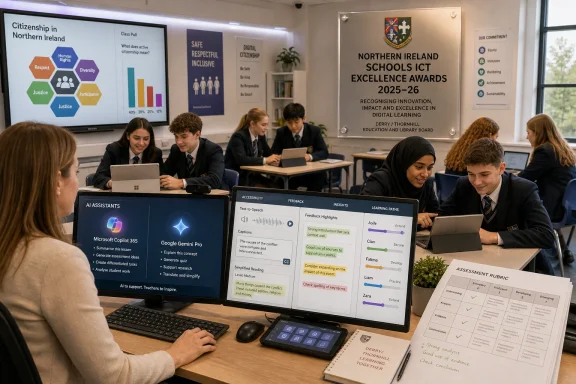 Thornhill’s Win Shows AI Has Entered the Ordinary School Day
The most revealing detail in Thornhill College’s award is not that pupils are using digital tools. Schools have been doing that for decades, with varying degrees of ambition and administrative pain. The important shift is that Thornhill is being recognised for embedding generative AI into the routines of teaching and learning, rather than treating it as a novelty, a threat, or a banned shortcut.According to Ireland Live’s report, Thornhill’s entry centred on “Digital Readiness for the Future,” with Microsoft Copilot 365 and Google Gemini Pro used by staff to create resources, support assessment, streamline planning, and improve accessibility. That combination matters. Copilot and Gemini are not niche classroom apps; they are mainstream productivity-layer AI systems from two of the world’s most consequential platform companies.
For WindowsForum readers, the Microsoft angle is obvious. Copilot has been sold by Microsoft as a new interface for work, productivity, and eventually Windows itself. In Thornhill’s case, that corporate pitch is meeting a messier but more meaningful test: whether AI can help teachers handle mixed-ability classrooms, additional needs, heavy planning burdens, and the constant demand to make learning more personal without making teaching impossible.
The judges’ framing suggests Northern Ireland’s schools are not merely asking pupils to consume technology. They are trying to move pupils toward digital capability: creativity, judgement, problem solving, and confident use of tools across subjects. That is a more mature ambition than the old “computer literacy” model, where success meant knowing how to use a word processor, format a spreadsheet, or survive a PowerPoint presentation.
The Old ICT Model Is Giving Way to Digital Capability
Mervyn Storey, chairperson of the Education Authority, used the awards ceremony to make the point plainly: the system is moving beyond standalone IT literacy toward digital capability. That phrase can sound like policy wallpaper, but it marks a real change in emphasis. The computer lab model treated technology as a subject. The digital capability model treats technology as a medium running through every subject.That distinction is especially important in post-primary education, where pupils are already sorting themselves into academic identities. A pupil who sees digital tools only inside an ICT classroom may decide early that technology “isn’t for them.” A pupil who uses AI to draft a revision plan, adapt a text, explore historical sources, prototype a game, analyse a poem, or produce a video may encounter technology as a general-purpose creative instrument.
Thornhill’s win sits inside that broader shift. The awards judges praised schools for helping young people become active creators, not passive users, of digital tools. That is the right distinction, and it is one the technology industry itself often blurs. A child swiping through algorithmic feeds is “digital” in the thinnest possible sense. A child using AI, robotics, coding, or media tools to make something is building a different kind of agency.
This is also why the award lands differently in 2026 than it would have in 2016. A decade ago, school ICT excellence often meant visible hardware: tablets, interactive whiteboards, coding clubs, 3D printers, maybe a robotics programme. Those still matter, but the front line has shifted upward into software, data, identity, accessibility, and teacher workflow. The question is no longer whether schools have devices. It is whether they can use complex digital systems wisely.
Copilot and Gemini Are Becoming Classroom Infrastructure
The presence of both Microsoft Copilot 365 and Google Gemini Pro in Thornhill’s work is telling. Schools have long lived in hybrid ecosystems, even when vendors pretend otherwise. Microsoft dominates many administrative and productivity environments, while Google has strong classroom penetration through Workspace, Chromebooks, and collaboration tools. Thornhill’s example reflects reality: educators use what works, what is available, and what fits the task.That hybridity is healthy, but it also complicates governance. Generative AI is not just another app category. It changes how teachers produce materials, how pupils interact with information, and how assessment is interpreted. When a school uses Copilot to help staff plan lessons or Gemini to adapt content, it is also deciding what kinds of machine assistance are acceptable, auditable, and educationally legitimate.
The Ireland Live report presents Thornhill’s use of AI as a positive force for more personalised learning and better outcomes, including for pupils with additional needs. That is the strongest case for AI in education. Not the sci-fi fantasy of replacing teachers, but the practical possibility of producing differentiated resources, alternative explanations, accessibility supports, and feedback loops faster than a teacher could do alone.
Still, this is where the hard questions begin. Personalisation is a word technology vendors adore because it sounds humane and efficient at the same time. In practice, personalisation can mean anything from genuinely adaptive support to a thin layer of automated worksheet generation. The award suggests Thornhill is on the better side of that line, but the sector will need more than success stories. It will need evidence, policies, and professional judgement.
Teacher Workload Is the Quiet AI Use Case That Actually Matters
The most credible near-term use of generative AI in schools is not pupils chatting with bots. It is teachers clawing back time. Planning, resource creation, differentiation, assessment support, communications, and administrative writing eat into the hours that should be spent on relationships, instruction, and feedback. If AI reduces that burden without lowering quality, it deserves serious attention.Thornhill’s entry appears to understand this. Ireland Live reports that staff used Copilot 365 and Gemini Pro to create engaging resources, support assessment, and streamline planning. Those are not glamorous use cases, but they are exactly where AI can have a compounding effect. A teacher who can generate a first draft of a differentiated worksheet, simplify a reading passage, produce extension questions, or reorganise feedback more quickly may have more time for the human work of teaching.
This is also why blanket panic about AI in schools often misses the mark. Yes, pupils can misuse AI to produce homework. Yes, schools need rules about authorship, assessment, data protection, and academic integrity. But focusing only on cheating reduces the entire debate to discipline. It ignores the professional productivity layer, where teachers may become more effective because the machine handles some of the repetitive drafting and formatting.
Microsoft has been explicit in positioning Copilot as a productivity assistant for work. In education, that pitch becomes more socially consequential. A marginal time saving in a corporate inbox is nice. A marginal time saving across lesson planning, accessibility adaptation, and assessment preparation can alter the texture of a school week. The difference is not the technology itself, but the setting in which it is deployed.
Accessibility Is Where the AI Argument Gets Stronger
The strongest moral case for classroom AI is accessibility. Pupils with additional needs often require alternative formats, scaffolded explanations, vocabulary support, different pacing, or more varied ways to show understanding. Human teachers already do this work, but they do it under constraints. Generative AI can help produce the raw material for adaptation faster, even if the teacher remains responsible for checking and shaping it.Thornhill’s recognition specifically notes that pupils benefit from accessible technologies enabling more personalised learning experiences and improved outcomes for all, including those with additional needs. That wording matters because it avoids treating accessibility as a side programme. The best accessibility work usually improves the general classroom as well. Captions, clearer instructions, visual supports, reading-level adjustments, and structured feedback help many pupils, not only those with formal diagnoses.
AI tools can also help pupils who struggle to start. A blank page is a barrier for many learners. Used properly, a generative system can provide prompts, structures, examples, and alternative routes into a task. That does not remove the need for knowledge; it can lower the friction that prevents pupils from demonstrating knowledge in the first place.
The danger is that accessibility becomes a vendor slogan rather than a pedagogical practice. AI output must be checked for accuracy, bias, tone, and suitability. Schools also need to avoid creating a two-tier model in which some pupils receive human explanation while others are routed toward machine-generated simplification. The teacher’s judgement remains the safeguard.
Northern Ireland’s Awards Are Becoming a Map of Educational Technology
The wider awards picture gives Thornhill’s win more context. The NI Schools ICT Excellence Awards, now in their eleventh year according to Ireland Live, recognised 24 schools and education centres. That breadth matters because it shows digital innovation is not confined to one well-resourced flagship school. The examples span post-primary, primary, and Education Otherwise Than at School settings.Strabane Controlled Primary School, named as a joint primary winner, was praised for putting digital competence at the centre of its mission. Its work included investment in a North-West Digital Skills Hub, partnerships with organisations such as Allstate and Strabane Academy, and a “Digital Passport” to track pupils’ progress from an early age. That is a notably different model from Thornhill’s AI-enhanced teaching and learning, but it points toward the same endpoint: pupils who see digital skills as part of their future identity.
The new Creativity Award, supported by Northern Ireland Screen, went jointly to post-primary EOTAS centres across Northern Ireland. Those centres used filmmaking, game development, photography, and industry-standard equipment to re-engage young people facing exclusion, trauma, or severe learning blocks. This is where the awards story becomes more than a celebration of shiny tools. Digital media can provide a route back into education for pupils who have found traditional classroom pathways alienating or unsuccessful.
The combination of Thornhill, Strabane, and EOTAS winners tells a richer story than any single award could. AI is part of the picture, but so are robotics, coding, creative media, accredited qualifications, career pathways, and inclusion. The mature version of school technology is not one platform. It is an ecosystem of tools matched to different learner needs.
The Vendor Layer Is Useful, but It Is Not Neutral
It would be naïve to discuss Copilot and Gemini in schools without acknowledging the platform politics. Microsoft and Google are not philanthropic background actors. They are competing to make their AI assistants the default layer through which students, teachers, and institutions interact with digital work. A school’s adoption decisions today may shape habits that persist into university, employment, and public life.That does not make the tools illegitimate. Schools have always used commercial platforms, from operating systems and office suites to learning management systems and cloud services. The question is whether public education can use those tools on its own terms. That means clear procurement, transparent privacy safeguards, staff training, and a willingness to change course when a tool does not serve learning.
For Microsoft, education remains strategically important because it is where future workers learn the grammar of productivity. Copilot in Microsoft 365 is not merely a chatbot; it is embedded into documents, email, meetings, and enterprise workflows. If pupils and teachers learn to treat AI assistance as a normal part of composing, summarising, planning, and presenting, Microsoft benefits from an early cultural foothold.
Google’s Gemini strategy carries similar stakes. Google has deep roots in search and classroom collaboration, and Gemini extends that influence into generative assistance. The classroom is a high-trust environment. If AI becomes normal there, the vendor that supplies the assistant gains more than usage metrics; it gains legitimacy.
Schools Need AI Literacy, Not AI Awe
Professor John Anderson MBE, the head judge quoted by Ireland Live, said teachers and pupils are using AI to make learning visible and to help young people become more effective learners. That is an optimistic and useful formulation. But the next phase must be AI literacy, not AI awe. Pupils need to understand that these systems can be helpful, fluent, wrong, biased, confident, and opaque all at once.The phrase “make learning visible” is powerful because it suggests process rather than product. If AI helps pupils externalise their thinking, compare drafts, test explanations, and reflect on feedback, it can support metacognition. If it simply produces finished answers, it hides learning. The difference depends on classroom design.
Teachers therefore need more than access to tools. They need time and training to build good tasks around them. A weak AI task asks the machine to produce the answer. A stronger AI task asks pupils to critique, improve, verify, adapt, or compare output against known criteria. The best uses of AI may involve slowing pupils down, not speeding them up.
This is where school leadership matters. Thornhill’s award suggests a strategic approach rather than isolated experimentation. “Digital Readiness for the Future” is not the language of one enthusiastic teacher trying a tool on Friday afternoon. It implies planning, culture, and institutional permission. Those are the conditions under which AI is most likely to become educationally useful rather than merely fashionable.
Assessment Will Be the Pressure Point
Every school that embraces generative AI eventually runs into assessment. If pupils can use AI to draft, summarise, translate, explain, and revise, then traditional homework becomes harder to interpret. A polished written response no longer proves the same thing it once did. That does not mean writing is dead, but it does mean assessment practices must become more explicit about process, evidence, and authorship.Thornhill’s reported use of AI to support assessment should be watched closely. There is a useful role for AI in generating rubrics, suggesting feedback language, identifying common misconceptions, or helping teachers organise evidence. But there is a bright line between support and automated judgement. Schools should be cautious about letting AI systems make or heavily determine evaluative decisions about pupils.
The risk is not only technical error. It is institutional drift. A tool introduced to save time can slowly become a gatekeeper if staff are overworked and leaders are under pressure for efficiency. That danger is especially acute in education, where the consequences of misjudgement fall on young people who may have limited ability to challenge the system.
The answer is not to ban AI from assessment-adjacent work. It is to design guardrails around it. Teachers should remain accountable for final judgements, pupils should know when AI is involved, and schools should preserve enough human review to catch errors and unfairness. AI can assist assessment, but it should not become the assessor.
Data Protection Is the Unseen Curriculum
For IT professionals, the data question will loom larger than the award ceremony. Generative AI in schools raises familiar but serious concerns: what data is entered, where it goes, how long it is retained, who can access it, and whether pupil information is used to train or improve models. These are not abstract compliance issues. They are the conditions under which trust survives.Microsoft and Google have enterprise and education controls, but controls are only as good as configuration, policy, and user behaviour. A teacher pasting identifiable pupil information into the wrong AI interface can create a problem even if the school’s official platform is compliant. A pupil using a personal account rather than a managed account can shift the risk profile entirely.
This is why AI deployment in schools belongs partly to educators and partly to IT governance. Teachers understand learning needs. IT teams understand identity, access, logging, retention, and vendor contracts. The best implementations will bring those groups together early, rather than asking one to clean up after the other.
Northern Ireland’s C2k and EdIS context is important here. The awards material referenced ongoing digital transformation across school services, with sponsors and partners including the Education Authority, EdIS/C2k, Capita, and Northern Ireland Screen. Centralised or coordinated infrastructure can make responsible AI adoption easier, provided it does not become too slow or rigid to support classroom innovation.
The EOTAS Creativity Award Shows Technology Can Reopen Closed Doors
The EOTAS award may be the most emotionally significant part of the wider story. Young people facing exclusion, trauma, or severe learning blocks are often discussed in terms of risk, deficit, and intervention. The awards report instead describes filmmaking, game development, photography, industry-standard equipment, accredited qualifications, and career pathways. That is a different narrative.Creative technology can be unusually effective for learners who have disengaged from conventional schooling. It produces visible outcomes. It allows collaboration without always requiring traditional academic performance. It connects directly to industries pupils recognise. It can also give young people a sense of competence before they are ready to re-enter more formal learning.
This should temper the AI-centric reading of Thornhill’s win. Generative AI is important, but it is not the whole future of educational technology. For some pupils, the transformative tool may be a camera, a game engine, a robotics kit, a music workstation, or an editing suite. The best digital strategy is plural.
Northern Ireland Screen’s support for the Creativity Award also points to a useful model: education linked to real sectors, not just abstract skills. “Digital skills” can become meaningless if detached from practice. Filmmaking, game development, and photography give pupils a reason to care about planning, sequencing, teamwork, iteration, and technical precision.
Primary Digital Passports and Post-Primary AI Are Two Ends of the Same Pipeline
Strabane Controlled Primary School’s “Digital Passport” idea is worth lingering on because it addresses a chronic weakness in school technology: continuity. Too often, pupils encounter digital learning as a set of disconnected projects. A coding week here, a robotics challenge there, a one-off e-safety lesson somewhere else. A passport model implies progression.If done well, such tracking can help teachers see what pupils have actually experienced and what they are ready to try next. It can also help pupils develop a vocabulary for their own skills. That matters when digital competence is linked to aspiration, especially in communities where pupils may not automatically see themselves in technology careers.
By the time pupils reach a school like Thornhill, the challenge changes. Post-primary learners need more sophisticated digital judgement. They must understand AI assistance, source reliability, creative production, data privacy, collaboration, and subject-specific tools. The primary passport and the post-primary AI strategy are therefore not separate trends. They are two points on the same pipeline.
That pipeline also has economic significance. Partnerships with organisations such as Allstate, noted in Ireland Live’s report on Strabane, connect classroom activity to employment pathways. Northern Ireland has a growing technology and cybersecurity profile, and schools are part of that long-term skills story. The issue is not simply whether pupils can code. It is whether they can imagine themselves as builders, analysts, designers, and problem-solvers.
The Awards Are Celebratory, but the Next Test Is Scale
Awards are designed to spotlight excellence, not average practice. That is both their value and their limitation. Thornhill College, Strabane Controlled Primary School, and the EOTAS centres offer models, but the real test is whether their practices can spread without being diluted into procurement slogans or superficial “AI ready” branding.Scaling this work will require professional development, not just licenses. Teachers need practical examples, shared resources, and safe spaces to discuss failures. IT staff need funding and authority to manage platforms properly. School leaders need policies that are clear enough to guide behaviour but flexible enough to adapt as tools change.
There is also a workload paradox. AI may reduce some burdens, but adopting AI responsibly creates new work: training, policy writing, evaluation, troubleshooting, parent communication, and safeguarding review. Schools that pretend otherwise will burn out the very staff expected to innovate. The productivity gains are real only if the implementation costs are acknowledged.
The awards’ emphasis on evidence of improved learning outcomes is therefore crucial. Technology integration should not be judged by enthusiasm alone. Schools need to show that digital tools are helping pupils learn more deeply, participate more fully, produce more creatively, or progress more confidently. Without that evidence, “innovation” becomes theatre.
Thornhill’s Award Leaves Schools With a More Practical AI Agenda
The lesson from Thornhill College is not that every school should rush to copy the same tools tomorrow. It is that generative AI has crossed the threshold into serious educational practice, and schools now need mature habits around it. The useful agenda is concrete, not breathless.- Schools should treat AI as a supported teaching and learning tool, not as an extracurricular experiment or a disciplinary problem to be handled only when pupils misuse it.
- Teachers should be trained to use AI for planning, differentiation, accessibility, and feedback support while retaining professional control over final materials and judgements.
- Pupils should learn how to critique, verify, and disclose AI assistance, because fluency with these systems will matter more than pretending they do not exist.
- IT leaders should make identity, privacy, retention, and platform governance part of the classroom AI conversation from the beginning.
- Policymakers should look beyond award-winning schools and fund the boring infrastructure that lets good practice become normal practice.
- Education systems should remember that AI is one tool among many, and that robotics, media production, coding, accessibility technology, and creative digital work remain essential parts of digital capability.
References
- Primary source: Ireland Live
Published: 2026-07-06T15:50:08.963313
Thornhill College wins post-primary ICT excellence award
Derry school praised for using Microsoft Copilot and Google Gemini to personalise pupil learningwww.ireland-live.ie - Related coverage: entrust-ed.co.uk
- Related coverage: gov.ie
Minister Foley congratulates students graduating with the P-TECH Special Purpose Award
P-TECH was launched as a pilot programme in November 2018www.gov.ie - Related coverage: eani.org.uk
NI schools named as leaders in digital excellence at the 2024 ICT Excellence Awards Ceremony
27 June 2024 Capita and the Education Authority Northern Ireland have announced the winners of the eighth annual 'NI Schools ICT Excellence’ Awards.www.eani.org.uk
- Related coverage: newrydemocrat.com
St. Colman's College celebrates second Capita NI Schools ICT Excellence Award - Photo 1 of 1 - Alpha Newspaper Group
ST. COLMAN’S COLLEGE, NEWRY has once again demonstrated its leadership in digital innovation by winning the Capita Northern Ireland Schools ICT Excellence...www.newrydemocrat.com
- Related coverage: holytrinitypscookstown.org
⭐️Holy Trinity Primary School - ICT Excellence Awards 2025 Finalists!!!⭐️
It was with great delight that our school received the news recently that we had been shortlisted for the ICT Excellence Awards 2024-25, a highly celebrated award for exemplary practices in Using ICT in schools in Northern Ireland. Last week, we welcomed the judging panel of this award to our...www.holytrinitypscookstown.org
- Related coverage: storage.googleapis.com
Theory of painting
Young professional painting teacher standing in front of audience and explaining his students main rulesstorage.googleapis.com
