

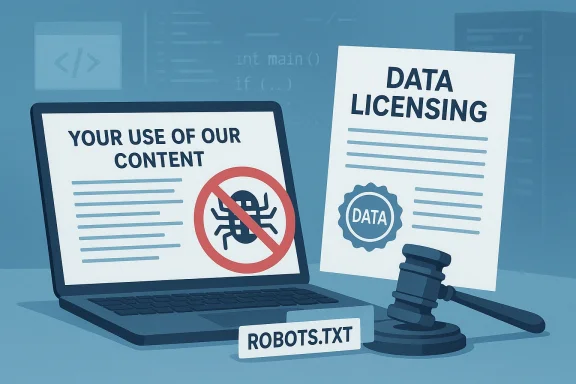
Thurrott’s recent reinforcement of its content rules — a short, lawyer‑lean paragraph that tells bots and commercial re‑users to back off — isn’t a petty, parochial demand; it’s a deliberate, public act of policy that sits at the junction of journalism economics, user expectations, and the legal limits of web scraping and large‑scale AI training. What appears on the surface as a publisher protecting its IP is also a signal to researchers, startups, and the broader Windows community about what is and isn’t acceptable when it comes to republishing, aggregating, or feeding a publisher’s work into automated systems. The practical fallout is already visible in community forums, in debates about robots.txt and contract law, and in the shifting business models of both publishers and AI platforms. s://www.thurrott.com/windows/windows-11/332685/de-enshittify-windows-11-start-fresh-with-a-new-install-of-windows-11)
Paul Thurrott’s site, Thurrott.com, has for decades been a trusted voice on Windows, hardware, and Microsoft’s product strategy. In February 2026 he published a multi‑part series and a book excerpt under the banner “De‑Enshittify Windows 11,” which is emblematic of the kind of original reporting and prescriptive how‑to content that independent publishers use to earn subscribers and advertising revenue. Those articles are high‑value editorial assets: they’re time‑consuming to research, tested with hands‑on steps, and often drive communities of readers to comment, subscribe, and share.
Against this backdrop, the terse “Your Use of Our Content” clause — which restricts use to personal, non‑commercial consumption and expressly bars automated scraping that substitutes for the Service — is a defensive move. It’s designed to preserve referral traffic, subscription conversions, and the site’s commercial viability by preventing wholesale copying or re‑publication that could undercut the publisher’s business model.
What that does, practically:
For Windows users and administrators, the practical takeaway is simple: rely on authoritative guides for complex tasks, support the publishers that produce them, and when building tools or services that compile third‑party content, plan to do so with permission — both because it’s the right thing for the sustainability of journalism, and because the legal and operational costs of treating the open web as a free data buffet are growing every year.
Source: Thurrott.com windows-update - Thurrott.com
 Background
Paul Thurrott’s site, Thurrott.com, has for decades been a trusted voice on Windows, hardware, and Microsoft’s product strategy. In February 2026 he published a multi‑part series and a book excerpt under the banner “De‑Enshittify Windows 11,” which is emblematic of the kind of original reporting and prescriptive how‑to content that independent publishers use to earn subscribers and advertising revenue. Those articles are high‑value editorial assets: they’re time‑consuming to research, tested with hands‑on steps, and often drive communities of readers to comment, subscribe, and share.Against this backdrop, the terse “Your Use of Our Content” clause — which restricts use to personal, non‑commercial consumption and expressly bars automated scraping that substitutes for the Service — is a defensive move. It’s designed to preserve referral traffic, subscription conversions, and the site’s commercial viability by preventing wholesale copying or re‑publication that could undercut the publisher’s business model.
Why publishers tighten terms now
Publishers face a twin pressure: the rise of generative AI (which benefits from high‑quality curated content) and the operational cost of unmanaged scraping. When third parties ingest full articles and then republish, summarize, or answer user queries in ways that displace the original, publishers lose both eyeballs and the revenue streams tied to them. Licensing has emerged as one response: large outlets have begun making money by striking data‑use deals with AI firms, while others pursue litigation or technical controls. Market reporting and publisher announcements across recent years document a clear pivot toward licensing and negotiated access rather than passive acceptance of wide open crawling.Overview of the current legal landscape
The legal picture that governs automated access to public web pages is not simple, and publishers’ contractual language sits beside a set of judicial precedents that are still evolving.- The Ninth Circuit’s hiQ v. LinkedIn saga established that scraping publicly available pages is not automatically a federal hacking violation under the Computer Fraud and Abuse Act (CFAA) — at least in many circumstances — and that blocking public‑data scrapers may be subject to careful judicial scrutiny. That line of cases has been litigated, remanded, and revisited, producing nuanced holdings about where CFAA liability begins and how contract and trespass claims may fill the enforcement gap.
- Contract law remains powerful. When a party accepts a site’s terms, or uses credentialed access to harvest content in ways the contract forbids, publishers have successfully pursued breach‑of‑contract claims. The hiQ litigation ultimately illustrates the bifurcated reality: scraping public pages may sometimes survive CFAA challenges but still fall afoul of enforceable user agreements or operational policies if the facts show authenticated access or circumvention.
- Robots.txt matters operationally even if it has ambiguous legal force. It’s widely treated as a community norm and a signal for ethical crawling. Publishers now explicitly reference robots directives in their Terms of Service as an additional basis for requiring compliance; they may also employ technical blocks, CAPTCHAs, and rate limiting to enforce the policy in practice.
What Thurrott’s policy actually says (and what it means)
Thurrott’s wording is streamlined, but precise: the site declares its content proprietary, confines permitted use to “personal, non‑commercial use,” and bars any automated or manual process that is “a source of or substitute for the Service or the content.” It further forbids bypassing robot exclusion headers or other technical measures.What that does, practically:
- Creates a contractual baseline that authorizes Thurrott to claim breach if a third party repurposes content in violation of these terms.
- Signals intent to enforce both technically (blocks, rate limits) and legally (contract or copyright claims).
- Discourages automated ingestion by making explicit that such behavior is not covered by the site’s license to readers.
Community reaction: friction and practical effects
The enforcement of such policies does not happen in a vacuum. Community forums — both on Thurrott and on independent sites — show that enforcement and technical changes ripple into user experience.- Users report broken comment load behavior, opaque moderation outcomes, and a migration to third‑party comment platforms that sometimes causes lost notifications or missing posts. Those operational disruptions can deepen distrust at the exact moment a publisher tightens policy, creating friction between community expectations and legal/technical realities.
- In the broader Windows ecosystem, changes to how Microsoft distributes updates — for example, its move to package non‑security fixes as monthly rollups or to route downloads through the Microsoft Update Catalog rather than the legacy Download Center — have historically forced users and admins to learn new workflows, resulting in forum threads full of troubleshooting and strong opinions. Those threads show the kind of community behavior publishers aim to monetize: timely, engaged, and technically literate audiences who value original content and practical guidance.
How this intersects with Windows Update coverage and reporting
Thurrott’s readership expects deep, actionable Windows reporting: how to manage feature updates, how to work around forced defaults, and how to handle sticky KBs. That kind of content has enduring value to power users and IT pros.- Consider Microsoft’s optional Windows 11 updates (example: KB5043145). This update introduced taskbar search file‑sharing, Start menu sign‑out restoration, and lock screen media controls, but rollout has been gradual and, in some cases, buggy — producing community threads that both praise the features and detail regressions. Reporting that explains the rollout status, build numbers, and practical mitigations is high‑value and invites direct substitution if aggregated content simply paraphrases the how‑to steps. The official Windows Insider notes and independent coverage show both the features and the slow, staged deployment process.
- Users who rely on guides to safely modify Windows 11 (e.g., de‑enabling forced telemetry, using Rufus or Tiny11 Builder for cleaner installs) need step‑by‑step material that’s tested and kept current. That labor is why publishers charge for premium access and why they will seek to prevent derivative services that reproduce the same instructions at scale without attribution or payment. Thurrott’s “De‑Enshittify Windows 11” series is a clear example of guided, high‑utility work that is not interchangeable with short summaries or scraped reprints.
Cross‑referenced verification: key claims backed by multiple sources
Because claims about updates, legal doctrine, and industry practice carry weight, it’s essential to cross‑check the big assertions.- The Windows Insider release notes and independent reporting document the features added in optional update KB5043145 (builds 22621.4247/22631.4247) — notably, the taskbar search file‑sharing and Start menu adjustments — and warn that rollout is staged and optional. Both Microsoft’s Insider post and GHacks/WindowsLatest reporting confirm these points.
- Publishers’ pivot to licensing is widely documented: numerous press reports and market analyses list major deals between AI firms and publishers (Condé Nast, The New York Times, Wired, Axios, and others) and highlight litigation trends. Market trackers and analysis pieces show a growing commercial market for licensed news and magazine content. That trend explains why a mid‑sized, specialist publisher would adopt explicit restrictions on automated reuse.
- The hiQ v. LinkedIn lineage remains the canonical judicial framing for scraping of public data: Ninth Circuit rulings, the Supreme Court remand, and later proceedings together form a body of law that makes scraping legally risky in some contexts while still possible in others — particularly when a site’s terms or authenticated access change the calculus. Legal databases and law‑firm analyses give a coherent picture of these limits.
Strengths and risks of Thurrott’s approach
Strengths
- Clear legal posture. The Terms give Thurrott a contractual foothold to object to large‑scale reuse, making it easier to negotiate or litigate when necessary.
- Preserves revenue pathways. By explicitly constraining re‑use, the site protects subscription and ad revenue that funds original reporting, including step‑by‑step Windows troubleshooting guides that are expensive to produce and maintain.
- Signals a market position. The policy tells AI companies, research teams, and aggregators that if they want to use Thurrott’s work, they should ask and pay.
Risks and weaknesses
- Overbreadth can chill legitimate uses. Language that bars any “substitute for the Service” can deter researchers, educators, and small developers who rely on limited quoting and indexing under fair use or for archival purposes.
- Enforcement overhead. Pursuing violators through contract claims or takedowns costs time and money, and it risks negative PR if enforcement is perceived as heavy‑handed.
- User friction and community trust. If tightened enforcement coincides with a degraded site experience — missing comments, broken notifications, or migration pain to a new comment system — longstanding community goodwill can erode. Forum threads already show users frustrated by comment platform migrations and update‑related nuisance issues.
Practical guidance: what researchers, startups, and community admins should do
For anyone who needs to collect or summarize publisher content, here is a simple, defensible checklist:- Seek an API or license first. If a publisher offers a feed or licensed endpoint, use it. Licensing is increasingly the practical path for reliable, legal access.
- Respect robots.txt and technical controls. Treat robots.txt as the minimum ethical standard and honor anti‑automation headers even when law is unsettled.
- Avoid credentialed scraping. Accessing content while logged in — or using scraped credentials — dramatically raises legal risk.
- Limit reuse and republishing. If you must summarize, keep it short, add value (analysis, synthesis), and don’t recreate the publisher’s product.
- Document your compliance. Keep logs that show you observed rate limits and obeyed robots directives; those records help in negotiations and defenses.
- When building a product, budget for licensing. The industry is trending toward paid arrangements; factoring licensing costs into product plans avoids surprise legal exposure.
A critical read: what Thurrott’s move tells us about the broader web economy
Thurrott’s content policy is neither novel nor unique — it is one node in a rapidly reorganizing content economy. Publishers with specialized expertise and trusted audiences are reasserting control because the market — and the law — now makes licensing feasible and litigation a plausible deterrent.- For consumers and power users, the immediate net effect is mixed: you’ll still find high‑quality, deep Windows guides on specialty sites, but derivative aggregators or “AI answers” that reproduce those guides without attribution or payment will face stronger headwinds.
- For AI developers and startups, the constraints mean two options: license high‑quality publisher content, or build model behavior on permitted, public, lower‑value corpora and accept the performance and factual‑accuracy tradeoffs.
- For the Windows community, this shift should be seen as an invitation to support the publications you use: subscription revenue and premium access are the clearest, fastest path to ensure the durability of specialized, practical reporting.
Conclusion
Thurrott’s “Your Use of Our Content” paragraph is a concise policy with far‑reaching implications. It formalizes a publisher’s effort to protect editorial investment from automated, unlicensed reuse — and in doing so it reflects a broader industry moment in which licensing and enforcement are becoming standard responses to indiscriminate scraping and unconsented model training. The legal terrain (including the hiQ lineage) and the market signals from licensing deals show that publishers can and will assert both contractual and practical controls, while communities will need clear, fair policies to prevent collateral damage to research and legitimate reuse.For Windows users and administrators, the practical takeaway is simple: rely on authoritative guides for complex tasks, support the publishers that produce them, and when building tools or services that compile third‑party content, plan to do so with permission — both because it’s the right thing for the sustainability of journalism, and because the legal and operational costs of treating the open web as a free data buffet are growing every year.
Source: Thurrott.com windows-update - Thurrott.com
