

A subtle but consequential TLS 1.3 implementation issue is circulating under the label CVE-2026-2673 — described as an OpenSSL behavior in which a TLS 1.3 server can select an unexpected key‑agreement group (and even place an unsupported group into the HelloRetryRequest/key_share exchange), producing handshake failures and compatibility problems for clients. The public evidence for this class of bug is mixed: a concrete OpenSSL issue demonstrating an unsupported group being placed into a HelloRetryRequest was logged against OpenSSL 3.0 (brainpoolP512r1 vs. X25519), and related TLS 1.3 key_share/HelloRetryRequest hazards have previously produced real CVEs in other stacks. Because an authoritative MSRC entry for CVE‑2026‑2673 is presently returning “not found,” administrators should treat the identifier with caution while still accepting the underlying behavioral risk as real and actionable: the protocol rules for TLS 1.3 are strict about which groups can be signaled, and implementations that deviate risk interoperability failures and, in some edge cases, worse security outcomes. This article explains how the issue works, why it matters, how to detect it in your environment, and practical remediation and mitigation steps for Windows and Linux server operators, appliance vendors, and embedded device teams.
TLS 1.3 separates the concepts of "supported groups" (the set of named groups — elliptic curves, finite-field DH groups, or hybrid/post‑quantum KEM groups — a client or server says it understands) and the "key_share" entries actually offered by the client in the initial ClientHello.
Key points of the technical behavior:
Severity assessment (practical): If the bug only causes handshake failures, it is an availability/compatibility problem (moderate priority). If there is evidence of memory safety issues or protocol downgrades that compromise PFS or other guarantees, the priority rises sharply (high/critical for affected environments). At the time of writing, available public evidence documents compatibility and handshake aborts; there is no public, reproducible exploit demonstrating arbitrary code execution tied to the group-selection bug itself.
 ort):
ort):
Primary remediation:
Action plan for operators today:
Source: MSRC Security Update Guide - Microsoft Security Response Center
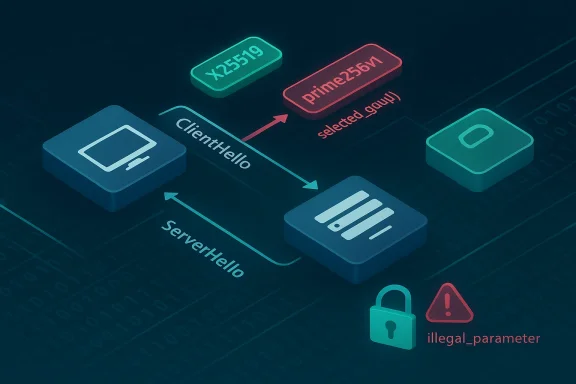 Background: TLS 1.3 key agreement, supported_groups and key_share
TLS 1.3 separates the concepts of "supported groups" (the set of named groups — elliptic curves, finite-field DH groups, or hybrid/post‑quantum KEM groups — a client or server says it understands) and the "key_share" entries actually offered by the client in the initial ClientHello.- The client advertises a supported_groups list and, for the groups it is willing to use immediately, it sends corresponding KeyShareEntry values in the ClientHello key_share extension. These entries contain the ephemeral public values needed for (EC)DHE or other group-based key agreement.
- If the server can pick a group that was already shared by the client, it responds in ServerHello with a single KeyShareEntry in the same group. That completes key establishment without a round trip.
- If the server wishes to negotiate a group for which the client did not include a key share in the ClientHello, the server must send a HelloRetryRequest (HRR) with a KeyShareHelloRetryRequest selected_group value asking the client to retry with a key_share entry for that group. On receiving the HRR, the client must verify that the selected group is one that it listed in supported_groups and that it did not already include as a key_share in the original ClientHello; otherwise the client must abort with an illegal_parameter/handshake_failure.
What the reported bug does (technical summary)
At the heart of the CVE-2026-2673 description is the same behavioral class: the server-side TLS library (OpenSSL, in the reported issue) may incorrectly populate the HelloRetryRequest/key_share exchange with a group that is not acceptable to the client — or even embed a full key_share blob where only a group identifier belongs — leading to client parsing errors and an aborted handshake.Key points of the technical behavior:
- The server inspects the client’s supported_groups and/or key_share entries and decides on a group. If the logic for selecting or echoing the selected group is flawed, the server may put an unexpected NamedGroup into the HRR/key_share extension.
- A client that follows the specification will check that this selected_group was present in its original supported_groups list. If it was not, the client will abort with an “illegal_parameter” or “bad key share” error.
- The immediate observable effect is connection failures — TLS 1.3 handshakes that previously succeeded fail with protocol errors. In short: interoperability breakage, and in some operational settings this looks like a denial-of-service (DoS) for affected endpoints.
- Because TLS 1.3 introduces new group types (FFDHE groups, brainpool curves, and hybrid/post‑quantum groups) and more dynamic group selection, the interaction surface is larger than in earlier TLS versions — increasing the risk that configuration mismatches or implementation bugs will surface.
Why this matters: impact analysis
The direct impacts of this class of bug are clear and immediate:- Connection failures and availability issues: Clients and servers that once intercommunicated can suddenly fail to establish TLS 1.3 sessions, resulting in application errors, service outages, or degraded user experience.
- Compatibility fragmentation: Diverse clients and servers supporting different sets of groups (especially while new groups — brainpool, FFDHE, ML‑KEM hybrids, PQC hybrids — were being added to stacks) increase the likelihood that the buggy selection logic triggers.
- Operational burden: Administrators must triage TLS handshake logs, differentiate this problem from firewall/network issues, and apply targeted fixes or workarounds — a nontrivial support challenge for managed services and cloud providers.
- Potential security semantics changes: While the logged OpenSSL issue and similar reports primarily describe handshake failures rather than direct remote code execution, related TLS 1.3 implementation quirks have historically produced more severe results (memory corruption, bypasses of expected key exchange modes, or PSK/PFS mix-ups). Thus, correctness bugs in key_share/HRR handling can have a range of consequences from mild (interoperability) to severe (cryptographic property weakening) depending on specifics.
Severity assessment (practical): If the bug only causes handshake failures, it is an availability/compatibility problem (moderate priority). If there is evidence of memory safety issues or protocol downgrades that compromise PFS or other guarantees, the priority rises sharply (high/critical for affected environments). At the time of writing, available public evidence documents compatibility and handshake aborts; there is no public, reproducible exploit demonstrating arbitrary code execution tied to the group-selection bug itself.
Reproducing and diagnosing the symptom (what you will see)
Symptoms administrators and developers are likely to notice:- Clients report TLS handshake errors: messages like “bad key share,” “illegal parameter,” or generic TLS handshake failure.
- Server logs may include TLS library errors similar to “sslv3 alert illegal parameter” or internal routine failures during TLS1.3 handshake parsing.
- Packet captures will show a ClientHello with supported_groups and a HelloRetryRequest where the extension content is incorrect (server selecting a group not present in client supported_groups or containing unexpected key_share bytes).
- Failing connections may be reproducible by varying the list of allowed groups on server or client, or by forcing TLS 1.3 only.
- Capture the handshake with a network trace (e.g., packet capture of the TLS ClientHello and the ServerHello/HelloRetryRequest).
- Inspect ClientHello: note the supported_groups and the groups offered in key_share.
- Inspect HRR/ServerHello: verify the selected_group in HRR or the key_share content in ServerHello. Confirm whether the selected group was indeed present in the client's supported_groups.
- Check application and OpenSSL logs for "bad key share", "illegal parameter", or other TLS errors.
- Test with a known-good client (for example, a recent OpenSSL s_client) to determine whether the issue is consistent across client implementations.
ort):- Test handshake and show negotiated group:
- openssl s_client -connect host:443 -tls1_3 -groups X25519,prime256v1 (observe output lines indicating negotiated group)
- Force specific client offered groups:
- openssl s_client -connect host:443 -tls1_3 -groups brainpoolP512r1:X25519 (to reproduce the mixed-list scenario described in bug reports)
Known instances and vendor responses
- Open-source issue trackers show concrete reports of TLS 1.3 HRR/key_share mishandling for OpenSSL 3.0 (a repro involving brainpoolP512r1 and X25519 produced client parse errors). That issue was triaged in the OpenSSL public issue tracker.
- The TLS specification (RFC 8446) is explicit about HRR and key_share behavior; deviations from the spec are legitimately treated as implementation bugs. Implementers of major TLS stacks have been patching HRR/key_share handling and related testcases over the past years as ecosystem support for a wider set of groups (brainpool, FFDHE, and post‑quantum hybrids) grew.
- Other TLS stacks have historically produced CVEs stemming from key_share/HRR errors (examples include client-side realloc/free issues in other libraries or incorrect PSK handling resulting in PFS bypasses). These precedents increase the urgency of addressing any similar OpenSSL behavior.
Remediation and mitigation: practical steps for admins and vendors
The correct long-term fix is to install a patched OpenSSL (or vendor-supplied TLS stack) where the HRR/key_share selection logic has been corrected. But there are immediate mitigations and hardening steps you can apply if patching will take time.Primary remediation:
- Upgrade OpenSSL to the latest vendor-published secure release. If you manage binaries from a Linux distribution, apply the distribution’s security update packages for openssl and dependent libraries immediately.
- For appliance vendors and embedded devices: build a firmware/software update with the patched OpenSSL library and plan for staged rollouts.
- Restrict the groups list to a small, well-tested set. On servers, configure the groups (the “groups list”) explicitly to the most interoperable and mature groups (commonly X25519 and prime256v1/secp256r1). Removing rarely used or exotic groups reduces the probability the buggy selection logic is triggered.
- Example: configure your server process or TLS library context to advertise only: X25519, prime256v1 (P-256). The exact configuration method depends on your application or server (Apache/mod_ssl, nginx, Postfix, etc. expose different configuration knobs).
- For services with fine-grained TLS policy support, disable brainpool curves or experimental groups until the stack is updated.
- Use TLS policy enforcement (network or reverse proxy) to translate problematic client group offerings into a safe baseline. In practice this means terminating TLS at a front-end proxy that has been patched, while backend services can remain patched secondarily.
- In environments using PSK or hybrid key exchange, be especially cautious: ensure your server does not accept an unauthenticated PSK-only negotiation when client requested PSK+DHE for PFS — that class of semantic mistake has been exploited before in unrelated CVEs.
- Monitor TLS termination logs for repeated "bad key share" or "illegal parameter" messages.
- Add packet-capture based checks in your SRE runbook for TLS 1.3 handshakes that fail: compare ClientHello supported_groups and ServerHello/HRR contents.
- Instrument user-facing services to detect spikes in TLS handshake failures after pushing new OpenSSL builds or configuration changes.
- Identify the OpenSSL/OpenSSL-based stack version running on each server. On many Linux systems:
- openssl version -a
- ldd /path/to/httpd | grep ssl (to see linked library)
- Check vendor advisory channels for your distribution (and appliance vendors) for published openssl packages. Prioritize kernel/OS vendors that backport fixes.
- If an updated package is available, stage and deploy it via your normal OS package management.
- If you need to roll an interim mitigation, edit your server TLS configuration to limit groups. Example directive names:
- nginx: ssl_ecdh_curve / ssl_conf_command or explicit TLS group settings
- Apache/mod_ssl: SSLHonorCipherOrder with specific TLS1.3 group settings in your OpenSSL conf
- Postfix: tls_eecdh_auto_curves / tls_ffdhe_auto_groups
Exact syntax varies — consult your server docs for the distribution of OpenSSL in your environment. - Validate after patch/mitigation: run openssl s_client tests from representative client platforms and capture a handshake with tcpdump or equivalent to verify HRR/ServerHello behavior is correct.
Vendor and ecosystem considerations
- Cloud providers, CDNs, and large web platforms: these operators typically deploy TLS stack updates centrally. If you rely on a hosted TLS termination service, check provider advisories for applied patches and any recommended reconfiguration.
- Embedded device and appliance vendors: these teams often have slower release cadence. If you operate appliances that terminate TLS (firewalls, load balancers, IoT gateways), coordinate with vendors to confirm whether they pack patched OpenSSL builds; in the interim, use fronting proxies or adjust allowed groups where possible.
- Browser ecosystem: mainstream browsers implement their own TLS stacks or borrow platform TLS APIs. The compatibility failures caused by an affected server will typically result in connection errors shown to end users; however, the browsers themselves are unlikely to be the locus of patching for this server-side behavior.
- Interoperability testing: maintain a TLS interoperability test harness (automated matrix tests across OpenSSL, BoringSSL, NSS, SChannel, and platform stacks) to detect regressions when you update either client or server TLS configurations.
Risk management and prioritization
How urgent is CVE‑2026‑2673 for your organization?- High priority if:
- Your infrastructure runs OpenSSL 3.0.x or another identified vulnerable release in production for public-facing services.
- You operate services that must maintain uninterrupted TLS connectivity across a heterogeneous client base (mobile apps, legacy clients, IoT devices).
- You use exotic curve sets (brainpool, large FFDHE groups, or experimental PQC hybrids).
- Medium priority if:
- You control both client and server (intra-service) and can coordinate patches and configuration updates.
- The observed impact is limited to a subset of clients and a configuration change (restricting groups) can restore compatibility.
- Lower priority if:
- Your environment already uses conservative group lists (X25519 and P‑256 only) and you're not seeing failures.
Developer-level analysis: why these TLS bugs keep appearing
Several ecosystem trends increase the likelihood of these kinds of bugs:- Growing group surface: TLS 1.3 initially standardized a small set of elliptic curves. Over successive updates and ecosystem experimentation, support for brainpool curves, additional FFDHE prime groups, and hybrid/post‑quantum KEM groups expanded, increasing combinatorial interactions.
- Complex decision logic: The server must make nuanced choices: whether to accept a client-offered key_share, which of the client’s supported_groups to pick, or whether to request an HRR. Implementation mistakes often arise in the logic that maps supported_groups, offered key_share entries, and server policy/preferences — especially when older codepaths and new group types are mixed.
- Backward/forward compatibility: The TLS stack must gracefully interoperate with older clients and new client configurations, and this mix often triggers corner cases.
- Testing gaps: Interop test matrices often omit exotic group combinations and new PQC hybrid groups, meaning edge cases remain uncovered until socialized by field use.
Conclusion and actionable recommendations
CVE‑2026‑2673 highlights an uncomfortable truth about cryptographic protocol implementations: the handshake state machine is fragile, and as TLS 1.3 evolves with new groups and hybrid algorithms, correctness bugs can break connectivity and — in worst-case variants — threaten cryptographic guarantees.Action plan for operators today:
- Immediately check if your environment uses OpenSSL builds (or vendor builds) in the 3.x family and whether vendor advisories mention TLS 1.3 HRR/key_share fixes. Prioritize updates where available.
- Monitor server logs and TLS handshake traces for “bad key share” and “illegal parameter” alerts, and capture failing handshakes for analysis.
- Temporarily limit the groups your server advertises to a small set of well-tested groups (X25519, P‑256) where feasible while you evaluate and deploy vendor patches.
- Coordinate with appliance and embedded vendors for firmware updates; if vendor timelines are long, use hardened front-end TLS termination or proxying to reduce exposure.
- Add HRR/key_share negative testcases to your CI/regression suite to catch regressions before rollouts.
Source: MSRC Security Update Guide - Microsoft Security Response Center
