

Researchers at Tohoku University reported in June 2026 that electrons accumulating at the interface between a two-dimensional semiconductor and its substrate can drive room-temperature formation of Janus 2D semiconductors, explaining how plasma treatment swaps surface atoms without the heat normally expected for such a reaction. The result matters because it turns a once-mysterious materials trick into an engineerable process. For the electronics industry, the finding is less about one exotic compound than about a familiar manufacturing lesson: interfaces, charges, and substrates often decide whether a laboratory material becomes a platform.
The short version is that Janus semiconductors may have just become less magical. These atomically thin sheets, chemically different on their top and bottom faces, have been discussed for years as candidates for photodetectors, solar conversion, hydrogen production, flexible devices, and next-generation optoelectronics. But a material that can only be made by empirical plasma recipes is not yet a technology; it is a promising science demo waiting for a process window.
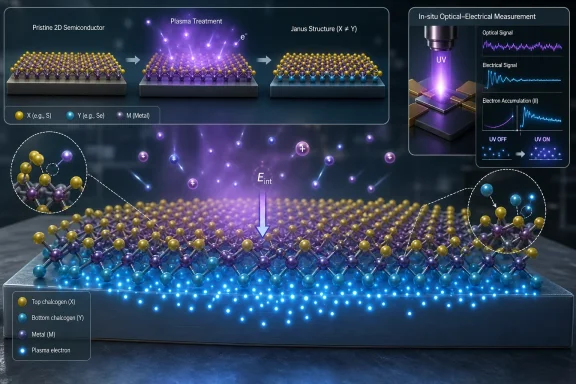
Janus two-dimensional materials are named after the two-faced Roman god because their two surfaces are not chemically identical. In a typical transition metal dichalcogenide, a layer of metal atoms is sandwiched between two matching chalcogen layers. In a Janus version, one side might contain one chalcogen element while the opposite side contains another, creating a built-in vertical asymmetry.
That asymmetry is the point. When the top and bottom of an atom-thin semiconductor are chemically different, the material can host an internal electric field that changes how charges, excitons, and optical responses behave. In the language of device engineering, this is a way to bake directionality into the material itself rather than adding it later with gates, interfaces, or stacked layers.
The problem has been that making Janus sheets has looked deceptively simple from the outside and maddeningly opaque from the inside. Researchers could expose a conventional 2D semiconductor to plasma and selectively replace atoms at the outer surface, leaving the rest of the crystal largely intact. That is the sort of claim that sounds straightforward until one asks why a room-temperature surface should allow atomic substitution that conventional intuition says ought to demand substantial energy.
Tohoku’s contribution is to put a plausible mechanism under that observation. The team built an in-situ optical-electrical measurement system that could track structural and electrical changes during plasma treatment. Instead of treating the plasma as a blunt chemical hammer, the researchers watched the electrical state of the material evolve while the reaction unfolded.
Their answer is that electrons from the plasma accumulate near the 2D material and at the interface with the substrate. Those excess electrons weaken metal-chalcogen bonds and lower the energy barrier for substitution. Ultraviolet illumination, which increased electron accumulation, accelerated the reaction by more than a factor of two, giving the mechanism an experimental lever rather than merely a post-hoc explanation.
If a Janus 2D semiconductor can be formed without high-temperature processing, it becomes easier to imagine using it on flexible plastic substrates, pre-patterned device stacks, or temperature-sensitive layers. That does not mean wearable electronics and hydrogen catalysts are suddenly around the corner. It does mean the synthesis route is less obviously trapped inside a narrow laboratory niche.
The finding also changes how one should read earlier plasma-based synthesis results. Plasma was not merely providing reactive species at the surface. It was also injecting or redistributing charge in a way that changed the local chemistry. That distinction is important because charge can be tuned, measured, and modeled; a mysterious plasma recipe is much harder to scale.
For process engineers, the most interesting sentence is not “we made a Janus material.” It is “we can control the state of accumulated charge.” That turns the story from materials discovery into process control. In semiconductor manufacturing, process control is the difference between a phenomenon and a product.
That is especially true for atomically thin semiconductors, where every atom is close to a surface and every surface is close to the channel. A bulk material can often tolerate some interfacial messiness because most of the active volume is far from it. A monolayer has no such luxury. The substrate is effectively in the room for every electronic and chemical event.
In this case, the researchers identify electron accumulation not only near the TMD surface but also at the material-substrate interface. That detail matters because it suggests the substrate is not merely holding the sheet in place. It is participating in the reaction environment by helping define where charge resides and how bonds respond.
This is where the science becomes both encouraging and inconvenient. If the interface can help drive selective substitution, then better interfaces may enable better Janus materials. But the reverse is also true: changing the substrate, dielectric, surface preparation, illumination, or plasma conditions could alter the reaction in ways that frustrate reproducibility.
The earlier mystery around Janus formation came from the mismatch between the gentleness of the desired outcome and the violence usually associated with breaking and remaking bonds. Selectively replacing only the outermost chalcogen atoms while preserving the underlying lattice is a very specific operation. It is more like changing the roof tiles on a house than demolishing and rebuilding the structure.
The electron accumulation model makes that selectivity more believable. If excess electrons weaken particular bonds and assist hydrogen-mediated substitution, then the reaction does not require brute-force thermal activation across the entire crystal. It can proceed where the charge and chemistry create a favorable pathway.
This does not make plasma trivial. A mechanism is not a turnkey recipe, and translating it across materials will take careful calibration. But the work narrows the unknowns. Instead of asking why plasma somehow performs a selective room-temperature atom swap, researchers can ask how electron density, substrate choice, illumination, and reactive species combine to tune a topotactic reaction.
That can matter for photodetectors, where separating photo-generated charges efficiently is central to performance. It can matter for solar conversion and photocatalysis, where charge separation and surface chemistry must be aligned. It can matter for spin-orbit and valley-related effects, where broken symmetry can unlock behaviors unavailable in centrosymmetric structures.
For WindowsForum readers, this may feel distant from the laptops, workstations, and servers that dominate practical computing discussions. That distance is real. Nobody should read this as a preview of next year’s CPU node or a hidden ingredient in the next Surface device. Materials advances usually travel a long road from mechanism to integration.
But the direction of travel is relevant. Modern computing hardware is increasingly constrained by power, heat, interconnect density, sensing requirements, and packaging complexity. Materials that encode useful electrical behavior at atomic thickness are part of the broader search for devices that do more with less volume, less heat, or fewer external control structures.
Still, energy materials are a graveyard of beautiful nanoscale effects that failed to survive cost, stability, scale, and real-world operating conditions. A monolayer that behaves elegantly under controlled laboratory conditions may degrade, foul, delaminate, or underperform when exposed to moisture, heat, impurities, cycling, and manufacturing variability. The bottleneck is rarely a single property.
That is why the room-temperature mechanism is important but not sufficient. It may make synthesis more controllable and substrate-compatible, which helps. It does not automatically solve throughput, uniformity over wafer-scale or roll-to-roll areas, long-term stability, or integration into complete devices.
The more defensible claim is that the work improves the odds. By identifying accumulated electrons as a controllable driver of substitution, the researchers provide a knob that can be optimized rather than guessed. In clean energy, as in computing, controllable synthesis is what turns a promising material into a candidate system.
This study sits squarely in that third phase. Room-temperature Janus conversion had been reported before, but the microscopic origin of selective replacement was unresolved. Tohoku’s team paired in-situ electrical and optical observation with first-principles calculations, tying a real-time process signal to an atomistic explanation.
That combination matters because neither half alone would be as convincing. Electrical measurements can show that charge accumulates, but they do not by themselves prove how bonds respond. Calculations can show that excess electrons lower relevant energies, but calculations alone can float too far from messy experimental reality. Together, they build a stronger case for a charge-mediated mechanism.
The ultraviolet-light experiment is particularly useful because it gives the model a perturbation test. If increasing electron accumulation accelerates the reaction, the mechanism gains predictive power. It is no longer just an elegant explanation for data already collected; it begins to behave like a design rule.
That knob is accumulated charge. If electron density at the surface and interface helps determine substitution kinetics, then process recipes can be built around measurable electrical states rather than only exposure time or plasma power. That is a more sophisticated way to think about plasma-assisted chemistry.
It also points toward better diagnostics. In-situ monitoring is not just a research convenience; it is often the bridge to manufacturing. If Raman signals, transistor characteristics, or related electrical signatures can track conversion in real time, then future tools might terminate or adjust a process before overreaction, underreaction, or damage occurs.
The history of semiconductor manufacturing is full of such transitions. A phenomenon begins as a recipe, becomes a monitored process, and eventually becomes a controlled module. Janus 2D materials are nowhere near that mature stage, but this work nudges them in that direction.
There is also the issue of scale. Many 2D-material results are compelling on flakes or small-area samples but become harder when pushed toward uniform, defect-controlled, large-area films. For commercial electronics, the question is not whether a beautiful monolayer can be made; it is whether millions or billions of devices can be made with tolerable variation.
Defects are another unresolved axis. Atomic substitution that preserves the lattice is the ideal. Real reactions can introduce vacancies, disorder, contamination, strain, or local nonuniformity. Some defects may be useful, but uncontrolled defects are usually where device dreams go to die.
Finally, the substrate dependence cuts both ways. If the interface helps drive the reaction, then changing the substrate may offer control. It may also create a portability problem. A synthesis process tuned on SiO₂ may not behave the same way on polymers, high-k dielectrics, metals, or complex device stacks.
The computing relevance is not that Janus sheets will replace silicon in mainstream processors next decade. Silicon has an enormous installed base, a vast manufacturing ecosystem, and a cost-performance curve that is difficult to displace. The relevance is that future computing systems increasingly depend on specialized materials for sensing, photonics, power handling, memory-adjacent functions, and energy efficiency.
Photodetectors are a good example. As machines become more dependent on cameras, lidar, optical interconnects, ambient sensing, and edge AI inputs, materials that can efficiently separate and manipulate light-generated carriers become more interesting. A built-in electric field in an atomically thin semiconductor is not a product roadmap, but it is a useful design ingredient.
Flexible electronics are another bridge. Windows devices have repeatedly flirted with foldable, dual-screen, wearable, and embedded form factors. The market has been uneven, but the engineering pressure remains: make electronics thinner, lighter, more conformal, and less power-hungry. Room-temperature processing on flexible substrates is directly relevant to that long-term direction.
That philosophy is already visible in mainstream chips. Gate stacks are interface engineering. Advanced packaging is interface engineering. Memory cells, sensors, and power devices all live or die by what happens where two materials meet. Janus 2D semiconductors simply make that reality impossible to ignore because the whole material is essentially surface and interface.
The Tohoku work also shows why instrumentation matters. Without real-time observation, plasma-assisted substitution can look like a black-box transformation. With in-situ optical-electrical measurement, it becomes a process whose hidden variable can be surfaced.
That is the kind of progress that rarely makes consumer headlines but often underwrites the next decade of hardware. A device revolution normally begins as an unglamorous ability to make the same thing, in the same way, with fewer surprises.
The short version is that Janus semiconductors may have just become less magical. These atomically thin sheets, chemically different on their top and bottom faces, have been discussed for years as candidates for photodetectors, solar conversion, hydrogen production, flexible devices, and next-generation optoelectronics. But a material that can only be made by empirical plasma recipes is not yet a technology; it is a promising science demo waiting for a process window.
 The Breakthrough Is Not the Material, but the Missing Mechanism
Janus two-dimensional materials are named after the two-faced Roman god because their two surfaces are not chemically identical. In a typical transition metal dichalcogenide, a layer of metal atoms is sandwiched between two matching chalcogen layers. In a Janus version, one side might contain one chalcogen element while the opposite side contains another, creating a built-in vertical asymmetry.That asymmetry is the point. When the top and bottom of an atom-thin semiconductor are chemically different, the material can host an internal electric field that changes how charges, excitons, and optical responses behave. In the language of device engineering, this is a way to bake directionality into the material itself rather than adding it later with gates, interfaces, or stacked layers.
The problem has been that making Janus sheets has looked deceptively simple from the outside and maddeningly opaque from the inside. Researchers could expose a conventional 2D semiconductor to plasma and selectively replace atoms at the outer surface, leaving the rest of the crystal largely intact. That is the sort of claim that sounds straightforward until one asks why a room-temperature surface should allow atomic substitution that conventional intuition says ought to demand substantial energy.
Tohoku’s contribution is to put a plausible mechanism under that observation. The team built an in-situ optical-electrical measurement system that could track structural and electrical changes during plasma treatment. Instead of treating the plasma as a blunt chemical hammer, the researchers watched the electrical state of the material evolve while the reaction unfolded.
Their answer is that electrons from the plasma accumulate near the 2D material and at the interface with the substrate. Those excess electrons weaken metal-chalcogen bonds and lower the energy barrier for substitution. Ultraviolet illumination, which increased electron accumulation, accelerated the reaction by more than a factor of two, giving the mechanism an experimental lever rather than merely a post-hoc explanation.
Room Temperature Is the Manufacturing Hook
The phrase “room-temperature synthesis” can sound like a press-release flourish, but here it carries practical weight. Many advanced materials processes become commercially awkward not because they are impossible, but because they require temperatures, atmospheres, substrates, or handling steps that are incompatible with the devices people actually want to build. Heat is often the enemy of integration.If a Janus 2D semiconductor can be formed without high-temperature processing, it becomes easier to imagine using it on flexible plastic substrates, pre-patterned device stacks, or temperature-sensitive layers. That does not mean wearable electronics and hydrogen catalysts are suddenly around the corner. It does mean the synthesis route is less obviously trapped inside a narrow laboratory niche.
The finding also changes how one should read earlier plasma-based synthesis results. Plasma was not merely providing reactive species at the surface. It was also injecting or redistributing charge in a way that changed the local chemistry. That distinction is important because charge can be tuned, measured, and modeled; a mysterious plasma recipe is much harder to scale.
For process engineers, the most interesting sentence is not “we made a Janus material.” It is “we can control the state of accumulated charge.” That turns the story from materials discovery into process control. In semiconductor manufacturing, process control is the difference between a phenomenon and a product.
The Interface Was Doing the Work All Along
The Tohoku result is a reminder that two-dimensional materials are rarely just two-dimensional in practice. The marketing image is a pristine atomic sheet suspended in conceptual space, but real devices sit on substrates, touch dielectrics, collect adsorbates, and exchange charge with their surroundings. The interface is not background scenery; it is part of the device.That is especially true for atomically thin semiconductors, where every atom is close to a surface and every surface is close to the channel. A bulk material can often tolerate some interfacial messiness because most of the active volume is far from it. A monolayer has no such luxury. The substrate is effectively in the room for every electronic and chemical event.
In this case, the researchers identify electron accumulation not only near the TMD surface but also at the material-substrate interface. That detail matters because it suggests the substrate is not merely holding the sheet in place. It is participating in the reaction environment by helping define where charge resides and how bonds respond.
This is where the science becomes both encouraging and inconvenient. If the interface can help drive selective substitution, then better interfaces may enable better Janus materials. But the reverse is also true: changing the substrate, dielectric, surface preparation, illumination, or plasma conditions could alter the reaction in ways that frustrate reproducibility.
Plasma Stops Looking Like a Black Box
Plasma processing is familiar territory in semiconductor fabrication, but “plasma” covers a vast range of chemistries, ion energies, electron densities, radicals, sheath conditions, and surface charging effects. It can etch, clean, activate, damage, passivate, or deposit, depending on how it is used. For 2D materials, that flexibility is both a gift and a hazard.The earlier mystery around Janus formation came from the mismatch between the gentleness of the desired outcome and the violence usually associated with breaking and remaking bonds. Selectively replacing only the outermost chalcogen atoms while preserving the underlying lattice is a very specific operation. It is more like changing the roof tiles on a house than demolishing and rebuilding the structure.
The electron accumulation model makes that selectivity more believable. If excess electrons weaken particular bonds and assist hydrogen-mediated substitution, then the reaction does not require brute-force thermal activation across the entire crystal. It can proceed where the charge and chemistry create a favorable pathway.
This does not make plasma trivial. A mechanism is not a turnkey recipe, and translating it across materials will take careful calibration. But the work narrows the unknowns. Instead of asking why plasma somehow performs a selective room-temperature atom swap, researchers can ask how electron density, substrate choice, illumination, and reactive species combine to tune a topotactic reaction.
Janus Materials Fit the Industry’s Search for Built-In Asymmetry
The semiconductor industry has spent decades learning how to impose structure from the outside: lithography defines geometry, doping defines carrier concentration, gates define electric fields, and multilayer stacks define interfaces. Janus 2D materials offer a different sort of control because the asymmetry is intrinsic. The material itself has a preferred vertical direction.That can matter for photodetectors, where separating photo-generated charges efficiently is central to performance. It can matter for solar conversion and photocatalysis, where charge separation and surface chemistry must be aligned. It can matter for spin-orbit and valley-related effects, where broken symmetry can unlock behaviors unavailable in centrosymmetric structures.
For WindowsForum readers, this may feel distant from the laptops, workstations, and servers that dominate practical computing discussions. That distance is real. Nobody should read this as a preview of next year’s CPU node or a hidden ingredient in the next Surface device. Materials advances usually travel a long road from mechanism to integration.
But the direction of travel is relevant. Modern computing hardware is increasingly constrained by power, heat, interconnect density, sensing requirements, and packaging complexity. Materials that encode useful electrical behavior at atomic thickness are part of the broader search for devices that do more with less volume, less heat, or fewer external control structures.
The Clean-Energy Angle Is Plausible, but Not Automatic
The Phys.org framing rightly mentions clean energy applications such as solar energy conversion, hydrogen production, and fuel-cell-related catalysis. Janus materials are attractive in those contexts because built-in electric fields can help separate charges, and chemically distinct surfaces can provide different reaction environments. In principle, that is exactly what many energy-conversion systems want.Still, energy materials are a graveyard of beautiful nanoscale effects that failed to survive cost, stability, scale, and real-world operating conditions. A monolayer that behaves elegantly under controlled laboratory conditions may degrade, foul, delaminate, or underperform when exposed to moisture, heat, impurities, cycling, and manufacturing variability. The bottleneck is rarely a single property.
That is why the room-temperature mechanism is important but not sufficient. It may make synthesis more controllable and substrate-compatible, which helps. It does not automatically solve throughput, uniformity over wafer-scale or roll-to-roll areas, long-term stability, or integration into complete devices.
The more defensible claim is that the work improves the odds. By identifying accumulated electrons as a controllable driver of substitution, the researchers provide a knob that can be optimized rather than guessed. In clean energy, as in computing, controllable synthesis is what turns a promising material into a candidate system.
The Best Part of the Study Is Its Refusal to Treat the Reaction as Magic
Materials science often advances through a cycle of surprise, recipe, explanation, and control. First, someone finds that a thing can be made. Then others repeat it, vary it, and argue over the recipe. Eventually, if the field is lucky, the mechanism becomes clear enough that researchers can design better routes rather than copying conditions.This study sits squarely in that third phase. Room-temperature Janus conversion had been reported before, but the microscopic origin of selective replacement was unresolved. Tohoku’s team paired in-situ electrical and optical observation with first-principles calculations, tying a real-time process signal to an atomistic explanation.
That combination matters because neither half alone would be as convincing. Electrical measurements can show that charge accumulates, but they do not by themselves prove how bonds respond. Calculations can show that excess electrons lower relevant energies, but calculations alone can float too far from messy experimental reality. Together, they build a stronger case for a charge-mediated mechanism.
The ultraviolet-light experiment is particularly useful because it gives the model a perturbation test. If increasing electron accumulation accelerates the reaction, the mechanism gains predictive power. It is no longer just an elegant explanation for data already collected; it begins to behave like a design rule.
Precision Manufacturing Begins With Knowing Which Knob Matters
The phrase “precision manufacturing” is often abused in coverage of advanced materials. In the strict sense, precision manufacturing means reproducible control across space, time, and batches, not simply a successful demonstration under one set of conditions. The Tohoku work does not deliver a factory line for Janus semiconductors, but it does identify a knob that factories could plausibly learn to control.That knob is accumulated charge. If electron density at the surface and interface helps determine substitution kinetics, then process recipes can be built around measurable electrical states rather than only exposure time or plasma power. That is a more sophisticated way to think about plasma-assisted chemistry.
It also points toward better diagnostics. In-situ monitoring is not just a research convenience; it is often the bridge to manufacturing. If Raman signals, transistor characteristics, or related electrical signatures can track conversion in real time, then future tools might terminate or adjust a process before overreaction, underreaction, or damage occurs.
The history of semiconductor manufacturing is full of such transitions. A phenomenon begins as a recipe, becomes a monitored process, and eventually becomes a controlled module. Janus 2D materials are nowhere near that mature stage, but this work nudges them in that direction.
The Caveats Are Not Footnotes
The study’s promise should be read alongside its limits. The demonstrated mechanism concerns a specific class of Janus transition metal dichalcogenide formation under plasma-assisted conditions, not every possible Janus material or every substrate. A mechanism can generalize, but it must earn that generalization.There is also the issue of scale. Many 2D-material results are compelling on flakes or small-area samples but become harder when pushed toward uniform, defect-controlled, large-area films. For commercial electronics, the question is not whether a beautiful monolayer can be made; it is whether millions or billions of devices can be made with tolerable variation.
Defects are another unresolved axis. Atomic substitution that preserves the lattice is the ideal. Real reactions can introduce vacancies, disorder, contamination, strain, or local nonuniformity. Some defects may be useful, but uncontrolled defects are usually where device dreams go to die.
Finally, the substrate dependence cuts both ways. If the interface helps drive the reaction, then changing the substrate may offer control. It may also create a portability problem. A synthesis process tuned on SiO₂ may not behave the same way on polymers, high-k dielectrics, metals, or complex device stacks.
Windows Readers Should Care Because Hardware Futures Start as Process Stories
A Windows enthusiast or sysadmin does not need to know the bond energy of a Janus TMD to understand why this matters. The devices we use are downstream of process breakthroughs that once looked similarly remote. EUV lithography, high-k dielectrics, strained silicon, FinFETs, chiplets, and advanced packaging all had long periods when they were “just” process or materials stories.The computing relevance is not that Janus sheets will replace silicon in mainstream processors next decade. Silicon has an enormous installed base, a vast manufacturing ecosystem, and a cost-performance curve that is difficult to displace. The relevance is that future computing systems increasingly depend on specialized materials for sensing, photonics, power handling, memory-adjacent functions, and energy efficiency.
Photodetectors are a good example. As machines become more dependent on cameras, lidar, optical interconnects, ambient sensing, and edge AI inputs, materials that can efficiently separate and manipulate light-generated carriers become more interesting. A built-in electric field in an atomically thin semiconductor is not a product roadmap, but it is a useful design ingredient.
Flexible electronics are another bridge. Windows devices have repeatedly flirted with foldable, dual-screen, wearable, and embedded form factors. The market has been uneven, but the engineering pressure remains: make electronics thinner, lighter, more conformal, and less power-hungry. Room-temperature processing on flexible substrates is directly relevant to that long-term direction.
The Lab Result Is Small; the Manufacturing Philosophy Is Big
What makes this story notable is not merely that a research team explained a reaction. It is that the explanation reinforces a broader philosophy in advanced electronics: the decisive action often happens at boundaries. Interfaces between materials, charges trapped at surfaces, local fields, and subtle chemical environments increasingly shape the performance of devices that are physically shrinking toward atomic dimensions.That philosophy is already visible in mainstream chips. Gate stacks are interface engineering. Advanced packaging is interface engineering. Memory cells, sensors, and power devices all live or die by what happens where two materials meet. Janus 2D semiconductors simply make that reality impossible to ignore because the whole material is essentially surface and interface.
The Tohoku work also shows why instrumentation matters. Without real-time observation, plasma-assisted substitution can look like a black-box transformation. With in-situ optical-electrical measurement, it becomes a process whose hidden variable can be surfaced.
That is the kind of progress that rarely makes consumer headlines but often underwrites the next decade of hardware. A device revolution normally begins as an unglamorous ability to make the same thing, in the same way, with fewer surprises.
The Electron Pileup Turns a Curiosity Into a Process Window
The most concrete lesson is that Janus 2D semiconductor formation is not just a chemical substitution story; it is an electrochemical and interfacial story. That does not make commercialization inevitable, but it gives researchers a better map of where to push next.- Researchers at Tohoku University identified accumulated plasma electrons at the 2D material and substrate interface as a driver of room-temperature Janus semiconductor formation.
- The mechanism helps explain how selective chalcogen atom replacement can occur without the high thermal energy normally expected for atom substitution.
- Ultraviolet illumination accelerated the reaction by increasing electron accumulation, strengthening the case that charge is a controllable process variable.
- The work points toward lower-temperature manufacturing routes that could be friendlier to flexible substrates and mixed-material device stacks.
- The biggest unresolved challenges remain scale, uniformity, defect control, substrate portability, and integration into complete devices.
- For computing hardware, the near-term importance is not a new CPU material but a better route to specialized optoelectronic, sensing, catalytic, and flexible-device components.
References
- Primary source: phys.org
Published: Wed, 24 Jun 2026 21:40:09 GMT
- Related coverage: tohoku.ac.jp
Mystery Solved! The Physics Behind Next-Generation Janus Semiconductors
While scientists have long known how to produce Janus 2D materials, they have yet to grasp the underlying physics behind the process. Now, researchers from Tohoku University have solved the mystery.www.tohoku.ac.jp
- Related coverage: xenospectrum.com
熱を使わず「原子を入れ替える」。東北大などが解明した次世代半導体ヤヌス2Dシートの画期的な室温生成メカニズムとは? | XenoSpectrum
ヤヌス型2次元シートは、非対称な原子配置により内部電場を生成し、光センサーや光触媒の性能を飛躍的に向上させる次世代材料である。これまで謎とされてきた室温での合成メカニズムは、プラズマ照射によって蓄積された電子が原子結合を弱めることで、熱エネルギーなしに原子置換反応を促進することが、世界初のリアルタイム観測と理論計算により解明された。xenospectrum.com
