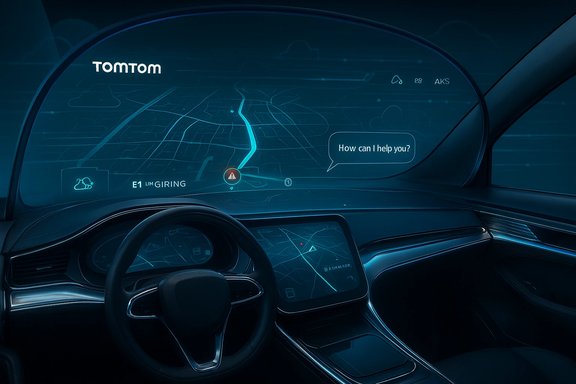
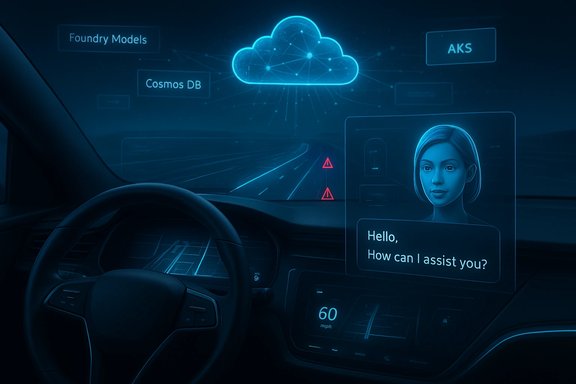
TomTom’s latest announcement that it is deepening its production-grade integration with Microsoft Azure—bringing Azure OpenAI in Microsoft Foundry Models, Azure Cosmos DB, and Azure Kubernetes Service (AKS) into its automotive stack—marks a concrete step from experimental voice assistants toward factory-ready, branded navigation systems that automakers can ship at scale.
TomTom and Microsoft have a multi-year relationship that has evolved from map licensing into a strategic cloud and AI partnership. Over the past two years the companies publicly documented work to embed TomTom’s Orbis map architecture and traffic feed into Microsoft’s cloud services, and TomTom has been building an AI-first in-cabin platform (branded in prior materials as Digital Cockpit) that uses Azure-hosted models and services for conversation, context, and stateful driver interactions. The new announcement updates that trajectory by naming specific Foundry-enabled capabilities—TomTom Automotive Navigation Application and TomTom AI Agent—as now integrating with the Foundry model stack, Cosmos DB for persistent context, and AKS for containerised orchestration.
This is not a standalone proof-of-concept: the narrative is explicitly production-oriented. TomTom and Microsoft are positioning the combined stack as a pre-integrated platform that lets OEMs deliver fully branded navigation and voice experiences ‘in weeks, not months,’ with cloud-delivered updates and modular components tailored to automaker needs.
However, certain vendor claims are inherently marketing-forward and need operational validation:
The real test will be operational: how the platform performs at scale across continents, how OEMs manage data residency and safety certification, and whether automakers can preserve brand differentiation while adopting a shared backend. For many carmakers, the trade-off—faster launch and richer language capabilities versus ongoing cloud dependency—will come down to business strategy and risk tolerance.
For the WindowsForum audience, the announcement signals a step closer to cars that feel conversational, contextual, and continuously updated. It also reinforces the new reality of vehicle software stacks: maps, cloud AI, and platform orchestration are central to competitive differentiation—and they will require OEMs to master cloud economics, data governance, and rigorous safety engineering to deliver on the promise.
Source: GlobeNewswire TomTom enhances maps and navigation with Microsoft Azure integration
 Background
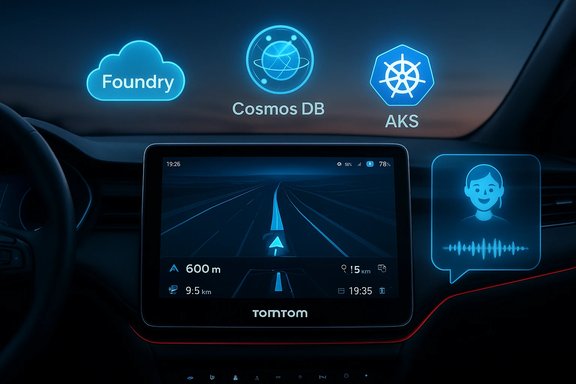
TomTom and Microsoft have a multi-year relationship that has evolved from map licensing into a strategic cloud and AI partnership. Over the past two years the companies publicly documented work to embed TomTom’s Orbis map architecture and traffic feed into Microsoft’s cloud services, and TomTom has been building an AI-first in-cabin platform (branded in prior materials as Digital Cockpit) that uses Azure-hosted models and services for conversation, context, and stateful driver interactions. The new announcement updates that trajectory by naming specific Foundry-enabled capabilities—TomTom Automotive Navigation Application and TomTom AI Agent—as now integrating with the Foundry model stack, Cosmos DB for persistent context, and AKS for containerised orchestration.This is not a standalone proof-of-concept: the narrative is explicitly production-oriented. TomTom and Microsoft are positioning the combined stack as a pre-integrated platform that lets OEMs deliver fully branded navigation and voice experiences ‘in weeks, not months,’ with cloud-delivered updates and modular components tailored to automaker needs.
Overview of the integration: what was announced and what it means
- TomTom is integrating its navigation and traffic intelligence with Azure OpenAI running inside Microsoft Foundry Models, enabling natural, multi-turn voice interactions for drivers.
- Azure Cosmos DB is named as the persistent layer to store conversation memory, preferences, and context—supporting stateful agents that remember user interactions and personalization.
- Azure Kubernetes Service (AKS) is cited as the runtime orchestration for the microservices, enabling scalable deployment and continuous delivery.
- TomTom positions the result as a pre-integrated, modular solution for OEMs that preserves brand control while reducing time-to-market.
Technical deep-dive
Azure Foundry Models and conversational audio
Microsoft’s Foundry platform centralizes access to a curated model catalog, an agent service, and audio-first models suited for real-time voice interactions. Foundry’s model catalog now includes multiple audio-capable models and front-line audio tooling—text-to-speech and transcription models designed for streaming, low-latency applications.- Foundry adds support for audio models—speech-to-text and text-to-speech—making it viable to drive an in-car conversation engine that needs real-time transcription and natural-sounding responses.
- Agent tooling in Foundry includes orchestration primitives, managed agent lifecycles, and control-plane features that simplify running multi-turn conversational flows in production environments.
Azure Cosmos DB as persistent context store
TomTom’s architecture calls out Azure Cosmos DB for storing prior conversations, preferences, and driver context. Cosmos DB’s global distribution, multi-model capabilities, and low-latency access patterns are attractive for stateful agents that need to recall driver history across sessions.- Using a globally-replicated store close to vehicle-edge endpoints reduces round-trip latency for agent context retrieval.
- Durable conversation memory enables multi-turn dialogs that feel natural; it also allows personalization across vehicles tied to a driver account.
AKS for orchestration and delivery
AKS provides the Kubernetes runtime for TomTom’s microservices: navigation, route planning, traffic ingestion, agent orchestration, and update pipelines.- AKS is a standard production choice for cloud-native automotive services and supports CI/CD, autoscaling, and integration with managed identity and security tooling.
- Running critical navigation components on AKS allows for rolling updates, A/B testing, and staged regional rollouts—key for automotive safety and certification workflows.
How this changes the OEM playbook: faster branding, deeper control
One of the clearest customer-facing claims is that OEMs can deliver a highly branded navigation experience faster because they can use TomTom’s pre-integrated stack rather than building voice and navigation from scratch. That product positioning has several practical effects:- Reduced integration scope: OEMs need fewer internal resources to wire up models, navigation engines, and backend data stores.
- Brand control maintained: TomTom emphasizes OEMs will retain UI/UX and voice-branding control—this is crucial for carmakers who view the in-car experience as a differentiator.
- Cloud-first continuous updates: over-the-air delivery of model and map updates shortens iterative improvement cycles.
Performance, latency, and offline operation: the trade-offs
Natural-language navigation requires both cloud-based reasoning and reliable local fallbacks. TomTom’s plan appears to lean heavily on cloud-hosted Foundry models and Cosmos DB for context. That architecture brings both advantages and challenges:- Advantages:
- Richer, up-to-date language models that can handle open-ended queries and context-aware routing, including EV routing and lane-level guidance.
- Continuous improvement of language capabilities and semantic search powered by Foundry updates without hardware recalls.
- Challenges and risks:
- Latency: Even with edge replication and regional compute, network latency remains a factor. Driving scenarios require near-instant responses; perceived delays can degrade usability and safety.
- Offline resilience: Vehicles must maintain core navigation, lane guidance, and hazard alerts when connectivity drops. OEMs must ensure a robust local fallback and deterministic behavior when cloud services are unavailable.
- Bandwidth and cost: Continuous voice interaction and model streaming increase data usage and operational costs—OEMs and operators must weigh these against perceived user benefit.
Safety, privacy, and regulatory implications
Embedding LLMs and persistent memory into cars raises new regulatory and privacy considerations.- Driver safety: voice assistants must minimize distraction and avoid encouraging prolonged driver interaction. Proactive prompts, proactive routing guidance, and anticipatory suggestions must be carefully tuned for safety. Systems that listen and react must incorporate explicit user consent and robust filtering of audio capture.
- Data protection and residency: storing conversation history and preferences in Cosmos DB is technically sound, but OEMs operating in Europe, China, or other jurisdictions must ensure data flows comply with GDPR-equivalent laws, cross-border transfers, and consumer consent requirements.
- Explainability and auditability: LLM-driven recommendations (e.g., hazard explanations, re-routing decisions) should be auditable. OEMs and regulators will demand transparency about why a route or warning was given—something generative models can struggle to provide without explicit retrieval grounding and logging.
- Security: the attack surface expands—voice interfaces, OTA model updates, identity tokens, and data pipelines must be protected with hardened identity, encryption-at-rest and in transit, and strict supply-chain controls.
Business strategy: who benefits and where caution is warranted
- Winners:
- Mid-size OEMs and EV startups that lack deep in-house voice or mapping teams can use the pre-integrated stack to offer competitive, branded experiences quickly.
- Tier-1 suppliers who can repackage TomTom’s platform into their HMI offerings and accelerate delivery to automakers.
- TomTom and Microsoft: TomTom monetizes maps and SaaS platform licensing; Microsoft drives Azure consumption and Foundry model licensing.
- Cautions:
- Large OEMs with existing investments in proprietary stacks may resist ceding model control to a cloud partner.
- Long-term differentiation: if multiple OEMs adopt the same pre-integrated platform, the resulting user experience could converge—diluting brand differentiation despite UI skinning.
- Cost structure: cloud model usage, streaming audio models, and Cosmos DB throughput all create recurring cost lines that must be priced into subscription or vehicle R&D budgets.
Competitive landscape and market positioning
TomTom’s combination of turnkey mapping assets and an Azure-aligned AI stack differentiates it from several competitors, but it does not remove competition:- Big cloud competitors and mapping providers (including the likes of other global map licensors and first-party cloud providers) are also pushing integrated solutions.
- In-house OEM solutions remain viable for carmakers that prioritize complete control or have substantial engineering budgets.
- Emerging startups focused on edge-first voice agents present alternative trade-offs—lower connectivity reliance at the cost of narrower language capability.
Verifying the claims: what checks we made and what remains uncertain
Several technical claims in the announcement align with prior public documentation and product roadmaps from both companies. Microsoft’s Foundry platform has published audio-capable models and agent services; Azure Cosmos DB has added toolkits and features for agentic integrations; AKS remains Microsoft’s recommended Kubernetes runtime for cloud-native workloads. TomTom has previously shown Digital Cockpit demos and documented production prototypes using Azure-hosted models and Cosmos DB for context.However, certain vendor claims are inherently marketing-forward and need operational validation:
- “Weeks, not months” time-to-market: plausible for baseline integrations and proof-of-concept demos, but OEM-specific safety certification, localization, and hardware integration commonly extend timelines. Treat the “weeks” claim as conditional rather than universal.
- “Eliminates the need for ongoing use case development”: this is optimistic. Continuous improvement and new feature development are still required—what the integration eliminates is the need to build foundational plumbing from scratch.
- Performance guarantees in the wild: claims about proactive hazard alerts, lane-level guidance, and EV routing depend on map freshness, telemetry density, and local connectivity—factors that vary regionally and are verifiable only through real-world trials.
What the CES showcase likely demonstrates (and why demos can overpromise)
TomTom plans to demo the integrated experience at CES, highlighting EV routing, proactive hazard alerts, lane-level guidance, and the voice agent. Live showcases are valuable for demonstrating latency, UI flows, and branded voice—but they are controlled environments.- Expect a connected demo with high-quality network connectivity, local acceleration, and curated scenarios that show the best-case behavior.
- Real-world deployments will face patchy cellular coverage, telematics variations, and third-party sensor discrepancies; pilots across diverse geographies are essential before scaling.
Practical considerations and a checklist for OEMs evaluating the platform
OEM teams should evaluate the following before committing to a TomTom–Azure integration:- Data governance:
- Define what conversational data is stored, retention policies, and consent mechanisms.
- Map data flows, replication topology, and region-specific residency requirements.
- Safety and offline strategy:
- Define deterministic behavior for navigation and lane guidance when the cloud is unavailable.
- Validate fail-safe modes and HMI timeouts for voice interactions.
- Performance and SLOs:
- Establish latency budgets for transcription and response generation.
- Conduct load testing that models many simultaneous vehicles per region.
- Brand control and UI integration:
- Confirm UI/UX customization boundaries and skinning capabilities.
- Validate voice persona controls and text-to-speech tuning for brand voice.
- Cost and business model:
- Run TCO modeling for cloud inference, storage, and telemetry at predicted fleet scale.
- Decide on pricing—free software bundle vs. subscription-based services.
- Security and supply chain:
- Verify patching cadence for AKS clusters, image signing, and secure OTA of models.
- Ensure identity integration with OEM backends and strong role-based access control.
- Legal and compliance:
- Ensure contractual terms cover liability for navigation errors, privacy breaches, and model hallucinations.
- Include audit rights and SLAs for critical services.
Strengths and potential risks — a balanced assessment
Strengths- Rich mapping foundation: TomTom’s Orbis maps and traffic telemetry provide lane-level and EV routing capabilities that are hard to match quickly.
- Enterprise-grade tooling: Microsoft Foundry and Azure services offer a robust path for model orchestration, monitoring, and governance.
- Faster productization for many OEMs: the pre-integration reduces repetitive engineering and shortens prototyping cycles.
- Over-reliance on cloud connectivity: user experience and safety-critical features must handle degraded or absent connections gracefully.
- Data and privacy exposure: persistent conversational memory introduces compliance work that may slow adoption in sensitive markets.
- Commoditization of UX: if many OEMs adopt the same platform, differentiation may shrink unless OEMs invest in bespoke voice personas and integrations.
What to watch next
- Field trials and early production announcements from OEM partners will be the first true test. Real-world telemetry on latency, disconnection handling, and regional map freshness will reveal the integration’s readiness.
- Regulatory scrutiny on in-vehicle AI and data handling could shape contractual terms and deployment strategies—particularly in the EU and other regions with stringent privacy laws.
- Pricing models for Foundry-hosted inference and Cosmos DB throughput at fleet scale—those economics will determine whether OEMs absorb costs or push them to consumers via subscriptions.
Conclusion
TomTom’s move to package maps, navigation, and voice experiences atop Microsoft’s Foundry, Cosmos DB, and AKS is the logical next step in the evolution of cinematic in-car assistants into production-grade, OEM-ready systems. The technical building blocks—low-latency audio models, globally distributed context storage, and Kubernetes orchestration—are all in place and have been validated in partner-facing demos and documentation.The real test will be operational: how the platform performs at scale across continents, how OEMs manage data residency and safety certification, and whether automakers can preserve brand differentiation while adopting a shared backend. For many carmakers, the trade-off—faster launch and richer language capabilities versus ongoing cloud dependency—will come down to business strategy and risk tolerance.
For the WindowsForum audience, the announcement signals a step closer to cars that feel conversational, contextual, and continuously updated. It also reinforces the new reality of vehicle software stacks: maps, cloud AI, and platform orchestration are central to competitive differentiation—and they will require OEMs to master cloud economics, data governance, and rigorous safety engineering to deliver on the promise.
Source: GlobeNewswire TomTom enhances maps and navigation with Microsoft Azure integration