

As artificial intelligence reshapes the enterprise software landscape, a short list of companies is capturing the lion’s share of attention, capital, and customer deployments—and their combined influence is already rewriting procurement rules, engineering priorities, and governance frameworks across industries. The Inventiva “Top 10 AI Software Companies in 2026” roundup distilled ten organizations—ranging from frontier-model labs to data‑infrastructure stalwarts and AI-native product startups—that together illustrate where value is concentrating, which technical bets are paying off, and where practical risks remain for IT leaders and procurement teams. The following feature summarizes those profiles, verifies headline claims where possible using available reporting, and offers a practical, critical analysis of what each company’s strengths and weaknesses mean for enterprise buyers adopting AI at scale.
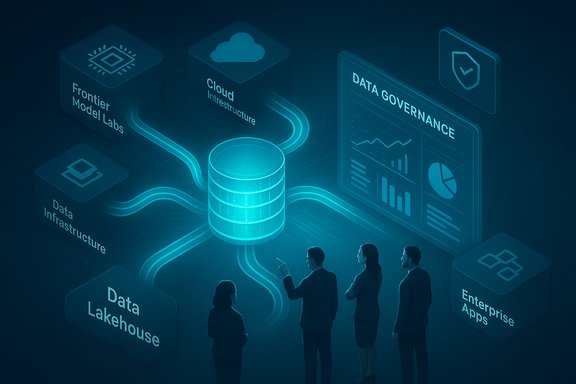
The AI software market in 2026 is not a single monolith but a multi-layered ecosystem combining:
Key strengths
Key strengths
Key strengths
Why it matters
Key strengths
Key strengths
Key strengths
Key strengths
Key strengths
Key strengths
The next 12–24 months will determine whether the dominant companies profiled—OpenAI, Anthropic, Microsoft, Databricks and others—consolidate lasting platform advantages or whether a more pluralistic, interoperable ecosystem emerges where enterprises mix and match models, clouds, and specialized products to optimize cost, compliance, and capability. For enterprise IT teams, the obligation is practical: pilot rigorously, contract wisely, and invest in the data foundation that makes advanced AI both useful and auditable.
Source: inventiva.co.in Top 10 AI Software Companies In 2026 - Inventiva
 Background / Overview
The AI software market in 2026 is not a single monolith but a multi-layered ecosystem combining:- Frontier model developers (large LLM creators) that drive capability and brand recognition.
- Cloud and infrastructure providers that supply compute, managed hosting, and developer tooling.
- Data and MLOps platforms that turn raw enterprise data into production-ready training and inference pipelines.
- Application-layer vendors and AI-native products that deliver measurable productivity gains to end users.
1. OpenAI — The market leader redefining software
OpenAI is presented in the Inventiva profile as the clear market leader: a brand synonymous with large language models and conversational AI, anchored by ChatGPT and a growing enterprise product line. The profile credits OpenAI with extraordinary monetization and scale claims—large funding rounds, a multibillion-dollar revenue run rate, and tens to hundreds of millions of users—while also underscoring enormous cost and capital intensity. These core points are corroborated in multiple industry reviews that verify OpenAI’s centrality to the consumer and developer AI conversation and the company’s outsized capital requirements and partnership dependencies.Key strengths
- Brand and distribution: ChatGPT is a cultural and product phenomenon that accelerated mainstream adoption of conversational AI.
- Model breadth: A family of models (GPT‑4o, o1 and successors) that target speed, multimodality (text, vision, audio), and improved reasoning.
- Developer ecosystem: A widely used API and plugin ecosystem enabling startups and enterprises to build on top of OpenAI models.
- Strategic partnership with Microsoft: Azure provides preferential cloud access and a massive distribution path into enterprise productivity tools.
- Massive operating cost: Public reporting and industry analysis point to very large losses driven by training and inference compute, talent, and infrastructure buildout. These cost pressures create sensitivity to pricing and contraction risk if enterprise contracts slow.
- Governance and mission tension: Transition from nonprofit roots to a hybrid/commercial model has raised legitimate questions about how safety and mission trade off against commercial pressures.
- Vendor concentration and partner friction: Heavy dependence on a single cloud partner for production capacity creates strategic constraints and potential competitive friction as OpenAI expands enterprise-facing offerings.
- Several highly specific claims about private valuations, funding round sizes, and user metrics in the Inventiva article reflect vendor or reporting estimates that vary across outlets. Treat precise private‑company valuations and internal run‑rate numbers as directional unless confirmed by audited filings or multiple independent sources.
2. Anthropic — Safety‑first enterprise AI
Anthropic’s rise is framed around an enterprise-first, safety‑centered strategy. The company’s Constitutional AI approach—training models to follow explicit principles—has proven compelling to regulated customers and government agencies that demand predictable behavior, long context windows, and explainability. Industry coverage shows Anthropic positioning itself as OpenAI’s closest challenger for enterprise workloads, with strong cloud relationships that reduce infrastructure risk.Key strengths
- Safety and alignment focus: Constitutional AI and interpretability work make Anthropic attractive for high‑assurance deployments in finance, legal, and government.
- Enterprise revenue mix: A revenue model weighted toward API and enterprise contracts yields higher per‑customer revenue and a narrower base of paid users, improving unit economics.
- Multi‑cloud flexibility: Partnerships with AWS and Google Cloud (and chip diversification) reduce single‑vendor infrastructure risk and can optimize cost/performance.
- Aggressive projections: Some reported revenue projections are extremely optimistic and should be scrutinized; rapid top‑line growth is real, but multi‑year multipliers require validation in signed, long‑term enterprise bookings.
- Legal exposure: Litigation and copyright claims over training data are an unresolved industry issue; adverse rulings could force costly changes to data strategies or licensing models.
- Competition: As more vendors emphasize safety features, Anthropic must sustain technical differentiation (e.g., extended context windows and steerability) to preserve premium pricing.
- Public reporting backs Anthropic’s enterprise traction and strategic cloud partnerships; however, projections of future revenue and private valuations should be treated as vendor-provided or analyst‑estimated unless independently audited.
3. Microsoft — Distribution, integration, and seat‑based monetization
Microsoft is not a model lab in the same sense as OpenAI or Anthropic, but its AI strategy—embedding Copilot experiences across Microsoft 365, GitHub, Dynamics, and Azure—makes it the most effective distributor of generative AI into enterprise workflows. Multiple independent analyses highlight Microsoft’s advantage: seat‑based monetization (Copilot per user pricing), deep identity and governance hooks (Azure AD, Entra), and the ability to convert existing enterprise relationships into AI revenue.Key strengths
- Unmatched enterprise distribution: Office, Windows, and enterprise agreements create a path to scale that few pure-play AI startups can match.
- Diverse monetization: Azure infrastructure revenue, seat‑based Copilot add‑ons, and productized developer tools like GitHub Copilot form a multi-channel revenue mix.
- Hybrid and compliance options: Strong on-premise and sovereign cloud offerings fit regulated customers.
- Dependency on external model providers: Microsoft’s leading revenue growth is in large part enabled by partnerships (notably OpenAI), which introduces a strategic dependence on external model quality and roadmaps.
- Integration complexity: Embedding AI across hundreds of products risks inconsistent UX or uneven enterprise adoption if experiences are not tightly executed.
- Perception and pricing: Customers may view Copilot add‑ons as expensive seat‑based upsells unless ROI is clearly demonstrated.
- Multiple independent analyses confirm Microsoft’s strategy and reported Copilot adoption; however, cross‑product comparisons (MAU vs. weekly users) require careful contextualization as vendors use different metrics.
4. Anysphere (Cursor) — Viral AI code editor transforming development
Cursor (Anysphere) demonstrates how an AI‑first product can displace incumbents in developer tooling by centering the editor experience on model‑driven workflows. The Inventiva profile and independent reporting highlight Cursor’s viral adoption, strong engagement, and a large valuation following a major funding round—evidence that developer productivity gains from AI are real and monetizable.Why it matters
- AI as a native workflow: Cursor’s clean‑sheet AI‑first design shows that retrofitting AI into legacy UIs is sometimes inferior to reimagining the product for model‑centric interactions.
- Measured productivity impact: Early studies and vendor case studies indicate substantial developer time savings (commonly cited ranges: 25–55% faster on specific tasks), which underpins willingness to pay for premium subscriptions and team licenses.
- Sustainability of differentiation: Big incumbents (Microsoft, JetBrains, GitHub) can integrate similar capabilities into familiar IDEs and leverage distribution advantages.
- Monetization and enterprise sales cycles: Converting millions of free users into predictable enterprise revenue requires productizing security, compliance, single‑sign‑on, and offline capabilities for risk‑sensitive customers.
- Model commoditization: If code generation quality becomes commoditized across multiple model providers, non‑technical differentiation (integrations, UI, community) will matter more.
- Viral growth and funding milestones are reported in industry coverage, but private valuations and internal ARR figures are based on investor reporting and should be considered estimates pending formal disclosures.
5. Databricks — Data and the lakehouse as foundational AI infrastructure
Databricks is widely recognized by enterprise buyers as the platform that solves the messy, real‑world problem of unifying and preparing data at scale for AI. The company’s lakehouse architecture, combined with Mosaic AI (the MosaicML acquisition and productization), positions Databricks as an infrastructure incumbent for organizations that want to build proprietary models or operationalize ML in production. Independent industry analysis affirms Databricks’ central role in enterprise AI stacks.Key strengths
- End‑to‑end data platform: Ingestion, transformation, feature stores, collaborative model development, and production deployment in a single platform reduce friction.
- Consumption pricing alignment: Pay‑for‑what‑you‑use models scale with customer AI usage and create natural expansion economics.
- Open‑source pedigree: Origins in Apache Spark and Delta Lake create a robust developer ecosystem and reduce lock‑in concerns.
- Competitive pressure from hyperscalers: Snowflake, AWS, and cloud providers are increasingly offering competing managed data and model services that threaten share.
- Complexity of enterprise adoption: Large organizations still struggle to operationalize models despite platform availability; Databricks must demonstrate ROI beyond tooling convenience.
- Acquisition of MosaicML and subsequent Mosaic AI capabilities are documented; enterprise customers and growth trajectories are corroborated across vendor and analyst reporting.
6. Palantir — Complex decision‑making and mission‑critical AI
Palantir’s profile differs from many peers: the company is focused on high‑assurance, mission‑critical applications (government, defense, and complex enterprise operations) where correctness, auditability, and integration with operational systems matter more than slick conversational UX. Palantir’s productization of AI into its Foundry and Gotham platforms, combined with an “AI Platform” for model deployment, gives it a defensible niche for customers requiring deterministic behavior and direct actionability.Key strengths
- Experience in high‑consequence environments: Engineering discipline and governance practices built for defense translate into advantages for regulated commercial customers.
- Bootcamp onboarding model: Hands‑on collaboration accelerates deployment and knowledge transfer.
- Profitability plus growth: Unlike many high‑growth AI companies that prioritize scale over earnings, Palantir has shown the ability to grow revenue while protecting margins.
- Reputational and ethical scrutiny: Legacy ties to surveillance and defense can complicate sales to privacy‑sensitive customers.
- Perception of complexity and cost: Palantir’s premium positioning must be justified by measurable outcomes, not just feature lists.
- Palantir’s commercial growth and inclusion in major indices have been validated in public reporting; however, precise customer ROI claims require case‑by‑case verification.
7. Scale AI — The often‑invisible data engine of model development
Scale AI’s role is unglamorous but indispensable: high‑quality labeled data, RLHF services, and evaluation pipelines are the foundation upon which models are trained and defended. Industry reporting confirms Scale’s central role in the training pipelines of many leading labs and autonomous vehicle programs. Without reliable annotation, even the best model architecture will underperform.Key strengths
- Quality at scale: Mature tooling for annotator workflows, validation, and ML‑assisted labeling.
- Breadth of clients: Deep penetration across large AI labs and industry customers.
- Expansion to safety and evaluation services: Moving beyond labeling into RLHF and evaluation strengthens capture of upstream value.
- Automation risk: Advances in model‑assisted annotation will change unit economics; Scale must keep improving higher‑value services to sustain margins.
- Competition from in‑house ops: Large labs can insource labeling when cost or sensitivity warrants.
- Scale’s customer base and valuation trajectory are reflected widely in industry coverage; however, per‑task pricing and contract terms vary and are generally private.
8. Glean — Enterprise knowledge and the AI work assistant
Glean’s product addresses a concrete productivity challenge: employees waste significant time searching across email, file systems, wikis, and messaging apps for relevant information. By indexing enterprise content with permission-aware connectors and adding AI synthesis, Glean positions itself as a direct contributor to knowledge worker efficiency. Recent funding and enterprise traction reported in industry summaries support the company’s momentum.Key strengths
- Focus on search + synthesis: Combines retrieval with natural language understanding to answer questions across disparate silos.
- Enterprise‑grade security and permissions: Essential for broad corporate deployments.
- Measured productivity value: Faster information discovery translates into tangible time savings.
- Competition from platform incumbents: Microsoft, Google, and major cloud vendors are adding integrated enterprise search and assistant features.
- Dependency on integrations: Value scales with depth of connectors; integration completeness is a gating factor.
- Glean’s valuation and customer growth are discussed in reporting; pricing and contract details are typical enterprise private metrics needing verification during procurement.
9. xAI — The Musk wildcard
xAI represents a contrarian, high‑profile entrant that blends model development with data and distribution advantages tied to Musk’s ecosystem (X, Tesla, SpaceX). While the company’s Grok models and muscle in real‑time social data offer unique assets, xAI’s contrarian positioning on content policy and “truth‑seeking” raises both distributional and regulatory questions. Industry observers treat xAI as an important wildcard: capable of rapid, media‑driven adoption but facing tougher commercialization and governance paths in enterprise contexts.Key strengths
- Proprietary streaming data: Deep integration with X offers unique training and retrieval signals for real‑time content.
- Capital and compute scale: Large GPU clusters and fast buildout capability back aggressive R&D.
- Founder brand and promotion: Public visibility accelerates user trial and attention.
- Regulatory and trust concerns: Open‑ended content policies invite misuse and regulatory scrutiny.
- Productization to enterprise: Contrarian consumer appeal does not automatically convert to large enterprise contracts requiring compliance and governance.
- xAI’s early funding, cluster claims, and positioning are well reported; however, exact revenue and internal metrics remain estimates and should be treated cautiously.
10. Sierra — AI agents for customer experience
Sierra is an example of a focused, high‑value application of AI: autonomous agents that can handle customer service interactions across channels while integrating with enterprise backend systems. The company’s founding team credentials and early enterprise traction explain a high valuation despite limited operating history. The critical enterprise test for Sierra is whether its agents can reliably reduce support costs while improving—rather than degrading—customer satisfaction.Key strengths
- Deep integrations: Back-end system access and CRM integration are required to resolve real support tasks, not just simulate them.
- Analytics and insights: Actionable intelligence on support patterns and product issues provides expansion paths beyond cost savings.
- Competition: Big CRM vendors (Salesforce, Zendesk) and model providers can replicate similar offerings, but incumbent platforms benefit from existing customer relationships.
- Operational risk: Mis‑configured agents that escalate or take incorrect actions generate customer harm and regulatory exposure.
- Sierra’s valuation and early customer signals are consistent with venture interest in vertical AI agents; the long-term test is enterprise proof of measurable ROI.
Cross‑cutting lessons for enterprise IT leaders
- Prioritize the data foundation: Without clean, governed, and well‑indexed enterprise data, retrieval‑augmented generation and grounded agentic workflows produce brittle results. Platforms like Databricks and Scale remain strategic investments.
- Match model capability to risk profile: Use safer, highly‑auditable models (or providers emphasizing safety) for regulated or high‑stakes operations; reserve experimental or consumer‑grade models for low‑risk internal pilot scenarios. Anthropic’s constitutional approach is an example of a choice that maps well to regulated needs.
- Negotiate contractual protections: No‑training clauses, data deletion SLAs, audit logs, and export paths for vector stores or model artifacts are no longer optional for sensitive workloads. Recent procurement guidance emphasizes pilot KPIs (accuracy, hallucination rate, cost per 1M tokens) and reserved capacity for GPU families.
- Beware of headline metrics: MAUs, weekly users, and valuation figures are often incomparable across vendors and may be optimistic; validate vendor KPIs against measurable business outcomes and independent references. Several widely reported user and revenue figures should be treated as directional until corroborated.
- Plan for operational complexity: Agentic AI multiplies east–west traffic, requires observability and incident playbooks, and shifts procurement from feature lists to long‑term capacity planning and governance. Network and cost considerations are real constraints for large deployments.
Final verdict — winners, risks, and what to watch in 2026
The Inventiva list correctly identifies the types of companies shaping enterprise AI: frontier model labs, hyperscalers, data layer platforms, enterprise specialists, and AI‑native application startups. Across these types, the winners will be those who can combine:- demonstrable, measurable ROI for business processes,
- contractual clarity around data usage and training,
- predictable TCO through efficient compute stacks or favorable cloud partnerships,
- and governance features that meet regulatory expectations.
- Consolidation or deeper strategic alliances between model labs and hyperscalers.
- Legal outcomes around training data and copyright that could reshape dataset strategies and licensing costs.
- Emergence of standardized SLAs and audit frameworks demanded by regulated industries.
- Continued productization of AI into seat‑based enterprise software (Copilots and agent platforms) that favor vendors with existing distribution channels.
The next 12–24 months will determine whether the dominant companies profiled—OpenAI, Anthropic, Microsoft, Databricks and others—consolidate lasting platform advantages or whether a more pluralistic, interoperable ecosystem emerges where enterprises mix and match models, clouds, and specialized products to optimize cost, compliance, and capability. For enterprise IT teams, the obligation is practical: pilot rigorously, contract wisely, and invest in the data foundation that makes advanced AI both useful and auditable.
Source: inventiva.co.in Top 10 AI Software Companies In 2026 - Inventiva
