

As Artificial Intelligence continues to reshape industries, the race to acquire credible, job‑ready AI skills has become a defining element of professional development in 2026. BusinessDay’s roundup highlights a practical shortlist of globally recognised certification programmes — from cloud vendor role exams to university professional certificates and vendor-backed generative‑AI credentials — that professionals are using today to move into roles like machine learning engineer, MLOps engineer, AI product manager, and AI architect. The original BusinessDay summary frames these programmes as hands‑on, industry‑aligned pathways that increasingly substitute for traditional degrees when employers prioritize demonstrable skills and deployment experience. view
Employers now prize evidence of practical AI outcomes: deployed models, reproducible notebooks, production pipelines and demonstrable familiarity with cloud AI platforms (Vertex AI, Azure AI Foundry, Amazon Bedrock). That market reality has driven the growth of several certification categories:
Certifications are no longer just badges; when paired with demonstrable projects, they act as signalling devices for recruiters and hiring managers. They matter for three reasons:
AI certification is no longer a checklist item — it is an investment decision. The smartest candidates in 2026 combine vendor‑aligned certifications, a compact set of production‑style portfolio projects, and the ability to explain the business impact, governance trade‑offs, and monitoring strategy of the systems they build. The programmes discussed here — from IBM and DeepLearning.AI to Google, Microsoft, AWS and NVIDIA, plus university professional certificates — each play a role in that ecosystem. Choose the credential that maps to your target role, verify the current exam/price details on the vendor page, and build projects that prove you can deliver reliable, monitored AI in production.
Source: Businessday NG Top AI certification courses for professional upskilling - Businessday NG
Employers now prize evidence of practical AI outcomes: deployed models, reproducible notebooks, production pipelines and demonstrable familiarity with cloud AI platforms (Vertex AI, Azure AI Foundry, Amazon Bedrock). That market reality has driven the growth of several certification categories:
- Vendor role certifications (Google Cloud, Microsoft Azure, AWS) that validate cloud‑native engineering and MLOps skills.
- Vendor or hardware‑platform certificates focused on generative AI and GPU acceleration (for example, NVIDIA’s new generative AI/LLM certifications).
- University and professional education certificates that combine academic credibility with applied capstones (MIT Professional Certificate, Johns Hopkins, IIMB programmes).
- Coursera / DeepLearning.AI specialisations and vendor professional certificates that emphasize project work and portfolio artifacts.
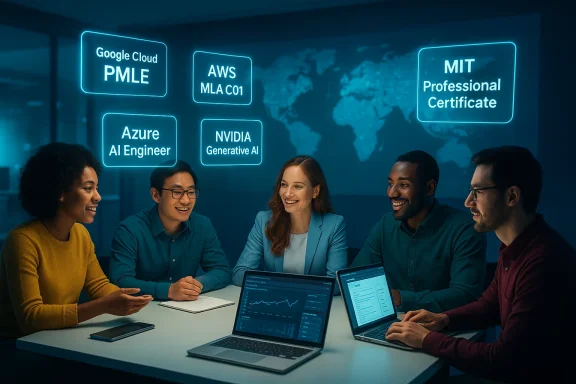 Why certifications matter today — and what they don’t
Certifications are no longer just badges; when paired with demonstrable projects, they act as signalling devices for recruiters and hiring managers. They matter for three reasons:- Platform fluency: Employers running production ML on a cloud provider prefer candidates who know that provider’s services and tooling. Google Cloud’s ML professional exam covers Vertex AI, Model Garden and MLOps tasks; Microsoft’s AI role exam maps to Azure AI Foundry and Azure OpenAI; AWS’ MLA exam maps to SageMaker and Bedrock patterns.
- Operational readiness: Modern AI work is as much about pipelines, monitoring, bias detection and governance as it is about model architectures. Vendor role exams now include MLOps, monitoring and responsible‑AI topics.
- Portfolio + credential combo: A certificate plus a small set of production‑style projects (an RAG prototype, a deployed inference endpoint, or a monitored pipeline) yields the strongest hiring signal.
- Immediate seniority. A certificate proves knowledge and sometimes hands‑on skill, but not the deep, contextual experience that senior roles require.
- Vendor neutrality. Many vendor certifications encourage lock‑in to a single cloud stack; choose them when your target employers use that platform.
The most in‑demand certifications in 2026 — verified and evaluated
Below are the programmes most often recommended for professionals who want measurable career impact. For each, I verify key claims (duration, price, exam format) against vendor/primary sources and offer a balanced analysis.IBM — AI Engineering Professional Certificate (Coursera)
- What it is: A multi‑course professional certificate hosted on Coursera, designed to teach ML, deep learning, NLP, computer vision, and generative AI with hands‑on labs and capstone projects. The programme emphasizes frameworks like PyTorch, TensorFlow, Hugging Face and tools for building LLM apps.
- Verified facts: Coursera lists the IBM AI Engineering Professional Certificate as a 13‑course (or multi‑course) professional certificate with a typical completion estimate around 3–6 months depending on weekly hours. It includes hands‑on projects and portfolio work.
- Strengths: Project‑centric, broad toolbox exposure (PyTorch/TensorFlow/Hugging Face), easy portfolio artifacts for interviews. Good bridge for career changers.
- Risks and caveats: Platform and hiring signal vary by market; many enterprise production roles still prefer cloud‑specific MLOps credentials (Google/Azure/AWS). The Coursera subscription model means final cost depends on your pace.
Google Cloud — Professional Machine Learning Engineer
- What it is: A role‑based professional certification validating the ability to design, build, productionize and monitor ML solutions on Google Cloud (Vertex AI, Model Garden, BigQuery ML, MLOps).
- Verified facts: Official Google Cloud exam guide shows a 120‑minute, multiple‑choice exam that covers generative AI, MLOps, model monitoring and Vertex AI; the proctored exam registration fee is commonly listed at USD $200.
- Strengths: Strong employer recognition for cloud‑native ML roles; exam content maps closely to production tasks (scaling, monitoring, pipelines). Google’s exam guide is explicit about required competencies and exam weighting.
- Risks and caveats: Expect a high bar for MLOps experience — passing typically requires months of hands‑on practice with Vertex AI and BigQuery. Budget $200+ for the exam and additional cloud credits for labs.
Microsoft — Azure AI Engineer Associate (Exam AI‑102)
- What it is: Role‑based certification for designing and implementing Azure AI solutions including Azure AI Foundry, Azure OpenAI services, vision, speech and responsible AI controls. The official skills measured and exam guide are published on Microsoft Learn.
- Verified facts: Microsoft’s certification page lists the role, skills measured and a 100‑minute exam duration; Microsoft updates the skills measured frequently to reflect Foundry and agentic AI changes.
- Strengths: Excellent for Azure‑centric organizations; strong coverage of governance and responsible AI. Microsoft’s free Learn resources and sandboxes can reduce training cost.
- Risks and caveats: Vendor lock‑in risk and frequent content churn (Azure tools and endpoints evolve quickly), so confirm the latest skills‑measured page before the exam. Some modules may reference retiring services (which Microsoft documents and updates).
AWS — AWS Certified Machine Learning Engineer — Associate (MLA‑C01)
- What it is: AWS’ associate‑level ML engineering credential that validates ability to build, deploy and operate ML solutions using AWS services (e.g., SageMaker). AWS publishes a detailed exam guide for MLA‑C01.
- Verified facts: AWS lists the MLA‑C01 blueprint and content domains; AWS exam pricing policy shows associate‑level exams are priced at USD $150. The AWS exam guide details domain weightings for data prep, model development, deployment and monitoring.
- Strengths: Strong alignment with production ML tasks on AWS and good employer recognition in AWS shops. Standardized pricing model ($150) makes budgeting straightforward.
- Risks and caveats: Like other vendor tests, it’s platform‑specific; many hiring managers look for both cloud certification and demonstrable artifacts (SageMaker notebooks, pipeline examples). Expect to budget cloud credits for hands‑on practice.
NVIDIA — Generative AI and LLM Certifications (Associate and Professional)
- What it is: NVIDIA has launched a suite of certifications aimed at GPU‑accelerated generative AI and LLM work, with associate and professional levels covering foundational LLM concepts, GPU optimisation and deployment best practices. Official certification pages list exam format and prices.
- Verified facts: NVIDIA lists the Generative AI LLMs Associate (NCA‑GENL) with a 60‑minute, ~50‑question exam priced at USD $125 and a Generative AI LLMs Professional exam priced at USD $200 with a longer time and deeper prerequisites.
- Strengths: For engineers building high‑performance LLM pipelines, NVIDIA’s certification signals competency in GPU acceleration, distributed training and inference optimisation — areas not covered in cloud‑only exams.
- Risks and caveats: These credentials are hardware‑centric; they are powerful if your work targets GPU‑accelerated pipelines or edge acceleration, but less immediately useful for purely cloud‑managed LLM deployments unless you control infrastructure choices.
MIT Professional Certificate in Machine Learning & AI
- What it is: A university‑backed professional education credential that requires completion of multiple short courses (16+ days of qualifying courses in some programmes) and is oriented to professionals with significant technical backgrounds.
- Verified facts: MIT Professional Education lists program requirements (for example, total taught days, prerequisites), and positions the certificate as an in‑person/online mixed professional development programme for experienced professionals. Application fees and course schedules are published on the MIT site.
- Strengths: Strong academic credibility, faculty instruction, and peer networking — useful for leaders and senior engineers seeking academic rigour.
- Risks and caveats: Cost and time commitment are higher than vendor micro‑courses, and hands‑on lab access for cloud sandboxes may vary by cohort. Not the fastest way into a junior engineering job.
DeepLearning.AI — Deep Learning Specialization / AI for Everyone
- What it is: Andrew Ng’s DeepLearning.AI specialisations (Deep Learning Specialization and AI for Everyone) provide foundational and managerial training respectively; Deep Learning Specialization remains a top foundational pathway into modern deep learning and transformers.
- Verified facts: DeepLearning.AI’s “AI for Everyone” is a short non‑technical course of roughly 6–8 hours; the Deep Learning specialization comprises multiple courses and typically takes several months at a moderate weekly cadence. Pricing follows Coursera’s certificate model or Coursera Plus where applicable.
- Strengths: Excellent theoretical grounding and approachable projects; high name recognition for hiring managers.
- Risks and caveats: Alone, these courses may not prove production MLOps experience; combine with cloud practice and deployment projects for maximum hiring signal.
Cross‑checks and verification checklist
Before you enroll, verify the following (every figure below is drawn from primary vendor pages or official exam guides):- Exam fee and exam length:
- Google Cloud PMLE: 120 minutes; typical fee cited at USD $200.
- AWS MLA‑C01: Associate‑level pricing structure (Associate = USD $150). Confirm specific exam code and booking info on AWS exam pages.
- Microsoft AI‑102: 100 minutes (Microsoft Learn) with periodic updates to skills measured. Check Microsoft Learn for the latest “skills measured” page.
- NVIDIA: Associate $125, Professional $200 (NVIDIA certification pages).
- Course duration estimates: vendor pages list typical completion windows (IBM/Coursera ~3–6 months; DeepLearning.AI specializations ~3–5 months depending on pace; MIT professional programs vary by cohort length). Always check the provider’s current cohort brochure.
- Hands‑on labs & sandbox access: confirm whether labs are included or require separate cloud credits (common for Vertex AI, Azure OpenAI, AWS SageMaker labs). Budget for $50–$300 in cloud credits for meaningful hands‑on practice.
How to choose the right certification for your goals (practical playbook)
Choosing the right path depends on role, time, and employer context. Use this 6‑step decision flow:- Define your target role (ML Engineer, MLOps, AI Product Manager, Cloud Architect).
- Map required skills to certs:
- ML Engineer / MLOps → Google PMLE, AWS MLA‑C01, IBM professional cert + poe.com]
- Cloud AI Engineer (Azure) → Microsoft AI‑102.
- GPU/LLM infra → NVIDIA Generative AI certs.
- Management / Strategy → DeepLearning.AI “AI for Everyone”, university executive certificates.
- Check employer preferences in job listings (platforms mentioned, e.g., Vertex AI, SageMaker, Azure OpenAI).
- Budget time and money: assume 3–6 months + $150–$400 exam/licensing + $50–$300 cloud credits for meaningful labs.
- Build a 3‑artifact portfolio: a reproducible notebook, a deployed endpoint with monitoring, and a short architecture README describing data → model → deployment → monitoring.
- Pair learning with a public signal: GitHub, a short demo video, or a recorded walk‑through.
A study roadmap (90‑day plan for a transitioning professional)
If you have around three months and want practical certification + portfolio:- Week 1–2: Foundation refresh — Python, statistics, ML basics; take a short non‑technical course to frame use cases. (DeepLearning.AI “AI for Everyone” or vendor fundamentals).
- Week 3–6: Platform practice — follow the cloud vendor’s learning path (Vertex AI labs for Google, SageMaker quickstarts for AWS, Azure AI sandboxes for Microsoft). Complete 1–2 labs end‑to‑end.
- Week 7–10: Project build — create an RAG demo (retrieval‑augmented QA) or image classifier and deploy as an endpoi a readme describing drift detection and mitigation.
- Week 11–12: Certification prep — practice exams, study guides, time‑boxed mocks. Schedule the vendor exam after confidence in mock scores.
Special considerations for African professionals and remote candidates
- Global portability: Vendor certificates are recognized internationally and can support remote job applications. BusinessDay highlights that these credentials are enabling Africans to win remote and freelance roles without relocation.
- Cost sensitivity: Use vendor free tiers, audit modes, and financial aid (Coursera) to reduce upfront costs. Budget for exam fees and modest cloud credits.
- Show impact, not just certificates: Employers in remote marketplaces prefer immediate evidence — a deployed demo that solves a domain problem (e.g., customer‑support summarizer, claims triage or dashboard automation) increases hireability far more than a certificate alone.
Risks, gaps and red flags to watch
- Rapid tool churn: Azure, Google and AWS frequently update services (retire features, combine agents, or change endpoints). Confirm “skills measured” pages immediately before taking an exam. Microsoft Learn and Google Cloud exam guides show frequent updates.
- Certificate vanity: Short micro‑courses that award badges after 1–2 hours are helpful for orientation but provide limited hiring signal unless paired with projects. BusinessDay and vendor roundups consistently mention this trade‑off.
- Hidden lab costs: Many labs require cloud credits. Always check lab requirements for Vertex AI, SageMaker or Azure Lab environments and budget accordingly.
- Over‑specialization: If you switch employers frequently, deep vendor lock‑in (only AWS or only Azure) may reduce opportunities in shops that standardize on a different cloud.
Final recommendations — a concise action plan
- If you want cloud production ML roles, prioritise a vendor role certification (Google PMLE or AWS MLA‑C01) plus a small, well‑documented project that demonstrates deployment and monitoring.
- If you want to lead AI strategy or manage cross‑functional teams, combine DeepLearning.AI’s managerial courses (AI for Everyone) or a university executive certificate with a short governance capstone.
- If you work on infrastructure, model optimisation, or high‑performance LLM deployments, consider NVIDIA’s associate or professional generative‑AI certifications.
- Always verify the latest exam guide on the vendor’s site before booking an exam; vendor pages are the authoritative source for pricing, exam length and skills measured.
AI certification is no longer a checklist item — it is an investment decision. The smartest candidates in 2026 combine vendor‑aligned certifications, a compact set of production‑style portfolio projects, and the ability to explain the business impact, governance trade‑offs, and monitoring strategy of the systems they build. The programmes discussed here — from IBM and DeepLearning.AI to Google, Microsoft, AWS and NVIDIA, plus university professional certificates — each play a role in that ecosystem. Choose the credential that maps to your target role, verify the current exam/price details on the vendor page, and build projects that prove you can deliver reliable, monitored AI in production.
Source: Businessday NG Top AI certification courses for professional upskilling - Businessday NG
