

In mid-2026, NubiaPage ranked Jasper AI, Gemini for Google Workspace, Microsoft Copilot, DealHub AI, ClickUp AI, Anyword, ChatGPT, Claude, Jetlink AI, and Chattermill as the world’s top AI report generators, reflecting a market now split between general-purpose writing systems and deeply embedded enterprise workflow tools. The list is less interesting as a beauty contest than as a map of where business reporting is going. Reports are no longer just documents; they are the final surface of a much larger contest over data access, workflow ownership, governance, and trust. The winner in this category may not be the model that writes the prettiest paragraph, but the platform already closest to the spreadsheet, dashboard, CRM record, ticket queue, or board packet.
The phrase AI report generator sounds narrower than the market it now describes. A few years ago, it meant a tool that could turn prompts into passable prose or summarize a PDF without embarrassing itself too badly. In 2026, the category has stretched to include marketing content engines, workplace copilots, customer-experience analytics platforms, revenue operations systems, and general-purpose chatbots with large context windows.
That sprawl explains why the ranking led by Jasper can still include Microsoft Copilot, Gemini, DealHub, ClickUp, ChatGPT, Claude, Jetlink, and Chattermill without being incoherent. These products do not all compete in the same procurement lane. Some are purchased by marketing teams, some by CIOs, some by sales operations leaders, and some by support organizations looking for a cleaner story inside messy customer data.
But they are converging on the same endpoint: a written, structured explanation of what happened and what a business should do next. That endpoint used to be assembled by humans moving between BI dashboards, email threads, spreadsheets, CRM exports, and slide decks. AI report generators are trying to collapse that work into a single prompt, button, agent, or workflow.
The ranking also reveals an uncomfortable truth for buyers. The best report generator is not necessarily the most intelligent model in isolation. It is the system with the best access to relevant data, the least friction in the workflow, and the clearest path to auditability when someone asks, “Where did this number come from?”
The strongest case for Jasper is not that it knows more than ChatGPT or Claude. It is that Jasper has spent years convincing marketing and sales teams that AI writing can be operationalized. Brand voice controls, templates, collaboration workflows, and campaign-oriented content structures are not glamorous features, but they are exactly the sort of scaffolding that lets a team produce recurring reports without starting from a blank prompt every Monday morning.
That also explains Jasper’s limitation. It is strongest where reports are themselves a form of business communication: campaign summaries, client-facing performance documents, sales enablement updates, and executive narratives. It is less obviously dominant where reporting depends on live operational data, governed analytics models, or complex permission boundaries.
Still, Jasper’s ranking makes sense because the report is not just an analytical artifact. It is also a persuasive document. A quarterly marketing report that buries its insight under stiff AI prose is not a success, even if the numbers are technically correct. Jasper’s bet is that businesses want AI systems that understand the rhetoric of business communication as well as the mechanics of summarization.
Gemini’s advantage is especially clear for organizations that live in Docs, Sheets, Slides, Gmail, and Drive. A report generator inside the productivity suite can pull context from the documents, spreadsheets, and messages that already define the workday. The output may be a summary in Docs, a presentation draft in Slides, or a narrative explanation of spreadsheet trends, but the strategic point is the same: the AI layer sits where the evidence already lives.
Microsoft’s version of the argument is even more pointed for WindowsForum readers, because Copilot is tied to the broader Microsoft 365 universe that dominates enterprise desktops. Word, Excel, Teams, SharePoint, OneDrive, and Power BI are not just apps; they are the record layer for countless organizations. Copilot’s promise is that the report can be generated from that organizational graph rather than from a manually curated pile of copied text.
The catch is cost, licensing, and expectation management. Microsoft 365 Copilot’s widely discussed $30-per-user-per-month business pricing has made many organizations more selective about deployment. For reporting-heavy roles, that price may be easy to justify; for casual users, it can look like an expensive shortcut to a draft that still needs human review.
Google’s Workspace AI strategy has become more aggressive as Gemini capabilities have been folded into the productivity experience, but buyers still need to watch plan differences, feature availability, admin controls, and data-handling rules. The headline price rarely tells the full story. In office suites, the real cost of AI reporting includes permissions hygiene, file sprawl, training, and the risk that the model summarizes the wrong version of the truth.
This is where Microsoft’s enterprise installed base becomes a genuine advantage. Many organizations have already invested years in Power BI datasets, semantic models, access controls, and reporting pipelines. If Copilot can sit on top of that infrastructure and help users move from “what does this chart say?” to “what should we tell leadership?” it becomes more than an AI writing add-on.
But it also inherits every problem in the underlying estate. A poorly governed Power BI deployment does not become trustworthy because Copilot can summarize it fluently. If the dataset is stale, the measures are inconsistent, or departments define revenue differently, AI can produce a polished report that accelerates confusion.
For IT leaders, this is the heart of the Copilot reporting question. The tool’s usefulness will depend less on whether it can generate paragraphs and more on whether the organization has done the unglamorous work of data governance. Copilot can make a mature reporting environment faster; it can also make a chaotic one louder.
DealHub’s appeal is obvious for revenue teams. Sales reporting is full of structured but messy data: quotes, pricing exceptions, deal cycles, renewals, discounting patterns, pipeline movement, and board-level forecasts. A system that already lives in quote-to-revenue workflows can produce sales and revenue reports with more native context than a generic assistant waiting for pasted exports.
ClickUp’s strength is similar but aimed at operations and project work. Status reports, sprint summaries, workload updates, meeting notes, and risk briefs are often assembled from task systems rather than written from scratch. If the work already lives in ClickUp, the AI layer can summarize progress without asking users to reconstruct the week manually.
Anyword’s niche is marketing performance and predictive content scoring. That makes it less of a general corporate report generator and more of a specialized engine for teams that need to tie messaging decisions to expected outcomes. Its value is not just “write me a report,” but “help me explain which version of this campaign is likely to perform and why.”
Jetlink and Chattermill point to another branch of the market: customer-experience reporting. Support conversations, survey responses, reviews, and feedback streams are too voluminous for manual theme extraction at scale. AI systems that cluster sentiment, surface recurring pain points, and generate CX narratives can turn a swamp of customer comments into an operational signal.
ChatGPT remains the default AI workbench for many professionals. It is flexible, familiar, and capable of producing structured reports across almost any subject when given good source material. Its weakness in enterprise reporting is not imagination; it is integration. Unless connected through approved business plans, APIs, connectors, or internal tools, users still end up copying data in, revising output, and moving drafts back into Office, Google Workspace, or a project management system.
Claude’s reputation is different. It is widely associated with long-context work, careful prose, and strong document synthesis. That makes it particularly attractive for research reports, policy analysis, legal summaries, technical documentation, and multi-document synthesis where the input corpus is long and the desired output must be coherent.
The risk for both systems is that flexibility can become ambiguity. A general-purpose assistant can write almost any kind of report, but the user has to define the structure, provide the evidence, enforce the style, and check the claims. In mature reporting operations, that burden often shifts the advantage back toward specialized or embedded systems.
Still, it would be a mistake to treat ChatGPT and Claude as also-rans. Many organizations use them precisely because they are not trapped inside one workflow. They are the drafting layer for unusual reports, exploratory analysis, and executive writing that does not fit neatly into a predefined dashboard or CRM template.
That question tends to produce different answers by department. Marketing may prefer Jasper or Anyword because messaging consistency and campaign framing are central to the work. Sales operations may prefer DealHub because revenue reporting depends on CPQ and pipeline context. IT and finance may lean toward Microsoft or Google because governance, identity, and document control matter more than specialized copywriting features.
The highest-risk reports are usually the ones that sound most authoritative. A polished AI-generated executive summary can make weak analysis look decisive. That is dangerous in board materials, financial updates, compliance narratives, and customer-impact reports, where a subtle error can survive because the prose is smooth.
This is why Windows admins and IT pros should care about the category even if they are not buying marketing tools. AI report generation is becoming another endpoint of enterprise data access. The same identity, retention, DLP, audit, and permission questions that govern email and file sharing now apply to automatically generated narratives.
A report generator that can see everything may be powerful. It may also be a governance nightmare if “everything” includes confidential HR files, privileged legal documents, stale drafts, or data the requester should not be able to synthesize. The future of AI reporting will be shaped as much by admin consoles and access boundaries as by model benchmarks.
That should change how buyers evaluate demos. A vendor-generated sample report is almost meaningless unless it uses data that resembles the buyer’s actual working mess. Real reporting involves half-finished documents, inconsistent naming, permission conflicts, missing fields, contradictory comments, and executives who want the story compressed to one page without losing the nuance.
The better test is repeatability. Can the tool generate the same kind of report every week with minimal cleanup? Can it cite or expose the underlying source material to reviewers? Can it handle revised data without inventing continuity? Can it enforce tone and structure across teams?
There is also a cultural question. Some teams want AI to draft prose from human-selected evidence. Others want AI to discover patterns and propose the narrative. Those are not the same workflow. The first treats AI as a writing assistant; the second treats it as an analyst, which raises the bar for validation.
The market is moving toward the second model, but most organizations are still safer starting with the first. Let AI accelerate drafting, summarization, formatting, and first-pass synthesis. Keep humans responsible for interpretation, accountability, and final claims.
For Windows-heavy organizations, Microsoft Copilot’s position is a sign of where the default enterprise workflow is heading. Reports will increasingly be generated inside Word, PowerPoint, Excel, Teams, and Power BI rather than assembled after the fact. The winners will be the deployments that pair Copilot with clean permissions, disciplined data models, and realistic expectations.
For Google Workspace shops, Gemini offers the same broad pattern through Docs, Sheets, Slides, Gmail, and Drive. Its strength is everyday proximity. If a team already collaborates in Google’s suite, Gemini’s reporting value comes from reducing the distance between communication, analysis, and presentation.
For departmental buyers, the specialists may remain more valuable than the giants. DealHub, ClickUp, Anyword, Jetlink, and Chattermill succeed because they understand the structure of a specific business problem. A generic AI assistant can summarize a sales export; a revenue platform can understand why the quote, discount, renewal, and forecast belong in the same story.
This is especially important because AI-generated reports tend to travel upward. A project summary becomes an executive update. A support-trend report becomes a product decision. A sales forecast becomes a board slide. Errors that begin as harmless automation can become institutional memory if no one checks the chain of evidence.
Administrators should therefore treat AI report generators as part of the information architecture. Who can generate reports from which repositories? Are outputs retained? Can sensitive content leak into summaries? Are prompts logged? Can managers audit the sources used to generate a recommendation?
The vendor language around AI reporting often emphasizes saved time, and the savings are real. But time saved at the drafting stage can be lost later if reviewers must reverse-engineer where every claim came from. The best systems will make verification easier, not merely make prose faster.
This is where embedded tools have a chance to outperform standalone assistants. A report generated from a governed BI model, CRM workflow, or project system can theoretically preserve more context about its sources. But that advantage only exists if the vendor exposes enough lineage and the organization configures the system properly.
That makes procurement more boring and more strategic. Instead of chasing the most impressive demo, buyers should map reporting use cases to data sources. Marketing reports belong near campaign data and brand controls. Revenue reports belong near quoting, CRM, and billing systems. Operations reports belong near tasks, tickets, and project timelines. Executive summaries belong wherever the organization can enforce governance across all of the above.
The ranking also shows why AI reporting will become harder to evaluate from the outside. Public review scores and badges can identify credible vendors, but they cannot tell an individual organization whether its permissions are clean, its datasets are reliable, or its managers will trust machine-generated summaries. Those answers are local.
For WindowsForum’s IT-minded audience, the operating principle is simple: do not buy an AI report generator as if it were a smarter template library. Buy it as a new interface to business data. That shift changes who needs to be in the room, from marketing and operations leaders to security, compliance, data owners, and endpoint administrators.
That split matters because it predicts the next round of consolidation. Office suites will absorb more everyday reporting tasks. Specialist platforms will deepen their vertical workflows. General-purpose assistants will become more connected to enterprise data through connectors, agents, and APIs. The standalone “AI report generator” may survive as a category label, but the function will increasingly be embedded everywhere.
The pressure on vendors will be to prove that their AI can do more than produce a plausible memo. Buyers will ask for source grounding, version control, approval workflows, role-based access, export options, and integration with existing reporting cadences. In other words, the market will mature from novelty to operations.
The pressure on users will be different. They will need to become better editors of machine-generated analysis. The skill is not just prompting; it is knowing when the draft is compressing reality too aggressively, when a trend needs more context, and when a confident recommendation is built on thin evidence.
The same is true for oversharing. Many organizations already suffer from broad SharePoint permissions, sprawling Google Drive folders, stale Teams channels, and forgotten exports. AI makes those old problems more visible and more dangerous because it can synthesize across material faster than a human snooper could read it.
That does not mean organizations should avoid AI report generation. It means they should treat deployment as an opportunity to clean the house. Data classification, retention policies, least-privilege access, and audit logging are not bureaucratic obstacles to AI productivity. They are the conditions that make AI productivity survivable.
The irony is that the best AI reporting deployments may begin with deeply human work: deciding which numbers matter, who owns them, what “current” means, and which audiences are allowed to see which conclusions. AI can accelerate reporting, but it cannot resolve organizational ambiguity by itself.
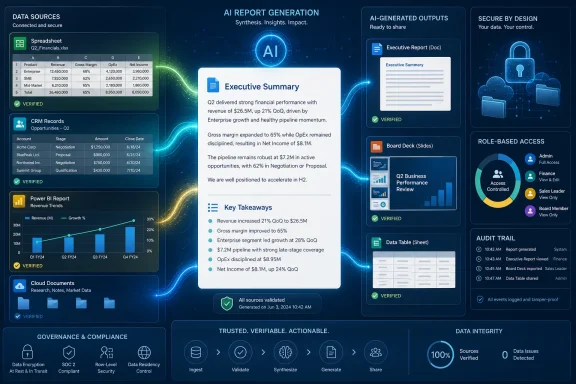 The Report Generator Has Become the New Office Battleground
The phrase AI report generator sounds narrower than the market it now describes. A few years ago, it meant a tool that could turn prompts into passable prose or summarize a PDF without embarrassing itself too badly. In 2026, the category has stretched to include marketing content engines, workplace copilots, customer-experience analytics platforms, revenue operations systems, and general-purpose chatbots with large context windows.That sprawl explains why the ranking led by Jasper can still include Microsoft Copilot, Gemini, DealHub, ClickUp, ChatGPT, Claude, Jetlink, and Chattermill without being incoherent. These products do not all compete in the same procurement lane. Some are purchased by marketing teams, some by CIOs, some by sales operations leaders, and some by support organizations looking for a cleaner story inside messy customer data.
But they are converging on the same endpoint: a written, structured explanation of what happened and what a business should do next. That endpoint used to be assembled by humans moving between BI dashboards, email threads, spreadsheets, CRM exports, and slide decks. AI report generators are trying to collapse that work into a single prompt, button, agent, or workflow.
The ranking also reveals an uncomfortable truth for buyers. The best report generator is not necessarily the most intelligent model in isolation. It is the system with the best access to relevant data, the least friction in the workflow, and the clearest path to auditability when someone asks, “Where did this number come from?”
Jasper’s Lead Shows That Packaging Still Matters
Jasper’s position at the top of the list is a reminder that the enterprise AI market does not reward raw capability alone. Jasper built its reputation before the current wave of office-suite copilots by selling AI writing as a disciplined business function rather than a parlor trick. That matters in reporting, where consistency, brand tone, campaign framing, and repeatable templates can matter as much as model novelty.The strongest case for Jasper is not that it knows more than ChatGPT or Claude. It is that Jasper has spent years convincing marketing and sales teams that AI writing can be operationalized. Brand voice controls, templates, collaboration workflows, and campaign-oriented content structures are not glamorous features, but they are exactly the sort of scaffolding that lets a team produce recurring reports without starting from a blank prompt every Monday morning.
That also explains Jasper’s limitation. It is strongest where reports are themselves a form of business communication: campaign summaries, client-facing performance documents, sales enablement updates, and executive narratives. It is less obviously dominant where reporting depends on live operational data, governed analytics models, or complex permission boundaries.
Still, Jasper’s ranking makes sense because the report is not just an analytical artifact. It is also a persuasive document. A quarterly marketing report that buries its insight under stiff AI prose is not a success, even if the numbers are technically correct. Jasper’s bet is that businesses want AI systems that understand the rhetoric of business communication as well as the mechanics of summarization.
Google and Microsoft Are Turning Reports Into Suite Features
The second and third positions in the ranking belong to Gemini for Google Workspace and Microsoft Copilot, and that placement says more about distribution than about writing quality. Google and Microsoft do not need to persuade users to visit a new reporting tool. They already own the tabs where reports are drafted, reviewed, revised, and presented.Gemini’s advantage is especially clear for organizations that live in Docs, Sheets, Slides, Gmail, and Drive. A report generator inside the productivity suite can pull context from the documents, spreadsheets, and messages that already define the workday. The output may be a summary in Docs, a presentation draft in Slides, or a narrative explanation of spreadsheet trends, but the strategic point is the same: the AI layer sits where the evidence already lives.
Microsoft’s version of the argument is even more pointed for WindowsForum readers, because Copilot is tied to the broader Microsoft 365 universe that dominates enterprise desktops. Word, Excel, Teams, SharePoint, OneDrive, and Power BI are not just apps; they are the record layer for countless organizations. Copilot’s promise is that the report can be generated from that organizational graph rather than from a manually curated pile of copied text.
The catch is cost, licensing, and expectation management. Microsoft 365 Copilot’s widely discussed $30-per-user-per-month business pricing has made many organizations more selective about deployment. For reporting-heavy roles, that price may be easy to justify; for casual users, it can look like an expensive shortcut to a draft that still needs human review.
Google’s Workspace AI strategy has become more aggressive as Gemini capabilities have been folded into the productivity experience, but buyers still need to watch plan differences, feature availability, admin controls, and data-handling rules. The headline price rarely tells the full story. In office suites, the real cost of AI reporting includes permissions hygiene, file sprawl, training, and the risk that the model summarizes the wrong version of the truth.
Power BI Gives Copilot a Different Kind of Reporting Credibility
Microsoft Copilot deserves separate attention because its reporting strength is not just Word. The deeper strategic asset is Power BI, where narrative generation meets governed data models. A chatbot that writes an executive summary is useful; a tool that can explain a dashboard, generate measures, surface trends, and help turn analytics into a board-ready narrative is much more consequential.This is where Microsoft’s enterprise installed base becomes a genuine advantage. Many organizations have already invested years in Power BI datasets, semantic models, access controls, and reporting pipelines. If Copilot can sit on top of that infrastructure and help users move from “what does this chart say?” to “what should we tell leadership?” it becomes more than an AI writing add-on.
But it also inherits every problem in the underlying estate. A poorly governed Power BI deployment does not become trustworthy because Copilot can summarize it fluently. If the dataset is stale, the measures are inconsistent, or departments define revenue differently, AI can produce a polished report that accelerates confusion.
For IT leaders, this is the heart of the Copilot reporting question. The tool’s usefulness will depend less on whether it can generate paragraphs and more on whether the organization has done the unglamorous work of data governance. Copilot can make a mature reporting environment faster; it can also make a chaotic one louder.
Specialist Tools Are Winning Where General AI Still Needs a Map
The middle of the ranking is where the category gets more interesting. DealHub AI, ClickUp AI, Anyword, Jetlink AI, and Chattermill are not trying to be universal writing assistants. They are trying to generate reports from a defined business system, which often gives them a sharper edge than general-purpose chatbots.DealHub’s appeal is obvious for revenue teams. Sales reporting is full of structured but messy data: quotes, pricing exceptions, deal cycles, renewals, discounting patterns, pipeline movement, and board-level forecasts. A system that already lives in quote-to-revenue workflows can produce sales and revenue reports with more native context than a generic assistant waiting for pasted exports.
ClickUp’s strength is similar but aimed at operations and project work. Status reports, sprint summaries, workload updates, meeting notes, and risk briefs are often assembled from task systems rather than written from scratch. If the work already lives in ClickUp, the AI layer can summarize progress without asking users to reconstruct the week manually.
Anyword’s niche is marketing performance and predictive content scoring. That makes it less of a general corporate report generator and more of a specialized engine for teams that need to tie messaging decisions to expected outcomes. Its value is not just “write me a report,” but “help me explain which version of this campaign is likely to perform and why.”
Jetlink and Chattermill point to another branch of the market: customer-experience reporting. Support conversations, survey responses, reviews, and feedback streams are too voluminous for manual theme extraction at scale. AI systems that cluster sentiment, surface recurring pain points, and generate CX narratives can turn a swamp of customer comments into an operational signal.
ChatGPT and Claude Remain the Benchmark for Flexible Drafting
ChatGPT and Claude sit lower in the NubiaPage ranking than their cultural importance might suggest. That is defensible if the list rewards enterprise workflow fit over general capability. These systems are extraordinarily useful for report drafting, but they often require more manual assembly, prompt design, and workflow discipline than embedded tools.ChatGPT remains the default AI workbench for many professionals. It is flexible, familiar, and capable of producing structured reports across almost any subject when given good source material. Its weakness in enterprise reporting is not imagination; it is integration. Unless connected through approved business plans, APIs, connectors, or internal tools, users still end up copying data in, revising output, and moving drafts back into Office, Google Workspace, or a project management system.
Claude’s reputation is different. It is widely associated with long-context work, careful prose, and strong document synthesis. That makes it particularly attractive for research reports, policy analysis, legal summaries, technical documentation, and multi-document synthesis where the input corpus is long and the desired output must be coherent.
The risk for both systems is that flexibility can become ambiguity. A general-purpose assistant can write almost any kind of report, but the user has to define the structure, provide the evidence, enforce the style, and check the claims. In mature reporting operations, that burden often shifts the advantage back toward specialized or embedded systems.
Still, it would be a mistake to treat ChatGPT and Claude as also-rans. Many organizations use them precisely because they are not trapped inside one workflow. They are the drafting layer for unusual reports, exploratory analysis, and executive writing that does not fit neatly into a predefined dashboard or CRM template.
Rankings Hide the Real Procurement Question
A top-10 list is useful as a market snapshot, but it can also obscure the decision a real organization has to make. The practical question is not “which AI report generator is best?” It is “which system has legitimate access to the data behind the report, and which team owns the risk if the output is wrong?”That question tends to produce different answers by department. Marketing may prefer Jasper or Anyword because messaging consistency and campaign framing are central to the work. Sales operations may prefer DealHub because revenue reporting depends on CPQ and pipeline context. IT and finance may lean toward Microsoft or Google because governance, identity, and document control matter more than specialized copywriting features.
The highest-risk reports are usually the ones that sound most authoritative. A polished AI-generated executive summary can make weak analysis look decisive. That is dangerous in board materials, financial updates, compliance narratives, and customer-impact reports, where a subtle error can survive because the prose is smooth.
This is why Windows admins and IT pros should care about the category even if they are not buying marketing tools. AI report generation is becoming another endpoint of enterprise data access. The same identity, retention, DLP, audit, and permission questions that govern email and file sharing now apply to automatically generated narratives.
A report generator that can see everything may be powerful. It may also be a governance nightmare if “everything” includes confidential HR files, privileged legal documents, stale drafts, or data the requester should not be able to synthesize. The future of AI reporting will be shaped as much by admin consoles and access boundaries as by model benchmarks.
The Best Tool Depends on the Shape of the Evidence
The strongest products in the NubiaPage list are not interchangeable because they are optimized around different kinds of evidence. Jasper and Anyword work best when the evidence is marketing performance and the output needs to persuade. Gemini and Copilot work best when the evidence lives in office documents, spreadsheets, chats, and BI assets. DealHub, ClickUp, Jetlink, and Chattermill work best when the evidence lives inside a specialized operational system.That should change how buyers evaluate demos. A vendor-generated sample report is almost meaningless unless it uses data that resembles the buyer’s actual working mess. Real reporting involves half-finished documents, inconsistent naming, permission conflicts, missing fields, contradictory comments, and executives who want the story compressed to one page without losing the nuance.
The better test is repeatability. Can the tool generate the same kind of report every week with minimal cleanup? Can it cite or expose the underlying source material to reviewers? Can it handle revised data without inventing continuity? Can it enforce tone and structure across teams?
There is also a cultural question. Some teams want AI to draft prose from human-selected evidence. Others want AI to discover patterns and propose the narrative. Those are not the same workflow. The first treats AI as a writing assistant; the second treats it as an analyst, which raises the bar for validation.
The market is moving toward the second model, but most organizations are still safer starting with the first. Let AI accelerate drafting, summarization, formatting, and first-pass synthesis. Keep humans responsible for interpretation, accountability, and final claims.
The 2026 Shortlist Rewards Data Gravity Over Clever Prompts
The most useful lesson from the ranking is that AI reporting is following data gravity. The tools closest to the work are gaining an advantage over tools that merely wait for users to paste context into a chat window. That does not make general-purpose assistants obsolete, but it does make integration a central feature rather than a convenience.For Windows-heavy organizations, Microsoft Copilot’s position is a sign of where the default enterprise workflow is heading. Reports will increasingly be generated inside Word, PowerPoint, Excel, Teams, and Power BI rather than assembled after the fact. The winners will be the deployments that pair Copilot with clean permissions, disciplined data models, and realistic expectations.
For Google Workspace shops, Gemini offers the same broad pattern through Docs, Sheets, Slides, Gmail, and Drive. Its strength is everyday proximity. If a team already collaborates in Google’s suite, Gemini’s reporting value comes from reducing the distance between communication, analysis, and presentation.
For departmental buyers, the specialists may remain more valuable than the giants. DealHub, ClickUp, Anyword, Jetlink, and Chattermill succeed because they understand the structure of a specific business problem. A generic AI assistant can summarize a sales export; a revenue platform can understand why the quote, discount, renewal, and forecast belong in the same story.
The Fine Print Is Where AI Reports Become Useful or Dangerous
The next phase of AI report generation will not be won purely on model quality. It will be won on provenance, permissions, repeatable workflows, and the ability to distinguish a confident summary from a verified conclusion. In business reporting, fluency is table stakes; accountability is the product.This is especially important because AI-generated reports tend to travel upward. A project summary becomes an executive update. A support-trend report becomes a product decision. A sales forecast becomes a board slide. Errors that begin as harmless automation can become institutional memory if no one checks the chain of evidence.
Administrators should therefore treat AI report generators as part of the information architecture. Who can generate reports from which repositories? Are outputs retained? Can sensitive content leak into summaries? Are prompts logged? Can managers audit the sources used to generate a recommendation?
The vendor language around AI reporting often emphasizes saved time, and the savings are real. But time saved at the drafting stage can be lost later if reviewers must reverse-engineer where every claim came from. The best systems will make verification easier, not merely make prose faster.
This is where embedded tools have a chance to outperform standalone assistants. A report generated from a governed BI model, CRM workflow, or project system can theoretically preserve more context about its sources. But that advantage only exists if the vendor exposes enough lineage and the organization configures the system properly.
The Practical Winner Is the Tool That Already Knows Your Business
The NubiaPage ranking gives Jasper the crown, and for broad business content generation that is a plausible call. But the more durable takeaway is that there may be no single universal winner in AI reporting. The best tool is increasingly the one that already sits on top of the system of record for the report you need.That makes procurement more boring and more strategic. Instead of chasing the most impressive demo, buyers should map reporting use cases to data sources. Marketing reports belong near campaign data and brand controls. Revenue reports belong near quoting, CRM, and billing systems. Operations reports belong near tasks, tickets, and project timelines. Executive summaries belong wherever the organization can enforce governance across all of the above.
The ranking also shows why AI reporting will become harder to evaluate from the outside. Public review scores and badges can identify credible vendors, but they cannot tell an individual organization whether its permissions are clean, its datasets are reliable, or its managers will trust machine-generated summaries. Those answers are local.
For WindowsForum’s IT-minded audience, the operating principle is simple: do not buy an AI report generator as if it were a smarter template library. Buy it as a new interface to business data. That shift changes who needs to be in the room, from marketing and operations leaders to security, compliance, data owners, and endpoint administrators.
The List Is Useful Because It Shows the Market Splitting
The top 10 list is strongest when read not as an absolute hierarchy but as a taxonomy of where AI reporting has landed in 2026. Jasper represents the mature AI content platform. Gemini and Copilot represent suite-native reporting. DealHub, ClickUp, Anyword, Jetlink, and Chattermill represent domain-specific reporting. ChatGPT and Claude represent flexible, model-first drafting and synthesis.That split matters because it predicts the next round of consolidation. Office suites will absorb more everyday reporting tasks. Specialist platforms will deepen their vertical workflows. General-purpose assistants will become more connected to enterprise data through connectors, agents, and APIs. The standalone “AI report generator” may survive as a category label, but the function will increasingly be embedded everywhere.
The pressure on vendors will be to prove that their AI can do more than produce a plausible memo. Buyers will ask for source grounding, version control, approval workflows, role-based access, export options, and integration with existing reporting cadences. In other words, the market will mature from novelty to operations.
The pressure on users will be different. They will need to become better editors of machine-generated analysis. The skill is not just prompting; it is knowing when the draft is compressing reality too aggressively, when a trend needs more context, and when a confident recommendation is built on thin evidence.
The Report Stack Now Has a Security Boundary
There is a Windows angle here that should not be missed. As AI reporting moves into Microsoft 365, Google Workspace, CRMs, customer support platforms, and project management systems, endpoint and identity hygiene become part of reporting quality. A compromised account with access to AI summarization is not just a compromised inbox; it is a potential report factory for sensitive internal knowledge.The same is true for oversharing. Many organizations already suffer from broad SharePoint permissions, sprawling Google Drive folders, stale Teams channels, and forgotten exports. AI makes those old problems more visible and more dangerous because it can synthesize across material faster than a human snooper could read it.
That does not mean organizations should avoid AI report generation. It means they should treat deployment as an opportunity to clean the house. Data classification, retention policies, least-privilege access, and audit logging are not bureaucratic obstacles to AI productivity. They are the conditions that make AI productivity survivable.
The irony is that the best AI reporting deployments may begin with deeply human work: deciding which numbers matter, who owns them, what “current” means, and which audiences are allowed to see which conclusions. AI can accelerate reporting, but it cannot resolve organizational ambiguity by itself.
The Ranking’s Real Signal Is Hidden in the Workflow
The practical reading of the 2026 list is that report generation has stopped being a single-product problem. The market is now a stack: models, connectors, workflow platforms, identity systems, data stores, review processes, and presentation layers. The visible report is only the final artifact.- Jasper is the strongest fit when teams need repeatable, polished business narratives with brand and campaign discipline.
- Gemini and Microsoft Copilot are the strongest fit when the report should emerge from documents, spreadsheets, email, meetings, and office-suite collaboration.
- DealHub, ClickUp, Anyword, Jetlink, and Chattermill are the strongest fit when the report depends on specialized operational data that a general assistant would need to be spoon-fed.
- ChatGPT and Claude remain essential flexible tools for research-heavy, unusual, or cross-domain reports that do not fit neatly inside one enterprise application.
- The most important buying criterion is not writing quality alone, but whether the tool can preserve context, permissions, and evidence as it turns data into narrative.
References
- Primary source: Nubia Magazine!
Published: 2026-06-30T09:50:15.991992
Top 10 Best AI Report Generators In The World 2026 | Nubia Magazine
Business reporting has undergone a fundamental shift. The days of manually compiling data into static documents are fading as AI report generators take over...nubiapage.com - Related coverage: learn.g2.com
G2's Enterprise AI Agents Report: Industry Outlook for 2026
Enterprise AI agents are moving into production. Learn how DataRobotxNvidia, CloudTalk, Salesforge, Agent.ai/HubSpot & Canva assess readiness and adoption. learn.g2.com
- Related coverage: cognipeer.com
cognipeer Report | Agentic AI in 2026: What 2025 Data Tells Enterprise Leaders
PDF documentcognipeer.com
