

When an activist hedge fund calls a toilet maker “the most undervalued and overlooked AI memory beneficiary,” it’s a headline-grabbing turn of phrase — but the story beneath the quip is rooted in hard engineering, razor-thin market niches, and a classic activist playbook. London-based Palliser Capital has disclosed a top‑20 stake in TOTO Ltd. and published a value‑enhancement presentation arguing that the company best known for the Washlet bidet is sitting on a materially undervalued semiconductor‑materials business built around advanced ceramics and electrostatic chucks (ESCs). The implication is simple: as hyperscalers spend billions on AI infrastructure, every component in the memory supply chain — including the ceramic platforms that hold wafers during atomic‑scale etches — becomes worth paying attention to. Whether that justifies a re‑rating of TOTO’s equity depends on technology moats, market cycles, and whether management will actually act on the shareholder demands being pushed by Palliser.
TOTO is an unlikely character in the semiconductor story. Founded nearly a century ago and famous for heated toilet seats, automated washlets, and sanitary ware, the company also manufactures high‑precision ceramics for industrial applications. Over decades its ceramics expertise migrated into niche industrial parts, and today those materials include the multi‑layer ceramic electrostatic chucks used inside high‑end etch tools that make advanced 3D NAND memory.
Electrostatic chucks are not glamorous. They are, however, mission‑critical. ESCs provide the vacuum‑tight, contaminant‑free surface that keeps silicon wafers flat, temperature‑uniform, and electrically clamped in hostile plasma and cryogenic environments. As NAND memory stacks layers ever higher and etch profiles demand tighter uniformity, ESCs face tougher tolerances — and their materials, finishes and thermal designs become a limiting factor for tool performance.
Palliser’s thesis is straightforward: the market still values TOTO primarily as a consumer products company, ignoring the margin, growth profile, and strategic significance of its advanced ceramics business. The fund lays out a three‑point plan — better disclosure, tighter capital allocation, and improved capital efficiency (including selling unwanted cross‑shareholdings and using excess cash) — that it claims would unlock more than 55 percent upside. Palliser even places a number on the “valuation gap”: roughly ¥554 billion (about $3.6 billion), based on the data and market levels it cites.
Advanced processes — including cryogenic etching and high‑aspect‑ratio etches used in modern 3D NAND — push wafer handling to extremes. Tools operate at low temperatures, tight pressures, and high plasma densities; any micro‑warpage, thermal gradient, particle generation, or contamination on the chuck surface can ruin a multi‑layer stack and cost fabs millions. That makes the chuck’s material properties (thermal conductivity, dielectric strength, CTE compatibility with silicon) and manufacturing precision hugely important. In short: you can’t reliably build next‑generation memory without chucks that do their job repeatably at nanometer scales.
For TOTO, this means the boardroom dynamic will be watched closely. Activist proposals that are constructive and technically credible — like clearer segment KPIs, return‑on‑capital thresholds, or a disciplined capital allocation framework — are more likely to gain traction than aggressive break‑up demands. Still, cultural friction and defensive corporate instincts remain real constraints.
That said, the leap from “mission‑critical parts supplier” to “unlocked multi‑billion dollar valuation gap” requires multiple boxes to be ticked: precise accounting of segment economics, credible and defensible growth forecasts, successful scaling of production without margin dilution, and, critically, management willingness to change capital allocation and disclosure practices. Palliser’s demands are sensible in isolation, but the timeline and probability of full adoption — and the durability of any re‑rating — are uncertain.
In other words: the toilet is indeed connected to the AI story — but investors should evaluate the steam‑pipes before assuming a royal flush is guaranteed. The winning outcome will be one where engineering substance (advanced ceramics and ESC expertise) meets disciplined corporate action (transparency, targeted reinvestment, and governance changes). If that alignment occurs, TOTO’s market identity could evolve swiftly. If not, the stock may remain a quirky case study in narrative‑driven rallying, with all the ups and downs that entails.
Source: theregister.com Investor says toilet maker Toto is an overlooked AI play
 Background / Overview
TOTO is an unlikely character in the semiconductor story. Founded nearly a century ago and famous for heated toilet seats, automated washlets, and sanitary ware, the company also manufactures high‑precision ceramics for industrial applications. Over decades its ceramics expertise migrated into niche industrial parts, and today those materials include the multi‑layer ceramic electrostatic chucks used inside high‑end etch tools that make advanced 3D NAND memory.Electrostatic chucks are not glamorous. They are, however, mission‑critical. ESCs provide the vacuum‑tight, contaminant‑free surface that keeps silicon wafers flat, temperature‑uniform, and electrically clamped in hostile plasma and cryogenic environments. As NAND memory stacks layers ever higher and etch profiles demand tighter uniformity, ESCs face tougher tolerances — and their materials, finishes and thermal designs become a limiting factor for tool performance.
Palliser’s thesis is straightforward: the market still values TOTO primarily as a consumer products company, ignoring the margin, growth profile, and strategic significance of its advanced ceramics business. The fund lays out a three‑point plan — better disclosure, tighter capital allocation, and improved capital efficiency (including selling unwanted cross‑shareholdings and using excess cash) — that it claims would unlock more than 55 percent upside. Palliser even places a number on the “valuation gap”: roughly ¥554 billion (about $3.6 billion), based on the data and market levels it cites.
Why electrostatic chucks matter for AI chips
What an ESC does — in plain engineering terms
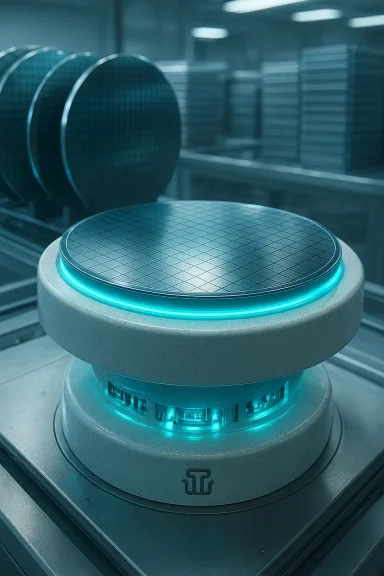
An electrostatic chuck (ESC) is, at its core, a precision ceramic pedestal with embedded electrodes and engineered backside gas channels that holds a silicon wafer by electrostatic attraction while providing uniform temperature control and an ultra‑clean surface. ESCs are used in etch, deposition, and other plasma processing chambers.Advanced processes — including cryogenic etching and high‑aspect‑ratio etches used in modern 3D NAND — push wafer handling to extremes. Tools operate at low temperatures, tight pressures, and high plasma densities; any micro‑warpage, thermal gradient, particle generation, or contamination on the chuck surface can ruin a multi‑layer stack and cost fabs millions. That makes the chuck’s material properties (thermal conductivity, dielectric strength, CTE compatibility with silicon) and manufacturing precision hugely important. In short: you can’t reliably build next‑generation memory without chucks that do their job repeatably at nanometer scales.
How that connects to AI
AI models require massive memory and high memory bandwidth. The recent surge in server GPU capacity and hyperscaler buildouts has sent demand rippling down the supply chain. When memory factor utilization tightens, fabs buy more capacity and replacement parts; equipment vendors buy more chucks; and niche suppliers of high‑end ceramic components see backlog and pricing power improve. That is Palliser’s connective tissue: AI infrastructure drives memory demand, memory drives wafer fab tool demand, and that demand flows to ESC suppliers.The investment case being made
Palliser frames TOTO as a hybrid business: legacy consumer plumbing plus a high‑margin, high‑growth industrial ceramics arm that the market underweights. The presentation and accompanying messages contain a few core claims:- TOTO’s advanced ceramics business produces electrostatic chucks used in cryogenic etching tools for 3D NAND production and has become a mission‑critical supplier for modern memory fabs.
- The segment now contributes a very large share of operating profit — Palliser’s materials put the ratio at “more than half,” while other market sources point to roughly 40–42% in recent periods.
- TOTO holds net cash on its balance sheet (Palliser references about ¥76 billion) that could be redeployed more efficiently or returned to shareholders.
- Management historically hasn’t emphasized or disclosed enough detail about the advanced ceramics business, creating a narrative gap that depresses the share price.
- Simple governance, disclosure, and capital allocation changes could unlock “well over 55%” upside.
What’s verifiable — and what isn’t
It’s important to separate demonstrable facts from activist estimates and bullish narrative.- Verifiable: TOTO manufactures electrostatic chucks and has sold them for decades; ESCs are used in advanced chipmaking processes and are important for wafer stability and thermal control during etch; patents and technical literature show cryogenic etching and low‑temperature ESC operation are real technologies used in 3D NAND processes.
- Verifiable: The stock moves and analyst notes — including high‑profile upgrades and intraday share spikes — are public market facts. TOTO’s consolidated results and guidance updates (revised operating profit guidance, revenue numbers, and the company’s own statements about growth in its ceramics/new‑domain businesses) are documented in company releases and filings.
- Less certain / activist‑asserted: The precise size of the “valuation gap” (¥554 billion) and the share of operating profit attributable to the ceramics business are both estimates that depend on allocation, forecasting, and valuation methodology. Different reputable data providers have reported a range (around 40–55%), so the headline “more than half” is Palliser’s interpretation rather than a universally accepted accounting fact. Any claim of a five‑year technological moat or 30%+ annual growth is a strategic forecast that should be treated as an investment thesis rather than settled truth.
Strengths of the Palliser case
1. Real engineering leverage
TOTO did not invent ESCs to chase AI. Its ceramics group evolved from decades of materials work. That gives the company a legitimate, technical foothold in an area where tight tolerances and specialized knowledge matter. Escaping commoditization is possible in ESCs because tiny material differences and the ability to meet toolmaker interfaces can be decisive.2. Margin profile and cash generation
Reported segment results and market commentary suggest that the new‑domain/ceramics business carries much higher margins than sanitary ware. High‑margin parts with steady replacement cycles can dramatically lift a conglomerate’s overall return on capital if given the right focus.3. Structural demand tailwinds
AI‑led memory demand is not a one‑quarter flash in the pan: hyperscalers’ long‑term GPU and memory needs, combined with the cyclical capex behavior of memory makers, create multi‑year windows where equipment and parts suppliers can enjoy sustained, high utilization.4. Activist playbook has precedent in Japan
Palliser is built by seasoned activists with prior success pushing capital‑structure and governance changes in Japan and global corporates. The firm’s asks — better disclosure, sale of cross‑shareholdings, clearer capital allocation — fit a textbook re‑rating strategy. Japanese boards have opened to activism in recent years, so change is plausible.Key risks and counterarguments
1. Cyclicality of memory markets
Memory is historically volatile. A demand surge can reverse if product cycles or macro conditions shift; new fab capacity can oversupply the market and depress pricing. That cyclicality works both ways for suppliers: boom times are lucrative, busts are painful. Betting on a permanent re‑rating assumes a sustained upgrade cycle.2. Customer concentration and bargaining power
ESC buyers are large tool OEMs and fabs — think Applied Materials, Lam Research, Tokyo Electron, and ultimately Samsung, SK Hynix, Micron, and Kioxia. These buyers have significant leverage and multiple supplier options. A supplier’s pricing power can be narrower than margin stories suggest, especially when tools are platform‑level systems purchased by a small number of customers.3. Competitive landscape and scalability
TOTO is not alone. Several Japanese and global firms — Shin‑Etsu, Kyocera, NGK, and NTK Ceratec among them — supply ceramic parts and ESCs. Some competitors have larger ceramics portfolios or tighter integration with equipment OEMs. A crucial question is whether TOTO can scale production capacity, manage yield, and protect IP while meeting the volume and quality expectations of the big memory customers.4. Execution and capital allocation
Palliser’s remedy list (sell non‑core cross‑shareholdings, deploy excess cash, invest in ceramics capacity) requires decisive board and management action. Japan’s corporate culture and long‑standing cross‑shareholding practices can slow change. Furthermore, investing in capacity ahead of confirmed long‑term supply contracts carries execution risk — new factories are expensive, and fabricating high‑precision ceramics at scale is non‑trivial.5. Valuation math is activist‑dependent
The headline “unlock 55% upside” is a projection based on Palliser’s modeling choices: multiples assigned to the ceramics business, assumptions on margin expansion, and balance‑sheet adjustments. Those are contestable. The market can and will disagree. The reality is that unlocking that upside requires both operational improvement and a re‑valuation by investors, which can be stubborn even when fundamentals improve.How the debate will likely play out — scenarios and milestones
- Management response: TOTO’s board can either engage constructively with Palliser, adopt some of the disclosure and governance changes, and present a clear plan; or it can push back, emphasizing long‑term strategy and customer confidentiality. A constructive engagement would be the quickest route to re‑rating.
- Incremental transparency: If TOTO begins disclosing more granular segment metrics (margin by business, backlog figures, product roadmap for ESCs), analysts will recalibrate models and investors will better value the ceramics arm. This is the low‑hanging fruit Palliser is demanding.
- Capital redeployment: Share buybacks, accelerated sale of cross holdings, or targeted M&A could materially change financial metrics. The question is whether management prefers to reinvest in industrial capacity (higher long‑term returns but longer timeline) or to return cash to shareholders (faster re‑rating).
- Execution on capacity: Contracts with tool OEMs or memory fabs, expanding a dedicated ceramics plant, and hitting yield targets are operational milestones that will determine whether the ceramics business scales on a durable basis.
- Macro sanity check: A broader memory market correction would undercut the entire thesis; conversely, continued fab buildouts and replacement cycles would validate Palliser’s argument.
Strategic and governance considerations — beyond the tech
Palliser’s campaign touches on a broader theme: Japan’s corporate reform journey. For years, activists argued that Japanese firms hoarded cross‑shareholdings, kept low returns on equity, and under‑communicated strategic shifts to the market. Regulators and exchanges nudged companies toward modernization; some firms responded quicker than others.For TOTO, this means the boardroom dynamic will be watched closely. Activist proposals that are constructive and technically credible — like clearer segment KPIs, return‑on‑capital thresholds, or a disciplined capital allocation framework — are more likely to gain traction than aggressive break‑up demands. Still, cultural friction and defensive corporate instincts remain real constraints.
Practical takeaways for investors and observers
- Don’t be distracted by the novelty: the idea that a toilet maker can matter to AI is weird only until you understand ESCs. Technology nuance matters; ceramic chemistry and thermal engineering are not trivial.
- Treat activist numbers with skepticism: Palliser’s valuation gap and profit‑share figures are useful framing tools, but they are model outputs, not audited facts. Compare activist claims with company disclosures and independent data.
- Watch a few concrete signals: increased segment disclosure from TOTO, capital redeployment announcements, new supplier contracts with tool OEMs, or meaningful capacity expansion plans would shift the story from speculative to actionable.
- Understand the risk‑reward balance: if you believe hyperscaler AI demand is long‑lived and that TOTO can sustain higher margins in a concentrated industrial niche, the upside story is attractive. If you view memory spending as cyclical and customers as highly disciplined buyers, the upside shrinks and execution risk looms larger.
Final assessment
Palliser Capital’s campaign is not a joke on the surface; it’s a classic activist argument dressed in an unusual headline. The technical claim — that high‑precision ceramics used in electrostatic chucks are crucial to advanced 3D NAND processes — is solid and backed by technical literature and industry reporting. The surprising element is not the technology but the market blind spot: many investors still default to seeing TOTO as a consumer staple rather than a hybrid industrial player.That said, the leap from “mission‑critical parts supplier” to “unlocked multi‑billion dollar valuation gap” requires multiple boxes to be ticked: precise accounting of segment economics, credible and defensible growth forecasts, successful scaling of production without margin dilution, and, critically, management willingness to change capital allocation and disclosure practices. Palliser’s demands are sensible in isolation, but the timeline and probability of full adoption — and the durability of any re‑rating — are uncertain.
In other words: the toilet is indeed connected to the AI story — but investors should evaluate the steam‑pipes before assuming a royal flush is guaranteed. The winning outcome will be one where engineering substance (advanced ceramics and ESC expertise) meets disciplined corporate action (transparency, targeted reinvestment, and governance changes). If that alignment occurs, TOTO’s market identity could evolve swiftly. If not, the stock may remain a quirky case study in narrative‑driven rallying, with all the ups and downs that entails.
Source: theregister.com Investor says toilet maker Toto is an overlooked AI play
