

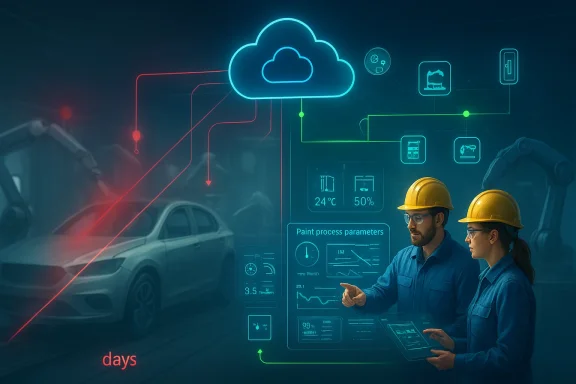
Toyota Industries’ paint shop overhaul is a useful snapshot of where industrial AI is heading in 2026: away from isolated dashboards and toward contextual, factory-scale decision systems that can cut defect rates, speed root-cause analysis, and reduce the burden on scarce specialists. In a Microsoft customer story published on April 15, 2026, the company says its Azure-based data foundation, built with Sight Machine, helped reduce defects by 25% in a pilot, cut analysis cycles from five days to under four hours, and improve day-to-day shop-floor coordination. Just as importantly, the story suggests Toyota Industries was not chasing novelty; it was trying to solve a very old manufacturing problem with a new operating model. (microsoft.com)
Toyota Industries’ challenge is familiar to anyone who has worked in high-volume manufacturing: quality issues often appear late, the underlying causes span multiple systems, and the people who can interpret the signals are limited in number. In the company’s paint operations, defects were costly because they emerged after significant value had already been added, making rework more expensive and root-cause analysis more urgent. The Microsoft story describes a transition from by-sight inspection and manual correlation hunting to a data-driven quality management approach. (microsoft.com)
What makes this case notable is the scale of the operational environment. Paint quality is influenced by equipment conditions, process parameters, and environmental variables such as temperature and humidity, which means the real challenge is not simply collecting data but organizing it into a usable context. Toyota Industries reportedly already had hundreds of data points, but the lack of a holistic view meant engineers still spent weeks tracing relationships by hand. That is exactly the kind of bottleneck industrial AI vendors have been promising to eliminate for years. (microsoft.com)
The company’s pilot matters because it indicates a deliberate approach rather than a slide-deck transformation. Toyota Industries ran a three-month proof of concept using actual factory data and wanted to see not just whether the pipeline worked, but whether plant behavior would change in practice. That distinction is critical, because many industrial analytics projects fail precisely where Toyota seems to have focused: on adoption, not merely instrumentation. (microsoft.com)
The broader strategic context is also significant. Microsoft has been steadily expanding its manufacturing story around digital threads, industrial data foundations, and AI at the edge and in the cloud, while partners like Sight Machine position themselves as the bridge between OT data and business decisions. Toyota Industries’ deployment sits squarely in that ecosystem and shows how Microsoft wants manufacturers to think about Azure: not as a generic cloud layer, but as the platform for contextual industrial intelligence.
For Toyota Industries, the value proposition is operational rather than abstract. Faster diagnosis means less scrap, fewer delays, fewer emergency standups, and a better chance of preserving quality even as experienced specialists become harder to replace. In other words, the project is as much about knowledge preservation as it is about analytics. (microsoft.com)
That is also why paint operations are such a strong proving ground for industrial AI. They are sensitive to temperature, humidity, sequencing, and process drift, and the effects of a bad decision can show up only after additional work has already been done. If an organization can solve this problem in paint, it can often carry the same operating principles into other production stages. (microsoft.com)
There is also a subtle but important cultural change. When operators, engineers, and supervisors all look at the same live view of the process, the conversation changes from “Who is right?” to “What is the evidence?” That may sound simple, but it often determines whether a digital initiative becomes daily practice or remains a sidecar for analysts. (microsoft.com)
This is where the business case becomes stronger than a pure efficiency argument. If better process control reduces defects and simultaneously lowers emissions, then the initiative can support operations, compliance, and corporate sustainability goals at the same time. That multi-objective payoff is one reason industrial AI has moved from pilot curiosity to board-level relevance. (microsoft.com)
The story says the data was unified and structured in Microsoft Azure, with Sight Machine software running inside Toyota Industries’ Azure tenant so data never leaves the customer environment. That design choice speaks directly to security, governance, and trust, which are often the first objections in factory IT/OT integration. In industrial settings, where the data lives can be just as important as what the model predicts. (microsoft.com)
The Azure-based setup also suggests a pragmatic compromise between edge and cloud. Toyota Industries did not need every inference to happen on a screen at the machine, but it did need enough connectivity and shared access to create a near real-time feedback loop. That balance—fast enough to matter, governed enough to trust—is where many industrial platforms are now competing. (microsoft.com)
The company’s second test was even more revealing: it wanted to know whether data insights would actually change behavior on the shop floor. That is the kind of question many tech vendors overlook. If operators and managers do not trust the data or see it as useful to daily decisions, the best model in the world will not move the needle. (microsoft.com)
The Microsoft customer story frames this as an industrial data pipeline that can turn historically difficult-to-connect data into a structured analytical workflow. That is a meaningful leap over traditional manufacturing intelligence tools, which often show what happened but do little to explain why it happened or what should happen next. Sight Machine’s value proposition, in this context, is turning disconnected measurements into actionable manufacturing narratives. (microsoft.com)
That is also why the story repeatedly stresses usability beyond specialists. A plant cannot rely on data scientists to triage every anomaly if it wants faster cycles and broader adoption. The whole promise of industrial AI is to make expert insight repeatable and accessible to production leaders, engineers, and operators. (microsoft.com)
For customers, that can be attractive because it reduces the need to stitch together separate data, AI, and security layers from scratch. For Microsoft, it is equally strategic because it creates a repeatable pattern: cloud plus partner plus vertical context. That pattern is becoming more visible across manufacturing stories, from predictive maintenance to digital threads to generative AI for shop-floor operations.
Those gains matter because they map to different layers of manufacturing value. Defect reduction affects quality and scrap. Faster analysis affects engineering productivity. Reduced standup preparation affects managerial overhead and communications. Together, they suggest a system that is changing the rhythm of work, not just the output metrics. (microsoft.com)
The reported move from weeks to hours is therefore more than a process improvement slogan. It is a structural reduction in the time between observation and intervention, which is one of the most important metrics in modern manufacturing control. That shorter loop can also improve morale because teams see progress faster and spend less time debating stale data. (microsoft.com)
That linkage reflects a broader industrial reality: fewer defects usually mean less rework, less wasted material, and less wasted energy. The sustainability case is often strongest when it emerges as a byproduct of better operations rather than as a separate compliance burden. That is the kind of win executives notice. (microsoft.com)
The story says supervisors and engineers can now spot abnormal patterns earlier, discuss potential causes using the same view, and apply countermeasures sooner. That sounds simple, but it is a meaningful improvement over fragmented meetings where each function interprets the issue through a different lens. Shared dashboards can become shared reality, and that shared reality is often the real enabler of speed. (microsoft.com)
This is where the Microsoft and Sight Machine partnership seems to have paid off. The implementation was not framed as replacing human judgment but as making human judgment more consistent and better informed. That distinction is subtle, but it often determines whether frontline teams embrace digital transformation or resist it. (microsoft.com)
The industrial AI promise, at its best, is not that it eliminates expertise but that it scales it. Toyota Industries appears to be taking that route, using the data foundation to allow more people to participate in quality decisions while preserving the insight of senior staff. That is a far more realistic transformation model than full automation fantasies. (microsoft.com)
This matters because manufacturing CIOs and operations leaders increasingly need platforms that can span plants, teams, and use cases. If a data foundation can begin in bumper painting and later extend to body painting or other continuous production areas, it starts to look like an enterprise capability rather than a single-use solution. Toyota Industries explicitly says it is considering exactly that expansion. (microsoft.com)
The scalability question is equally important. Many plants can launch a proof of concept, but few can carry a lesson learned in one line into another site without rework. A standardized Azure foundation offers a path to repeatability, which is what turns local wins into enterprise programs. (microsoft.com)
For competitors, the challenge is no longer just offering analytics, but proving that analytics can be operationalized in a way that changes daily behavior. In manufacturing, the market has become less forgiving of generic AI promises. Buyers want specific defect reduction, shorter cycles, and credible governance, not broad claims about digital transformation. (microsoft.com)
The broader signal is that AI in manufacturing is shifting from predictive maintenance headlines to more nuanced quality and process-control use cases. That evolution matters because it shows the market moving from “Can AI detect a failure?” to “Can AI help prevent the conditions that create failure in the first place?” (microsoft.com)
There is also a reputational angle. Companies that can say they are improving quality while reducing emissions can present a more compelling operational story to customers, regulators, and investors. In a market where sustainability claims are often scrutinized, data-backed process improvements carry more credibility than glossy commitments. That credibility is becoming a competitive moat. (microsoft.com)
If the system remains trusted and usable, it can become a quiet but powerful quality engine. If it becomes cumbersome or difficult to interpret, it risks fading into the background like so many industrial tools before it. The fact that Toyota Industries reports strong engagement suggests the implementation crossed that adoption threshold, at least in the pilot and early deployment stages. (microsoft.com)
The opportunity now is to convert a successful pilot into a durable operating model. If Toyota Industries can extend the same data foundation into additional paint processes or continuous production areas, the return on investment could multiply quickly. It also gives Microsoft and Sight Machine a strong reference case for broader industrial adoption. (microsoft.com)
There is also a dependency risk. A solution that relies on a partner ecosystem can be powerful, but it can also create ongoing platform, integration, and governance dependencies. Enterprises need to be sure they can operate and evolve the system without being trapped by a single vendor or a rigid architecture. (microsoft.com)
There is also the broader issue of measuring impact in industrial AI. When a story cites emissions reductions or faster meetings, the numbers are useful, but readers should still ask how those metrics are calculated and sustained. The Microsoft story is persuasive, but as with any vendor case study, the strongest interpretation is to treat the figures as reported outcomes rather than universal guarantees. (microsoft.com)
For Microsoft, this is another proof point in its broader industrial AI strategy. The company has been steadily aligning Azure, partner software, and manufacturing-specific data models around digital thread and operational AI themes. Toyota Industries gives that strategy a concrete, operational story with measurable outcomes, which is exactly what enterprise buyers tend to believe.
Source: Microsoft Toyota Industries innovates its paint shop processes with Azure industrial AI | Microsoft Customer Stories
 Overview
Toyota Industries’ challenge is familiar to anyone who has worked in high-volume manufacturing: quality issues often appear late, the underlying causes span multiple systems, and the people who can interpret the signals are limited in number. In the company’s paint operations, defects were costly because they emerged after significant value had already been added, making rework more expensive and root-cause analysis more urgent. The Microsoft story describes a transition from by-sight inspection and manual correlation hunting to a data-driven quality management approach. (microsoft.com)What makes this case notable is the scale of the operational environment. Paint quality is influenced by equipment conditions, process parameters, and environmental variables such as temperature and humidity, which means the real challenge is not simply collecting data but organizing it into a usable context. Toyota Industries reportedly already had hundreds of data points, but the lack of a holistic view meant engineers still spent weeks tracing relationships by hand. That is exactly the kind of bottleneck industrial AI vendors have been promising to eliminate for years. (microsoft.com)
The company’s pilot matters because it indicates a deliberate approach rather than a slide-deck transformation. Toyota Industries ran a three-month proof of concept using actual factory data and wanted to see not just whether the pipeline worked, but whether plant behavior would change in practice. That distinction is critical, because many industrial analytics projects fail precisely where Toyota seems to have focused: on adoption, not merely instrumentation. (microsoft.com)
The broader strategic context is also significant. Microsoft has been steadily expanding its manufacturing story around digital threads, industrial data foundations, and AI at the edge and in the cloud, while partners like Sight Machine position themselves as the bridge between OT data and business decisions. Toyota Industries’ deployment sits squarely in that ecosystem and shows how Microsoft wants manufacturers to think about Azure: not as a generic cloud layer, but as the platform for contextual industrial intelligence.
Why this story matters now
Manufacturing has entered a phase where data volume is no longer the main constraint. The real constraint is usable context—which variables matter, how they interact, and who can act on the insight before the line moves on. That is why the story emphasizes a semantic layer and a unified industrial data foundation rather than yet another reporting dashboard. (microsoft.com)For Toyota Industries, the value proposition is operational rather than abstract. Faster diagnosis means less scrap, fewer delays, fewer emergency standups, and a better chance of preserving quality even as experienced specialists become harder to replace. In other words, the project is as much about knowledge preservation as it is about analytics. (microsoft.com)
- The problem was not lack of data, but lack of context
- The pilot tested both technology and operator behavior
- The use case was focused on paint defects, where late discovery is expensive
- The goal was faster action, not prettier reporting
The Manufacturing Problem Behind the Announcement
The Microsoft story lands because it describes a pain point that is both technical and organizational. When defects occur in a paint shop, every minute spent investigating the cause can create downstream cost, especially when the issue involves a complex mix of equipment behavior and environmental conditions. Toyota Industries’ previous process reportedly required specialists to manually chase correlations, which is slow in any setting and especially problematic in a high-throughput environment. (microsoft.com)That is also why paint operations are such a strong proving ground for industrial AI. They are sensitive to temperature, humidity, sequencing, and process drift, and the effects of a bad decision can show up only after additional work has already been done. If an organization can solve this problem in paint, it can often carry the same operating principles into other production stages. (microsoft.com)
From inspection culture to decision culture
A major shift in the story is the move away from relying on a shrinking pool of seasoned specialists. That phrase matters because it points to a broader manufacturing trend: a lot of operational knowledge still lives in human judgment, but the workforce carrying that judgment is aging or thinning. Turning that knowledge into data-backed workflows is not optional anymore; it is a resilience strategy. (microsoft.com)There is also a subtle but important cultural change. When operators, engineers, and supervisors all look at the same live view of the process, the conversation changes from “Who is right?” to “What is the evidence?” That may sound simple, but it often determines whether a digital initiative becomes daily practice or remains a sidecar for analysts. (microsoft.com)
- Late-stage defects are expensive because value has already been added
- Manual correlation hunting does not scale in complex process environments
- Shared visibility can shorten debate and speed countermeasures
- Experienced specialists are a valuable, but limited, resource
Sustainability adds urgency
Toyota Industries also linked the project to sustainability pressure, which is increasingly common in manufacturing transformation stories. The story says rising regulatory scrutiny created an imperative to advance sustainability initiatives, and it later points to an expected 18% lower emissions rate during winter painting months. That is important because it shows industrial AI being sold not only as a productivity tool, but also as a lever for energy and carbon management. (microsoft.com)This is where the business case becomes stronger than a pure efficiency argument. If better process control reduces defects and simultaneously lowers emissions, then the initiative can support operations, compliance, and corporate sustainability goals at the same time. That multi-objective payoff is one reason industrial AI has moved from pilot curiosity to board-level relevance. (microsoft.com)
How the Azure-Based Foundation Works
Toyota Industries’ approach centers on a unified, AI-ready industrial data foundation built on Azure with Sight Machine. The crucial point is that the system is meant to operate at production scale, not as a demonstration environment. That framing matters because industrial buyers have grown wary of “pilot theater”—projects that look impressive in a controlled setting but fail to integrate into real operations. (microsoft.com)The story says the data was unified and structured in Microsoft Azure, with Sight Machine software running inside Toyota Industries’ Azure tenant so data never leaves the customer environment. That design choice speaks directly to security, governance, and trust, which are often the first objections in factory IT/OT integration. In industrial settings, where the data lives can be just as important as what the model predicts. (microsoft.com)
Why the tenant model matters
Keeping the software inside the customer tenant is not a small architectural detail. It reduces the perceived risk of sending sensitive production data into a vendor-controlled environment and gives the manufacturer more confidence about access boundaries and governance. For regulated or reputation-sensitive businesses, that reassurance can make the difference between a stalled proposal and a live deployment. (microsoft.com)The Azure-based setup also suggests a pragmatic compromise between edge and cloud. Toyota Industries did not need every inference to happen on a screen at the machine, but it did need enough connectivity and shared access to create a near real-time feedback loop. That balance—fast enough to matter, governed enough to trust—is where many industrial platforms are now competing. (microsoft.com)
- The architecture emphasizes shared governance
- Data remains inside the customer’s Azure environment
- The system is positioned for production, not demos
- Near real-time visibility is the operational goal
Pilot first, scale second
The three-month proof of concept is another practical signal. Instead of asking leadership to believe in a grand digital transformation, Toyota Industries tested actual factory data and looked for measurable results. That is a healthier model for industrial AI because it validates both the data pipeline and the human workflow around it. (microsoft.com)The company’s second test was even more revealing: it wanted to know whether data insights would actually change behavior on the shop floor. That is the kind of question many tech vendors overlook. If operators and managers do not trust the data or see it as useful to daily decisions, the best model in the world will not move the needle. (microsoft.com)
The Role of Sight Machine and Industrial AI
Sight Machine appears in the story as more than a systems integrator. The company’s role was to contextualize factory data and use AI and machine learning to sort through nearly 400 variables before narrowing the field to the signals most correlated with defects. That is the essence of industrial AI: not prediction for its own sake, but prioritization that tells teams where to focus. (microsoft.com)The Microsoft customer story frames this as an industrial data pipeline that can turn historically difficult-to-connect data into a structured analytical workflow. That is a meaningful leap over traditional manufacturing intelligence tools, which often show what happened but do little to explain why it happened or what should happen next. Sight Machine’s value proposition, in this context, is turning disconnected measurements into actionable manufacturing narratives. (microsoft.com)
From raw signals to operational meaning
The number of variables is less important than the quality of the narrowing process. In a process as complex as automotive painting, hundreds of signals may be present, but only a subset drive defects in a statistically meaningful way. By filtering the noise, the system helps frontline teams avoid being overwhelmed by data they cannot reasonably act on. (microsoft.com)That is also why the story repeatedly stresses usability beyond specialists. A plant cannot rely on data scientists to triage every anomaly if it wants faster cycles and broader adoption. The whole promise of industrial AI is to make expert insight repeatable and accessible to production leaders, engineers, and operators. (microsoft.com)
- Nearly 400 variables were analyzed before narrowing to key defect drivers
- The objective was to speed up learning, not merely to classify defects
- Accessibility matters as much as analytical sophistication
- A usable system must work for frontline teams, not just analysts
What this says about the market
This partnership also reflects a broader Microsoft strategy. The company has been building a manufacturing narrative around unified data, digital threads, and partner-delivered industrial AI capabilities, and Sight Machine is one of the clearest examples of that ecosystem approach. Rather than trying to own every layer, Microsoft is positioning Azure as the platform on which specialized industrial intelligence can run.For customers, that can be attractive because it reduces the need to stitch together separate data, AI, and security layers from scratch. For Microsoft, it is equally strategic because it creates a repeatable pattern: cloud plus partner plus vertical context. That pattern is becoming more visible across manufacturing stories, from predictive maintenance to digital threads to generative AI for shop-floor operations.
Measurable Operational Results
The headline numbers are what make the story credible. Toyota Industries says the pilot delivered a 25% drop in defects, while the deployed foundation reduced analysis cycles from five days to under four hours. It also claims daily standup meetings now take 80% less time to prepare for, and that a specific bottleneck analysis was completed in about 45 minutes from review to actionable insight. (microsoft.com)Those gains matter because they map to different layers of manufacturing value. Defect reduction affects quality and scrap. Faster analysis affects engineering productivity. Reduced standup preparation affects managerial overhead and communications. Together, they suggest a system that is changing the rhythm of work, not just the output metrics. (microsoft.com)
Why speed is a quality metric
In a factory, speed is not only about throughput. It is also about how quickly a plant can isolate a signal, test a hypothesis, and act before more parts are affected. A five-day cycle can be adequate for some environments, but in paint operations it can mean several shifts of exposure before a fix is in place. (microsoft.com)The reported move from weeks to hours is therefore more than a process improvement slogan. It is a structural reduction in the time between observation and intervention, which is one of the most important metrics in modern manufacturing control. That shorter loop can also improve morale because teams see progress faster and spend less time debating stale data. (microsoft.com)
- 25% fewer defects in the pilot period
- Analysis cycles reduced from five days to under four hours
- Daily standup preparation cut by 80%
- A bottleneck analysis completed in about 45 minutes
The sustainability dividend
The story also claims an expected 18% lower emissions rate during winter painting months. That number is not the headline, but it may prove strategically important because it ties quality control to energy efficiency. If process stabilization improves seasonal performance, then the system can contribute to emissions reduction without requiring a separate sustainability project. (microsoft.com)That linkage reflects a broader industrial reality: fewer defects usually mean less rework, less wasted material, and less wasted energy. The sustainability case is often strongest when it emerges as a byproduct of better operations rather than as a separate compliance burden. That is the kind of win executives notice. (microsoft.com)
What Changed on the Shop Floor
The most interesting part of the story may be the human one. Koichiro Taka, a paint production leader at Toyota Industries, says the biggest change for frontline workers was trust—both in the data and in each other. That sentence captures a major reason industrial transformation succeeds or fails: people need to believe that the data is legitimate and that shared visibility will lead to fairer, faster decisions. (microsoft.com)The story says supervisors and engineers can now spot abnormal patterns earlier, discuss potential causes using the same view, and apply countermeasures sooner. That sounds simple, but it is a meaningful improvement over fragmented meetings where each function interprets the issue through a different lens. Shared dashboards can become shared reality, and that shared reality is often the real enabler of speed. (microsoft.com)
Trust as an operating asset
Trust is not just a culture word here; it is an operational asset. If a line worker does not trust the data, they will work around it. If a supervisor does not trust the interpretation, they will revert to the old specialist-led model. If engineering and production do not trust each other’s priorities, the system becomes a reporting tool instead of a decision tool. (microsoft.com)This is where the Microsoft and Sight Machine partnership seems to have paid off. The implementation was not framed as replacing human judgment but as making human judgment more consistent and better informed. That distinction is subtle, but it often determines whether frontline teams embrace digital transformation or resist it. (microsoft.com)
- Shared dashboards can compress debate
- Common data views reduce cross-functional friction
- Trust improves when teams see the same evidence
- Faster action depends on faster alignment
Training without a heavy training burden
Another underappreciated benefit is reduced dependence on deep specialist training. If a system can surface likely defect drivers and present them in an accessible way, then less of the organization has to become a statistical expert to contribute meaningfully. That matters in a labor market where experienced manufacturing talent is scarce and institutional knowledge is fragile. (microsoft.com)The industrial AI promise, at its best, is not that it eliminates expertise but that it scales it. Toyota Industries appears to be taking that route, using the data foundation to allow more people to participate in quality decisions while preserving the insight of senior staff. That is a far more realistic transformation model than full automation fantasies. (microsoft.com)
Enterprise Implications
For enterprise leaders, this story is a reminder that factory AI initiatives are becoming less about experimentation and more about governance, repeatability, and scale. Toyota Industries did not simply buy a dashboard; it created an Azure-based operational layer intended to support production decisions. That is much closer to enterprise architecture than to an isolated analytics project. (microsoft.com)This matters because manufacturing CIOs and operations leaders increasingly need platforms that can span plants, teams, and use cases. If a data foundation can begin in bumper painting and later extend to body painting or other continuous production areas, it starts to look like an enterprise capability rather than a single-use solution. Toyota Industries explicitly says it is considering exactly that expansion. (microsoft.com)
Governance, security, and scale
Security is often the unglamorous but decisive layer in industrial AI. The story’s emphasis on running Sight Machine inside Toyota Industries’ Azure tenant is a signal to enterprise buyers that data control and compliance were built into the design. That reduces one of the biggest barriers to wider deployment, especially in regulated or IP-sensitive environments. (microsoft.com)The scalability question is equally important. Many plants can launch a proof of concept, but few can carry a lesson learned in one line into another site without rework. A standardized Azure foundation offers a path to repeatability, which is what turns local wins into enterprise programs. (microsoft.com)
- Enterprise value comes from repeatable architecture
- Security built into the tenant model supports adoption
- Expansion across production areas is the real test
- One successful line is not the same as one scalable platform
Strategic positioning versus rivals
The competitive implication for Microsoft is that stories like this reinforce its manufacturing narrative against cloud rivals and industrial software vendors. Microsoft is not claiming to be the sole owner of industrial data; instead, it is embedding itself in the ecosystem where data contextualization, AI, and operational workflows meet. That position can be powerful if customers want flexibility and partner choice.For competitors, the challenge is no longer just offering analytics, but proving that analytics can be operationalized in a way that changes daily behavior. In manufacturing, the market has become less forgiving of generic AI promises. Buyers want specific defect reduction, shorter cycles, and credible governance, not broad claims about digital transformation. (microsoft.com)
Consumer and Industry Signaling
Although this is an industrial story, it has consumer-market implications because automotive quality is ultimately part of the brand promise. Paint defects may start as a factory issue, but they affect the consistency, fit, and finish that end customers notice. In that sense, industrial AI contributes indirectly to customer satisfaction even when the consumer never sees the underlying technology. (microsoft.com)The broader signal is that AI in manufacturing is shifting from predictive maintenance headlines to more nuanced quality and process-control use cases. That evolution matters because it shows the market moving from “Can AI detect a failure?” to “Can AI help prevent the conditions that create failure in the first place?” (microsoft.com)
What buyers will infer
Purchasers in other industries will likely read this as a template for how to modernize legacy operations without rebuilding everything at once. Start with one painful, measurable process; validate with real data; demonstrate human workflow change; then scale outward. That stepwise pattern is much more believable than a big-bang factory digitization campaign. (microsoft.com)There is also a reputational angle. Companies that can say they are improving quality while reducing emissions can present a more compelling operational story to customers, regulators, and investors. In a market where sustainability claims are often scrutinized, data-backed process improvements carry more credibility than glossy commitments. That credibility is becoming a competitive moat. (microsoft.com)
- Quality improvements support brand trust
- Process efficiency can reinforce sustainability claims
- Stepwise deployment is more believable than broad promises
- Industrial AI is becoming part of market differentiation
The role of frontline adoption
Consumer-facing benefit depends on frontline adoption. The story repeatedly returns to operators and supervisors because their acceptance determines whether the solution sticks. That is a useful reminder for any company trying to digitize work: the end customer may never see the dashboard, but they will feel the consequences of whether the dashboard changed behavior. (microsoft.com)If the system remains trusted and usable, it can become a quiet but powerful quality engine. If it becomes cumbersome or difficult to interpret, it risks fading into the background like so many industrial tools before it. The fact that Toyota Industries reports strong engagement suggests the implementation crossed that adoption threshold, at least in the pilot and early deployment stages. (microsoft.com)
Strengths and Opportunities
The strongest aspect of this project is that it ties technology to a clearly measurable manufacturing pain point. Toyota Industries is not talking about AI in abstract terms; it is talking about defect reduction, faster root-cause analysis, and better sustainability performance. That makes the story much more credible and much more transferable to other plants. (microsoft.com)The opportunity now is to convert a successful pilot into a durable operating model. If Toyota Industries can extend the same data foundation into additional paint processes or continuous production areas, the return on investment could multiply quickly. It also gives Microsoft and Sight Machine a strong reference case for broader industrial adoption. (microsoft.com)
- Clear operational metrics make the case easy to understand
- The architecture appears designed for scale
- The tenant model supports security and trust
- The pilot validated both data and human workflow
- Sustainability benefits strengthen the business case
- Shared dashboards improve cross-functional alignment
- The use case can likely extend beyond one line or one plant
Risks and Concerns
The biggest risk is overgeneralization. A win in one paint shop does not automatically translate to every production environment, and the conditions that drive defects in one facility may not behave the same way elsewhere. Industrial AI systems can create false confidence if organizations assume one successful pilot is enough to justify broad rollout. (microsoft.com)There is also a dependency risk. A solution that relies on a partner ecosystem can be powerful, but it can also create ongoing platform, integration, and governance dependencies. Enterprises need to be sure they can operate and evolve the system without being trapped by a single vendor or a rigid architecture. (microsoft.com)
- Pilot success may not generalize across sites
- Partner dependence can create long-term lock-in concerns
- Data quality problems can resurface at scale
- Human adoption may weaken if workflows become too complex
- Sustainability metrics may be harder to verify externally
- Fast analytics can still produce bad decisions if the inputs are poor
- Expansion can expose integration gaps the pilot did not reveal
The verification challenge
Another concern is whether the reported benefits will remain durable over time. Early gains in defect reduction and cycle time are often easiest to achieve when teams are highly engaged and the project is still new. Maintaining those gains requires discipline, continuous model tuning, and ongoing process management. The hard part usually starts after the first victory. (microsoft.com)There is also the broader issue of measuring impact in industrial AI. When a story cites emissions reductions or faster meetings, the numbers are useful, but readers should still ask how those metrics are calculated and sustained. The Microsoft story is persuasive, but as with any vendor case study, the strongest interpretation is to treat the figures as reported outcomes rather than universal guarantees. (microsoft.com)
Looking Ahead
Toyota Industries says it is considering expanding the approach beyond bumper painting into body painting and other continuous production areas. That next step will matter more than the initial rollout because it will show whether the data foundation can become a real enterprise platform. If it does, the company could use the same pattern for quality, sustainability, and operational decision-making across more of its manufacturing footprint. (microsoft.com)For Microsoft, this is another proof point in its broader industrial AI strategy. The company has been steadily aligning Azure, partner software, and manufacturing-specific data models around digital thread and operational AI themes. Toyota Industries gives that strategy a concrete, operational story with measurable outcomes, which is exactly what enterprise buyers tend to believe.
What to watch next
- Whether Toyota Industries extends the model to additional paint lines
- Whether defect reduction holds as the solution scales
- Whether sustainability gains are independently validated over time
- Whether the approach spreads to other plants or business units
- Whether Microsoft and Sight Machine package this as a repeatable reference architecture
Source: Microsoft Toyota Industries innovates its paint shop processes with Azure industrial AI | Microsoft Customer Stories
