

Toyota Leasing Thailand’s security team turned to Microsoft Security Copilot to protect customer data and preserve trust, embedding the AI assistant into a Microsoft security stack (Defender, Entra, Purview) to accelerate phishing triage, reduce analyst toil, and deliver leadership-ready incident summaries—changes the company says shortened investigations and kept service continuity top of mind during high-volume phishing activity.
Toyota Leasing Thailand (TLT) is a major auto-finance and mobility-services subsidiary that handles large volumes of personally identifiable information and mission‑critical services for vehicle buyers and lessees. In that context, customer trust depends on operational continuity and rapid, accurate incident response—not just prevention. According to TLT’s security leadership, repeated phishing attempts and high alert volume exposed gaps in their prior toolchain: slow investigations, manual report creation, and analyst fatigue undermined both productivity and confidence. TLT deployed Microsoft Security Copilot integrated with Microsoft Defender, Microsoft Entra, and Microsoft Purview to change that operational profile. This implementation is presented as a case study in which Copilot became an “assistant” that summarized incidents in human language, classified alerts, generated leadership-ready reports, and produced end-to-end views of risk → action → outcome.
Why this matters: defenders in financial services must respond at machine speed because minutes lost in detection and containment translate directly into reputational and financial risk. Microsoft’s product strategy—embedding Security Copilot agents into Defender, Entra, Intune and Purview—explicitly aims to move routine enrichment and triage tasks from humans to AI-augmented workflows so that security teams can focus on containment and remediation.
Strengths of the approach:
Security Copilot can be an effective accelerator for trust-preservation in customer-facing financial services—but only when it is deployed as part of a disciplined, auditable program that balances automation with human oversight.
(Important verification note: the customer quotes and specific incident details referenced were taken from the Toyota Leasing Thailand–Microsoft customer story and its reported statements; Microsoft’s broader product claims and agent-integration roadmap are documented in Microsoft’s Security Blog and Microsoft Learn material describing Security Copilot’s agent expansion and E5 entitlements. Readers should validate operational figures and licensing terms with their vendor representatives and test results in their own environment, because entitlements, consumption units and feature rollouts may vary by tenant and region.
Source: Microsoft Toyota Leasing Thailand and Microsoft: Safeguarding customer trust with AI-powered security | Microsoft Customer Stories
 Background / Overview
Toyota Leasing Thailand (TLT) is a major auto-finance and mobility-services subsidiary that handles large volumes of personally identifiable information and mission‑critical services for vehicle buyers and lessees. In that context, customer trust depends on operational continuity and rapid, accurate incident response—not just prevention. According to TLT’s security leadership, repeated phishing attempts and high alert volume exposed gaps in their prior toolchain: slow investigations, manual report creation, and analyst fatigue undermined both productivity and confidence. TLT deployed Microsoft Security Copilot integrated with Microsoft Defender, Microsoft Entra, and Microsoft Purview to change that operational profile. This implementation is presented as a case study in which Copilot became an “assistant” that summarized incidents in human language, classified alerts, generated leadership-ready reports, and produced end-to-end views of risk → action → outcome.Why this matters: defenders in financial services must respond at machine speed because minutes lost in detection and containment translate directly into reputational and financial risk. Microsoft’s product strategy—embedding Security Copilot agents into Defender, Entra, Intune and Purview—explicitly aims to move routine enrichment and triage tasks from humans to AI-augmented workflows so that security teams can focus on containment and remediation.
What Toyota Leasing Thailand implemented
The problem: alerts, blind spots and analyst overload
- High phishing volume and persistent social‑engineering campaigns created a deluge of alerts.
- Existing tooling produced fragmented context: analysts had to switch tools to gather evidence, run lookups, and produce leadership summaries.
- Investigation timelines were stretched by manual tasks (classification, report formatting, scripting analysis), which raised the risk to customer-facing services.
The solution: Security Copilot as a consolidated workflow assistant
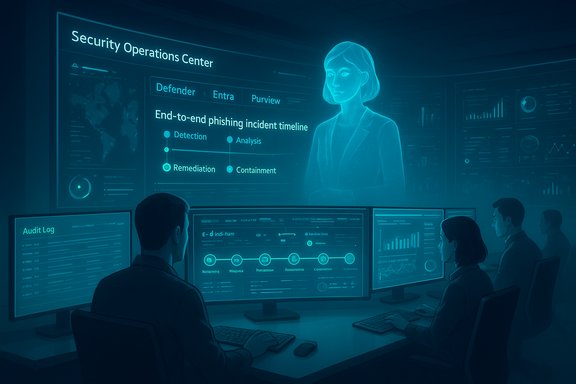
TLT integrated Microsoft Security Copilot into its Microsoft-native security stack (Defender, Entra, Purview). The practical outcomes reported by the team included:- Natural‑language queries for analysts that return action‑oriented, contextualized summaries.
- Automated phishing incident summarization and classification.
- Generation of leadership-ready reports and user notifications without heavy manual preparation.
- Consolidated, single‑pane views that link risk, action and outcomes—reducing tool switching and improving briefings to executives.
Technical picture: how Copilot fits into a Microsoft security stack
Architecture and integrations
- Microsoft Security Copilot operates as a tenant‑aware assistant that can consume telemetry and context from Microsoft Defender (endpoint and email telemetry), Entra (identity signals, conditional access), and Purview (classification and DLP). These integrations let Copilot ground responses in live tenant data instead of generic web knowledge, enabling more precise, auditable guidance.
- At scale, Microsoft has also introduced agent frameworks and governance surfaces (Agent 365 / Security Store) so agents can be registered, given identities, and subject to lifecycle controls—making agents first‑class, auditable tenants in Entra. This shift is an operational control plane for AI agents, intended to prevent “shadow AI” and agent sprawl.
Typical Copilot-enabled flow for a phishing incident
- Ingest: Defender/Exchange and Purview DLP generate an alert that enters Sentinel or Defender.
- Enrichment: Security Copilot automatically runs context enrichment (URL/hash reputation, recent activity, user history).
- Triage: Copilot classifies the incident (malicious/phish/false-positive) and recommends containment steps (isolate endpoint, block URL, reset credentials).
- Action packaging: Analyst or playbook author accepts Copilot recommendations; Copilot formats a leadership-ready report and user notification language.
- Audit & retention: All actions, agent decisions and artifacts are logged to tenant telemetry for IR and compliance review.
Business results reported by Toyota Leasing Thailand
- Faster investigations: Automatic summarization and classification shaved time from detection to decision, letting analysts hand off to IT and containment teams more rapidly.
- Less manual reporting: Copilot produced leadership-ready reports during high-volume phishing events, which preserved executive-level visibility without lengthy manual preparation.
- Improved analyst morale: By automating repetitive enrichment tasks and consolidating context, analysts could focus on higher-leverage activities such as hunting and containment.
- Clear chain-of-evidence for briefings: The team can now present the full chain—from risk to action to outcome—in a single interface, improving transparency for leadership.
Strengths — the practical wins of AI-assisted security
- Speed and scale: AI agents reduce time spent on routine enrichment (reputation lookups, script analysis, report composition), directly lowering mean time to detection (MTTD) and mean time to respond (MTTR) when properly integrated. Security vendors and enterprise customers consistently highlight this operational speed-up.
- Contextualized guidance: Tenant-scoped Copilot responses that leverage Microsoft Graph and Defender telemetry reduce hallucination risk and make recommendations traceable to tenant artifacts (files, mailboxes, identities). The ability to ground guidance in tenant data is a defining advantage over generic LLMs.
- Operational consolidation: By surfacing correlated signals from Defender, Entra and Purview, Copilot reduces tool switching and creates more coherent narratives for incident timelines—useful for fast decision-making and executive briefings.
- Democratization of basic security checks: When Copilot exposes simple verdicts (is this link malicious? has this hash been seen?, non-SOC teams can perform quicker triage and reduce unnecessary escalations—important for under‑resourced environments.
Risks and limitations — what to watch for
While AI-assisted security can accelerate operations, the case study and independent product documentation reveal several important caveats and operational risks.1) The demo-to-production gap
Capabilities shown in demos or early pilots may not translate perfectly into complex, heterogeneous production environments. False positives, unexpected connector behavior, or incomplete signal coverage can produce brittle outcomes if not validated in real-world telemetry conditions. Enterprises should pilot in controlled segments and measure both detection accuracy and operational overhead.2) Over-reliance and vendor lock-in risk
Adopting a stack where agent identities, governance and telemetry are all vendor-controlled can increase operational dependence on a single supplier. Organizations must weigh the benefits of deep integration (fewer blind spots) against the risks of placing too much control and telemetry provenance within one ecosystem. Architectures that permit multi‑vendor telemetry ingestion mitigate this risk.3) Governance, lifecycle and agent sprawl
Making agents “first-class” identities is powerful but introduces new governance obligations: inventorying agents, enforcing least-privilege, running access reviews, and building IR playbooks for agent compromise (revoke identity, block connectors, reclassify exposed documents). Without a rigorous control plane, “agent sprawl” can create new attack surfaces. Microsoft’s Agent 365 and Security Store aim to help here, but they also require disciplined adoption and change-control practices.4) Data handling and compliance concerns
Copilot operates by accessing tenant context. While Microsoft positions Copilot as tenant-scoped (tenant data is not used to train Microsoft’s public models absent an admin opt‑in), practical guarantees depend on connector choices, storage locations, and contractual terms. Regulated industries must validate data residency, retention, and eDiscovery controls, and use Purview DLP controls to block sensitive content from being processed if that is a policy requirement.5) Cost and capacity management
Microsoft has started including Security Copilot entitlements in certain licenses (for example, announcements around Microsoft 365 E5 inclusion and Security Compute Units), but agentic workloads are metered and can result in extra consumption-based charges for high-volume automation. Capacity planning and FinOps are essential to avoid unexpected bills.Practical checklist for organizations considering a similar deployment
- Inventory existing telemetry and integrations:
- Map where email, endpoint, identity and DLP telemetry live and ensure connectors to Defender, Sentinel and Purview are complete.
- Start with micro‑use cases:
- Pilot Copilot with phishing triage or alert enrichment before enabling auto-remediation.
- Define KPIs (MTTR, analyst time saved, false-positive reduction).
- Establish governance and agent lifecycle controls:
- Use a registry (Agent 365) or equivalent to approve and monitor agents.
- Assign owner, cost center and lifecycle policies to each agent.
- Harden identity and conditional access:
- Require short-lived credentials and enforce Conditional Access for any agent or automation identity.
- Integrate agent identities into access reviews and privileged access processes.
- Tune Purview and DLP:
- Classify high-risk datasets and set rules to prevent sensitive content from being exposed to Copilot or third‑party agents.
- Enable prompt-level DLP and audit logs where available.
- Define human-in-the-loop policies:
- Require analyst sign-off for cross-cutting or destructive actions (deletes, credential resets, wide quarantines).
- Keep auto-remediations narrow and reversible.
- Run adversarial tests:
- Simulate agent compromise (prompt injection, RAG poisoning) and practice revocation and remediation playbooks.
- Track costs and establish quotas:
- Monitor Security Compute Units or other consumption metrics and set spending alerts.
Critical analysis: why this matters to financial-services security teams
Financial services organizations operate under intense regulatory and reputational constraints: a single data leak or prolonged service outage can trigger fines, litigation, and customer churn. The TLT case shows a pragmatic path where AI reduces time spent on repetitive enrichment and improves leadership visibility—two key pain points for regulated firms.Strengths of the approach:
- Real operational uplift by automating enrichment and report generation.
- Better executive visibility via concise, auditable summaries.
- Integrated, identity-aware governance reduces many of the “unknowns” that make enterprises nervous about agentic systems.
- It requires investment in governance, device and identity hygiene, and SIEM/SOAR integration to be effective.
- It increases the operational surface that must be audited; simply switching on Copilot without appropriate DLP, logging and lifecycle processes invites risk.
- Vendor entitlements and metering models add a FinOps dimension that security teams must own jointly with procurement and finance.
Where Security Copilot and Microsoft’s agent model fit into the market
Microsoft is betting that deep integration—tenant-aware grounding, identity controls via Entra, and data governance via Purview—gives it an advantage in enterprise security. That integrated approach is now being complemented by a Security Store and an Agent 365 control plane to manage and distribute agent tooling and partner solutions. Industry coverage notes this is designed to make agentic defenses accessible to the large installed base of Microsoft customers while giving partners a route to deliver enhanced telemetry and enrichments inside Copilot workflows. Third-party security vendors are likewise building integrations and “agents” that surface their telemetry into Copilot flows, which helps organizations standardize enrichment but also raises questions about contractual data handling and SLAs for telemetry enrichment. Procurement and legal teams must validate these aspects during pilots.Recommendations for WindowsForum readers (practical, prioritized)
- Short term (0–3 months):
- Run a focused pilot for phishing triage that integrates Defender and Purview. Measure MTTR and analyst time saved.
- Map sensitive datasets and apply Purview DLP rules to prevent accidental prompt leakage.
- Mid term (3–9 months):
- Create an agent registry and lifecycle policy: owner, approval process, logging and deprovisioning playbooks.
- Add human-in-the-loop approvals for any agent capable of destructive or wide-reaching actions.
- Long term (9–18 months):
- Formalize FinOps: monitor Security Compute Unit consumption and set spending/quota thresholds.
- Run regular red-team exercises that include agent compromise scenarios and practice full remediation playbooks.
Final assessment and closing perspective
Toyota Leasing Thailand’s reported experience illustrates the core promise of AI in security: reduce repetitive human work, provide context-rich summaries, and accelerate time-to-action—especially vital in financial services where seconds matter. The implementation demonstrates practical wins (faster triage, leadership-ready reports, reduced tool switching) that align closely with Microsoft’s published agent roadmap for Security Copilot. At the same time, the case underscores the non-trivial governance, identity and FinOps work that must accompany agent adoption. Organizations should treat Security Copilot and similar AI agents as platform changes—deploy them with staged pilots, robust DLP and identity controls, documented playbooks for agent compromise, and cost monitoring.Security Copilot can be an effective accelerator for trust-preservation in customer-facing financial services—but only when it is deployed as part of a disciplined, auditable program that balances automation with human oversight.
(Important verification note: the customer quotes and specific incident details referenced were taken from the Toyota Leasing Thailand–Microsoft customer story and its reported statements; Microsoft’s broader product claims and agent-integration roadmap are documented in Microsoft’s Security Blog and Microsoft Learn material describing Security Copilot’s agent expansion and E5 entitlements. Readers should validate operational figures and licensing terms with their vendor representatives and test results in their own environment, because entitlements, consumption units and feature rollouts may vary by tenant and region.
Source: Microsoft Toyota Leasing Thailand and Microsoft: Safeguarding customer trust with AI-powered security | Microsoft Customer Stories
