

TQA’s move into an “agentic” identity and deeper integrations with Microsoft and ServiceNow is less a marketing pivot than a tactical response to a persistent challenge: how to turn generative AI pilots into dependable, governed, production-grade services that actually change business outcomes. The announcement — a rebrand and a platform-aligned strategy that emphasizes Copilot, Power Platform and Azure AI alongside ServiceNow workflow orchestration — maps neatly onto where enterprise AI is tripping up today: identity, lifecycle, and cross‑platform interoperability. The company frames the change as solving the pilot-to-production gap; that claim aligns with industry research showing a sharp divide between proof-of-concept activity and measurable ROI for enterprise GenAI efforts.
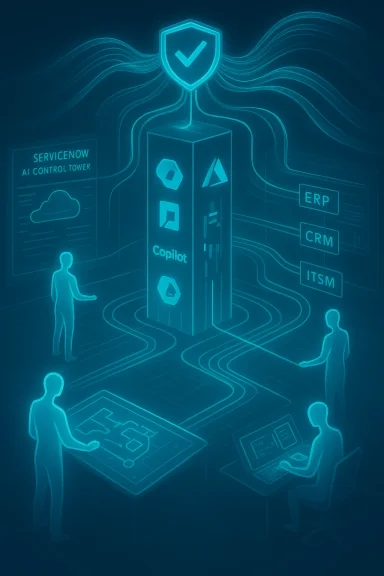
The industry shorthand “agentic AI” refers to systems that do more than reply to prompts: they plan, call tools, act across systems, and persist state across multi‑step workflows. This evolution — from assistant to autonomous agent — is reshaping product roadmaps at Microsoft, ServiceNow and many of their partners. Microsoft’s push to register agents inside identity fabrics and treat them as accountable “digital workers” has become central to that strategy, while ServiceNow’s AI Agent Fabric and AI Control Tower focus on lifecycle, governance, and cross‑agent orchestration. Together, these platform moves attempt to solve the operational problems enterprises face when agents must access data, run processes, and appear in audit trails like any other enterprise actor.
TQA’s announcement positions the company as a systems integrator that stitches these platform primitives into real business workflows. It walks a familiar channel playbook: lean on leading platform partners for core capabilities (identity, models, runtime, governance) and provide the domain‑specific integration, workflow redesign, and change management that actually delivers value. The PR states that TQA will “integrate Copilot, Power Platform, and Azure AI” and expand its ServiceNow practice to convert legacy workflows into agentic automations — an approach intended to address the common failure modes identified in recent industry studies.
ServiceNow’s AI Control Tower and Agent Fabric make the complementary case: governance and orchestration cannot live only inside clouds or model runtimes; they must span the enterprise fabric where business processes and human approvals live. By connecting these governance surfaces to Copilot and Azure runtimes, enterprises can more realistically expect agents to operate within defined policy boundaries and to be constrained by workflow logic when necessary.
TQA’s message that the “pilot-to-production” gap is primarily an orchestration and identity problem is no accident. The recent MIT‑centered industry coverage that underpins the 95% pilot‑failure claim points to the same core weaknesses: brittle integrations, limited feedback loops, and solutions treated as point demos rather than reshaped processes. While the headline statistic is dramatic, it’s useful shorthand for the systemic problem: enterprises need deterministic ways to bind agents to identity, to control how they access data, and to instrument the business value they create.
But there are open, practical tests:
Source: Redmond Channel Partner TQA Expands Agentic AI Focus, Deepens Microsoft and ServiceNow Partnerships -- Redmond Channel Partner
 Background / Overview
The industry shorthand “agentic AI” refers to systems that do more than reply to prompts: they plan, call tools, act across systems, and persist state across multi‑step workflows. This evolution — from assistant to autonomous agent — is reshaping product roadmaps at Microsoft, ServiceNow and many of their partners. Microsoft’s push to register agents inside identity fabrics and treat them as accountable “digital workers” has become central to that strategy, while ServiceNow’s AI Agent Fabric and AI Control Tower focus on lifecycle, governance, and cross‑agent orchestration. Together, these platform moves attempt to solve the operational problems enterprises face when agents must access data, run processes, and appear in audit trails like any other enterprise actor.TQA’s announcement positions the company as a systems integrator that stitches these platform primitives into real business workflows. It walks a familiar channel playbook: lean on leading platform partners for core capabilities (identity, models, runtime, governance) and provide the domain‑specific integration, workflow redesign, and change management that actually delivers value. The PR states that TQA will “integrate Copilot, Power Platform, and Azure AI” and expand its ServiceNow practice to convert legacy workflows into agentic automations — an approach intended to address the common failure modes identified in recent industry studies.
Why identity and interoperability matter now
Identity is the new perimeter for agentic systems. When AI agents can take actions, query sensitive data, or trigger workflows, organizations can’t treat them as stateless demo artifacts. They must be discoverable, auditable, and governed in the same identity, rights, and lifecycle frameworks that manage human employees. Microsoft’s explicit work to add agent identities into Entra — and to extend Zero Trust principles to an “agentic workforce” — validates that identity-first control is now a product requirement, not a thought experiment.ServiceNow’s AI Control Tower and Agent Fabric make the complementary case: governance and orchestration cannot live only inside clouds or model runtimes; they must span the enterprise fabric where business processes and human approvals live. By connecting these governance surfaces to Copilot and Azure runtimes, enterprises can more realistically expect agents to operate within defined policy boundaries and to be constrained by workflow logic when necessary.
TQA’s message that the “pilot-to-production” gap is primarily an orchestration and identity problem is no accident. The recent MIT‑centered industry coverage that underpins the 95% pilot‑failure claim points to the same core weaknesses: brittle integrations, limited feedback loops, and solutions treated as point demos rather than reshaped processes. While the headline statistic is dramatic, it’s useful shorthand for the systemic problem: enterprises need deterministic ways to bind agents to identity, to control how they access data, and to instrument the business value they create.
What TQA announced — the details that matter
- A new agentic-focused identity and multi‑platform strategy: TQA announced a rebrand and repositioning that explicitly prioritizes agentic AI as a core competency. The PR cites integration across Microsoft’s Copilot family, Power Platform and Azure AI, and deeper ServiceNow practice offerings focused on Workflow Data Fabric and AI agent lifecycle.
- Platform partnerships and “best‑of‑breed” posture: TQA is not abandoning its UiPath heritage — it remains a Diamond UiPath partner and claims recognition for agentic AI skills — but it adds Microsoft and ServiceNow as formal technology practices to address multi‑platform enterprise needs. The intent is to combine RPA, low‑code orchestration, and agentic model runtimes.
- Outcome framing: TQA emphasizes “agents that actually work” and positions itself as a delivery partner that handles process redesign, identity integration, and change programs necessary to translate agentic automation into measurable business outcomes. The PR quotes leadership that frames the offering as a remedy for the “massive production gap” in enterprise AI.
How realistic is TQA’s pitch?
Short answer: the strategy is sensible and market‑aligned, but success depends on execution across three hard problem sets: identity and authentication, workflow redesign, and operational governance.1) Identity and secure credentials
- Strength: Aligning agents to Entra‑style identity and Microsoft’s agent identity constructs reduces a major operational risk — unknown or untracked access by ephemeral agent processes. Microsoft’s Entra Agent ID and related controls are explicitly designed to treat agents as first‑class identities, enabling RBAC, conditional access, and audit trails that InfoSec teams already trust. Integrators that can map an organization’s existing entitlement model into agent identities reduce friction and risk.
- Risk: Identity alone does not solve privilege creep, credential sprawl, or lateral movement risks. Agent identities must be constrained with least privilege, just-in-time elevation, and comprehensive logging. Implementation quality matters: automated provisioning workflows that don’t include human approval gates or anomaly detection can create new attack vectors. TQA’s success depends on demonstrating operational mastery of identity hardening, not just checkbox integration.
2) Workflow and data integration
- Strength: TQA’s model of pairing Copilot and Power Platform with ServiceNow workflow capabilities addresses a practical truth: many GenAI pilots fail because they are not embedded into the business process that owns the outcome. Connecting agents to ServiceNow’s workflow fabric allows organizations to define deterministic pathways for handoffs, approvals, and exception handling that agents must follow. This reduces brittleness and clarifies ownership.
- Risk: Enterprises are full of shadow processes and brittle integrations. Rewriting workflows to accommodate agentic actors is costly and organizationally disruptive. The firms that succeed will invest in process discovery, human-in-the-loop design, and incremental rollouts — not in rapid “agentize everything” conversions. TQA must show repeatable methods and prebuilt connectors for the heavy‑lift systems that enterprises actually use (ERP, core banking, supply chain, etc.) to make this credible.
3) Governance, observability, and economics
- Strength: ServiceNow’s AI Control Tower and Microsoft’s Agent 365/Foundry direction give systems integrators a way to centralize policy, detect drift, and measure impact. If TQA can operationalize telemetry, cost metering, and value measurement (e.g., reductions in cycle time, error rates, or cost-per-case), it will have the metrics CIOs demand to justify scaling.
- Risk: Production-grade observability is difficult. Measuring the causal impact of an agent across a complex process requires instrumentation that few organizations have today. There is also the risk of vendor lock‑in and cost surprises: running many agents across commercial model runtimes and cloud resources can produce unpredictable bills. TQA must be explicit about cost models and offer governance controls to prevent runaway consumption.
What this means for CIOs, channel partners and integrators
CIOs should treat TQA’s announcement as confirmation of a trend rather than a unique innovation: identity-first agent management, platform-aligned partnerships, and workflow-centric delivery are rapidly becoming table stakes for enterprise AI programs. That said, the announcement highlights a few actionable points:- Prioritize identity and entitlement audits now. If agents will be first‑class identities, CIOs need to decide how agent accounts are provisioned, who owns them, and what SSO/conditional access policies apply. Microsoft’s identity primitives are maturing to support this, but organizational policy must catch up.
- Treat agent projects as process redesign initiatives, not feature builds. Successful deployments will often require changing handoffs, SLAs, and metrics to ensure agents have clear responsibilities and exit paths when uncertain. Use ServiceNow or equivalent orchestration systems to centralize lifecycle controls.
- Build cost governance into pilot-to-scale plans. Agents that call expensive model endpoints, spawn compute jobs, or invoke external services can create new cost centers. Insist on consumption caps, visibility, and approval workflows before scaling.
Where TQA’s approach aligns with market reality — and where it must prove itself
Industry reporting from the past year paints a consistent picture: the promise of Copilot and agentic systems is real, but production success requires governance and tight integration. Microsoft’s product roadmap — from Copilot Studio to Azure AI Foundry to identity controls — is squarely aligned with the operational problems TQA claims to solve. Likewise, ServiceNow’s AI Control Tower and Agent Fabric are designed to host, govern, and orchestrate agents across heterogeneous systems. These platform investments make the integrator playbook that TQA announced a reasonable market strategy.But there are open, practical tests:
- Can TQA translate platform-level promises into repeatable, industry‑specific outcomes? Large enterprises expect vertical accelerators and data connectors for SAP, Oracle, Salesforce, and industry systems. A generic Copilot + ServiceNow approach will falter without those integrations.
- Can TQA demonstrate governance that prevents abuse while enabling productivity? The operational controls—role‑based agent provisioning, just‑in‑time access, and human escalation points—are what separate safe pilots from risky rollouts.
- Can TQA help customers estimate and control total cost of ownership? Model usage, storage, and orchestration costs must be visible and controllable.
Practical recommendations for teams planning agentic deployments
If your organization is evaluating agents, follow a disciplined, staged approach.- Define the business outcome and owner.
- Start with a single, measurable goal (e.g., reduce time-to-resolution for IT incidents by X%).
- Assign a process owner who has budget authority and domain knowledge.
- Map the workflow and data dependencies.
- Document touchpoints, approvals, and where human judgment is needed.
- Identify data sources and the sensitivity classification for each field.
- Anchor identity and access controls before agent activation.
- Provision agent identities into your identity provider and apply least-privilege policies.
- Plan for lifecycle management: who decommissions an agent, and under what triggers.
- Use orchestration and governance platforms as control planes.
- Deploy agents under a centralized control tower (ServiceNow-style or equivalent) that can apply policy, monitor performance, and inject human review when needed.
- Meter and iterate.
- Track both technical metrics (latency, error rates) and business KPIs (cost savings, cycle time).
- Start small, instrument deeply, and scale only when metrics show repeatable impact.
Competitive dynamics and channel implications
TQA’s announcement should be read in the context of a broader partner ecosystem consolidation around Microsoft and ServiceNow for agentic workloads. Microsoft is explicitly enabling partners to build Copilot‑anchored solutions and to register agents under identity constructs; ServiceNow is positioning itself as the enterprise control plane for agent orchestration and governance. Large global systems integrators and consultancies are making similar bets, and software vendors are embedding agentic features into their products. The implication: channel partners must choose strategies that emphasize either deep vertical specialization or horizontal orchestration expertise.- For smaller integrators: focus on vertical use cases where domain knowledge sells (healthcare authorization, claims processing, fixed‑asset reconciliation).
- For larger integrators: invest in reusable components — identity templates, connector libraries, and governance playbooks — that reduce marginal delivery costs.
Risks, regulatory considerations, and open questions
Agentic systems increase the attack surface and raise regulatory and compliance questions that are not yet fully settled.- Data residency and model use: Agents that access cross-border data must be constrained by data residency and contractual limitations. Enterprises should ensure that model providers’ terms and any third‑party processing comply with contracts and local regulations.
- Auditability and explainability: Regulators and auditors will demand evidence that automated decisions meet standards for fairness, accuracy, and accountability. ServiceNow’s Control Tower and Microsoft’s telemetry can help, but organizations must maintain auditable trails of decisions and approvals.
- Vendor concentration and lock-in: Heavy reliance on a small set of cloud and model providers can create operational and commercial lock‑in. Multicloud and multi‑model strategies are technically challenging but may be necessary to manage risk and cost.
- Human oversight fatigue: When agents proliferate, the burden on human managers to review exceptions can grow. Design governance to limit review fatigue through prioritization and automated triage.
How to evaluate TQA or similar partners
When engaging TQA or any integrator claiming agentic expertise, ask for:- Concrete case studies showing measurable business outcomes, not just demos.
- Prebuilt connectors for your core systems and examples of how they handled edge cases.
- A documented security and identity plan that includes provisioning, deprovisioning, and monitoring for agent identities.
- Cost governance and metering strategies tied to scaling scenarios.
- A roadmap for integration with your compliance and audit tooling.
Conclusion
TQA’s repositioning around an agentic identity and deepened Microsoft and ServiceNow partnerships is strategic and market‑aware. It reflects an important shift: enterprise AI is no longer primarily an experimentation problem but an operational one — identity, governance, orchestration, and workflow redesign are the obstacles to value. The platform direction taken by Microsoft and ServiceNow gives integrators the primitives to address those obstacles; success will depend on execution, measurement, and the discipline to treat agents as governed members of the workforce rather than ephemeral side projects. For CIOs and channel partners, the message is clear: plan for identity-first agents, insist on process redesign, and require measurable outcomes before scaling. The architecture is aligning — now the industry must deliver on the operational rigor.Source: Redmond Channel Partner TQA Expands Agentic AI Focus, Deepens Microsoft and ServiceNow Partnerships -- Redmond Channel Partner
