

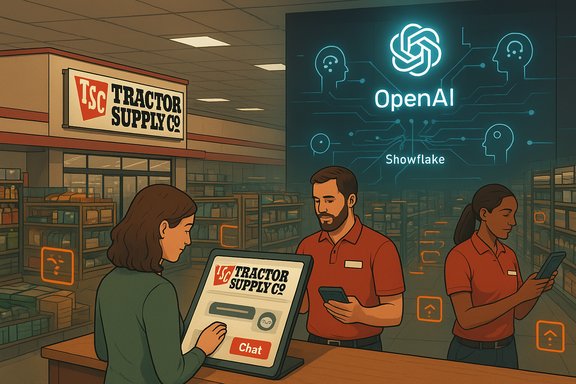
Tractor Supply’s recent decision to make OpenAI its primary AI partner marks a decisive moment in how a large, operationally complex retailer is choosing to industrialize generative AI across customer channels, store operations, and supply‑chain workflows. The move — described by Tractor Supply executives as a deliberate pivot from a multi‑vendor experimentation phase to a closer, single‑vendor collaboration with OpenAI — is already driving live deployments (chat assistants, computer‑vision triggers, and internal productivity agents), while raising familiar questions about vendor concentration, governance, and the practical limits of current large language models (LLMs).
Tractor Supply began experimenting with several AI providers after the ChatGPT era catalyzed enterprise interest in 2023. By early 2025 the company elected to concentrate most of its efforts with OpenAI, keeping other vendors only where their capabilities were embedded in an existing product (for example, replenishment or specialized vendor software). That rationale, according to Rob Mills, Tractor Supply’s EVP and chief technology, digital and corporate strategy officer, was to create consistency in governance, rollout, and a joint roadmap for future features. Executives say OpenAI tooling is already in use both in field teams and at Tractor Supply’s Tennessee headquarters. At the corporate level Tractor Supply frames its AI approach into three practical buckets:
However, the strategy is not without caveats. Vendor concentration introduces switching costs and potential blind spots as other models evolve. The claim of “1,500 processes automated” is an important adoption signal, but it remains a company‑reported metric that needs independent verification for external benchmarking. Operational risks — hallucinations, cost creep, rural connectivity, and supplier data governance — are real and require ongoing investment in observability, red teaming, and contractual safeguards.
For enterprise IT leaders, Tractor Supply’s example is a useful case study: pick your priorities, invest in engineering and prompt discipline, anchor agents to authoritative data, and treat governance as an operational competency rather than a checkbox. Done well, this approach will save labor, speed decision‑making, and enable new commerce flows. Done poorly, it amplifies risk and vendor dependence at scale.
Tractor Supply’s concentrated bet on OpenAI is a pragmatic attempt to convert generative AI’s promise into operational reality across thousands of stores and hundreds of corporate workflows. The approach accelerates standardization, governance, and co‑development benefits, and the company is already seeing productivity enhancements. Yet the move also concentrates risk — contractual, technical, and strategic — at a time when the LLM landscape remains volatile. The net effect for Tractor Supply will depend on disciplined governance, transparent metrics, and an exit/portability posture that preserves strategic optionality as models and commercial terms continue to evolve.
Source: Modern Retail Tractor Supply bets on OpenAI as its primary AI partner
 Background / Overview
Tractor Supply began experimenting with several AI providers after the ChatGPT era catalyzed enterprise interest in 2023. By early 2025 the company elected to concentrate most of its efforts with OpenAI, keeping other vendors only where their capabilities were embedded in an existing product (for example, replenishment or specialized vendor software). That rationale, according to Rob Mills, Tractor Supply’s EVP and chief technology, digital and corporate strategy officer, was to create consistency in governance, rollout, and a joint roadmap for future features. Executives say OpenAI tooling is already in use both in field teams and at Tractor Supply’s Tennessee headquarters. At the corporate level Tractor Supply frames its AI approach into three practical buckets:- Off‑the‑shelf AI modules embedded in vendor software (ERP, replenishment, marketing platforms).
- Custom, company‑built applications (in‑store computer vision, team member assistants).
- Agents and automation that stitch enterprise data with LLMs to reduce manual work and speed decisions.
What Tractor Supply is rolling out today
Customer‑facing assistants and AI‑driven commerce
One visible outcome of the OpenAI collaboration is the AI assistant on Tractor Supply’s website. Executives declined to fully disclose the assistant’s internal architecture, but said OpenAI technology underpins conversational customer support and exploratory commerce experiences. The company is also “beginning to explore AI‑driven commerce” — leaning into agentic shopping flows where conversational interfaces can surface products, confirm availability, and (eventually) help close transactions.Store operations: computer vision and team member aides
Tractor Supply has deployed computer‑vision capabilities in stores to detect customer behavior patterns — for example, queue lengths and browsing signals — and to nudge staff when intervention is warranted. A separate internal assistant (branded in past announcements as a generative application powering team members) helps store employees answer product questions and onboard more rapidly by providing consistent, documented responses. Tractor Supply previously received industry recognition for combining vision alerts with a voice/handheld assistant for team members, highlighting a real‑world operational emphasis rather than purely experimental use.Automation and agents: Snowflake + OpenAI
In earnings remarks Tractor Supply’s CEO and other executives confirmed an enterprise integration with OpenAI that ties into the company’s Snowflake data lake. That integration has been used to construct internal agents that automate routine tasks — for instance, automatically reviewing photos of planogram resets and surfacing only escalations to district managers, rather than routing every submission through manual checks. Executives cited the number of enterprise OpenAI accounts (1,200–1,500) as evidence of scale across organizational functions.Scale claim: “1,500 processes automated” — read this with care
Public commentary from Tractor Supply leaders reported to Modern Retail says the company “has automated about 1,500 processes using AI.” That is a significant operational claim, but it should be treated as a company‑reported metric: the number is consistent with internal adoption signals (user counts, pilot rollouts), but the details — what constitutes a “process,” the automation depth, and the measured business impact — are not independently audited in public filings. The earnings transcript and other remarks corroborate rapid adoption and agent creation, but they reference users and automation pilots rather than an externally verified count of completed process automations. Readers should treat the 1,500 figure as a directional indicator of scale rather than a third‑party validated KPI.Why Tractor Supply doubled down on a single AI vendor
The reasoning Tractor Supply leadership gave is operational clarity and governance:- Consistent governance and security: Standardizing on one primary model provider simplifies data‑access patterns, audit trails, and policy enforcement across retail, supply chain, and corporate domains.
- Faster co‑development: Executives said OpenAI has been especially proactive in collaborating with retailers, sharing product roadmaps and integrations that help Tractor Supply prepare for new features.
- Simplified internal developer experience: Narrowing the model surface reduces friction when training employees to create robust prompts, agents, and RAG (retrieval‑augmented generation) workflows.
Strengths of Tractor Supply’s approach
1) Focused governance and safety posture
Consolidating around a primary provider makes it easier to implement consistent data‑use policies, model‑version controls, red‑team exercises, and provenance tracking. Where LLM outputs are business‑critical, a centralized governance model expedites consistent audit trails and response playbooks.2) Faster internal adoption and measurable productivity wins
Tractor Supply’s deployments are explicitly tied to frontline productivity: planogram photo review automation, line‑length alerts, and a store assistant that lowers new‑hire ramp time. These are not speculative demos — they replace clear manual steps and route only exceptions to human supervisors, delivering measurable time savings. Executive remarks and past awards underscore that these are production systems, not proofs of concept.3) Platform leverage and technical integration
Connecting OpenAI to a centralized enterprise data lake (Snowflake) creates a retrieval‑augmented foundation for agents that need context — inventory levels, product metadata, and supply‑chain telemetry. This architecture reduces hallucination risk when done correctly, because agents can cite evidence from internal sources rather than relying solely on model priors.4) Vendor attention and co‑innovation
Tractor Supply executives said OpenAI’s engagement level — sharing product direction and prioritizing retail use cases — makes the relationship feel collaborative rather than transactional. For a retailer aiming to move rapidly from pilots to scale, preferential vendor attention can accelerate feature parity and integration cadence.Risks and downside considerations
No enterprise AI program is risk‑free. Tractor Supply’s approach exposes several operational, legal, and strategic hazards that IT and business leaders must grapple with.Vendor concentration and potential lock‑in
Relying on a single primary model provider increases switching costs and concentrates operational dependency. Even if the company keeps exceptions, critical agent logic and production prompts can become caller‑specific, vector‑index formats can differ across providers, and proprietary fine‑tunes or embeddings may not be portable. That concentration can limit strategic flexibility as other model architectures or cost structures evolve.Rapidly moving model landscape
Industry experts warn the “best” LLM for a job can change quickly; one model may outperform another for images, reasoning, or code at different times. Betting heavily on one provider risks missing transient but material advances from competitors. Public critics have argued for multi‑model strategies that route the right task to the right model at runtime; Tractor Supply’s approach trades that flexibility for governance simplicity. This is a pragmatic tradeoff — but it’s not free.Hallucinations, provenance and liability
Even with retrieval grounding, LLM outputs can fabricate plausible but false details. When agents touch supply chains, pricing, or regulated product guidance, incorrect outputs can have downstream operational and legal consequences. Retailers should enforce explicit human‑in‑the‑loop controls for decisions that have financial or compliance impact and mandate provenance links for every recommendation. Tractor Supply executives emphasized training and prompt libraries to reduce bad outputs, but the technical risk remains inherent.Cost and inference economics
Large‑scale agent deployments carry ongoing inference costs, vector store storage charges, and potentially significant egress or telemetry expenses. A centralized enterprise agreement can help predict TCO, but the operational model should include rigorous cost telemetry. Without it, an expanding number of agents and retrieval queries can produce expensive and unexpected monthly bills.Rural connectivity and edge resilience
Tractor Supply’s customer footprint is in rural and small‑town areas where connectivity varies. Any customer‑facing or field‑agent feature must include offline or degraded‑mode support; otherwise the very customers and staff who need AI the most may be excluded. This challenge is often underestimated in early pilots.Data governance and supplier confidentiality
Retailers hold sensitive supplier, pricing, and inventory data. Enterprises must ensure contractual clarity on how model vendors use, store, and (crucially) train on customer data. Organizations should demand contractual guarantees around data residency, non‑training clauses, and strict access controls where appropriate. Tractor Supply’s integration into Snowflake suggests they’re thinking about this, but contractual and technical guardrails must be explicit.Operational lessons from Tractor Supply’s rollout
Tractor Supply’s journey offers practical takeaways for other retail CIOs and IT leaders evaluating LLM adoption.- Start with productivity wins that minimize risk. Tractor Supply prioritized image review automation and employee assistants — tasks that save labor and reduce churn without exposing customers to high regulatory risk.
- Invest in prompt engineering and shared workflows. The company created a library of prompts and trained employees to write effective prompts. Good prompt hygiene reduces garbage outputs and gives teams reusable building blocks.
- Connect agents to an authoritative data layer. The Snowflake integration is a textbook example of retrieval‑augmented reasoning (RAR): anchor agent responses to internal, timestamped data to reduce hallucinations and provide traceable provenance.
- Measure adoption, not vanity metrics. Executives stressed adoption and employee use over headline KPIs. Adoption is an early signal of product market fit for internal tools; once employees rely on an agent, it becomes easier to measure downstream ROI.
- Operationalize rollback and monitoring. Any production agent should have versioning, observability, and a rollback playbook in case of drift or problematic outputs.
Strategic alternatives Tractor Supply could have chosen
For context, other retailers and enterprises have pursued multiple strategies:- Multi‑model orchestration: Maintain connectors to multiple LLM providers and route tasks to the best tool at runtime.
- Hyperscaler + vendor mix: Keep one hyperscaler for infrastructure but mix model vendors for different capabilities.
- In‑house fine‑tuned private models: Host customer‑owned models (on‑prem or private cloud) for maximum data control and portability.
What governance at scale should look like (practical checklist)
Enterprises that want to replicate Tractor Supply’s success while avoiding common pitfalls should insist on these guardrails:- Strong contractual data‑use limits (no training on customer data without explicit consent).
- Model versioning and automated rollback SLAs.
- Provenance at the response level — every recommendation should cite the authoritative record or document.
- Human‑in‑the‑loop thresholds for regulated or high‑impact decisions.
- Cost observability tied to inference, vector storage, and data egress.
- Portability clauses and exportable index snapshots to reduce lock‑in risk.
- Offline/edge modes for field teams with intermittent connectivity.
- Continuous red‑teaming and regression testing across model updates.
Bigger picture: what Tractor Supply’s bet signals for retail AI
Tractor Supply’s choice to concentrate on OpenAI rekindles an industry debate: is deep vendor partnership the most effective way to industrialize AI, or does rapid model innovation force a polyglot approach?- On one hand, strong vendor partnerships accelerate integration and give customers a direct product roadmap to influence. Vendors eager to learn from retail pilots can co‑design features that solve real operational problems.
- On the other hand, the LLM landscape evolves quickly; models often leap in performance in narrow domains on short timetables. Relying on one provider can risk falling behind in specialized capabilities like image generation, multimodal reasoning, or long‑context reasoning where other vendors may pull ahead.
Final appraisal: prudent accelerator or strategic bet with caveats?
Tractor Supply’s OpenAI partnership is a practical, well‑scoped move to accelerate agentic automation across a large, distributed retail footprint. The company has anchored deployments in concrete operational problems (planogram review, queue monitoring, store assistant support) and paired those efforts with data governance and employee training programs. Those choices increase the odds of early, measurable ROI.However, the strategy is not without caveats. Vendor concentration introduces switching costs and potential blind spots as other models evolve. The claim of “1,500 processes automated” is an important adoption signal, but it remains a company‑reported metric that needs independent verification for external benchmarking. Operational risks — hallucinations, cost creep, rural connectivity, and supplier data governance — are real and require ongoing investment in observability, red teaming, and contractual safeguards.
For enterprise IT leaders, Tractor Supply’s example is a useful case study: pick your priorities, invest in engineering and prompt discipline, anchor agents to authoritative data, and treat governance as an operational competency rather than a checkbox. Done well, this approach will save labor, speed decision‑making, and enable new commerce flows. Done poorly, it amplifies risk and vendor dependence at scale.
What to watch next
- How Tractor Supply quantifies business outcomes from its agents — explicit ROI measures, error rates, escalation frequency, and time‑saved metrics.
- Any public disclosures on contractual data‑use terms with OpenAI — especially clauses around training on customer data and data residency.
- Evidence of multi‑model experimentation reappearing (e.g., when a particular task calls for an alternate model).
- Broader industry moves: whether other mid‑large retailers formalize single‑vendor partnerships or embrace multi‑model orchestration.
- Technical indicators: deployment of offline/edge capabilities for rural stores and more granular cost attribution for inference workloads.
Tractor Supply’s concentrated bet on OpenAI is a pragmatic attempt to convert generative AI’s promise into operational reality across thousands of stores and hundreds of corporate workflows. The approach accelerates standardization, governance, and co‑development benefits, and the company is already seeing productivity enhancements. Yet the move also concentrates risk — contractual, technical, and strategic — at a time when the LLM landscape remains volatile. The net effect for Tractor Supply will depend on disciplined governance, transparent metrics, and an exit/portability posture that preserves strategic optionality as models and commercial terms continue to evolve.
Source: Modern Retail Tractor Supply bets on OpenAI as its primary AI partner
