

Former President Donald Trump’s warning about the Taiwan Strait lands at a moment when the world is already more alert to maritime chokepoints, semiconductor fragility, and great-power brinkmanship than it was even a few years ago. The rhetoric was blunt, the symbolism was unmistakable, and the reaction was immediate because the Taiwan Strait sits at the intersection of military deterrence, trade security, and the long-running contest over China’s future. It is also a reminder that a few seconds of political language can ripple far beyond a campaign rally, especially when the subject is one of the most heavily watched waterways on the planet.
The Taiwan Strait has never been merely a body of water. It is a strategic corridor, a legal dispute, a historical scar, and a live test of whether rival powers can manage competition without stumbling into conflict. Since 1949, when the Chinese Civil War ended with the Republic of China retreating to Taiwan and the People’s Republic of China taking the mainland, the strait has remained a flashpoint where sovereignty claims and military realities collide. The basic political fact has not changed, but the surrounding strategic environment has become more dangerous, more technologically complex, and more economically consequential.
That is why Trump’s remarks resonated so widely. Any statement about the Taiwan Strait instantly activates a dense web of assumptions about deterrence, U.S. credibility, freedom of navigation, and Chinese red lines. Washington’s long-standing one-China policy is distinct from Beijing’s one-China principle, and that distinction remains at the heart of the U.S. balancing act. The Congressional Research Service notes that the Taiwan Relations Act underpins a policy of strategic ambiguity, leaving open how the United States would respond to a major attack while still committing to provide Taiwan with defensive support
The stakes are not only diplomatic. The Taiwan Strait is intertwined with global logistics and manufacturing in ways that make even hypothetical disruption a market-moving event. UNCTAD and the World Bank both emphasize that more than 80% of world trade travels by sea, and modern shipping corridors are increasingly vulnerable to geopolitical shocks and rerouting costs. Add Taiwan’s central role in advanced chip production, and the security question becomes an industrial one as well. CSIS notes that Taiwan accounts for over 90% of advanced chips, a concentration that gives the island an outsized role in the digital economy and in the security calculations of the United States and its allies
Trump’s warning therefore should be read less as an isolated comment and more as a signal that the Taiwan issue remains politically potent in Washington. It also highlights how candidate-era statements can shape expectations even without changing policy. The real question is not whether one speech alters the regional balance. The more important question is whether such language strengthens deterrence, raises ambiguity, or inadvertently narrows room for crisis management.
The legal and diplomatic framework surrounding Taiwan was deliberately built to avoid finality. The U.S. recognized Beijing in 1979, but also passed the Taiwan Relations Act to preserve unofficial ties and ensure Taiwan could maintain a credible defense. The historical point of that architecture was to deter unilateral change, not to settle the sovereignty dispute. In practice, that means Washington supports Taiwan without formally recognizing it as a state, a formula that has held together mostly because all sides understood the risks of pushing too far
Over time, however, the military and economic weight of the issue has grown dramatically. China’s armed forces have modernized at speed, and the Pentagon’s latest annual report says the People’s Liberation Army Navy is now the world’s largest by number of ships. Taiwan, by contrast, has leaned into asymmetric defense, betting that mobile missiles, dispersed sensors, coastal defense systems, and cyber resilience can complicate a much larger adversary. That approach reflects a blunt reality: Taiwan cannot outbuild China ship-for-ship, so it must make invasion or blockade painful, uncertain, and expensive.
The economic backdrop makes this rivalry more global than ever. UNCTAD’s recent maritime assessments stress that shipping is under pressure from disruptions, longer routes, and mounting costs, with knock-on effects across food security, energy, and industrial supply chains. Taiwan sits near the center of all of that. A crisis in the strait would not merely be an Asian security event; it would be a direct shock to the world economy.
That can have real deterrent value. In crisis environments, ambiguity sometimes stabilizes, but it can also invite miscalculation when adversaries believe resolve is weak. Trump’s approach seeks to remove that uncertainty by projecting strength early. The upside is that Beijing may interpret the signal as a warning against adventurism. The downside is that a hard-edged statement can also reduce diplomatic flexibility later if tensions rise unexpectedly.
Trump’s first term offers clues to this posture. His administration approved major arms sales to Taiwan and increased pressure on Beijing in broader trade and technology disputes. Congress and the executive branch also reinforced Taiwan-related policy through legislation and official messaging. Yet the same administration also pursued negotiations with China on trade, showing that the relationship was never purely ideological or consistently hawkish. The result was not a doctrinaire China policy so much as a transactional one, in which pressure, bargaining, and unpredictability were all part of the toolkit
Taiwan’s strategy is built around the idea that survivability matters more than platform count. Mobile anti-ship missiles, fast response times, hardened communications, and distributed command systems are designed to survive the opening hours of any attack. This is a smarter posture than trying to mirror China’s fleet expansion. It is also a recognition that speed, deception, and resilience may matter more than traditional symmetry in a cross-strait fight.
The United States Navy’s regular transits through the Taiwan Strait are part of that deterrent ecosystem. The Navy says such operations are conducted in accordance with international law and demonstrate support for navigational rights and freedoms. Those moves are not just symbolic. They communicate that Washington rejects any attempt to turn the strait into a closed zone or a de facto Chinese lake.
This is why claims about the percentage of global container traffic passing through the Taiwan Strait tend to attract scrutiny. Even when exact figures vary by methodology, the larger point is stable: the route is critical enough that disruption would force rerouting, raise insurance costs, and reverberate through supply chains. That is not a theoretical risk. The Red Sea and Suez crises have already shown how quickly maritime congestion and rerouting can alter freight dynamics and squeeze margins
The Taiwan Strait’s strategic weight is amplified by Taiwan’s semiconductor sector. CSIS notes that Taiwan produces over 90% of advanced chips, and the island’s foundry dominance makes it indispensable to everything from smartphones to cars to defense systems. That concentration creates what some analysts call a silicon shield: the idea that global dependence on Taiwanese chips helps deter aggression. But a shield is only useful until it is tested, and a serious blockade would expose how fragile modern production networks really are.
Europe tends to speak more cautiously, but its stake is real. The European Union’s trade exposure in Asia means any maritime disruption would have economic consequences well beyond the region. EU officials generally emphasize dialogue, restraint, and a peaceful resolution, which is diplomatically prudent but also consistent with Europe’s broader preference for predictable trade conditions. That caution is not weakness; it is a recognition that the costs of escalation would be shared globally.
Beijing, predictably, rejects any U.S. framing that treats the strait as an international security problem rather than a Chinese sovereignty issue. Chinese officials routinely object to arms sales, military transits, and official interactions between Washington and Taipei. Their position is that outside involvement distorts what they regard as an internal matter. That line is unlikely to change, but the intensity of the response can vary depending on how forcefully the United States speaks.
The United States has not ratified UNCLOS, but it generally treats freedom of navigation as a customary international principle. China, although a party to UNCLOS, has at times adopted broader security interpretations of what it can restrict in nearby waters, especially where military activity is concerned. That mismatch in interpretation creates friction even when both sides claim to be acting lawfully. The danger is not just legal disagreement; it is operational misunderstanding.
This is where the Taiwan Strait becomes especially sensitive. If one side believes a transit is routine and the other sees it as hostile, then every patrol becomes a test of wills. The legal argument provides the language, but the real contest is over enforcement. What one navy sees as lawful presence, the other may frame as provocation.
This is why governments on both sides of the Atlantic have spent years trying to de-risk semiconductor supply chains. CSIS notes that the U.S. and Europe have both pushed policies aimed at reducing reliance on Taiwan while improving resilience across the broader semiconductor ecosystem. That effort is sensible, but it is slow. Building fabs, training workers, and stabilizing supply ecosystems takes years, not quarters. In the meantime, the world remains deeply exposed.
There is also a strategic irony here. The more important Taiwan becomes to the global economy, the more tempted China may be to use economic leverage as a pressure tool. At the same time, the more important Taiwan becomes, the more likely outside powers are to care about its security. That is the essence of the silicon shield debate: dependence can deter aggression, but it can also create a massive hostage situation if deterrence fails.
There is also the danger of overpromising. A statement that sounds decisive may please domestic audiences, but it can create expectations that future policymakers may not want or be able to meet. That gap between rhetoric and capacity is where credibility problems begin. If a threat is not matched by a plausible plan, adversaries eventually discount it.
Another risk is that the Taiwan issue becomes over-personalized around one political figure. The underlying structural tension predates Trump and will almost certainly outlast him. Overfocusing on his phrasing can obscure the deeper reality: U.S.-China competition, Taiwan’s status, and the security of the maritime commons are all moving on separate but interconnected tracks.
It may also push allied governments and private-sector planners to accelerate resilience measures. That is a good thing. Better stockpiles, diversified sourcing, and more realistic contingency planning would all reduce the shock of a future crisis. In geopolitical terms, preparation is its own form of deterrence.
There is also a genuine risk that the conversation becomes too militarized. The region needs clear signaling, but it also needs channels for diplomacy, trade continuity, and incident prevention. When political competition is framed only in military terms, it becomes harder to preserve the routines that keep accidents from becoming wars.
What happens next will depend on several overlapping variables: military signaling, election-year messaging, Chinese force posture, allied coordination, and the condition of global supply chains. Each of these can amplify the others. That is why the Taiwan Strait should be understood not as a single issue but as a system of risks, where political words, naval movements, and industrial dependencies all interact.
Source: Bitcoin World Geopolitical Tensions: Analyzing Trump’s Stark Warning on the Taiwan Strait Crisis
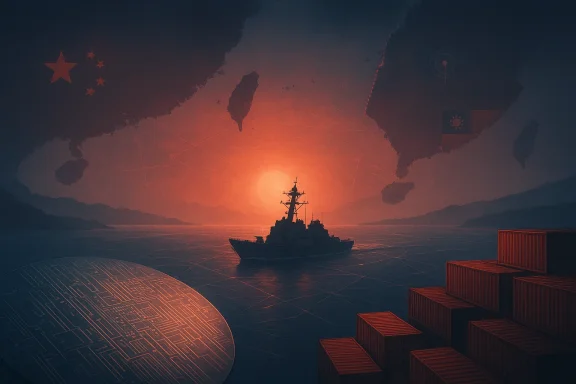 Overview
The Taiwan Strait has never been merely a body of water. It is a strategic corridor, a legal dispute, a historical scar, and a live test of whether rival powers can manage competition without stumbling into conflict. Since 1949, when the Chinese Civil War ended with the Republic of China retreating to Taiwan and the People’s Republic of China taking the mainland, the strait has remained a flashpoint where sovereignty claims and military realities collide. The basic political fact has not changed, but the surrounding strategic environment has become more dangerous, more technologically complex, and more economically consequential.That is why Trump’s remarks resonated so widely. Any statement about the Taiwan Strait instantly activates a dense web of assumptions about deterrence, U.S. credibility, freedom of navigation, and Chinese red lines. Washington’s long-standing one-China policy is distinct from Beijing’s one-China principle, and that distinction remains at the heart of the U.S. balancing act. The Congressional Research Service notes that the Taiwan Relations Act underpins a policy of strategic ambiguity, leaving open how the United States would respond to a major attack while still committing to provide Taiwan with defensive support
The stakes are not only diplomatic. The Taiwan Strait is intertwined with global logistics and manufacturing in ways that make even hypothetical disruption a market-moving event. UNCTAD and the World Bank both emphasize that more than 80% of world trade travels by sea, and modern shipping corridors are increasingly vulnerable to geopolitical shocks and rerouting costs. Add Taiwan’s central role in advanced chip production, and the security question becomes an industrial one as well. CSIS notes that Taiwan accounts for over 90% of advanced chips, a concentration that gives the island an outsized role in the digital economy and in the security calculations of the United States and its allies
Trump’s warning therefore should be read less as an isolated comment and more as a signal that the Taiwan issue remains politically potent in Washington. It also highlights how candidate-era statements can shape expectations even without changing policy. The real question is not whether one speech alters the regional balance. The more important question is whether such language strengthens deterrence, raises ambiguity, or inadvertently narrows room for crisis management.
Background
The Taiwan Strait crisis does not begin with contemporary American politics. It is rooted in the unresolved aftermath of the Chinese Civil War and the split between two governments that both once claimed to represent all of China. The People’s Republic of China has long maintained that Taiwan is an inseparable part of its territory, while Taiwan has evolved into a self-governing democracy with its own institutions, elections, military, and identity. That unresolved status has made the strait one of the most consequential pieces of geography in Asia.The legal and diplomatic framework surrounding Taiwan was deliberately built to avoid finality. The U.S. recognized Beijing in 1979, but also passed the Taiwan Relations Act to preserve unofficial ties and ensure Taiwan could maintain a credible defense. The historical point of that architecture was to deter unilateral change, not to settle the sovereignty dispute. In practice, that means Washington supports Taiwan without formally recognizing it as a state, a formula that has held together mostly because all sides understood the risks of pushing too far
Over time, however, the military and economic weight of the issue has grown dramatically. China’s armed forces have modernized at speed, and the Pentagon’s latest annual report says the People’s Liberation Army Navy is now the world’s largest by number of ships. Taiwan, by contrast, has leaned into asymmetric defense, betting that mobile missiles, dispersed sensors, coastal defense systems, and cyber resilience can complicate a much larger adversary. That approach reflects a blunt reality: Taiwan cannot outbuild China ship-for-ship, so it must make invasion or blockade painful, uncertain, and expensive.
The economic backdrop makes this rivalry more global than ever. UNCTAD’s recent maritime assessments stress that shipping is under pressure from disruptions, longer routes, and mounting costs, with knock-on effects across food security, energy, and industrial supply chains. Taiwan sits near the center of all of that. A crisis in the strait would not merely be an Asian security event; it would be a direct shock to the world economy.
Why this issue persists
A few structural features keep the Taiwan Strait in permanent danger territory.- The sovereignty dispute is unresolved by design.
- The U.S. wants to deter coercion without inviting provocation.
- China wants eventual reunification and rejects outside interference.
- Taiwan wants to preserve de facto autonomy without triggering war.
- Regional powers want stability, but not at the price of abandonment.
Trump’s Rhetorical Approach
Trump’s style in foreign policy has always been confrontational clarity. He prefers blunt warnings to layered diplomatic signaling, and that tendency matters when applied to a place like the Taiwan Strait. A direct statement about the waterway staying open is not just about maritime policy. It implicitly ties American credibility to the idea that coercion in the region will be met with consequences, even if the exact response remains undefined.That can have real deterrent value. In crisis environments, ambiguity sometimes stabilizes, but it can also invite miscalculation when adversaries believe resolve is weak. Trump’s approach seeks to remove that uncertainty by projecting strength early. The upside is that Beijing may interpret the signal as a warning against adventurism. The downside is that a hard-edged statement can also reduce diplomatic flexibility later if tensions rise unexpectedly.
Trump’s first term offers clues to this posture. His administration approved major arms sales to Taiwan and increased pressure on Beijing in broader trade and technology disputes. Congress and the executive branch also reinforced Taiwan-related policy through legislation and official messaging. Yet the same administration also pursued negotiations with China on trade, showing that the relationship was never purely ideological or consistently hawkish. The result was not a doctrinaire China policy so much as a transactional one, in which pressure, bargaining, and unpredictability were all part of the toolkit
What the warning signals
Trump’s warning can be read in several ways, and none of them are trivial.- It reinforces the concept of freedom of navigation as a non-negotiable principle.
- It signals to allies that Washington still views the Taiwan Strait as a vital interest.
- It tells Beijing that coercive escalation could carry political and military costs.
- It suggests that Taiwan remains central to any Indo-Pacific security agenda.
- It also leaves open the question of what “consequences” actually means.
Military Balance and Deterrence
The military balance across the strait has shifted in China’s favor in broad conventional terms, even if the outcome of any future conflict would still be highly uncertain. The Pentagon’s 2024 report underscores the scale of China’s modernization and the size of its naval force, while also noting that the United States continues to support Taiwan’s defense posture. That imbalance is precisely why Washington and Taipei have invested so heavily in deterrence-by-denial rather than deterrence-by-punishment.Taiwan’s strategy is built around the idea that survivability matters more than platform count. Mobile anti-ship missiles, fast response times, hardened communications, and distributed command systems are designed to survive the opening hours of any attack. This is a smarter posture than trying to mirror China’s fleet expansion. It is also a recognition that speed, deception, and resilience may matter more than traditional symmetry in a cross-strait fight.
The United States Navy’s regular transits through the Taiwan Strait are part of that deterrent ecosystem. The Navy says such operations are conducted in accordance with international law and demonstrate support for navigational rights and freedoms. Those moves are not just symbolic. They communicate that Washington rejects any attempt to turn the strait into a closed zone or a de facto Chinese lake.
The problem of escalation control
Deterrence works best when both sides believe the other wants to avoid war. But the Taiwan Strait is crowded with military patrols, surveillance flights, exercises, and signaling operations, which increases the chance of accident. One misread maneuver, one radar lock, or one collision can turn a signaling contest into a crisis. That is why communication protocols matter as much as force posture.- Regular transits normalize international access.
- Chinese shadowing operations are meant to contest that normalization.
- Taiwanese readiness reduces vulnerability but heightens alert levels.
- U.S. arms sales strengthen defense but also provoke countermeasures.
- Crisis hotlines and deconfliction procedures remain essential.
Trade, Shipping, and the Global Economy
The economic logic of the Taiwan Strait is every bit as important as the military one. The strait sits within a region that supports some of the world’s densest trade flows, and the broader maritime system is already under strain from geopolitical disruption. UNCTAD and the World Bank both stress that seaborne trade remains the backbone of the global economy, while chokepoints and regional tensions can quickly elevate costs and delay shipmentsThis is why claims about the percentage of global container traffic passing through the Taiwan Strait tend to attract scrutiny. Even when exact figures vary by methodology, the larger point is stable: the route is critical enough that disruption would force rerouting, raise insurance costs, and reverberate through supply chains. That is not a theoretical risk. The Red Sea and Suez crises have already shown how quickly maritime congestion and rerouting can alter freight dynamics and squeeze margins
The Taiwan Strait’s strategic weight is amplified by Taiwan’s semiconductor sector. CSIS notes that Taiwan produces over 90% of advanced chips, and the island’s foundry dominance makes it indispensable to everything from smartphones to cars to defense systems. That concentration creates what some analysts call a silicon shield: the idea that global dependence on Taiwanese chips helps deter aggression. But a shield is only useful until it is tested, and a serious blockade would expose how fragile modern production networks really are.
Consumer and enterprise fallout
A Taiwan Strait disruption would hit consumers and businesses differently, but both would feel it fast.- Consumers would see delays in electronics availability and price increases.
- Automakers would face component shortages and production interruptions.
- Cloud and data-center operators would worry about chip allocation.
- Defense contractors would face procurement pressure for key components.
- Shipping insurers would quickly reprice regional risk.
International Reactions and Alliance Politics
Trump’s warning also matters because it forces allies to interpret U.S. intentions in real time. Japan, Australia, and the Philippines have all deepened security cooperation with Washington in response to China’s growing maritime assertiveness, and their interest in Taiwan Strait stability is obvious. For these countries, the strait is not an abstract sovereignty dispute. It is a corridor connected to sea lanes, energy supplies, and the credibility of American extended deterrence.Europe tends to speak more cautiously, but its stake is real. The European Union’s trade exposure in Asia means any maritime disruption would have economic consequences well beyond the region. EU officials generally emphasize dialogue, restraint, and a peaceful resolution, which is diplomatically prudent but also consistent with Europe’s broader preference for predictable trade conditions. That caution is not weakness; it is a recognition that the costs of escalation would be shared globally.
Beijing, predictably, rejects any U.S. framing that treats the strait as an international security problem rather than a Chinese sovereignty issue. Chinese officials routinely object to arms sales, military transits, and official interactions between Washington and Taipei. Their position is that outside involvement distorts what they regard as an internal matter. That line is unlikely to change, but the intensity of the response can vary depending on how forcefully the United States speaks.
Why allies watch Trump closely
Allied governments do not just react to policy; they react to predictability. Trump’s foreign policy has often been less about consistency than leverage, and that makes planning difficult for partners.- Allies want assurance that Washington will not improvise in a crisis.
- They need to know whether U.S. support for Taiwan is durable.
- They want clarity on whether tariffs, defense commitments, and naval signaling are coordinated.
- They fear escalation that could pull them into a conflict they did not choose.
- They also worry that ambiguity can invite coercion if not backed by force.
Legal and Normative Frameworks
The Taiwan Strait dispute is not only about power. It is also about law, and more specifically about competing interpretations of maritime rights under the law of the sea. UNCLOS distinguishes between innocent passage, transit passage, and rights within exclusive economic zones. Those concepts are foundational to how states behave in strategic waterways, but they do not eliminate conflict when major powers disagree on what the rules allow.The United States has not ratified UNCLOS, but it generally treats freedom of navigation as a customary international principle. China, although a party to UNCLOS, has at times adopted broader security interpretations of what it can restrict in nearby waters, especially where military activity is concerned. That mismatch in interpretation creates friction even when both sides claim to be acting lawfully. The danger is not just legal disagreement; it is operational misunderstanding.
This is where the Taiwan Strait becomes especially sensitive. If one side believes a transit is routine and the other sees it as hostile, then every patrol becomes a test of wills. The legal argument provides the language, but the real contest is over enforcement. What one navy sees as lawful presence, the other may frame as provocation.
Key legal tensions
Several principles keep the dispute alive.- Innocent passage allows ships to transit territorial seas, but only under specific conditions.
- Transit passage applies to international straits and is broader than innocent passage.
- Exclusive economic zones grant resource rights, not full control over navigation.
- Military vessels are often the source of interpretive tension.
- Customary practice matters almost as much as written law.
Semiconductors, Supply Chains, and Industrial Security
No discussion of the Taiwan Strait is complete without semiconductors, because chips have become a core national-security issue. Taiwan’s dominance in advanced chipmaking means any instability on the island immediately becomes a concern for technology companies, automakers, cloud providers, and defense planners. The chip sector is not just another export industry. It is the hardware foundation of the digital economy.This is why governments on both sides of the Atlantic have spent years trying to de-risk semiconductor supply chains. CSIS notes that the U.S. and Europe have both pushed policies aimed at reducing reliance on Taiwan while improving resilience across the broader semiconductor ecosystem. That effort is sensible, but it is slow. Building fabs, training workers, and stabilizing supply ecosystems takes years, not quarters. In the meantime, the world remains deeply exposed.
There is also a strategic irony here. The more important Taiwan becomes to the global economy, the more tempted China may be to use economic leverage as a pressure tool. At the same time, the more important Taiwan becomes, the more likely outside powers are to care about its security. That is the essence of the silicon shield debate: dependence can deter aggression, but it can also create a massive hostage situation if deterrence fails.
Industrial implications by sector
The consequences of a prolonged Taiwan Strait crisis would vary, but they would not stay isolated.- Consumer electronics manufacturers would face inventory shocks.
- Automotive firms would struggle with embedded chip shortages.
- Industrial equipment makers would see delivery delays and price spikes.
- Cloud providers would confront capacity planning uncertainty.
- Governments would move semiconductor policy higher on the agenda.
Risks and Unintended Consequences
Trump’s warning may have been intended to project resolve, but assertive rhetoric always carries side effects. In a region as sensitive as the Taiwan Strait, language can harden positions, narrow diplomatic off-ramps, and encourage mirror-image escalation. If Beijing reads the warning as a sign that Washington is willing to intensify confrontation, it may respond with more patrols, more exercises, or more coercive signaling of its own.There is also the danger of overpromising. A statement that sounds decisive may please domestic audiences, but it can create expectations that future policymakers may not want or be able to meet. That gap between rhetoric and capacity is where credibility problems begin. If a threat is not matched by a plausible plan, adversaries eventually discount it.
Another risk is that the Taiwan issue becomes over-personalized around one political figure. The underlying structural tension predates Trump and will almost certainly outlast him. Overfocusing on his phrasing can obscure the deeper reality: U.S.-China competition, Taiwan’s status, and the security of the maritime commons are all moving on separate but interconnected tracks.
Main concerns to watch
- Escalatory language could trigger stronger Chinese military responses.
- Allies may worry about inconsistency if rhetoric outruns policy.
- Taiwan could be caught between reassurance and provocation.
- Markets may overreact to headline risk without clear policy follow-through.
- Crisis communications could be strained by political theatrics.
- Domestic campaign messaging may distort strategic realities.
Strengths and Opportunities
The upside of Trump’s warning, at least from a deterrence perspective, is that it keeps attention on the Taiwan Strait at a time when strategic fatigue can be dangerous. The more policymakers talk about the issue in concrete terms, the harder it becomes for rivals to assume drift or disengagement. The statement also reinforces the idea that open sea lanes are not optional and that international waters should remain accessible under broadly accepted norms.It may also push allied governments and private-sector planners to accelerate resilience measures. That is a good thing. Better stockpiles, diversified sourcing, and more realistic contingency planning would all reduce the shock of a future crisis. In geopolitical terms, preparation is its own form of deterrence.
- It sharpens attention on maritime freedom.
- It reminds markets that Taiwan risk is systemic.
- It reinforces U.S. Indo-Pacific commitments.
- It may strengthen allied coordination.
- It could motivate supply-chain diversification.
- It re-centers Taiwan in strategic debate.
- It highlights the need for crisis planning.
Risks and Concerns
The downside is that forceful rhetoric can be mistaken for a strategy. Deterrence requires more than tough language; it needs discipline, consistency, and credible follow-through. If those elements are missing, the result may be more volatility rather than more security. The Taiwan Strait is too important to become a stage for improvisation.There is also a genuine risk that the conversation becomes too militarized. The region needs clear signaling, but it also needs channels for diplomacy, trade continuity, and incident prevention. When political competition is framed only in military terms, it becomes harder to preserve the routines that keep accidents from becoming wars.
- Rhetoric may outpace policy substance.
- China may respond with escalation.
- Taiwan may face increased pressure.
- Allies may question predictability.
- Markets may price in greater instability.
- Diplomatic space may shrink.
- Incident risk may rise through over-signaling.
Looking Ahead
The immediate impact of Trump’s comments is rhetorical, but the underlying issue is enduring and increasingly high-stakes. The Taiwan Strait will remain one of the clearest tests of whether the United States, China, and regional powers can preserve stability in an era of sharper rivalry. The strategic question is not whether tension exists; it clearly does. The real question is whether deterrence, diplomacy, and trade resilience can coexist long enough to prevent a crisis from becoming a catastrophe.What happens next will depend on several overlapping variables: military signaling, election-year messaging, Chinese force posture, allied coordination, and the condition of global supply chains. Each of these can amplify the others. That is why the Taiwan Strait should be understood not as a single issue but as a system of risks, where political words, naval movements, and industrial dependencies all interact.
- Watch for further U.S. campaign statements on Taiwan policy.
- Monitor Chinese military exercises and maritime patrol intensity.
- Track allied diplomatic language, especially from Japan and Australia.
- Watch semiconductor supply-chain resilience efforts in the U.S. and Europe.
- Follow any changes in naval transit patterns through the strait.
- Pay attention to crisis deconfliction mechanisms and hotlines.
- Observe whether markets begin pricing in a higher Taiwan risk premium.
Source: Bitcoin World Geopolitical Tensions: Analyzing Trump’s Stark Warning on the Taiwan Strait Crisis
Last edited:
