

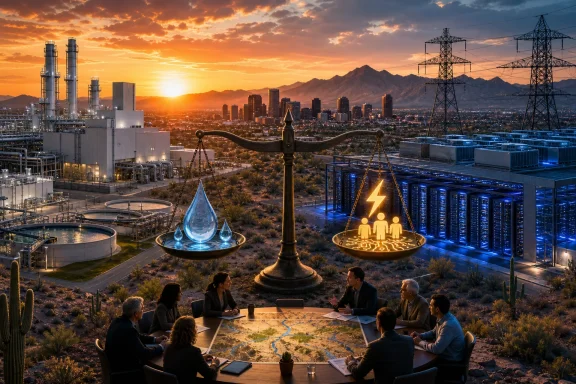
Arizona’s race to become a defining center of American semiconductor manufacturing is sharpening a difficult but necessary debate: when a desert city has limited water, how should it weigh the value of a chip fab against that of an AI data center? The answer is not as simple as comparing headline gallons. Semiconductor fabs can use far more water directly than most data centers, yet they can also reclaim a substantial share of it, support far more permanent jobs, and anchor a wider industrial supply chain. Data centers, meanwhile, may operate with very low on-site water use, but their enormous electricity appetite can shift water demand upstream to power generation.
That distinction matters more than ever in Phoenix, where Taiwan Semiconductor Manufacturing Company’s expanding North Phoenix campus could become one of the city’s largest water customers. The project promises advanced chip capacity, thousands of highly skilled jobs, supplier investment, and a stronger domestic technology base. It also raises a central question for a region living with Colorado River constraints: what counts as responsible water-intensive growth?
The comparison between semiconductor fabs and data centers should not become a simplistic contest in which one industry is declared sustainable and the other is not. Both sectors are essential to the modern computing economy. Every AI server, Windows PC, smartphone, electric vehicle, cloud platform, and industrial automation system depends on semiconductor manufacturing. Every digital service also relies on the data centers that store, process, and deliver information.
But the two industries use water differently, create value differently, and present different risks to local communities.
Public conversations about industrial water demand frequently rely on a single number: gallons withdrawn per day. That figure is useful, but incomplete.
A facility can withdraw water from a municipal system, treat and reuse part of it several times, discharge another portion for treatment, and ultimately consume a smaller amount through evaporation, incorporation into waste streams, or losses that cannot be returned to the local water system. Those are not interchangeable measures.
For Arizona residents, the practical concern is still straightforward: water entering an industrial facility is water that must be available in the city’s supply portfolio. Yet a complete assessment must consider several layers:
A fab is a chemical, materials, precision-manufacturing, wastewater-treatment, and cleanroom operation wrapped around the production of microscopic circuits. A data center is a power-intensive computing facility that turns electricity into digital services and, inevitably, heat. One needs extremely pure water for production; the other needs reliable cooling systems to remove heat from servers.
The distinction is central to any serious discussion of Arizona water policy.
A modern chip travels through hundreds or even thousands of manufacturing steps. During deposition, lithography, etching, ion implantation, cleaning, polishing, and other processes, wafers must be rinsed repeatedly. A contaminant that would be harmless in drinking water can be unacceptable in a process intended to create billions of precisely controlled transistors.
That means fabs need extensive water infrastructure:
Earlier environmental planning for the first three phases of the Arizona operation projected a combined city-water demand of approximately 17.29 million gallons per day at full production. Those figures describe the initial multi-fab buildout, not every potential future expansion scenario now being discussed.
Recent reporting has described a far larger long-term vision, potentially including up to 10 fabs, advanced packaging capacity, and research facilities. However, the company’s publicly available Arizona project material has not always moved in lockstep with the newest expansion figures. That discrepancy is itself important. Water planning cannot rely on broad investment headlines when the scale of construction, manufacturing capacity, and water demand may evolve over time.
Phoenix, TSMC, and the public need updated, facility-specific disclosure as each phase proceeds.
TSMC Arizona has said that approximately 65% of the water used at startup would come through its in-house recycling systems, particularly for applications such as cooling towers and air scrubbers. Its planned industrial water reclamation facility is intended to push reuse and reclamation to 90% or more when it becomes operational.
That is an ambitious and meaningful target. It does not mean a fab becomes water-free. Reclaimed water cannot automatically replace fresh, ultra-pure water in every manufacturing step, and treatment itself requires energy, equipment, chemicals, and careful management of concentrated waste streams.
Still, robust reclamation changes the calculation. A facility that brings in millions of gallons daily but reuses a large portion internally imposes a different long-term burden than a facility that consumes most of its intake once.
This is why industrial pretreatment, monitoring, permitted discharges, and on-site treatment capacity are as important as recycling percentages. A company’s water stewardship claims should be judged not merely by the volume it recycles, but by whether it can safely segregate, treat, reuse, and discharge process water under transparent regulatory oversight.
The need for high-purity production water and high-quality wastewater management is expensive. It is also one reason fabs tend to create a larger permanent operational footprint than data centers.
In Arizona, the trend has increasingly favored cooling approaches that reduce direct water consumption. That is an understandable adaptation to regional scarcity. But low on-site water use does not necessarily mean low overall water impact.
The hotter the weather and the greater the computing load, the more difficult and expensive cooling becomes. AI workloads intensify the issue because GPU-heavy servers can consume far more power per rack than conventional enterprise equipment. Every kilowatt consumed by a server ultimately becomes heat that must be removed.
A data center using evaporative cooling can therefore be a significant direct water consumer. Its demand is influenced by:
However, cooling technology does not erase the facility’s total resource footprint. It moves the question toward electricity.
Data centers consumed about 176 terawatt-hours of electricity in the United States in 2023, representing roughly 4.4% of national electricity consumption. Projections for 2028 span a wide range, but the high end suggests data centers could approach 12% of U.S. electricity use as AI infrastructure expands.
That power must come from somewhere. Depending on the grid mix, electricity generation can have its own water footprint through thermal power plant cooling, fuel extraction, emissions-control processes, and related infrastructure. Renewable resources can reduce operational water needs relative to conventional thermal generation, but they do not remove all lifecycle impacts.
The lesson is clear: a low-water data center is not automatically a low-water digital service. It may simply have less visible water use at its front gate.
WUE is useful, but it should not be treated as a complete sustainability score. A low WUE can result from avoiding water-intensive cooling, yet the same facility may draw extraordinary amounts of electricity from a water-dependent generation mix.
A stronger disclosure standard would include:
This does not mean large water users deserve automatic approval because they are associated with technology. It means public officials should evaluate projects based on measurable local benefits, costs, and alternatives.
TSMC Arizona has more than 3,500 employees associated with its first fab, while the first three fabs are expected to support around 6,000 direct high-tech jobs. The broader economic effect can extend far beyond the fab walls through construction contracts, supplier investment, workforce development, and higher-value technical employment.
That does not excuse inefficient water use. It does explain why cities often view semiconductor manufacturing as a strategically valuable use of a limited resource.
A fab also produces physical goods with geopolitical significance. Domestic capacity for advanced semiconductors affects consumer electronics, automotive production, communications infrastructure, defense supply chains, cloud computing, and the wider Windows PC ecosystem.
But after construction, many data centers employ comparatively few people relative to their size, power demand, and capital cost. A highly automated hyperscale campus may support a relatively small operational workforce compared with a manufacturing site of similar physical scale.
That distinction matters when a city is evaluating a project’s claim on water, power capacity, land, infrastructure spending, and tax incentives.
A useful policy framework asks:
But flexibility is not abundance.
Colorado River supplies remain under continuing pressure, and Arizona’s water future depends on conservation, storage, infrastructure, legal agreements, reduced demand, and the ability to adapt to conditions that may change faster than long-range planning models assumed.
Long-term water security requires ongoing management. It depends on the nature of supplies, delivery infrastructure, demand growth, drought conditions, conservation performance, and future agreements among Colorado River users.
Large industrial projects need to be planned in stages, with updated water assessments rather than blanket assumptions based on early project announcements.
For TSMC’s expansion, the most responsible path is not opposition by reflex or approval by reflex. It is phased accountability.
Each new fab should bring public clarity on:
It is also the kind of investment that should become an expectation for future water-intensive industrial development.
That creates a timing issue. Fabs can ramp production before every long-term water-management asset has reached full performance. Communities should therefore distinguish among:
A company that says it plans to achieve near-zero liquid discharge may be setting an admirable engineering objective. But the public needs independently verifiable data on actual water intake, reclaimed volume, discharge volume, and consumptive losses once systems are operating at scale.
A fab may use reclaimed water for cooling towers, scrubbers, and other utility systems while reserving the highest-quality water for wafer processing. This still reduces demand for fresh municipal supply. But it reinforces why public water accounting must be technically precise.
The ultimate measure is not merely how many times a gallon circulates. It is how much potable or high-quality water the operation requires over time, what happens to the resulting waste streams, and whether the system remains reliable under stress.
The state’s semiconductor fabs and data centers should be viewed as distinct categories, but held to a common principle: the greater the resource demand, the greater the obligation to disclose, conserve, mitigate, and deliver measurable local benefit.
For semiconductor fabs, it means pushing water-reclamation systems beyond voluntary pledges and into verified performance benchmarks.
Semiconductor fabs are direct, visible, high-volume water users. They need ultra-pure water, industrial treatment, and resilient municipal supply. Their environmental burden can be substantial, and future expansion must not be approved on vague assumptions.
At the same time, fabs can support thousands of high-paying jobs, create durable technical ecosystems, and recycle a significant portion of their water when they make the necessary investments. In a national effort to rebuild advanced semiconductor capacity, that economic and strategic value is real.
Data centers can use less water at the site, especially when designed for dry climates. Yet their low direct water consumption can mask enormous electricity demand, which brings its own environmental and water implications. Their permanent job creation is often far smaller than their capital footprint suggests, making careful scrutiny essential when they seek scarce water, grid upgrades, or public incentives.
For Phoenix and other Southwestern communities, the right comparison is not just gallons versus gallons. It is gallons, reuse, energy, jobs, public cost, resilience, and accountability.
The desert cannot afford opaque infrastructure planning. Whether the project is a semiconductor fab producing the chips inside tomorrow’s Windows devices or an AI data center processing the workloads those devices increasingly depend on, the standard should be clear: use water intelligently, prove the numbers, protect the community’s long-term supply, and deliver benefits proportionate to the resources consumed.
That distinction matters more than ever in Phoenix, where Taiwan Semiconductor Manufacturing Company’s expanding North Phoenix campus could become one of the city’s largest water customers. The project promises advanced chip capacity, thousands of highly skilled jobs, supplier investment, and a stronger domestic technology base. It also raises a central question for a region living with Colorado River constraints: what counts as responsible water-intensive growth?
The comparison between semiconductor fabs and data centers should not become a simplistic contest in which one industry is declared sustainable and the other is not. Both sectors are essential to the modern computing economy. Every AI server, Windows PC, smartphone, electric vehicle, cloud platform, and industrial automation system depends on semiconductor manufacturing. Every digital service also relies on the data centers that store, process, and deliver information.
But the two industries use water differently, create value differently, and present different risks to local communities.
 Overview: Why Water Comparisons Often Miss the Point
Public conversations about industrial water demand frequently rely on a single number: gallons withdrawn per day. That figure is useful, but incomplete.A facility can withdraw water from a municipal system, treat and reuse part of it several times, discharge another portion for treatment, and ultimately consume a smaller amount through evaporation, incorporation into waste streams, or losses that cannot be returned to the local water system. Those are not interchangeable measures.
For Arizona residents, the practical concern is still straightforward: water entering an industrial facility is water that must be available in the city’s supply portfolio. Yet a complete assessment must consider several layers:
- Gross water demand: How much water does the site receive?
- Recycling and reuse: How much of that water stays in circulation inside the facility?
- Net consumptive use: How much water is effectively removed from the local system?
- Water quality: Can discharged water be reused, or does it require extensive treatment?
- Energy-related water use: How much water is associated with producing the electricity the facility consumes?
- Economic return: How many jobs, wages, tax revenues, and local suppliers does each unit of water support?
- System resilience: Can the city maintain service during drought, shortages, heat waves, and population growth?
A fab is a chemical, materials, precision-manufacturing, wastewater-treatment, and cleanroom operation wrapped around the production of microscopic circuits. A data center is a power-intensive computing facility that turns electricity into digital services and, inevitably, heat. One needs extremely pure water for production; the other needs reliable cooling systems to remove heat from servers.
The distinction is central to any serious discussion of Arizona water policy.
Semiconductor Fabs: Why Chip Manufacturing Is So Water Intensive
Semiconductor manufacturing is one of the most water-dependent industrial processes in the modern economy. The reason is not ordinary cooling alone. It is the extraordinarily demanding process of making integrated circuits at nanometer-scale precision.Ultra-pure water is a production input
Chip fabrication relies on ultra-pure water, commonly called UPW. It is not ordinary tap water. It must be processed to remove minerals, organic compounds, particles, microbes, and trace contaminants that could damage a wafer or alter microscopic circuit patterns.A modern chip travels through hundreds or even thousands of manufacturing steps. During deposition, lithography, etching, ion implantation, cleaning, polishing, and other processes, wafers must be rinsed repeatedly. A contaminant that would be harmless in drinking water can be unacceptable in a process intended to create billions of precisely controlled transistors.
That means fabs need extensive water infrastructure:
- Municipal water intake systems
- Pre-treatment and filtration equipment
- Ultra-pure water production systems
- Process-water distribution networks
- Cooling-water loops
- Air-scrubber systems
- Industrial wastewater treatment
- Recycling and reclamation systems
- Brine and concentrate management
TSMC Arizona illustrates the scale
The first operating TSMC fab in North Phoenix reportedly uses roughly 5,300 acre-feet of water annually, equivalent to about 1.7 billion gallons per year. In daily terms, that is close to 4.7 million gallons. That is a large number by any reasonable standard, particularly in a fast-growing desert metropolis.Earlier environmental planning for the first three phases of the Arizona operation projected a combined city-water demand of approximately 17.29 million gallons per day at full production. Those figures describe the initial multi-fab buildout, not every potential future expansion scenario now being discussed.
Recent reporting has described a far larger long-term vision, potentially including up to 10 fabs, advanced packaging capacity, and research facilities. However, the company’s publicly available Arizona project material has not always moved in lockstep with the newest expansion figures. That discrepancy is itself important. Water planning cannot rely on broad investment headlines when the scale of construction, manufacturing capacity, and water demand may evolve over time.
Phoenix, TSMC, and the public need updated, facility-specific disclosure as each phase proceeds.
Gross use is not the whole story
The strongest argument in favor of a semiconductor fab’s water profile is its ability to reclaim water. Unlike irrigation, where much of the water is consumed by plants or lost through evaporation, a fab can route certain wastewater streams through advanced treatment systems and reuse the recovered water for suitable on-site purposes.TSMC Arizona has said that approximately 65% of the water used at startup would come through its in-house recycling systems, particularly for applications such as cooling towers and air scrubbers. Its planned industrial water reclamation facility is intended to push reuse and reclamation to 90% or more when it becomes operational.
That is an ambitious and meaningful target. It does not mean a fab becomes water-free. Reclaimed water cannot automatically replace fresh, ultra-pure water in every manufacturing step, and treatment itself requires energy, equipment, chemicals, and careful management of concentrated waste streams.
Still, robust reclamation changes the calculation. A facility that brings in millions of gallons daily but reuses a large portion internally imposes a different long-term burden than a facility that consumes most of its intake once.
Fabs also have a water-quality challenge
Water quantity is only one side of the equation. Semiconductor fabrication uses acids, bases, solvents, specialty gases, metals, and other materials in carefully controlled industrial processes. The final chips do not contain most of those manufacturing chemicals, but the production process generates wastewater that must be handled responsibly.This is why industrial pretreatment, monitoring, permitted discharges, and on-site treatment capacity are as important as recycling percentages. A company’s water stewardship claims should be judged not merely by the volume it recycles, but by whether it can safely segregate, treat, reuse, and discharge process water under transparent regulatory oversight.
The need for high-purity production water and high-quality wastewater management is expensive. It is also one reason fabs tend to create a larger permanent operational footprint than data centers.
Data Centers: Lower Direct Water Use, Enormous Energy Demand
The water profile of a data center is more varied than the public debate often suggests. A cloud facility can use very little municipal water on-site, or it can use substantial water through cooling towers, depending on its design, local climate, server density, and power requirements.In Arizona, the trend has increasingly favored cooling approaches that reduce direct water consumption. That is an understandable adaptation to regional scarcity. But low on-site water use does not necessarily mean low overall water impact.
The direct-water model depends on cooling
Traditional data center cooling can rely on chilled-water systems and evaporative cooling towers. In those setups, water helps move heat away from servers, and a portion is evaporated to reject that heat into the atmosphere.The hotter the weather and the greater the computing load, the more difficult and expensive cooling becomes. AI workloads intensify the issue because GPU-heavy servers can consume far more power per rack than conventional enterprise equipment. Every kilowatt consumed by a server ultimately becomes heat that must be removed.
A data center using evaporative cooling can therefore be a significant direct water consumer. Its demand is influenced by:
- Server power density
- Facility size
- Outdoor temperature
- Humidity levels
- Cooling-tower efficiency
- Water chemistry
- Cycles of concentration
- Use of air cooling, liquid cooling, or hybrid designs
- Workload intensity and operating hours
Air cooling reduces one burden but not every burden
Some Arizona data center operators are choosing air-cooled or low-water cooling systems specifically because of local water concerns. That is a positive development. It can sharply reduce the amount of potable water consumed at the site.However, cooling technology does not erase the facility’s total resource footprint. It moves the question toward electricity.
Data centers consumed about 176 terawatt-hours of electricity in the United States in 2023, representing roughly 4.4% of national electricity consumption. Projections for 2028 span a wide range, but the high end suggests data centers could approach 12% of U.S. electricity use as AI infrastructure expands.
That power must come from somewhere. Depending on the grid mix, electricity generation can have its own water footprint through thermal power plant cooling, fuel extraction, emissions-control processes, and related infrastructure. Renewable resources can reduce operational water needs relative to conventional thermal generation, but they do not remove all lifecycle impacts.
The lesson is clear: a low-water data center is not automatically a low-water digital service. It may simply have less visible water use at its front gate.
Water Usage Effectiveness needs wider adoption
Data center operators often use a metric called Water Usage Effectiveness, or WUE. In simplified terms, it measures how much water a facility uses relative to the energy consumed by its IT equipment.WUE is useful, but it should not be treated as a complete sustainability score. A low WUE can result from avoiding water-intensive cooling, yet the same facility may draw extraordinary amounts of electricity from a water-dependent generation mix.
A stronger disclosure standard would include:
- Annual potable-water withdrawals
- Annual non-potable and reclaimed-water use
- Estimated consumptive water use
- Cooling design and seasonal operating strategy
- WUE, reported consistently
- Power Usage Effectiveness, or PUE
- Electricity source and hourly clean-energy matching
- Estimated indirect water footprint of energy supply
- Peak-demand impact on the local grid
- Public reporting of changes as AI capacity expands
The Economic Return on Water Is Not Equal
Water policy is not only about who uses the fewest gallons. It is also about what each gallon enables for the community.This does not mean large water users deserve automatic approval because they are associated with technology. It means public officials should evaluate projects based on measurable local benefits, costs, and alternatives.
Semiconductor fabs have a deeper employment footprint
A leading-edge fab requires engineers, technicians, equipment specialists, facilities staff, environmental and safety professionals, logistics workers, construction trades, suppliers, and service firms. It also tends to attract adjacent companies that provide chemicals, gases, tools, testing, packaging, maintenance, training, and design support.TSMC Arizona has more than 3,500 employees associated with its first fab, while the first three fabs are expected to support around 6,000 direct high-tech jobs. The broader economic effect can extend far beyond the fab walls through construction contracts, supplier investment, workforce development, and higher-value technical employment.
That does not excuse inefficient water use. It does explain why cities often view semiconductor manufacturing as a strategically valuable use of a limited resource.
A fab also produces physical goods with geopolitical significance. Domestic capacity for advanced semiconductors affects consumer electronics, automotive production, communications infrastructure, defense supply chains, cloud computing, and the wider Windows PC ecosystem.
Data centers can create outsized tax value but fewer jobs
Data centers provide essential cloud, enterprise, AI, and internet infrastructure. They can generate construction activity, property-tax revenue, and demand for network, electrical, and facilities services. They can also strengthen a region’s reputation as a technology hub.But after construction, many data centers employ comparatively few people relative to their size, power demand, and capital cost. A highly automated hyperscale campus may support a relatively small operational workforce compared with a manufacturing site of similar physical scale.
That distinction matters when a city is evaluating a project’s claim on water, power capacity, land, infrastructure spending, and tax incentives.
A useful policy framework asks:
- How much water is required at full operation?
- How much water is consumed rather than recycled or returned?
- What is the project’s electricity demand, including peak load?
- How many permanent, local jobs will it create?
- What wages and training opportunities accompany those jobs?
- Does it build a supplier ecosystem or operate largely as a self-contained facility?
- What tax incentives, utility upgrades, and public investments are required?
- Does the project use potable water when reclaimed water would be viable?
- What happens if regional water availability worsens?
- Are performance commitments enforceable after approval?
Arizona’s Water Reality Changes the Stakes
Phoenix has a diversified water portfolio that includes Salt and Verde River supplies, Colorado River deliveries through the Central Arizona Project, limited groundwater use, reclaimed water, long-term storage, and other arrangements. That diversity gives the city more flexibility than many communities in the Southwest.But flexibility is not abundance.
Colorado River supplies remain under continuing pressure, and Arizona’s water future depends on conservation, storage, infrastructure, legal agreements, reduced demand, and the ability to adapt to conditions that may change faster than long-range planning models assumed.
Assured supply is not a blank check
Arizona’s assured water supply framework is designed to ensure that designated providers can demonstrate long-term availability for planned development. That system is important, but a 100-year planning standard should not be mistaken for a guarantee that no difficult trade-offs will arise.Long-term water security requires ongoing management. It depends on the nature of supplies, delivery infrastructure, demand growth, drought conditions, conservation performance, and future agreements among Colorado River users.
Large industrial projects need to be planned in stages, with updated water assessments rather than blanket assumptions based on early project announcements.
For TSMC’s expansion, the most responsible path is not opposition by reflex or approval by reflex. It is phased accountability.
Each new fab should bring public clarity on:
- Expected gross municipal-water demand
- Planned recycling and reclamation rate
- Expected net consumptive use
- Water source and drought-contingency arrangements
- Wastewater-treatment capacity
- Energy demand and clean-power strategy
- Job commitments and local hiring outcomes
- Community and infrastructure investments
- Actual performance against prior projections
Reclamation Is a Strength, Not a Substitute for Limits
TSMC’s planned effort to reclaim 90% or more of its water is one of the strongest elements of its Arizona sustainability case. High-rate industrial reclamation is technically challenging, capital intensive, and especially relevant in a desert market.It is also the kind of investment that should become an expectation for future water-intensive industrial development.
The risk of relying on a future target
A stated recycling target is not the same as demonstrated operational performance. The planned industrial reclamation plant is expected to become operational in 2028, meaning the facility’s near-term water profile and its later profile will not be identical.That creates a timing issue. Fabs can ramp production before every long-term water-management asset has reached full performance. Communities should therefore distinguish among:
- Current water use
- Permitted water capacity
- Projected full-buildout demand
- Current reuse rates
- Commissioned reclamation capacity
- Future recycling targets
A company that says it plans to achieve near-zero liquid discharge may be setting an admirable engineering objective. But the public needs independently verifiable data on actual water intake, reclaimed volume, discharge volume, and consumptive losses once systems are operating at scale.
Reuse has practical limits
Not all reclaimed water can become ultra-pure process water again. Reuse depends on the contaminants involved, the quality required for the next application, the cost of treatment, and the waste concentrates generated by filtration and reverse-osmosis systems.A fab may use reclaimed water for cooling towers, scrubbers, and other utility systems while reserving the highest-quality water for wafer processing. This still reduces demand for fresh municipal supply. But it reinforces why public water accounting must be technically precise.
The ultimate measure is not merely how many times a gallon circulates. It is how much potable or high-quality water the operation requires over time, what happens to the resulting waste streams, and whether the system remains reliable under stress.
A Better Standard for Semiconductor Fabs and Data Centers
Arizona does not need to choose between the digital economy and water stewardship. It needs rules that make advanced infrastructure earn its place.The state’s semiconductor fabs and data centers should be viewed as distinct categories, but held to a common principle: the greater the resource demand, the greater the obligation to disclose, conserve, mitigate, and deliver measurable local benefit.
Minimum expectations for major industrial users
A modern approval and accountability framework should include the following requirements:- Public water budgets showing average and peak demand.
- Separate reporting for withdrawals, reuse, discharge, and consumption.
- Mandatory use of reclaimed water where technically feasible.
- Cooling-system disclosure for data centers, including seasonal water use.
- Independent verification of recycling and reclamation claims.
- Tiered conservation requirements that tighten during shortage conditions.
- No open-ended potable-water commitments without periodic review.
- Energy and water co-planning for high-load facilities.
- Transparent incentive agreements tied to jobs, investment, and conservation outcomes.
- Community-benefit commitments for workforce training, local hiring, and infrastructure support.
For semiconductor fabs, it means pushing water-reclamation systems beyond voluntary pledges and into verified performance benchmarks.
What the Comparison Ultimately Reveals
The most important conclusion is not that fabs are good and data centers are bad, or that data centers are efficient and fabs are wasteful. The reality is more demanding.Semiconductor fabs are direct, visible, high-volume water users. They need ultra-pure water, industrial treatment, and resilient municipal supply. Their environmental burden can be substantial, and future expansion must not be approved on vague assumptions.
At the same time, fabs can support thousands of high-paying jobs, create durable technical ecosystems, and recycle a significant portion of their water when they make the necessary investments. In a national effort to rebuild advanced semiconductor capacity, that economic and strategic value is real.
Data centers can use less water at the site, especially when designed for dry climates. Yet their low direct water consumption can mask enormous electricity demand, which brings its own environmental and water implications. Their permanent job creation is often far smaller than their capital footprint suggests, making careful scrutiny essential when they seek scarce water, grid upgrades, or public incentives.
For Phoenix and other Southwestern communities, the right comparison is not just gallons versus gallons. It is gallons, reuse, energy, jobs, public cost, resilience, and accountability.
The desert cannot afford opaque infrastructure planning. Whether the project is a semiconductor fab producing the chips inside tomorrow’s Windows devices or an AI data center processing the workloads those devices increasingly depend on, the standard should be clear: use water intelligently, prove the numbers, protect the community’s long-term supply, and deliver benefits proportionate to the resources consumed.
References
- Primary source: AZ Family
Published: 2026-07-23T03:11:04+00:00
Loading…
www.azfamily.com - Related coverage: news.azpm.org
Loading…
news.azpm.org - Related coverage: thecooldown.com
Loading…
www.thecooldown.com - Related coverage: tomshardware.com
Loading…
www.tomshardware.com - Related coverage: axios.com
Loading…
www.axios.com - Related coverage: energyanalysis.lbl.gov
Loading…
energyanalysis.lbl.gov