

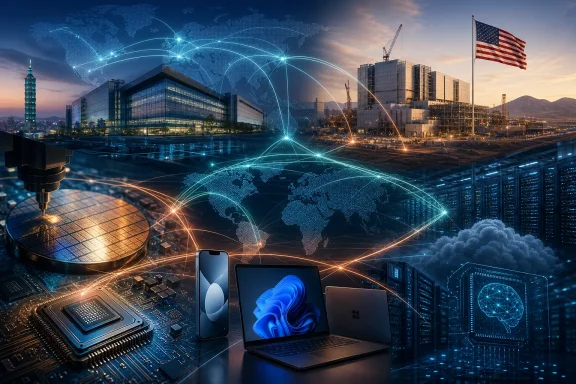
The United States invented the semiconductor industry, but Taiwan now sits at the center of the supply chain producing the processors behind smartphones, PCs, cloud infrastructure, and artificial intelligence. A new Business Insider explainer published July 13 traces that reversal through Intel’s missed mobile opportunity and the rise of Taiwan Semiconductor Manufacturing Company, while the US pours public and private money into rebuilding advanced manufacturing at home.
The headline number captures the scale of the shift. TSMC controlled roughly 70% of the global contract-foundry market by late 2025, according to TrendForce, and its position has remained formidable as AI accelerator demand strains leading-edge production capacity. That concentration means many ostensibly competing products—from Apple devices to AMD processors and Nvidia GPUs—ultimately depend on manufacturing technology operated by the same Taiwanese company.
For Windows users and enterprise IT, this is not an abstract industrial-policy dispute. Processor availability affects PC pricing, server deployments, cloud capacity, and how quickly new AI hardware reaches production. The US effort to catch up is therefore less about reclaiming a historical title than reducing the risk attached to one highly concentrated and geopolitically exposed supply chain.
American companies established the foundations of the modern semiconductor business. Intel, founded in California in 1968, became particularly influential by combining chip design with manufacturing and supplying the x86 processors around which the PC software ecosystem developed.
That integration was a powerful advantage during the expansion of personal computing. Intel could create a processor, refine the manufacturing process used to build it, and sell the resulting platform to PC manufacturers. The “Intel Inside” campaign turned a component manufacturer into a consumer-facing brand, while Windows software reinforced demand for compatible x86 hardware.
By the 1990s, Intel had become the world’s largest semiconductor manufacturer. Its factories, engineering teams, and product road maps were built around a market in which increasingly powerful desktop and notebook processors represented the industry’s center of gravity.
The problem was not that PCs disappeared. It was that another enormous computing market emerged with different requirements.
Smartphones needed processors optimized for battery life, thermal efficiency, wireless connectivity, and compact system-on-chip designs. The companies best positioned for that transition were not necessarily those with the most successful PC factories, but those able to manufacture many customers’ specialized designs and rapidly adopt new production technologies.
Intel was reportedly offered the opportunity to produce silicon for Apple’s original iPhone. Former CEO Paul Otellini later acknowledged that Intel declined because its financial estimates did not justify Apple’s proposed price, an assessment made before anyone knew how many iPhones Apple would sell.
The decision became one of the technology industry’s most consequential missed opportunities. More importantly, it illustrated how a business optimized around controlling both product design and manufacturing could struggle to accommodate an outside customer with unfamiliar economics and requirements.
That separation helped enable the rise of fabless chip designers. Companies could concentrate their resources on processor architecture, graphics, networking, or mobile systems without spending tens of billions of dollars on fabrication plants and manufacturing equipment.
TSMC, meanwhile, could spread the extraordinary cost of each new manufacturing generation across orders from numerous customers. The more chip designers it attracted, the more money it could invest in equipment, process development, and manufacturing capacity. Better processes attracted still more customers, creating a reinforcing cycle that became increasingly difficult for competitors to interrupt.
Taiwan also cultivated the broader ecosystem required to sustain that model. Semiconductor production depends on far more than a factory shell: suppliers, materials, precision equipment, packaging, testing, engineers, technicians, utilities, and manufacturing knowledge must work together with exceptionally low tolerance for error.
That ecosystem became a strategic asset. A company can purchase similar lithography equipment or announce a factory using the same nominal process size, but it cannot instantly reproduce decades of operating experience, supplier coordination, and improvements in yield—the percentage of usable chips obtained from each wafer.
TSMC’s role expanded with the smartphone market and then grew again with AI. Apple, AMD, Nvidia, Qualcomm, and other leading designers rely on outside manufacturing, while increasingly complex AI processors also require sophisticated packaging to connect compute dies and high-bandwidth memory.
The foundry is consequently involved in more than etching smaller transistors. Advanced packaging capacity has become another potential bottleneck, especially for the accelerators filling AI data centers and powering services that eventually surface in Windows applications and Microsoft’s cloud.
The Semiconductor Industry Association estimates that the US share of global chip-manufacturing capacity fell from 37% in 1990 to about 10% in 2022. The country remained strong in chip design, manufacturing equipment, and software, but much of the physical production had shifted to East Asia.
Federal awards have supported projects from Intel, Samsung, Micron, GlobalFoundries, and TSMC. Yet the most revealing part of the strategy is that Washington is paying a Taiwanese manufacturer to bring its expertise to Arizona.
TSMC’s first Arizona fab began high-volume production using its N4 process in the fourth quarter of 2024. The company says its second fab is targeting N3 production in the second half of 2027, while a third facility planned for N2 and A16 technologies is expected to enter production by the end of the decade.
The US Department of Commerce finalized up to $6.6 billion in direct CHIPS funding for the initial three-fab project, alongside access to as much as $5 billion in loans. TSMC has since outlined a broader US expansion that includes additional fabs, advanced-packaging facilities, and an R&D center.
Intel remains central to the domestic strategy as well. Its foundry ambitions are meant to restore the company’s manufacturing leadership while opening its factories to external chip designers—the customer-oriented model that helped TSMC overtake it.
Building fabs, however, does not guarantee competitive output. Intel and other US manufacturers must deliver viable process technology on schedule, secure enough customers to keep expensive facilities busy, and achieve production yields that make their chips economical. Delays measured in quarters can allow rivals to capture an entire product generation.
New US fabs also need packaging, testing, chemicals, equipment servicing, and a durable technical workforce. The Semiconductor Industry Association has projected that tens of thousands of American semiconductor jobs could go unfilled by 2030 without expanded training and immigration pathways.
Cost is another constraint. US construction, labor, regulation, and supply-chain expenses can make domestic manufacturing more expensive than production in Taiwan. Subsidies can help establish capacity, but factories must eventually support commercially sustainable products rather than exist primarily as insurance against a crisis.
Nor does reshoring eliminate international dependence. Advanced semiconductor production relies on equipment and materials sourced across the United States, Europe, and Asia. Resilience is not the same as self-sufficiency; the practical goal is to create enough geographic diversity that a disruption in one region does not immobilize the global technology industry.
For PC buyers and IT departments, the race will play out gradually rather than through a single breakthrough. Arizona-made processors may enter consumer devices and data centers, Intel may regain manufacturing customers, and advanced packaging may spread across more locations. But through at least the latter half of this decade, the road maps for Windows PCs, AI servers, and cloud platforms will continue to be shaped heavily by manufacturing decisions made in Taiwan.
The US has started rebuilding the industrial capacity it allowed to erode. The unresolved test is whether it can turn new buildings and subsidies into a self-sustaining manufacturing ecosystem before the next supply shock—or geopolitical crisis—demonstrates why that capacity was needed.
The headline number captures the scale of the shift. TSMC controlled roughly 70% of the global contract-foundry market by late 2025, according to TrendForce, and its position has remained formidable as AI accelerator demand strains leading-edge production capacity. That concentration means many ostensibly competing products—from Apple devices to AMD processors and Nvidia GPUs—ultimately depend on manufacturing technology operated by the same Taiwanese company.
For Windows users and enterprise IT, this is not an abstract industrial-policy dispute. Processor availability affects PC pricing, server deployments, cloud capacity, and how quickly new AI hardware reaches production. The US effort to catch up is therefore less about reclaiming a historical title than reducing the risk attached to one highly concentrated and geopolitically exposed supply chain.
 Intel Built the Model That the PC Era Rewarded
American companies established the foundations of the modern semiconductor business. Intel, founded in California in 1968, became particularly influential by combining chip design with manufacturing and supplying the x86 processors around which the PC software ecosystem developed.That integration was a powerful advantage during the expansion of personal computing. Intel could create a processor, refine the manufacturing process used to build it, and sell the resulting platform to PC manufacturers. The “Intel Inside” campaign turned a component manufacturer into a consumer-facing brand, while Windows software reinforced demand for compatible x86 hardware.
By the 1990s, Intel had become the world’s largest semiconductor manufacturer. Its factories, engineering teams, and product road maps were built around a market in which increasingly powerful desktop and notebook processors represented the industry’s center of gravity.
The problem was not that PCs disappeared. It was that another enormous computing market emerged with different requirements.
Smartphones needed processors optimized for battery life, thermal efficiency, wireless connectivity, and compact system-on-chip designs. The companies best positioned for that transition were not necessarily those with the most successful PC factories, but those able to manufacture many customers’ specialized designs and rapidly adopt new production technologies.
Intel was reportedly offered the opportunity to produce silicon for Apple’s original iPhone. Former CEO Paul Otellini later acknowledged that Intel declined because its financial estimates did not justify Apple’s proposed price, an assessment made before anyone knew how many iPhones Apple would sell.
The decision became one of the technology industry’s most consequential missed opportunities. More importantly, it illustrated how a business optimized around controlling both product design and manufacturing could struggle to accommodate an outside customer with unfamiliar economics and requirements.
TSMC Sold Manufacturing Without Competing With Its Customers
TSMC’s breakthrough was as much about its business model as its location. Established in 1987, the company pioneered the pure-play foundry: it manufactured chips designed by other companies instead of building a large portfolio of processors that competed against those customers.That separation helped enable the rise of fabless chip designers. Companies could concentrate their resources on processor architecture, graphics, networking, or mobile systems without spending tens of billions of dollars on fabrication plants and manufacturing equipment.
TSMC, meanwhile, could spread the extraordinary cost of each new manufacturing generation across orders from numerous customers. The more chip designers it attracted, the more money it could invest in equipment, process development, and manufacturing capacity. Better processes attracted still more customers, creating a reinforcing cycle that became increasingly difficult for competitors to interrupt.
Taiwan also cultivated the broader ecosystem required to sustain that model. Semiconductor production depends on far more than a factory shell: suppliers, materials, precision equipment, packaging, testing, engineers, technicians, utilities, and manufacturing knowledge must work together with exceptionally low tolerance for error.
That ecosystem became a strategic asset. A company can purchase similar lithography equipment or announce a factory using the same nominal process size, but it cannot instantly reproduce decades of operating experience, supplier coordination, and improvements in yield—the percentage of usable chips obtained from each wafer.
TSMC’s role expanded with the smartphone market and then grew again with AI. Apple, AMD, Nvidia, Qualcomm, and other leading designers rely on outside manufacturing, while increasingly complex AI processors also require sophisticated packaging to connect compute dies and high-bandwidth memory.
The foundry is consequently involved in more than etching smaller transistors. Advanced packaging capacity has become another potential bottleneck, especially for the accelerators filling AI data centers and powering services that eventually surface in Windows applications and Microsoft’s cloud.
America’s Catch-Up Plan Starts With Factories, Not Independence
The US response accelerated after pandemic-era shortages demonstrated how semiconductor disruptions could halt industries far beyond consumer electronics. Congress enacted the CHIPS and Science Act in 2022, providing manufacturing incentives and research support intended to reverse a long decline in domestic production.The Semiconductor Industry Association estimates that the US share of global chip-manufacturing capacity fell from 37% in 1990 to about 10% in 2022. The country remained strong in chip design, manufacturing equipment, and software, but much of the physical production had shifted to East Asia.
Federal awards have supported projects from Intel, Samsung, Micron, GlobalFoundries, and TSMC. Yet the most revealing part of the strategy is that Washington is paying a Taiwanese manufacturer to bring its expertise to Arizona.
TSMC’s first Arizona fab began high-volume production using its N4 process in the fourth quarter of 2024. The company says its second fab is targeting N3 production in the second half of 2027, while a third facility planned for N2 and A16 technologies is expected to enter production by the end of the decade.
The US Department of Commerce finalized up to $6.6 billion in direct CHIPS funding for the initial three-fab project, alongside access to as much as $5 billion in loans. TSMC has since outlined a broader US expansion that includes additional fabs, advanced-packaging facilities, and an R&D center.
Intel remains central to the domestic strategy as well. Its foundry ambitions are meant to restore the company’s manufacturing leadership while opening its factories to external chip designers—the customer-oriented model that helped TSMC overtake it.
Building fabs, however, does not guarantee competitive output. Intel and other US manufacturers must deliver viable process technology on schedule, secure enough customers to keep expensive facilities busy, and achieve production yields that make their chips economical. Delays measured in quarters can allow rivals to capture an entire product generation.
Geographic Diversity Will Not Duplicate Taiwan Overnight
The Arizona investments are significant, but they do not amount to a quick transfer of the semiconductor center of gravity. TSMC continues to develop and operate extensive capacity in Taiwan, where its suppliers, engineering talent, and most mature manufacturing network remain concentrated.New US fabs also need packaging, testing, chemicals, equipment servicing, and a durable technical workforce. The Semiconductor Industry Association has projected that tens of thousands of American semiconductor jobs could go unfilled by 2030 without expanded training and immigration pathways.
Cost is another constraint. US construction, labor, regulation, and supply-chain expenses can make domestic manufacturing more expensive than production in Taiwan. Subsidies can help establish capacity, but factories must eventually support commercially sustainable products rather than exist primarily as insurance against a crisis.
Nor does reshoring eliminate international dependence. Advanced semiconductor production relies on equipment and materials sourced across the United States, Europe, and Asia. Resilience is not the same as self-sufficiency; the practical goal is to create enough geographic diversity that a disruption in one region does not immobilize the global technology industry.
For PC buyers and IT departments, the race will play out gradually rather than through a single breakthrough. Arizona-made processors may enter consumer devices and data centers, Intel may regain manufacturing customers, and advanced packaging may spread across more locations. But through at least the latter half of this decade, the road maps for Windows PCs, AI servers, and cloud platforms will continue to be shaped heavily by manufacturing decisions made in Taiwan.
The US has started rebuilding the industrial capacity it allowed to erode. The unresolved test is whether it can turn new buildings and subsidies into a self-sustaining manufacturing ecosystem before the next supply shock—or geopolitical crisis—demonstrates why that capacity was needed.
References
- Primary source: LinkedIn
Published: 2026-07-13T18:50:09.757907
The world's most advanced chips power everything from smartphones to AI. Here's how Taiwan became the center of that industry — and why the US is racing to catch up. Senior producer Olivia Nemec… | Business Insider
The world's most advanced chips power everything from smartphones to AI. Here's how Taiwan became the center of that industry — and why the US is racing to catch up. Senior producer Olivia Nemec explains.www.linkedin.com
- Related coverage: tomshardware.com
Apple reportedly strikes deal for Intel to make some of its chips — two tech giants reached a preliminary agreement for Intel to make processors for Cupertino | Tom's Hardware
We don't know which chips Intel will be making, but it's a good sign for Lip-Bu Tan regardless.www.tomshardware.com - Related coverage: lemonde.fr
'Taiwan has become essential for the world's future,' says François Wu, deputy foreign minister
Two weeks before US President Donald Trump is due to visit Beijing, on May 14 and 15, Taiwanese Deputy Foreign Minister François Wu Chih-chung emphasized Taiwan's increasingly strategic position and the 'useful' global role it can play.www.lemonde.fr
