

AI tools have moved from experiment to everyday practice in many UAE classrooms — but the rollout is emphatically supervised, governed by data-protection guardrails, and taught as a set of thinking skills, not a shortcut to answers.
Across the UAE, private schools are actively integrating generative AI into teaching and learning, yet the way they do it varies sharply by age group, vendor, and local policy interpretation. Over the past 12 months national and emirate-level authorities and large vendors have tightened the compliance frame for educational AI: Ministries and education authorities have published guidance and partnerships focused on responsible use; major technology providers have announced local data‑processing and education‑grade offerings; and school leaders have responded by creating tightly controlled, teacher-led deployment models.
This is not a wild west. Multiple Emirati education stakeholders — from the federal Ministry of Education to regional regulators and major vendors — are explicitly treating generative models as powerful tools that require governance, curriculum alignment, and teacher professional development. At the same time, front-line schools emphasize intentionality: what matters is not simply whether a student can access a chatbot, but how that access is structured to build critical thinking, ethical judgement, and digital literacy.
Meanwhile, emirate-level agencies are investing in capacity-building. Dubai’s education regulator has launched partnerships and pilots to build AI literacy for both students and teachers, including multiyear collaborations with international research groups and private partners to embed responsible AI learning across core subjects. The emphasis from regulators is consistent: scale AI literacy while protecting student wellbeing and data.
Best practices emerging at school level include:
The path ahead is not risk‑free. Assessment design, vendor governance, equitable access, and the avoidance of over‑automation remain open challenges. But with clear policies, shared procurement mechanisms, scaled teacher training, and transparent vendor commitments, schools can make AI a tool that strengthens learning while protecting the rights and wellbeing of students.
If the last two years have taught educators anything, it is this: the question is not whether AI will be used in schools — it already is — but whether it will be used wisely. The UAE’s emerging practice shows that with deliberate policy, technical controls, and classroom-level pedagogy focused on critical thinking, the answer can be yes.
Source: Menafn.com Chatgpt, Gemini In UAE Classrooms: How Schools Teach Safe, Responsible AI Use
 Background
Across the UAE, private schools are actively integrating generative AI into teaching and learning, yet the way they do it varies sharply by age group, vendor, and local policy interpretation. Over the past 12 months national and emirate-level authorities and large vendors have tightened the compliance frame for educational AI: Ministries and education authorities have published guidance and partnerships focused on responsible use; major technology providers have announced local data‑processing and education‑grade offerings; and school leaders have responded by creating tightly controlled, teacher-led deployment models.This is not a wild west. Multiple Emirati education stakeholders — from the federal Ministry of Education to regional regulators and major vendors — are explicitly treating generative models as powerful tools that require governance, curriculum alignment, and teacher professional development. At the same time, front-line schools emphasize intentionality: what matters is not simply whether a student can access a chatbot, but how that access is structured to build critical thinking, ethical judgement, and digital literacy.
How the UAE’s education ecosystem is shaping AI in schools
National and emirate-level policy context
Recent government-level activity has set clear expectations that generative AI must be controlled in school environments. National guidance issued in 2026 articulates age-based restrictions, bans on AI during formal assessments, and the requirement that AI tools be used within teacher-supervised frameworks. These rules put academic integrity, cultural values, and student safeguarding front and center.Meanwhile, emirate-level agencies are investing in capacity-building. Dubai’s education regulator has launched partnerships and pilots to build AI literacy for both students and teachers, including multiyear collaborations with international research groups and private partners to embed responsible AI learning across core subjects. The emphasis from regulators is consistent: scale AI literacy while protecting student wellbeing and data.
Vendor and platform moves that matter
The vendor landscape for education AI is evolving fast, and several developments materially affect how schools can adopt tools:- Major productivity vendors have introduced education-focused, tenant‑controlled AI services that can operate inside a school’s cloud tenancy or within the country, reducing cross-border data flow concerns.
- Dedicated school‑grade platforms appear with explicit privacy claims (SOC 2, non‑training of models on student inputs, COPPA/FERPA alignment) to make safer student interactions possible.
- Traditional consumer-facing chatbots remain in use, but mostly under staff-only access or strict teacher supervision in classrooms.
What schools are actually doing in classrooms
A consistent pattern: teacher-led, age-sensitive deployment
Conversations with school leaders across Dubai and the Northern Emirates reveal a recurring approach: AI is introduced in stages.- Early years and lower primary: No independent access to public generative AI. Educators use teacher-created resources and pedagogy that do not rely on student‑facing chatbots.
- Upper primary and lower secondary: Controlled, group-based activities with educator-moderated prompts and structured tasks that teach students how to formulate questions, check outputs, and identify bias.
- Secondary and higher grades: Supervised individual use for research, coding, creative projects, and media literacy lessons — always with explicit instructions on verification, citation, and disclosure.
Platform selection and internal due diligence
Because regulators and school regulators have not published a single prescriptive “approved list” of third-party models for every school, many institutions perform internal reviews before adopting a tool. These due-diligence checks typically assess:- Data residency and processing practices
- Whether vendor terms permit student data to be used for model training
- Security certifications (SOC 2, ISO 27001)
- Age-appropriate content filtering and moderation
- Integration with school identity systems (SSO, Role-Based Access Control)
- Vendor willingness to sign education-specific data protection agreements
Classroom practice: prompts, prompts, prompts
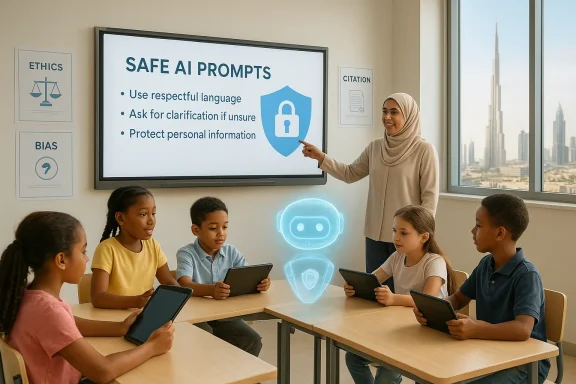
Teachers are not only gatekeepers — they are teaching how to ask AI to be useful and safe. Instructional focus includes:- Ethical prompting: framing questions so outputs respect cultural and value-based boundaries.
- Bias and source awareness: understanding model tendencies and why outputs can be misleading.
- Fact-checking and citation practice: students must verify model claims against trusted references and cite AI‑generated assistance when it informs their work.
- Metacognitive habits: using AI as a thinking partner, not as a substitute for learning or reflection.
Technical and legal safeguards schools must get right
Student data protection is non‑negotiable
Schools in the UAE are operating within a changing privacy landscape. National data-protection legislation and education-sector advisory guidance require schools to know what personal data they collect, where it’s stored, and whether third-party services (including AI vendors) have access.Best practices emerging at school level include:
- Using school-managed accounts for any tool with generative features.
- Running Data Protection Impact Assessments (DPIAs) when deploying new AI services that could process student data.
- Ensuring vendors explicitly do not use student inputs to retrain models (or that they provide opt-out and contractual protections).
- Restricting entry of any personally identifiable information or sensitive health/behavioural data into public models.
Technical controls and local processing
Several practical controls are being used to reduce risk:- In‑country or tenant‑scoped processing for sensitive operations, where vendors offer local data-processing options that reduce the need for cross-border transfers.
- Network-level controls like web filtering, DLP (data loss prevention), and blocking of public AI sites on school-managed devices.
- Identity and device management to ensure only teachers can create or control student AI sessions.
The pedagogical promise: what AI can improve
AI in school settings, when implemented carefully, can accelerate several positive outcomes:- More personalised learning: adaptive generators and scaffolded content can help differentiate tasks for students across ability bands.
- Teacher efficiency: teachers report that AI tools speed up lesson planning, resource generation, and formative assessment analysis, freeing time for relationship-building.
- Improved digital literacy: structured AI lessons give students practical experience evaluating sources, interrogating algorithmic outputs, and making ethical judgements.
- New curricular pathways: AI projects provide authentic contexts for learning computational thinking, data literacy, and cross-disciplinary problem-solving.
Major risks and practical gaps that remain
Even with cautious rollout, several structural risks must be acknowledged and actively managed.1) Assessment and academic integrity
Generative AI can obfuscate authorship, prompting an urgent need to redesign assessment. If conventional essays and rote tasks remain the default, students may be incentivised to present AI‑produced work as their own.- Schools must update assessment formats to focus on process, reflection, and in‑class demonstrations of understanding.
- Clear policies are required on disclosure and citation of AI assistance.
2) False confidence and misinformation
Large language models are fluent but not infallible. Students can take plausible‑sounding responses as fact.- Schools need structured verification workflows in every AI lesson.
- Teachers must model cross-referencing outputs against curriculum-validated sources.
3) Data exposure and vendor dependence
Even with contractual protections, the long-term privacy posture of cloud AI vendors can change. The risk increases if student inputs, classroom recordings, or assessment data flow into vendor systems without robust contractual and technical safeguards.- Institutions must insist on data-residency options, non-training clauses, and audit rights within vendor contracts.
- Schools should prefer tools that explicitly state they do not use student data to train models.
4) Unequal access and capability gaps
AI can widen inequality: better-resourced schools can afford in-country, managed deployments and staff training; smaller schools may be left to choose between no AI or risky consumer-grade access.- Capacity-building programs and shared procurement frameworks are needed to level the playing field.
- Regulators and larger school groups can help by negotiating education‑grade contracts and training packages.
5) Over-reliance on automation in pastoral work
AI can analyse patterns in assessment data or attendance, but it cannot replace human judgement about wellbeing and motivations. Schools uniformly cite that human interpretation of context, behaviour, and wellbeing remains irreplaceable.Practical checklist for schools adopting generative AI
To move from ad-hoc experiments to robust, repeatable practice, institutions should consider the following steps:- Define educational purpose: state the learning outcomes AI will support, and how success will be measured.
- Conduct a DPIA: map data flows, risks, and mitigation strategies before any tool is approved.
- Select vendors on a security and privacy basis: prioritise SOC-compliant, education-focused providers that offer non‑training guarantees and local processing options.
- Build identity and access controls: ensure SSO, role-based permissions, and device management are enforced.
- Train staff: invest in professional learning for ethical prompting, verifying outputs, and redesigning assessments.
- Update policies: what counts as plagiarism, what must be disclosed, and how to handle suspected misuse should be explicit and communicated to students and parents.
- Run pilots and evaluate: scale via phased rollouts and continuous evaluation against learning objectives and safeguarding indicators.
- Engage parents: transparent communication about what tools are used, what data is shared, and how consent is managed is essential.
Case snapshots from UAE classrooms
- A Dubai campus uses tenant-scoped Microsoft productivity copilots inside its school-managed Microsoft 365 environment to support teacher planning and formative feedback, while restricting ChatGPT to staff-only accounts for professional use. Educators emphasise that student use is always teacher-led and that no personal data is entered into open systems.
- A British curriculum school in Ajman allows selected education-grade platforms under secure, school-managed accounts and reserves independent usage for older students after formal instruction in bias, citing and fact-checking.
- Indian-curriculum schools in the UAE are adapting fast because their board-level AI options (across the CBSE network) have normalised age-appropriate AI learning; these institutions encourage student questioning of AI as an ethical and social technology, not merely as a coding exercise.
Policy implications and recommendations for regulators
The current national and emirate-level trajectory is positive, but to scale safe, equitable AI education several policy refinements would help:- Publish clear, evidence‑based guidance on age‑appropriate access and acceptable classroom scenarios; align expectations across federal and emirate regulators to remove ambiguity for schools.
- Support shared procurement or framework agreements for education-grade AI tools so smaller schools can access compliant services at scale and lower cost.
- Fund teacher professional development at scale: regulation without training produces either risk-averse paralysis or careless rollouts.
- Encourage curriculum authorities to redesign assessments that test reasoning, process and application — not merely product — so that AI can augment learning rather than incentivise misuse.
- Require vendor transparency and enforceable contractual guarantees around data non-disclosure, non-training on student data, and audit access for school or regulator review.
How to balance innovation and safeguards — a framework for action
Implementing AI in education is an exercise in balance. A practical, repeatable framework for schools can be condensed to five components:- Purpose: Start with explicit learning goals.
- Protect: Build privacy and security measures first.
- Prepare: Train teachers and run staged pilots.
- Probe: Embed verification and reflective practice into lessons.
- Publicise: Be transparent with parents about tools, data, and rights.
Looking ahead: trends to watch
Several trends will determine whether the current cautious progress becomes transformative:- Local processing and compliance features from major vendors will make more schools comfortable adopting AI for everyday teaching tasks.
- Curriculum evolution — the trend to embed AI literacy early and across subjects — will push schools to rethink what competency in the 21st century looks like.
- Assessment redesign across the region may accelerate as exam bodies and regulators seek methods that cannot be easily replicated by an external model.
- Consolidation of education-grade vendors that offer privacy-by-design and contractual protections will likely reduce ad-hoc use of consumer models in classrooms.
- Capacity-building programs by regulators or public-private partnerships will define whether less well-resourced institutions can safely adopt AI.
Conclusion
The UAE’s classroom experience with generative AI is a practical lesson in responsible adoption: schools are not reflexively banning or embracing technology, they are marrying pedagogy-driven purpose with rigorous safeguards. The dominant model favors teacher-led, age-appropriate interactions, contractual and technical protections for student data, and an instructional focus on critical reasoning rather than mere output generation.The path ahead is not risk‑free. Assessment design, vendor governance, equitable access, and the avoidance of over‑automation remain open challenges. But with clear policies, shared procurement mechanisms, scaled teacher training, and transparent vendor commitments, schools can make AI a tool that strengthens learning while protecting the rights and wellbeing of students.
If the last two years have taught educators anything, it is this: the question is not whether AI will be used in schools — it already is — but whether it will be used wisely. The UAE’s emerging practice shows that with deliberate policy, technical controls, and classroom-level pedagogy focused on critical thinking, the answer can be yes.
Source: Menafn.com Chatgpt, Gemini In UAE Classrooms: How Schools Teach Safe, Responsible AI Use
