

Artificial intelligence has quietly moved from a classroom novelty to a supervised, curriculum-shaped reality in many UAE schools — but the way it’s being introduced is as notable for what it restricts as for what it enables.
The UAE’s national education authorities launched an ambitious push to teach AI across public schools in the 2025–2026 academic year, and private schools have followed by building their own, measured approaches to classroom use. The Ministry of Education’s curriculum rollout emphasises practical, project-driven learning rather than high-stakes testing, with guidance aimed at teaching students how AI systems work, how to evaluate outputs, and how to use tools responsibly.
Across Dubai and other emirates, authorities and education partners have backed complementary programmes: curated AI literacy pilots for private schools, teacher-training initiatives, and centralized supports to help schools select age-appropriate tools. These programmes stress teacher-led activity, safeguarding, and alignment to local values. The rollout is explicitly framed as building AI literacy, not handing students unfettered access to consumer models.
That national momentum has left private schools with a practical problem: there is no single, public “approved platforms” list that covers every third‑party generative AI tool for classroom use, which has led individual schools to conduct their own vendor due diligence and governance reviews before introducing tools to staff or students. School leaders and digital-learning heads have told reporters that their approach is deliberate, age-sensitive, and always teacher-led.
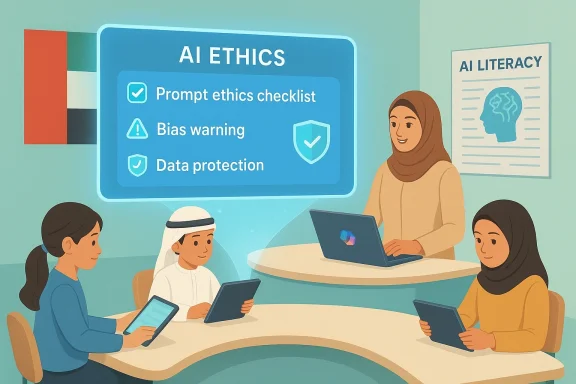
AI also makes classroom work an opportunity to teach how to think about technology: constructing better prompts, spotting bias, verifying claims, and understanding model limitations are transferable skills that belong in modern digital literacy curricula. The UAE’s national curriculum rollout and school pilots both emphasise these higher‑order competencies.
But the approach is not finished. The absence of a single, public list of approved third‑party generative‑AI platforms, uneven procurement capacity across schools, and the need for verifiable vendor transparency all point to the next phase: turning early pilots into robust, auditable systems that protect students while equipping them with future‑ready skills. If policymakers, vendors and school leaders accelerate the work on common procurement standards, parental engagement, and teacher training, the UAE’s model could become a practical blueprint for responsible classroom AI elsewhere.
Source: Khaleej Times Khaleej Times - Dubai News, UAE News, Gulf, News, Latest news, Arab news, Gulf News, Dubai Labour News
 Background / Overview
The UAE’s national education authorities launched an ambitious push to teach AI across public schools in the 2025–2026 academic year, and private schools have followed by building their own, measured approaches to classroom use. The Ministry of Education’s curriculum rollout emphasises practical, project-driven learning rather than high-stakes testing, with guidance aimed at teaching students how AI systems work, how to evaluate outputs, and how to use tools responsibly.Across Dubai and other emirates, authorities and education partners have backed complementary programmes: curated AI literacy pilots for private schools, teacher-training initiatives, and centralized supports to help schools select age-appropriate tools. These programmes stress teacher-led activity, safeguarding, and alignment to local values. The rollout is explicitly framed as building AI literacy, not handing students unfettered access to consumer models.
That national momentum has left private schools with a practical problem: there is no single, public “approved platforms” list that covers every third‑party generative AI tool for classroom use, which has led individual schools to conduct their own vendor due diligence and governance reviews before introducing tools to staff or students. School leaders and digital-learning heads have told reporters that their approach is deliberate, age-sensitive, and always teacher-led.
How UAE schools are actually using AI — a practical snapshot
Teacher-first, classroom-second
Across interviews with school leaders in the UAE, three consistent patterns emerge: tools are introduced only after internal review; student access is supervised and scaffolded; and staff use secure, tenant-scoped services for planning and feedback.- Many schools differentiate between staff and student access: teacher use of larger models (for drafting lesson plans, generating rubrics, analysing assessment data) is common, while student interactions are tightly controlled and typically teacher-led. Dubai British School, Jumeirah Park, for example, reported using Microsoft Copilot within its Microsoft 365 environment for staff workflows, while restricting ChatGPT to staff use only.
- Schools are adopting education‑focused platforms or vendor offerings that can be deployed inside secure, school-managed accounts rather than public, consumer services. Examples mentioned by school leads include Microsoft Copilot (tenant‑scoped), MagicSchool AI (education-first lesson planning and differentiation), Canva for Education, and selected “education‑grade” tools that include compliance and safer data handling.
- Younger learners rarely interact independently with generative models. Instead, teachers use AI to support instruction (e.g., produce differentiated worksheets, design project scaffolds) while guiding students through critical evaluation of outputs. For older students, instruction increasingly includes ethical prompting, detection of bias, and verification techniques.
Platforms named in practice
Media reporting and school statements list a mix of mainstream models and specialist education tools being trialled under supervision: ChatGPT, Google Gemini, Anthropic’s Claude, Leonardo AI, Gizmo AI, plus specialist platforms such as MagicSchool AI and education instances of Microsoft Copilot. Schools say they restrict unsupervised access to public generative services and only permit supervised interaction inside safeguarding and curriculum frameworks.The governance and legal frame: data protection, procurement, and parental trust
UAE data‑protection context
Any school using third‑party AI in the UAE must reckon with the federal Personal Data Protection Law (PDPL, Federal Decree‑Law No. 45 of 2021) and related regulatory layers in free zones such as DIFC and ADGM. The PDPL requires lawful bases for processing personal data, transparency, data‑minimisation, and controls on cross‑border transfers — obligations that apply to education providers and their vendors. In practice, this means schools and edtech suppliers must treat student information carefully: avoid sending identifiable student records to open consumer models, execute data‑processing agreements, and conduct impact assessments for higher‑risk uses.Practical school-level safeguards
Schools described several recurring technical and contractual safeguards:- Use of tenant‑scoped, school‑managed accounts (for example, Microsoft 365 Copilot deployed within an institution’s tenant) so that organizational data remains inside the school’s control and is governed by existing Microsoft 365 compliance tools. Microsoft’s documentation and education guidance stress that Copilot can be configured with enterprise data protections, sensitivity labels, and data‑loss prevention (DLP) to limit how content is accessed and exported.
- No entry of personal student data into consumer, public versions of generative AI systems. School leaders explicitly said that student names, grades, behavioural notes, or other personally identifiable information are not fed into open systems. This is a basic but critical rule schools have been enforcing.
- Vendor reviews and procurement checks including privacy policies, training‑data claims, regional data residency, contractual warranties, and the ability to execute a data‑processing agreement that meets PDPL expectations. Several schools reported internal approval processes before any tool is introduced.
- Age-gating and pedagogical scaffolding: generative AI use is typically prohibited for young children or tightly controlled until students demonstrate critical evaluation skills. The Ministry’s guidance language and regional reporting indicate an emphasis on age-appropriate access.
What this change means for teaching and learning
Opportunities: productivity, accessibility and new literacies
When deployed cautiously and pedagogically, AI can free teachers from repetitive planning work and help personalise resources. Schools describe use cases where AI accelerates lesson planning, helps generate differentiated tasks for diverse learners, and supports formative assessment analysis — giving teachers back time for direct student support. AI can also increase accessibility through automatic translations, reading scaffolds, or resources adapted for different learning needs.AI also makes classroom work an opportunity to teach how to think about technology: constructing better prompts, spotting bias, verifying claims, and understanding model limitations are transferable skills that belong in modern digital literacy curricula. The UAE’s national curriculum rollout and school pilots both emphasise these higher‑order competencies.
Risks: academic integrity, hallucinations, bias and inequality
Despite the benefits, the classroom use of generative AI introduces well-documented risks that schools are only beginning to manage systematically:- Academic integrity: Generative models can produce convincing but unoriginal essays, code, and answers. Schools emphasise disclosure and teacher supervision, but detection remains imperfect and enforcement resource‑intensive.
- Hallucinations and factual errors: AI outputs are not guaranteed to be true. Pedagogically, this requires teaching students to verify sources, cross‑check facts, and treat model responses as starting points, not final answers.
- Bias and cultural sensitivity: Models trained on large swathes of global data can reproduce biased assumptions or generate content that clashes with local cultural values. UAE schools are explicit that outputs must align with national and cultural standards.
- Privacy leakage: Even well-intentioned prompts can accidentally reveal sensitive information if student data is mishandled. The PDPL’s cross‑border and processing obligations raise regulatory stakes for institutions and vendors alike.
- Equity of access: Not all families or schools have equal access to safe, school‑managed AI environments. If only well‑resourced schools deploy well‑configured tools, equity gaps could widen in terms of who learns AI literacy and who benefits from productivity gains.
Case studies and classroom practices
Dubai Schools Al Khawaneej — deliberate and measured
At Dubai Schools Al Khawaneej, the principal describes a deliberate approach: platforms are reviewed internally before introduction, AI use is embedded within safeguarding and curriculum frameworks, and the emphasis is on AI literacy rather than blind access. Older primary students are given structured sessions with education-specific tools, while staff use secure Copilot deployments for planning and feedback. The school explicitly bans unsupervised access to public generative tools.Dubai British School, Jumeirah Park — staff-first Copilot
The digital‑learning lead at Dubai British School explained a small, approved set of tools: Microsoft Copilot (in Microsoft 365) for staff, Canva for Education, and MagicSchool for supervised student activities. ChatGPT is reserved for staff only; any student interactions are teacher-led. This model puts the teacher in the centre of the AI experience.Woodlem British School (Ajman) — cautious, compliance-centred
Woodlem British School’s leaders emphasise legal compliance and the imperative that no personal student data be entered into open consumer systems. They use secure, school-managed accounts and only allow selected education-grade platforms that claim compliance with UAE data‑protection expectations. Their stance is cautious by design.Verification and cross‑checking: techniques taught to students
Classrooms teaching AI literacy are developing short, practical lessons that can be applied immediately:- Prompt-critique: Teach students to ask why a model produced a specific output and what assumptions it contains.
- Lateral reading: Verify claims by consulting multiple sources and checking authoritativeness.
- Evidence tagging: Require students to annotate any AI‑assisted work with the sources they used and explain how outputs were evaluated.
- Bias spotting: Use red‑team exercises where students try to coax biased outputs to understand model limitations.
- Reflection on intent: Ask pupils to explain how they used a tool (planning, drafting, feedback) and why they made particular edits.
Critical analysis: strengths, blind spots, and emergent risks
Strengths
- Policy-aligned, pragmatic adoption: The UAE’s coordinated national curriculum push and parallel private‑school pilots show a pragmatic path: teach AI literacy across age bands while retaining teacher oversight. This balanced approach reduces the risk of unregulated student exposure and supports scale through teacher training.
- Use of tenant-scoped enterprise AI: Deploying Copilot inside Microsoft 365 tenants and similar managed offerings significantly reduces privacy and leakage risks compared with unvetted public models — provided institutions configure DLP, sensitivity labels, and contractual protections correctly. Microsoft’s documentation and education case studies show these features are available and valuable when activated.
- Pedagogical emphasis on critical thinking: Framing AI as an opportunity to teach how to think rather than what to accept is the single most important pedagogical move schools can make. UAE guidance and school practice emphasise this, which aligns with global recommendations from learning sciences.
Blind spots and unresolved challenges
- Governance fragmentation: Because there is no single, publicly accessible list of “KHDA‑approved” third‑party tools for classrooms, schools are left to run uneven due diligence processes. That duplication of effort risks inconsistent protections and uneven parental information. School leaders’ statements suggest responsible internal review, but the lack of a unified, transparent register leaves room for variability. This absence should be treated as a governance gap until a consistent public register or framework exists.
- Vendor transparency and training‑data claims: Many vendor privacy statements and “safety” claims remain difficult to verify. Schools should treat vendor assertions about training‑data use, deletion policies, and model‑behaviour guarantees as starting points for technical and contractual verification — not as substitutes for direct testing or proof. Independent model cards, red‑team reports, and signed contractual assurances will be necessary to build audit-ready procurement files.
- Operationalizing parental consent and communication: Even where schools restrict student data exchange, parental understanding and consent practices vary. Clear, simple communications about what tools are used, what data (if any) is shared, and how parents can opt‑out are essential to maintain trust. The legal landscape (PDPL obligations, plus free‑zone regimes) also creates different compliance mechanics for different schools.
- Resource and equity pressures: Rolling out secure, properly governed AI tools costs time and money. Under-resourced schools may rely on default public consumer models or struggle to implement DLP and contractual protections, magnifying inequities in students’ AI literacy and safety. National programmes can help address this gap, but funding, technical assistance, and procurement frameworks will be needed.
Practical recommendations for schools, IT leaders and policymakers
- For school leaders:
- Establish a formal AI procurement checklist that includes PDPL‑compliant DPA clauses, training‑data transparency, data‑residency commitments, and incident notification timelines.
- Insist on tenant‑scoped or school‑account deployments where possible and require vendor attestations that institutional data will not be used for model training without explicit contractual permission.
- For teachers:
- Start small with teacher‑led pilots, build documented lesson plans showing how AI was used and assessed, and require students to include a short “AI use log” with AI‑assisted submissions (what was asked, what was changed, what sources were checked).
- For policymakers and regulators:
- Consider a transparent, centralized register or guidance listing the types of vendor assurances and technical protections required for school use, while avoiding prescriptive bans that stifle legitimate educational innovation. A curated portal of recommended, education‑grade tools (with model cards and verified DPA templates) would reduce duplication of due diligence and improve consistency.
- For vendors:
- Publish concise, testable model cards that describe training data provenance, known limitations, fairness audits, and concrete data‑handling commitments for education deployments. Provide inexpensive or free education‑tier contracts that meet PDPL standards and support institutional audits.
What we still need to watch
- Regulatory clarification on PDPL operational rules and how they apply to machine learning operations and cross‑border model hosting; until executive regulations and practice notes are clear, school risk teams need conservative defaults.
- Independent auditing and certification of education-targeted models to provide schools with verifiable assurances about safety, bias mitigation, and nonuse of student data for model training.
- Scaled teacher professional development: only with broad, sustained upskilling will teachers be able to turn AI from a novelty into a disciplined classroom partner. National and county‑level training initiatives exist, but capacity building must continue.
- Equitable access to safe AI environments so that students in all schools — not only well‑funded ones — learn the same critical literacies and protections.
Conclusion
The UAE’s early and deliberate embrace of classroom AI is noteworthy because it pairs a national curriculum push with careful, school‑level governance: teacher‑led pilots, tenant‑scoped enterprise deployments, and a focus on how to think about AI rather than simply how to use it. Those choices put pedagogy and safety at the centre of the experiment — a wise stance given the very real risks around privacy, academic integrity, and bias.But the approach is not finished. The absence of a single, public list of approved third‑party generative‑AI platforms, uneven procurement capacity across schools, and the need for verifiable vendor transparency all point to the next phase: turning early pilots into robust, auditable systems that protect students while equipping them with future‑ready skills. If policymakers, vendors and school leaders accelerate the work on common procurement standards, parental engagement, and teacher training, the UAE’s model could become a practical blueprint for responsible classroom AI elsewhere.
Source: Khaleej Times Khaleej Times - Dubai News, UAE News, Gulf, News, Latest news, Arab news, Gulf News, Dubai Labour News
