

Ubisoft’s Teammates demo is the clearest, most polished argument yet that voice‑driven, cloud‑assisted AI can be more than a novelty chatbot in games — but it also underlines how much careful design, editorial control, and technical guardrails are required before this technology can move from R&D showcases into mainstream releases.
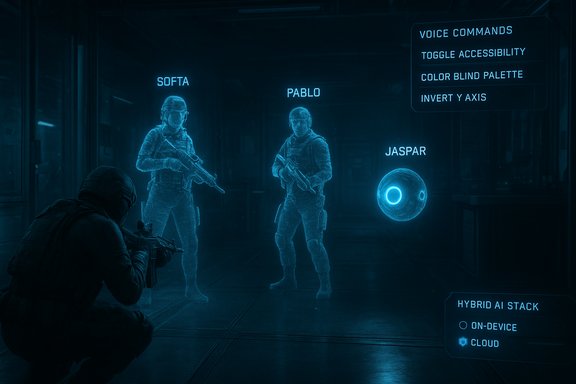
The last 24 months have seen AI move from a toolbox for developers to a player‑facing feature set: companies are experimenting with companions that listen, plan and act, voice interfaces that change how players interact with menus and systems, and hybrid local/cloud models that try to balance latency, privacy and capability. Ubisoft’s Teammates demo — a hands‑on tech preview that pairs two AI companions (Sofia and Pablo) with a conversational assistant called Jaspar — is intended to show how that technology can be used inside a shooter to manage UX, accessibility and companion behaviour while maintaining a narrative spine written by humans. The demo couples natural speech input (player talks into a mic) with on‑the‑fly decisions by the AI partners, and the system can also execute non‑narrative tasks such as changing control schemes or display settings on command.
This wave of in‑game assistants and co‑playable agents is not unique to Ubisoft. Major platform and middleware vendors are building stacks to support similar features: hybrid Game Bar/Copilot overlays that accept voice and screenshots for context, and toolkits like NVIDIA’s ACE that aim to produce autonomous, perceptive teammates with on‑device RTX acceleration for low‑latency perception and local inference. Those platform efforts reinforce the same technical tradeoffs Ubisoft confronted: latency, data handling, hardware fragmentation, and the need for authorial constraints to preserve design intent.
This is an important distinction:
Cautionary note — the claim that feeding only studio‑authored material into character models eliminates all IP concerns is partially true: it certainly reduces third‑party scraping risks, but the provenance of any external models and pretraining data used by the engine must still be audited to be certain no unlicensed material influenced outputs. That auditing is rarely visible outside vendor documentation, so treat claims of “no outside data used” cautiously unless explicitly documented by the technology vendor.
At the same time, there are systemic issues that will determine whether these tools become mainstream:
If Teammates teaches anything to developers and publishers, it’s this: generative AI in games will succeed when it is treated as a design lever — applied intentionally, constrained by authorial intent, and offered to players as an option rather than a mandate. The technology is already powerful enough to change how we play; the challenge now is to make sure it changes the right things.
Bold, immersive companions and useful voice assistants are coming. The decisive questions now are about governance, design choices and the social contracts studios forge with players and creators — not about whether the underlying AI can be made to work.
Source: Video Games Chronicle The future of gaming, or ‘just a tool’? Hands-on with Teammates, Ubisoft’s ambitious voice AI tech demo | VGC
 Background / Overview
The last 24 months have seen AI move from a toolbox for developers to a player‑facing feature set: companies are experimenting with companions that listen, plan and act, voice interfaces that change how players interact with menus and systems, and hybrid local/cloud models that try to balance latency, privacy and capability. Ubisoft’s Teammates demo — a hands‑on tech preview that pairs two AI companions (Sofia and Pablo) with a conversational assistant called Jaspar — is intended to show how that technology can be used inside a shooter to manage UX, accessibility and companion behaviour while maintaining a narrative spine written by humans. The demo couples natural speech input (player talks into a mic) with on‑the‑fly decisions by the AI partners, and the system can also execute non‑narrative tasks such as changing control schemes or display settings on command.This wave of in‑game assistants and co‑playable agents is not unique to Ubisoft. Major platform and middleware vendors are building stacks to support similar features: hybrid Game Bar/Copilot overlays that accept voice and screenshots for context, and toolkits like NVIDIA’s ACE that aim to produce autonomous, perceptive teammates with on‑device RTX acceleration for low‑latency perception and local inference. Those platform efforts reinforce the same technical tradeoffs Ubisoft confronted: latency, data handling, hardware fragmentation, and the need for authorial constraints to preserve design intent.
What Teammates actually does — a practical walk‑through
The Teammates tech demo showcases several tightly integrated features, each designed to address a concrete gameplay or UX problem rather than simply to show off generative dialogue.- Voice assistant as UI layer — Jaspar acts both as a narrative companion and as an extension of menus. In the demo the assistant instantly applied settings (inverting the Y‑axis, switching to a color‑blind palette) on spoken command. The interaction itself is simple: the system maps natural language to existing game options and toggles them, which is technically straightforward but ergonomically powerful.
- Companions that act, not just talk — Sofia and Pablo interpret high‑level spoken orders (take cover, flank, distract) and perform coordinated actions in the environment, including combat and puzzle cooperation (pressure‑pad puzzles, flanking enemies). The AI companion behaviour is integrated into the gameplay loop — players direct tactics rather than simply listening to exposition.
- Narrative scaffolding + generative dialogue — Ubisoft’s team combines authored artifacts (the “black box” logs in the demo and extensive character sheets created by narrative designers) with generative responses so that emergent, context‑sensitive lines are still grounded in authorial intent. In practice this means designers seed a character model with original scripts, personality data and constraints, then permit the AI to interpolate within that envelope.
- In‑game awards and evaluation — Rather than mechanically unlocking achievements when triggers are hit, the system can judge player behaviour and award achievements at opportune moments, creating a feeling that the AI is noticing and rewarding emergent play styles.
The technical picture: where Teammates fits in the AI stack
Several industry trends and technical constraints frame what Ubisoft is doing.- Hybrid architectures are the practical compromise. Real‑time gameplay requires low latency. For perception and immediate action loops, on‑device inference or edge‑proximate compute is preferable; for longer context and heavier reasoning, cloud servers remain attractive. Platform efforts — including overlay assistants on Windows — emphasise a hybrid model where local UI and capture controls keep responsiveness high while cloud services handle heavy LLM work. That same hybrid pattern underlies many game AI toolkits.
- Small, game‑oriented models matter. Toolkits like NVIDIA ACE target compact instruction‑tuned models and perceptual pipelines so companion agents can run parts of their stack on RTX hardware, reducing round‑trip latency and cost. That approach is one reason developers pursue on‑device inference for moment‑to‑moment actions while relying on the cloud for deeper context.
- Guardrails and layered safety are required. Any voice‑driven, generative system must mitigate abuse (toxic speech, prompt injection into published text, etc. and abide by the game’s narrative constraints. Multi‑layered detection and strong character‑sheet constraints reduce the chance that an agent goes off the rails, but they are not a magic bullet; design choices and policy enforcement still matter.
Why Ubisoft’s approach to writing and ownership matters
One of the loudest objections to in‑game generative AI is the fear it will displace writers or abuse other creators’ works as training data. Ubisoft’s approach — having narrative designers create detailed character sheets and hundreds of seed lines — is a deliberate attempt to ensure the generative outputs are driven by studio‑owned creative assets rather than scraping third‑party works.This is an important distinction:
- It preserves a deterministic authorial control layer: designers decide what a character can or cannot say, what events must happen at key narrative beats, and which story threads are fixed.
- It reframes narrative teams as curators and directors for generative outputs rather than as redundant sources of canned dialogue. Narrative designers still write thousands of lines and create the metadata that drives believable behaviour.
Cautionary note — the claim that feeding only studio‑authored material into character models eliminates all IP concerns is partially true: it certainly reduces third‑party scraping risks, but the provenance of any external models and pretraining data used by the engine must still be audited to be certain no unlicensed material influenced outputs. That auditing is rarely visible outside vendor documentation, so treat claims of “no outside data used” cautiously unless explicitly documented by the technology vendor.
Strengths: what Teammates gets right
- Player‑first design choices. Using voice as a shortcut to accessibility settings and menu toggles is a straightforward win — the same tech that produces novel conversation also reduces friction for players with mobility or vision needs. That’s a low‑risk, high‑value application that deserves to be supported early.
- Meaningful interactivity. Having teammates that can interpret high‑level orders and act in coherent, coordinated ways adds tactical depth and reduces the cognitive overhead of micromanagement. It’s a natural fit for squad‑based shooters and tactical games.
- Narrative + generative hybrid. The black‑box logs and authored nodes in the demo show how generative dialogue can augment rather than supplant scripted narrative beats. The combination preserves the writer’s intentions while offering the player surprise and specificity.
- Design as the lever of control. Ubisoft’s insistence that this is a tool and not a turn‑key replacement is a healthy architectural stance: teams can opt in to discrete capabilities (accessibility assistant, companion AI) instead of being forced into a single workflow. Related platform efforts make a similar point: designers should pick what they need, not be told how to build a game.
Risks, unknowns and what needs solving
No demo is a finished product, and Teammates exposes several unresolved issues that studios and platform vendors must address before these systems can be broadly adopted.- Toxicity and abuse in the wild. Open voice inputs invite players to experiment. Where Epic’s AI Darth Vader revealed how fast players can subvert AI behaviour, Ubisoft’s team has added guardrails, but history shows determined players find creative ways to break systems. Layered detection and game design incentives (making abuse unprofitable) help, but they are not foolproof.
- Competitive fairness and mode segregation. Any agent that perceives the game state and offers tactical advantage raises questions about ranked play and tournaments. Publishers will need clear rules: are AI companions allowed in ranked queues? Are there dedicated servers or match types that permit them? Expect explicit policy work here.
- Hardware fragmentation and accessibility tradeoffs. If some companion features require RTX‑level local inference, developers will have to offer fallback modes or server‑assisted inference for players without modern GPUs. Without graceful degradation, features can splinter player bases.
- Privacy, telemetry and training governance. Voice inputs, screenshots and gameplay traces are extremely sensitive. Clear opt‑in flows, retention policies, and public statements about whether player inputs are used to further train models are essential. Much of the platform ecosystem now treats these inputs as optional — but verification and transparency remain necessary.
- Artistic and labour impacts. While Ubisoft’s narrative directors describe ongoing creative work, the net labour impact across the industry is uncertain. Will writers become curators and directors (a positive re‑skilling), or will studios use generative tools to reduce writing budgets? That depends on business models, contracts and union negotiations, not on the technology itself.
- Energy, cost and maintainability. Running low‑latency multimodal AI at scale — especially if done in the cloud for many players — is expensive and energy‑intensive. Studios must budget for compute costs and consider environmental impact when choosing cloud vs. local inference strategies.
Practical advice for developers and publishers
If a team is considering shipping AI companions or voice assistants, the demo suggests a pragmatic, incremental approach:- Start with low‑risk, high‑value features: voice toggles for accessibility and in‑game menus. These are straightforward and provide immediate player benefit.
- Protect narrative intent: author character sheets and seed dialogues before enabling open generation; preserve fixed beats with authored content.
- Offer competence sliders and mode gating: let players tune AI assistance and opt into or out of dynamic companion behaviour.
- Publish transparent data policies: state clearly how voice and gameplay inputs are stored, whether they are used for model training, and how long data is retained.
- Implement layered safety: character constraints + narrative flow controls + telemetry‑based moderation + server‑side filters to reduce the chance of abusive outputs.
- Design matchmaking and mode rules: separate casual modes that permit AI companions from ranked modes that disallow them, at least initially.
- Build fallback paths for hardware: cloud‑assist features or simplified behaviour trees so players on older GPUs are not excluded.
A measured verdict: tool, not takeover
Ubisoft’s Teammates demo is notable because it is not a speculative demo designed purely to impress; it shows concrete design patterns that could be useful today — from accessibility commands delivered by voice to teammates that follow high‑level tactical orders. Ubisoft’s insistence that the feature is a tool for designers, not a replacement for them, is the most defensible stance: generative systems amplify and scale authorial voice when they’re properly restrained, and they break immersion when left unconstrained.At the same time, there are systemic issues that will determine whether these tools become mainstream:
- Economics: who pays for the cloud compute and infrastructure needed to host scalable voice AI?
- Trust: will players and creators trust platforms with voice data and generative outputs?
- Fairness: will competitive scenes ban or restrict AI teammates, fragmenting player communities?
- Creative labour: how studios choose to integrate AI into pipelines will shape the labour market for writers and designers.
Final thoughts
The most important takeaway from Teammates is not that AI will replace writers or produce flawless companions tomorrow. It is that studios are learning how to fold generative systems into design processes rather than outsourcing creativity to models. When narrative teams write the moral contours of characters, and engineers build layered safety and latency‑aware pipelines, generative AI starts to look like a practical extension of design tools rather than a disruptive replacement.If Teammates teaches anything to developers and publishers, it’s this: generative AI in games will succeed when it is treated as a design lever — applied intentionally, constrained by authorial intent, and offered to players as an option rather than a mandate. The technology is already powerful enough to change how we play; the challenge now is to make sure it changes the right things.
Bold, immersive companions and useful voice assistants are coming. The decisive questions now are about governance, design choices and the social contracts studios forge with players and creators — not about whether the underlying AI can be made to work.
Source: Video Games Chronicle The future of gaming, or ‘just a tool’? Hands-on with Teammates, Ubisoft’s ambitious voice AI tech demo | VGC
