
Ubuntu’s newest long-term support cycle has created an unexpectedly sharp comparison with Windows 11: Canonical is now positioning the desktop with a higher RAM floor than Microsoft’s mainstream client OS. That is a headline-grabber, but it is also a useful window into how both platforms have evolved under pressure from security requirements, modern desktop environments, and user expectations. The bigger story is not that Linux suddenly became bloated; it is that the definition of a “minimum” PC has moved upward across the board. Ubuntu 26.04 LTS now sits at the center of that shift, and the implications are more interesting than the clickbait suggests.
For years, Ubuntu earned a reputation as the desktop operating system that could revive older hardware. That reputation was built on practical realities: modest system requirements, a leaner default desktop, and a stronger emphasis on getting work done without the overhead many users associate with commercial operating systems. In the early and middle 2010s, Ubuntu was often the answer when someone wanted a capable desktop on a machine that Windows had outgrown.
That image, however, has been steadily changing. The modern Linux desktop is no longer just a hobbyist environment or a lightweight fallback. It is now expected to support polished graphical effects, integrated security features, broad hardware compatibility, Wayland sessions, sandboxed software delivery, and a broader set of background services than the old “bare-bones” stereotype implies. Ubuntu has had to grow up with that reality, and the desktop stack has grown with it.
At the same time, Windows 11 has set a different kind of baseline. Microsoft’s platform is built around strong compatibility demands, broad OEM support, and a highly managed support lifecycle. The company has held firm on its hardware requirements, including TPM 2.0 and supported CPUs, even as it has continued to push users toward newer releases through automatic upgrade policies. That makes Windows 11 feel heavier in one sense, but it also means Microsoft is optimizing around security, fleet consistency, and upgrade discipline rather than raw minimalism.
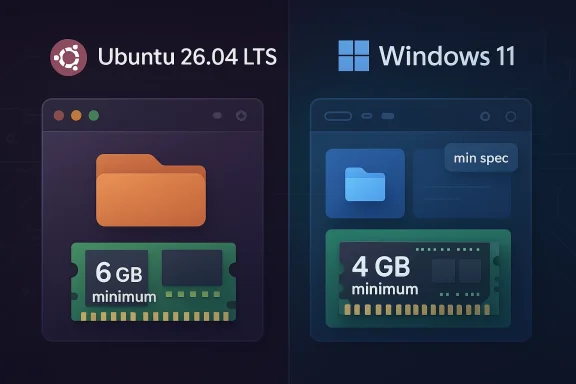
The immediate comparison in the current reporting is simple: Ubuntu 26.04 LTS is being discussed with a 6 GB RAM minimum, while Windows 11’s published minimum remains 4 GB. That does not mean Windows is the more demanding operating system in practice, because published minimums are only one part of the real-world story. Still, the symbolism matters, especially for a community that still remembers when Linux was the go-to choice for squeezing life out of limited hardware.
It also matters because this comparison arrives at a moment when desktop computing is being reshaped by AI features, browser-heavy workflows, and more ambitious user interfaces. A machine that once only needed enough memory to launch a browser and office suite now has to absorb always-on chat tools, background sync, containers, virtual desktops, and more. That environment changes what “lightweight” actually means in 2026.
The key point is not that the desktop suddenly became extreme. Rather, Canonical appears to be acknowledging that the modern default experience needs a little more breathing room to feel smooth, especially once you account for browser tabs, system services, and the overhead of a more graphical, more integrated desktop stack. In other words, the new floor is less about chasing luxury hardware and more about avoiding a poor first impression on machines that are technically “supported” but practically underfed.
That matters because minimum specs often shape retail reality. OEMs and refurbishers look at published requirements and design around them, which means a small change on paper can influence thousands of bundled devices. If Ubuntu is comfortable saying 6 GB is the floor, that sends a signal that Canonical is optimizing for a desktop that needs to feel solid, not merely launchable.
There is also a subtle difference between “can run” and “can run well.” Canonical likely cares less about whether someone can boot a desktop session on a minimal configuration and more about whether the experience feels presentable enough for a default installation. That is a much more commercially useful metric, even if it disappoints enthusiasts who equate Linux excellence with extreme thrift.
Windows 11 is also not standing still. Microsoft continues to push feature updates, refine servicing, and enforce newer release cadences for Home and Pro devices. In the current material, the company is actively steering unmanaged 24H2 PCs toward 25H2 using an automatic rollout model. That means the platform’s baseline is not only technical; it is administrative. Microsoft wants users on a supported build, and it uses update infrastructure to make that happen.
That makes the Ubuntu comparison more complicated than it first appears. A distro that asks for 6 GB on paper may still feel leaner than a Windows install on the same hardware, depending on workload, drivers, and app choices. The headline is useful, but it is not the same as a benchmark.
In other words, Windows 11 asks users to accept not only a hardware baseline but a lifecycle baseline. You are expected to keep moving, keep updating, and keep aligning with Microsoft’s support expectations. Ubuntu’s new memory requirement is a hardware story; Windows’ story is hardware plus administration.
There are multiple contributors to memory pressure: the compositor, the desktop shell, the browser, sandboxing layers, services for online accounts and updates, and the increasing expectation that the system will feel responsive even while several apps are active. If Ubuntu’s desktop team has accepted a higher floor, it may be because the user experience improves more than the raw number worsens.
There is also a difference between memory allocation and memory pressure. A system may reserve more RAM while still performing better than a smaller-footprint configuration because it is avoiding the expensive delays that come from constantly unloading and reloading pieces of the desktop.
This is the trade-off Canonical is making visible. The company can remain the home of lightweight Linux, but its flagship LTS desktop also has to be credible on modern consumer machines. That is a different product strategy than the one many older Linux users remember, and it is not necessarily a betrayal of the project’s ethos.
That reversal is powerful because it plays into a broader narrative about software bloat, AI creep, and the changing expectations of desktop users. When people feel their systems are becoming more resource-hungry, a spec-sheet comparison becomes a proxy for a much larger frustration. The numbers are only the hook.
But raw memory requirements do not exist in a vacuum. Linux distros vary widely in desktop environment, services, and defaults. Windows installations vary by OEM image, preloaded software, and user behavior. So a flat comparison may be attention-grabbing without being fully representative.
That is not unique to Ubuntu. It is the state of desktop software in 2026. The real surprise is simply that the old distinction between “heavy Windows” and “light Linux” is no longer clean enough to describe the market.
What enterprises care about is predictable support, consistent performance, and low support friction. If Canonical’s change improves first-boot experience and reduces complaints about sluggish desktops, then the higher minimum could actually help IT departments rather than hurt them. A desktop that feels viable out of the box is a desktop that requires fewer caveats in procurement.
Still, it affects messaging. Vendors, integrators, and desktop image teams will need to account for the new floor in their standard configuration guidance. That is especially true for organizations using refurbished or low-cost hardware pools.
The broader enterprise lesson is that Linux desktop adoption is no longer simply about “can we get away with less?” It is increasingly about whether the platform delivers a polished, supportable workstation experience. A few extra gigabytes may be an acceptable cost for that outcome.
For many people, the practical question is simple: what works well on the hardware I already own? On that front, Ubuntu’s new floor may push some users away from the absolute cheapest machines and toward 8 GB systems, which are already increasingly common. That may be a healthy outcome in 2026, but it also changes the entry point.
That does not mean Ubuntu is suddenly out of reach. It means the economics of the budget segment are shifting. A few years ago, 4 GB was a common low-end compromise; now it increasingly feels like a false economy.
The deeper question is whether this change makes Ubuntu feel more like a modern desktop product or less like a niche efficiency project. Canonical seems to be betting on the former. That is a reasonable bet, even if it alienates people who still measure excellence by how little memory an idle desktop consumes.
Microsoft is pushing Windows 11 deeper into managed servicing and newer release cycles, while also layering in more AI-oriented capabilities and tighter platform rules. Ubuntu, meanwhile, is balancing its open-source roots with a more modern desktop experience that appeals to users who want something polished and dependable. Both ecosystems are becoming more opinionated.
That maturation comes with consequences. Mature software carries maintenance burden, support expectations, and feature debt. The result is often a product that feels better to use but less heroic to describe.
Microsoft, for its part, is not trying to be the lightest OS in the room. It is trying to be the most secure, most compatible, and most administratively coherent OS for its audience. That gives Ubuntu room to compete on a different axis: simplicity, control, and openness.
The comparison will also keep evolving as Windows 11 continues its own push toward newer releases and more assertive servicing. Microsoft’s automatic upgrade strategy and its continued reliance on security and compatibility gates mean the Windows baseline will keep shifting in ways that matter to users even if the RAM number on the support page does not. In that environment, Ubuntu’s RAM floor is only one part of a much larger desktop computing recalibration.
Watch these closely:
If that trade-off pays off in daily responsiveness and broader adoption, the 6 GB minimum will look like a sensible evolution rather than a disappointing concession. And if it does not, the old Linux promise of doing more with less will suddenly feel a lot more valuable than many people expected.
Source: How-To Geek Ubuntu now requires more RAM than Windows 11
Source: Technetbook Ubuntu 26.04 LTS RAM Requirements Exceed Windows 11 Hardware Specifications for Resolute Raccoon
 Background
For years, Ubuntu earned a reputation as the desktop operating system that could revive older hardware. That reputation was built on practical realities: modest system requirements, a leaner default desktop, and a stronger emphasis on getting work done without the overhead many users associate with commercial operating systems. In the early and middle 2010s, Ubuntu was often the answer when someone wanted a capable desktop on a machine that Windows had outgrown.That image, however, has been steadily changing. The modern Linux desktop is no longer just a hobbyist environment or a lightweight fallback. It is now expected to support polished graphical effects, integrated security features, broad hardware compatibility, Wayland sessions, sandboxed software delivery, and a broader set of background services than the old “bare-bones” stereotype implies. Ubuntu has had to grow up with that reality, and the desktop stack has grown with it.
At the same time, Windows 11 has set a different kind of baseline. Microsoft’s platform is built around strong compatibility demands, broad OEM support, and a highly managed support lifecycle. The company has held firm on its hardware requirements, including TPM 2.0 and supported CPUs, even as it has continued to push users toward newer releases through automatic upgrade policies. That makes Windows 11 feel heavier in one sense, but it also means Microsoft is optimizing around security, fleet consistency, and upgrade discipline rather than raw minimalism.
The immediate comparison in the current reporting is simple: Ubuntu 26.04 LTS is being discussed with a 6 GB RAM minimum, while Windows 11’s published minimum remains 4 GB. That does not mean Windows is the more demanding operating system in practice, because published minimums are only one part of the real-world story. Still, the symbolism matters, especially for a community that still remembers when Linux was the go-to choice for squeezing life out of limited hardware.
It also matters because this comparison arrives at a moment when desktop computing is being reshaped by AI features, browser-heavy workflows, and more ambitious user interfaces. A machine that once only needed enough memory to launch a browser and office suite now has to absorb always-on chat tools, background sync, containers, virtual desktops, and more. That environment changes what “lightweight” actually means in 2026.
What Changed in Ubuntu
Ubuntu 26.04 LTS is the release at the center of the new RAM debate. According to the forum material reflecting the linked coverage, Canonical’s next long-term support desktop is moving its memory floor to 6 GB, up from the 4 GB associated with Ubuntu 24.04 LTS. That is a meaningful jump even if it still leaves Ubuntu well within reach of mainstream consumer systems.The key point is not that the desktop suddenly became extreme. Rather, Canonical appears to be acknowledging that the modern default experience needs a little more breathing room to feel smooth, especially once you account for browser tabs, system services, and the overhead of a more graphical, more integrated desktop stack. In other words, the new floor is less about chasing luxury hardware and more about avoiding a poor first impression on machines that are technically “supported” but practically underfed.
Why 6 GB Matters
A 6 GB minimum sits in a strange but telling middle zone. It is not expensive hardware by 2026 standards, but it is also no longer the kind of spec that lets vendors cut every corner on low-end machines. It nudges Ubuntu away from the ultra-thrifty era and toward a model where the OS assumes a more realistic baseline for everyday multitasking.That matters because minimum specs often shape retail reality. OEMs and refurbishers look at published requirements and design around them, which means a small change on paper can influence thousands of bundled devices. If Ubuntu is comfortable saying 6 GB is the floor, that sends a signal that Canonical is optimizing for a desktop that needs to feel solid, not merely launchable.
- 6 GB is still modest, but it is a notable step up from 4 GB.
- The desktop is maturing, not becoming bloated in the Windows sense.
- OEM configuration choices may shift upward in response.
- Refurbished hardware buyers could notice the change first.
- The minimum is now more realistic for modern multitasking workloads.
Desktop Expectations Have Changed
The Ubuntu desktop of the past was often judged by whether it could fit into older machines and remain responsive. The Ubuntu desktop of today has to balance that heritage against the reality that most users expect a polished environment with predictable behavior, modern graphics paths, and strong integration across apps and services. That raises the floor.There is also a subtle difference between “can run” and “can run well.” Canonical likely cares less about whether someone can boot a desktop session on a minimal configuration and more about whether the experience feels presentable enough for a default installation. That is a much more commercially useful metric, even if it disappoints enthusiasts who equate Linux excellence with extreme thrift.
Windows 11’s Position
The comparison to Windows 11 is provocative because Microsoft’s published minimum remains lower on paper. Windows 11 is still listed at 4 GB of RAM, which makes Ubuntu 26.04 LTS look more demanding in the narrowest possible reading. But that reading can be misleading if you ignore the broader context of what Windows asks for in practice and how Microsoft manages the platform overall.Windows 11 is also not standing still. Microsoft continues to push feature updates, refine servicing, and enforce newer release cadences for Home and Pro devices. In the current material, the company is actively steering unmanaged 24H2 PCs toward 25H2 using an automatic rollout model. That means the platform’s baseline is not only technical; it is administrative. Microsoft wants users on a supported build, and it uses update infrastructure to make that happen.
Minimums Versus Reality
The published minimum RAM figure for Windows 11 tells only part of the story. A machine may technically install and boot with 4 GB, but user experience can be far from ideal once browsers, background services, cloud sync, and modern apps are in play. Many users already treat 8 GB as the functional minimum for a comfortable Windows experience, even if the official threshold is lower.That makes the Ubuntu comparison more complicated than it first appears. A distro that asks for 6 GB on paper may still feel leaner than a Windows install on the same hardware, depending on workload, drivers, and app choices. The headline is useful, but it is not the same as a benchmark.
- Published minimums are not lived experience.
- Windows 11’s practical comfort zone is often higher than 4 GB.
- Update and servicing behavior matters as much as the spec sheet.
- App model differences can reverse the headline in daily use.
- User perception often lags behind technical nuance.
The Service Model Matters
Microsoft’s automatic upgrade behavior is part of the same story. The company is increasingly using managed rollout systems to keep consumer devices current, which shows how seriously it treats supportability and security. That kind of governance can make Windows feel more demanding, even when the raw numbers look gentler.In other words, Windows 11 asks users to accept not only a hardware baseline but a lifecycle baseline. You are expected to keep moving, keep updating, and keep aligning with Microsoft’s support expectations. Ubuntu’s new memory requirement is a hardware story; Windows’ story is hardware plus administration.
The Technical Trade-Offs
A Linux desktop that needs 6 GB of RAM is not automatically inefficient. In many cases, it simply reflects the cost of a more capable modern stack. This is where simplistic “Linux versus Windows” arguments fall apart, because both operating systems are now carrying more responsibilities than they did a decade ago.There are multiple contributors to memory pressure: the compositor, the desktop shell, the browser, sandboxing layers, services for online accounts and updates, and the increasing expectation that the system will feel responsive even while several apps are active. If Ubuntu’s desktop team has accepted a higher floor, it may be because the user experience improves more than the raw number worsens.
Where RAM Goes
Modern desktop operating systems spend memory on more than just visible apps. They cache frequently used data, keep services ready in the background, and preserve state so that switching between tasks feels instant. That can look like waste to an old-school benchmarker, but it often translates into smoother daily use.There is also a difference between memory allocation and memory pressure. A system may reserve more RAM while still performing better than a smaller-footprint configuration because it is avoiding the expensive delays that come from constantly unloading and reloading pieces of the desktop.
- Compositing and graphics effects add overhead.
- Background services improve usability and security.
- Caching makes the system feel faster.
- Sandboxed apps often cost more memory.
- Web-first workflows dominate modern usage patterns.
The Desktop Has Become More Ambitious
Ubuntu’s default experience has also grown more ambitious in visual polish and feature depth. That ambition is valuable because it lowers the friction for mainstream users, but it rarely comes for free. A desktop environment that aims to be accessible, attractive, and broadly compatible is likely to carry more baggage than one optimized purely for minimal resource use.This is the trade-off Canonical is making visible. The company can remain the home of lightweight Linux, but its flagship LTS desktop also has to be credible on modern consumer machines. That is a different product strategy than the one many older Linux users remember, and it is not necessarily a betrayal of the project’s ethos.
Why the Comparison Is Explosive
The reason the Ubuntu-versus-Windows 11 RAM comparison spread so quickly is that it flips a long-standing assumption. For years, Windows was the operating system associated with heavier requirements, while Linux was the lean alternative that made older PCs usable again. Now the headline says the opposite, and that creates instant attention.That reversal is powerful because it plays into a broader narrative about software bloat, AI creep, and the changing expectations of desktop users. When people feel their systems are becoming more resource-hungry, a spec-sheet comparison becomes a proxy for a much larger frustration. The numbers are only the hook.
Perception Versus Measurement
Perception is doing a lot of work here. A user does not need to know the exact memory footprint of GNOME or the internals of Windows 11 to react strongly to the idea that Linux now wants more RAM than Microsoft’s flagship desktop. It sounds backwards, and backwardness is memorable.But raw memory requirements do not exist in a vacuum. Linux distros vary widely in desktop environment, services, and defaults. Windows installations vary by OEM image, preloaded software, and user behavior. So a flat comparison may be attention-grabbing without being fully representative.
- The headline is emotionally sticky.
- The comparison is technically narrow.
- Different default stacks matter a lot.
- User workflows distort any simple ranking.
- Brand expectations shape interpretation.
The Symbolism Is Bigger Than the Spec
This is also about identity. Ubuntu has long marketed itself as the friendly, approachable face of Linux. If even that baseline desktop is now asking for more memory, it suggests that the easy-performance era for general-purpose desktops is fading. Consumers now expect AI tools, richer visuals, cloud integration, and seamless multitasking.That is not unique to Ubuntu. It is the state of desktop software in 2026. The real surprise is simply that the old distinction between “heavy Windows” and “light Linux” is no longer clean enough to describe the market.
Enterprise Implications
For enterprise IT, a higher Linux desktop memory floor is usually less alarming than it is for enthusiasts. Businesses already buy with headroom in mind, and they are more likely to standardize on 8 GB or 16 GB systems than on bare-minimum configs. In practice, Ubuntu 26.04 LTS moving to 6 GB may be almost invisible to many corporate buyers.What enterprises care about is predictable support, consistent performance, and low support friction. If Canonical’s change improves first-boot experience and reduces complaints about sluggish desktops, then the higher minimum could actually help IT departments rather than hurt them. A desktop that feels viable out of the box is a desktop that requires fewer caveats in procurement.
Procurement and Fleet Planning
Procurement teams do not buy operating systems in isolation. They buy whole endpoints, and they usually already budget some margin above the bare minimum. That means 6 GB may not trigger a purchasing change in organizations that are serious about Linux deployments.Still, it affects messaging. Vendors, integrators, and desktop image teams will need to account for the new floor in their standard configuration guidance. That is especially true for organizations using refurbished or low-cost hardware pools.
- 8 GB remains the safe enterprise baseline.
- Standard images should be reviewed for updated support guidance.
- Refurbished fleets may need closer validation.
- Helpdesk load may improve if the default experience is smoother.
- Procurement documents should reflect the new floor.
Virtualization and Thin Client Scenarios
In virtualized environments, the RAM minimum can matter even more because memory is allocated by the host in rigid chunks. A shift from 4 GB to 6 GB can change density planning, especially in large environments where dozens or hundreds of desktops are hosted. That said, such deployments are rarely judged on the same basis as consumer laptops.The broader enterprise lesson is that Linux desktop adoption is no longer simply about “can we get away with less?” It is increasingly about whether the platform delivers a polished, supportable workstation experience. A few extra gigabytes may be an acceptable cost for that outcome.
Consumer Impact
Consumers are the group most likely to notice the headline and the group least likely to care about the nuance behind it. If you are buying a new laptop or considering a hand-me-down PC, the fact that Ubuntu wants 6 GB and Windows 11 officially wants 4 GB can influence your choice, even if the lived performance story is more complicated.For many people, the practical question is simple: what works well on the hardware I already own? On that front, Ubuntu’s new floor may push some users away from the absolute cheapest machines and toward 8 GB systems, which are already increasingly common. That may be a healthy outcome in 2026, but it also changes the entry point.
Budget Buyers Will Feel It First
The people most sensitive to minimum requirements are budget buyers, students, and families looking to stretch a laptop purchase as far as possible. If a device ships with only 4 GB of RAM, the Ubuntu desktop may no longer be the obvious “cheap and cheerful” alternative.That does not mean Ubuntu is suddenly out of reach. It means the economics of the budget segment are shifting. A few years ago, 4 GB was a common low-end compromise; now it increasingly feels like a false economy.
- 4 GB systems are becoming too tight for modern desktops.
- 8 GB is becoming the new comfort floor for many users.
- Browser-heavy usage punishes low-memory devices.
- Refurbished PCs will need closer scrutiny.
- Consumers will compare total experience, not just installability.
Power Users Will Read the Signal Differently
Power users are likely to interpret the change as a sign that Canonical cares more about polish and consistency than about preserving an old minimalism badge. That will be welcome to some and disappointing to others. It is a familiar split in Linux communities, where one faction wants broader mainstream adoption and another wants uncompromising efficiency.The deeper question is whether this change makes Ubuntu feel more like a modern desktop product or less like a niche efficiency project. Canonical seems to be betting on the former. That is a reasonable bet, even if it alienates people who still measure excellence by how little memory an idle desktop consumes.
The Bigger Market Context
This change lands in a market where desktop operating systems are being judged by more than performance. Security, update management, AI integration, browser dominance, and hardware compatibility all matter now. That’s why a RAM comparison can become a proxy battle for much larger platform philosophies.Microsoft is pushing Windows 11 deeper into managed servicing and newer release cycles, while also layering in more AI-oriented capabilities and tighter platform rules. Ubuntu, meanwhile, is balancing its open-source roots with a more modern desktop experience that appeals to users who want something polished and dependable. Both ecosystems are becoming more opinionated.
Linux Is Growing Up in Public
Linux desktop adoption has always been tied to two things: technical merit and frustration with the alternatives. The fact that Ubuntu is now being compared against Windows 11 on RAM requirements is evidence that Linux has become a serious mainstream computing choice rather than a pure fallback.That maturation comes with consequences. Mature software carries maintenance burden, support expectations, and feature debt. The result is often a product that feels better to use but less heroic to describe.
- Ubuntu is becoming more mainstream.
- Windows is becoming more managed and opinionated.
- Both platforms are increasing baseline expectations.
- Users now demand smoothness over austerity.
- The market rewards consistency more than purity.
Competition Is About Experience, Not Ideology
The old ideological framing — Linux is light, Windows is heavy — no longer explains the market very well. Users care about how fast their apps open, how long their battery lasts, whether their browser chews through memory, and whether the OS gets in the way. If Ubuntu can deliver a better experience by accepting a slightly higher baseline, that may be a smart competitive move.Microsoft, for its part, is not trying to be the lightest OS in the room. It is trying to be the most secure, most compatible, and most administratively coherent OS for its audience. That gives Ubuntu room to compete on a different axis: simplicity, control, and openness.
Strengths and Opportunities
The new Ubuntu baseline creates some clear upsides if Canonical plays it well. A higher memory floor can produce a more consistent first-run experience, reduce complaints about sluggish behavior on borderline machines, and help Ubuntu look more credible as a polished everyday desktop rather than a purely budget-minded alternative. It also gives OEMs and refurbishers a cleaner configuration target, which can improve the quality of the machines users actually buy.- Better out-of-box responsiveness on mainstream systems.
- Cleaner OEM guidance for default configurations.
- Improved perception of Ubuntu as a modern desktop.
- Less compromise on visual polish and background services.
- Stronger appeal for users migrating from Windows.
- More realistic minimums for current workloads.
- Potentially fewer support complaints from underpowered installs.
Risks and Concerns
The downside is that a higher minimum can reinforce the perception that every modern desktop is getting heavier, even if the change is justified. It may also price out or discourage users who rely on older hardware, especially if they are looking for Ubuntu specifically because of its traditional efficiency advantages. The risk is not that 6 GB is too much in absolute terms; it is that the symbolic loss of “lightness” could matter more than the technical justification.- Alienating old-hardware users who still expect Linux to be ultra-light.
- Encouraging oversimplified comparisons with Windows 11.
- Pressuring budget OEMs to move up in price or spec.
- Creating confusion between minimum and recommended requirements.
- Reinforcing “software bloat” narratives even when they are incomplete.
- Potential mismatch between headline specs and real-world workloads.
- Reduced room for ultra-low-end configurations in some markets.
Looking Ahead
The next few months will tell us whether the 6 GB minimum becomes a meaningful market signal or just a footnote in a larger release cycle. If Ubuntu 26.04 LTS feels noticeably smoother and more dependable than its predecessors on standard hardware, the spec increase will look prescient rather than indulgent. If not, critics will use it as proof that Linux has joined the same resource creep long associated with Windows.The comparison will also keep evolving as Windows 11 continues its own push toward newer releases and more assertive servicing. Microsoft’s automatic upgrade strategy and its continued reliance on security and compatibility gates mean the Windows baseline will keep shifting in ways that matter to users even if the RAM number on the support page does not. In that environment, Ubuntu’s RAM floor is only one part of a much larger desktop computing recalibration.
Watch these closely:
- Ubuntu 26.04 LTS release notes and final desktop requirements
- Actual performance on 4 GB, 6 GB, and 8 GB systems
- OEM shipment trends for low-end Ubuntu laptops and mini PCs
- Microsoft’s Windows 11 servicing and upgrade behavior
- User sentiment among Linux newcomers and long-time enthusiasts
If that trade-off pays off in daily responsiveness and broader adoption, the 6 GB minimum will look like a sensible evolution rather than a disappointing concession. And if it does not, the old Linux promise of doing more with less will suddenly feel a lot more valuable than many people expected.
Source: How-To Geek Ubuntu now requires more RAM than Windows 11
Source: Technetbook Ubuntu 26.04 LTS RAM Requirements Exceed Windows 11 Hardware Specifications for Resolute Raccoon
