

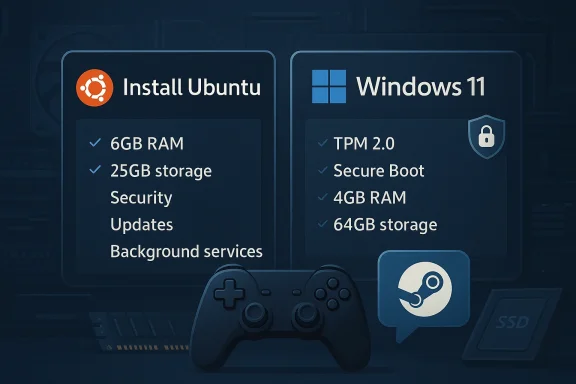
Canonical’s latest Ubuntu release paperwork has ignited an oddly revealing comparison with Windows 11: the Linux desktop now asks for more RAM and more storage than Microsoft’s mainstream consumer OS, even as Steam’s Linux footprint hits a new high. The headline sounds provocative, but the underlying story is more nuanced than a simple “Linux got heavier” narrative. Ubuntu 26.04 LTS is still a relatively modest desktop by modern standards, yet its rising baseline speaks to how far the Linux desktop has moved from the age of ultra-thin installs and tiny spinning drives. At the same time, Steam’s newest survey underscores that Linux gaming is no longer a rounding error.
Ubuntu has always lived in an interesting tension between accessibility and practicality. On one hand, Canonical markets it as a free, general-purpose operating system that can serve everyone from hobbyists to enterprise admins. On the other hand, each new release must keep pace with a desktop stack that has become more capable, more graphical, and more demanding than the stripped-down Linux environments many people still imagine. The result is a platform that remains lean by Windows standards, but not as featherweight as it once was.
That tension matters because desktop Linux has spent years trying to shed an old reputation: the idea that it is only useful on ancient hardware or only attractive to enthusiasts willing to compromise on convenience. Modern Ubuntu ships with a fuller graphical environment, broader device support expectations, and a more polished installer experience than earlier generations. Those improvements have value, but they come with a cost in memory, disk space, and “just works” expectations.
Ubuntu 26.04 LTS, codenamed Resolute Raccoon, is part of Canonical’s regular long-term-support cadence. LTS releases are the versions businesses and cautious home users tend to treat as anchor points, precisely because they promise stability and predictable support windows. The release-cycle page shows 26.04 as the next LTS track, fitting the familiar pattern that has made Ubuntu the default Linux choice for many organizations. That makes any requirement shift more important than it would be on a short-lived interim release.
The timing is also important. Windows 10 support ended in October 2025, pushing many users toward Windows 11, newer PCs, or alternative operating systems. Microsoft’s own requirements remain a frequent topic of frustration because of the TPM 2.0, Secure Boot, and supported CPU restrictions. In that environment, Ubuntu’s appeal is partly technical and partly emotional: it feels like a route around forced hardware replacement, even when its own desktop baseline grows more demanding.
The server side looks different, and that distinction matters. Ubuntu Server remains comparatively modest, with Canonical listing a minimum of 1.5GB RAM for ISO installs and a suggested minimum storage of 25GB or more. That split reinforces what Ubuntu has become: a family of products with different expectations rather than a single universal footprint. The desktop is the visible, polished face of the platform, while server builds remain intentionally flexible.
This is where the Windows comparison becomes more theatrical than practical. Microsoft’s Windows 11 checklist also includes more than raw CPU and memory numbers. TPM 2.0, UEFI Secure Boot, and a compatible graphics/display stack are part of the picture. Meanwhile, Canonical’s newer numbers still remain broadly attainable for most systems sold in the last decade. The practical difference is less about whether a machine can boot and more about what kind of machine is considered comfortable for each operating system.
The Steam angle gives the story more cultural weight. Valve’s March 2026 Hardware & Software Survey shows Linux at 5.33%, up 3.10 percentage points from the prior month in the survey snapshot. That is a record high for the platform, and it follows a multi-year trend of gradual Linux gaming growth. The survey is not a census, and it is not a perfect mirror of the PC market, but it is still one of the best public gauges of enthusiast desktop behavior. (store.steampowered.com)
That increase is easy to explain once you think about modern desktop expectations. Today’s Ubuntu is not a minimalist text console with a window manager bolted on. It is a full graphical environment with background services, update frameworks, security layers, networking components, app packaging support, and increasingly complex hardware enablement. Each of those features improves usability, but together they move the floor upward.
Canonical’s posture here is also strategic. LTS releases are where enterprises, universities, and serious hobbyists put their trust, which means Ubuntu cannot optimize only for “it runs on anything.” It has to optimize for predictable, supportable, modern behavior. A desktop image that officially expects a bit more RAM can be easier to validate, easier to support, and less likely to generate avoidable performance complaints.
That hardware gate has real-world effects. Millions of otherwise usable PCs were sidelined by the transition from Windows 10, and that experience remains one of the strongest drivers of Linux curiosity. Ubuntu’s higher RAM recommendation does not change the fact that many older systems still fail Windows 11 for reasons unrelated to memory. In practice, Microsoft’s ecosystem filter is often stricter than Canonical’s.
The Copilot+ tier raises the bar even further. Microsoft now positions those systems around an NPU capable of at least 40 TOPS, plus 16GB of memory and 256GB of storage. That is not a minimum requirement for Windows 11 itself, but it shows where Microsoft believes the future of its premium Windows line is headed. The gap between “can install Windows” and “represents the direction of the platform” is widening.
The survey also suggests that the average Linux gaming rig is not a museum piece. Steam’s March 2026 snapshot shows a large share of users with 16GB or 32GB of RAM, and many systems with modern multi-core CPUs. That means Ubuntu’s 6GB desktop guidance is not aimed at the core Steam audience. It is aimed at the long tail of older notebooks, retrofitted desktops, educational PCs, and low-end secondary systems. (store.steampowered.com)
That distinction matters because too many discussions flatten “Linux” into one audience. The Linux gamer, the Ubuntu desktop user, the server administrator, and the embedded developer are all distinct users with different tolerance for overhead. Steam’s numbers primarily describe one of those groups. Ubuntu’s requirements speak to another. The overlap is real, but it is not total. (store.steampowered.com)
Storage is equally telling. Canonical’s 25GB recommendation is not outrageous, but it reflects how desktops now accumulate updates, cached package data, container runtimes, snaps, Flatpak apps, browser profiles, and user files very quickly. Microsoft’s 64GB Windows 11 floor is higher in absolute terms, yet that larger number also reflects the sheer volume of OS-level and vendor-provided content Windows tends to carry. Both systems are recognizing that small disks are a maintenance problem, not just a convenience problem.
In that sense, Ubuntu’s change is not a sign of failure. It is a sign that Canonical is willing to codify a more realistic modern desktop expectation instead of pretending a cutting-edge GUI stack can be happy indefinitely on ancient hardware. That honesty may inconvenience some users, but it can also reduce disappointment later. There is a difference between theoretical support and practical comfort.
For Microsoft, the competitive pressure is subtler. Windows 11 still dominates Steam at 92.33% in the March 2026 survey snapshot, but Linux’s rise to 5.33% is part of a slow normalization. As more users experience Linux through handhelds, gaming-focused distros, and desktop-friendly environments, Ubuntu’s higher baseline may not hurt Linux adoption nearly as much as it might have a decade ago. The market has become more tolerant of software that expects real hardware. (store.steampowered.com)
The more interesting rivalry may be philosophical. Microsoft is pushing toward an AI-enabled, hardware-attested future with NPUs and Copilot+ branding. Canonical is pushing toward a more traditional but still modern Linux desktop that assumes a bit more RAM and disk space. Those trajectories are different, yet they both point away from the ultra-cheap, ultra-minimal PC of the past.
The bigger enterprise value is predictability. Canonical’s LTS model gives admins a long runway, and the move to publish clearer guidance helps procurement teams avoid underpowered builds that generate support tickets. If anything, the higher baseline can simplify deployment decisions by narrowing the range of hardware that should realistically be considered. Fewer borderline systems means fewer borderline outcomes.
There is also a security dimension. Enterprises increasingly care about memory headroom because it improves stability under modern endpoint security tools, logging agents, VPN clients, and browser-based SaaS workloads. Ubuntu’s newer baseline tacitly acknowledges that the desktop is no longer just the shell; it is the platform for a dense layer of operational software.
Still, some users will read the numbers as proof that Linux is no longer the ultra-light refuge it once was. That perception is not entirely wrong, but it is incomplete. The desktop environment, browser workload, and application model of 2026 are simply heavier than they were in the days when 512MB systems felt normal. Ubuntu’s recommendation reflects that reality more than it creates it.
For buyers of new consumer PCs, the practical takeaway is simpler: 8GB should probably be the psychological floor, not 4GB, regardless of operating system. That is not an official statement from either Canonical or Microsoft; it is a market-level inference based on how software behaves today. A system that merely meets published minimums can still feel cramped the moment a browser, cloud app, and background updater all start competing for memory.
Steam’s Linux numbers will also be worth watching for context. A single month of growth to 5.33% is exciting, but sustained gains matter more than one survey spike. If Linux holds above the previous plateau and keeps converting Steam Deck and desktop curiosity into broader adoption, Ubuntu’s revised requirements may arrive at the right moment rather than the wrong one. (store.steampowered.com)
What to watch next:
Source: HotHardware Ubuntu Raises CPU And RAM Requirements Above Windows 11 Amid Linux’s Steam Surge
 Background
Ubuntu has always lived in an interesting tension between accessibility and practicality. On one hand, Canonical markets it as a free, general-purpose operating system that can serve everyone from hobbyists to enterprise admins. On the other hand, each new release must keep pace with a desktop stack that has become more capable, more graphical, and more demanding than the stripped-down Linux environments many people still imagine. The result is a platform that remains lean by Windows standards, but not as featherweight as it once was.That tension matters because desktop Linux has spent years trying to shed an old reputation: the idea that it is only useful on ancient hardware or only attractive to enthusiasts willing to compromise on convenience. Modern Ubuntu ships with a fuller graphical environment, broader device support expectations, and a more polished installer experience than earlier generations. Those improvements have value, but they come with a cost in memory, disk space, and “just works” expectations.
Ubuntu 26.04 LTS, codenamed Resolute Raccoon, is part of Canonical’s regular long-term-support cadence. LTS releases are the versions businesses and cautious home users tend to treat as anchor points, precisely because they promise stability and predictable support windows. The release-cycle page shows 26.04 as the next LTS track, fitting the familiar pattern that has made Ubuntu the default Linux choice for many organizations. That makes any requirement shift more important than it would be on a short-lived interim release.
The timing is also important. Windows 10 support ended in October 2025, pushing many users toward Windows 11, newer PCs, or alternative operating systems. Microsoft’s own requirements remain a frequent topic of frustration because of the TPM 2.0, Secure Boot, and supported CPU restrictions. In that environment, Ubuntu’s appeal is partly technical and partly emotional: it feels like a route around forced hardware replacement, even when its own desktop baseline grows more demanding.
Why this comparison suddenly feels sharper
The comparison is not just about one operating system being “lighter” than another. It is about the perception of what counts as a reasonable baseline in 2026. If Ubuntu’s recommended desktop floor crosses Windows 11’s headline memory figure, the old assumption that Linux is automatically the low-overhead option becomes less useful as shorthand. That does not make Ubuntu bloated; it means the broader desktop ecosystem has moved.Overview
The immediate flashpoint is Canonical’s updated guidance for Ubuntu 26.04 LTS desktop use. According to the release-note material reported by HotHardware and reflected in Canonical’s published server guidance, the desktop build now calls for a 2GHz dual-core processor, 6GB of RAM, and 25GB of storage. That puts the RAM and storage recommendations above Microsoft’s published minimums for Windows 11, which remain 4GB of RAM and 64GB of storage with a compatible 64-bit CPU, TPM 2.0, UEFI, and Secure Boot.The server side looks different, and that distinction matters. Ubuntu Server remains comparatively modest, with Canonical listing a minimum of 1.5GB RAM for ISO installs and a suggested minimum storage of 25GB or more. That split reinforces what Ubuntu has become: a family of products with different expectations rather than a single universal footprint. The desktop is the visible, polished face of the platform, while server builds remain intentionally flexible.
This is where the Windows comparison becomes more theatrical than practical. Microsoft’s Windows 11 checklist also includes more than raw CPU and memory numbers. TPM 2.0, UEFI Secure Boot, and a compatible graphics/display stack are part of the picture. Meanwhile, Canonical’s newer numbers still remain broadly attainable for most systems sold in the last decade. The practical difference is less about whether a machine can boot and more about what kind of machine is considered comfortable for each operating system.
The Steam angle gives the story more cultural weight. Valve’s March 2026 Hardware & Software Survey shows Linux at 5.33%, up 3.10 percentage points from the prior month in the survey snapshot. That is a record high for the platform, and it follows a multi-year trend of gradual Linux gaming growth. The survey is not a census, and it is not a perfect mirror of the PC market, but it is still one of the best public gauges of enthusiast desktop behavior. (store.steampowered.com)
What the numbers do and do not mean
The numbers do not mean Ubuntu is suddenly a heavyweight OS. A 6GB RAM recommendation is still modest by 2026 PC standards, and most active gaming systems are far above that. Steam’s survey shows 16GB and 32GB systems dominating large portions of the respondent pool, which means the Ubuntu requirement increase is unlikely to affect the enthusiast class very much. The real impact is on older office machines, secondary laptops, and repurposed hardware. (store.steampowered.com)- Ubuntu’s desktop baseline is rising, but not explosively.
- Windows 11 still carries stricter platform rules in other areas.
- Steam’s Linux growth is meaningful, but it measures a gaming subset, not all PC users.
- Server and desktop requirements should be treated separately.
- The story is really about ecosystem maturity, not just raw footprint.
The New Ubuntu Baseline
The most important detail in the new Ubuntu guidance is not that it is higher than Windows 11 in one or two categories. It is that Canonical appears comfortable telling desktop users that 6GB of RAM is the point at which the experience starts to feel appropriate, not merely functional. That is a quiet admission that modern desktop Linux is doing more in the background than it used to.That increase is easy to explain once you think about modern desktop expectations. Today’s Ubuntu is not a minimalist text console with a window manager bolted on. It is a full graphical environment with background services, update frameworks, security layers, networking components, app packaging support, and increasingly complex hardware enablement. Each of those features improves usability, but together they move the floor upward.
Canonical’s posture here is also strategic. LTS releases are where enterprises, universities, and serious hobbyists put their trust, which means Ubuntu cannot optimize only for “it runs on anything.” It has to optimize for predictable, supportable, modern behavior. A desktop image that officially expects a bit more RAM can be easier to validate, easier to support, and less likely to generate avoidable performance complaints.
From “runs anywhere” to “runs well”
The subtle shift in wording is more important than the spec sheet itself. A platform can still technically install on lesser hardware and yet recommend a higher baseline for a smooth experience. That is common in modern operating systems, where the minimum requirement is a legal floor and the recommended requirement is a usability line. Ubuntu’s new guidance fits that model neatly.- The new floor is about user experience, not absolute bootability.
- More RAM helps with browsing, app switching, and sandboxed apps.
- Modern desktops are burdened by security, search, notifications, and compositing.
- Canonical likely wants fewer support cases from marginal hardware.
- A higher recommendation is not the same as a hard lockout.
Windows 11 Still Has the Harder Gate
It is tempting to say Ubuntu “beat” Windows 11 on requirements, but that framing misses the most consequential part of Microsoft’s policy. Windows 11’s published minimums may still sit at 4GB RAM and 64GB storage, but the platform also insists on TPM 2.0, UEFI, Secure Boot, and a compatible processor family. In other words, Windows 11 can look cheaper on paper and still be far harder to adopt on old hardware.That hardware gate has real-world effects. Millions of otherwise usable PCs were sidelined by the transition from Windows 10, and that experience remains one of the strongest drivers of Linux curiosity. Ubuntu’s higher RAM recommendation does not change the fact that many older systems still fail Windows 11 for reasons unrelated to memory. In practice, Microsoft’s ecosystem filter is often stricter than Canonical’s.
The Copilot+ tier raises the bar even further. Microsoft now positions those systems around an NPU capable of at least 40 TOPS, plus 16GB of memory and 256GB of storage. That is not a minimum requirement for Windows 11 itself, but it shows where Microsoft believes the future of its premium Windows line is headed. The gap between “can install Windows” and “represents the direction of the platform” is widening.
Minimums versus expectations
This matters because consumers rarely experience operating systems as pure minimum-spec tables. They experience them as laptop recommendations, OEM configurations, and upgrade pressure. The result is a two-layer reality: one set of official minimums and another set of market expectations that is often much higher. Windows 11 and Ubuntu are both in that situation now, just for different reasons.- Windows 11 has lower memory minimums but heavier platform constraints.
- Copilot+ sets a much more demanding premium baseline.
- TPM and Secure Boot exclusions matter more than 4GB versus 6GB.
- Ubuntu’s recommendation increase is gentler and easier to absorb.
- Both platforms are signaling that modern hardware is the assumed norm.
Why the Steam Survey Matters
Steam is not the whole PC market, but it is one of the clearest windows into enthusiast behavior. When Linux rises on Steam, it usually tells us something about gaming interest, hardware experimentation, and the effectiveness of platforms like Proton and the Steam Deck in normalizing Linux. A jump to 5.33% is significant precisely because Steam users are a skeptical, demanding population. (store.steampowered.com)The survey also suggests that the average Linux gaming rig is not a museum piece. Steam’s March 2026 snapshot shows a large share of users with 16GB or 32GB of RAM, and many systems with modern multi-core CPUs. That means Ubuntu’s 6GB desktop guidance is not aimed at the core Steam audience. It is aimed at the long tail of older notebooks, retrofitted desktops, educational PCs, and low-end secondary systems. (store.steampowered.com)
That distinction matters because too many discussions flatten “Linux” into one audience. The Linux gamer, the Ubuntu desktop user, the server administrator, and the embedded developer are all distinct users with different tolerance for overhead. Steam’s numbers primarily describe one of those groups. Ubuntu’s requirements speak to another. The overlap is real, but it is not total. (store.steampowered.com)
A survey with signal, not certainty
Valve’s survey is still valuable even with its limitations. It is opt-in, sample-based, and susceptible to short-term swings when one segment of users becomes more or less likely to participate. That is why the monthly jumps should be interpreted as indicators, not gospel. Still, the direction of travel has been upward enough to justify attention. (store.steampowered.com)- Steam growth validates Linux as a mainstream-ish gaming option.
- The survey reflects engaged users, not all desktop users.
- A stronger Linux gaming base improves ecosystem confidence.
- Ubuntu benefits when Linux no longer feels fringe to gamers.
- Survey volatility should temper overconfident conclusions.
The Real Hardware Story
At the hardware level, Ubuntu’s new guidance is a reminder that the desktop is now shaped by app complexity, browser tab counts, and background services as much as by the kernel itself. A dual-core 2GHz CPU and 6GB of RAM are still entry-level by 2026 standards, but they are no longer “tiny.” They reflect a baseline where multitasking, browser-heavy workflows, and packaged software are assumed.Storage is equally telling. Canonical’s 25GB recommendation is not outrageous, but it reflects how desktops now accumulate updates, cached package data, container runtimes, snaps, Flatpak apps, browser profiles, and user files very quickly. Microsoft’s 64GB Windows 11 floor is higher in absolute terms, yet that larger number also reflects the sheer volume of OS-level and vendor-provided content Windows tends to carry. Both systems are recognizing that small disks are a maintenance problem, not just a convenience problem.
In that sense, Ubuntu’s change is not a sign of failure. It is a sign that Canonical is willing to codify a more realistic modern desktop expectation instead of pretending a cutting-edge GUI stack can be happy indefinitely on ancient hardware. That honesty may inconvenience some users, but it can also reduce disappointment later. There is a difference between theoretical support and practical comfort.
Enterprise versus consumer hardware
Enterprises are likely to react differently than home users. Businesses generally deploy more memory, more storage, and more capable processors than the minimums required by either Ubuntu or Windows 11. For them, the new Ubuntu desktop floor is mostly a documentation update, not a procurement shock. Consumer holdouts on older laptops, by contrast, may suddenly feel the change more acutely.- Modern browsers are memory-hungry regardless of OS.
- Containerized app formats add storage overhead.
- Enterprises already overspec most endpoints.
- Older consumer machines feel requirement changes first.
- The “lightweight Linux” label is now contextual, not absolute.
Competitive Implications
Canonical does not need Ubuntu to be lighter than Windows in every category to win users. It needs Ubuntu to be a credible, low-friction alternative that feels modern and trustworthy. In that respect, the new requirements may actually help. They signal maturity. A platform that openly recommends more memory because it expects users to run a fuller, richer desktop may appear more honest than one that keeps emphasizing a technically minimal floor.For Microsoft, the competitive pressure is subtler. Windows 11 still dominates Steam at 92.33% in the March 2026 survey snapshot, but Linux’s rise to 5.33% is part of a slow normalization. As more users experience Linux through handhelds, gaming-focused distros, and desktop-friendly environments, Ubuntu’s higher baseline may not hurt Linux adoption nearly as much as it might have a decade ago. The market has become more tolerant of software that expects real hardware. (store.steampowered.com)
The more interesting rivalry may be philosophical. Microsoft is pushing toward an AI-enabled, hardware-attested future with NPUs and Copilot+ branding. Canonical is pushing toward a more traditional but still modern Linux desktop that assumes a bit more RAM and disk space. Those trajectories are different, yet they both point away from the ultra-cheap, ultra-minimal PC of the past.
Why older PCs are the battlefield
The real contest is not among new laptops sold this spring. It is among the millions of existing machines that users hope to keep alive for another cycle. That is where Ubuntu’s relatively modest requirements can still matter, because a 6GB recommendation is often easier to meet than Microsoft’s platform attestation rules. Linux remains a salvage path for competent older systems.- Ubuntu’s new floor improves supportability.
- Windows 11’s guardrails still exclude more legacy PCs.
- Linux gains credibility as mainstream gaming exposure grows.
- The competitive fight is shifting from “lightweight” to “practical.”
- Hardware refresh cycles remain a powerful adoption lever.
The Enterprise Angle
For enterprises, Ubuntu 26.04’s requirement changes are more about consistency than cost. Corporate desktops already tend to ship with enough memory to absorb the upgrade comfortably, and many IT departments prefer to standardize on headroom rather than minimums. In that world, a 6GB recommendation mostly validates choices they were already making.The bigger enterprise value is predictability. Canonical’s LTS model gives admins a long runway, and the move to publish clearer guidance helps procurement teams avoid underpowered builds that generate support tickets. If anything, the higher baseline can simplify deployment decisions by narrowing the range of hardware that should realistically be considered. Fewer borderline systems means fewer borderline outcomes.
There is also a security dimension. Enterprises increasingly care about memory headroom because it improves stability under modern endpoint security tools, logging agents, VPN clients, and browser-based SaaS workloads. Ubuntu’s newer baseline tacitly acknowledges that the desktop is no longer just the shell; it is the platform for a dense layer of operational software.
Procurement implications
Procurement teams dislike ambiguity, and a clearer recommendation can be useful even when it is higher. If the practical floor is 6GB and 25GB, buyers can budget accordingly and avoid false economies. That is particularly relevant for educational deployments, public-sector refreshes, and distributed field equipment.- LTS guidance reduces deployment uncertainty.
- Headroom matters more than bare minimums in managed fleets.
- Security tooling pushes desktops upward over time.
- A documented baseline can improve support outcomes.
- Underpowered endpoints often cost more later.
Consumer Impact and Upgrade Pressure
Consumers are where the headline lands hardest, because the comparison invites a simple question: if Ubuntu needs more RAM than Windows 11, why switch? The answer is that raw spec tables are only one part of the decision. Ubuntu still offers freedom from licensing costs, a different software model, and a far friendlier path for older PCs blocked by TPM 2.0 or CPU lists.Still, some users will read the numbers as proof that Linux is no longer the ultra-light refuge it once was. That perception is not entirely wrong, but it is incomplete. The desktop environment, browser workload, and application model of 2026 are simply heavier than they were in the days when 512MB systems felt normal. Ubuntu’s recommendation reflects that reality more than it creates it.
For buyers of new consumer PCs, the practical takeaway is simpler: 8GB should probably be the psychological floor, not 4GB, regardless of operating system. That is not an official statement from either Canonical or Microsoft; it is a market-level inference based on how software behaves today. A system that merely meets published minimums can still feel cramped the moment a browser, cloud app, and background updater all start competing for memory.
The aging-PC question
The aging-PC story remains where Ubuntu has the most to gain. Users with a capable but unsupported Windows 10 machine may find that Ubuntu still turns that hardware into a viable daily driver, even if the desktop spec sheet has crept upward. The old “rescue distro” role is evolving, but it is not disappearing.- Ubuntu still offers an escape from Microsoft hardware gates.
- The practical floor for comfortable use is higher than the minimum.
- Older PCs remain relevant to Linux adoption.
- New buyers should think beyond official minimums.
- Memory pressure is the real everyday bottleneck for many users.
Strengths and Opportunities
Ubuntu’s updated baseline comes with several advantages that are easy to miss if you focus only on the symmetry-breaking headline. It helps Canonical align the desktop with real-world usage, gives enterprises clearer guidance, and reinforces the message that Linux desktop software is mature enough to expect modern hardware. Meanwhile, Linux’s rise on Steam gives the platform more cultural legitimacy than it had a few years ago.- Better alignment between recommendations and actual desktop workloads.
- Fewer support issues from borderline hardware.
- Stronger enterprise confidence in LTS planning.
- More honest communication about what a good experience requires.
- Growing Linux gaming visibility through Steam.
- Greater room for Canonical to optimize around modern hardware assumptions.
- Continued value as a refuge from Windows 11 hardware exclusions.
Risks and Concerns
The downside is that headlines rarely preserve nuance. Some readers will conclude that Ubuntu has become “heavier than Windows,” which is not really the right takeaway, but it may still shape public perception. There is also a risk that lower-end users assume the desktop has abandoned them, even though Ubuntu remains installable on hardware below the recommendation in some cases.- Misleading comparisons can damage Ubuntu’s lightweight reputation.
- Older machines may feel less welcome.
- Casual readers may confuse recommended and minimum specs.
- The Steam survey can be over-interpreted as a total market measure.
- Users with 4GB systems may experience frustration if they ignore the guidance.
- The desktop’s increasing complexity may erode Linux’s “lean” appeal.
- Marketing narratives can outrun technical reality.
Looking Ahead
The next few months will be about whether Ubuntu 26.04 LTS’s real-world performance matches its updated guidance. If the desktop feels noticeably smoother on modern systems and the installer and updates remain stable, the higher baseline will likely be seen as a sensible recalibration rather than a setback. If, however, users with 4GB or 8GB systems report sluggishness, the conversation will shift from “interesting comparison” to “Canonial overreached.”Steam’s Linux numbers will also be worth watching for context. A single month of growth to 5.33% is exciting, but sustained gains matter more than one survey spike. If Linux holds above the previous plateau and keeps converting Steam Deck and desktop curiosity into broader adoption, Ubuntu’s revised requirements may arrive at the right moment rather than the wrong one. (store.steampowered.com)
What to watch next:
- Final Ubuntu 26.04 LTS release notes and any requirement clarifications.
- Whether Canonical distinguishes “minimum” from “recommended” more clearly.
- Future Steam survey months to see if Linux remains above 5%.
- Any response from Microsoft as Windows 11 and Copilot+ expectations keep evolving.
- How much desktop Linux messaging leans into gaming credibility.
Source: HotHardware Ubuntu Raises CPU And RAM Requirements Above Windows 11 Amid Linux’s Steam Surge
