

UK child-protection agencies warned parents on July 3, 2026, to stop leaving children’s photographs publicly visible online, after the National Crime Agency and Internet Watch Foundation said AI tools are being used to turn ordinary images into child sexual abuse material. The guidance, reported by The Guardian and echoed by outlets including The News International and s2jnews.com, is not a moral panic about family photos; it is a belated admission that the public web has become training data, target list, and blackmail inventory all at once. The uncomfortable lesson for WindowsForum readers is that “privacy settings” are no longer a lifestyle preference. They are now part of the same threat model as passwords, backups, endpoint protection, and phishing awareness.
For years, parents were told to worry about oversharing because of embarrassment, identity clues, or the vague possibility that a stranger might misuse a picture. That advice often sounded like etiquette dressed up as cybersecurity. The new NCA and IWF warning changes the frame: the risk is no longer only that a child’s image can be copied, but that it can be transformed into something criminal, coercive, and psychologically devastating.
The agencies’ central recommendation is blunt in practice even if carefully worded in public: do not leave identifiable pictures of children on open social media, school websites, sports-club pages, or any public-facing gallery unless there is a compelling reason. They suggest making accounts private, limiting sharing to trusted groups, reviewing old posts, and revisiting permissions previously granted to schools or clubs. That is basic hygiene, but it also marks a cultural shift.
The old internet bargain assumed that a photo was mostly what it appeared to be. A family uploaded a school play, a football match, a birthday party, or a holiday snap, and the main risk was uncontrolled distribution. Generative AI breaks that bargain because the source image is no longer the final artifact. It is raw material.
That is why this story belongs on a technology site, not just a parenting page. The abuse described by the NCA and IWF is a consequence of cheap computation, model availability, image scraping, social media defaults, and weak institutional data practices. It is the consumer version of a problem IT departments already know well: once sensitive data has escaped into an uncontrolled environment, policy becomes archaeology.
Traditional online child-safety advice has often focused on grooming, messaging, fake accounts, coercion, and direct contact. Those remain major dangers. But AI-generated abuse introduces a parallel path: an offender can scrape or copy public photos, use manipulation tools to create explicit material, and then use the result for gratification, circulation, harassment, or blackmail.
The IWF says it identified 8,029 realistic AI-created child sexual abuse images and videos in 2025, a 14 percent increase in this category from the previous year. More strikingly, its own reporting has emphasized the explosion in AI-generated video, with thousands of such videos identified in 2025 compared with a tiny number the year before. The raw count is still smaller than the broader universe of child sexual abuse material online, but the direction of travel is obvious.
That distinction matters because the public often misunderstands statistical risk. A number can be small relative to the entire internet and still large enough to require changed behavior. Ransomware was once a specialist nuisance; then it became a line item in every board meeting. Deepfake abuse is following a similar curve, except the victims may be children who never chose to participate in online life at all.
The NCA’s Lorna Sinclair captured the gap between parental intent and criminal exploitation when she said the average parent does not post a child’s picture thinking it might be scraped and turned into CSAM. That is precisely the point. Most data breaches do not begin with a user intending to create a breach. They begin with an assumption that a system will be used in the way its friendly interface suggests.
This is where the issue becomes bigger than parental caution. Schools, nurseries, sports clubs, youth groups, local councils, and community organizations have spent years treating children’s images as harmless evidence of activity. The smiling gallery page became part of institutional branding. Parents signed photo consent forms at the start of term, often as one more administrative box in a stack of paperwork.
The NCA and IWF are now effectively saying that many of those consent forms were signed under obsolete assumptions. A parent who agreed in 2019 that a school could post a child’s photo on a website did not agree to have that image scraped into a malicious workflow in 2026. Consent that predates the threat is not necessarily meaningful consent.
That does not mean every photo must disappear from every corner of the web. It does mean institutions should stop treating public publication as the default. If a child’s name, face, uniform, location, club, age group, and routine can be inferred from a post, the image is no longer just a celebration. It is a data bundle.
That makes this threat especially corrosive. A teenager does not need to have taken or shared an explicit image to become the target of sextortion. The attacker can manufacture the compromising artifact and then rely on fear, shame, and social pressure to do the rest.
The psychological mechanism is brutally simple. The victim knows the image is fake, but also knows peers, parents, teachers, or online communities may not immediately understand or believe that. Even if adults do respond properly, the first moments after receiving a threat can feel catastrophic. AI manipulation turns plausibility into a weapon.
For IT professionals, this should sound familiar. Many modern attacks do not rely on perfect deception; they rely on panic, urgency, and asymmetry. A phishing email does not need to withstand forensic analysis if it gets the target to click within 30 seconds. A fake nude image does not need to be authentic if it terrifies a child into silence.
For more than a decade, social networks encouraged the transformation of family life into content. Platforms rewarded photo-heavy posts with engagement, turned memory resurfacing into a feature, and normalized the idea that every milestone should be publicly archived. Smartphones made image capture frictionless. Cloud syncing made retention automatic. Recommendation feeds made visibility unpredictable.
Then AI arrived and changed the unit economics of abuse. Manipulation that once required time, skill, and specialist software can now be attempted with consumer-grade tools, underground services, or poorly governed models. Even when mainstream AI companies deploy safeguards, the broader ecosystem contains open models, jailbroken workflows, cloned services, and criminal communities trading methods.
The result is an ugly inversion of the platform promise. Families were told that sharing created connection. Now agencies are warning that the same share button can seed downstream harms beyond the family’s control. That does not make every parent reckless. It makes the internet less trustworthy than its interfaces pretend.
Microsoft, Google, Meta, Apple, OpenAI, and other major technology companies all have pieces of this puzzle: cloud storage, device ecosystems, AI models, app stores, search indexes, safety tooling, and identity systems. But no single company controls the entire pipeline. That fragmentation is why the practical advice falls first on users and local institutions, even when the systemic responsibility is far broader.
Still, imperfect friction is better than open publication. A private family group is not a vault, but it narrows the audience and reduces opportunistic scraping. A school intranet is not invulnerable, but it is preferable to an indexed public gallery. A cropped photo without a uniform, name badge, location tag, or full-face shot may still carry risk, but it leaks less than the alternative.
Security culture often fails when it presents controls as absolute guarantees. Password managers do not eliminate credential theft; they reduce reuse and phishing exposure. Multi-factor authentication does not end account compromise; it raises the attacker’s cost. In the same way, limiting children’s image visibility does not make AI abuse impossible. It makes the easiest attacks harder.
The practical standard should be minimization, not paranoia. Share less publicly. Strip context. Avoid identifiable school or club details. Prefer private channels. Ask older children before posting. Revisit old albums. Treat consent as renewable. None of that requires retreating from family life. It requires refusing to make a child’s identity part of the open web by default.
A child’s face is biometric data in any common-sense meaning of the term. Pair it with a uniform, a school name, a sports team, a classroom display, a geotagged event, or a newsletter PDF, and it becomes richer still. The danger is not only AI-generated abuse; it is indexing, profiling, impersonation, and long-term loss of control.
Schools and youth organizations should treat public image publication as a risk decision requiring justification, not a communications habit. If the goal is to show community life, use group shots from behind, staged non-identifiable images, illustrations, locked parent portals, or opt-in galleries with short retention periods. If the goal is publicity, adults can carry more of that burden than children.
The consent process also needs repair. A single annual checkbox is too crude for the AI era. Parents should know where an image will appear, for how long, whether it will be downloadable, whether names or identifying details will accompany it, and how removal can be requested. Older children should be asked too, not because they can carry the full legal burden, but because dignity is learned by being respected.
The IWF’s Tom Dyson has emphasized that parents can ask for images to be removed from websites or social media where permission was previously granted. That should become a routine right, not an awkward confrontation. Institutions that handle children’s images need deletion workflows as much as publication workflows.
The IWF’s 2025 figures show why enforcement alone will struggle. If realistic AI-generated videos can jump from almost nonexistent to thousands in a year, investigators face not merely more files but more ambiguity. They must determine whether content depicts a real child, a manipulated real child, a synthetic child-like figure, a known victim, or a mix. Each category can carry different investigative priorities, harms, and legal pathways.
There is also a moderation problem. Platforms need to detect illegal content without wrongly flagging benign family images, private medical contexts, or lawful material. That is not a theoretical worry; automated safety systems have a long history of false positives and blind spots. Families also have legitimate concerns about client-side scanning, cloud photo analysis, and overbroad surveillance.
This is the policy trap. Protecting children from AI-generated abuse requires detection, reporting, takedown, and law enforcement cooperation. Protecting families from intrusive monitoring requires restraint, transparency, due process, and narrow scope. Anyone offering a simple answer is probably selling something.
The best near-term approach is layered. Criminalize and prosecute abuse. Require platforms and AI providers to harden systems against generation and distribution. Give victims rapid removal channels. Educate schools and parents. Reduce the public availability of source images. No single layer will hold. The point is to make failure less catastrophic.
At a minimum, image and video models should resist sexualized transformations involving minors, block nudification workflows, detect attempts to use child-like subjects, and prevent face-swapping into explicit contexts. Services that host or distribute models should treat child-safety mitigations as core infrastructure, not optional reputation management. App stores and payment processors also have leverage over the ecosystem of abusive “nudify” services.
The harder problem is open models and local execution. Once weights are released or tools are modified, central enforcement becomes difficult. That reality is often used as an excuse for fatalism, but it should instead guide policy toward chokepoints that still exist: hosting, search visibility, payment rails, cloud GPUs, forums, model repositories, and distribution channels.
Windows users understand this from malware. You cannot uninvent code that can be used badly, but you can improve defaults, block known threats, maintain signatures, restrict execution paths, and punish distribution. AI abuse needs the same operational mindset. Safety is not a slogan; it is maintenance.
That does not mean every old post is a disaster. It means old posts deserve review under new facts. A baby photo in a private album is different from a public school sports image with names attached. A family WhatsApp group is different from an open Instagram account. A cropped picture of a child’s artwork is different from a high-resolution face shot in uniform outside a school gate.
Children should be part of the conversation when they are old enough. The NCA and IWF campaign rightly emphasizes that children and parents can say no to a photo being posted. That matters because many children have grown up with adults casually narrating their lives online before they could object.
There is a useful household rule hiding here: if a child would not be comfortable with the image being seen by classmates, strangers, or future acquaintances, do not publish it. AI makes that rule more urgent, but it did not invent the underlying principle. Children are not content assets.
Start with account visibility. Public social profiles should be treated as broadcast channels, not family albums. If relatives insist on sharing, help them create restricted groups and check whether old posts are indexed or visible to friends-of-friends. Make sure cloud photo links are not set to “anyone with the link” unless that is genuinely intended.
Then look at metadata and context. Most major platforms strip some EXIF data, but not all sharing routes do, and the visible content of the image often says more than metadata anyway. Uniforms, street signs, certificates, classroom boards, sports fixtures, and birthday decorations can reveal names, locations, routines, and ages. Cropping and blurring are not perfect, but they can reduce leakage.
Finally, treat removal as normal maintenance. Search for a child’s name alongside school, club, or team names. Review school and nursery pages. Ask clubs how long they retain images. Revoke old permissions where appropriate. This is not overreaction; it is asset inventory.
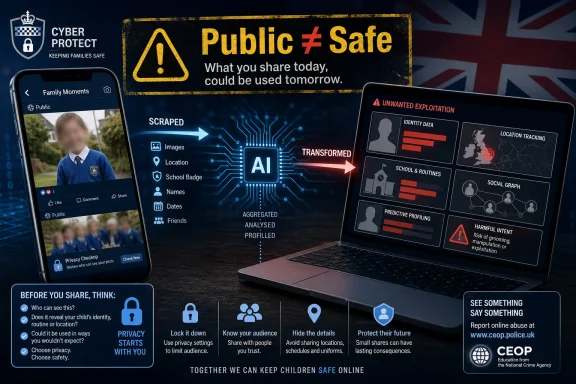 The Family Photo Has Become an Attack Surface
For years, parents were told to worry about oversharing because of embarrassment, identity clues, or the vague possibility that a stranger might misuse a picture. That advice often sounded like etiquette dressed up as cybersecurity. The new NCA and IWF warning changes the frame: the risk is no longer only that a child’s image can be copied, but that it can be transformed into something criminal, coercive, and psychologically devastating.The agencies’ central recommendation is blunt in practice even if carefully worded in public: do not leave identifiable pictures of children on open social media, school websites, sports-club pages, or any public-facing gallery unless there is a compelling reason. They suggest making accounts private, limiting sharing to trusted groups, reviewing old posts, and revisiting permissions previously granted to schools or clubs. That is basic hygiene, but it also marks a cultural shift.
The old internet bargain assumed that a photo was mostly what it appeared to be. A family uploaded a school play, a football match, a birthday party, or a holiday snap, and the main risk was uncontrolled distribution. Generative AI breaks that bargain because the source image is no longer the final artifact. It is raw material.
That is why this story belongs on a technology site, not just a parenting page. The abuse described by the NCA and IWF is a consequence of cheap computation, model availability, image scraping, social media defaults, and weak institutional data practices. It is the consumer version of a problem IT departments already know well: once sensitive data has escaped into an uncontrolled environment, policy becomes archaeology.
The NCA Is Warning About Capability, Not Just Content
The most important line in the new guidance is not the headline warning to parents. It is the observation that offenders no longer need direct contact with a child to create abusive material. That one technical change rewrites the risk model.Traditional online child-safety advice has often focused on grooming, messaging, fake accounts, coercion, and direct contact. Those remain major dangers. But AI-generated abuse introduces a parallel path: an offender can scrape or copy public photos, use manipulation tools to create explicit material, and then use the result for gratification, circulation, harassment, or blackmail.
The IWF says it identified 8,029 realistic AI-created child sexual abuse images and videos in 2025, a 14 percent increase in this category from the previous year. More strikingly, its own reporting has emphasized the explosion in AI-generated video, with thousands of such videos identified in 2025 compared with a tiny number the year before. The raw count is still smaller than the broader universe of child sexual abuse material online, but the direction of travel is obvious.
That distinction matters because the public often misunderstands statistical risk. A number can be small relative to the entire internet and still large enough to require changed behavior. Ransomware was once a specialist nuisance; then it became a line item in every board meeting. Deepfake abuse is following a similar curve, except the victims may be children who never chose to participate in online life at all.
The NCA’s Lorna Sinclair captured the gap between parental intent and criminal exploitation when she said the average parent does not post a child’s picture thinking it might be scraped and turned into CSAM. That is precisely the point. Most data breaches do not begin with a user intending to create a breach. They begin with an assumption that a system will be used in the way its friendly interface suggests.
Public Does Not Mean Harmless
The phrase “publicly available” does a lot of moral laundering on the internet. It suggests a thing is fair game because it was visible, even if it was posted in a context never meant for mass harvesting, automated analysis, or abuse. A child’s face on a school website may be technically public. That does not mean it was meaningfully consented into the global machinery of AI-enabled exploitation.This is where the issue becomes bigger than parental caution. Schools, nurseries, sports clubs, youth groups, local councils, and community organizations have spent years treating children’s images as harmless evidence of activity. The smiling gallery page became part of institutional branding. Parents signed photo consent forms at the start of term, often as one more administrative box in a stack of paperwork.
The NCA and IWF are now effectively saying that many of those consent forms were signed under obsolete assumptions. A parent who agreed in 2019 that a school could post a child’s photo on a website did not agree to have that image scraped into a malicious workflow in 2026. Consent that predates the threat is not necessarily meaningful consent.
That does not mean every photo must disappear from every corner of the web. It does mean institutions should stop treating public publication as the default. If a child’s name, face, uniform, location, club, age group, and routine can be inferred from a post, the image is no longer just a celebration. It is a data bundle.
The Blackmail Vector Is the Cruelest Part
The abuse risk is not limited to the existence of fake explicit images. The NCA and IWF warning also points toward coercion: children and teenagers being threatened with images that were fabricated from ordinary photos. The IWF’s Report Remove service, run with Childline, has received reports involving fully clothed selfies manipulated into explicit content.That makes this threat especially corrosive. A teenager does not need to have taken or shared an explicit image to become the target of sextortion. The attacker can manufacture the compromising artifact and then rely on fear, shame, and social pressure to do the rest.
The psychological mechanism is brutally simple. The victim knows the image is fake, but also knows peers, parents, teachers, or online communities may not immediately understand or believe that. Even if adults do respond properly, the first moments after receiving a threat can feel catastrophic. AI manipulation turns plausibility into a weapon.
For IT professionals, this should sound familiar. Many modern attacks do not rely on perfect deception; they rely on panic, urgency, and asymmetry. A phishing email does not need to withstand forensic analysis if it gets the target to click within 30 seconds. A fake nude image does not need to be authentic if it terrifies a child into silence.
Platforms Built the Sharing Reflex, Then AI Changed the Cost
It is easy to dump this problem on parents: stop posting, lock down accounts, be careful. That advice is necessary, but incomplete. Parents did not create the incentive structure that made public sharing normal, nor did children ask to have their childhoods documented across commercial platforms.For more than a decade, social networks encouraged the transformation of family life into content. Platforms rewarded photo-heavy posts with engagement, turned memory resurfacing into a feature, and normalized the idea that every milestone should be publicly archived. Smartphones made image capture frictionless. Cloud syncing made retention automatic. Recommendation feeds made visibility unpredictable.
Then AI arrived and changed the unit economics of abuse. Manipulation that once required time, skill, and specialist software can now be attempted with consumer-grade tools, underground services, or poorly governed models. Even when mainstream AI companies deploy safeguards, the broader ecosystem contains open models, jailbroken workflows, cloned services, and criminal communities trading methods.
The result is an ugly inversion of the platform promise. Families were told that sharing created connection. Now agencies are warning that the same share button can seed downstream harms beyond the family’s control. That does not make every parent reckless. It makes the internet less trustworthy than its interfaces pretend.
Microsoft, Google, Meta, Apple, OpenAI, and other major technology companies all have pieces of this puzzle: cloud storage, device ecosystems, AI models, app stores, search indexes, safety tooling, and identity systems. But no single company controls the entire pipeline. That fragmentation is why the practical advice falls first on users and local institutions, even when the systemic responsibility is far broader.
The “Close Friends” Era Is a Downgrade, but a Necessary One
The agencies’ advice to use private accounts or “close friends” groups will irritate people who resent being told how to share family life. It will also irritate technically minded readers who know that privacy controls are not magic. Screenshots happen. Accounts get compromised. Relatives repost. Platforms change settings. Data leaks.Still, imperfect friction is better than open publication. A private family group is not a vault, but it narrows the audience and reduces opportunistic scraping. A school intranet is not invulnerable, but it is preferable to an indexed public gallery. A cropped photo without a uniform, name badge, location tag, or full-face shot may still carry risk, but it leaks less than the alternative.
Security culture often fails when it presents controls as absolute guarantees. Password managers do not eliminate credential theft; they reduce reuse and phishing exposure. Multi-factor authentication does not end account compromise; it raises the attacker’s cost. In the same way, limiting children’s image visibility does not make AI abuse impossible. It makes the easiest attacks harder.
The practical standard should be minimization, not paranoia. Share less publicly. Strip context. Avoid identifiable school or club details. Prefer private channels. Ask older children before posting. Revisit old albums. Treat consent as renewable. None of that requires retreating from family life. It requires refusing to make a child’s identity part of the open web by default.
Schools Are Now Custodians of Biometric Data, Whether They Admit It or Not
The school website example is especially important because it exposes the gap between safeguarding language and digital practice. Many schools have robust policies for physical access, visitor badges, pickup permissions, and staff background checks. Yet the same institutions may publish hundreds of identifiable pupil images on pages that are trivial to scrape.A child’s face is biometric data in any common-sense meaning of the term. Pair it with a uniform, a school name, a sports team, a classroom display, a geotagged event, or a newsletter PDF, and it becomes richer still. The danger is not only AI-generated abuse; it is indexing, profiling, impersonation, and long-term loss of control.
Schools and youth organizations should treat public image publication as a risk decision requiring justification, not a communications habit. If the goal is to show community life, use group shots from behind, staged non-identifiable images, illustrations, locked parent portals, or opt-in galleries with short retention periods. If the goal is publicity, adults can carry more of that burden than children.
The consent process also needs repair. A single annual checkbox is too crude for the AI era. Parents should know where an image will appear, for how long, whether it will be downloadable, whether names or identifying details will accompany it, and how removal can be requested. Older children should be asked too, not because they can carry the full legal burden, but because dignity is learned by being respected.
The IWF’s Tom Dyson has emphasized that parents can ask for images to be removed from websites or social media where permission was previously granted. That should become a routine right, not an awkward confrontation. Institutions that handle children’s images need deletion workflows as much as publication workflows.
The Legal System Is Chasing a Moving Target
The UK has had laws covering indecent photographs and pseudo-photographs of children for decades, and AI-generated CSAM can fall within that framework. Recent UK government action has also aimed to close loopholes around the creation, possession, and distribution of AI-related abuse material. But law works after classification, detection, and evidence. AI moves at the speed of replication.The IWF’s 2025 figures show why enforcement alone will struggle. If realistic AI-generated videos can jump from almost nonexistent to thousands in a year, investigators face not merely more files but more ambiguity. They must determine whether content depicts a real child, a manipulated real child, a synthetic child-like figure, a known victim, or a mix. Each category can carry different investigative priorities, harms, and legal pathways.
There is also a moderation problem. Platforms need to detect illegal content without wrongly flagging benign family images, private medical contexts, or lawful material. That is not a theoretical worry; automated safety systems have a long history of false positives and blind spots. Families also have legitimate concerns about client-side scanning, cloud photo analysis, and overbroad surveillance.
This is the policy trap. Protecting children from AI-generated abuse requires detection, reporting, takedown, and law enforcement cooperation. Protecting families from intrusive monitoring requires restraint, transparency, due process, and narrow scope. Anyone offering a simple answer is probably selling something.
The best near-term approach is layered. Criminalize and prosecute abuse. Require platforms and AI providers to harden systems against generation and distribution. Give victims rapid removal channels. Educate schools and parents. Reduce the public availability of source images. No single layer will hold. The point is to make failure less catastrophic.
AI Companies Cannot Hide Behind the Prompt Box
The generative AI industry often frames abuse as misuse by bad actors, which is true but insufficient. A power tool can be misused, but manufacturers still add guards, warnings, shutoffs, and liability-aware design. AI systems capable of transforming real people’s images into explicit material need more than terms of service and press-release safety language.At a minimum, image and video models should resist sexualized transformations involving minors, block nudification workflows, detect attempts to use child-like subjects, and prevent face-swapping into explicit contexts. Services that host or distribute models should treat child-safety mitigations as core infrastructure, not optional reputation management. App stores and payment processors also have leverage over the ecosystem of abusive “nudify” services.
The harder problem is open models and local execution. Once weights are released or tools are modified, central enforcement becomes difficult. That reality is often used as an excuse for fatalism, but it should instead guide policy toward chokepoints that still exist: hosting, search visibility, payment rails, cloud GPUs, forums, model repositories, and distribution channels.
Windows users understand this from malware. You cannot uninvent code that can be used badly, but you can improve defaults, block known threats, maintain signatures, restrict execution paths, and punish distribution. AI abuse needs the same operational mindset. Safety is not a slogan; it is maintenance.
Parents Need a Threat Model, Not a Guilt Trip
The worst version of this conversation shames parents for having shared normal family moments before the threat was widely understood. That helps nobody. The better version gives parents a workable model: assume that any public photo of a child can be copied, searched, altered, and recontextualized by people who do not share your intentions.That does not mean every old post is a disaster. It means old posts deserve review under new facts. A baby photo in a private album is different from a public school sports image with names attached. A family WhatsApp group is different from an open Instagram account. A cropped picture of a child’s artwork is different from a high-resolution face shot in uniform outside a school gate.
Children should be part of the conversation when they are old enough. The NCA and IWF campaign rightly emphasizes that children and parents can say no to a photo being posted. That matters because many children have grown up with adults casually narrating their lives online before they could object.
There is a useful household rule hiding here: if a child would not be comfortable with the image being seen by classmates, strangers, or future acquaintances, do not publish it. AI makes that rule more urgent, but it did not invent the underlying principle. Children are not content assets.
The WindowsForum Angle Is Digital Hygiene at Home
For this community, the story should land as a home-network and identity-management issue as much as a social one. Many WindowsForum readers are the unofficial IT administrators for their families. They set up Microsoft accounts, OneDrive backups, shared albums, parental controls, routers, phones, tablets, and school devices. That role now includes helping relatives understand image exposure.Start with account visibility. Public social profiles should be treated as broadcast channels, not family albums. If relatives insist on sharing, help them create restricted groups and check whether old posts are indexed or visible to friends-of-friends. Make sure cloud photo links are not set to “anyone with the link” unless that is genuinely intended.
Then look at metadata and context. Most major platforms strip some EXIF data, but not all sharing routes do, and the visible content of the image often says more than metadata anyway. Uniforms, street signs, certificates, classroom boards, sports fixtures, and birthday decorations can reveal names, locations, routines, and ages. Cropping and blurring are not perfect, but they can reduce leakage.
Finally, treat removal as normal maintenance. Search for a child’s name alongside school, club, or team names. Review school and nursery pages. Ask clubs how long they retain images. Revoke old permissions where appropriate. This is not overreaction; it is asset inventory.
The Hardest Advice Is Also the Simplest
The NCA and IWF are not asking families to abandon photography. They are asking them to stop feeding open repositories of identifiable child images at a moment when AI abuse has lowered the barrier between ordinary photo and weaponized fake. The practical answer is not secrecy, but deliberate sharing.- Parents should make social accounts private before posting children’s images, and they should assume that public posts can be copied and manipulated indefinitely.
- Families should review old albums, school posts, club galleries, and relatives’ public profiles for identifiable images that no longer need to be online.
- Schools, nurseries, and sports organizations should revisit photo-consent policies written before modern AI image manipulation became widely accessible.
- Children old enough to understand should be asked before their images are shared, and a refusal should be treated as final rather than inconvenient.
- Removal requests should become routine, documented, and easy, especially when images include faces, uniforms, names, locations, or other identifying details.
- AI safety cannot be left to parents alone, because platforms, model providers, app stores, payment systems, and lawmakers all shape the abuse economy.
References
- Primary source: s2jnews.com
Published: 2026-07-04T14:50:33.482367
Loading…
s2jnews.com - Independent coverage: The News International
Published: 2026-07-04T01:50:33.464881
Loading…
www.thenews.com.pk - Related coverage: theguardian.com
Loading…
www.theguardian.com - Related coverage: iwf.org.uk
Loading…
www.iwf.org.uk - Related coverage: euronews.com
Loading…
www.euronews.com - Related coverage: gov.uk
Loading…
www.gov.uk