

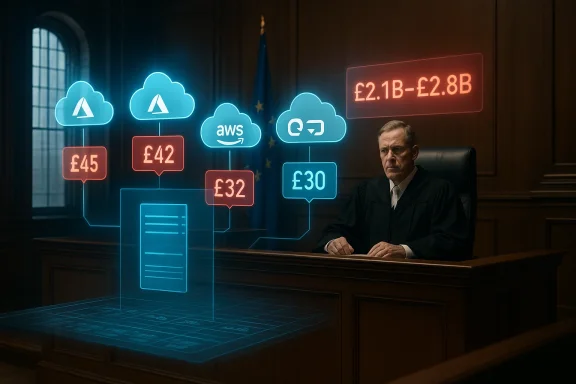
Microsoft is heading into a UK courtroom fight that could reshape how the market thinks about cloud licensing, platform leverage, and the real price of running Windows Server outside Azure. A London tribunal has now allowed a class action to proceed that alleges Microsoft charged higher wholesale prices to customers using rival clouds such as AWS and Google Cloud than it charged on Azure itself, potentially affecting roughly 60,000 UK businesses and putting about £2.1 billion to £2.8 billion at stake depending on how the claim is framed. That makes this more than a narrow licensing dispute; it is a test of whether a dominant software vendor can legally use pricing architecture to tilt customers toward its own cloud. The timing is especially sensitive because the UK Competition and Markets Authority is simultaneously revisiting Microsoft’s broader software and cloud practices. com]
Microsoft’s cloud business has long rested on a powerful combination of installed base, software control, and infrastructure scale. Windows Server remains a foundational enterprise product, and Azure has become one of the company’s core growth engines. When a vendor controls both the software layer and a major cloud platform, even subtle pricing decisions can have outsized effects on customer behavior. That is why the current case matters: the allegation is not merely that Microsoft charges a lot, but that it charges more when customers choose a rival cloud.
The legal theory behind the claim is straightforward, even if the accounting may be anything but. The plaintiffs argue that Microsoft’s licensing structure effectively penalizes enterprises for using AWS, Google Cloud, or Alibaba Cloud to host Windows Server workloads, while making Azure look more attractive by comparison. Reuters reporting from the original hearing described Microsoft’s response as a challenge to the claim’s damages methodology, while the tribunal found the case had enough merit to move forward.
This dispute did not appear out of nowhere. In 2024, Google went so far as to complain to the European Commission that Microsoft’s cloud licensing practices lock customers into Azure by imposing financial penalties on rival infrastructure. Google’s argument echoed a broader theme already familiar to antitrust regulators: in cloud markets, vendor rules can matter as much as raw server performance or price-per-vCPU. The UK case simply translates that broader tension into a large-scale damages claim.
The UK regulator has also been moving in parallel. In March 2026, the CMA announced a fresh package of actions on business software and cloud services, including a new Strategic Market Status investigation into Microsoft’s corporate software stack. The agency said the work would address remaining concerns about Microsoft’s licensing practices in cloud and help ensure a level playing field as AI becomes more embedded in business software. That backdrop matters because it suggests the tribunal case is landing in a climate where regulators are already skeptical of the cloud market’s competitive structure.
What makes this case especially important is that it sits at the intersection of cloud economics and software dependency. Customers do not buy Windows Server in isolation; they buy it as part of a much larger architecture involving identity, security, productivity, and application compatibility. Once those systems are intertwined, price discrimination can function as a steering mechanism rather than a simple sales tactic. That is the deeper issue the tribunal will now have to weigh.
The claim is not merely that Microsoft’s prices were high. It is that they were selectively high in a way that distorted customer choice. That distinction matters because competition law often tolerates robust pricing but scrutinizes pricing practices that leverage market power to disadvantage rivals. In a cloud market where customers compare total cost of ownership, a licensing surcharge can be more influential than a storage or compute discount.
In cloud computing, that kind of spread can be potent because migration decisions are rarely made on one line item. Enterprises model licensing, data transfer, support, identity, security, and administration together. A small shift in licensing cost can ripple across the entire procurement calculus, especially when the vendor can bundle adjacent products or offer enterprise discounts that muddy direct comparisons.
The lawsuit therefore has implications far beyond Windows Server. If the court accepts the basic theory, it could open the door to arguments about whether software vendors can make rival clouds systematically less attractive through contractual design. That would not automatically outlaw differentiated pricing, but it would invite closer scrutiny of how those prices are justified.
That matters because class actions of this scale often die early if the damages theory is weak. Microsoft had argued, according to Reuters and other coverage, that the claim lacked a workable method for calculating harm. The tribunal’s willingness to let the case continue suggests it thinks the economic model can be argued, even if it remains highly contested. In antitrust litigation, surviving that early filter can be half the battle.
For Microsoft, the tribunal’s move creates immediate reputational pressure. The company has repeatedly argued that the cloud market is dynamic and competitive, and that its vertically integrated model can benefit competition. That defense may still prevail, but it now has to survive a full trial record rather than a preliminary hearing.
The legal process also matters because it could generate documents, economic models, and internal explanations that are far more revealing than public statements. If the trial proceeds deeply enough, it may shed light on how Microsoft thinks about customer segmentation, cloud competition, and the strategic role of Windows Server in its broader ecosystem. That is the kind of evidence regulators and rivals pay attention to for years.
If the alleged Windows Server surcharge exists, it would effectively turn a licensing fee into a competitive toll. Customers who want flexibility would pay more for it, while customers who accept Azure would receive a commercial break. That is not unheard of in technology markets, but it becomes legally fraught when the pricing structure lines up too neatly with the vendor’s own platform priorities.
This is also why the issue resonates so strongly in public-sector procurement, where switching costs are especially sensitive and budgets are under pressure. A surcharge on a foundational workload like Windows Server can cascade into other purchase decisions, from database choices to identity architecture. Over time, the cheapest ecosystem can matter more than the cheapest standalone service.
Microsoft’s critics argue that such practices effectively punish portability. Microsoft’s defenders counter that integrated pricing can reflect legitimate product design, investment recovery, or bundled value. Both arguments can be true in principle, which is why courts and regulators tend to focus on outcomes: does the pricing preserve choice, or does it erode it?
The company’s public line is also that the cloud market is vigorous and contested. Microsoft has said the lawsuit does not provide a workable damages method and has stressed that there has been no final determination on the merits. That is a sensible litigation posture, but it also hints at a broader strategy: frame the dispute as a narrow pricing disagreement in a lively market rather than a structural abuse of power.
Yet integration is also what makes the case so dangerous for Microsoft. The more tightly the stack fits together, the easier it is for critics to argue that the vendor has too much power to shape customer behavior. In other words, the same corporate design that supports Microsoft’s competitive moat may also strengthen the plaintiffs’ theory of exclusion. That is the classic antitrust paradox.
This is why Microsoft has been careful to emphasize market dynamism. If it can show that AWS, Google Cloud, and others remain able to compete vigorously on price, service, and innovation, the company’s model looks less like coercion and more like normal platform competition. The challenge is that regulators increasingly treat cloud interoperability and licensing as core competition issues, not peripheral business terms.
That broader scrutiny is important because it changes the context in which the lawsuit will be read. A private class action might be dismissed as a financial dispute if it stood alone. But when the same commercial behavior is being examined by a competition authority, the case starts to look like one part of a larger pattern. That can influence both public perception and legal strategy.
For Microsoft, this means the legal challenge is also a strategic messaging problem. If the company is seen as defending legacy pricing habits at the same moment governments are trying to prevent AI-era lock-in, its public policy posture becomes harder to defend. The optics are especially awkward because Microsoft has been marketing itself as a partner in digital transformation, openness, and enterprise choice.
The CMA’s involvement could also increase the odds of behavioral remedies rather than purely monetary outcomes. If regulators decide that licensing terms distort competition, they may seek changes to commercial practice instead of waiting for damages to work their way through the courts. That possibility gives the case a much broader significance than the headline number alone would suggest.
That would not suddenly reverse the cloud market. Azure, AWS, and Google Cloud are competing on a scale far beyond any one licensing issue. But it could force Microsoft to rethink how much of its cloud advantage comes from product quality versus ecosystem steering. Rivals would likely use the decision in sales discussions, policy advocacy, and public-relations campaigns.
Alibaba Cloud’s inclusion in the claim also matters because it highlights the global dimension of cloud competition. Even though the UK market is the battleground, the principles at stake extend beyond domestic borders. The same licensing patterns, if upheld, could become a template for complaints elsewhere. That is especially relevant in jurisdictions that are already sharpening their focus on digital market power.
For AWS in particular, the case is strategically useful because it allows Amazon to argue that cloud competition is not being decided only by infrastructure breadth or AI partnerships. It is also being shaped by whether software vendors can tilt the field from the top of the stack. That makes the lawsuit a broader referendum on whether cloud neutrality still exists in practice.
Enterprise customers, by contrast, are right at the center of the issue. They are the ones making architecture decisions that involve Windows Server, cloud-hosted databases, identity systems, and application portability. For them, licensing is not a side issue; it is one of the main determinants of where workloads land and how much those workloads cost over time.
This is particularly important for public-sector buyers, where budget discipline and auditability matter as much as technical capability. The NHS, local councils, and other UK bodies have already been showing more interest in benchmarking and license optimization. That trend suggests buyers are becoming more alert to the fact that cloud portability is not just a technical challenge but a commercial one.
The consumer-enterprise split also helps explain why Microsoft can face intense criticism in regulatory circles without suffering immediate public backlash. Ordinary users may care more about Windows features or Copilot than about Windows Server economics. But enterprises, which account for much of Microsoft’s recurring revenue, will pay very close attention to whether a court validates the idea that licensing can be used as a competitive lever.
There is also a broader market timing issue. Cloud competition is no longer just about storage and compute; it now overlaps with AI, productivity software, and enterprise workflow control. That means any ruling on Microsoft’s licensing tactics could have implications well beyond Windows Server, especially as companies increasingly buy cloud, security, and AI capabilities as one interconnected stack.
Source: Windows Central £2.8B UK lawsuit against Microsoft’s Azure raises questions about cloud pricing and contracts
 Background
Microsoft’s cloud business has long rested on a powerful combination of installed base, software control, and infrastructure scale. Windows Server remains a foundational enterprise product, and Azure has become one of the company’s core growth engines. When a vendor controls both the software layer and a major cloud platform, even subtle pricing decisions can have outsized effects on customer behavior. That is why the current case matters: the allegation is not merely that Microsoft charges a lot, but that it charges more when customers choose a rival cloud.The legal theory behind the claim is straightforward, even if the accounting may be anything but. The plaintiffs argue that Microsoft’s licensing structure effectively penalizes enterprises for using AWS, Google Cloud, or Alibaba Cloud to host Windows Server workloads, while making Azure look more attractive by comparison. Reuters reporting from the original hearing described Microsoft’s response as a challenge to the claim’s damages methodology, while the tribunal found the case had enough merit to move forward.
This dispute did not appear out of nowhere. In 2024, Google went so far as to complain to the European Commission that Microsoft’s cloud licensing practices lock customers into Azure by imposing financial penalties on rival infrastructure. Google’s argument echoed a broader theme already familiar to antitrust regulators: in cloud markets, vendor rules can matter as much as raw server performance or price-per-vCPU. The UK case simply translates that broader tension into a large-scale damages claim.
The UK regulator has also been moving in parallel. In March 2026, the CMA announced a fresh package of actions on business software and cloud services, including a new Strategic Market Status investigation into Microsoft’s corporate software stack. The agency said the work would address remaining concerns about Microsoft’s licensing practices in cloud and help ensure a level playing field as AI becomes more embedded in business software. That backdrop matters because it suggests the tribunal case is landing in a climate where regulators are already skeptical of the cloud market’s competitive structure.
What makes this case especially important is that it sits at the intersection of cloud economics and software dependency. Customers do not buy Windows Server in isolation; they buy it as part of a much larger architecture involving identity, security, productivity, and application compatibility. Once those systems are intertwined, price discrimination can function as a steering mechanism rather than a simple sales tactic. That is the deeper issue the tribunal will now have to weigh.
What the Lawsuit Actually Alleges
At the heart of the claim is a simple accusation: Microsoft allegedly set different wholesale prices for Windows Server depending on where customers ran it, and those differences made Azure the cheapest home for workloads that could technically run elsewhere. According to reporting on the case, the class representative says Microsoft’s pricing punished businesses that chose AWS, Google Cloud, or Alibaba Cloud instead of Azure. The result, if the allegation is proved, would be a classic self-preferencing structure dressed up as licensing policy.The claim is not merely that Microsoft’s prices were high. It is that they were selectively high in a way that distorted customer choice. That distinction matters because competition law often tolerates robust pricing but scrutinizes pricing practices that leverage market power to disadvantage rivals. In a cloud market where customers compare total cost of ownership, a licensing surcharge can be more influential than a storage or compute discount.
The Pricing Mechanism
The logic of the alleged scheme is familiar from many platform disputes. If a company owns a product customers need and also runs the infrastructure competing for their spend, it can arrange its commercial terms so that the same workload is cheaper on its own platform. That does not require an outright ban on rivals. It only requires a pricing spread wide enough to make the “choice” feel expensive.In cloud computing, that kind of spread can be potent because migration decisions are rarely made on one line item. Enterprises model licensing, data transfer, support, identity, security, and administration together. A small shift in licensing cost can ripple across the entire procurement calculus, especially when the vendor can bundle adjacent products or offer enterprise discounts that muddy direct comparisons.
The lawsuit therefore has implications far beyond Windows Server. If the court accepts the basic theory, it could open the door to arguments about whether software vendors can make rival clouds systematically less attractive through contractual design. That would not automatically outlaw differentiated pricing, but it would invite closer scrutiny of how those prices are justified.
- The claim targets pricing discrimination, not just high prices.
- The alleged effect is to make Azure cheaper by design.
- Customers on rival clouds may have paid a premium simply for choosing another provider.
- The case hinges on whether the pricing had a competitive justification.
- The bigger question is whether software licensing can be used as a market-shaping lever.
Why the Tribunal’s Decision Matters
The Competition Appeal Tribunal’s refusal to throw out the case is the procedural turning point. It does not mean Microsoft has lost. It means the court believes the claim has enough substance to be tested, which is already a significant threshold in a case of this size. Bloomberg Law reported that judges found the lawsuit had “reasonable prospects of success,” signaling that the complaint is not being dismissed as speculative or incoherent.That matters because class actions of this scale often die early if the damages theory is weak. Microsoft had argued, according to Reuters and other coverage, that the claim lacked a workable method for calculating harm. The tribunal’s willingness to let the case continue suggests it thinks the economic model can be argued, even if it remains highly contested. In antitrust litigation, surviving that early filter can be half the battle.
Certification and Leverage
For the plaintiffs, certification is more than a legal milestone. It gives the case institutional momentum and broadens its political significance. A mass action on behalf of tens of thousands of businesses makes the alleged harm look systemic rather than isolated, and that can influence settlement posture even before trial begins.For Microsoft, the tribunal’s move creates immediate reputational pressure. The company has repeatedly argued that the cloud market is dynamic and competitive, and that its vertically integrated model can benefit competition. That defense may still prevail, but it now has to survive a full trial record rather than a preliminary hearing.
The legal process also matters because it could generate documents, economic models, and internal explanations that are far more revealing than public statements. If the trial proceeds deeply enough, it may shed light on how Microsoft thinks about customer segmentation, cloud competition, and the strategic role of Windows Server in its broader ecosystem. That is the kind of evidence regulators and rivals pay attention to for years.
- A tribunal refusal to dismiss a claim is a meaningful procedural win for plaintiffs.
- Microsoft now faces the risk of a much fuller discovery process.
- The case may shape not only damages but also market perception.
- Early rulings can influence whether similar claims are filed elsewhere.
- The trial could produce evidence regulators might later use in parallel probes.
The Cloud Pricing Problem
Cloud pricing is famously difficult to compare because it is never just about raw compute. Enterprises buy a bundle: virtual machines, storage, egress, identity, support, compliance tooling, backups, and software licenses. That makes it easy for vendors to claim that one platform is cheaper in aggregate even when one component is plainly more expensive. The Microsoft case goes straight at that ambiguity.If the alleged Windows Server surcharge exists, it would effectively turn a licensing fee into a competitive toll. Customers who want flexibility would pay more for it, while customers who accept Azure would receive a commercial break. That is not unheard of in technology markets, but it becomes legally fraught when the pricing structure lines up too neatly with the vendor’s own platform priorities.
Why Enterprise Buyers Care
Large enterprises rarely make cloud choices on ideology. They care about availability, migration risk, performance, security, and monthly spend. If Windows Server is materially more expensive on a rival platform, procurement teams may find themselves nudged toward Azure even when another cloud is operationally preferable. That is precisely how pricing can become strategic rather than merely transactional.This is also why the issue resonates so strongly in public-sector procurement, where switching costs are especially sensitive and budgets are under pressure. A surcharge on a foundational workload like Windows Server can cascade into other purchase decisions, from database choices to identity architecture. Over time, the cheapest ecosystem can matter more than the cheapest standalone service.
Microsoft’s critics argue that such practices effectively punish portability. Microsoft’s defenders counter that integrated pricing can reflect legitimate product design, investment recovery, or bundled value. Both arguments can be true in principle, which is why courts and regulators tend to focus on outcomes: does the pricing preserve choice, or does it erode it?
- Cloud bills are a stack of interdependent charges.
- Software licensing can function like a competitive tax.
- Enterprises care about total economics, not just headline server rates.
- Public buyers are especially vulnerable to lock-in effects.
- The central legal question is whether price differences are competitive or coercive.
Microsoft’s Defense and the Vertical Integration Argument
Microsoft has been signaling a defense rooted in vertical integration and competitive efficiency. Reuters reported that the company has argued its model, in which Windows Server is used as an input for Azure while also being licensed to rivals, can actually benefit competition. That is a familiar antitrust argument: a vendor can claim that integration lowers costs, improves performance, and delivers a better product to customers.The company’s public line is also that the cloud market is vigorous and contested. Microsoft has said the lawsuit does not provide a workable damages method and has stressed that there has been no final determination on the merits. That is a sensible litigation posture, but it also hints at a broader strategy: frame the dispute as a narrow pricing disagreement in a lively market rather than a structural abuse of power.
The Integrated Stack Is the Real Story
Microsoft’s strongest defense may not be that the pricing spread never existed, but that the spread reflects the realities of integrating software and cloud infrastructure. When a company sells the operating system, the identity layer, the productivity suite, and the hosting environment, the economics are not comparable to those of a pure-play infrastructure provider. That argument may resonate with judges who are wary of second-guessing commercial architecture.Yet integration is also what makes the case so dangerous for Microsoft. The more tightly the stack fits together, the easier it is for critics to argue that the vendor has too much power to shape customer behavior. In other words, the same corporate design that supports Microsoft’s competitive moat may also strengthen the plaintiffs’ theory of exclusion. That is the classic antitrust paradox.
This is why Microsoft has been careful to emphasize market dynamism. If it can show that AWS, Google Cloud, and others remain able to compete vigorously on price, service, and innovation, the company’s model looks less like coercion and more like normal platform competition. The challenge is that regulators increasingly treat cloud interoperability and licensing as core competition issues, not peripheral business terms.
- Microsoft’s defense centers on integration, not innocence.
- The company wants the case seen as a pricing dispute, not a structural abuse.
- A vertically integrated stack can be efficient and anti-competitive at the same time.
- The broader the ecosystem, the stronger the lock-in argument becomes.
- The company must prove that its model reflects legitimate commercial structure.
The CMA and the Regulatory Environment
The lawsuit is not occurring in isolation. The CMA’s March 2026 package of actions signaled that the UK watchdog is still actively worried about Microsoft’s influence across cloud and business software. The regulator’s new investigation into Microsoft’s corporate software services, including Windows, Word, Excel, Teams, and Copilot, suggests a wider concern than one licensing dispute. The issue is whether Microsoft’s software estate is becoming a gatekeeper for cloud choice and AI adoption.That broader scrutiny is important because it changes the context in which the lawsuit will be read. A private class action might be dismissed as a financial dispute if it stood alone. But when the same commercial behavior is being examined by a competition authority, the case starts to look like one part of a larger pattern. That can influence both public perception and legal strategy.
A Pattern of Pressure
The UK is now applying pressure from multiple angles: class action litigation, market investigation, and policy scrutiny around AI and software licensing. The CMA has already tied cloud competition to concerns about Microsoft’s licensing practices, explicitly linking the issue to fair competition in an era where AI is being folded into everyday business tools. That framing is significant because it suggests the regulator views this as a future-proofing issue, not just a backward-looking antitrust complaint.For Microsoft, this means the legal challenge is also a strategic messaging problem. If the company is seen as defending legacy pricing habits at the same moment governments are trying to prevent AI-era lock-in, its public policy posture becomes harder to defend. The optics are especially awkward because Microsoft has been marketing itself as a partner in digital transformation, openness, and enterprise choice.
The CMA’s involvement could also increase the odds of behavioral remedies rather than purely monetary outcomes. If regulators decide that licensing terms distort competition, they may seek changes to commercial practice instead of waiting for damages to work their way through the courts. That possibility gives the case a much broader significance than the headline number alone would suggest.
- The CMA has linked cloud competition to Microsoft’s software licensing.
- AI adoption is making the issue more urgent, not less.
- Private litigation and public regulation are reinforcing each other.
- Microsoft’s policy narrative now faces a credibility test.
- The likely long-term outcome may involve conduct changes, not just damages.
Competitive Implications for AWS, Google Cloud, and Alibaba Cloud
If the plaintiffs succeed, the biggest immediate beneficiaries may not be the businesses receiving damages but Microsoft’s cloud rivals. AWS and Google Cloud have long argued that licensing rules can unfairly distort competition in Azure’s favor. A court finding that Microsoft’s Windows Server pricing meaningfully disadvantaged rival clouds would validate one of their central competitive complaints.That would not suddenly reverse the cloud market. Azure, AWS, and Google Cloud are competing on a scale far beyond any one licensing issue. But it could force Microsoft to rethink how much of its cloud advantage comes from product quality versus ecosystem steering. Rivals would likely use the decision in sales discussions, policy advocacy, and public-relations campaigns.
Market Signaling
The symbolic value may be just as important as the direct financial one. Cloud buyers are acutely aware that vendor contracts can hide structural bias. A courtroom win for the plaintiffs would tell CIOs and procurement leaders that they were not imagining the imbalance. It would also reassure rivals that their complaints about licensing were not just sour grapes.Alibaba Cloud’s inclusion in the claim also matters because it highlights the global dimension of cloud competition. Even though the UK market is the battleground, the principles at stake extend beyond domestic borders. The same licensing patterns, if upheld, could become a template for complaints elsewhere. That is especially relevant in jurisdictions that are already sharpening their focus on digital market power.
For AWS in particular, the case is strategically useful because it allows Amazon to argue that cloud competition is not being decided only by infrastructure breadth or AI partnerships. It is also being shaped by whether software vendors can tilt the field from the top of the stack. That makes the lawsuit a broader referendum on whether cloud neutrality still exists in practice.
- Rivals gain if Microsoft’s pricing is found to be anti-competitive.
- The case validates long-standing complaints about cloud lock-in.
- Sales teams at AWS and Google can use the ruling as proof of structural bias.
- The story is global even if the lawsuit is UK-based.
- A plaintiff win would strengthen the case for regulatory intervention elsewhere.
Enterprise vs. Consumer Impact
For consumers, this case is mostly invisible, at least in the short term. Most individuals do not buy Windows Server licenses, and they are unlikely to notice changes in cloud pricing directly. The broader consumer effect would be indirect, showing up through business software costs, service pricing, or slower innovation if competition in the cloud market becomes distorted.Enterprise customers, by contrast, are right at the center of the issue. They are the ones making architecture decisions that involve Windows Server, cloud-hosted databases, identity systems, and application portability. For them, licensing is not a side issue; it is one of the main determinants of where workloads land and how much those workloads cost over time.
What IT Teams Should Notice
The practical lesson for enterprise IT is that licensing and cloud design can no longer be separated. A procurement team that treats software fees as a later-stage line item may underestimate how much vendor policy shapes architecture. Likewise, architects who focus only on compute performance may miss the commercial constraints that determine whether the design is sustainable.This is particularly important for public-sector buyers, where budget discipline and auditability matter as much as technical capability. The NHS, local councils, and other UK bodies have already been showing more interest in benchmarking and license optimization. That trend suggests buyers are becoming more alert to the fact that cloud portability is not just a technical challenge but a commercial one.
The consumer-enterprise split also helps explain why Microsoft can face intense criticism in regulatory circles without suffering immediate public backlash. Ordinary users may care more about Windows features or Copilot than about Windows Server economics. But enterprises, which account for much of Microsoft’s recurring revenue, will pay very close attention to whether a court validates the idea that licensing can be used as a competitive lever.
- Consumers feel the effect indirectly.
- Enterprises feel it in contracts, architecture, and migration planning.
- Public bodies are especially sensitive to licensing opacity.
- Cloud portability is partly a procurement issue.
- The case could influence how buyers negotiate multi-year enterprise agreements.
Strengths and Opportunities
Microsoft is not entering this fight as a weak company. It has deep enterprise relationships, a massive installed base, strong legal resources, and a cloud platform that many customers genuinely rely on. Even so, the case forces a broader reckoning with how the company monetizes that power, and that may create opportunities for more transparent licensing and better market trust if Microsoft chooses to adapt rather than simply defend.- Microsoft still has scale, cash flow, and legal firepower.
- The company can argue that integration improves customer outcomes.
- A trial offers a chance to clarify contested licensing practices.
- Reforming pricing could reduce regulatory pressure over time.
- Better disclosure could improve trust with enterprise buyers.
- Competitors’ complaints may be neutralized if Microsoft makes meaningful changes.
- The company can still position Azure as a strong platform on merit, not only on pricing.
Risks and Concerns
The biggest risk for Microsoft is not the immediate damages figure, but the possibility that the trial exposes a licensing strategy that looks worse under oath than it does in marketing copy. If judges or regulators conclude that the structure was designed to steer customers into Azure, the company could face a mix of financial penalties, behavioral remedies, and reputational harm. That combination would be far more costly than any single settlement number.- The case could reveal internal pricing strategies that are hard to defend.
- A court finding may embolden regulators in other regions.
- Enterprise customers could demand better discounts or escape clauses.
- Rivals could use the case to argue for stricter cloud rules.
- Microsoft’s cloud narrative could suffer if the company looks coercive.
- A broad loss might force changes to licensing across multiple products.
- The controversy could distract from Microsoft’s AI and cloud growth story.
What to Watch Next
The next phase will be about evidence, not headlines. If the case proceeds to trial as expected, the key questions will revolve around economic modeling, licensing comparisons, and whether Microsoft can justify the pricing differences as commercially necessary. The outcome will also be watched closely by the CMA, which is already probing how software licensing affects cloud competition in the UK.There is also a broader market timing issue. Cloud competition is no longer just about storage and compute; it now overlaps with AI, productivity software, and enterprise workflow control. That means any ruling on Microsoft’s licensing tactics could have implications well beyond Windows Server, especially as companies increasingly buy cloud, security, and AI capabilities as one interconnected stack.
- Watch for trial scheduling and procedural rulings.
- Watch for any settlement signals from Microsoft.
- Watch for CMA statements linking the case to its own investigation.
- Watch for reactions from AWS, Google Cloud, and industry groups.
- Watch for enterprise buyers reassessing multi-cloud strategies.
- Watch for whether Microsoft adjusts licensing terms proactively.
- Watch for whether the case influences AI-era cloud regulation.
Source: Windows Central £2.8B UK lawsuit against Microsoft’s Azure raises questions about cloud pricing and contracts
