

The UK government’s latest push to make free AI training available to every adult is a bold escalation in a national skills agenda that has already been rolling since 2024–25. Announced as an expansion of the AI Skills Boost programme, the revamped offer promises open access to benchmarked, industry-backed micro‑courses through a redesigned AI Skills Hub, a government-backed virtual AI foundations badge, a cross‑government “AI and the Future of Work” unit, and a package of local funding aimed at turning digital literacy into real jobs. The headline aim — to upskill 10 million workers by 2030 — is politically audacious and practically consequential. But the difference between a meaningful national capability and a well‑intentioned PR milestone lies in the details: delivery models, credential standards, digital inclusion, and safeguards for safety, privacy and workplace rights.
Key programme components announced by government include:
At the same time, some important operational details remain to be clarified publicly:
A practical model that tends to work:
That said, ambition is the easy part. The hard work is execution: designing tiered, assessed learning pathways; embedding verification, ethics and sector‑specific safeguards; ensuring digital inclusion; protecting workers’ rights; and funding local delivery for years rather than months.
If ministers and delivery partners commit to robust standards, independent assessment, and transparent measurement of real workplace outcomes, this programme could shift how millions work with AI and meaningfully improve productivity and inclusion. If it defaults to short, unassessed modules and ceremonial badges, it risks credential inflation and a false sense of security that could increase rather than reduce harms.
For workers, employers and policymakers, the pragmatic approach is the same: treat initial micro‑courses as the beginning of a learning journey, insist on demonstrable artifacts and assessments for job‑critical roles, and hold the programme to long‑term outcome metrics rather than short‑term completion counts. Done right, this is a once‑in‑a‑generation opportunity to broaden AI literacy; done poorly, it will be an expensive footnote.
Source: The Independent UK to offer free AI training to every adult
 Background
Where this comes from and what changed
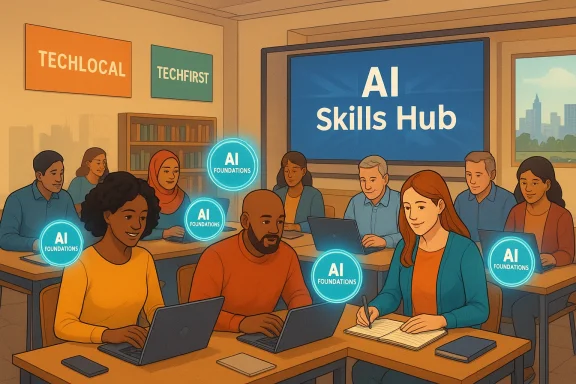
Over the past two years the UK has pursued a strategy of public–private partnerships to accelerate AI adoption and upskilling. What was initially framed as an industry‑led drive to reach a multi‑million cohort has now been elevated to a central government programme: the AI Skills Boost platform has been expanded, new public sector partners (including the NHS and local government) have been added, fresh funding lines for local delivery have been announced, and ministers have formally set a 2030 ambition to reach 10 million learners.Key programme components announced by government include:
- A revamped AI Skills Hub that aggregates industry‑developed courses and learning journeys.
- Selected courses checked against an AI foundation benchmark and eligible for a virtual AI foundations badge on completion.
- Short, practical modules (the government highlights that some can be completed in under 20 minutes) aimed at workplace applications like drafting, summarising and basic automation.
- A new AI and the Future of Work Unit to research and monitor labour‑market effects and advise policy.
- Targeted funding: a £27 million injection to kickstart TechLocal as part of a wider TechFirst fund, and a scholarship scheme supporting up to 100 master’s students.
What the programme offers
Free, benchmarked micro‑learning for adults
The AI Skills Hub will host curated, industry‑developed modules intended to be low friction and easily consumable. The design emphasis is clear: scale first, depth later. By offering short modules that teach practical, job‑relevant tasks (for example, using generative AI to draft text or automate administrative flows), the programme seeks to quickly raise baseline AI literacy across industries and regions.- Accessibility goal: Open to every adult online, with content designed for quick completion.
- Credential signal: Completion can earn a government‑backed digital badge intended to signal a baseline competence in AI fundamentals.
- Partner content: Large vendors and platforms provide materials and reach; professional services are named as delivery partners for larger implementation work.
Local pathways and graduate routes
The funding package includes monies to stimulate local progression into tech roles: TechLocal is meant to create pathways through colleges, local employers and bootcamps, while a scholarship strand aims to bolster master’s‑level pipelines with industry placements and mentorship.Institutional supports
The creation of an AI and the Future of Work Unit reflects a political recognition that skills are only one side of the ledger. That unit is charged to monitor economic impacts, recommend interventions, and coordinate across departments as AI reshapes jobs and sectors.Why this matters: promise and productivity
The upside is tangible
If executed thoughtfully, the programme could deliver measurable public value:- Rapid baseline literacy: Short, practical modules can reduce anxiety and help workers adopt time‑saving AI workflows in everyday tasks.
- Productivity gains: Practical AI use across clerical, administrative and content roles can free time for higher‑value activity.
- Inclusion and mobility: Localised delivery and scholarships can create pathways for under‑represented groups into tech careers.
- Visible signal for employers: A government‑backed badge, if underpinned by meaningful assessment, could standardise minimum workplace expectations for AI use.
The political optics
Announcing universal eligibility for free AI training is a high‑visibility win for ministers: it links technological leadership to social mobility and national competitiveness. It also reframes AI from a threat into an inclusive opportunity, which is useful messaging ahead of a longer transition period in labour markets.Where the risks and gaps lie
1. Credential inflation and the “badge effect”
A digital badge can be useful as a completion signal, but badges vary wildly in meaning. If tens of millions of learners earn a badge for a 20‑minute module, employers may quickly discount badges as mere attendance tokens rather than evidence of capability.- Risk: Certificates without independent assessment or demonstrable artifacts (work products, projects) will dilute labour‑market value.
- Mitigation: Establish competency checklists, assessment standards and tiered credentials (awareness → practical → accredited).
2. Superficial training vs practical competence
Short modules are excellent for awareness but cannot substitute for hands‑on practice. A 20‑minute primer that teaches the idea of prompting is not equivalent to a 10‑hour practical course that requires learners to produce verifiable outputs.- Risk: False confidence — learners may overestimate their ability, increasing error and harm in safety‑sensitive domains.
- Mitigation: Require practical exercises, portfolios of applied work, and follow‑on pathways into deeper training.
3. Vendor capture and narrow tool training
Relying on vendor content can accelerate scale but risks teaching platform‑specific workflows instead of transferable skills in verification, prompt engineering and ethics.- Risk: Workforce becomes skilled at a vendor’s interface rather than at problem solving with AI concepts.
- Mitigation: Ensure content is platform‑agnostic where possible and requires transferable competencies (e.g., evaluating outputs, provenance checking).
4. Digital exclusion and access barriers
“Online and free” does not automatically mean accessible. Device ownership, broadband, language, and basic digital literacy are real constraints for many adults.- Risk: The most vulnerable are left behind, widening inequalities.
- Mitigation: Fund device loan schemes, in‑person hubs (libraries, colleges), and assisted learning routes; measure reach among underserved groups.
5. Safety, misinformation and legal risk
AI systems hallucinate and can produce harmful outputs, including deepfakes. Training that fails to teach verification, escalation and governance may amplify harm.- Risk: Operational decisions based on unverified AI outputs could cause reputational, legal or safety incidents.
- Mitigation: Make verification and ethics mandatory in every module, include sector‑specific case studies (healthcare, policing, finance), and provide escalation pathways.
6. Sustainability and operational delivery
A national ambition needs a stable, multi‑year funding and delivery model. Short funding windows or an overreliance on voluntary industry commitments risk a programme that looks big on day one but collapses without sustained investment.- Risk: Programmes that stop when initial grants end leave learners stranded and reduce trust.
- Mitigation: Ring‑fence funding for core delivery, measure outcomes rather than completions, and commit to long‑term local partnerships.
Practical recommendations: how to make this credible
Design principles for a credible national programme
- Tiered learning paths
- Awareness modules (20 minutes or less) for broad reach and literacy.
- Practical primers (3–10 hours) with job‑specific exercises and artifacts.
- Accredited foundations (20+ hours) with independent assessment for roles that require real accountability.
- Clear credential definitions
- Publish competency checklists for each badge.
- Require an assessment format and minimum learning hours for higher‑value credentials.
- Use independent or multi‑stakeholder assessment panels for accredited pathways.
- Embed safety, verification and ethics
- Every module must include verification exercises (detect hallucinations, check provenance).
- Use sector‑specific scenarios and escalate processes for harm mitigation.
- Local delivery and inclusion
- Fund colleges, libraries and combined authorities to provide blended and in‑person training.
- Offer device loans, subsidised connectivity and assisted learning for digitally excluded populations.
- Independent evaluation and KPIs
- Track workplace outcomes: time saved, incidents avoided, job transitions.
- Require post‑course artifacts (prompt portfolios, automation demos) as part of assessment.
Guidance for different stakeholders
- For workers: Treat short badges as starters. Build a portfolio of applied work and seek deeper, assessed courses if your role requires accountability.
- For employers: Require demonstrable artifacts from training you fund; don’t hire on badge counts alone.
- For trade unions: Negotiate joint governance of AI deployment in workplaces and insist on protections and redress for displaced workers.
- For policymakers: Publish learning standards, assessment frameworks and multi‑year funding commitments; prioritise evaluation over vanity metrics.
Real‑world caveats and verifiable facts
Several concrete claims in the new rollout are verifiable: the government’s published programme materials confirm the expansion to an ambition of 10 million people by 2030, the use of the AI Skills Hub as the delivery platform, the availability of short awareness modules, named industry partners contributing content, and targeted local funds (including a £27 million TechLocal pot as part of a larger TechFirst investment). The government also committed to establishing a cross‑government unit to monitor labour‑market impacts.At the same time, some important operational details remain to be clarified publicly:
- The assessment standards underpinning the “virtual AI foundations badge”: who will issue, audit and accredit the badge at scale?
- The breakdown of funding and durable budgets for local delivery beyond the initial pots announced.
- Detailed KPIs and publication schedules for evaluation of actual workplace outcomes (not just completion numbers).
Comparative context: lessons from other national efforts
Other countries and large organisations are pursuing similar programmes, combining vendor contributions with national playbooks. The consistent lesson internationally is that scale without standards produces patchy results: countries that paired micro‑learning with accredited pathways and local, in‑person delivery saw better outcomes for digitally excluded groups and stronger employer recognition of credentials.A practical model that tends to work:
- Combine open online modules for mass reach with funded local bootcamps that convert awareness into demonstrable competency.
- Use employer alliances to create guaranteed interviews or work placements for learners who complete accredited pathways.
- Run rigorous, independent evaluation from the outset, focusing on job outcomes and incident metrics rather than vanity completion figures.
What to watch next
- Publication of operational plans and budgets — look for a detailed DSIT or cross‑government operational plan that specifies delivery models, funding timelines and accountability structures.
- Badge standards and assessment mechanics — whether badges are purely completion signals or tied to demonstrable work artifacts and independent assessment will matter.
- Local pilots and sector rollouts — early regional trials (for example, combined authority academies) will reveal how blended delivery and device support affect inclusion and competence.
- Independent evaluation reports — the first third‑party assessments of workplace outcomes will determine whether the programme is producing durable skills or superficial credentials.
- Regulatory and legal responses — any new incidents tied to AI misuse will shape the safety content and governance expectations embedded in the training.
Bottom line: an optimistic but cautious verdict
The expansion of free AI training to every adult in the UK is an important and timely policy move. It acknowledges a basic truth: meaningful control over technological change requires broad human capital investment, and public backing reduces the risk that AI skill access becomes the preserve of the digitally literate few.That said, ambition is the easy part. The hard work is execution: designing tiered, assessed learning pathways; embedding verification, ethics and sector‑specific safeguards; ensuring digital inclusion; protecting workers’ rights; and funding local delivery for years rather than months.
If ministers and delivery partners commit to robust standards, independent assessment, and transparent measurement of real workplace outcomes, this programme could shift how millions work with AI and meaningfully improve productivity and inclusion. If it defaults to short, unassessed modules and ceremonial badges, it risks credential inflation and a false sense of security that could increase rather than reduce harms.
For workers, employers and policymakers, the pragmatic approach is the same: treat initial micro‑courses as the beginning of a learning journey, insist on demonstrable artifacts and assessments for job‑critical roles, and hold the programme to long‑term outcome metrics rather than short‑term completion counts. Done right, this is a once‑in‑a‑generation opportunity to broaden AI literacy; done poorly, it will be an expensive footnote.
Source: The Independent UK to offer free AI training to every adult
