

The UK Government is moving to ban ransomware payments by public-sector bodies and critical national infrastructure operators while requiring other organisations to notify authorities before paying, following a 2025 consultation response that frames cyber extortion as a national resilience problem rather than a private IT crisis. The proposal does not end ransomware, and it does not magically give every hospital trust, council, utility, supplier, or business a clean recovery path. What it does is remove the most politically convenient fiction in incident response: that payment can remain a quiet, last-resort commercial decision. Britain is trying to make ransomware economics less attractive, but the real test will be whether it can make non-payment survivable.
For years, ransomware response has occupied a morally awkward but commercially familiar space. A company gets hit, operations stop, lawyers enter the room, insurers and negotiators are called, and a grim calculation begins: is paying less damaging than rebuilding? The answer has often been treated as an internal risk decision, even when the consequences spill into hospitals, schools, local councils, supply chains, and public services.
The UK’s proposed approach challenges that assumption. By targeting public-sector bodies and operators of Critical National Infrastructure, ministers are saying that some organisations should never be in the business of funding the gangs that attack them. That is a political statement, but it is also a practical one: if essential services pay, attackers learn that essential services are profitable.
The more interesting part is what happens outside the outright ban. The proposed payment prevention regime would require organisations and individuals beyond the banned sectors to notify authorities before making a ransomware payment. That shifts the act of paying from a private transaction into a regulated event, giving the state a chance to warn about sanctions, collect intelligence, and possibly stop payments that would otherwise vanish into criminal infrastructure.
This is not the maximalist version of a ransomware ban. It is a staged intervention, and that matters. The Government appears to understand that an economy-wide prohibition would be clean as a slogan and messy as a recovery plan, especially for organisations whose backups are bad, whose estates are old, and whose crisis muscle has never been tested.
That is why payment restrictions have become attractive to policymakers. The malware is only one part of the machine; the payment is the oxygen. If reliable victims in wealthy economies stop paying, or if payment becomes slower, riskier, and more visible, the economics of attack change.
The UK is not pretending that gangs will retire because a statute appears on the books. Attackers may shift to softer private-sector targets, intensify data-leak extortion, lean harder on suppliers, or focus on jurisdictions where payment remains easier. But a payment ban for public bodies and CNI operators is designed to remove a class of high-value targets from the ransom market, at least in theory.
The theory is not foolish. Criminal groups do respond to incentives. They select victims based on perceived ability to pay, pressure to restore, insurance coverage, regulatory exposure, and operational pain. If the state can credibly signal that certain victims cannot pay, those victims become less lucrative over time.
The problem is the word credibly. A ban that exists on paper but is not matched by resilience, funding, reporting discipline, and political support may simply convert ransom demands into prolonged outages. The Government can prohibit payment faster than it can modernise the fragmented, underfunded, vendor-dependent systems that many essential services rely on every day.
In late October 2023, the British Library suffered a major ransomware attack that disrupted many of its online systems and services. The Rhysida ransomware group claimed responsibility, data was stolen, and the institution embarked on a long rebuild rather than a quick return to normal. Researchers and readers felt the effects for months, and the recovery bill was reported in the millions.
The lesson is not that the British Library did the wrong thing. On the contrary, its public post-incident transparency has become a rare resource in a field where too many victims disclose the minimum required and bury the operational lessons. The lesson is that rebuilding is not a button; it is a programme.
When ransomware reaches identity systems, servers, endpoints, catalogue systems, remote access, administrative functions, and backups, recovery becomes archaeology. Teams must decide what can be trusted, what must be rebuilt, what data has been exposed, what services are safe to restore, and what technical debt can no longer be ignored. Every shortcut risks reintroducing the attacker or rebuilding on compromised foundations.
That is the uncomfortable context for a payment ban. If public bodies are legally barred from paying, then the British Library model of recovery becomes not an exceptional episode but the kind of experience more organisations must be prepared to endure. The question is whether they will have the funding, people, suppliers, and executive patience to do it.
But ransomware payment has never been a reliable recovery strategy. Decryptors can be slow, incomplete, or technically crude. Attackers may disappear after payment, demand more money, leak data anyway, or leave behind compromised accounts and persistence mechanisms. Even when decryption works, organisations still face forensic work, rebuilding, legal duties, regulatory exposure, customer communications, and the possibility of reinfection.
The larger danger is cultural. If payment remains part of the assumed contingency plan, investment in recovery can become easier to defer. Backups are “good enough,” segmentation is tomorrow’s project, incident response exercises are postponed, asset inventories remain aspirational, and identity hardening gets trapped in a budget queue.
That is why the Government’s approach is deliberately coercive. It tries to force the issue before the crisis. If payment will not be available, or if it will require pre-notification and scrutiny, then leaders must ask harder questions while systems are still running.
This is where cyber policy becomes management policy. The ransom decision is rarely made by the security team alone. It is made by executives, lawyers, insurers, public officials, finance teams, and operational leaders under extreme pressure. A payment ban changes the meeting before the attack happens, because it changes what options can be credibly put on the table.
Mandatory reporting is intended to correct that blindness. If organisations must report ransomware incidents, authorities can build better intelligence about attacker tactics, payment flows, exploited sectors, common weaknesses, and emerging campaigns. That intelligence can support sanctions enforcement, disruption operations, warnings to other victims, and more realistic policy.
There is a bargain here, though it is not always stated honestly. Government wants visibility; organisations want help, discretion, and predictability. If reporting becomes mainly a route to punishment, reputational harm, or bureaucratic delay, victims will minimise, lawyer up, or look for ways to classify incidents narrowly.
The regime will therefore succeed or fail on trust. Reporting must be fast enough to matter, clear enough to follow, and useful enough that organisations do not see it as merely another post-breach burden. If an overstretched IT director at a local authority believes that early reporting brings practical support, they will behave differently than if they believe it brings only scrutiny.
The payment prevention regime raises similar questions. Pre-notification before payment could stop sanctions violations and help officials identify criminal infrastructure. But if the response is slow, opaque, or unrealistic about operational pressure, it may be seen as Whitehall inserting itself into the worst day of a company’s year without sharing responsibility for the outcome.
A ransom ban does not patch Windows servers. It does not replace unsupported applications, rationalise identity estates, fund 24/7 monitoring, rebuild flat networks, or test backups. It does not solve the procurement reality in which public bodies depend on third parties for systems they do not fully control.
That does not make the ban wrong. It makes implementation decisive. If ministers want essential services to refuse payment, they must also accept that refusal has a cost. The money that might otherwise have gone to criminals must be spent before the attack on architecture, recovery, skilled people, and tested plans.
The danger is a policy gap in which the Government declares that payment is unacceptable while leaving individual organisations to discover, during an incident, that recovery is slower and more expensive than anyone budgeted for. That would produce the worst of both worlds: fewer payments in theory, but public anger at prolonged service failures in practice.
There is also a political problem. The public may support a hard line against cybercriminals until a hospital system, council service, transport provider, or school network is offline for weeks. At that point, the abstract virtue of non-payment collides with the immediate demand for restoration. Governments need to prepare the public for that reality as much as they prepare institutions.
A ban that applies to the operator but not every supplier creates practical complexity. If a third-party provider is hit and the disruption cascades into a critical service, who is effectively being extorted? If a managed service provider pays to restore systems used by multiple clients, does that indirectly undermine the ban’s purpose? If a software supplier is outside the formal category but sits inside essential workflows, does the policy capture the real risk?
These are not academic edge cases. Ransomware groups already target managed service providers because one compromise can produce many victims. They target data-rich service providers because stolen information creates pressure even when core systems can be rebuilt. They target suppliers that hold credentials, remote access, privileged tooling, or operational data.
That means boards outside the formal ban should not comfort themselves with scope arguments. If the UK is moving toward a more interventionist ransomware regime, suppliers to critical sectors will face tougher questions from customers, insurers, regulators, and procurement teams. The legal obligation may begin with public bodies and CNI, but the commercial obligation will spread outward.
This is one of the underappreciated effects of cyber regulation. It rarely stays inside the regulated entity. Banks changed the security expectations for fintech suppliers; healthcare rules changed expectations for technology vendors; resilience rules for critical infrastructure will change expectations for everyone connected to it.
The proposed pre-notification regime makes that risk more explicit. Authorities would have an opportunity to warn victims before payment if sanctions concerns are apparent. That is sensible, but it also formalises something many executives would rather not confront: “we had to pay” is not a magic legal defence.
The ransomware ecosystem is intentionally murky. Affiliates, brokers, initial access sellers, laundering services, and rebranded gangs create distance between the victim and the ultimate beneficiaries. That opacity does not eliminate risk. It increases it.
For boards, the message should be blunt. A ransom decision is no longer just a business continuity decision. It is a legal, regulatory, geopolitical, and reputational decision made under time pressure with incomplete information. If that sentence sounds like a bad governance model, that is because it is.
This is why serious organisations are moving the conversation upstream. They are not simply asking whether they would pay. They are asking what conditions could put them in a position where payment seemed necessary, and how to eliminate those conditions before an attacker creates them.
Payment restrictions will force insurers to adjust. Policies cannot treat ransom reimbursement as an uncomplicated tool if certain payments are banned, others require pre-notification, and sanctions risk remains live. Underwriting will likely lean harder into resilience evidence: tested backups, privileged access controls, network segmentation, endpoint detection, logging, incident response retainers, and supplier assurance.
That is not necessarily bad. Insurance markets often move faster than regulation in translating risk into practical demands. If insurers demand proof that restoration works, boards may finally fund the unglamorous controls that security teams have been requesting for years.
But insurance cannot become a substitute for public resilience. Some public bodies are uninsured, underinsured, or covered in ways that do not match the realities of a major rebuild. Even where coverage exists, money after the fact does not restore trust in compromised systems or conjure experienced responders out of thin air during a national wave of incidents.
The old playbook assumed that a painful event could be contained through a mixture of negotiation, coverage, consultants, and communications. The new playbook requires evidence that the organisation can operate through degradation and recover without bargaining with criminals. That is a much higher bar.
This is not because Windows is uniquely doomed. It is because Windows remains the operational substrate of countless organisations. Identity, file services, endpoint management, business applications, print services, administrative tooling, and third-party integrations often converge in ways that give attackers enormous leverage once they gain privileged access.
The most dangerous phrase in many estates is “temporary exception.” MFA is deployed for some users but not all access paths. Legacy systems are segmented later. Service accounts keep broad privileges because nobody wants to break an application. Backups are immutable in the slide deck but reachable in practice. Remote management tools are necessary for support, but poorly monitored.
A payment ban makes these compromises less tolerable. If an organisation cannot pay and cannot rebuild quickly, every architectural weakness becomes a board-level risk. The distance between a skipped hardening project and a public-service outage becomes easier to see.
Administrators should take that as both warning and opportunity. The policy environment is creating a stronger argument for the basics that have long sounded boring: least privilege, privileged access workstations, tiered administration, application control, tested restore procedures, tamper-resistant logging, offline backups, and ruthless removal of abandoned systems. The boring controls are becoming the difference between a bad week and a civic crisis.
Backups are the obvious starting point, but they are not the whole story. Backups must be offline, immutable, segregated, monitored, and regularly restored in realistic tests. A backup that has never been used under pressure is not a recovery capability; it is a hopeful artefact.
Network segmentation matters because ransomware is a campaign, not a lightning strike. Attackers move laterally, escalate privileges, find backup infrastructure, identify sensitive data, and time detonation for maximum leverage. Segmentation slows that process, limits blast radius, and gives defenders a chance to detect activity before everything is encrypted.
Incident response exercises matter because crisis roles cannot be invented at 3 a.m. Executives need to know who can authorise shutdowns, who speaks to regulators, who contacts law enforcement, who manages suppliers, who communicates with customers, and who decides when systems are safe to restore. Technical recovery and executive governance must meet before the incident, not during it.
Supplier assurance matters because no organisation is only itself anymore. A beautifully hardened internal estate can still be exposed through a remote support tool, compromised MSP account, vulnerable appliance, software update channel, or neglected integration. Ransomware resilience is therefore partly a procurement discipline.
But the existence of evasion is not a reason to preserve a broken market. We do not abandon anti-money-laundering rules because laundering persists. We do not abandon sanctions because evasion networks exist. The question is whether the regime is designed well enough to reduce harm without creating perverse incentives.
That requires proportionality. Organisations that report early and cooperate should not be treated the same as those that conceal, mislead, or recklessly pay sanctioned actors. Regulators will need to distinguish between negligence, unavoidable compromise, poor preparation, and bad-faith secrecy.
It also requires useful government response. If mandatory reporting becomes a one-way extraction of data from victims, resentment will grow. If it produces timely warnings, sector-specific intelligence, coordinated disruption, and practical support, reporting becomes part of resilience rather than merely a compliance ritual.
The UK’s challenge is to make transparency less frightening than secrecy. That is not achieved by speeches. It is achieved by how the first major cases are handled.
A payment ban changes the timing of the bill. Instead of paying criminals after failure, organisations must spend before failure. That is better public policy, but it is not cost-free.
For private companies, the cost will show up in cyber budgets, insurance requirements, supplier contracts, board oversight, and potentially higher prices. For public bodies, it will show up in spending settlements, procurement reform, shared services, and politically difficult choices about replacing systems that still “work” until they suddenly do not.
There is a temptation to treat ransomware resilience as a matter of discipline rather than resources. Discipline matters, but so does money. Smaller councils, schools, charities, and public-service suppliers may know exactly what good looks like and still struggle to buy it, staff it, and maintain it.
That is where national policy must connect to national capability. If the state declares that payment is unacceptable for essential services, it must help create the conditions under which refusal is operationally credible. Otherwise the policy becomes a moral demand issued to organisations that were never equipped to meet it.
Evidence means restore tests with measured timings. It means records of tabletop exercises involving executives, legal, communications, operations, and technical teams. It means identity audits, supplier risk reviews, segmentation maps, privileged access controls, and documented decisions about which services must return first.
It also means understanding the organisation’s true tolerance for downtime. Many businesses claim they can tolerate outages until they test the assumptions behind that claim. Dependencies are discovered late, manual workarounds fail, and recovery priorities clash with customer expectations or public obligations.
The coming UK regime will make those gaps harder to hide. Mandatory reporting will create more external visibility. Payment pre-notification will create more scrutiny. Public-sector bans will create stronger expectations that leaders planned for non-payment before the crisis.
The best-prepared organisations will not be those that write the most elegant ransomware policy. They will be those that can show, in evidence, that paying was never central to their recovery model.
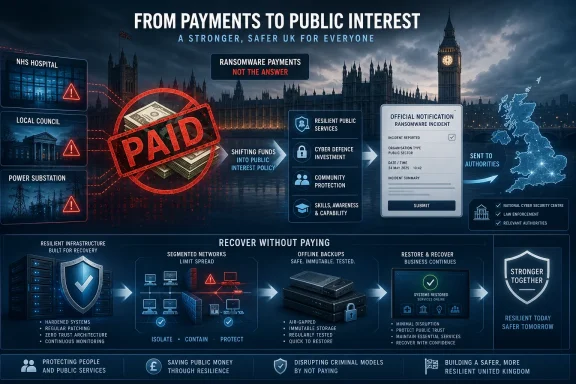 The Government Is Turning Ransomware From a Boardroom Decision Into a Public-Interest Event
For years, ransomware response has occupied a morally awkward but commercially familiar space. A company gets hit, operations stop, lawyers enter the room, insurers and negotiators are called, and a grim calculation begins: is paying less damaging than rebuilding? The answer has often been treated as an internal risk decision, even when the consequences spill into hospitals, schools, local councils, supply chains, and public services.The UK’s proposed approach challenges that assumption. By targeting public-sector bodies and operators of Critical National Infrastructure, ministers are saying that some organisations should never be in the business of funding the gangs that attack them. That is a political statement, but it is also a practical one: if essential services pay, attackers learn that essential services are profitable.
The more interesting part is what happens outside the outright ban. The proposed payment prevention regime would require organisations and individuals beyond the banned sectors to notify authorities before making a ransomware payment. That shifts the act of paying from a private transaction into a regulated event, giving the state a chance to warn about sanctions, collect intelligence, and possibly stop payments that would otherwise vanish into criminal infrastructure.
This is not the maximalist version of a ransomware ban. It is a staged intervention, and that matters. The Government appears to understand that an economy-wide prohibition would be clean as a slogan and messy as a recovery plan, especially for organisations whose backups are bad, whose estates are old, and whose crisis muscle has never been tested.
The Ban Is Aimed at the Business Model, Not the Malware
Ransomware is often discussed as if it were primarily a technical phenomenon: malicious code encrypts files, defenders restore backups, everyone learns a lesson, and the story ends. That picture is obsolete. Modern ransomware is a business model built around intrusion, theft, coercion, reputational pressure, regulatory fear, and the victim’s own operational dependency on digital systems.That is why payment restrictions have become attractive to policymakers. The malware is only one part of the machine; the payment is the oxygen. If reliable victims in wealthy economies stop paying, or if payment becomes slower, riskier, and more visible, the economics of attack change.
The UK is not pretending that gangs will retire because a statute appears on the books. Attackers may shift to softer private-sector targets, intensify data-leak extortion, lean harder on suppliers, or focus on jurisdictions where payment remains easier. But a payment ban for public bodies and CNI operators is designed to remove a class of high-value targets from the ransom market, at least in theory.
The theory is not foolish. Criminal groups do respond to incentives. They select victims based on perceived ability to pay, pressure to restore, insurance coverage, regulatory exposure, and operational pain. If the state can credibly signal that certain victims cannot pay, those victims become less lucrative over time.
The problem is the word credibly. A ban that exists on paper but is not matched by resilience, funding, reporting discipline, and political support may simply convert ransom demands into prolonged outages. The Government can prohibit payment faster than it can modernise the fragmented, underfunded, vendor-dependent systems that many essential services rely on every day.
The British Library Showed What Non-Payment Recovery Really Looks Like
The 2023 British Library attack has become the unavoidable case study because it punctures two comforting myths at once. The first myth is that public institutions are too culturally valuable or operationally boring to be prime ransomware targets. The second is that recovery without payment is a matter of restoring from backup and issuing a few apologetic service updates.In late October 2023, the British Library suffered a major ransomware attack that disrupted many of its online systems and services. The Rhysida ransomware group claimed responsibility, data was stolen, and the institution embarked on a long rebuild rather than a quick return to normal. Researchers and readers felt the effects for months, and the recovery bill was reported in the millions.
The lesson is not that the British Library did the wrong thing. On the contrary, its public post-incident transparency has become a rare resource in a field where too many victims disclose the minimum required and bury the operational lessons. The lesson is that rebuilding is not a button; it is a programme.
When ransomware reaches identity systems, servers, endpoints, catalogue systems, remote access, administrative functions, and backups, recovery becomes archaeology. Teams must decide what can be trusted, what must be rebuilt, what data has been exposed, what services are safe to restore, and what technical debt can no longer be ignored. Every shortcut risks reintroducing the attacker or rebuilding on compromised foundations.
That is the uncomfortable context for a payment ban. If public bodies are legally barred from paying, then the British Library model of recovery becomes not an exceptional episode but the kind of experience more organisations must be prepared to endure. The question is whether they will have the funding, people, suppliers, and executive patience to do it.
Payment Was Always a Bad Recovery Strategy Disguised as a Shortcut
The argument for paying a ransom is emotionally easy to understand. Systems are down, customers are angry, public services are interrupted, payroll may be affected, clinical appointments may be cancelled, production lines may be idle, and losses mount by the hour. In that moment, a decryption key can look less like capitulation and more like a tourniquet.But ransomware payment has never been a reliable recovery strategy. Decryptors can be slow, incomplete, or technically crude. Attackers may disappear after payment, demand more money, leak data anyway, or leave behind compromised accounts and persistence mechanisms. Even when decryption works, organisations still face forensic work, rebuilding, legal duties, regulatory exposure, customer communications, and the possibility of reinfection.
The larger danger is cultural. If payment remains part of the assumed contingency plan, investment in recovery can become easier to defer. Backups are “good enough,” segmentation is tomorrow’s project, incident response exercises are postponed, asset inventories remain aspirational, and identity hardening gets trapped in a budget queue.
That is why the Government’s approach is deliberately coercive. It tries to force the issue before the crisis. If payment will not be available, or if it will require pre-notification and scrutiny, then leaders must ask harder questions while systems are still running.
This is where cyber policy becomes management policy. The ransom decision is rarely made by the security team alone. It is made by executives, lawyers, insurers, public officials, finance teams, and operational leaders under extreme pressure. A payment ban changes the meeting before the attack happens, because it changes what options can be credibly put on the table.
The Reporting Regime May Matter More Than the Ban
The headline is the ban, but the reporting obligations may produce the deeper structural change. Ransomware thrives in part because governments see only a fraction of the battlefield. Many incidents are handled quietly, disclosed narrowly, or reported through fragmented channels that do not give law enforcement or policymakers a coherent picture.Mandatory reporting is intended to correct that blindness. If organisations must report ransomware incidents, authorities can build better intelligence about attacker tactics, payment flows, exploited sectors, common weaknesses, and emerging campaigns. That intelligence can support sanctions enforcement, disruption operations, warnings to other victims, and more realistic policy.
There is a bargain here, though it is not always stated honestly. Government wants visibility; organisations want help, discretion, and predictability. If reporting becomes mainly a route to punishment, reputational harm, or bureaucratic delay, victims will minimise, lawyer up, or look for ways to classify incidents narrowly.
The regime will therefore succeed or fail on trust. Reporting must be fast enough to matter, clear enough to follow, and useful enough that organisations do not see it as merely another post-breach burden. If an overstretched IT director at a local authority believes that early reporting brings practical support, they will behave differently than if they believe it brings only scrutiny.
The payment prevention regime raises similar questions. Pre-notification before payment could stop sanctions violations and help officials identify criminal infrastructure. But if the response is slow, opaque, or unrealistic about operational pressure, it may be seen as Whitehall inserting itself into the worst day of a company’s year without sharing responsibility for the outcome.
Public-Sector Resilience Is the Weak Link in a Hard-Line Policy
There is an obvious tension in the UK’s posture. The organisations most likely to be prohibited from paying are often the organisations least able to absorb a long digital outage. Public-sector bodies, schools, councils, health organisations, and infrastructure-adjacent providers are not uniformly underprepared, but many operate with legacy systems, constrained budgets, recruitment challenges, and complex supplier dependencies.A ransom ban does not patch Windows servers. It does not replace unsupported applications, rationalise identity estates, fund 24/7 monitoring, rebuild flat networks, or test backups. It does not solve the procurement reality in which public bodies depend on third parties for systems they do not fully control.
That does not make the ban wrong. It makes implementation decisive. If ministers want essential services to refuse payment, they must also accept that refusal has a cost. The money that might otherwise have gone to criminals must be spent before the attack on architecture, recovery, skilled people, and tested plans.
The danger is a policy gap in which the Government declares that payment is unacceptable while leaving individual organisations to discover, during an incident, that recovery is slower and more expensive than anyone budgeted for. That would produce the worst of both worlds: fewer payments in theory, but public anger at prolonged service failures in practice.
There is also a political problem. The public may support a hard line against cybercriminals until a hospital system, council service, transport provider, or school network is offline for weeks. At that point, the abstract virtue of non-payment collides with the immediate demand for restoration. Governments need to prepare the public for that reality as much as they prepare institutions.
Critical Infrastructure Is Not a Neat Category in the Ransomware Economy
The focus on public bodies and CNI operators sounds clear until it meets the modern supply chain. Essential services are delivered through layers of contractors, managed service providers, software vendors, cloud platforms, data processors, facilities firms, and specialist technology suppliers. Attackers know this and often exploit the weakest link that gives them leverage over the real target.A ban that applies to the operator but not every supplier creates practical complexity. If a third-party provider is hit and the disruption cascades into a critical service, who is effectively being extorted? If a managed service provider pays to restore systems used by multiple clients, does that indirectly undermine the ban’s purpose? If a software supplier is outside the formal category but sits inside essential workflows, does the policy capture the real risk?
These are not academic edge cases. Ransomware groups already target managed service providers because one compromise can produce many victims. They target data-rich service providers because stolen information creates pressure even when core systems can be rebuilt. They target suppliers that hold credentials, remote access, privileged tooling, or operational data.
That means boards outside the formal ban should not comfort themselves with scope arguments. If the UK is moving toward a more interventionist ransomware regime, suppliers to critical sectors will face tougher questions from customers, insurers, regulators, and procurement teams. The legal obligation may begin with public bodies and CNI, but the commercial obligation will spread outward.
This is one of the underappreciated effects of cyber regulation. It rarely stays inside the regulated entity. Banks changed the security expectations for fintech suppliers; healthcare rules changed expectations for technology vendors; resilience rules for critical infrastructure will change expectations for everyone connected to it.
Sanctions Turn the Ransom Decision Into a Legal Minefield
Even before a formal ban, paying ransomware gangs has carried legal danger. Many major ransomware operations are linked, directly or indirectly, to sanctioned individuals, groups, jurisdictions, or financial infrastructure. A payment that appears operationally expedient can become a sanctions problem if money flows to a prohibited actor.The proposed pre-notification regime makes that risk more explicit. Authorities would have an opportunity to warn victims before payment if sanctions concerns are apparent. That is sensible, but it also formalises something many executives would rather not confront: “we had to pay” is not a magic legal defence.
The ransomware ecosystem is intentionally murky. Affiliates, brokers, initial access sellers, laundering services, and rebranded gangs create distance between the victim and the ultimate beneficiaries. That opacity does not eliminate risk. It increases it.
For boards, the message should be blunt. A ransom decision is no longer just a business continuity decision. It is a legal, regulatory, geopolitical, and reputational decision made under time pressure with incomplete information. If that sentence sounds like a bad governance model, that is because it is.
This is why serious organisations are moving the conversation upstream. They are not simply asking whether they would pay. They are asking what conditions could put them in a position where payment seemed necessary, and how to eliminate those conditions before an attacker creates them.
The Insurance Market Will Not Save the Old Playbook
Cyber insurance has played a complicated role in ransomware. At its best, it has professionalised incident response by connecting victims with forensic firms, legal advisers, negotiators, and recovery specialists. At its worst, critics argue, it has made payment easier to operationalise and helped attackers price demands around perceived coverage.Payment restrictions will force insurers to adjust. Policies cannot treat ransom reimbursement as an uncomplicated tool if certain payments are banned, others require pre-notification, and sanctions risk remains live. Underwriting will likely lean harder into resilience evidence: tested backups, privileged access controls, network segmentation, endpoint detection, logging, incident response retainers, and supplier assurance.
That is not necessarily bad. Insurance markets often move faster than regulation in translating risk into practical demands. If insurers demand proof that restoration works, boards may finally fund the unglamorous controls that security teams have been requesting for years.
But insurance cannot become a substitute for public resilience. Some public bodies are uninsured, underinsured, or covered in ways that do not match the realities of a major rebuild. Even where coverage exists, money after the fact does not restore trust in compromised systems or conjure experienced responders out of thin air during a national wave of incidents.
The old playbook assumed that a painful event could be contained through a mixture of negotiation, coverage, consultants, and communications. The new playbook requires evidence that the organisation can operate through degradation and recover without bargaining with criminals. That is a much higher bar.
Windows Estates Sit at the Center of the Blast Radius
For WindowsForum readers, the policy story has a familiar technical underside. Ransomware incidents still very often become Windows estate failures: Active Directory abuse, stolen credentials, weak remote access, unmanaged endpoints, over-permissive shares, exposed management tools, legacy servers, poor logging, and backups reachable from the same compromised environment.This is not because Windows is uniquely doomed. It is because Windows remains the operational substrate of countless organisations. Identity, file services, endpoint management, business applications, print services, administrative tooling, and third-party integrations often converge in ways that give attackers enormous leverage once they gain privileged access.
The most dangerous phrase in many estates is “temporary exception.” MFA is deployed for some users but not all access paths. Legacy systems are segmented later. Service accounts keep broad privileges because nobody wants to break an application. Backups are immutable in the slide deck but reachable in practice. Remote management tools are necessary for support, but poorly monitored.
A payment ban makes these compromises less tolerable. If an organisation cannot pay and cannot rebuild quickly, every architectural weakness becomes a board-level risk. The distance between a skipped hardening project and a public-service outage becomes easier to see.
Administrators should take that as both warning and opportunity. The policy environment is creating a stronger argument for the basics that have long sounded boring: least privilege, privileged access workstations, tiered administration, application control, tested restore procedures, tamper-resistant logging, offline backups, and ruthless removal of abandoned systems. The boring controls are becoming the difference between a bad week and a civic crisis.
Resilience by Design Is Not a Slogan If It Changes Spending
The phrase resilience by design is at risk of becoming another governance cliché, but it has a concrete meaning in ransomware preparation. It means systems are built with the assumption that compromise will happen, that some services will fail, and that recovery must be rehearsed rather than improvised. It also means the business accepts degraded operation as something to plan for, not something to discover during an attack.Backups are the obvious starting point, but they are not the whole story. Backups must be offline, immutable, segregated, monitored, and regularly restored in realistic tests. A backup that has never been used under pressure is not a recovery capability; it is a hopeful artefact.
Network segmentation matters because ransomware is a campaign, not a lightning strike. Attackers move laterally, escalate privileges, find backup infrastructure, identify sensitive data, and time detonation for maximum leverage. Segmentation slows that process, limits blast radius, and gives defenders a chance to detect activity before everything is encrypted.
Incident response exercises matter because crisis roles cannot be invented at 3 a.m. Executives need to know who can authorise shutdowns, who speaks to regulators, who contacts law enforcement, who manages suppliers, who communicates with customers, and who decides when systems are safe to restore. Technical recovery and executive governance must meet before the incident, not during it.
Supplier assurance matters because no organisation is only itself anymore. A beautifully hardened internal estate can still be exposed through a remote support tool, compromised MSP account, vulnerable appliance, software update channel, or neglected integration. Ransomware resilience is therefore partly a procurement discipline.
The Underground-Payment Risk Is Real, but It Is Not an Argument for Doing Nothing
Critics of ransom bans often warn that prohibitions can drive payments underground. That risk is real. If organisations fear reputational damage, regulatory scrutiny, or operational ruin, some may hide incidents, route payments through intermediaries, misclassify extortion, or delay disclosure until the facts are harder to reconstruct.But the existence of evasion is not a reason to preserve a broken market. We do not abandon anti-money-laundering rules because laundering persists. We do not abandon sanctions because evasion networks exist. The question is whether the regime is designed well enough to reduce harm without creating perverse incentives.
That requires proportionality. Organisations that report early and cooperate should not be treated the same as those that conceal, mislead, or recklessly pay sanctioned actors. Regulators will need to distinguish between negligence, unavoidable compromise, poor preparation, and bad-faith secrecy.
It also requires useful government response. If mandatory reporting becomes a one-way extraction of data from victims, resentment will grow. If it produces timely warnings, sector-specific intelligence, coordinated disruption, and practical support, reporting becomes part of resilience rather than merely a compliance ritual.
The UK’s challenge is to make transparency less frightening than secrecy. That is not achieved by speeches. It is achieved by how the first major cases are handled.
The Ransomware Debate Is Really About Who Pays for Resilience
Behind the policy argument sits a fiscal argument. Paying a ransom is often cheaper in the short term than years of investment in modernisation, hardening, redundancy, skilled staffing, and recovery testing. That is precisely why ransomware has become so effective: criminals exploit deferred maintenance and convert it into immediate leverage.A payment ban changes the timing of the bill. Instead of paying criminals after failure, organisations must spend before failure. That is better public policy, but it is not cost-free.
For private companies, the cost will show up in cyber budgets, insurance requirements, supplier contracts, board oversight, and potentially higher prices. For public bodies, it will show up in spending settlements, procurement reform, shared services, and politically difficult choices about replacing systems that still “work” until they suddenly do not.
There is a temptation to treat ransomware resilience as a matter of discipline rather than resources. Discipline matters, but so does money. Smaller councils, schools, charities, and public-service suppliers may know exactly what good looks like and still struggle to buy it, staff it, and maintain it.
That is where national policy must connect to national capability. If the state declares that payment is unacceptable for essential services, it must help create the conditions under which refusal is operationally credible. Otherwise the policy becomes a moral demand issued to organisations that were never equipped to meet it.
The New Reality for Boards Is Evidence, Not Intentions
Boards and senior leaders should assume that ransomware governance is moving from “did you have a policy?” to “can you prove you could recover?” That is a profound shift. Policies are easy to approve; evidence is harder to manufacture.Evidence means restore tests with measured timings. It means records of tabletop exercises involving executives, legal, communications, operations, and technical teams. It means identity audits, supplier risk reviews, segmentation maps, privileged access controls, and documented decisions about which services must return first.
It also means understanding the organisation’s true tolerance for downtime. Many businesses claim they can tolerate outages until they test the assumptions behind that claim. Dependencies are discovered late, manual workarounds fail, and recovery priorities clash with customer expectations or public obligations.
The coming UK regime will make those gaps harder to hide. Mandatory reporting will create more external visibility. Payment pre-notification will create more scrutiny. Public-sector bans will create stronger expectations that leaders planned for non-payment before the crisis.
The best-prepared organisations will not be those that write the most elegant ransomware policy. They will be those that can show, in evidence, that paying was never central to their recovery model.
The Practical Meaning of Britain’s Hard Line
The UK’s ransomware plan is not the end of cyber extortion. It is the end of plausible deniability around ransom payments as an acceptable private fallback. For Windows admins, security teams, executives, and suppliers, the practical consequences are already visible.- Organisations in the UK public sector and critical national infrastructure should plan on ransomware payment becoming legally unavailable rather than merely discouraged.
- Businesses outside the ban should expect greater scrutiny before any payment, including government notification, sanctions checks, and a stronger expectation that incidents are reported.
- Recovery planning must be judged by tested restoration capability, not by the existence of backups, cyber insurance, or an incident response document.
- Suppliers to public bodies and critical sectors should expect tougher contractual demands because ransomware resilience will spread through procurement and assurance requirements.
- Windows estate fundamentals such as identity hardening, segmentation, privileged access control, endpoint detection, and offline recovery are now governance issues as much as technical ones.
- Organisations that wait for legislation before changing behaviour will be behind the curve when attackers, regulators, insurers, and customers all ask the same question: why was payment ever part of the plan?
References
- Primary source: teiss
Published: Wed, 17 Jun 2026 22:52:30 GMT
- Related coverage: gov.uk
Ransomware: proposals to increase incident reporting and reduce payments to criminals - GOV.UK
The government is consulting on proposals to reduce the threat posed by the criminal infection of computer systems with malicious 'ransomware' software.www.gov.uk
- Related coverage: techradar.com
Ransomware and the UK’s proposed ban on payments: a measured legal response or risk amplifier? | TechRadar
The merits of the recent Government proposal around ransomwarewww.techradar.com - Related coverage: tomshardware.com
UK to ban making ransomware payments for some organizations — targets 'public sector bodies and operators of critical national infrastructure' | Tom's Hardware
The country also wants to force businesses to inform the government when they plan to make a ransom payment.www.tomshardware.com
