

Microsoft’s short public mapping that “Azure Linux includes this open‑source library and is therefore potentially affected” is accurate — but it is a product‑scoped attestation, not proof that Azure Linux is the only Microsoft product that could include the same code. Organizations should treat Microsoft’s statement as an authoritative inventory result for Azure Linux, and should simultaneously assume other Microsoft artifacts might carry the same vulnerable component until those artifacts are individually verified or Microsoft updates its VEX/CSAF attestations.
CVE‑2024‑8096 is an OCSP‑stapling validation flaw disclosed by the curl project in September 2024. The bug can cause curl to incorrectly accept certain OCSP responses as valid when curl is built to use the GnuTLS TLS backend. The curl project’s advisory shows the vulnerability is reachable only when curl is compiled against GnuTLS; the fix was incorporated in curl 8.10.0.
Microsoft’s Security Response Center (MSRC) public CVE entry for a given vulnerability sometimes includes a short FAQ sentence that names Azure Linux as a product that “includes this open‑source library and is therefore potentially affected,” and promises to publish machine‑readable VEX/CSAF attestations and to update CVE mappings if additional Microsoft products are found to ship the component. That wording is deliberate: it tells Azure Linux customers to treat the distro as known to contain the upstream component, and it provides a process commitment to expand product mappings later.
This article explains the practical meaning of Microsoft’s statement for defenders, why Azure Linux being named does not automatically make it the only affected Microsoft product, and what security teams should do right now to identify and remediate risk across their Microsoft‑supplied artifacts.
Microsoft’s language is an important operational signal: it directs immediate remediation toward Azure Linux customers and provides a path (VEX/CSAF) for Microsoft to expand attestations later. But organizations should not treat the attestation as a global exclusivity guarantee — perform artifact‑level verifications for other Microsoft bits you run.
Microsoft’s public wording is an important transparency improvement and gives Azure Linux customers a clear, immediate remediation path — but it is not a substitute for thorough artifact‑level verification. Treat the MSRC attestation as authoritative for Azure Linux, and treat every other Microsoft artifact as “not yet verified” until you inspect it or Microsoft expands its VEX/CSAF attestations. Act now to inventory and patch, and bake SBOM and image scanning into your build pipeline so the next upstream disclosure doesn’t blindside you.
Source: MSRC Security Update Guide - Microsoft Security Response Center
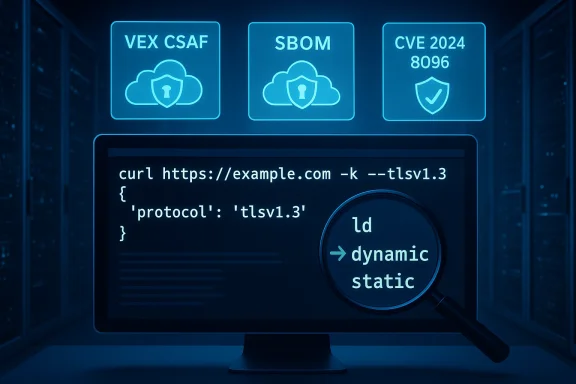 Background / Overview
CVE‑2024‑8096 is an OCSP‑stapling validation flaw disclosed by the curl project in September 2024. The bug can cause curl to incorrectly accept certain OCSP responses as valid when curl is built to use the GnuTLS TLS backend. The curl project’s advisory shows the vulnerability is reachable only when curl is compiled against GnuTLS; the fix was incorporated in curl 8.10.0.Microsoft’s Security Response Center (MSRC) public CVE entry for a given vulnerability sometimes includes a short FAQ sentence that names Azure Linux as a product that “includes this open‑source library and is therefore potentially affected,” and promises to publish machine‑readable VEX/CSAF attestations and to update CVE mappings if additional Microsoft products are found to ship the component. That wording is deliberate: it tells Azure Linux customers to treat the distro as known to contain the upstream component, and it provides a process commitment to expand product mappings later.
This article explains the practical meaning of Microsoft’s statement for defenders, why Azure Linux being named does not automatically make it the only affected Microsoft product, and what security teams should do right now to identify and remediate risk across their Microsoft‑supplied artifacts.
What the CVE actually is (technical summary)
- The vulnerability affects the curl/libcurl code path that processes the Certificate Status Request (OCSP stapling) TLS extension.
- It manifests only when curl is built with GnuTLS as its TLS backend; other TLS backends for curl are not affected by this specific bug.
- A practical, upstream remediation was released as part of curl 8.10.0; upstream advice is to upgrade to curl/libcurl 8.10.0 or later, or rebuild curl with an unaffected TLS backend.
- Multiple downstream vendor advisories and distribution trackers (Debian, Red Hat, security vendors) mapped the curl advisory into their packaged releases and urged upgrades or rebuilds.
What Microsoft actually said — read it precisely
Microsoft’s short FAQ reply on its Update Guide (and later VEX/CSAF output work that began in October 2025) typically follows the pattern:- Confirm that Azure Linux includes the open‑source library and is therefore potentially affected.
- Explain Microsoft’s commitment to publishing machine‑readable VEX/CSAF attestations (a program announced in October 2025) and to update CVE mappings if further Microsoft products are identified that ship the same upstream component.
- Product attestation: Microsoft htory of Azure Linux images and found the upstream component in those images. That is an authoritative statement for Azure Linux customers.
- Not exclusivity: Microsoft’s attestation is not an explicit claim that no other Microsoft product includes the component. Instead, the absence of other product names is an absence of attestation — not proof of absence of the component elsewhere. Security teams relying on vendor attestations must therefore verify other Microsoft artifacts they consume.
Is Azure Linux the only Microsoft product that includes GnuTLS (short answer)
No — not necessarily. Azure Linux is the only Microsoft product Microsoft has publicly attested (so far) to include the implicated open‑source library for the CVE in question. That does not definitively prove other Microsoft products (images, SDKs, tools, managed agents, container base images, embedded components) do not also include the library and therefore may still be potentially affected.Microsoft’s language is an important operational signal: it directs immediate remediation toward Azure Linux customers and provides a path (VEX/CSAF) for Microsoft to expand attestations later. But organizations should not treat the attestation as a global exclusivity guarantee — perform artifact‑level verifications for other Microsoft bits you run.
Why product‑scoped attestations are limited — a technical breakdown
Several technical realities make a single product attestation insufficient to conclude exclusivity across a vendor’s entire portfolio:- Diverse build choices: Different Microsoft images and packages may use different build flags, different TLS backends, or different packaging choices. A curl binary built with OpenSSL is not vulnerable for this bug; a curl binary built with GnuTLS is. A product that ships a static curl binary or statically links GnuTLS may still carry the flaw even when other images do not.
- Multiple distribution channels: Microsoft distributes software in many forms — OS images (Azure Linux), container base images, SDK packages, appliance images, CI runner images, agent installers, and managed platform components. Each artifact must be inventoried separately.
- Static vs dynamic linking and repackaging: Upstream libraries are sometimes bundled, vendored, or statically linked inside a larger binary/package. A product attestation that checks package manifests might miss a statically‑linked component buried inside a larger executable unless binary scanning is performed.
- Forks and downstream patches: Vendors and third parties sometimes patch or backport fixes locally. A vendor’s attestation for one product does not imply the same patching cadence or inclusion in other products.
How to verify whether a Microsoft artifact you run contains curl + GnuTLS (practical detection steps)
Security teams should scan the actual artifacts they operate. The steps below are operational, short, and effective.- Inventory and prioritize
- Start with images and artifacts that handle network traffic, run HTTPS clients, or provide SDKs/agents. These are higher risk.
- Search packages inside images
- For RPM‑based images: rpm -qa | grep -i curl OR rpm -q --whatprovides /usr/bin/curl
- For DEB‑based images: dpkg -l | grep -i curl
- Inspect the curl binary for its TLS backend
- Run: curl --version
- The output lists which TLS backend curl was built with (for example: "libcurl/8.9.1 GnuTLS/3.8.0" or "OpenSSL/1.1.1k").
- If you cannot run the binary, pull it out of the image and run the same command in a scratch container.
- Check dynamic linking
- ldd /usr/bin/curl | grep -i gnutls
- If the curl binary is dynamically linked to libgnutls, the combination is relevant.
- Check for static or bundled copies
- If the binary is stripped or statically linked, use strings / binwalk / readelf to search for “GnuTLS” or related symbol names.
- Scan container images and packages automatically
- Use SBOM and image scanners (Syft + Grype, Trivy, Anchore, Clair, Snyk, etc.) to enumerate packages and reveal whether curl/libcurl or GnuTLS are present and which versions. Generate an SBOM and examine package/version fields.
- Search for transitive dependency usage
- Applications can embed libcurl or call out to curl via language bindings. Look for vendored libcurl in application dependencies (for example, Python wheels, Node native modules, or custom Go/C binaries).
- For cloud‑hosted services
- Ask operators for SBOMs or VEX/CSAF attestations. Microsoft’s VEX program is intended to help here, but the vendor’s published attestations must match the specific artifacts you consume.
Recommended mitigations and remediation actions
If you discover curl built with GnuTLS in artifacts you operate, take these actions immediately, ordered by preference:- Upgrade or rebuild (preferred)
- Upgrade curl/libcurl to 8.10.0 or later (upstream fix) or to your vendor’s patched package. Rebuild any images that include the older build.
- If you build from source, apply the upstream patch commit and rebuild with your desired TLS backend.
- If your workflow depends on a particular TLS backend, consider rebuilding curl against an unaffected backend (e.g., OpenSSL or others) if that is operationally acceptable.
- Vendor patches and distribution updates
- Apply vendor-supplied updates for your OS distribution images, SDK packages, or Microsoft images (if Microsoft supplies a patched image). Monitor MSRC / distribution advisories for fixed packages.
- Short‑term mitigations when patches are not immediately available
- Replace or rebuild affected images to remove the vulnerable curl build (for example, swap in a curl binary built with OpenSSL).
- Limit the use of OCSP stapling in client configurations where feasible (note: disabling OCSP stapling is a fallback and can weaken certificate revocation checks — treat this as a last‑resort temporary mitigation).
- Apply network controls to reduce exposure of vulnerable clients to untrusted ive MitM could attempt to exploit certificate validation logic.
- Operational hardening
- Add image scanning to CI/CD pipelines.
- Generate and publish SBOMs for images and artifacts you ship. Use SBOMs and VEX/CSAF data to automate triage.
- For third‑party images or Microsoft artifacts you do not control, require SBOMs or VEX attestations as part of procurement and deployment processes.
- Verify all Microsoft artifacts you consume
- Don’t assume that “Microsoft‑branded” means “safe” for this specific bug; inspect each artifact (AKS node images, container base images, agents, SDKs, WSL kernels, and appliance images) and ask Microsoft for VEX attestations or published SBOMs when necessary. Microsoft’s Azure Linux attestation narrows where Microsoft will focus first — but it does not remove the need to verify other artifacts.
Operational risk analysis: strengths and blind spots of Microsoft’s approach
What Microsoft did right- Microsoft’s public attestation that it inspected Azure Linux and will publish VEX/CSAF attestation data provides meaningful transparency and a clear starting point for customers who run Azure Linux. Publishing VEX/CSAF is a high‑quality operational control that enables automated triage.
- By naming the product and committing to expand attestations, Microsoft gives security teams a prioritized remediation path for at least one of its product families.
- Attestation scope: A named product is only the slice Microsoft has inventoried to date. Many Microsoft arages, agents, SDKs, appliances, third‑party integrations) are not covered until specifically checked and attested.
- Time‑to‑attestation: Microsoft’s phased rollout of machine‑readable VEX/CSAF (starting with Azure Linux) is positive, but until that rollout completes across all Microsoft product families, there will be windows where customers must perform their own artifact verification.
- Static/vendored code: Product attestations that rely on package manifests may miss statically‑linked or vendored copies of vulnerable code inside other binaries unless binary scanning is applied.
- Complexity of downstream ecosystems: Microsoft distributes software through many channels and partners; not all artifacts will be in sync with the same patching cadence. Microsoft’s attestation for one product cannot be assumed to cover partner‑published images or community images used on Microsoft platforms.
Example discovery checklist for security teams (quick reference)
- High priority
- Check all Azure Linux images you run — Microsoft has attested these may include the component. Apply vendor image updates first.
- Check any container base image originating from Microsoft (or third parties used on Azure) for curl/libcurl built with GnuTLS.
- Medium priority
- Check CI runners, build images, and developer toolchains that may invoke libcurl or curl in automated flows.
- Check any service agents or monitoring probes shipped by Micr your environment.
- Low priority (but still necessary)
- Check WSL distributions, desktop SDKs, or userland tools shipped by Microsoft where curl or libcurl might be present (these often follow distro behavior, so treat them as separate artifacts to inspect).
- Continuous
- Add SBOM generation, image scanning, and parse MSRC/VEX/CSAF data into your vulnerability management pipeline.
Final assessment and recommended posture
- Azure Linux being explicitly named is an important and actionable signal: if you run Azure Linux images, treat them as known carriers and patch or upgrade promptly per Microsoft’s guidance.
- However, the core technical reality behind CVE‑2024‑8096 — that the flaw is present only when curl is built with GnuTLS — means vulnerability exposure depends on artifact‑level choices (which TLS backend was used, whether binaries are static, etc.). Treat Microsoft’s attestation as a starting point, not a comprehensive inventory.
- Best practice: combine vendor VEX/CSAF signals with your own SBOMs, CI/CD image scanning, and binary inspection. Prioritize patching Azure Linux images, then expand artifact discovery across all Microsoft‑provided images and packages in your estate.
Closing checklist (actions to take now)
- If you run Azure Linux images: Apply Microsoft’s recommended updates or rebuild to include the upstream curl 8.10.0 fix.
- Search your environment for curl installations and determine the TLS backend (curl --version; ldd /usr/bin/curl).
- Generate SBOMs for in‑house images and run an automated scanner that recognizes CVE‑2024‑8096 and the presence of libcurl built against GnuTLS.
- For third‑party or Microsoft artifacts you do not control, request SBOMs or VEX/CSAF attestations; if unavailable, block or isolate until you can verify.
- Automate future checks: ingest MSRC/CSAF/VEX outputs and correlate them with your SBOM/image inventory so you are alerted the moment a vendor expands attestations or publishes a fix.
Microsoft’s public wording is an important transparency improvement and gives Azure Linux customers a clear, immediate remediation path — but it is not a substitute for thorough artifact‑level verification. Treat the MSRC attestation as authoritative for Azure Linux, and treat every other Microsoft artifact as “not yet verified” until you inspect it or Microsoft expands its VEX/CSAF attestations. Act now to inventory and patch, and bake SBOM and image scanning into your build pipeline so the next upstream disclosure doesn’t blindside you.
Source: MSRC Security Update Guide - Microsoft Security Response Center
