

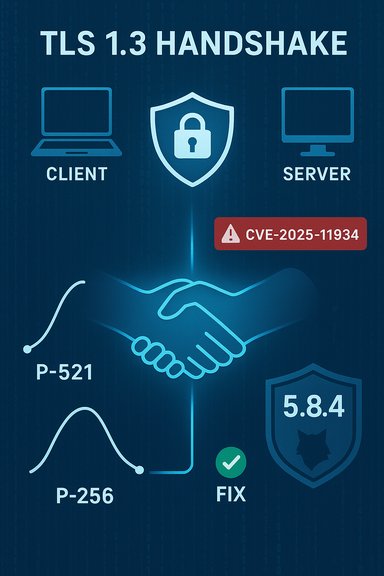
wolfSSL disclosed a protocol‑validation flaw tracked as CVE‑2025‑11934 that can let a TLS 1.3 handshake inadvertently downgrade the signature algorithm used for CertificateVerify, enabling a server‑side negotiation to settle on a weaker ECDSA curve than the client originally preferred — a mistake fixed upstream in wolfSSL’s November 2025 release and already flagged by public vulnerability trackers.
Background
TLS 1.3 moved many negotiation details to safer, clearer extensions compared with earlier TLS versions, but correct enforcement of the handshake rules remains critical: the CertificateVerify message binds the handshake transcript to the peer’s certificate via a signature made with a specific signature/hash pair. If implementations accept a signature algorithm that was not actually advertised (or fail to check that it was advertised and compatible with the key), the practical assurance provided by that signature is weakened. The wolfSSL report and corresponding public entries describe a validation gap in CertificateVerify parsing that allowed a downgrade from a high‑strength ECDSA curve (for example, P‑521) to a smaller curve (P‑256) under particular negotiation sequences. The bug was responsibly disclosed to wolfSSL by researchers at POSTECH and was addressed in wolfSSL’s 5.8.4 release series. The vendor’s release notes map multiple TLS 1.3 handshake hardening fixes into that bundle, including the code change merged as PR #9113 which explicitly tightened the CertificateVerify signature algorithm checks.What exactly is CVE‑2025‑11934?
Technical summary
- Vulnerability class: Improper input validation of the TLS 1.3 CertificateVerify signature algorithm negotiation.
- Root cause: The TLS 1.3 handshake code did not always verify that the signature algorithm used in CertificateVerify was one actually listed and agreed upon by the peer, allowing a server to accept (and proceed with) a weaker signature algorithm than the client originally advertised.
- Concrete example provided by vendors: If a client advertises ECDSA with curve P‑521 but also supports P‑256, a malicious or faulty server response could cause the connection to continue using ECDSA P‑256 even though the stronger preference existed.
Affected components and versions
- Primary affected product: wolfSSL versions up to and including v5.8.2-stable (the vulnerability was fixed in the 5.8.4 release). Public vulnerability databases and vendor changelogs list the affected versions and the specific upstream fix commit(s).
Severity and scoring
Public trackers and vendors classify CVE‑2025‑11934 as low severity in the commonly used scoring models (CVSSv3/v4 values reported in the low range). That rating reflects this being a protocol validation weakness rather than memory corruption or direct code‑execution. Low CVSS does not mean “ignore”: the real impact depends on where wolfSSL is used and the security model of the deployment.Why this matters: attack model and real‑world impact
How an attacker could use it
The simplest threat model is a man‑in‑the‑middle (MitM) or a malicious TLS server in contexts where a client accepts an untrusted server certificate (for example, some embedded device provisioning flows or special instrumentation). By steering the algorithm negotiation to a weaker curve that the client still supports, an adversary can lower the cryptographic strength of the signature used to authenticate the handshake. While this alone is not an immediate key‑extraction or RCE vector, it reduces the margin of safety and can enable further attacks in chained attack scenarios (for example, when the weaker curve has known weaknesses for a particular environment, or when combined with poor certificate management).Practical reach: where the risk concentrates
- Embedded devices and IoT appliances that embed wolfSSL statically and have infrequent patch cycles are the highest operational risk. These devices often terminate TLS in constrained environments and may accept a broader set of algorithm choices for compatibility.
- Appliances and vendor products that bundle wolfSSL (VPN endpoints, routers, gateways, some industrial controllers) may remain vulnerable until vendors rebuild firmware with the patched library and distribute updates. Distribution packaging lags are a known operational hurdle.
- Desktop and server ecosystems using mainstream TLS stacks (Schannel, OpenSSL, BoringSSL) are not directly affected unless they use wolfSSL as a component. For Windows admins the exposure is mainly via third‑party appliance chains, VPN clients, or vendor tools that include wolfSSL.
Exploitability and PoC status
As of public records collected during the disclosure window, there were no widely circulated, practical exploit demonstrations weaponizing CVE‑2025‑11934 at scale. Public EPSS estimates and exploitability metrics are very low. That does not mean a proof‑of‑concept cannot be created quickly — protocol downgrade bugs are commonly exploited once details and test harnesses are public — but the complexity and impact remain contextual rather than universally severe.Vendor response and technical fixes
wolfSSL's remediation
wolfSSL merged a targeted fix (PR #9113) which added explicit validation: the library now ensures the signature algorithm in CertificateVerify was actually advertised/allowed and compatible with the signing key. The fix was bundled into the wolfSSL 5.8.4 release published in November 2025. The release notes list this CVE as one of several TLS 1.3 hardening updates.What the fix changes (high level)
- The handshake processing code verifies the signature/hash pair sent in CertificateVerify against the supported/advertised signature algorithms for the connection and the public key type in the peer certificate.
- Tests and regression checks were added to prevent reintroduction of the same parsing/validation gap.
- Downstream maintainers and appliance vendors must rebuild images/firmware to incorporate the patched wolfSSL build.
Cross‑checks and independent confirmation
Multiple independent vulnerability databases (NVD, Tenable, OSV, cvefeed, cvedetails) indexed CVE‑2025‑11934 and reproduced the technical summary and affected version mapping reported by wolfSSL. Linux distribution bug trackers (Debian) also created follow‑up tickets advising package maintainers to update wolfSSL binaries. This multi‑source corroboration reduces ambiguity about the bug’s nature and the remediation path.What Windows system administrators and security teams must do now
Immediate checklist (first 24–72 hours)
- Inventory devices and third‑party products that embed wolfSSL. Focus on:
- VPN appliances and clients
- Embedded gateways, routers, firewalls, and IoT appliances
- Vendor tools, SDKs, or custom binaries that may vendor wolfSSL statically.
- Prioritize assets that are externally reachable or that perform certificate‑based authentication for high‑value functions (VPNs, mTLS endpoints).
- Obtain and apply vendor firmware/patches that include wolfSSL 5.8.4 or later. If vendors have not yet published updates, request a timeline and mitigation guidance.
- If you operate wolfSSL directly in services you control, build and deploy wolfSSL v5.8.4 (or a later stable release containing the fix) and redeploy dependent services.
Short‑term compensating controls (when patching is delayed)
- Terminate TLS at a patched, protocol‑aware reverse proxy or load balancer (OpenSSL/BoringSSL/Schannel) so unpatched wolfSSL endpoints are not exposed directly to untrusted networks.
- Enforce stricter server‑side checks where possible: servers that request client certificates should validate that the CertificateVerify signature algorithm is one of the algorithms they advertised in CertificateRequest and abort on mismatch.
- Restrict access to vulnerable appliances using network ACLs, segmentation, or IP allow‑lists and apply rate limits for handshake attempts to reduce scanning and brute‑force probing.
Detection and hunting guidance
- Search TLS handshake logs and packet captures for odd CertificateVerify signatures where the signature algorithm does not match the expected supported list for the session. Look for mismatches between the advertised signature_algorithms and the algorithm used in CertificateVerify.
- Use SCA (software composition analysis) to detect wolfSSL versions in firmware, container images, and packages; inspect version strings, SBOMs, and vendor release notes.
- Monitor for vendor advisories and distribution package updates; add test plans to verify firmware images actually include the patched wolfSSL build before wide deployment.
Risk analysis: strengths of the fix and remaining weaknesses
Notable strengths
- The flaw is a protocol validation bug rather than a memory‑safety or code‑execution vulnerability, which is easier to patch and less likely to be a prelude to large‑scale compromise.
- wolfSSL responded quickly with a focused fix and included it in a formal release; independent trackers and distributions have already mapped the CVE to the vendor patch. This reduces the window of uncertainty and lowers the operational burden for vendors that follow upstream closely.
Persistent risks and operational pain points
- Embedded/IoT update lag: Many devices and appliances embed wolfSSL statically and do not receive frequent updates; those devices can remain vulnerable for months or years, creating persistent exposure on networks.
- Supply‑chain blind spots: Organizations may not have a complete inventory of all binary images, firmware, vendor appliances, or third‑party tools that include wolfSSL. Without accurate SBOMs or SCA results, remediation can miss critical devices.
- Combinatorial attacks: While a signature algorithm downgrade alone is not catastrophic, when combined with other weaknesses (weak PKI issuance, acceptance of deprecated hashes, or devices that accept unsigned configuration blobs) it can materially reduce the security posture of a system. This is particularly relevant for deployments that still allow SHA‑1 or other legacy choices for compatibility.
Detection examples and checklist for SOCs
- Add SIEM rules to flag TLS sessions where the CertificateVerify signature algorithm diverges from the advertised list in the same session. Focus on ECDSA curve discrepancies (e.g., P‑521 → P‑256).
- Capture PCAPs for suspicious endpoints and inspect the ClientHello/ServerHello and CertificateVerify messages. The signature/hash pair in CertificateVerify should appear in the signature_algorithms extension from the peer’s earlier handshake messages.
- Scan firmware images and container layers for wolfSSL version strings and correlate unpatched versions with exposed services. If you cannot reimage an appliance immediately, isolate it behind a patched TLS terminator.
Developer guidance: avoid repeating this class of error
- Validate every negotiation value: Implementations must strictly check that any algorithm, cipher, or parameter used in authenticated handshake messages was explicitly advertised and selected within the protocol rules.
- Unit and integration tests: Add differential tests that present mismatched or maliciously ordered handshake parameters and assert the implementation rejects or aborts the handshake.
- SBOMs and rebuild discipline: When an upstream TLS library is updated for security fixes, downstream consumers should rebuild and redeploy entire firmware images or binaries rather than attempting in‑place library swaps in production.
Caveats and unverifiable claims
- Public trackers and vendor notes consistently describe the issue and the fix; however, telemetry about in‑the‑wild exploitation is sparse. The absence of confirmed exploitation does not equal absence of risk — attackers can exploit protocol negotiation flaws quickly once details and test harnesses are public. Treat exploitability projections with caution and prioritize patching in externally reachable contexts.
- Some vendor or distributor pages (for example the Microsoft Security Update Guide web UI) may require dynamic rendering to view mapped component data; operators should consult wolfSSL’s security advisories and distribution trackers for definitive patch binaries when the Microsoft index page does not present full details in static fetches.
Final assessment and recommended action plan
CVE‑2025‑11934 is a low‑scored but meaningful protocol‑validation vulnerability that underscores a recurring theme: negotiation semantics must be enforced precisely. The technical risk to mainstream Windows servers and clients is limited unless wolfSSL is present in the stack; the operational risk is concentrated in embedded devices, third‑party appliances, VPN endpoints, and vendor firmware that embed wolfSSL and are slow to update. Recommended prioritized steps for WindowsForum readers and IT teams:- Identify wolfSSL usage across your estate and mark externally reachable appliances as highest priority.
- Apply wolfSSL 5.8.4 or later to services you control and demand patched firmware from vendors for embedded devices.
- Place unpatched devices behind patched TLS terminators and enforce strict signature algorithm checks at the server termination point.
- Add detection rules for CertificateVerify mismatches in TLS handshakes and increase logging for TLS negotiation anomalies.
- Maintain SBOMs and SCA scans to track downstream consumers of wolfSSL so future updates are traceable and actionable.
Conclusion
CVE‑2025‑11934 is a concrete example of how subtle errors in TLS negotiation handling can reduce authentication guarantees even in TLS 1.3. The fix is available and has been merged upstream; operators should prioritize devices that embed wolfSSL, enforce server‑side checks at TLS termination, and treat firmware updates and SBOM visibility as the critical path to eliminating exposure. Prompt action will prevent this low‑scored, contextually dangerous bug from becoming an operational problem in embedded and supply‑chain dependent environments.
Source: MSRC Security Update Guide - Microsoft Security Response Center
